
Report Feature
Black Soldier Fly Larvae Market Trends and Forecast
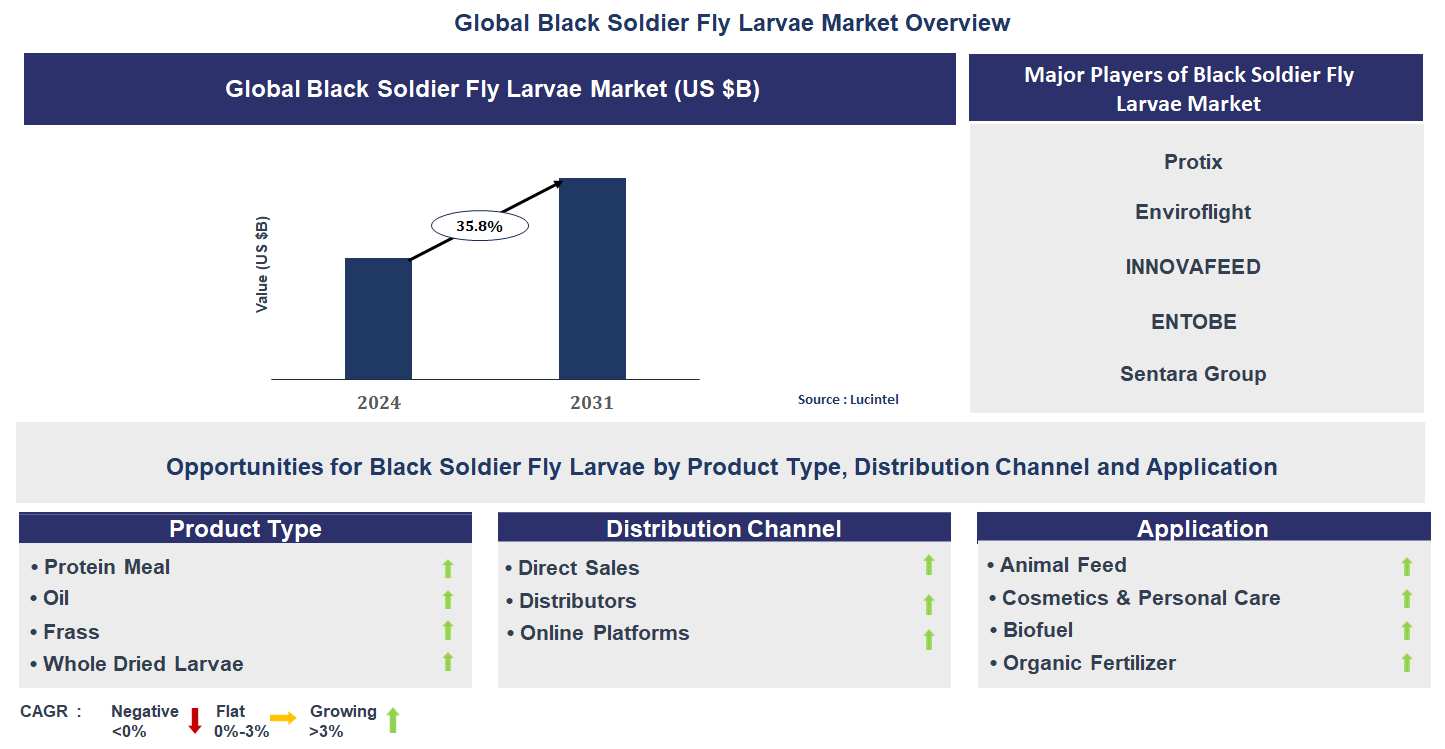
The future of the global black soldier fly larvae market looks promising with opportunities in the animal feed, cosmetics & personal care, biofuel, and organic fertilizer markets. The global black soldier fly larvae market is expected to grow with a CAGR of 35.8% from 2025 to 2031. The major drivers for this market are the increasing demand for sustainable animal feed, the rising adoption of insect-based protein sources, and the growing focus on waste-to-feed solutions.• Lucintel forecasts that, within the product type category, protein meal is expected to witness the highest growth over the forecast period.
• Within the application category, animal feed is expected to witness the highest growth.
• In terms of region, APAC is expected to witness the highest growth over the forecast period. Gain valuable insights for your business decisions with our comprehensive 150+ page report. Sample figures with some insights are shown below.
Emerging Trends in the Black Soldier Fly Larvae Market
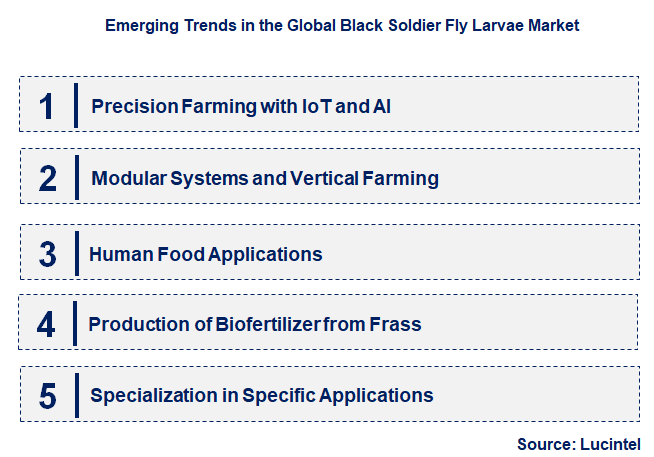
The black soldier fly larvae industry is in a period of transition, going from a new idea to a central pillar of the circular economy and the global food system. These are a direct consequence of an increasing world population, protein demand escalation, and heightened environmental sustainability concern. They are revolutionizing fundamentally the way BSFL is produced, processed, and consumed, opening markets and developing a more advanced, high-tech sector. These changes are not merely technological but also concern business models and the value chain.• Precision Farming with IoT and AI: Utilization of IoT and AI is leading the trend toward precision farming in BSFL production. This includes the use of sensors to track environmental conditions including temperature and humidity, and AI to study information about larval growth and feed conversion. The effect is an enormous boost in production yield and efficiency. Through the highly controlled environment produced, this technology reduces waste and guarantees a consistent high-quality product, which means large-scale production can be more predictable and profitable.
• Modular Systems and Vertical Farming: The movement towards modular systems and vertical farming is changing the physical footprint of BSFL production. Rather than expansive, sprawling facilities, companies are creating stacked, compact modules that can be located in urban environments or on-site at a source of waste. The effect is a cost-saving, scalable, decentralized production model. This decreases transportation expenses for both the product and waste, as well as opening the door for new entrants with a reduced first-time investment and more agile business model.
• Human Food Applications: Although animal feed has been the major market for BSFL, there is a growing trend to utilize BSFL protein and oil in human food. This is motivated by consumer demand for sustainable and alternative sources of protein. The effect is a new, high-value market segment. As nascent as the trend is, it can potentially significantly boost the revenue potential of BSFL producers, with an emphasis on developing such products as protein powders, snack bars, and even meat alternatives from BSFL-sourced ingredients.
• Production of Biofertilizer from Frass: One major trend is growing awareness of frass, the byproduct of BSFL farming, as a useful biofertilizer. This is transforming the BSFL industry from a single product to a double product industry. The result is a closed-loop system that extracts maximum value out of the whole process. By selling frass as a premium organic fertilizer, manufacturers can generate another revenue source and offer a sustainable means of enriching soils, which supports the larger objectives of a circular economy.
• Specialization in Specific Applications: With maturing of the BSFL market, specialization is becoming the emerging trend. Rather than a broad-stroke solution, firms are concentrating on niche applications, for example, high-end pet food, premium aquaculture feed, or pharmaceutical industry bioproducts. The result is a more customized and high-value product portfolio. This enables firms to specialize and take a bigger chunk of market share in a certain niche by offering products that are optimized for the distinct nutritional requirements and quality requirements of a given application. These trends are collectively transforming the BSFL market into a more technologically advanced, economically feasible, and eco-friendly market. The sector is tending toward a future where BSFL becomes a common commodity, serving as a central figure in waste management and food production.
Recent Development in the Black Soldier Fly Larvae Market
The black soldier fly larvae industry is going through a time of major evolution, spurred by a global trend toward sustainable food systems and waste management. These trends are not merely incremental improvements but are transforming the way BSFL is created and utilized in its products. The industry is evolving from an experimental to a commercial sector with an emphasis on scalability, efficiency, and diversification of use. Such advancements are placing BSFL at the center of the circular economy.• Scale-Up of Production Facilities: One of the important developments has been the establishment and expansion of high-volume, automated BSFL manufacturing facilities around the world. Firms are raising substantial amounts of money to construct "insect factories" that produce thousands of tons of organic waste a year. The result is a staggering surge in supply, which is required to satisfy increasing demand for BSFL products by the pet food and animal feed industries. This expansion also reduces production costs by economies of scale.
• Technological Integration: The technological integration is another significant evolution. Manufacturers are now employing sophisticated automation, robotics, and sensors to track and regulate every step of the BSFL life cycle, from feeding to harvesting. This encompasses the application of AI in optimizing growing conditions. The effect is an improved and more predictable production process. This technological advancement minimizes manpower, enhances product uniformity, and makes BSFL farming a more profitable and less risky business.
• Regulatory Approvals: A key milestone has been broadening regulatory approvals for BSFL products. In most nations, including the US and in the European Union, regulations were enhanced to permit BSFL as a protein source in animal feed for poultry, swine, and aquaculture. The significance is that this offers large commercial markets to BSFL producers. These certifications establish a legal and commercial basis, and grant business firms the courage to invest in BSFL production.
• Diversification of the Market: Although animal feed is still the biggest application, the recent trend is diversification of the market to newer fields. Firms are now making BSFL oil for cosmetic and biofuel application, and chitin for bioplastic and pharmaceutical applications. The effect is that this generates new sources of income and mitigates market risk. By discovering high-value uses of different BSFL products, producers would be able to achieve maximum profit and more resiliency to shifts in one market.
• Emphasis on Biofertilizer: The growing value assigned to BSFL frass, the digest of larvae, is a major trend. The frass is a rich organic fertilizer that can now be sold as a product in itself. The effect is a zero-waste, closed-loop production model. This shift imparts an extra level of profitability and sustainability to BSFL farming, turning what was previously a waste product into a worthwhile resource for farming. These advancements are cumulatively shaping the BSFL market towards a future that is more scalable, technologically advanced, and diversified. The market is rapidly transforming to cope with the increasing demand for green protein and waste management on a worldwide level.
Strategic Growth Opportunities in the Black Soldier Fly Larvae Market
The black soldier fly larvae industry is full of strategic opportunity for growth in a broad array of applications, fueled by worldwide demand for sustainable protein and waste management. Those organizations that can succeed in pursuing these opportunities by application will be well-positioned to take advantage of the markets exponential growth. The opportunities are not limited to one sector but extend across many industries, from farming to high-tech bioproducts. Success will rely on the capacity to innovate and offer customized solutions to address specific market requirements.• High-Value Aquaculture and Pet Food: The most pressing and substantial growth opportunity is in the animal feed market. Particularly, the high-value segments of aquaculture and pet food. Fishmeal and soy are unviable and costly, providing a strong surge for BSFL protein meal as an alternative. The effect is that this offers a huge, steady market with immense growth prospects. Organizations can tactically concentrate on establishing alliance with large pet food companies and fish farming operations in order to establish long-term agreements and become market leaders.
• Industrial and Municipal Waste: Organic waste processing ability of BSFL is a huge opportunity for growth. Firms can form strategic alliances with food processing facilities, restaurants, and municipalities to gain a biological waste management solution. The effect is that this generates a circular economy framework where waste becomes a source of income. Rather than paying to have their waste disposed of, companies can make money by selling it to BSFL manufacturers. This is a strong value proposition that solves an urgent environmental issue.
• Biofertilizer Production: The BSFL byproduct frass is a very valuable organic fertilizer. The opportunity for growth is to market this frass as a high-end product to the organic agriculture and horticulture industries. The effect is that this diversifies a company’s revenue and makes it a zero-waste company. Through careful positioning of frass as a viable, sustainable replacement for chemical fertilizers, producers can capitalize on increasing demand for organic and green agricultural products.
• Harvesting High-Value Compounds: The harvesting of high-value compounds from BSFL is a new growth prospect. The larvae have an array of useful constituents, such as lauric acid-rich oil and chitin, which is a utilitarian biopolymer. The effect is that this opens up new, high-margin markets. Firms can strategically invest in R&D to create and market BSFL oil for cosmetics, biofuels, and pharmaceuticals, and chitin for bioplastics and wound dressings.
• Human Nutrition: Though still in its early days, the human food sector is a great long-term growth potential. As people become more accepting of insect protein, there will be the need for new food products. Strategic prospects involve creating protein powders, snack bars, and nutritional supplements based on BSFL. The impact is that this could potentially be the most profitable application, but it will require extensive research, marketing, and navigating regulatory hurdles to gain consumer trust and market access. These strategic growth prospects are influencing the BSFL industry by pushing it to diversify and specialize. The business is no longer purely one of producing a single commodity but one of developing a portfolio of high-margin products that can solve a vast array of environmental and economic issues.
Black Soldier Fly Larvae Market Driver and Challenges
The black soldier fly larvae market is going through a phase of sudden growth, driven by multiple drivers and at the same time restrained by major hindrances. The drivers have limited to global movements toward sustainability, food security, and a circular economy. The hindrances, however, are in relation to the novelty of the industry, regulatory complications, limited need for huge capital outlays. The long-term prosperity of the market will hinge on its capacity to harness such strong drivers while successfully struggling and conquering its inherent complexities. The factors responsible for driving the black soldier fly larvae market include: 1. Alternative Sustainable Protein: The global need for protein and the environmental unsustainability of conventional protein sources such as fishmeal and soy are the driving forces. BSFL presents an extremely effective and sustainable source of protein. The larvae consume very little land and water and can be raised on organic waste, which is a strong value proposition that is pushing market adoption in animal feed and pet food. 2. Organic Waste Management: BSFL’s capability to transform huge amounts of organic waste into useful products is a big driver. Landfills are getting filled up and regulations are tightening, and municipalities and food companies are seeking out environmentally friendly and sustainable waste management options. BSFL farming is a very effective and lucrative method for keeping waste out of landfills, and that is a big driver for the business. 3. Supportive Regulatory Reforms: Supportive regulatory reforms in major markets such as the European Union and the United States have been a main driver. Recent reforms have licensed BSFL for use in diverse animal feeds, which has given the industry legitimacy and access to big commercial markets. This regulatory backing provides companies with the assurance to invest and expand operations. 4. Technology Advances: The innovation of automated and sensor-driven agriculture technology is a major impetus. These technologies are increasing the efficiency, consistency, and scalability of BSFL production. Through savings on labor costs and improvements in environmental conditions, technology is turning BSFL farming into a more profitable and viable undertaking that is increasing investment. 5. Circular Economy Model: The BSFL industry represents the circular economy model, in which waste is being transformed into a valuable commodity. This is in accordance with corporate sustainability objectives and government regulations, hence a viable business model. The two-product aspect of BSFL farming, where it produces both protein and biofertilizer, is a major impetus that increases resource utilization and profitability. Challenges in the black soldier fly larvae market are: 1. High Capital Investment: The biggest challenge is the huge initial investment needed to establish and run large-scale, automated BSFL farming facilities. Such capital-intensive ventures can become a huge impediment for new players, restricting the market to a few solvent companies and slowing down the overall rate of growth. 2. Regulatory and Permitting Barriers: Regulatory and permitting barriers continue to be an issue despite some advancements. Regulations for the utilization of BSFL in various applications and across various geographies are usually scattered, which may generate uncertainty among businesses and retard market growth, especially in new and frontier markets. 3. Consumer Acceptance: Although the animal feed market is robust, consumer acceptance for BSFL as a human food ingredient remains a significant hurdle. Consumers are reluctant to consume insects, necessitating significant marketing and education to overcome this barrier. This is one major obstacle to a potentially lucrative market segment. In summary, the BSFL industry is being driven by strong drivers embedded in international sustainability and food security imperatives. It is, however, confronted with major challenges of high entry costs, regulatory issues, and consumer perception. The industry’s capacity to attract increased investment, deal with divergent regulatory environments, and enlighten consumers will be essential to its sustained growth and its potential to transform the global food and waste management sectors.List of Black Soldier Fly Larvae Companies
Companies in the market compete on the basis of product quality offered. Major players in this market focus on expanding their manufacturing facilities, R&D investments, infrastructural development, and leverage integration opportunities across the value chain. With these strategies black soldier fly larvae companies cater increasing demand, ensure competitive effectiveness, develop innovative products & technologies, reduce production costs, and expand their customer base. Some of the black soldier fly larvae companies profiled in this report include-• Protix
• Enviroflight
• INNOVAFEED
• ENTOBE
• Sentara Group
• PROTENGA
• ENTOCYCLE
• ENTOMAL Biotech
• Life Origin
• Beta Bugs
Black Soldier Fly Larvae Market by Segment
The study includes a forecast for the global black soldier fly larvae market by product type, distribution channel, application, and region.Black Soldier Fly Larvae Market by Product Type [Value from 2019 to 2031]:
• Protein Meal
• Oil
• Frass
• Whole Dried Larvae
Black Soldier Fly Larvae Market by Distribution Channel [Value from 2019 to 2031]:
• Direct Sales
• Distributors
• Online Platforms
Black Soldier Fly Larvae Market by Application [Value from 2019 to 2031]:
• Animal Feed
• Cosmetics & Personal Care
• Biofuel
• Organic Fertilizer
Black Soldier Fly Larvae Market by Region [Value from 2019 to 2031]:
• North America
• Europe
• Asia Pacific
• The Rest of the World
Country Wise Outlook for the Black Soldier Fly Larvae Market
The black soldier fly larvae industry is a leader in the circular economy through its singular capability of transforming organic waste into high-quality protein, oil, and fertilizer. With the world looking for sustainable protein and waste management solutions for food security, BSFL has become a promising new source of protein, compared to conventional sources such as fishmeal and soy. Current advancements center on upscaling production, enhancing efficiency through technology, and diversifying the scope of BSFL product applications. These innovations are turning BSFL into a mainstream concept and a commercially sustainable globally known industry.• United States: In the United States, the United States market is accelerating, fueled by increasing national interest in the circular economy and a favorable regulatory climate. Current trends are focused on industrial-scale production units and innovation. Businesses are putting money into automated vertical farming units to increase production levels and efficiency. There is equally strong emphasis on producing BSFL products for high-value uses, specifically for pet food and aquaculture industries, as consumers demand sustainable and traceable inputs.
• China: Being the world leader in aquaculture and waste management, China is a dominant force in the BSFL market. Recent growth is spurred by a national plan to improve food security and cut down on environmental pollution. There is a compelling government initiative for industrial-scale BSFL processing facilities that have the capacity to handle a massive volume of organic waste, such as agricultural by-products and food waste. Chinese firms are leading the way in breeding and bioconversion research, and they are creating new, low-cost technologies for mass-scale production of high-quality protein meal and biofertilizer.
• Germany: The BSFL market in Germany is dominated by a very strong focus on sustainability and a circular economy approach. The trend is backed up by a positive regulatory environment that favors the use of insect products. German firms are working to develop closed-loop systems that effectively transform food waste into BSFL biomass. High-quality, traceable products for the animal feed market are a strategic focus. German scientists and startups are also working on new BSFL uses, including within pharmaceuticals and cosmetics.
• India: India’s BSFL market is in an early but fast-expanding stage, with innovation spurred by the necessity for efficient waste management applications as well as affordable animal nutrition. Current advances are targeted at decentralized small-scale agricultural models that benefit local farmers and entrepreneurs. Firms are designing easy, inexpensive technologies for rearing BSFL that can be merged with existing agricultural practice. The government is also encouraging the application of BSFL to treat organic waste and yield biofertilizer, a key impetus in the country’s thrust towards organic farming.
• Japan: Japan’s market for BSFL is a niche but highly innovative industry, with innovations aimed at meeting the country’s specific challenges, including scarce land and a high-cost climate. The latest trends focus on sophisticated, urban agricultural systems based on IoT and AI to maximize production in controlled environments. Japanese corporations are investigating the possibility of BSFL as a high-end, niche product for pet food and even human food uses. There is also considerable research on the exclusive compounds in BSFL, e.g., chitin and fatty acids, for application in high-end bioproducts.

Features of the Global Black Soldier Fly Larvae Market
Market Size Estimates: Black soldier fly larvae market size estimation in terms of value ($B). Trend and Forecast Analysis: Market trends (2019 to 2024) and forecast (2025 to 2031) by various segments and regions. Segmentation Analysis: Black soldier fly larvae market size by product type, distribution channel, application, and region in terms of value ($B). Regional Analysis: Black soldier fly larvae market breakdown by North America, Europe, Asia Pacific, and Rest of the World. Growth Opportunities: Analysis of growth opportunities in different product types, distribution channels, applications, and regions for the black soldier fly larvae market. Strategic Analysis: This includes M&A, new product development, and competitive landscape of the black soldier fly larvae market. Analysis of competitive intensity of the industry based on Porter’s Five Forces model.
FAQ
Q1. What is the growth forecast for black soldier fly larvae market? Answer: The global black soldier fly larvae market is expected to grow with a CAGR of 35.8% from 2025 to 2031. Q2. What are the major drivers influencing the growth of the black soldier fly larvae market? Answer: The major drivers for this market are the increasing demand for sustainable animal feed, the rising adoption of insect-based protein sources, and the growing focus on waste-to-feed solutions. Q3. What are the major segments for black soldier fly larvae market? Answer: The future of the black soldier fly larvae market looks promising with opportunities in the animal feed, cosmetics & personal care, biofuel, and organic fertilizer markets. Q4. Who are the key black soldier fly larvae market companies? Answer: Some of the key black soldier fly larvae companies are as follows:• Protix
• Enviroflight
• INNOVAFEED
• ENTOBE
• Sentara Group
• PROTENGA
• ENTOCYCLE
• ENTOMAL Biotech
• Life Origin
• Beta Bugs Q5. Which black soldier fly larvae market segment will be the largest in future? Answer: Lucintel forecasts that, within the product type category, protein meal is expected to witness the highest growth over the forecast period. Q6. In black soldier fly larvae market, which region is expected to be the largest in next 5 years? Answer: In terms of region, APAC is expected to witness the highest growth over the forecast period. Q7. Do we receive customization in this report? Answer: Yes, Lucintel provides 10% customization without any additional cost.
Table of Contents
List of Figures
List of Tables
Methodology
- In-depth interviews of the major players in this market
- Detailed secondary research from competitors’ financial statements and published data
- Extensive searches of published works, market, and database information pertaining to industry news, company press releases, and customer intentions
- A compilation of the experiences, judgments, and insights of Lucintel’s professionals, who have analyzed and tracked this market over the years.


Buy Now
Choose a license that fits your team. Instant PDF delivery.
Prices exclude taxes. Instant delivery. Custom licensing available on request.
Key Questions
- • What are some of the most promising, high-growth opportunities for the black soldier fly larvae market by product type (protein meal, oil, frass, and whole dried larvae), distribution channel (direct sales, distributors, and online platforms), application (animal feed, cosmetics & personal care, biofuel, and organic fertilizer), and region (North America, Europe, Asia Pacific, and the Rest of the World)?
- • Which segments will grow at a faster pace and why?
- • Which region will grow at a faster pace and why?
- • What are the key factors affecting market dynamics? What are the key challenges and business risks in this market?
- • What are the business risks and competitive threats in this market?
- • What are the emerging trends in this market and the reasons behind them?
- • What are some of the changing demands of customers in the market?
- • What are the new developments in the market? Which companies are leading these developments?
- • Who are the major players in this market? What strategic initiatives are key players pursuing for business growth?
- • What are some of the competing products in this market and how big of a threat do they pose for loss of market share by material or product substitution?
- • What M&A activity has occurred in the last 5 years and what has its impact been on the industry? For any questions related to Black Soldier Fly Larvae Market, Black Soldier Fly Larvae Market Size, Black Soldier Fly Larvae Market Growth, Black Soldier Fly Larvae Market Analysis, Black Soldier Fly Larvae Market Report, Black Soldier Fly Larvae Market Share, Black Soldier Fly Larvae Market Trends, Black Soldier Fly Larvae Market Forecast, Black Soldier Fly Larvae Companies, write Lucintel analyst at email: helpdesk@lucintel.com. We will be glad to get back to you soon.


