
Market Report · July 31, 2026

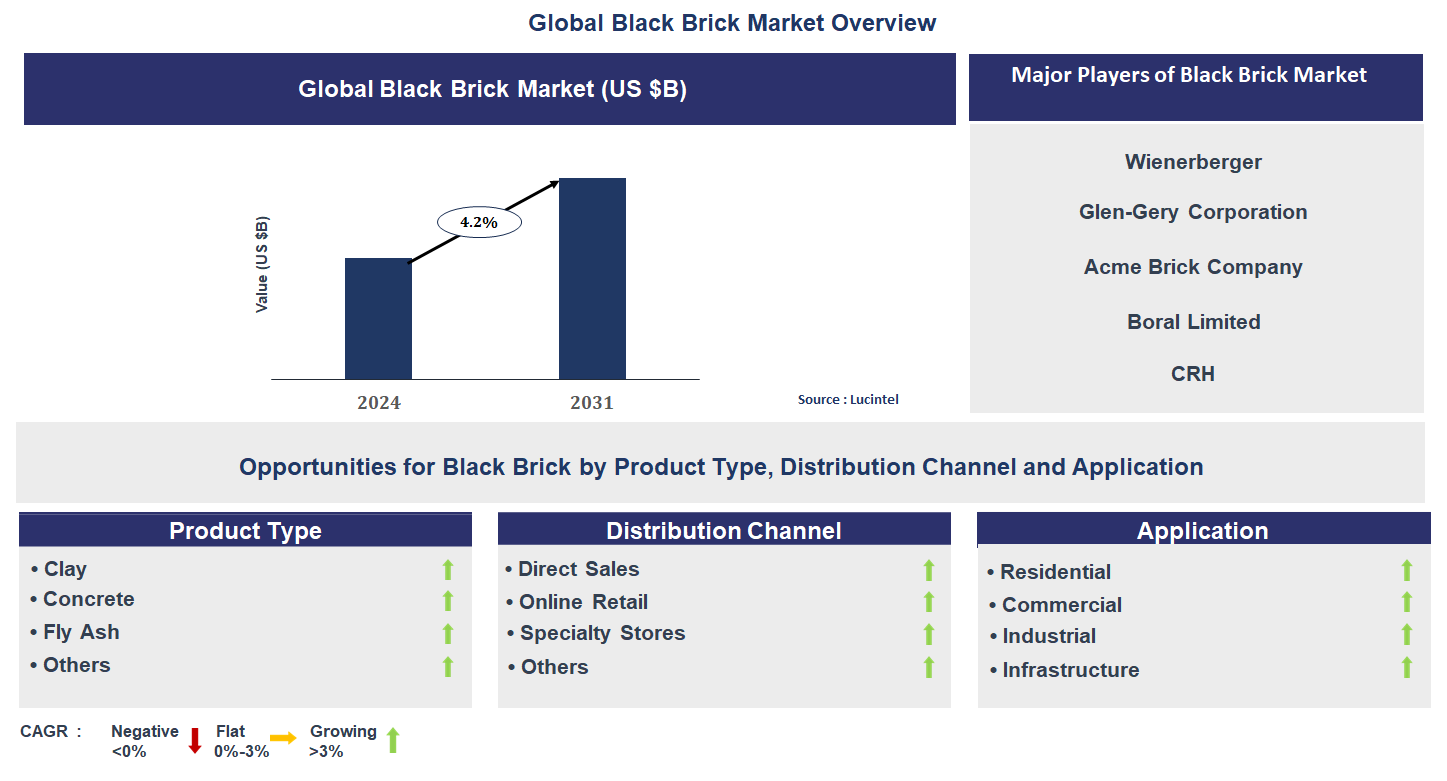
Key data points: The growth forecast = 4.2% annually for the next 7 years. Scroll below to get more insights. This market report covers trends, opportunities and forecasts in black brick market to 2031 by product type (clay, concrete, fly ash, and others), distribution channel (direct sales, online retail, specialty stores, and specialty stores), application (residential, commercial, industrial, and infrastructure), and region (North America, Europe, Asia Pacific, and the Rest of the World)
We'll send your sample report shortly.
• Lucintel forecasts that, within the product type category, clay is expected to witness the highest growth over the forecast period.
• Within the application category, residential is expected to witness the highest growth.
• In terms of region, APAC is expected to witness the highest growth over the forecast period. Gain valuable insights for your business decisions with our comprehensive 150+ page report. Sample figures with some insights are shown below.
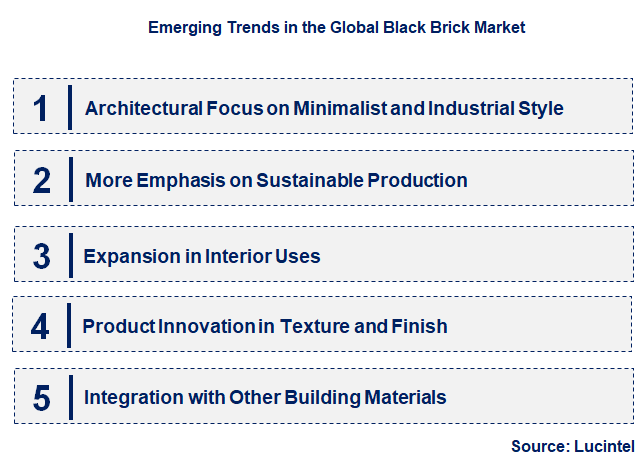
• Architectural Focus on Minimalist and Industrial Style: The chief trend is the increasing architectural choice for minimalist and industrial style. Black bricks are a perfect match for this look because of their clean lines, monochromatic color, and capacity to provide a powerful visual contrast. The product is being utilized to produce striking facades, feature walls, and accent features that deliver a touch of contemporary elegance. This movement is affecting the market by increasing the demand for a broader array of black brick products, such as various textures, widths, and finishes.
• More Emphasis on Sustainable Production: There is a strong developing trend towards sustainable production. Due to rising environmental issues and tighter regulations, brick producers are embracing cleaner forms of production. This involves recycled raw materials such as fly ash and integrating more energy-efficient kilns to lower carbon footprint emissions. This trend is influencing the market by making black bricks an environmentally friendly material used in construction, which is an essential worry for most companies and consumers.
• Expansion in Interior Uses: One of the major trends is the expansion of black bricks in interior uses. Once reserved for exterior use almost exclusively, black bricks are being employed in interior accent walls, fireplace surrounds, and kitchen backsplashes to achieve a dramatic and contemporary aesthetic. The thin brick veneers have expanded this trend to both homeowners and designers, which is a major competitive advantage. This is affecting the market by creating a new and profitable segment outside of conventional exterior application.
• Product Innovation in Texture and Finish: The market is witnessing a high demand for product innovation in finish and texture. Companies are producing black bricks with different surfaces ranging from smooth and glossy to rough and textured. This enables designers and architects to produce distinctive and visually appealing facades that play with light and dark. This trend is affecting the market by providing a more differentiated product lineup and addressing a greater variety of design tastes.
• Integration with Other Building Materials: The new trend is the integration of black bricks with other building materials. Black bricks are now applied together with such materials as glass, wood, and metal to achieve a high-contrast and modern look. This enables the possibility of a more dynamic and visually richer design. This trend is affecting the market through the placement of black bricks as a material that can be utilized to enhance other components in a building design. These trends are all coming together to redefine the black brick market by turning it from an old-school building material into a high-value, design-oriented product. The focus on sustainability, design flexibility, and technological advancement is allowing manufacturers to give more value to their customers and establish themselves firmly in the future of construction.
• Offering Expansion: Another key development is offering expansion. Producers are now producing new black brick products with different textures, sizes, and finishes to suit the varied demands of architects and designers. These include matte, glazed, and wire-cut finishes, along with a variety of sizes ranging from conventional to extra-long. This is influencing the market by providing designers with increased freedom of creativity and establishing black bricks as a versatile and modifiable product.
• Adoption of Green Production Practices: One of the most important developments is the increased use of green production practices. As a result of increased environmental consciousness, producers are employing recycled materials, like industrial waste and fly ash, for brick manufacturing. This contributes to minimizing the consumption of natural resources and emissions of carbon. This is shaping the market by making black bricks a sustainable option for eco-friendly construction projects.
• Greater Use of Digital Visualization Software: New trends reflect a significant emphasis on greater use of digital visualization software. Architects, designers, and homeowners are employing 3D modeling and virtual reality to see the appearance of black bricks on their projects. This enables them to make better-informed decisions and ensures that the end product lives up to their expectations. This is influencing the market by reducing the design cycle and enhancing customer satisfaction.
• Strategic Partnerships among Manufacturers and Architects: The industry is witnessing a dramatic evolution in strategic partnerships among manufacturers and architects. Manufacturers and architects are collaborating to create new black brick products that are tailored specifically to high-profile projects. This enables manufacturers to present their products in a high-end environment. This is affecting the industry by making the value chain more integrated and ensuring that the product is customized for the design community.
• Development of the DIY and Thin Brick Veneer Segment: The explosive development of the DIY and thin brick veneer segment is significant. Thin black brick veneers, which weigh a fraction of a full-size brick, are being utilized for interior accent walls and home remodels. This brings the material within the reach of homeowners and small projects. This is affecting the market by making available a new and high-volume customer segment. These fundamental developments are together influencing the black brick market by pushing towards a more diversified, competitive, and sustainable industry. The demand for product innovation and growth in sustainable manufacturing is generating new growth opportunities, while the emphasis on high-value products is basically redefining the market.
• Growth into the High-end Residential Market: The high-end residential market is an important strategic growth opportunity. Black bricks are highly sought after for use in luxury homes, where they are employed to achieve a sophisticated and contemporary look. This encompasses facades, interior feature walls, and landscape architecture. This has an effect on the market by providing a high-margin application that is less susceptible to conventional economic cycles and more attuned to the dynamic growth of the luxury housing market.
• Targeting the Commercial and Hospitality Industry: The commercial and hospitality industry represents a major growth opportunity. Black bricks are utilized within hotels, restaurants, and shopping areas to produce a distinctive and memorable environment. They are utilized to establish a brand identity as well as to achieve a perception of luxury and sophistication. This affects the market by giving a steady source of demand from a vital and ongoing innovating industry.
• Taking Advantage of the Renovation and Restoration Business: The renovation and restoration business is a highly profitable business. With urbanization, there is a great demand for material that can be employed for the restoration of old buildings with a modern feel. Black bricks can be employed to provide a new facade to a historic building, which can modernize the building while maintaining its historical character. This affects the market by offering a consistent source of demand from a vital and constantly evolving industry.
• Solving for Landscape and Public Infrastructure: The landscape and public infrastructure industry presents a strategic opportunity. Black bricks are utilized in a range of public areas, from parks and plazas to pedestrian paths and bridges. They are utilized to instill an air of sophistication and to form a long-lasting and long-term surface. This affects the market through the generation of a new source of revenue that is essential for a variety of industries.
• Concentrating on Aftermarket and Maintenance Services: A strategic play is to target aftermarket and maintenance services. As the base of installed black bricks expands, there is a growing demand for specialized cleaning, repair, and restoration services. Businesses that are able to provide comprehensive service packages will have a major competitive edge. It affects the market by providing a high-margin income stream that is less volatile than new equipment sales. These strategic growth opportunities are revolutionizing the black brick market by stimulating a move away from an bulk commodity business to one centered on high-end, specialized products. By going after high-growth markets and adopting the trend toward sustainability, firms can open up new revenue streams, differentiate themselves from the competition, and gain a more secure market position for the future.
• Wienerberger
• Glen-Gery Corporation
• Acme Brick Company
• Boral Limited
• CRH
• Brickworks Limited
• Ibstock Brick Limited
• Forterra Building Products Limited
• General Shale Brick
• Carmeuse Group
• Clay
• Concrete
• Fly Ash
• Others
• Direct Sales
• Online Retail
• Specialty Stores
• Specialty Stores
• Residential
• Commercial
• Industrial
• Infrastructure
• North America
• Europe
• Asia Pacific
• The Rest of the World
• United States: In the United States, the black brick market is growing strongly, especially in residential and high-end commercial construction. Usage of the material is fueled by consumer demand for a clean, modern, and minimalist look, one of the product’s major competitive selling points. One of the biggest advancements is the wider availability of thin black brick veneers in both interior and exterior use, allowing architects and designers to use the material without the structural complexity of full-size bricks.
• China: China’s black brick industry is booming with explosive growth as a result of rapid urbanization and high-volume infrastructure projects. One of the developments is the large-scale production of high-quality, uniform black bricks for meeting the needs of a burgeoning construction industry. The product is finding applications across a vast spectrum of projects, ranging from new housing developments to commercial buildings and public areas.
• Germany: The black brick market in Germany is dominated by a powerful push for quality, sustainability, and energy efficiency. Current activities are focused on creating black bricks that meet stringent German and EU construction standards. Manufacturers are investing in high-tech kilns and eco-friendly firing processes to minimize carbon emissions. Demand is shifting toward the use of black bricks in passive house projects and other energy-efficient structures, where the material’s thermal qualities are greatly appreciated. The emphasis is on blending a visually striking appearance with enhanced functional performance.
• India: India’s black brick market is in an early but fast-growing stage. The recent growth is fueled by an increasing demand for attractive and visually pleasing materials in urban housing projects. Although the market remains under the sway of conventional red bricks, black bricks are emerging as a high-end product. Significant developments involve the introduction of superior-quality pigments and surface finishing to produce an intensified, more even black color. The market is also witnessing novel manufacturing processes producing more uniform and long-lasting products.
• Japan: Japan’s black brick market is established and is typified by an emphasis on accuracy, craftsmanship, and a smooth integration with traditional and contemporary architectural schemes. One new trend is the application of black bricks in small urban houses and structures, where space is a luxury. The material is employed to generate a feeling of depth and refinement within a limited space. Japanese producers are renowned for producing quality products with close attention to detail. The emphasis is on creating a material that is not just aesthetically pleasing but also extremely resilient and resistant to the seismic nature of the country.


• Wienerberger
• Glen-Gery Corporation
• Acme Brick Company
• Boral Limited
• CRH
• Brickworks Limited
• Ibstock Brick Limited
• Forterra Building Products Limited
• General Shale Brick
• Carmeuse Group Q5. Which black brick market segment will be the largest in future? Answer: Lucintel forecasts that, within the product type category, clay is expected to witness the highest growth over the forecast period. Q6. In black brick market, which region is expected to be the largest in next 5 years? Answer: In terms of region, APAC is expected to witness the highest growth over the forecast period. Q7. Do we receive customization in this report? Answer: Yes, Lucintel provides 10% customization without any additional cost.


Choose a license that fits your team. Instant PDF delivery.
Prices exclude taxes. Instant delivery. Custom licensing available on request.
Market Report · July 31, 2026
Market Report · July 22, 2026
Market Report · July 20, 2026
Trusted partner for strategic intelligence and business growth


Receive a complimentary market analysis tailored to your industry. Our analysts will identify key growth opportunities and competitive dynamics specific to your business.

Market size, growth rate, and key trend analysis for your specific sector.

Top competitor positioning and market share analysis.

Strategic recommendations backed by data-driven insights.
Get curated market intelligence and competitive moves straight to your inbox.
By subscribing, you agree to receive our monthly insights. Unsubscribe anytime.
Receive a complimentary market analysis tailored to your industry. Our analysts will identify key growth opportunities and competitive dynamics specific to your business.
Market size, growth rate, and key trend analysis for your specific sector.
Top competitor positioning and market share analysis.
Strategic recommendations backed by data-driven insights.
Get curated market intelligence, emerging trends, and competitive moves straight to your inbox each month.
By subscribing, you agree to receive our monthly insights. Unsubscribe anytime.
We'll send your sample report shortly.