
Report Feature
Bitcoin Mining Hardware Market Trends and Forecast
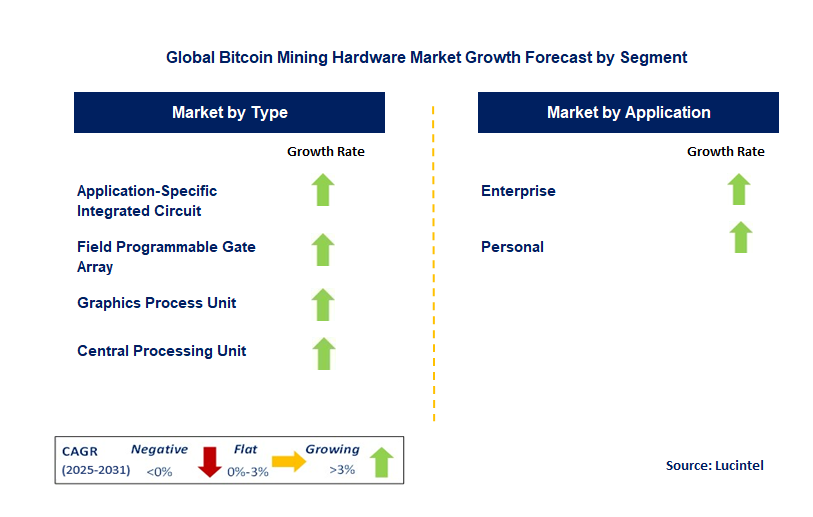
The future of the global bitcoin mining hardware market looks promising with opportunities in the enterprise and personal markets. The global bitcoin mining hardware market is expected to grow with a CAGR of 22.3% from 2025 to 2031. The major drivers for this market are growing popularity and adoption of cryptocurrencies, particularly bitcoin, have led to an increased demand for mining hardware, expansion of bitcoin mining farms, particularly in regions with low electricity costs, and increased institutional interest in cryptocurrencies and bitcoin mining operations has contributed to higher investments. Lucintel forecasts that, within the type category, application-specific integrated circuit is expected to witness the highest growth over the forecast period due to their specialized design for bitcoin mining makes them the go-to choice for miners seeking profitability. Within the application category, enterprise is expected to witness the higher growth due to these mining farms often run 24/7 and rely on high-performance. In terms of region, APAC is expected to witness the highest growth over the forecast period due to the rising adoption of blockchain technology and digital currencies. Gain valuable insights for your business decisions with our comprehensive 150+ page report. Sample figures with some insights are shown below.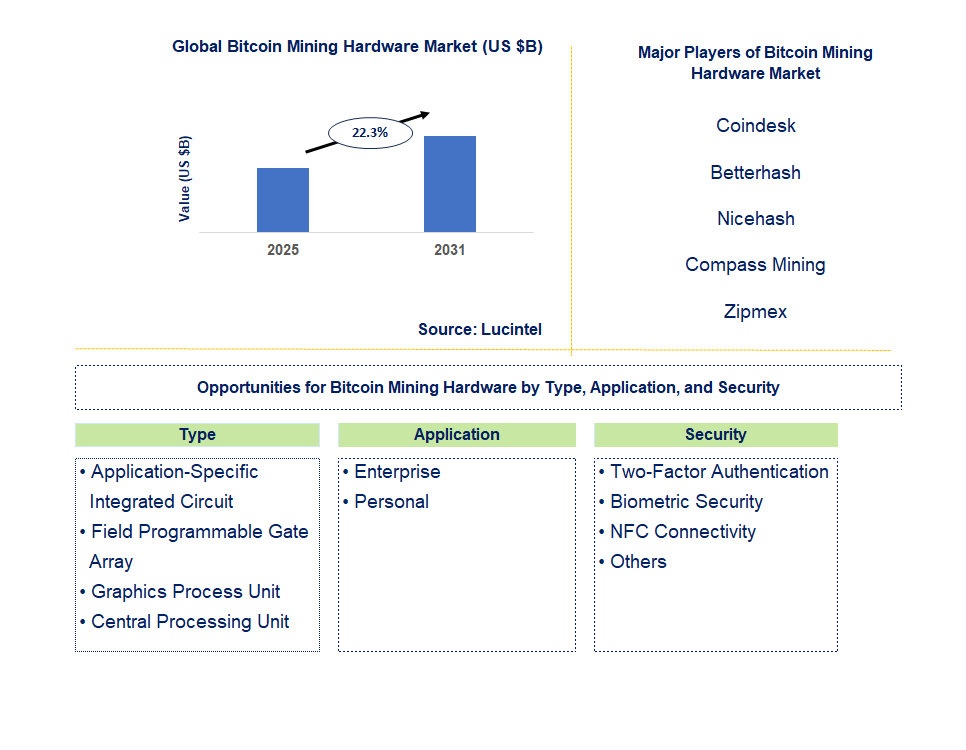
Emerging Trends in the Bitcoin Mining Hardware Market
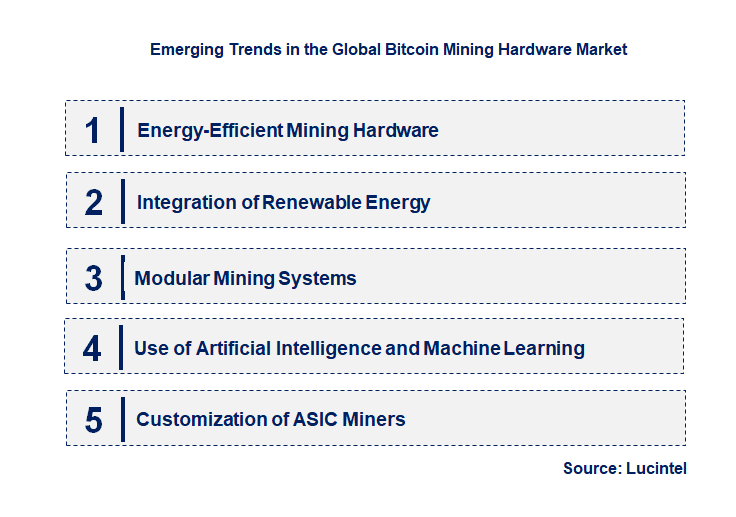
Accelerating innovation is already leading to profound changes in the bitcoin mining hardware market. The emergence of new trends is primarily driving miners toward achieving more efficiency and profitability, reshaping the industry in terms of operations and the scale of mining. From advances in energy-efficient technology to growing interest in environmental sustainability, these trends are reshaping mining operations. Understanding these emerging trends helps stakeholders better navigate the evolving bitcoin mining landscape.• Energy-Efficient Mining Hardware: Energy efficiency is a central focus in the bitcoin mining hardware market. As energy consumption remains a major concern for miners, newer models of ASIC miners are designed to maximize hashing power while minimizing energy use. This trend is largely driven by the need to reduce operational costs and adhere to global environmental standards. Innovations, including custom-built chips, cooling solutions, and improvements in power management, contribute to more sustainable mining practices. There is a rapidly increasing demand for energy-efficient mining rigs as miners aim to reduce costs and enhance profitability.
• Integration of Renewable Energy: The inclusion of renewable sources such as solar, wind, and hydropower in bitcoin mining operations is another important trend that has emerged recently. Miners are seeking ways to reduce the environmental impact of their operations by using renewable energy to power their rigs. This trend is not only due to regulatory pressure but also because of the need to lower electricity costs, especially in regions where energy costs are high. The future of the industry will likely be influenced by the transition to green mining practices in regions such as the U.S., China, and Germany.
• Modular Mining Systems: Modular mining systems are gaining popularity due to their scalability and flexibility in bitcoin mining. Modular mining systems allow miners to scale up or scale down their operations as market conditions and hardware requirements change. Furthermore, modular rigs facilitate easier portability and shorter setup times. This trend is particularly attractive for large-scale mining farms and data centers, where efficiency and ease of scale expansion are important. Modular systems enable miners to optimize hardware resources and adapt to changes in the environment and economy.
• Use of Artificial Intelligence and Machine Learning: Artificial intelligence and machine learning are becoming essential for optimizing bitcoin mining hardware by predicting hardware failure, improving miners’ performance, and optimizing power consumption in real-time. By using AI/ML-driven solutions, miners can make better and more informed choices about hardware placement, heat management, and maintenance schedules. As mining becomes increasingly competitive, AI and ML are helping miners stay ahead by providing data-driven strategies to maximize profitability.
• Customization of ASIC Miners: The customization of ASIC (Application-Specific Integrated Circuit) miners is growing as hardware developers offer customized solutions that cater to specific mining needs. Chips built specifically for the miner can ensure better efficiency, performance, and energy consumption compared to off-the-shelf solutions. This trend is pushing hardware to its limits as companies create specialized miners for different bitcoin block difficulties and operational conditions. Competition in the mining space is intensifying, and customization will be key for miners to maximize the potential of their hardware. These emerging trends are reshaping the bitcoin mining hardware market by focusing on efficiency, scalability, and sustainability. As energy consumption becomes a more critical issue, miners are increasingly adopting greener, more efficient technologies. Moreover, innovations in AI, modular systems, and customization are enabling miners to operate more effectively in an ever-competitive market. These trends are not only enhancing hardware performance but also contributing to the broader goal of making bitcoin mining more sustainable and profitable in the long term.
Recent Development in the Bitcoin Mining Hardware Market
The development of new technologies to meet the demands of miners worldwide is constantly revolutionizing the bitcoin mining hardware market. These developments are critical in improving efficiency, lowering operational costs, and ensuring regulatory compliance. Miners are under pressure to stay profitable due to competition and energy consumption concerns in the market. Here are five major developments transforming the bitcoin mining hardware market.• ASIC Miner Improvements: ASIC miners have made tremendous improvements as companies develop new models with higher hash rates and lower power consumption. These newer models incorporate better technologies in chips, such as smaller process nodes, to improve performance and minimize energy consumption. ASIC miners are now more efficient than ever, and their increased computing power enables miners to compete effectively in the market. This development has significantly improved mining efficiency, allowing miners to mine more bitcoin at a lower and more sustainable cost. Energy-Efficient Hardware: Energy-efficient bitcoin mining hardware is a growing trend, as newer machines are optimized for maximum hash rates and very low power consumption, addressing one of the major pain points for miners to date: innovating on systems for power supply, custom chips, and enhanced cooling techniques. In addition to decreasing operational costs, energy-efficient hardware helps lower mining’s ecological footprint. Energy-efficient solutions provide miners with a competitive edge as they optimize consumption and other elements.
• Liquid Cooling Solutions: Mining rig heat outputs increase with computing power and density, creating the need for liquid cooling for miners. Liquid cooling dissipates heat much more efficiently than air cooling methods. This allows miners to operate their hardware at greater efficiency without overheating. It reduces the energy consumption for cooling and prevents overheating, which can shorten mining hardware lifespan. This technology is especially valuable in large-scale mining farms, as keeping temperatures within an optimal range is crucial for long-term profitability.
• Sustainability Focus: The emphasis on sustainability is driving mining hardware development. Companies are incorporating renewable energy sources into mining rigs, making it easier for miners to utilize solar, wind, or hydroelectric power. Companies are also designing machines to last longer with recyclable materials, reducing electronic waste. Sustainability has become a competitive differentiator for miners, as they strive to meet environmental goals while improving the bottom line and remaining compliant with regulations.
• Customization and Specialized Hardware: As the need to develop highly specialized ASIC miners for optimal functionality in specific mining tasks grows, the demand for customized and specialized hardware is increasing. Miners are seeking tailored solutions to better meet their needs, such as specific algorithms or unique environmental conditions. Customization allows miners to extract more value from their hardware investments, improving profitability in a competitive landscape. Specialized hardware is becoming a niche market segment with growing demand. The latest developments in bitcoin mining hardware are helping improve the efficiency, profitability, and sustainability of mining operations. As miners face pressure to reduce costs while meeting environmental regulations, the most important areas for advancement include ASIC miners, energy efficiency, cooling technologies, and sustainability initiatives. The growing trend of custom hardware enables miners to optimize operations, ensuring the market remains competitive and technologically advanced.
Strategic Growth Opportunites in the Bitcoin Mining Hardware Market
With technological developments taking place in the bitcoin mining hardware market, new growth opportunities in key applications are emerging. Miners are becoming more competitive by using advanced technology that leads to better performance, reduced costs, and improved capabilities. Companies aiming to be market leaders in this rapidly changing scenario must identify such growth opportunities. Below are five key growth opportunities that will shape the future of the bitcoin mining hardware market.• Renewable Energy Integration: The integration of renewable energy sources into bitcoin mining represents the most relevant growth area. As the use of carbon footprints decreases, fluctuations in traditional energy prices have led miners to consider solar, wind, and hydroelectric power as sustainable ways to power their rigs. This opportunity is not only environmentally friendly but also economically rewarding in the long term, as renewable energy provides steady, low-cost power for mining operations. Miners adopting green energy solutions can optimize profits while meeting international environmental requirements.
• AI-Powered Optimization for Mining Bitcoin: AI and machine learning are increasingly being used to optimize bitcoin mining operations. AI applications include monitoring hardware performance, making maintenance predictions, and optimizing power consumption for efficiency, which helps reduce downtime. AI solutions also enable miners to scale operations for better profitability. The future of bitcoin mining hardware will rely heavily on the development and adoption of AI tools that help miners make data-driven decisions.
• Modular Mining Infrastructure: The shift toward modular mining systems presents a significant growth opportunity. Modular hardware systems allow miners to scale their operations efficiently, adapting to market conditions and hardware advancements without the need for complete overhauls. This flexibility makes it easier for both small and large-scale miners to optimize their hardware resources. The demand for modular systems is expected to rise as miners seek greater agility and cost efficiency in a fluctuating market.
• Improved Cooling Solutions: Advanced cooling solutions, such as liquid cooling and immersion cooling technologies, represent an important growth opportunity within the bitcoin mining hardware market. These systems provide more efficient heat management as mining rigs become more powerful and the need to manage heat increases. The development and adoption of efficient cooling systems will allow miners to run more powerful rigs with fewer cooling costs and a lower chance of overheating.
• Geothermal Mining: Geothermal mining offers bitcoin miners a remarkable opportunity to grow due to its abundance in many geothermal-rich areas. Geothermal energy is always available, allowing miners to operate their rigs with minimal environmental impact and reduced operational costs. With improved technology to harness geothermal energy, this could become a main growth area in the bitcoin mining hardware industry. These strategic growth opportunities are reshaping the bitcoin mining hardware market by focusing on sustainability, optimization, and scalability. As miners look for ways to stay competitive, leveraging renewable energy, AI, modular infrastructure, and advanced cooling technologies will provide critical advantages. By tapping into these opportunities, companies can enhance profitability, reduce environmental impact, and position themselves for long-term success in a rapidly evolving market.
Bitcoin Mining Hardware Market Driver and Challenges
The market of bitcoin mining hardware is influenced by technological, economic, and regulatory factors. These are determining the growth, efficiency, and sustainability of the mining process all over the world. Technological advancements force the innovation in capabilities of the hardware, and on the other hand, the economic pressure creates a need for cost-efficient and energy-effective solutions. Moreover, regulatory development gives both opportunity and challenge at the same time. These drivers and challenges create a dynamic environment for companies in the bitcoin mining hardware market, compelling them to adapt and innovate continuously to stay competitive and compliant. The factors responsible for driving the bitcoin mining hardware market include: 1. Technological Advancements: Technological progress is one of the key drivers in the bitcoin mining hardware market. With improved ASICs (Application-Specific Integrated Circuit) chips and rigs in mining hardware, hash rate as well as power consumption in processing are increased greatly. With energy as the primary source of expenditure for any miner in an industry that solely runs on a decentralized energy production process, having higher hashing powers means one has a much faster capability of transacting compared to when utilizing much less powerful miners, resulting in energy-efficient miner. Hence, in hardware evolution, demand increases. 2. Energy Efficiency: This is an issue of growing significance to the bitcoin mining industry since the cost of energy is now going up. It is accompanied by growing environmental consciousness, and equipment manufacturers in the sector are investing efforts in solutions for lowering power consumption without sacrificing too much processing capacity. Energy efficiency remains an important direction, as these operations need lower costs and stiffer environmental regulations. Miners also rely on alternative energy sources like solar and wind to keep running their mining business, leading to increased efficiency and profitability. Once energy-saving miners start becoming mainstream, the products demand will certainly see a dramatic surge. 3. Value of Bitcoins: The value increase in bitcoin, is another vital driving force to consume mining machines. When bitcoin prices are high, mining becomes more profitable, prompting miners to invest in the latest, more powerful hardware to increase their mining capacity and returns. Higher bitcoin prices stimulate interest in the market, as miners look to capitalize on potential gains. However, volatile prices of bitcoins make the miners agile in order to make their hardware investment according to market fluctuations that impact both demand and production cycles. 4. Regulatory Support for Crypto Mining: The bitcoin mining hardware market is getting more support through regulatory developments in key regions. Some countries implement favorable regulations on cryptocurrency mining operations, including tax incentives, government-backed initiatives for energy-efficient mining, or even clearer legal frameworks. Such measures promote stability and increase investment in the bitcoin mining sector, making it a more attractive proposition to investors and hardware manufacturers. Market growth is facilitated by regulatory clarity and financial incentives, especially in the U.S., Canada, and some parts of Europe. 5. Use of Renewable Energy: The use of renewable energy for bitcoin mining is becoming one of the key drivers in the hardware market. The environmental concerns over the consumption of energy will make miners opt for sustainable sources of energy for their operations. There is an integration of renewable energy sources, including solar, wind, and hydroelectric power, into mining operations to reduce carbon footprint and lower operational costs. This shift to greener mining practices is fostering the development of energy-efficient hardware that can effectively work with renewable energy systems. Miners using renewable energy can also tap into government incentives for green energy adoption. Challenges in the bitcoin mining hardware market are: 1. High Energy Consumption: Despite the development of energy-efficient mining hardware, the bitcoin mining industry still heavily relies on massive amounts of electricity. The mining process requires solving complex mathematical problems that require powerful computing systems and consumes much energy. This high energy consumption is a cost burden and also an environmental issue. Areas with high electricity costs increase the operational expenses of miners, and regions with strict environmental regulations may struggle to meet sustainability goals. Energy consumption is still a significant challenge for miners, pushing them to look for further innovations in energy-efficient hardware and renewable energy sources. 2. Regulatory Uncertainty: Regulatory uncertainty is a major challenge for the bitcoin mining hardware market. Different countries have varying stances on cryptocurrency mining, with some embracing the technology while others impose strict regulations or outright bans. This creates a lack of stability and hinders investment in certain regions, as miners and manufacturers face challenges in navigating the legal landscape. The shifting regulatory environment forces mining companies to remain adaptable, adjust operations to comply with changing laws, and potentially relocate to more favorable jurisdictions. This can lead to volatility in the market and have implications for long-term growth. 3. Supply Chain Problems: Supply chain issues are the other most significant issue faced by the bitcoin mining hardware industry. Demand for highly advanced mining rigs has skyrocketed. The supply chain of semiconductors that are necessary to produce high performance ASIC miners faces a shortage. Partly, shipping delays for hardware globally, manufacturing bottlenecks, and raw material shortages have been unable to meet demand. Such supply chain issues raise the cost of production and cause delays in when hardware availability will occur. This becomes a challenge to miners desirous of increasing their operations. Miners can thus incur more costs or operate in old hardware till new arrivals are available. The bitcoin mining hardware market is a complex combination of technological innovation, economic pressures, and regulatory dynamics. Innovations in energy-efficient hardware and renewable energy sources drive growth in the market, but challenges like high energy consumption, regulatory uncertainty, and supply chain disruptions pose barriers for miners. How the market manages to overcome these challenges while taking advantage of emerging technologies will define the future of bitcoin mining hardware. With the evolution of the industry, miners must adjust to these drivers and challenges to stay competitive, efficient, and compliant with these emerging regulations.List of Bitcoin Mining Hardware Companies
Companies in the market compete on the basis of product quality offered. Major players in this market focus on expanding their manufacturing facilities, R&D investments, infrastructural development, and leverage integration opportunities across the value chain. With these strategies bitcoin mining hardware companies cater increasing demand, ensure competitive effectiveness, develop innovative products & technologies, reduce production costs, and expand their customer base. Some of the bitcoin mining hardware companies profiled in this report include-• Coindesk
• Betterhash
• Nicehash
• Compass Mining
• Zipmex
• Stormgain
• Biostar Group
• Bitcoin Merch
• Bitmain Technologies Holding Company
Bitcoin Mining Hardware Market by Segment
The study includes a forecast for the global bitcoin mining hardware market by type, application, security, and region.Bitcoin Mining Hardware Market by Type [Value from 2019 to 2031]:
• Application-Specific Integrated Circuit
• Field Programmable Gate Array
• Graphics Process Unit
• Central Processing Unit
Bitcoin Mining Hardware Market by Application [Value from 2019 to 2031]:
• Enterprise
• Personal
Bitcoin Mining Hardware Market by Region [Value from 2019 to 2031]:
• North America
• Europe
• Asia Pacific
• The Rest of the World
Country Wise Outlook for the Bitcoin Mining Hardware Market
The bitcoin mining hardware market has been experiencing dynamic shifts due to technological innovations, economic factors, and regulatory changes. As the demand for mining becomes increasingly competitive and energy-intensive, advancements in hardware are necessary for maintaining profitability. In recent years, major global players in the market, including key players in the United States, China, Germany, India, and Japan, have made significant improvements to mining hardware efficiency and performance while incorporating sustainability. These changes are creating a future where mining capacities not only expand but also comply with new and more stringent regulations and environmental standards.• United States: In the United States, the growing demand for more efficient mining operations has led to a new wave of innovation in bitcoin mining hardware. Companies like Bitmain, Micro BT, and Canaan have produced more powerful ASIC miners that feature better hash rates and energy efficiency. The U.S. is also seeing a rise in investments in data centers and energy-efficient mining farms. Focusing on sustainability, U.S. miners are increasingly considering renewable sources such as solar and wind power to reduce operational costs and comply with local environmental regulations. This will further solidify the United States as the global bitcoin mining leader.
• China: In the wake of China’s clampdown on cryptocurrency mining in 2021, most miners moved to other countries. However, the market in China is slowly picking up. Some Chinese manufacturers are producing more advanced hardware, including newer models of ASIC miners that offer higher hash rates and consume less power. Domestic companies such as Bitmain continue to produce next-generation hardware, although most of it is now marketed abroad. The increasing focus on energy-efficient machines aligns with China’s long-term environmental goals, despite the difficult regulatory framework.
• Germany: Germany has positioned itself as the hub for crypto mining in Europe, thanks to its stable energy grid and favorable regulatory environment. Recently, German miners have been focusing on integrating renewable energy sources like hydro and wind power into their operations to minimize carbon footprints. The country has seen increased partnerships between technology companies and mining companies, with a rise in research and development for hardware to achieve higher efficiency and profitability. Improved cooling technology and the development of recovery systems for waste heat are further enhancing mining operations in Germany.
• India: India’s bitcoin mining hardware market is still developing but has picked up recently. Given that power costs are high and the regulatory environment is somewhat ambiguous, most local miners are investing in high-performance ASIC miners to increase output. Hardware suppliers from India are importing these mining rigs and setting up their data centers to facilitate these operations. Additionally, miners are looking into off-grid mining solutions like solar-powered mining farms to circumvent energy-related challenges. It is a growing market with significant potential for the future.
• Japan: In Japan, progress in bitcoin mining hardware is a blend of high-tech innovation and sustainability. Miners in Japan are embracing state-of-the-art ASIC hardware that offers enhanced processing power and lower energy consumption. Japanese firms are also pushing forward through significant investments in research and development aimed at creating more efficient and eco-friendly mining rigs. As global interest in renewable energy intensifies, more people are shifting toward integrating solar and geothermal power within mining operations. The country is also showing clearer regulatory aspects regarding infrastructure development and acceptance of hardware equipment.

Features of the Global Bitcoin Mining Hardware Market
Market Size Estimates: Bitcoin mining hardware market size estimation in terms of value ($B). Trend and Forecast Analysis: Market trends (2019 to 2024) and forecast (2025 to 2031) by various segments and regions. Segmentation Analysis: Bitcoin mining hardware market size by type, application, security, and region in terms of value ($B). Regional Analysis: Bitcoin mining hardware market breakdown by North America, Europe, Asia Pacific, and Rest of the World. Growth Opportunities: Analysis of growth opportunities in different type, application, security, and regions for the bitcoin mining hardware market. Strategic Analysis: This includes M&A, new product development, and competitive landscape of the bitcoin mining hardware market. Analysis of competitive intensity of the industry based on Porter’s Five Forces model.
FAQ
Q1. What is the growth forecast for bitcoin mining hardware market? Answer: The global bitcoin mining hardware market is expected to grow with a CAGR of 22.3% from 2025 to 2031. Q2. What are the major drivers influencing the growth of the bitcoin mining hardware market? Answer: The major drivers for this market are growing popularity and adoption of cryptocurrencies, particularly bitcoin, have led to an increased demand for mining hardware, expansion of bitcoin mining farms, particularly in regions with low electricity costs, and increased institutional interest in cryptocurrencies and bitcoin mining operations has contributed to higher investments. Q3. What are the major segments for bitcoin mining hardware market? Answer: The future of the bitcoin mining hardware market looks promising with opportunities in the enterprise and personal markets. Q4. Who are the key bitcoin mining hardware market companies? Answer: Some of the key bitcoin mining hardware companies are as follows:• Coindesk
• Betterhash
• Nicehash
• Compass Mining
• Zipmex
• Stormgain
• Biostar Group
• Bitcoin Merch
• Bitmain Technologies Holding Company Q5. Which bitcoin mining hardware market segment will be the largest in future? Answer: Lucintel forecasts that application-specific integrated circuit is expected to witness the highest growth over the forecast period due to their specialized design for bitcoin mining makes them the go-to choice for miners seeking profitability. Q6. In bitcoin mining hardware market, which region is expected to be the largest in next 5 years? Answer: APAC is expected to witness the highest growth over the forecast period due to the rising adoption of blockchain technology and digital currencies. Q7. Do we receive customization in this report? Answer: Yes, Lucintel provides 10% customization without any additional cost.
Table of Contents
Methodology
- In-depth interviews of the major players in this market
- Detailed secondary research from competitors’ financial statements and published data
- Extensive searches of published works, market, and database information pertaining to industry news, company press releases, and customer intentions
- A compilation of the experiences, judgments, and insights of Lucintel’s professionals, who have analyzed and tracked this market over the years.


Buy Now
Choose a license that fits your team. Instant PDF delivery.
Prices exclude taxes. Instant delivery. Custom licensing available on request.
Key Questions
- • What are some of the most promising, high-growth opportunities for the bitcoin mining hardware market by type (application-specific integrated circuit, field programmable gate array, graphics process unit, and central processing unit), application (enterprise and personal), security (two-factor authentication, biometric security, NFC connectivity, and others), and region (North America, Europe, Asia Pacific, and the Rest of the World)?
- • Which segments will grow at a faster pace and why?
- • Which region will grow at a faster pace and why?
- • What are the key factors affecting market dynamics? What are the key challenges and business risks in this market?
- • What are the business risks and competitive threats in this market?
- • What are the emerging trends in this market and the reasons behind them?
- • What are some of the changing demands of customers in the market?
- • What are the new developments in the market? Which companies are leading these developments?
- • Who are the major players in this market? What strategic initiatives are key players pursuing for business growth?
- • What are some of the competing products in this market and how big of a threat do they pose for loss of market share by material or product substitution?
- • What M&A activity has occurred in the last 5 years and what has its impact been on the industry? For any questions related to Bitcoin Mining Hardware Market, Bitcoin Mining Hardware Market Size, Bitcoin Mining Hardware Market Growth, Bitcoin Mining Hardware Market Analysis, Bitcoin Mining Hardware Market Report, Bitcoin Mining Hardware Market Share, Bitcoin Mining Hardware Market Trends, Bitcoin Mining Hardware Market Forecast, Bitcoin Mining Hardware Companies, write Lucintel analyst at email: helpdesk@lucintel.com. We will be glad to get back to you soon.


