
Report Feature
Bird Repellent Market Trends and Forecast
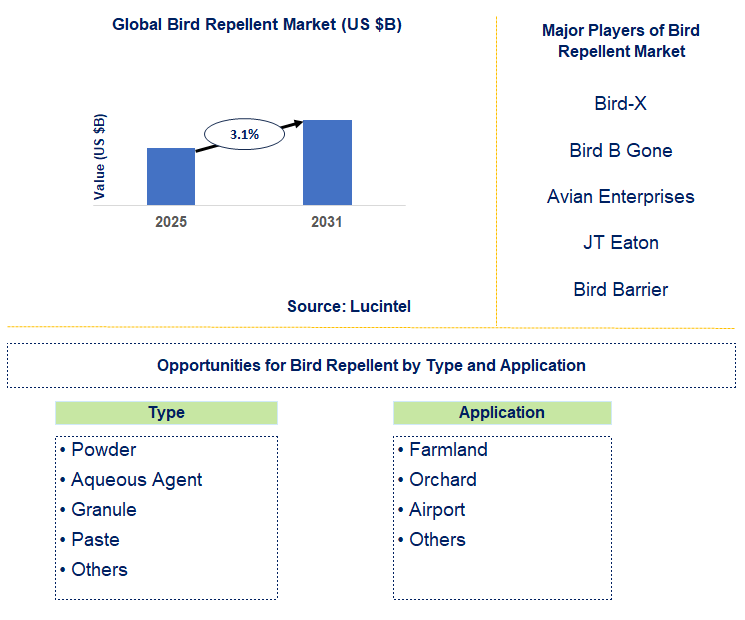
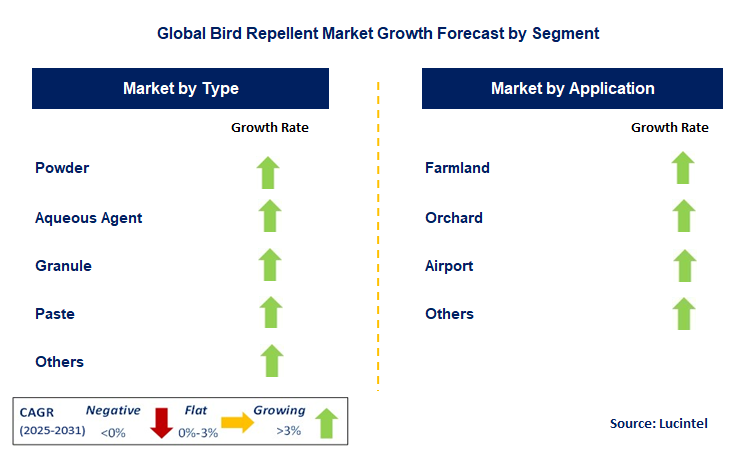
The future of the global bird repellent market looks promising with opportunities in the farmland, orchard, and airport markets. The global bird repellent market is expected to grow with a CAGR of 3.1% from 2025 to 2031. The major drivers for this market are the increasing need for crop protection, the rising concerns about bird-related damage, and the growing adoption of eco-friendly solutions.• Lucintel forecasts that, within the type category, aqueous agent is expected to witness the highest growth over the forecast period.
• Within the application category, airport is expected to witness the highest growth.
• In terms of region, APAC is expected to witness the highest growth over the forecast period. Gain valuable insights for your business decisions with our comprehensive 150+ page report. Sample figures with some insights are shown below.
Emerging Trends in the Bird Repellent Market
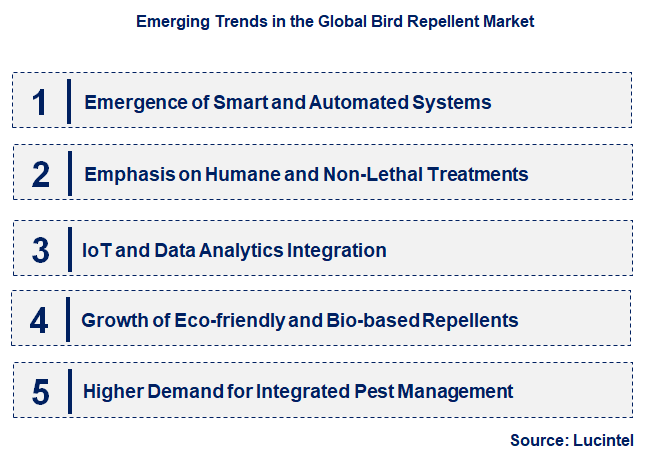
The bird repellent industry is evolving dramatically, from being a simple commodity business to an advanced technology-based industry. These new trends are basically rewriting the way bird control is tackled, with an emphasis on effectiveness, sustainability, and animal welfare. The industry is changing from mere bird deterrence to delivering holistic, data-based solutions that are customized for particular environments. This change is important to safeguard important resources and public health while existing alongside urban and wild bird populations.• Emergence of Smart and Automated Systems: This movement entails the creation of bird repellent systems, integrating sensors, artificial intelligence, and automation to identify and drive away birds. Such systems may integrate drones equipped with AI cameras that classify bird species and release customized deterrents. The effect is a more effective and efficient bird control system with less human intervention. This phenomenon is especially applicable in large-scale uses such as agriculture, airports, and solar farms, where manual treatments are not feasible.
• Emphasis on Humane and Non-Lethal Treatments: A prominent trend is the overwhelming consumer and regulatory demand for humane bird repellant treatments that do not kill or injure the birds. This involves the application of sonic, visual, and physical deterrents that merely deter birds from coming into a place without stressing them out. The effect is a move away from the conventional use of chemicals and killing methods towards a more humane approach. This movement is essential for public relations and assists businesses and municipalities in keeping pace with animal welfare standards.
• IoT and Data Analytics Integration: The industry is experiencing a new trend towards the integration of Internet of Things (IoT) and data analytics. Devices are being outfitted with sensors to gather data on bird behavior, and this data is utilized to enhance the effectiveness of the deterrents. The effect is a more predictive and proactive method of controlling birds. This trend makes possible a more focused approach, which wastes less, saves more, and prevents birds from becoming accustomed to a specific method.
• Growth of Eco-friendly and Bio-based Repellents: The industry is witnessing a strong trend toward creating eco-friendly, bio-based chemical repellents that are environmentally friendly and nontoxic to wildlife and birds. These repellents tend to employ natural materials such as methyl anthranilate, which birds cannot stand to eat. The effect is a decrease in environmental pollution and safer product use in delicate habitats. This is necessitated by tighter controls as well as an increased consumer desire for environmentally friendly products.
• Higher Demand for Integrated Pest Management: One of the major trends is the increased demand for an extensive, Integrated Pest Management strategy that incorporates bird control. This entails a synthesis of various repellent techniques, such as a blend of physical, visual, and audio deterrents, to create a multi-layered protection. The result is a stronger and more long-term solution that keeps birds from getting used to one approach. This is important in addressing complex problems with birds in urban and rural settings. These trends are transforming the bird repellent market into a smarter, specialized, and more sustainable business. Emphasis on technology, ethics, and holistic solutions is altering the whole business model for producers. They are transitioning from supplying basic products to delivering end-to-end, data-intensive services that are customized for a client’s precise requirements. This transformation is crucial in order to make the industry more effective, humane, and responsive to the intricacies of contemporary society.
Recent Development in the Bird Repellent Market
Recent advances in the bird repellent industry are radically changing the way public and private institutions deal with bird problems. Spurred by advancements in technology and increased emphasis on humane and environmentally friendly approaches, these advances are ushering in a new generation of advanced bird management solutions. The industry is experiencing a shift from older, less-efficient means to those with more precision and control. These technologies are facilitating a more proactive and responsible manner of asset protection and public safety.• High-Power Laser Technology Development: One of the developments is applying high-power laser technology for bird deterrents. These systems emit a green laser beam that the birds see as a physical danger, and they fly away unscathed. The effect is a very effective, long-range solution for extensive areas. Such technology is being used more and more at airports to avert bird strikes and in farming to cover extensive fields, providing an efficient and effective alternative to conventional techniques.
• Solar-Powered Deterrent Commercialization: One of the most significant advances is the commercialization of solar-powered bird deterrent products. Such devices, such as sonic repellents, visual strobing lights, and remote-controlled scarecrows, are capable of being operated in far-flung areas without any external power supply. The solution is more sustainable and cost-effective. The innovation is especially useful in application in farming and on building rooftops where there is limited access to power, thus making bird control more affordable and eco-friendlier.
• Launch of Smart, Networked Systems: The market has witnessed considerable innovation with the launch of smart, networked bird repellent systems. These systems are controlled and monitored remotely through a smartphone or computer, enabling real-time control against bird activity and weather. The result is a more adaptive and responsive system. With this technology, facility managers and farmers can maximize the efficiency of their systems without being present, saving time and enhancing performance.
• Bio-acoustics and Species-Specific Sounds: One of the recent innovations is the use of bio-acoustics, where species-specific distress calls or predator sounds are broadcast to repel birds. The effect is a more precise and effective method. This innovation is essential in not allowing birds to become habituated to a single sound and in having a very specific solution to a very specific problem. This technology is frequently paired with other deterrents for a holistic approach.
• Anti-Perching Surface and Gel Advances: One of the most important developments is the development of new, humane anti-perching surfaces and gels. These can be used to coat ledges and surfaces and create a sticky or uncomfortable surface that discourages birds from settling on them. The effect is an unharmful solution for monuments and buildings that is also subtle and durable. This innovation is a central component of an overall system of bird control and is being used more and more in city settings. These advances are influencing the bird repellent industry by making it smarter and more connected. The emphasis on technology, humane treatment, and remote operation is transforming the business model of the entire industry. They are shifting from the sale of a single product to providing integrated, data-based services that deliver ongoing protection. This change is rendering the industry more innovative, effective, and attuned to the multifaceted needs of contemporary society.
Strategic Growth Opportunities in the Bird Repellent Market
Strategic opportunities for expansion in the bird repellent industry are centered on delivering innovative, value-added solutions to address changing application needs. These opportunities are created by the imperative to enhance efficiency, increase safety, and encourage humane procedures. By targeting individual market segments, businesses can apply their knowledge and deliver customized solutions that solve the specific issues of various industries and environments. These strategic emphases are vital to a more competitive and technology-oriented market.• Agricultural and Horticultural Application: The agricultural and horticultural industry is a significant growth area as a result of the huge economic damages inflicted on crops by birds. The potential lies in the creation and sale of sophisticated, large-scale repellent systems, including automated laser and drone-based deterrents, which can safeguard huge expanses of agricultural land. The application is a dramatic reduction in crop production and profitability to farmers. This use is stimulated by an acute necessity for effective and economical solutions.
• Aviation and Airports: The aviation industry is a significant opportunity for growth from the imperative necessity to avoid bird strikes, which present a substantial safety hazard. The application is to deliver very reliable and technologically sophisticated solutions, including radar-based systems and high-power lasers, to drive birds off runways and airspace. The benefit is increased passenger and aircraft safety. This application is motivated by regulatory compliance and reduction of serious safety threats.
• Construction and Architecture: The construction and architecture industry is a major growth area because birds can be such a destructive force on buildings and infrastructure. The potential is to offer a variety of physical and visual deterrents which can be tactically incorporated into building design. The effect is less damage to property, maintenance, and public health hazards. This application is motivated by the requirement to safeguard commercial and residential buildings against bird droppings and nesting.
• Solar Farms and Energy Infrastructure: The development of solar farms and other energy infrastructure represents a primary growth opportunity. Birds can do a lot of damage to solar panels and other equipment. The opportunity lies in creating and selling specialized deterrents that can guard these huge, distant installations. The effect is a more stable and effective energy supply. This use demands strong and maintenance-free solutions, like solar-powered sonic and laser systems, which can resist severe outdoor environments.
• Urban and Public Spaces: Public areas such as city squares, stadiums, and parks are a growth area. The potential is to offer humane and non-intrusive methods for controlling bird populations in these places, which can be a nuisance and health hazard. The effect is cleaner public places and a more enjoyable urban environment. This use is compelled by the desire to preserve public property and secure the health and well-being of urban residents. These opportunities for growth are affecting the bird repellent market by encouraging specialization and innovation. The market is more and more segmented, and companies specialize in delivering customized solutions to a particular industry. This strategy is shifting the industry from a one-size-fits-all mentality to a value-driven proposition. The outcome is a stronger, more profitable, and more dynamic industry that is better equipped to address the multiple and varied demands of the global marketplace.
Bird Repellent Market Driver and Challenges
The market for bird repellent is driven by a mix of key drivers and obstacles that involve diverse technological, economic, and regulatory conditions. The market is driven by an increasing global appreciation of the economic and health impacts of birds and a strong demand for humane and effective control measures. Nevertheless, the market is confronted with considerable challenges, including the expense of sophisticated technologies and the potential for birds to acclimatize to some types of deterrents. An appreciation of these factors is important to inform all players in this developing sector. The factors responsible for driving the bird repellent market include: 1. Growing Economic Losses from Birds: The major push for the bird repellent market is the extensive economic loss inflicted by birds on industries. Birds can destroy yields and crop values in agriculture while leading to disastrous crashes in aviation due to bird collisions. The financial imperative to safeguard assets and avoid losses acts as a strong stimulus for the uptake of bird repellent products in the government and private sectors. 2. Urbanization and Infrastructure Growth: Increasing urbanization and ongoing development of new infrastructure are a primary cause. As city limits grow, the conflicts between bird populations and human activity escalate. Birds may damage structures, block drainage systems, and create health hazards with their droppings. The result has been a consistent need for efficient bird control solutions across urban and business settings. 3. Technological Developments in Repellents: Constant innovation and technological developments in the industry are a primary driver. New product creation, such as automatic laser systems, artificial intelligence-based drones, and intelligent sonic repellents, has become more efficient, effective, and easier to implement. These technologies offer more specific and consistent solutions that are an effective alternative to conventional means. 4. Increased Public Health and Hygiene Awareness: This is a significant driver, with a growing worldwide realization of the public health danger posed by birds. Birds release droppings that can have diseases and parasites that are harmful to human beings. This has contributed to an increased need for bird control measures in food processing facilities, warehouses, hospitals, and other public areas. This driver, in turn, plays a significant role in providing a safe and hygienic environment for consumers. 5. Emphasis on Humane and Non-Lethal Methods: Increased public concern for animal welfare is one of the key drivers, and consequently, there is tremendous demand for humane and non-lethal bird repellent techniques. This has fostered a market for products that merely repel birds rather than harm them. The emphasis on humane methods is assisting in getting the industry away from old, destructive methods and creating a fairer and more acceptable market in the eyes of the public. Challenges in the bird repellent market are: 1. Birds’ Habituation to Repellents: Another major challenge is that birds can be habituated to a given deterrent over time. For instance, birds will ultimately learn to disregard a given sound or visual deterrent. This will make the product useless and necessitate the need to continuously interchange between various methods, which increases the cost and complexity of the solution. This is a big issue that the industry is attempting to overcome. 2. Exorbitant Cost of Sophisticated Technology: The expensive initial investment in sophisticated bird repellent technologies, including laser systems and computer-powered drones, is a major problem, particularly for small farms and businesses. The cost factor can be restrictive, preventing the widespread use of these extremely effective solutions. Although the return on investment can be enormous, the initial capital outlay can be too high for many users, which can slow down the market. 3. Technical Expertise Gap: The industry is confronted with a challenge of the absence of technical know-how among the end-users, particularly for advanced and sophisticated systems. There is need to install and maintain these systems in a proper manner for them to deliver as expected. Without proper training and facilitation, the users may not be in a position to realize the benefits of the technology, resulting in substandard outcomes and dissatisfaction. The net effect of these drivers and challenges on the bird repellent market is a fast-changing and intricate environment. Though dominant drivers are steering the market towards innovation and growth, the major challenges are compelling the industry to evolve and look for answers to improve their products and make them more effective and available. The market’s future will be determined by how well the manufacturers can navigate these challenges in order to make the advantages of contemporary, humane bird control available in a more universal and fair way.List of Bird Repellent Companies
Companies in the market compete on the basis of product quality offered. Major players in this market focus on expanding their manufacturing facilities, R&D investments, infrastructural development, and leverage integration opportunities across the value chain. With these strategies bird repellent companies cater increasing demand, ensure competitive effectiveness, develop innovative products & technologies, reduce production costs, and expand their customer base. Some of the bird repellent companies profiled in this report include-• Bird-X
• Bird B Gone
• Avian Enterprises
• JT Eaton
• Bird Barrier
• Bonide
• Sunjoy Agro
• Seed Doctor
• Zhengshi Chemical
• TOPPER
Bird Repellent Market by Segment
The study includes a forecast for the global bird repellent market by type, application, and region.Bird Repellent Market by Type [Value from 2019 to 2031]:
• Powder
• Aqueous Agent
• Granule
• Paste
• Others
Bird Repellent Market by Application [Value from 2019 to 2031]:
• Farmland
• Orchard
• Airport
• Others
Bird Repellent Market by Region [Value from 2019 to 2031]:
• North America
• Europe
• Asia Pacific
• The Rest of the World
Country Wise Outlook for the Bird Repellent Market
The latest trends in the bird repellent industry are fueled by a universal move towards more humane, efficient, and technologically sophisticated measures. As the economic and public health toll of bird-inflicted damage to agriculture, air transport, and urban infrastructure continues to rise, there is a firm demand for new deterrents. This has spawned a shift from conventional to a new generation of products that are less invasive, more sustainable, and very targeted. The industry is experiencing a merging of materials science, digital technology, and behavioral research to develop more intelligent and efficient bird control systems.• United States: United States bird repellent market is dominated by the dominance of a heavy focus on technology-based, non-lethal solutions. Recent advancements involve the extensive use of laser bird deterrents for farm and airport uses and the application of sonic and ultrasonic devices in commercial complexes. The industry is also experiencing an increasing need for professional installation and integrated pest management services. This is fueled by stringent controls on chemical repellents and an increasing public demand for humane animal control.
• China: China is a large consumer and producer of bird repellent products, with recent technology focused on a massive use in its expansive agricultural industry. There is an intense push from the government for technology and efficient means to farm in order to sustain food security, and this is propelling the uptake of high-technology bird repellents. The market is witnessing a high growth rate in the adoption of AI-based drone systems for crop protection and increased demand for low-cost, effective physical and visual deterrents for urban applications.
• Germany: Germany’s bird repellent market is mature and highly regulated with a strong emphasis on environmentally and ethically friendly products. Recent trends involve a penchant for physical deterrents, like bird netting and spikes, that are designed specifically for aesthetic incorporation into cityscapes. The market is also witnessing growing demand for specialist sonic and bio-acoustic repellents that are engineered to be non-disruptive to society. This is prompted by stringent animal welfare regulations and high environmental awareness.
• India: The Indian bird repellent market is in the emerging stage, with recent growth propelled by a fast-growing agricultural and infrastructure sector. There is an increasing realization among farmers regarding the huge crop damage caused by birds, which is leading to increased demand for low-cost, cost-saving solutions. The market is witnessing new partnerships between tech firms and farm communities to provide simple, reproducible solutions such as low-cost sonic devices and robotic scarecrows. This is complemented by government initiatives for enhancing agricultural harvests.
• Japan: Japan’s bird deterrent market is very advanced and concentrates on high-tech and specific uses. Recent innovation involves a heavy focus on creating extremely advanced visual and audio deterrents to deploy along high-speed rail and in airports to avoid bird collision. The market is also experiencing a push toward employing innovative, solar-powered units for household and business use that can be integrated into home management systems. This is fueled by an emphasis on efficiency, public safety, and an extremely urbanized society.

Features of the Global Bird Repellent Market
Market Size Estimates: Bird repellent market size estimation in terms of value ($B). Trend and Forecast Analysis: Market trends (2019 to 2024) and forecast (2025 to 2031) by various segments and regions. Segmentation Analysis: Bird repellent market size by type, application, and region in terms of value ($B). Regional Analysis: Bird repellent market breakdown by North America, Europe, Asia Pacific, and Rest of the World. Growth Opportunities: Analysis of growth opportunities in different type, application, and regions for the bird repellent market. Strategic Analysis: This includes M&A, new product development, and competitive landscape of the bird repellent market. Analysis of competitive intensity of the industry based on Porter’s Five Forces model.
FAQ
Q1. What is the growth forecast for bird repellent market? Answer: The global bird repellent market is expected to grow with a CAGR of 3.1% from 2025 to 2031. Q2. What are the major drivers influencing the growth of the bird repellent market? Answer: The major drivers for this market are the increasing need for crop protection, the rising concerns about bird-related damage, and the growing adoption of eco-friendly solutions. Q3. What are the major segments for bird repellent market? Answer: The future of the bird repellent market looks promising with opportunities in the farmland, orchard, and airport markets. Q4. Who are the key bird repellent market companies? Answer: Some of the key bird repellent companies are as follows:• Bird-X
• Bird B Gone
• Avian Enterprises
• JT Eaton
• Bird Barrier
• Bonide
• Sunjoy Agro
• Seed Doctor
• Zhengshi Chemical
• TOPPER Q5. Which bird repellent market segment will be the largest in future? Answer: Lucintel forecasts that, within the type category, aqueous agent is expected to witness the highest growth over the forecast period. Q6. In bird repellent market, which region is expected to be the largest in next 5 years? Answer: In terms of region, APAC is expected to witness the highest growth over the forecast period. Q7. Do we receive customization in this report? Answer: Yes, Lucintel provides 10% customization without any additional cost.
Table of Contents
Methodology
- In-depth interviews of the major players in this market
- Detailed secondary research from competitors’ financial statements and published data
- Extensive searches of published works, market, and database information pertaining to industry news, company press releases, and customer intentions
- A compilation of the experiences, judgments, and insights of Lucintel’s professionals, who have analyzed and tracked this market over the years.


Buy Now
Choose a license that fits your team. Instant PDF delivery.
Prices exclude taxes. Instant delivery. Custom licensing available on request.
Key Questions
- • What are some of the most promising, high-growth opportunities for the bird repellent market by type (powder, aqueous agent, granule, paste, and others), application (farmland, orchard, airport, and others), and region (North America, Europe, Asia Pacific, and the Rest of the World)?
- • Which segments will grow at a faster pace and why?
- • Which region will grow at a faster pace and why?
- • What are the key factors affecting market dynamics? What are the key challenges and business risks in this market?
- • What are the business risks and competitive threats in this market?
- • What are the emerging trends in this market and the reasons behind them?
- • What are some of the changing demands of customers in the market?
- • What are the new developments in the market? Which companies are leading these developments?
- • Who are the major players in this market? What strategic initiatives are key players pursuing for business growth?
- • What are some of the competing products in this market and how big of a threat do they pose for loss of market share by material or product substitution?
- • What M&A activity has occurred in the last 5 years and what has its impact been on the industry? For any questions related to Bird Repellent Market, Bird Repellent Market Size, Bird Repellent Market Growth, Bird Repellent Market Analysis, Bird Repellent Market Report, Bird Repellent Market Share, Bird Repellent Market Trends, Bird Repellent Market Forecast, Bird Repellent Companies, write Lucintel analyst at email: helpdesk@lucintel.com. We will be glad to get back to you soon.


