
Report Feature
Biologics CDMO Market Trends and Forecast
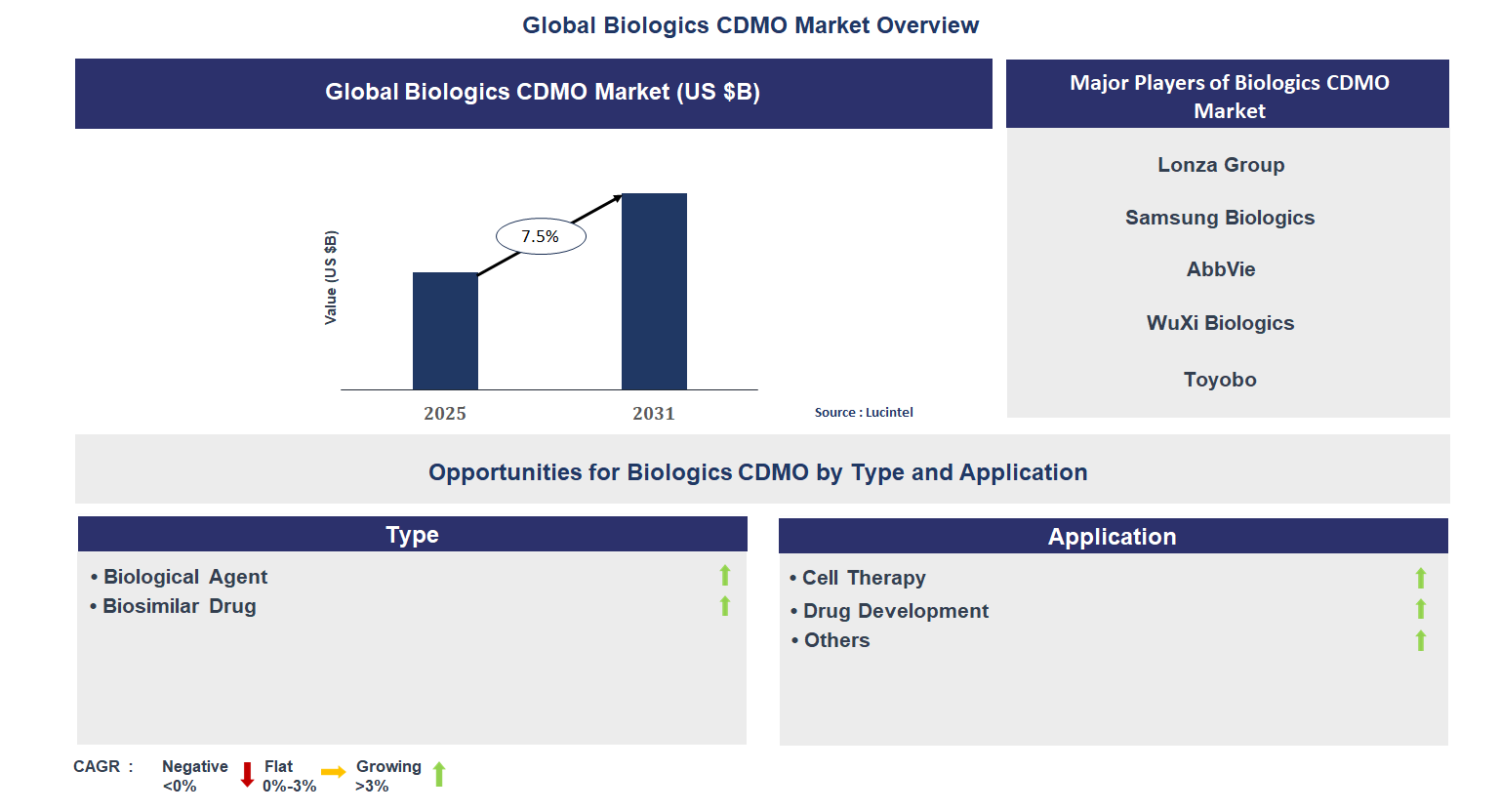
The future of the global biologics CDMO market looks promising with opportunities in the cell therapy and drug development markets. The global biologics CDMO market is expected to grow with a CAGR of 7.5% from 2025 to 2031. The major drivers for this market are the increasing outsourcing of biologics manufacturing services, the rising demand for monoclonal antibody production, and the growing investment in advanced bioprocessing technologies.• Lucintel forecasts that, within the type category, biological agent is expected to witness higher growth over the forecast period.
• Within the application category, cell therapy is expected to witness higher growth.
• In terms of region, APAC is expected to witness the highest growth over the forecast period. Gain valuable insights for your business decisions with our comprehensive 150+ page report. Sample figures with some insights are shown below.
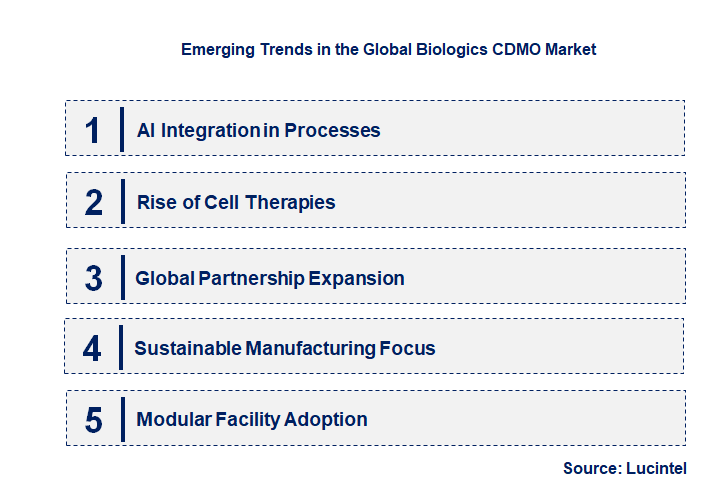
Emerging Trends in the Biologics CDMO Market
Emerging trends in the biologics CDMO market are shaped by technological integration and global collaboration, addressing the complexities of advanced therapies. These shifts emphasize efficiency, scalability, and innovation to support the burgeoning pipeline of biologics and personalized treatments.• AI Integration in Processes: Artificial intelligence is transforming biologics CDMO operations by optimizing process development and predictive analytics for yield improvements. This reduces development timelines and minimizes risks in scale-up phases, enabling faster commercialization of complex molecules like gene therapies. The impact includes cost savings and enhanced quality control, making CDMOs more agile in meeting sponsor demands for precision manufacturing.
• Rise of Cell Therapies: The surge in cell and gene therapy outsourcing is driving CDMOs to specialize in cryopreservation and viral vector production. This trend accelerates clinical advancements in regenerative medicine, broadening treatment options for rare diseases. Its impact fosters innovation ecosystems, with CDMOs partnering with biotech firms to navigate regulatory pathways and scale personalized solutions effectively.
• Global Partnership Expansion: Increasing cross-border alliances between CDMOs and pharma companies are facilitating technology transfers and shared R&D efforts. This enhances access to diverse expertise and markets, particularly in emerging regions. The impact strengthens supply chain diversity, mitigates geopolitical risks, and promotes sustainable growth through collaborative innovation in biologics platforms.
• Sustainable Manufacturing Focus: CDMOs are adopting green chemistry and energy-efficient bioreactors to align with environmental regulations and corporate sustainability goals. This trend reduces operational footprints while maintaining high yields for antibody production. Its impact improves brand reputation, attracts eco-conscious investors, and ensures long-term viability in a regulatory-tightening landscape for biologics development.
• Modular Facility Adoption: The shift to flexible, modular production units allows rapid reconfiguration for varying biologic scales and types. This supports agile responses to pipeline fluctuations in oncology and autoimmune areas. The impact enhances capacity utilization, lowers capital expenditures, and positions CDMOs to handle diverse portfolios, driving overall market efficiency and sponsor satisfaction. These trends are collectively reshaping the biologics CDMO market by promoting resilience, innovation, and inclusivity. They enable seamless scaling of advanced therapies, reduce barriers to entry for smaller biotechs, and align the sector with global health priorities for broader therapeutic access.
Recent Development in the Biologics CDMO Market
Recent key developments in the biologics CDMO market highlight strategic expansions and technological leaps amid heightened demand for integrated services. These initiatives underscore a commitment to overcoming production bottlenecks and enhancing global accessibility for cutting-edge biologics.• Major Capacity Expansions: Leading CDMOs have launched new bioreactor suites tailored for high-titer monoclonal antibody production, addressing shortages in commercial-scale manufacturing. This development streamlines supply for oncology pipelines, reducing lead times from lab to market. Its impact fortifies global supply chains, boosts investor confidence, and enables biotechs to focus on core R&D without infrastructure burdens.
• Strategic Mergers Activity: High-profile acquisitions among CDMOs aim to consolidate expertise in fill-finish and analytics for advanced therapies. This integrates fragmented services, enhancing end-to-end capabilities for gene editing products. The impact accelerates innovation velocity, expands geographic reach, and creates economies of scale that lower costs for sponsors pursuing complex biologic modalities.
• AI-Enabled Process Optimization: Implementation of machine learning tools in upstream processing has revolutionized yield predictions and contamination detection in biologics fermentation. This cuts variability in batch production for biosimilars. Its impact improves regulatory compliance, shortens validation periods, and empowers CDMOs to handle diverse portfolios, ultimately speeding up therapy approvals and market penetration.
• Viral Vector Tech Advances: Breakthroughs in scalable viral vector platforms support surging cell therapy demands, with CDMOs upgrading cleanrooms for GMP-grade production. This facilitates personalized medicine rollouts for hematologic conditions. The impact broadens therapeutic horizons, attracts venture funding, and positions the market as a pillar for next-generation treatments with high clinical success rates.
• Regulatory Harmonization Efforts: Collaborative frameworks between CDMOs and agencies are simplifying approval pathways for cross-border biologic transfers. This eases market entry for innovative formats like bispecifics. Its impact fosters international trade, reduces compliance costs, and encourages investment in harmonized standards, ensuring safer, faster delivery of biologics to patients worldwide. These developments are profoundly impacting the biologics CDMO market by driving efficiency and collaboration. They mitigate supply vulnerabilities, spur technological adoption, and expand therapeutic frontiers, ultimately enhancing affordability and speed in delivering life-saving biologics globally.
Strategic Growth Opportunities in the Biologics CDMO Market
Strategic growth opportunities in the biologics CDMO market are emerging across key applications, fueled by unmet needs in chronic and rare diseases. CDMOs are leveraging specialized expertise to capture value in high-potential areas, optimizing outsourcing for biopharma innovation.• Oncology Biologics Demand: The oncology segment offers robust growth as CDMOs scale antibody-drug conjugates and checkpoint inhibitors production. These addresses rising cancer incidences with targeted therapies. Its impact accelerates personalized oncology pipelines, reduces development costs through shared platforms, and enhances survival outcomes by enabling quicker access to precision treatments for diverse patient populations.
• Autoimmune Therapy Expansion: Opportunities in autoimmune applications thrive via CDMOs specializing in biosimilar interferons and fusion proteins manufacturing. This meets chronic disease management needs affordably. The impact broadens treatment accessibility, supports global health equity, and drives revenue through high-volume contracts, while fostering R&D in novel immunomodulators for refractory conditions.
• Cell Therapy Platforms: Growth in cell therapies leverages CDMOs‘ cryopreservation and expansion expertise for CAR-T and stem cell products. This targets hematologic malignancies effectively. Its impact revolutionizes regenerative approaches, attracts biotech investments, and shortens timelines from discovery to clinic, transforming outcomes for patients with limited conventional options.
• Vaccine Biologic Production: Vaccine applications present opportunities in adjuvant and recombinant protein scaling by CDMOs, bolstering pandemic preparedness. This ensures rapid response capabilities. The impact strengthens public health infrastructures, secures long-term partnerships with governments, and diversifies CDMO portfolios beyond therapeutics, enhancing resilience against emerging infectious threats.
• Rare Disease Focus: Rare disease biologics growth stems from CDMOs offering orphan drug process development for enzyme replacements. This fills niche market gaps innovatively. Its impact incentivizes specialized investments, expedites orphan designations, and improves quality of life for underserved patients, while commanding premium pricing in low-volume, high-value segments. These opportunities are reshaping the biologics CDMO market by diversifying revenue streams and aligning with therapeutic evolution. They empower CDMOs to lead in niche innovations, foster sustainable partnerships, and contribute to equitable healthcare advancements across global applications.
Biologics CDMO Market Driver and Challenges
The biologics CDMO market is propelled and constrained by intertwined technological, economic, and regulatory factors that influence scalability and accessibility. These elements collectively dictate investment flows and operational strategies in an increasingly complex landscape. The factors responsible for driving the biologics CDMO market include: 1. Outsourcing Surge in Biopharma: Biopharma firms increasingly outsource to CDMOs to access specialized expertise without heavy capital outlays, focusing resources on discovery. This driver amplifies pipeline progression for monoclonal antibodies and vectors. Its implications include faster time-to-market, cost efficiencies, and collaborative ecosystems that democratize access to advanced manufacturing for emerging biotechs. 2. Technological Innovation Push: Advances in continuous manufacturing and single-use systems are enabling CDMOs to handle complex biologics with higher precision and lower contamination risks. This drives efficiency in cell therapy production. Implications encompass reduced waste, enhanced scalability, and regulatory advantages, positioning innovative CDMOs as preferred partners for cutting-edge therapeutic modalities. 3. Personalized Medicine Rise: The shift toward individualized therapies demands CDMOs‘ flexible platforms for small-batch gene editing and patient-specific formulations. This fuels demand in oncology and rare diseases. Implications involve bespoke service models that accelerate clinical trials, improve efficacy rates, and create high-margin opportunities through tailored, data-driven manufacturing approaches. 4. Emerging Market Penetration: Expansion into cost-competitive regions like Asia-Pacific is drawing global sponsors seeking affordable large-scale biologics production. This leverages local talent and infrastructure. Implications include diversified supply chains, reduced geopolitical dependencies, and accelerated biosimilar launches, broadening therapeutic access while stimulating economic growth in developing biopharma hubs. 5. Regulatory Support Frameworks: Streamlined guidelines for biologic approvals are encouraging CDMOs to invest in compliant, harmonized facilities. This supports faster biosimilar and advanced therapy entries. Implications foster international collaborations, lower entry barriers for novel products, and build trust through quality assurances, ultimately expanding market volumes and innovation throughput. Challenges in the biologics CDMO market are: 1. Capacity Constraint Pressures: Limited bioreactor availability hampers CDMOs‘ ability to meet surging demands for viral vectors and high-titer processes. This leads to project delays in peak pipelines. Implications strain sponsor relationships, inflate costs via backlogs, and necessitate urgent infrastructure investments to sustain growth without compromising delivery timelines. 2. Supply Chain Vulnerabilities: Disruptions in raw materials like resins and media expose biologics production to global fluctuations and quality inconsistencies. This affects batch reliability. Implications heighten risk management needs, elevate operational expenses, and prompt diversification strategies to ensure uninterrupted manufacturing for time-sensitive therapies. 3. Talent Shortage Issues: The scarcity of skilled bioprocess engineers and regulatory experts challenges CDMOs in scaling innovative operations. This slows technology adoption. Implications include training investments, potential quality lapses, and competitive disadvantages, underscoring the need for robust workforce development to maintain leadership in complex biologic domains. These drivers and challenges synthesize a dynamic market trajectory, where opportunities for innovation outweigh hurdles through strategic adaptations. Balancing them ensures sustained expansion, equitable access to biologics, and resilient ecosystems that advance global therapeutic landscapes.List of Biologics CDMO Companies
Companies in the market compete on the basis of product quality offered. Major players in this market focus on expanding their manufacturing facilities, R&D investments, infrastructural development, and leverage integration opportunities across the value chain. With these strategies biologics CDMO companies cater increasing demand, ensure competitive effectiveness, develop innovative products & technologies, reduce production costs, and expand their customer base. Some of the biologics CDMO companies profiled in this report include-• Lonza Group
• Samsung Biologics
• AbbVie
• WuXi Biologics
• Toyobo
• AGC
• Thermo Fisher Scientific
• ICON
• Boehringer Ingelheim
• Fujifilm Diosynth Biotechnologies
Biologics CDMO Market by Segment
The study includes a forecast for the global biologics CDMO market by type, application, and region.Biologics CDMO Market by Type [Value from 2019 to 2031]:
• Biological Agent
• Biosimilar Drug
Biologics CDMO Market by Application [Value from 2019 to 2031]:
• Cell Therapy
• Drug Development
• Others
Biologics CDMO Market by Region [Value from 2019 to 2031]:
• North America
• Europe
• Asia Pacific
• The Rest of the World
Country Wise Outlook for the Biologics CDMO Market
The biologics CDMO market is evolving rapidly amid rising demand for complex therapies and outsourcing needs. Key players are expanding capacities and adopting innovative technologies to meet global supply chains. This growth reflects a shift toward integrated services in monoclonal antibodies and advanced therapies across major economies.• United States: The United States leads in biologics CDMO with significant investments in manufacturing facilities to support oncology and personalized medicine pipelines. Major CDMOs are enhancing end-to-end services, including process development and fill-finish operations, driven by strong domestic biotech innovation. This bolsters supply chain resilience and accelerates drug commercialization, positioning the region as a hub for high-value biologics production.
• China: China‘s biologics CDMO sector is surging through state-supported initiatives that promote low-cost, high-volume production of monoclonal antibodies and biosimilars. Companies are scaling up bioreactor capacities and forming international partnerships to access global markets. This development enhances export capabilities and integrates China into worldwide supply networks, fostering innovation in cell and gene therapies.
• Germany: Germany is advancing its biologics CDMO landscape with a focus on precision engineering and sustainable manufacturing processes for advanced biologics. CDMOs are investing in modular facilities to handle complex formulations like bispecific antibodies. These efforts strengthen Europe‘s role in quality-driven production, improving efficiency and compliance for European pharmaceutical firms seeking localized expertise.
• India: India‘s biologics CDMO market is expanding via cost-efficient large-molecule drug substance manufacturing, targeting vaccines and recombinant proteins. Local players are upgrading cleanroom technologies and securing technology transfers from global partners. This positions India as an attractive outsourcing destination, reducing timelines for clinical trials and enhancing access to affordable biologics for emerging markets.
• Japan: Japan is bolstering its biologics CDMO capabilities by improving active pharmaceutical ingredient production for biologics, with firms like AGC Biologics leading expansions. Emphasis on high-tech automation supports cell therapy development and regulatory alignment. These strides enhance Japan‘s competitiveness in Asia-Pacific, facilitating faster market entry for innovative therapies and strengthening regional supply chains.

Features of the Global Biologics CDMO Market
Market Size Estimates: Biologics CDMO market size estimation in terms of value ($B). Trend and Forecast Analysis: Market trends (2019 to 2024) and forecast (2025 to 2031) by various segments and regions. Segmentation Analysis: Biologics CDMO market size by type, application, and region in terms of value ($B). Regional Analysis: Biologics CDMO market breakdown by North America, Europe, Asia Pacific, and Rest of the World. Growth Opportunities: Analysis of growth opportunities in different types, applications, and regions for the biologics CDMO market. Strategic Analysis: This includes M&A, new product development, and competitive landscape of the biologics CDMO market. Analysis of competitive intensity of the industry based on Porter’s Five Forces model.
FAQ
Q1. What is the growth forecast for biologics CDMO market? Answer: The global biologics CDMO market is expected to grow with a CAGR of 7.5% from 2025 to 2031. Q2. What are the major drivers influencing the growth of the biologics CDMO market? Answer: The major drivers for this market are the increasing outsourcing of biologics manufacturing services, the rising demand for monoclonal antibody production, and the growing investment in advanced bioprocessing technologies. Q3. What are the major segments for biologics CDMO market? Answer: The future of the biologics CDMO market looks promising with opportunities in the cell therapy and drug development markets. Q4. Who are the key biologics CDMO market companies? Answer: Some of the key biologics CDMO companies are as follows:• Lonza Group
• Samsung Biologics
• AbbVie
• WuXi Biologics
• Toyobo
• AGC
• Thermo Fisher Scientific
• ICON
• Boehringer Ingelheim
• Fujifilm Diosynth Biotechnologies Q5. Which biologics CDMO market segment will be the largest in future? Answer: Lucintel forecasts that, within the type category, biological agent is expected to witness higher growth over the forecast period. Q6. In biologics CDMO market, which region is expected to be the largest in next 5 years? Answer: In terms of region, APAC is expected to witness the highest growth over the forecast period. Q7. Do we receive customization in this report? Answer: Yes, Lucintel provides 10% customization without any additional cost.
Table of Contents
List of Figures
List of Tables
Methodology
- In-depth interviews of the major players in this market
- Detailed secondary research from competitors’ financial statements and published data
- Extensive searches of published works, market, and database information pertaining to industry news, company press releases, and customer intentions
- A compilation of the experiences, judgments, and insights of Lucintel’s professionals, who have analyzed and tracked this market over the years.


Buy Now
Choose a license that fits your team. Instant PDF delivery.
Prices exclude taxes. Instant delivery. Custom licensing available on request.
Key Questions
- • What are some of the most promising, high-growth opportunities for the biologics CDMO market by type (biological agent and biosimilar drug), application (cell therapy, drug development, and others), and region (North America, Europe, Asia Pacific, and the Rest of the World)?
- • Which segments will grow at a faster pace and why?
- • Which region will grow at a faster pace and why?
- • What are the key factors affecting market dynamics? What are the key challenges and business risks in this market?
- • What are the business risks and competitive threats in this market?
- • What are the emerging trends in this market and the reasons behind them?
- • What are some of the changing demands of customers in the market?
- • What are the new developments in the market? Which companies are leading these developments?
- • Who are the major players in this market? What strategic initiatives are key players pursuing for business growth?
- • What are some of the competing products in this market and how big of a threat do they pose for loss of market share by material or product substitution?
- • What M&A activity has occurred in the last 5 years and what has its impact been on the industry? For any questions related to Biologics CDMO Market, Biologics CDMO Market Size, Biologics CDMO Market Growth, Biologics CDMO Market Analysis, Biologics CDMO Market Report, Biologics CDMO Market Share, Biologics CDMO Market Trends, Biologics CDMO Market Forecast, Biologics CDMO Companies, write Lucintel analyst at email: helpdesk@lucintel.com. We will be glad to get back to you soon.


