
Market Report · July 15, 2026

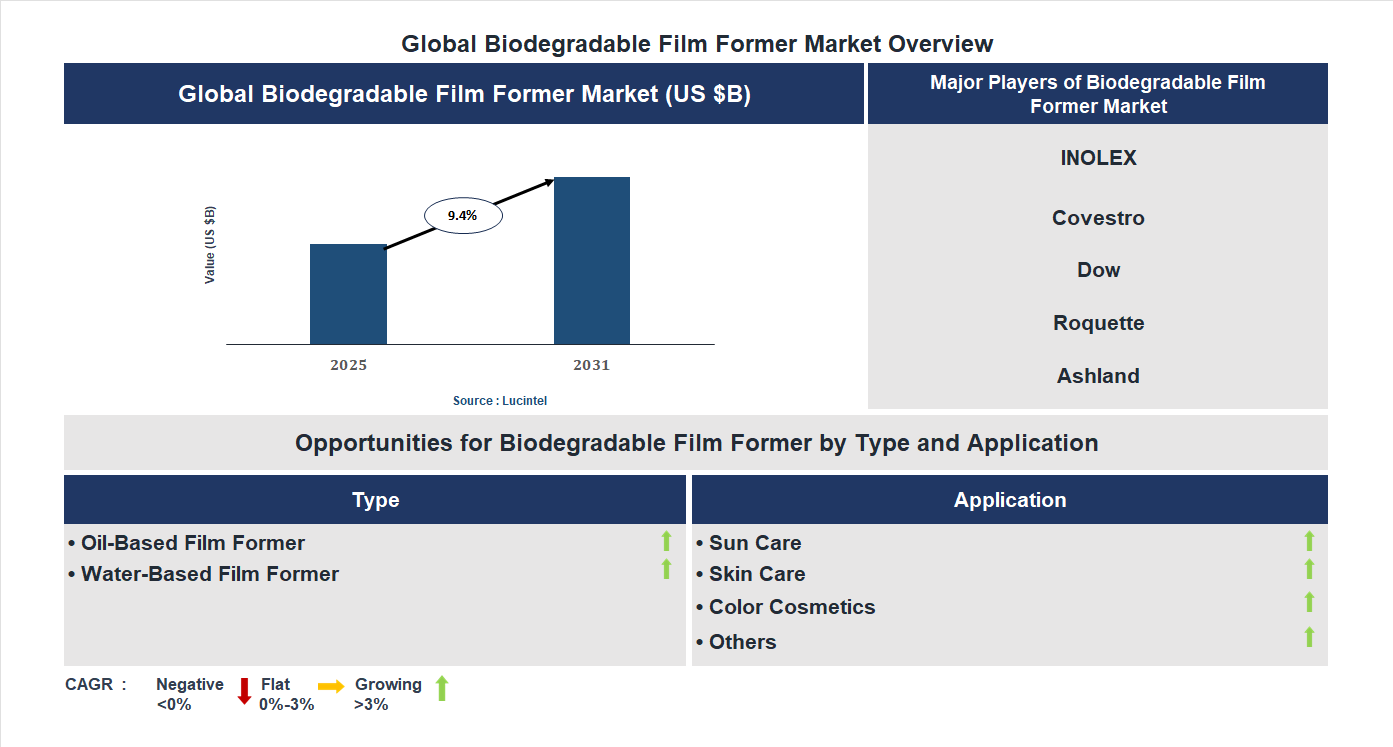
Key data points: The growth forecast = 9.4% annually for the next 7 years. Scroll below to get more insights. This market report covers trends, opportunities and forecasts in biodegradable film former market to 2031 by type (oil-based film former and water-based film former), application (sun care, skin care, color cosmetics, and others), and region (North America, Europe, Asia Pacific, and the Rest of the World)
We'll send your sample report shortly.
• Lucintel forecasts that, within the type category, water-based film former is expected to witness higher growth over the forecast period.
• Within the application category, color cosmetics is expected to witness the highest growth.
• In terms of region, APAC is expected to witness the highest growth over the forecast period. Gain valuable insights for your business decisions with our comprehensive 150+ page report. Sample figures with some insights are shown below.
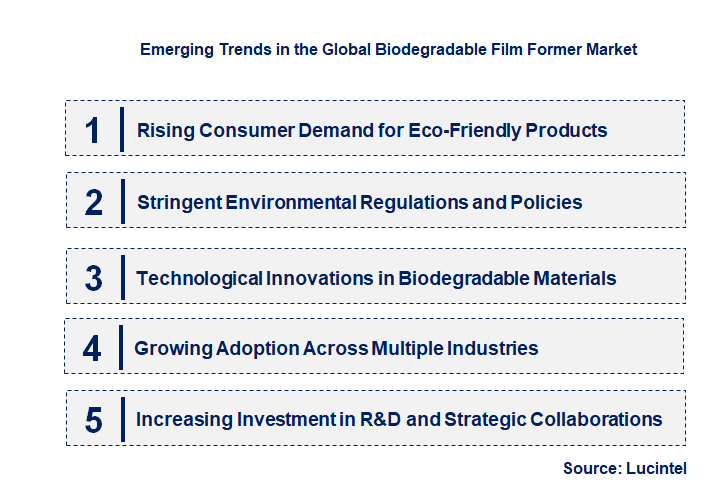
• Rising Consumer Demand for Eco-Friendly Products: Consumers are increasingly prioritizing sustainability, leading to higher demand for biodegradable packaging solutions. This shift influences manufacturers to innovate and adopt environmentally friendly materials, which enhances brand reputation and meets regulatory standards. The trend encourages the development of biodegradable film formers that are safe, effective, and align with eco-conscious consumer values, ultimately expanding market opportunities and driving growth.
• Stringent Environmental Regulations and Policies: Governments worldwide are implementing stricter regulations to reduce plastic waste and promote sustainability. These policies incentivize companies to adopt biodegradable alternatives and invest in research and development. As a result, the market for biodegradable film formers is expanding, with increased compliance requirements pushing manufacturers to innovate and produce more effective, eco-friendly products that meet evolving legal standards.
• Technological Innovations in Biodegradable Materials: Advances in material science are enabling the creation of more durable, versatile, and cost-effective biodegradable film formers. Innovations such as bio-based polymers and improved manufacturing processes enhance product performance and environmental compatibility. These technological developments are critical in overcoming previous limitations of biodegradable films, thereby broadening their application scope across various industries and increasing market penetration.
• Growing Adoption Across Multiple Industries: The demand for biodegradable film formers is rising across sectors such as packaging, agriculture, and textiles. Industries are seeking sustainable alternatives to traditional plastics to meet consumer expectations and regulatory requirements. This diversification accelerates market growth, encourages industry-specific innovations, and fosters collaborations that expand the application range of biodegradable films, making them integral to sustainable industrial practices.
• Increasing Investment in R&D and Strategic Collaborations: Companies and research institutions are investing heavily in developing advanced biodegradable film formers. Strategic partnerships facilitate knowledge sharing, resource pooling, and accelerated innovation. This trend enhances product quality, reduces costs, and speeds up commercialization, positioning the market for sustained growth. Investment in R&D is crucial for overcoming technical challenges and creating next-generation biodegradable solutions that meet market demands. In summary, these trends are collectively transforming the biodegradable film former market by fostering innovation, expanding application areas, and aligning industry practices with environmental sustainability goals. As consumer preferences and regulatory landscapes evolve, the market is poised for significant growth, driven by technological advancements and strategic collaborations that promote eco-friendly solutions.
• Rising Environmental Regulations: Governments worldwide are implementing stricter regulations on plastic waste, encouraging the adoption of biodegradable alternatives. This regulatory push is accelerating market growth by incentivizing manufacturers to develop eco-friendly film solutions, thereby reducing plastic pollution and aligning with sustainability goals.
• Technological Innovations in Biodegradable Materials: Advances in biopolymer research have led to the creation of more durable, cost-effective biodegradable films. These innovations improve product performance and shelf life, making biodegradable films more attractive to industries such as packaging, agriculture, and retail, thus expanding market applications.
• Increasing Consumer Awareness and Demand: Consumers are increasingly seeking sustainable products, prompting brands to adopt biodegradable packaging. This shift in consumer preferences is driving companies to invest in biodegradable film solutions, which enhances brand reputation and meets environmental expectations.
• Strategic Collaborations and Partnerships: Market players are forming alliances with research institutions and technology providers to develop advanced biodegradable films. These collaborations facilitate knowledge sharing, reduce R&D costs, and accelerate product commercialization, strengthening market competitiveness.
• Expansion of Production Capacities: Companies are investing in expanding manufacturing facilities to meet rising demand. Increased production capacity ensures supply chain stability, reduces costs, and enables market players to serve larger geographic regions, thereby supporting market growth. In summary, these developments are collectively propelling the biodegradable film former market towards rapid growth and innovation. Regulatory pressures and technological advancements are fostering a more sustainable industry landscape. Consumer preferences are shifting towards eco-friendly products, prompting companies to innovate and expand. Strategic collaborations and capacity expansions are further strengthening market dynamics. Overall, these factors are positioning the market for sustained growth, driven by environmental imperatives and technological progress.
• Packaging Industry: Expanding Eco-Friendly Packaging Solutions : The demand for biodegradable films in packaging is rising due to consumer preference for sustainable products and stricter environmental regulations. This growth reduces plastic waste and enhances brand reputation, encouraging manufacturers to adopt biodegradable options for food, retail, and e-commerce packaging.
• Agriculture Sector: Sustainable Mulching and Crop Protection : Biodegradable films are increasingly used as mulch and crop covers, offering an eco-friendly alternative to traditional plastic films. This application improves soil health, reduces waste management issues, and aligns with sustainable farming practices, thereby boosting adoption among farmers.
• Consumer Goods: Eco-Conscious Product Packaging : The consumer goods industry is shifting towards biodegradable films for product wrapping and packaging. This not only appeals to environmentally conscious consumers but also helps brands meet regulatory standards, fostering innovation in biodegradable material formulations.
• Medical and Healthcare: Biodegradable Films for Medical Packaging : The healthcare sector is adopting biodegradable films for packaging medical devices and pharmaceuticals. This reduces medical waste and aligns with sustainability goals, creating new opportunities for biodegradable film manufacturers.
• Automotive Industry: Sustainable Interior and Exterior Components : The automotive sector explores biodegradable films for interior trims and exterior parts, aiming to reduce environmental impact. This application supports automakers sustainability commitments and opens new avenues for biodegradable material use. In summary, these growth opportunities across packaging, agriculture, consumer goods, healthcare, and automotive sectors are significantly impacting the biodegradable film former market. They drive innovation, promote sustainability, and expand market reach, positioning biodegradable films as essential components in the global shift towards environmentally responsible products.
• Growing Environmental Awareness: The increasing global focus on sustainability and environmental conservation is a primary driver. Consumers and industries are seeking eco-friendly alternatives to traditional plastics, which has led to heightened demand for biodegradable film formers. Governments worldwide are implementing stricter regulations to reduce plastic waste, encouraging manufacturers to innovate and adopt biodegradable solutions. This shift not only benefits the environment but also offers companies a competitive edge in a market increasingly driven by eco-conscious consumers. The rising awareness and regulatory push are expected to sustain long-term growth in the biodegradable film former industry.
• Technological Advancements in Biodegradable Materials: Innovations in biodegradable polymers and formulations have significantly enhanced the performance and applicability of biodegradable film formers. Researchers are developing new materials that offer improved strength, flexibility, and barrier properties, making them suitable for various packaging and agricultural applications. These technological improvements reduce the gap between biodegradable and conventional plastics, encouraging wider adoption. Additionally, advancements in manufacturing processes have lowered production costs, making biodegradable film formers more economically viable. Continuous R&D efforts are vital for overcoming existing limitations and expanding the market’s scope.
• Increasing Regulatory Support and Policies: Governments across the globe are implementing policies and regulations aimed at reducing plastic pollution. Bans on single-use plastics, mandates for biodegradable packaging, and incentives for sustainable manufacturing are creating a favorable environment for biodegradable film formers. Such regulatory frameworks compel industries to transition from traditional plastics to eco-friendly alternatives, thereby boosting market demand. Compliance with these regulations not only helps companies avoid penalties but also enhances their brand image. The evolving regulatory landscape is expected to further accelerate market growth as policymakers continue to promote sustainable practices.
• Rising Demand in Packaging and Agriculture Sectors: The packaging industry is a significant consumer of biodegradable film formers, driven by the need for sustainable packaging solutions. The agricultural sector also increasingly adopts biodegradable films for mulching and crop protection, reducing plastic waste and environmental impact. The versatility, biodegradability, and eco-friendliness of these films make them attractive options for these sectors. As global demand for sustainable packaging and agricultural products grows, the market for biodegradable film formers is poised for expansion. This demand is further supported by consumer preferences shifting towards environmentally responsible products.
• Cost Reduction and Scalability of Production: Economies of scale and technological improvements have contributed to lowering the production costs of biodegradable film formers. As manufacturing processes become more efficient, the price gap between biodegradable and conventional plastics narrows, making biodegradable options more accessible to a broader range of industries. Cost reductions also enable companies to invest in research and development, further enhancing product quality and performance. Increased scalability ensures consistent supply and availability, which are critical for widespread adoption. These factors collectively support the market’s growth by making biodegradable film formers more economically attractive. The challenges facing this biodegradable film former market include:
• Performance Limitations of Biodegradable Films: Despite technological advancements, biodegradable films often face challenges related to durability, barrier properties, and shelf life compared to traditional plastics. These limitations restrict their use in certain applications, especially where high strength and long-term stability are required. Overcoming these performance issues requires ongoing research and development, which can be costly and time-consuming. If not addressed, these limitations may hinder market expansion and limit consumer confidence in biodegradable alternatives, thereby impacting overall growth prospects.
• High Production Costs and Limited Raw Material Availability: Although costs are decreasing, biodegradable film formers still tend to be more expensive than conventional plastics due to raw material costs and complex manufacturing processes. Limited availability of high-quality biodegradable raw materials can lead to supply chain disruptions and increased prices. These factors pose challenges for manufacturers seeking to scale production and meet rising demand. The economic viability of biodegradable film formers depends heavily on raw material accessibility and cost competitiveness, which remain significant hurdles.
• Regulatory Uncertainty and Lack of Standardization: While regulations favor biodegradable solutions, inconsistent policies across regions create uncertainty for market participants. The absence of standardized testing methods and certification processes complicates compliance and hampers international trade. This regulatory ambiguity can delay product launches and increase costs associated with certification and quality assurance. As governments refine policies, market players must navigate a complex landscape, which can slow down adoption and market growth, especially in emerging regions with evolving regulations. In summary, the biodegradable film former market is driven by increasing environmental awareness, technological innovations, supportive regulations, and rising demand from key sectors. However, challenges such as performance limitations, high costs, and regulatory uncertainties pose obstacles to growth. The overall impact of these drivers and challenges will shape the market’s evolution, requiring stakeholders to innovate continuously and adapt to changing regulatory and consumer landscapes. Successful navigation of these factors will determine the market’s potential for sustainable expansion and long-term profitability.
• INOLEX
• Covestro
• Dow
• Roquette
• Ashland
• Nouryon
• Miyoshi Kasei
• Surfatech Corp
• TC USA Inc
• LLS Beauty
• Oil-Based Film Former
• Water-Based Film Former
• Sun Care
• Skin Care
• Color Cosmetics
• Others
• North America
• Europe
• Asia Pacific
• The Rest of the World
• United States: The US market has seen increased investment in biodegradable film research, supported by government initiatives and private sector partnerships. Major companies are expanding product lines to include eco-friendly packaging solutions, driven by consumer demand and regulatory pressures. Innovations in compostable materials and recycling technologies are also prominent, with several startups emerging in this space. The US government’s policies aim to reduce plastic waste, encouraging industry adoption of biodegradable films across various sectors, including food packaging and retail.
• China: China is rapidly expanding its biodegradable film industry, fueled by government policies promoting environmental sustainability and waste reduction. The country has invested heavily in research and development, leading to the commercialization of new biodegradable materials. Domestic manufacturers are increasing production capacity to meet rising demand from packaging and agriculture sectors. Additionally, China’s focus on reducing plastic pollution has resulted in stricter regulations, encouraging the adoption of biodegradable alternatives in both urban and rural areas.
• Germany: Germany remains a leader in sustainable packaging innovations, with a strong emphasis on biodegradable films. The country’s stringent environmental regulations and consumer preferences drive industry advancements. German companies are developing high-performance biodegradable films suitable for various applications, including food packaging and industrial uses. The country also invests in research collaborations and pilot projects to improve biodegradability and recyclability, aligning with the European Union’s sustainability goals.
• India: India’s biodegradable film market is experiencing rapid growth due to increasing environmental awareness and government initiatives like the Plastic Waste Management Rules. The country is witnessing a surge in local manufacturing of biodegradable films, especially for agricultural and packaging applications. Efforts are underway to improve raw material availability and reduce costs, making these products more accessible. The government’s push for sustainable practices and bans on single-use plastics are further accelerating market expansion.
• Japan: Japan continues to innovate in biodegradable film technology, focusing on high-quality, eco-friendly materials. The country’s advanced research institutions and industry players are developing biodegradable films with enhanced durability and performance. Government policies promoting sustainability and waste reduction support market growth. Japan’s emphasis on circular economy principles encourages the adoption of biodegradable films in packaging, agriculture, and consumer goods, fostering a competitive and environmentally conscious industry landscape.


• INOLEX
• Covestro
• Dow
• Roquette
• Ashland
• Nouryon
• Miyoshi Kasei
• Surfatech Corp
• TC USA Inc
• LLS Beauty Q5. Which biodegradable film former market segment will be the largest in future? Answer: Lucintel forecasts that, within the type category, water-based film former is expected to witness higher growth over the forecast period. Q6. In biodegradable film former market, which region is expected to be the largest in next 5 years? Answer: In terms of region, APAC is expected to witness the highest growth over the forecast period. Q7. Do we receive customization in this report? Answer: Yes, Lucintel provides 10% customization without any additional cost.


Choose a license that fits your team. Instant PDF delivery.
Prices exclude taxes. Instant delivery. Custom licensing available on request.
Market Report · July 15, 2026
Market Report · July 15, 2026
Market Report · July 10, 2026
Trusted partner for strategic intelligence and business growth


Receive a complimentary market analysis tailored to your industry. Our analysts will identify key growth opportunities and competitive dynamics specific to your business.

Market size, growth rate, and key trend analysis for your specific sector.

Top competitor positioning and market share analysis.

Strategic recommendations backed by data-driven insights.
Get curated market intelligence and competitive moves straight to your inbox.
By subscribing, you agree to receive our monthly insights. Unsubscribe anytime.
Receive a complimentary market analysis tailored to your industry. Our analysts will identify key growth opportunities and competitive dynamics specific to your business.
Market size, growth rate, and key trend analysis for your specific sector.
Top competitor positioning and market share analysis.
Strategic recommendations backed by data-driven insights.
Get curated market intelligence, emerging trends, and competitive moves straight to your inbox each month.
By subscribing, you agree to receive our monthly insights. Unsubscribe anytime.
We'll send your sample report shortly.