
Close Lucintel Chat
Didn't Find What You're Looking for?
Call us at +1972 636 5056 or write at helpdesk@Lucintel.com
Ask an Expert Provide Custom Requirements Download Sample Report Search Available Reports
  • helpdesk@Lucintel.com
  • |
  • Call Lucintel +1 972 636 5056
  • |
  • Login
  • |
  • Register
  • |
  • Search
  • |
'
...

The Impact of COVID-19 is included in Biodegradable Diaper Market Report. Buy it today to get an advantage.

Request the impact of COVID-19 on your product or industry


Biodegradable Diaper Market Trends and Forecast

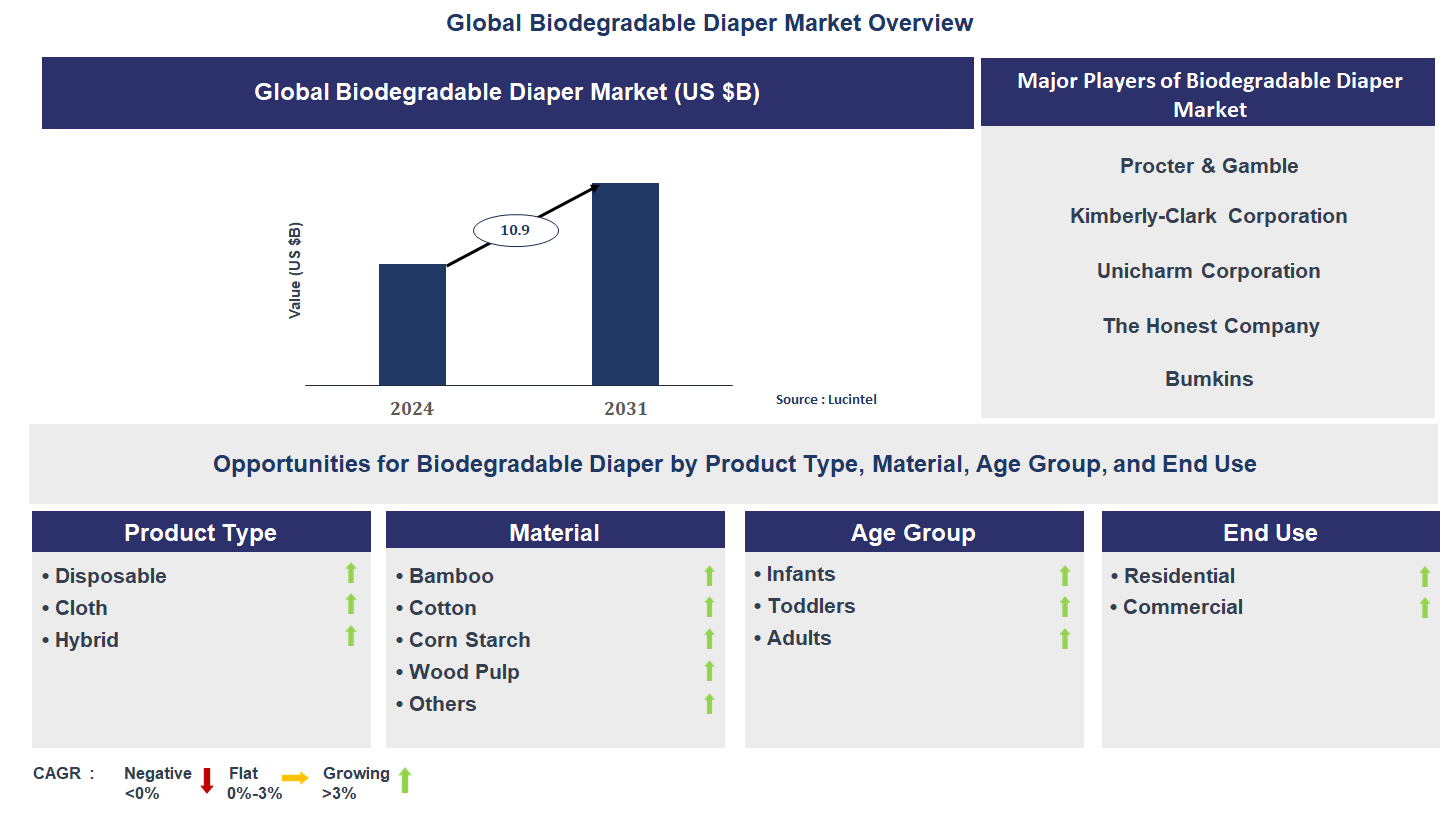
The future of the global biodegradable diaper market looks promising with opportunities in the residential and commercial markets. The global biodegradable diaper market is expected to grow with a CAGR of 10.9% from 2025 to 2031. The major drivers for this market are the increasing demand for eco-friendly products, the rising awareness of environmental sustainability, and the growing preference for natural materials in diapers.

• Lucintel forecasts that, within the product type category, disposable will remain the largest segment over the forecast period.
• Within the end use category, residential will remain a larger segment.
• In terms of region, North America will remain the largest region over the forecast period.
Gain valuable insights for your business decisions with our comprehensive 150+ page report. Sample figures with some insights are shown below.
Biodegradable Diaper Market Trends and Forecast

Emerging Trends in the Biodegradable Diaper Market

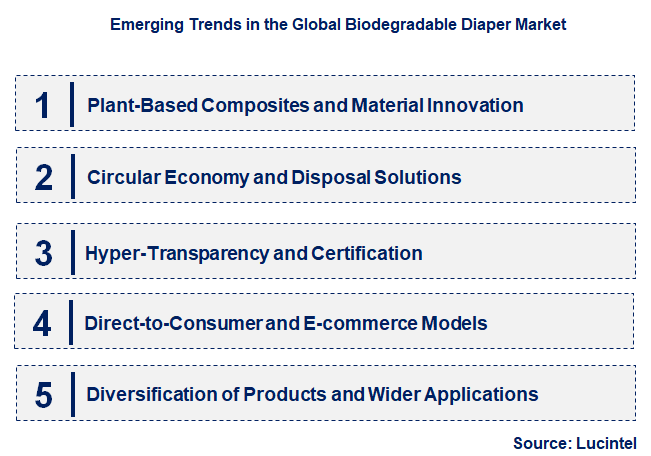
The biodegradable diaper market is being transformed by a number of emerging trends, which mirror a larger trend towards sustainability and thoughtful consumerism. These trends are not disparate; they are interrelated and working together to shape product innovation, marketing efforts, and consumer attitudes. From product innovation to supply chain visibility, these trends are pushing the market past the point of a mere eco-labeling, compelling brands to provide an integrated solution to sustainability that is both efficacious and can be accessed by more people.
• Plant-Based Composites and Material Innovation: New plant-based materials are a notable trend. Beyond basic bamboo and cotton, manufacturers are now leveraging advanced biopolymers from corn starch, sugarcane, and other renewable resources. This trend is enhancing product performance with increased absorbency and breathability, rendering biodegradable diapers competitive with conventional ones.
• Circular Economy and Disposal Solutions: One of the primary trends is incorporating circular economy principles. Brands are not only concerned with the product, but with its full life cycle. This involves the creation of diaper subscription services that offer take-back programs and collaborations with industrial composting facilities. By developing closed-loop systems, corporations are giving consumers an easy and transparent means of disposing used diapers, thus solving the major challenge of waste disposal and landfill buildup.
• Hyper-Transparency and Certification: Consumers are not satisfied with only a "green" label; they need extensive information on a product’s make-up, origin, and environmental footprint. This has created the phenomenon of hyper-transparency, whereby companies give explicit information on their site and packaging. The application of third-party certifications, e.g., for home composability or non-toxicity, is increasingly becoming an essential tool in establishing consumer confidence and distinguishing a product among many others.
• Direct-to-Consumer and E-commerce Models: The emergence of e-commerce has been a game-saver for biodegradable diapers. It makes it possible for niche and start-up brands to avoid traditional retail channels and address environmentally aware consumers directly. The model supports subscription services and customized customer experiences.
• Diversification of Products and Wider Applications: The other trend in the making is product diversification away from baby diapers. The technology is finding its way into other absorbent hygiene products, like adult incontinence pads and training pants. Diversification provides access to more consumers and different demographics, creating new market segments.
These trends are combined to redefine the biodegradable diaper market, turning it from a niche category into a consequential and fast-growing industry. Material technology is enhancing product performance and narrowing the performance gap with conventional diapers, while circular economy policies are offering effective solutions for sustainable disposal. This is aided by pressure for transparency and direct-to-consumer contact through e-commerce.
Emerging Trends in the Biodegradable Diaper Market

Recent Development in the Biodegradable Diaper Market

The biodegradable diaper market is changing very fast, inspired by increasing concern for environmental issues and pressure towards greener consumer products. These changes are not solely about new materials; they involve innovations in manufacturing, product designs, and business models. The market is shifting away from incremental improvements to a drastic overhaul of how diapers are produced and consumed.
• Sophisticated Bio-based Polymers: One of the developments is applying sophisticated bio-based polymers to replace conventional plastics used in diaper making. Rather than depending on pure natural fibers such as bamboo or cotton, businesses are now developing advanced polymers from materials like corn and sugarcane. This innovation improves the absorbency, strength, and biodegradability of the diaper.
• Take-Back and Composting Services Emerge: A major development is the advent of business models targeting the end-of-life issue of diapers. Companies are entering into collaborations with waste management services to provide take-back and industrial composting schemes. For a modest monthly charge, consumers can have used diapers picked up and shipped to a special facility where they biodegrade as nature intended. This innovation delivers on the promise of biodegradability.
• Greater Emphasis on Adult Incontinence Products: Although the market traditionally centered on baby diapers, a new trend is the diversification into adult incontinence products. With an aging population worldwide and an increasing need for eco-friendly healthcare products, companies are introducing biodegradable technology to adult pads and briefs. This trend is unlocking a vast and new untapped market, offering an opportunity for companies to grow and for a new segment to be offered a more eco-friendly solution.
• Intelligent Diapers with Environmentally Friendly Sensors: Incorporating technology into biodegradable diapers is another innovation within the recent times. Organizations are launching intelligent diapers with sensors that check for moisture and inform parents through a mobile app when it is time for a change. The sensors are made removable or using biodegradable materials, making the entire product environmentally safe.
• Increased Packaging and Supply Chain Sustainability: Recent innovations reach beyond the product to its supply chain and packaging. Companies are relying more on plastic-free, recyclable, or compostable packaging to further minimize their environmental impact. This is combined with initiatives to localize supply chains in order to reduce transportation emissions. These integrative sustainability measures are becoming a major differentiator, attracting customers who wish to patronize brands with an all-around commitment to the environment.
These new advancements are all coming together to transform the biodegradable diaper industry. The emphasis has moved beyond merely utilizing natural material to developing end-to-end, holistic sustainable solutions. From product performance innovation through materials to business model innovation for proper disposal, these innovations are tackling the top challenges that have kept markets stunted. Expansion into new categories and utilizing sustainable packaging is also evidence of a mature and holistic mindset toward sustainability.

Strategic Growth Opportunities in the Biodegradable Diaper Market

The biodegradable diaper market offers several strategic growth prospects through various applications based on a change in consumer values and growing emphasis on environmental sustainability. The firms that are able to successfully take advantage of these prospects are likely to gain a competitive edge and drive the future growth of the market. These are not merely opportunities for product innovation but also involve new business models, market segments, and consumer engagement strategies that address the changing needs of an attuned consumer base.
• Premium Baby Diaper Segment: There is a high growth potential in the premium baby diaper segment. The consumers with greater disposable incomes are willing to pay premium for products that are high-performing as well as sustainable. Such companies can leverage this by emphasizing product superiority, employing high-grade material such as organic bamboo and cotton, and stressing advantages like improved absorbency and rash prevention.
• for Adult Incontinence: The elderly population of the world is a huge and as yet untapped growth opportunity. Demand for adult incontinence items is increasing, and interest in sustainable solutions to conventional products is growing. By creating and marketing biodegradable briefs and pads, businesses can break into the new market segment. This approach meets a vital social and environmental requirement, positioning brands at the forefront of eco-friendly healthcare solutions and servicing a fast-growing segment.
• Subscription-Based Services: The growth of e-commerce and direct-to-consumer business models offers the potential to build subscription-based services. It is convenient for parents as it provides a constant supply of diapers shipped to their doorstep. It also enables brands to establish direct connections with consumers, collect important data, and provide customized incentives.
• Special Needs Diapers: There is a special growth potential in creating biodegradable diapers for sensitive skin and special health needs babies. These diapers can be made from hypoallergenic materials and be fragrance-free, lotion-free, and chlorine-free. By solving a particular pain point of the consumer, companies can create a good reputation of product safety and quality. This niche segment, being smaller in terms of size, commands larger profit margins and enables a brand to position itself as a reliable expert in infant care.
• Growing Markets with Rising Disposable Income: The so-called BRIC markets, i.e., China and India, are a huge long-term growth potential. With growing disposable incomes in these markets, more consumers increasingly can purchase premium and eco-friendly products. Strategic expansion into these economies calls for knowledge of local consumer patterns and brand building based on trust.
Collectively, these strategic growth opportunities are remaking the biodegradable diaper market. Through targeting high-end baby segments, moving into adult care, and subscription models, firms are diversifying revenue streams and opening up new means of growth. The emphasis on niche markets and growing economies also reflects a strategic transition toward winning share in the market beyond the usual consumer.

Biodegradable Diaper Market Driver and Challenges

The biodegradable diaper industry is influenced by the interplay of numerous technological, economic, and regulatory drivers. Its path is driven by an increasing awareness among consumers about the environmental implications and a need for more environmentally friendly products. But this promising growth is balanced against daunting challenges that affect its widespread usage and commercial success.
The factors responsible for driving the biodegradable diaper market include:
1. Rising Environmental Consciousness: Rising consumer awareness regarding the environmental costs of conventional diapers is a major catalyst. With billions of regular diapers going to waste every year, parents are consciously looking for alternatives with a reduced carbon footprint. This increased sensitivity is generating extensive demand for products derived from natural, plant sources and is compelling manufacturers to innovate and provide green solutions.
2. Regulatory Support by the Government: Most governments are enacting policies and legislation that minimize plastic usage and use environmentally friendly products. These measures, ranging from plastic taxes to waste management legislation and incentives for green manufacturing, are establishing a positive regulatory climate for biodegradable diapers. Such government encouragement motivates firms to spend more on research and development and makes green products competitive.
3. Technology Advances in Materials: Ongoing research in material technology is one of the main drivers. Advances in bio-based polymers, renewable wood pulp, and other plant-based materials are enhancing the absorbency, breathability, and overall performance of biodegradable diapers. These technological advances are narrowing the performance gap between environmentally friendly and conventional products, addressing one of the main concerns for many consumers.
4. Growing Disposable Income: Growing disposable incomes, especially in emerging economies such as China and India, are allowing more consumers to spend money on premium, sustainable products. The wealthier consumers get, the more they are happy to pay a premium for products that suit their health and sustainable values. This changing demographic is driving market growth and opening up new avenues for growth.
5. Brand Image and Corporate Sustainability Objectives: Large businesses are increasingly embracing sustainability as a key business strategy. Providing biodegradable diapers can create better brand image, attract an environmentally aware new generation of consumers, and achieve corporate social responsibility objectives. This is a strategic way to differentiate the brand in a saturated market and gain customer loyalty.
Challenges in the biodegradable diaper market are:
1. High Cost of Production: Perhaps the greatest challenge is the high production cost. The raw materials that biodegradable diapers are made from tend to be more costly than the plastics and synthetics found in traditional diapers. These added costs are frequently transferred on to the consumer, thus making the environmentally friendly choice less accessible to most families and a strong obstacle to mass adoption.
2. Limited Disposal Infrastructure: One of the biggest challenges is the lack of adequate disposal infrastructure. Some biodegradable diapers are designed to need special conditions, like industrial composting facilities, to degrade properly. Because these facilities are not common, most biodegradable diapers end up in standard landfills, where they may not degrade as planned. This counteracts the green benefits and can cause confusion and mistrust among consumers.
3. Perception of Performance and Durability: The public has an enduring belief that biodegradable diapers will be less effective than conventional ones, especially in their ability to absorb and contain leaks. Changing this perception is a significant hurdle for producers. They need to spend on advertising and consumer awareness efforts to prove that new material science has ensured that biodegradable diapers perform as well and last as long as conventional ones.
The net effect of these drivers and challenges is a market in a state of dynamic transition. The dominant drivers—environmental consciousness and technological innovation—are propelling the market towards a sustainable future. They are building a solid foundation for growth and luring in new companies. Yet the major challenges of high expense and poor disposal infrastructure are serving as dominant brakes on this growth.

List of Biodegradable Diaper Companies

Companies in the market compete on the basis of product quality offered. Major players in this market focus on expanding their manufacturing facilities, R&D investments, infrastructural development, and leverage integration opportunities across the value chain. With these strategies biodegradable diaper companies cater increasing demand, ensure competitive effectiveness, develop innovative products & technologies, reduce production costs, and expand their customer base. Some of the biodegradable diaper companies profiled in this report include-
• Procter & Gamble
• Kimberly-Clark Corporation
• Unicharm Corporation
• The Honest Company
• Bumkins
• Ontex Group
• Kao Corporation
• Seventh Generation
• Naty
• Bambo Nature

Biodegradable Diaper Market by Segment

The study includes a forecast for the global biodegradable diaper market by product type, material, age group, end use, and region.

Biodegradable Diaper Market by Product Type [Value from 2019 to 2031]:


• Disposable
• Cloth
• Hybrid

Biodegradable Diaper Market by Material [Value from 2019 to 2031]:


• Bamboo
• Cotton
• Corn Starch
• Wood Pulp
• Others

Biodegradable Diaper Market by Age Group [Value from 2019 to 2031]:


• Infants
• Toddlers
• Adults

Biodegradable Diaper Market by End Use [Value from 2019 to 2031]:


• Residential
• Commercial

Biodegradable Diaper Market by Region [Value from 2019 to 2031]:


• North America
• Europe
• Asia Pacific
• The Rest of the World

Country Wise Outlook for the Biodegradable Diaper Market

The world biodegradable diaper market is witnessing major overhaul, fueled by a combination of growing environmental concerns, new technologies, and changing customer behavior. As customers increasingly realize the long-term environmental cost of conventional disposable diapers, demand for environmentally friendly ones is on the rise. This has brought in fresh entrants and new products, rewriting the market dynamics.
• United States: There is a growing prevalence of niche and direct-to-consumer brands in the United States market that focus on sustainable materials and open sourcing. Brands are turning to materials such as bamboo and plant-based polymers, and several are introducing subscription services with composting or recycling initiatives. While big brands launch their own green lines, smaller, pioneering start-ups are gaining an appreciable market share by going straight to environmentally oriented parents who are prepared to pay a premium for independently certified biodegradable products.
• China: China’s biodegradable diaper market is driven by accelerating growth supported by a rapidly expanding middle class and urbanization. Although conventional brands remain the leaders, there is a rise in demand for high-end, imported, as well as locally made environment-friendly products. The drive by the government to protect the environment and cut plastic usage is also spurring innovation.
• Germany: Germany leads in the biodegradable diaper industry because of high consumer eco-awareness as well as government regulation on waste management. The market is fueled by a demand for products derived from natural and organic raw materials. German consumers and retailers are more concerned about certifications and sustainability claims, which has created a very competitive landscape where brands need to prove they practice genuine eco-friendly operations.
• India: The Indian biodegradable diaper market is in its infancy but has strong growth prospects. The drivers of the market are rising disposable incomes, high health and hygiene awareness, and an increasing number of young, urban parents. Although price is a vital consideration for the majority of consumers, there is a small but increasingly significant proportion that is ready to spend on biodegradable products.
• Japan: Japan’s biodegradable diaper market is driven by a highly-established hygiene product market and high emphasis on quality and innovation. Conventional diapers dominate, but consumer demand for environmentally-friendly alternatives is steadily increasing. Companies are meeting this demand by using additional natural, vegetable materials and making their products more biodegradable.

Lucintel Analytics Dashboard

Features of the Global Biodegradable Diaper Market

Market Size Estimates: Biodegradable diaper market size estimation in terms of value ($B).
Trend and Forecast Analysis: Market trends (2019 to 2024) and forecast (2025 to 2031) by various segments and regions.
Segmentation Analysis: Biodegradable diaper market size by various segments, such as by product type, material, age group, end use, and region in terms of value ($B).
Regional Analysis: Biodegradable diaper market breakdown by North America, Europe, Asia Pacific, and Rest of the World.
Growth Opportunities: Analysis of growth opportunities in different product types, materials, age group, end uses, and regions for the biodegradable diaper market.
Strategic Analysis: This includes M&A, new product development, and competitive landscape of the biodegradable diaper market.
Analysis of competitive intensity of the industry based on Porter’s Five Forces model.

Lucintel Consulting Services

FAQ

Q1. What is the growth forecast for biodegradable diaper market?
Answer: The global biodegradable diaper market is expected to grow with a CAGR of 10.9% from 2025 to 2031.
Q2. What are the major drivers influencing the growth of the biodegradable diaper market?
Answer: The major drivers for this market are the increasing demand for eco-friendly products, the rising awareness of environmental sustainability, and the growing preference for natural materials in diapers.
Q3. What are the major segments for biodegradable diaper market?
Answer: The future of the biodegradable diaper market looks promising with opportunities in the residential and commercial markets.
Q4. Who are the key biodegradable diaper market companies?
Answer: Some of the key biodegradable diaper companies are as follows:
• Procter & Gamble
• Kimberly-Clark Corporation
• Unicharm Corporation
• The Honest Company
• Bumkins
• Ontex Group
• Kao Corporation
• Seventh Generation
• Naty
• Bambo Nature
Q5. Which biodegradable diaper market segment will be the largest in future?
Answer: Lucintel forecasts that, within the product type category, disposable will remain the largest segment over the forecast period.
Q6. In biodegradable diaper market, which region is expected to be the largest in next 5 years?
Answer: In terms of region, North America will remain the largest region over the forecast period.
Q7. Do we receive customization in this report?
Answer: Yes, Lucintel provides 10% customization without any additional cost.

This report answers following 11 key questions:

Q.1. What are some of the most promising, high-growth opportunities for the biodegradable diaper market by product type (disposable, cloth, and hybrid), material (bamboo, cotton, corn starch, wood pulp, and others), age group (infants, toddlers, and adults), end use (residential and commercial), and region (North America, Europe, Asia Pacific, and the Rest of the World)?
Q.2. Which segments will grow at a faster pace and why?
Q.3. Which region will grow at a faster pace and why?
Q.4. What are the key factors affecting market dynamics? What are the key challenges and business risks in this market?
Q.5. What are the business risks and competitive threats in this market?
Q.6. What are the emerging trends in this market and the reasons behind them?
Q.7. What are some of the changing demands of customers in the market?
Q.8. What are the new developments in the market? Which companies are leading these developments?
Q.9. Who are the major players in this market? What strategic initiatives are key players pursuing for business growth?
Q.10. What are some of the competing products in this market and how big of a threat do they pose for loss of market share by material or product substitution?
Q.11. What M&A activity has occurred in the last 5 years and what has its impact been on the industry?

For any questions related to Biodegradable Diaper Market, Biodegradable Diaper Market Size, Biodegradable Diaper Market Growth, Biodegradable Diaper Market Analysis, Biodegradable Diaper Market Report, Biodegradable Diaper Market Share, Biodegradable Diaper Market Trends, Biodegradable Diaper Market Forecast, Biodegradable Diaper Companies, write Lucintel analyst at email: helpdesk@lucintel.com. We will be glad to get back to you soon.
                                           Table of Contents

            1. Executive Summary

            2. Market Overview

                        2.1 Background and Classifications
                        2.2 Supply Chain

            3. Market Trends & Forecast Analysis

                        3.1 Macroeconomic Trends and Forecasts
                        3.2 Industry Drivers and Challenges
                        3.3 PESTLE Analysis
                        3.4 Patent Analysis
                        3.5 Regulatory Environment
                        3.6 Global Biodegradable Diaper Market Trends and Forecast

            4. Global Biodegradable Diaper Market by Product Type

                        4.1 Overview
                        4.2 Attractiveness Analysis by Product Type
                        4.3 Disposable : Trends and Forecast 2025 to 2031
                        4.4 Cloth : Trends and Forecast 2025 to 2031
                        4.5 Hybrid : Trends and Forecast 2025 to 2031

            5. Global Biodegradable Diaper Market by Material

                        5.1 Overview
                        5.2 Attractiveness Analysis by Material
                        5.3 Bamboo : Trends and Forecast 2025 to 2031
                        5.4 Cotton : Trends and Forecast 2025 to 2031
                        5.5 Corn Starch : Trends and Forecast 2025 to 2031
                        5.6 Wood Pulp : Trends and Forecast 2025 to 2031
                        5.7 Others : Trends and Forecast 2025 to 2031

            6. Global Biodegradable Diaper Market by Age Group

                        6.1 Overview
                        6.2 Attractiveness Analysis by Age Group
                        6.3 Infants : Trends and Forecast 2025 to 2031
                        6.4 Toddlers : Trends and Forecast 2025 to 2031
                        6.5 Adults : Trends and Forecast 2025 to 2031

            7. Global Biodegradable Diaper Market by End Use

                        7.1 Overview
                        7.2 Attractiveness Analysis by End Use
                        7.3 Residential : Trends and Forecast 2025 to 2031
                        7.4 Commercial : Trends and Forecast 2025 to 2031

            8. Regional Analysis

                        8.1 Overview
                        8.2 Global Biodegradable Diaper Market by Region

            9. North American Biodegradable Diaper Market

                        9.1 Overview
                        9.2 North American Biodegradable Diaper Market by Product Type
                        9.3 North American Biodegradable Diaper Market by End Use
                        9.4 The United States Biodegradable Diaper Market
                        9.5 Canadian Biodegradable Diaper Market
                        9.6 Mexican Biodegradable Diaper Market

            10. European Biodegradable Diaper Market

                        10.1 Overview
                        10.2 European Biodegradable Diaper Market by Product Type
                        10.3 European Biodegradable Diaper Market by End Use
                        10.4 German Biodegradable Diaper Market
                        10.5 French Biodegradable Diaper Market
                        10.6 Italian Biodegradable Diaper Market
                        10.7 Spanish Biodegradable Diaper Market
                        10.8 The United Kingdom Biodegradable Diaper Market

            11. APAC Biodegradable Diaper Market

                        11.1 Overview
                        11.2 APAC Biodegradable Diaper Market by Product Type
                        11.3 APAC Biodegradable Diaper Market by End Use
                        11.4 Chinese Biodegradable Diaper Market
                        11.5 Indian Biodegradable Diaper Market
                        11.6 Japanese Biodegradable Diaper Market
                        11.7 South Korean Biodegradable Diaper Market
                        11.8 Indonesian Biodegradable Diaper Market

            12. ROW Biodegradable Diaper Market

                        12.1 Overview
                        12.2 ROW Biodegradable Diaper Market by Product Type
                        12.3 ROW Biodegradable Diaper Market by End Use
                        12.4 Middle Eastern Biodegradable Diaper Market
                        12.5 South American Biodegradable Diaper Market
                        12.6 African Biodegradable Diaper Market

            13. Competitor Analysis

                        13.1 Product Portfolio Analysis
                        13.2 Operational Integration
                        13.3 Porter’s Five Forces Analysis
                                    • Competitive Rivalry
                                    • Bargaining Power of Buyers
                                    • Bargaining Power of Suppliers
                                    • Threat of Substitutes
                                    • Threat of New Entrants
                        13.4 Market Share Analysis

            14. Opportunities & Strategic Analysis

                        14.1 Value Chain Analysis
                        14.2 Growth Opportunity Analysis
                                    14.2.1 Growth Opportunity by Product Type
                                    14.2.2 Growth Opportunity by Material
                                    14.2.3 Growth Opportunity by Age Group
                                    14.2.4 Growth Opportunity by End Use
                        14.3 Emerging Trends in the Global Biodegradable Diaper Market
                        14.4 Strategic Analysis
                                    14.4.1 New Product Development
                                    14.4.2 Certification and Licensing
                                    14.4.3 Mergers, Acquisitions, Agreements, Collaborations, and Joint Ventures

            15. Company Profiles of the Leading Players Across the Value Chain

                        15.1 Competitive Analysis
                        15.2 Procter & Gamble
                                    • Company Overview
                                    • Biodegradable Diaper Market Business Overview
                                    • New Product Development
                                    • Merger, Acquisition, and Collaboration
                                    • Certification and Licensing
                        15.3 Kimberly-Clark Corporation
                                    • Company Overview
                                    • Biodegradable Diaper Market Business Overview
                                    • New Product Development
                                    • Merger, Acquisition, and Collaboration
                                    • Certification and Licensing
                        15.4 Unicharm Corporation
                                    • Company Overview
                                    • Biodegradable Diaper Market Business Overview
                                    • New Product Development
                                    • Merger, Acquisition, and Collaboration
                                    • Certification and Licensing
                        15.5 The Honest Company
                                    • Company Overview
                                    • Biodegradable Diaper Market Business Overview
                                    • New Product Development
                                    • Merger, Acquisition, and Collaboration
                                    • Certification and Licensing
                        15.6 Bumkins
                                    • Company Overview
                                    • Biodegradable Diaper Market Business Overview
                                    • New Product Development
                                    • Merger, Acquisition, and Collaboration
                                    • Certification and Licensing
                        15.7 Ontex Group
                                    • Company Overview
                                    • Biodegradable Diaper Market Business Overview
                                    • New Product Development
                                    • Merger, Acquisition, and Collaboration
                                    • Certification and Licensing
                        15.8 Kao Corporation
                                    • Company Overview
                                    • Biodegradable Diaper Market Business Overview
                                    • New Product Development
                                    • Merger, Acquisition, and Collaboration
                                    • Certification and Licensing
                        15.9 Seventh Generation
                                    • Company Overview
                                    • Biodegradable Diaper Market Business Overview
                                    • New Product Development
                                    • Merger, Acquisition, and Collaboration
                                    • Certification and Licensing
                        15.10 Naty
                                    • Company Overview
                                    • Biodegradable Diaper Market Business Overview
                                    • New Product Development
                                    • Merger, Acquisition, and Collaboration
                                    • Certification and Licensing
                        15.11 Bambo Nature
                                    • Company Overview
                                    • Biodegradable Diaper Market Business Overview
                                    • New Product Development
                                    • Merger, Acquisition, and Collaboration
                                    • Certification and Licensing

            16. Appendix

                        16.1 List of Figures
                        16.2 List of Tables
                        16.3 Research Methodology
                        16.4 Disclaimer
                        16.5 Copyright
                        16.6 Abbreviations and Technical Units
                        16.7 About Us
                        16.8 Contact Us

                                               List of Figures


            Chapter 1

                        Figure 1.1: Trends and Forecast for the Global Biodegradable Diaper Market

            Chapter 2

                        Figure 2.1: Usage of Biodegradable Diaper Market
                        Figure 2.2: Classification of the Global Biodegradable Diaper Market
                        Figure 2.3: Supply Chain of the Global Biodegradable Diaper Market

            Chapter 3

                        Figure 3.1: Trends of the Global GDP Growth Rate
                        Figure 3.2: Trends of the Global Population Growth Rate
                        Figure 3.3: Trends of the Global Inflation Rate
                        Figure 3.4: Trends of the Global Unemployment Rate
                        Figure 3.5: Trends of the Regional GDP Growth Rate
                        Figure 3.6: Trends of the Regional Population Growth Rate
                        Figure 3.7: Trends of the Regional Inflation Rate
                        Figure 3.8: Trends of the Regional Unemployment Rate
                        Figure 3.9: Trends of Regional Per Capita Income
                        Figure 3.10: Forecast for the Global GDP Growth Rate
                        Figure 3.11: Forecast for the Global Population Growth Rate
                        Figure 3.12: Forecast for the Global Inflation Rate
                        Figure 3.13: Forecast for the Global Unemployment Rate
                        Figure 3.14: Forecast for the Regional GDP Growth Rate
                        Figure 3.15: Forecast for the Regional Population Growth Rate
                        Figure 3.16: Forecast for the Regional Inflation Rate
                        Figure 3.17: Forecast for the Regional Unemployment Rate
                        Figure 3.18: Forecast for Regional Per Capita Income
                        Figure 3.19: Driver and Challenges of the Biodegradable Diaper Market

            Chapter 4

                        Figure 4.1: Global Biodegradable Diaper Market by Product Type in 2019, 2024, and 2031
                        Figure 4.2: Trends of the Global Biodegradable Diaper Market ($B) by Product Type
                        Figure 4.3: Forecast for the Global Biodegradable Diaper Market ($B) by Product Type
                        Figure 4.4: Trends and Forecast for Disposable in the Global Biodegradable Diaper Market (2019-2031)
                        Figure 4.5: Trends and Forecast for Cloth in the Global Biodegradable Diaper Market (2019-2031)
                        Figure 4.6: Trends and Forecast for Hybrid in the Global Biodegradable Diaper Market (2019-2031)

            Chapter 5

                        Figure 5.1: Global Biodegradable Diaper Market by Material in 2019, 2024, and 2031
                        Figure 5.2: Trends of the Global Biodegradable Diaper Market ($B) by Material
                        Figure 5.3: Forecast for the Global Biodegradable Diaper Market ($B) by Material
                        Figure 5.4: Trends and Forecast for Bamboo in the Global Biodegradable Diaper Market (2019-2031)
                        Figure 5.5: Trends and Forecast for Cotton in the Global Biodegradable Diaper Market (2019-2031)
                        Figure 5.6: Trends and Forecast for Corn Starch in the Global Biodegradable Diaper Market (2019-2031)
                        Figure 5.7: Trends and Forecast for Wood Pulp in the Global Biodegradable Diaper Market (2019-2031)
                        Figure 5.8: Trends and Forecast for Others in the Global Biodegradable Diaper Market (2019-2031)

            Chapter 6

                        Figure 6.1: Global Biodegradable Diaper Market by Age Group in 2019, 2024, and 2031
                        Figure 6.2: Trends of the Global Biodegradable Diaper Market ($B) by Age Group
                        Figure 6.3: Forecast for the Global Biodegradable Diaper Market ($B) by Age Group
                        Figure 6.4: Trends and Forecast for Infants in the Global Biodegradable Diaper Market (2019-2031)
                        Figure 6.5: Trends and Forecast for Toddlers in the Global Biodegradable Diaper Market (2019-2031)
                        Figure 6.6: Trends and Forecast for Adults in the Global Biodegradable Diaper Market (2019-2031)

            Chapter 7

                        Figure 7.1: Global Biodegradable Diaper Market by End Use in 2019, 2024, and 2031
                        Figure 7.2: Trends of the Global Biodegradable Diaper Market ($B) by End Use
                        Figure 7.3: Forecast for the Global Biodegradable Diaper Market ($B) by End Use
                        Figure 7.4: Trends and Forecast for Residential in the Global Biodegradable Diaper Market (2019-2031)
                        Figure 7.5: Trends and Forecast for Commercial in the Global Biodegradable Diaper Market (2019-2031)

            Chapter 8

                        Figure 8.1: Trends of the Global Biodegradable Diaper Market ($B) by Region (2019-2024)
                        Figure 8.2: Forecast for the Global Biodegradable Diaper Market ($B) by Region (2025-2031)

            Chapter 9

                        Figure 9.1: Trends and Forecast for the North American Biodegradable Diaper Market (2019-2031)
                        Figure 9.2: North American Biodegradable Diaper Market by Product Type in 2019, 2024, and 2031
                        Figure 9.3: Trends of the North American Biodegradable Diaper Market ($B) by Product Type (2019-2024)
                        Figure 9.4: Forecast for the North American Biodegradable Diaper Market ($B) by Product Type (2025-2031)
                        Figure 9.5: North American Biodegradable Diaper Market by Material in 2019, 2024, and 2031
                        Figure 9.6: Trends of the North American Biodegradable Diaper Market ($B) by Material (2019-2024)
                        Figure 9.7: Forecast for the North American Biodegradable Diaper Market ($B) by Material (2025-2031)
                        Figure 9.8: North American Biodegradable Diaper Market by Age Group in 2019, 2024, and 2031
                        Figure 9.9: Trends of the North American Biodegradable Diaper Market ($B) by Age Group (2019-2024)
                        Figure 9.10: Forecast for the North American Biodegradable Diaper Market ($B) by Age Group (2025-2031)
                        Figure 9.11: North American Biodegradable Diaper Market by End Use in 2019, 2024, and 2031
                        Figure 9.12: Trends of the North American Biodegradable Diaper Market ($B) by End Use (2019-2024)
                        Figure 9.13: Forecast for the North American Biodegradable Diaper Market ($B) by End Use (2025-2031)
                        Figure 9.14: Trends and Forecast for the United States Biodegradable Diaper Market ($B) (2019-2031)
                        Figure 9.15: Trends and Forecast for the Mexican Biodegradable Diaper Market ($B) (2019-2031)
                        Figure 9.16: Trends and Forecast for the Canadian Biodegradable Diaper Market ($B) (2019-2031)

            Chapter 10

                        Figure 10.1: Trends and Forecast for the European Biodegradable Diaper Market (2019-2031)
                        Figure 10.2: European Biodegradable Diaper Market by Product Type in 2019, 2024, and 2031
                        Figure 10.3: Trends of the European Biodegradable Diaper Market ($B) by Product Type (2019-2024)
                        Figure 10.4: Forecast for the European Biodegradable Diaper Market ($B) by Product Type (2025-2031)
                        Figure 10.5: European Biodegradable Diaper Market by Material in 2019, 2024, and 2031
                        Figure 10.6: Trends of the European Biodegradable Diaper Market ($B) by Material (2019-2024)
                        Figure 10.7: Forecast for the European Biodegradable Diaper Market ($B) by Material (2025-2031)
                        Figure 10.8: European Biodegradable Diaper Market by Age Group in 2019, 2024, and 2031
                        Figure 10.9: Trends of the European Biodegradable Diaper Market ($B) by Age Group (2019-2024)
                        Figure 10.10: Forecast for the European Biodegradable Diaper Market ($B) by Age Group (2025-2031)
                        Figure 10.11: European Biodegradable Diaper Market by End Use in 2019, 2024, and 2031
                        Figure 10.12: Trends of the European Biodegradable Diaper Market ($B) by End Use (2019-2024)
                        Figure 10.13: Forecast for the European Biodegradable Diaper Market ($B) by End Use (2025-2031)
                        Figure 10.14: Trends and Forecast for the German Biodegradable Diaper Market ($B) (2019-2031)
                        Figure 10.15: Trends and Forecast for the French Biodegradable Diaper Market ($B) (2019-2031)
                        Figure 10.16: Trends and Forecast for the Spanish Biodegradable Diaper Market ($B) (2019-2031)
                        Figure 10.17: Trends and Forecast for the Italian Biodegradable Diaper Market ($B) (2019-2031)
                        Figure 10.18: Trends and Forecast for the United Kingdom Biodegradable Diaper Market ($B) (2019-2031)

            Chapter 11

                        Figure 11.1: Trends and Forecast for the APAC Biodegradable Diaper Market (2019-2031)
                        Figure 11.2: APAC Biodegradable Diaper Market by Product Type in 2019, 2024, and 2031
                        Figure 11.3: Trends of the APAC Biodegradable Diaper Market ($B) by Product Type (2019-2024)
                        Figure 11.4: Forecast for the APAC Biodegradable Diaper Market ($B) by Product Type (2025-2031)
                        Figure 11.5: APAC Biodegradable Diaper Market by Material in 2019, 2024, and 2031
                        Figure 11.6: Trends of the APAC Biodegradable Diaper Market ($B) by Material (2019-2024)
                        Figure 11.7: Forecast for the APAC Biodegradable Diaper Market ($B) by Material (2025-2031)
                        Figure 11.8: APAC Biodegradable Diaper Market by Age Group in 2019, 2024, and 2031
                        Figure 11.9: Trends of the APAC Biodegradable Diaper Market ($B) by Age Group (2019-2024)
                        Figure 11.10: Forecast for the APAC Biodegradable Diaper Market ($B) by Age Group (2025-2031)
                        Figure 11.11: APAC Biodegradable Diaper Market by End Use in 2019, 2024, and 2031
                        Figure 11.12: Trends of the APAC Biodegradable Diaper Market ($B) by End Use (2019-2024)
                        Figure 11.13: Forecast for the APAC Biodegradable Diaper Market ($B) by End Use (2025-2031)
                        Figure 11.14: Trends and Forecast for the Japanese Biodegradable Diaper Market ($B) (2019-2031)
                        Figure 11.15: Trends and Forecast for the Indian Biodegradable Diaper Market ($B) (2019-2031)
                        Figure 11.16: Trends and Forecast for the Chinese Biodegradable Diaper Market ($B) (2019-2031)
                        Figure 11.17: Trends and Forecast for the South Korean Biodegradable Diaper Market ($B) (2019-2031)
                        Figure 11.18: Trends and Forecast for the Indonesian Biodegradable Diaper Market ($B) (2019-2031)

            Chapter 12

                        Figure 12.1: Trends and Forecast for the ROW Biodegradable Diaper Market (2019-2031)
                        Figure 12.2: ROW Biodegradable Diaper Market by Product Type in 2019, 2024, and 2031
                        Figure 12.3: Trends of the ROW Biodegradable Diaper Market ($B) by Product Type (2019-2024)
                        Figure 12.4: Forecast for the ROW Biodegradable Diaper Market ($B) by Product Type (2025-2031)
                        Figure 12.5: ROW Biodegradable Diaper Market by Material in 2019, 2024, and 2031
                        Figure 12.6: Trends of the ROW Biodegradable Diaper Market ($B) by Material (2019-2024)
                        Figure 12.7: Forecast for the ROW Biodegradable Diaper Market ($B) by Material (2025-2031)
                        Figure 12.8: ROW Biodegradable Diaper Market by Age Group in 2019, 2024, and 2031
                        Figure 12.9: Trends of the ROW Biodegradable Diaper Market ($B) by Age Group (2019-2024)
                        Figure 12.10: Forecast for the ROW Biodegradable Diaper Market ($B) by Age Group (2025-2031)
                        Figure 12.11: ROW Biodegradable Diaper Market by End Use in 2019, 2024, and 2031
                        Figure 12.12: Trends of the ROW Biodegradable Diaper Market ($B) by End Use (2019-2024)
                        Figure 12.13: Forecast for the ROW Biodegradable Diaper Market ($B) by End Use (2025-2031)
                        Figure 12.14: Trends and Forecast for the Middle Eastern Biodegradable Diaper Market ($B) (2019-2031)
                        Figure 12.15: Trends and Forecast for the South American Biodegradable Diaper Market ($B) (2019-2031)
                        Figure 12.16: Trends and Forecast for the African Biodegradable Diaper Market ($B) (2019-2031)

            Chapter 13

                        Figure 13.1: Porter’s Five Forces Analysis of the Global Biodegradable Diaper Market
                        Figure 13.2: Market Share (%) of Top Players in the Global Biodegradable Diaper Market (2024)

            Chapter 14

                        Figure 14.1: Growth Opportunities for the Global Biodegradable Diaper Market by Product Type
                        Figure 14.2: Growth Opportunities for the Global Biodegradable Diaper Market by Material
                        Figure 14.3: Growth Opportunities for the Global Biodegradable Diaper Market by Age Group
                        Figure 14.4: Growth Opportunities for the Global Biodegradable Diaper Market by End Use
                        Figure 14.5: Growth Opportunities for the Global Biodegradable Diaper Market by Region
                        Figure 14.6: Emerging Trends in the Global Biodegradable Diaper Market

                                               List of Tables


            Chapter 1

                        Table 1.1: Growth Rate (%, 2023-2024) and CAGR (%, 2025-2031) of the Biodegradable Diaper Market by Product Type, Material, Age Group, and End Use
                        Table 1.2: Attractiveness Analysis for the Biodegradable Diaper Market by Region
                        Table 1.3: Global Biodegradable Diaper Market Parameters and Attributes

            Chapter 3

                        Table 3.1: Trends of the Global Biodegradable Diaper Market (2019-2024)
                        Table 3.2: Forecast for the Global Biodegradable Diaper Market (2025-2031)

            Chapter 4

                        Table 4.1: Attractiveness Analysis for the Global Biodegradable Diaper Market by Product Type
                        Table 4.2: Market Size and CAGR of Various Product Type in the Global Biodegradable Diaper Market (2019-2024)
                        Table 4.3: Market Size and CAGR of Various Product Type in the Global Biodegradable Diaper Market (2025-2031)
                        Table 4.4: Trends of Disposable in the Global Biodegradable Diaper Market (2019-2024)
                        Table 4.5: Forecast for Disposable in the Global Biodegradable Diaper Market (2025-2031)
                        Table 4.6: Trends of Cloth in the Global Biodegradable Diaper Market (2019-2024)
                        Table 4.7: Forecast for Cloth in the Global Biodegradable Diaper Market (2025-2031)
                        Table 4.8: Trends of Hybrid in the Global Biodegradable Diaper Market (2019-2024)
                        Table 4.9: Forecast for Hybrid in the Global Biodegradable Diaper Market (2025-2031)

            Chapter 5

                        Table 5.1: Attractiveness Analysis for the Global Biodegradable Diaper Market by Material
                        Table 5.2: Market Size and CAGR of Various Material in the Global Biodegradable Diaper Market (2019-2024)
                        Table 5.3: Market Size and CAGR of Various Material in the Global Biodegradable Diaper Market (2025-2031)
                        Table 5.4: Trends of Bamboo in the Global Biodegradable Diaper Market (2019-2024)
                        Table 5.5: Forecast for Bamboo in the Global Biodegradable Diaper Market (2025-2031)
                        Table 5.6: Trends of Cotton in the Global Biodegradable Diaper Market (2019-2024)
                        Table 5.7: Forecast for Cotton in the Global Biodegradable Diaper Market (2025-2031)
                        Table 5.8: Trends of Corn Starch in the Global Biodegradable Diaper Market (2019-2024)
                        Table 5.9: Forecast for Corn Starch in the Global Biodegradable Diaper Market (2025-2031)
                        Table 5.10: Trends of Wood Pulp in the Global Biodegradable Diaper Market (2019-2024)
                        Table 5.11: Forecast for Wood Pulp in the Global Biodegradable Diaper Market (2025-2031)
                        Table 5.12: Trends of Others in the Global Biodegradable Diaper Market (2019-2024)
                        Table 5.13: Forecast for Others in the Global Biodegradable Diaper Market (2025-2031)

            Chapter 6

                        Table 6.1: Attractiveness Analysis for the Global Biodegradable Diaper Market by Age Group
                        Table 6.2: Market Size and CAGR of Various Age Group in the Global Biodegradable Diaper Market (2019-2024)
                        Table 6.3: Market Size and CAGR of Various Age Group in the Global Biodegradable Diaper Market (2025-2031)
                        Table 6.4: Trends of Infants in the Global Biodegradable Diaper Market (2019-2024)
                        Table 6.5: Forecast for Infants in the Global Biodegradable Diaper Market (2025-2031)
                        Table 6.6: Trends of Toddlers in the Global Biodegradable Diaper Market (2019-2024)
                        Table 6.7: Forecast for Toddlers in the Global Biodegradable Diaper Market (2025-2031)
                        Table 6.8: Trends of Adults in the Global Biodegradable Diaper Market (2019-2024)
                        Table 6.9: Forecast for Adults in the Global Biodegradable Diaper Market (2025-2031)

            Chapter 7

                        Table 7.1: Attractiveness Analysis for the Global Biodegradable Diaper Market by End Use
                        Table 7.2: Market Size and CAGR of Various End Use in the Global Biodegradable Diaper Market (2019-2024)
                        Table 7.3: Market Size and CAGR of Various End Use in the Global Biodegradable Diaper Market (2025-2031)
                        Table 7.4: Trends of Residential in the Global Biodegradable Diaper Market (2019-2024)
                        Table 7.5: Forecast for Residential in the Global Biodegradable Diaper Market (2025-2031)
                        Table 7.6: Trends of Commercial in the Global Biodegradable Diaper Market (2019-2024)
                        Table 7.7: Forecast for Commercial in the Global Biodegradable Diaper Market (2025-2031)

            Chapter 8

                        Table 8.1: Market Size and CAGR of Various Regions in the Global Biodegradable Diaper Market (2019-2024)
                        Table 8.2: Market Size and CAGR of Various Regions in the Global Biodegradable Diaper Market (2025-2031)

            Chapter 9

                        Table 9.1: Trends of the North American Biodegradable Diaper Market (2019-2024)
                        Table 9.2: Forecast for the North American Biodegradable Diaper Market (2025-2031)
                        Table 9.3: Market Size and CAGR of Various Product Type in the North American Biodegradable Diaper Market (2019-2024)
                        Table 9.4: Market Size and CAGR of Various Product Type in the North American Biodegradable Diaper Market (2025-2031)
                        Table 9.5: Market Size and CAGR of Various Material in the North American Biodegradable Diaper Market (2019-2024)
                        Table 9.6: Market Size and CAGR of Various Material in the North American Biodegradable Diaper Market (2025-2031)
                        Table 9.7: Market Size and CAGR of Various Age Group in the North American Biodegradable Diaper Market (2019-2024)
                        Table 9.8: Market Size and CAGR of Various Age Group in the North American Biodegradable Diaper Market (2025-2031)
                        Table 9.9: Market Size and CAGR of Various End Use in the North American Biodegradable Diaper Market (2019-2024)
                        Table 9.10: Market Size and CAGR of Various End Use in the North American Biodegradable Diaper Market (2025-2031)
                        Table 9.11: Trends and Forecast for the United States Biodegradable Diaper Market (2019-2031)
                        Table 9.12: Trends and Forecast for the Mexican Biodegradable Diaper Market (2019-2031)
                        Table 9.13: Trends and Forecast for the Canadian Biodegradable Diaper Market (2019-2031)

            Chapter 10

                        Table 10.1: Trends of the European Biodegradable Diaper Market (2019-2024)
                        Table 10.2: Forecast for the European Biodegradable Diaper Market (2025-2031)
                        Table 10.3: Market Size and CAGR of Various Product Type in the European Biodegradable Diaper Market (2019-2024)
                        Table 10.4: Market Size and CAGR of Various Product Type in the European Biodegradable Diaper Market (2025-2031)
                        Table 10.5: Market Size and CAGR of Various Material in the European Biodegradable Diaper Market (2019-2024)
                        Table 10.6: Market Size and CAGR of Various Material in the European Biodegradable Diaper Market (2025-2031)
                        Table 10.7: Market Size and CAGR of Various Age Group in the European Biodegradable Diaper Market (2019-2024)
                        Table 10.8: Market Size and CAGR of Various Age Group in the European Biodegradable Diaper Market (2025-2031)
                        Table 10.9: Market Size and CAGR of Various End Use in the European Biodegradable Diaper Market (2019-2024)
                        Table 10.10: Market Size and CAGR of Various End Use in the European Biodegradable Diaper Market (2025-2031,)
                        Table 10.11: Trends and Forecast for the German Biodegradable Diaper Market (2019-2031)
                        Table 10.12: Trends and Forecast for the French Biodegradable Diaper Market (2019-2031)
                        Table 10.13: Trends and Forecast for the Spanish Biodegradable Diaper Market (2019-2031)
                        Table 10.14: Trends and Forecast for the Italian Biodegradable Diaper Market (2019-2031)
                        Table 10.15: Trends and Forecast for the United Kingdom Biodegradable Diaper Market (2019-2031)

            Chapter 11

                        Table 11.1: Trends of the APAC Biodegradable Diaper Market (2019-2024)
                        Table 11.2: Forecast for the APAC Biodegradable Diaper Market (2025-2031)
                        Table 11.3: Market Size and CAGR of Various Product Type in the APAC Biodegradable Diaper Market (2019-2024)
                        Table 11.4: Market Size and CAGR of Various Product Type in the APAC Biodegradable Diaper Market (2025-2031)
                        Table 11.5: Market Size and CAGR of Various Material in the APAC Biodegradable Diaper Market (2019-2024)
                        Table 11.6: Market Size and CAGR of Various Material in the APAC Biodegradable Diaper Market (2025-2031)
                        Table 11.7: Market Size and CAGR of Various Age Group in the APAC Biodegradable Diaper Market (2019-2024)
                        Table 11.8: Market Size and CAGR of Various Age Group in the APAC Biodegradable Diaper Market (2025-2031)
                        Table 11.9: Market Size and CAGR of Various End Use in the APAC Biodegradable Diaper Market (2019-2024)
                        Table 11.10: Market Size and CAGR of Various End Use in the APAC Biodegradable Diaper Market (2025-2031)
                        Table 11.11: Trends and Forecast for the Japanese Biodegradable Diaper Market (2019-2031)
                        Table 11.12: Trends and Forecast for the Indian Biodegradable Diaper Market (2019-2031)
                        Table 11.13: Trends and Forecast for the Chinese Biodegradable Diaper Market (2019-2031)
                        Table 11.14: Trends and Forecast for the South Korean Biodegradable Diaper Market (2019-2031)
                        Table 11.15: Trends and Forecast for the Indonesian Biodegradable Diaper Market (2019-2031)

            Chapter 12

                        Table 12.1: Trends of the ROW Biodegradable Diaper Market (2019-2024)
                        Table 12.2: Forecast for the ROW Biodegradable Diaper Market (2025-2031)
                        Table 12.3: Market Size and CAGR of Various Product Type in the ROW Biodegradable Diaper Market (2019-2024)
                        Table 12.4: Market Size and CAGR of Various Product Type in the ROW Biodegradable Diaper Market (2025-2031)
                        Table 12.5: Market Size and CAGR of Various Material in the ROW Biodegradable Diaper Market (2019-2024)
                        Table 12.6: Market Size and CAGR of Various Material in the ROW Biodegradable Diaper Market (2025-2031)
                        Table 12.7: Market Size and CAGR of Various Age Group in the ROW Biodegradable Diaper Market (2019-2024)
                        Table 12.8: Market Size and CAGR of Various Age Group in the ROW Biodegradable Diaper Market (2025-2031)
                        Table 12.9: Market Size and CAGR of Various End Use in the ROW Biodegradable Diaper Market (2019-2024)
                        Table 12.10: Market Size and CAGR of Various End Use in the ROW Biodegradable Diaper Market (2025-2031)
                        Table 12.11: Trends and Forecast for the Middle Eastern Biodegradable Diaper Market (2019-2031)
                        Table 12.12: Trends and Forecast for the South American Biodegradable Diaper Market (2019-2031)
                        Table 12.13: Trends and Forecast for the African Biodegradable Diaper Market (2019-2031)

            Chapter 13

                        Table 13.1: Product Mapping of Biodegradable Diaper Suppliers Based on Segments
                        Table 13.2: Operational Integration of Biodegradable Diaper Manufacturers
                        Table 13.3: Rankings of Suppliers Based on Biodegradable Diaper Revenue

            Chapter 14

                        Table 14.1: New Product Launches by Major Biodegradable Diaper Producers (2019-2024)
                        Table 14.2: Certification Acquired by Major Competitor in the Global Biodegradable Diaper Market

.

Buy full report or by chapter as follows

Limited Time Offer

Price by License Type:
[-] Hide Chapter Details
[Chapter Number] [Chapter Name] [Chapter Number Of Pages] [Chapter Price]
Title/Chapter Name Pages Price
Full Report: Biodegradable Diaper Market Report: Trends, Forecast and Competitive Analysis to 2031 Full Report $ 2,990
A 150 Page Report
Lucintel has been in the business of market research and management consulting since 2000 and has published over 1000 market intelligence reports in various markets / applications and served over 1,000 clients worldwide. This study is a culmination of four months of full-time effort performed by Lucintel's analyst team. The analysts used the following sources for the creation and completion of this valuable report:
  • In-depth interviews of the major players in this market
  • Detailed secondary research from competitors’ financial statements and published data 
  • Extensive searches of published works, market, and database information pertaining to industry news, company press releases, and customer intentions
  • A compilation of the experiences, judgments, and insights of Lucintel’s professionals, who have analyzed and tracked this market over the years.
Extensive research and interviews are conducted across the supply chain of this market to estimate market share, market size, trends, drivers, challenges, and forecasts. Below is a brief summary of the primary interviews that were conducted by job function for this report.
 
Thus, Lucintel compiles vast amounts of data from numerous sources, validates the integrity of that data, and performs a comprehensive analysis. Lucintel then organizes the data, its findings, and insights into a concise report designed to support the strategic decision-making process. The figure below is a graphical representation of Lucintel’s research process. 
 

Please sign in below to get report brochure - Biodegradable Diaper Market Report.

At Lucintel, we respect your privacy and maintain the confidentiality of information / data provided by you
(Please enter your corporate email. * These fields are mandatory )

Follow us on