
Report Feature
BIM in Construction Market Trends and Forecast
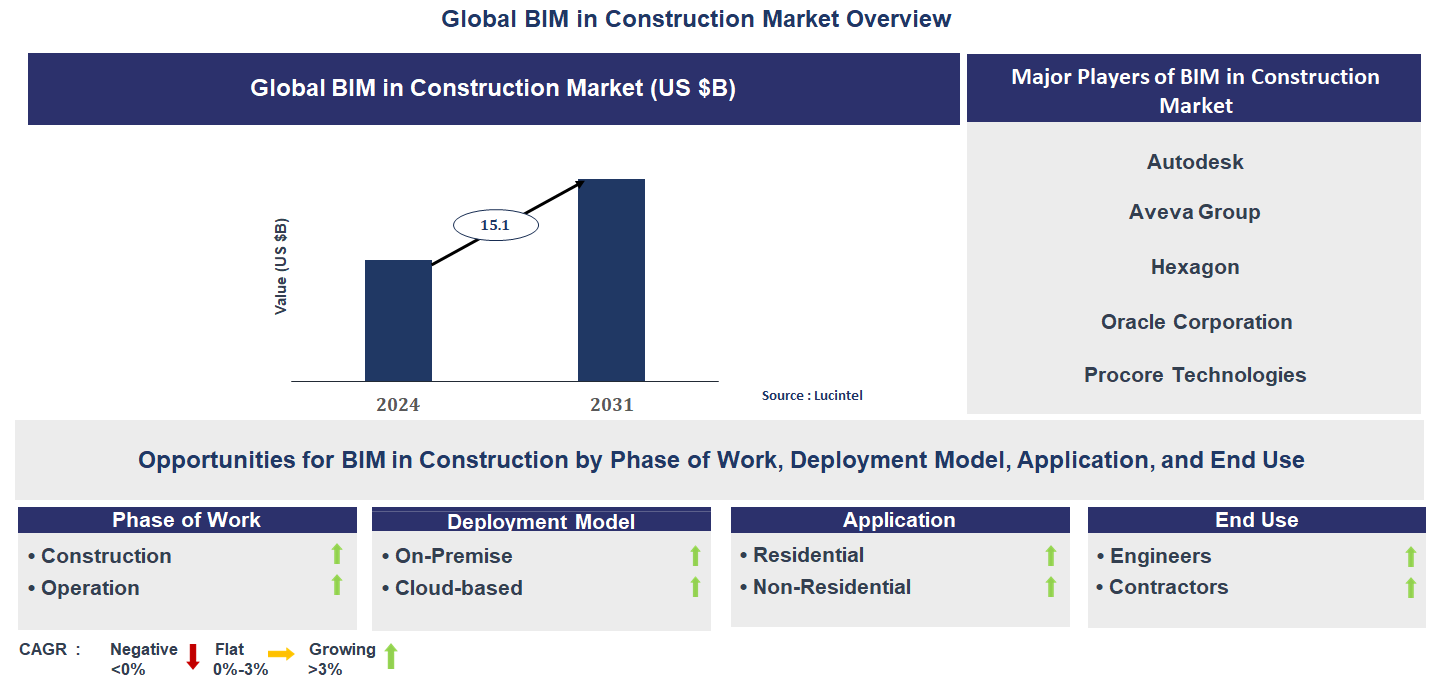
The future of the global BIM in construction market looks promising with opportunities in the residential and non-residential markets. The global BIM in construction market is expected to grow with a CAGR of 15.1% from 2025 to 2031. The major drivers for this market are the increasing adoption of digital construction solutions, the rising demand for project efficiency in construction, and the growing integration of BIM technologies in projects.• Lucintel forecasts that, within the phase of work category, construction is expected to witness higher growth over the forecast period.
• Within the application category, residential is expected to witness higher growth.
• In terms of region, APAC is expected to witness the highest growth over the forecast period. Gain valuable insights for your business decisions with our comprehensive 150+ page report. Sample figures with some insights are shown below.
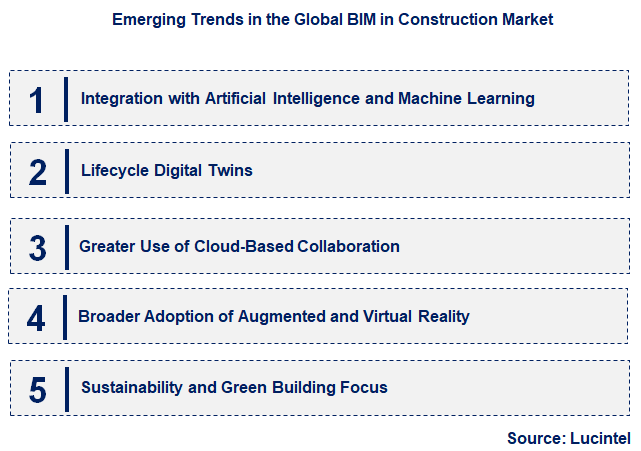
Emerging Trends in the BIM in Construction Market
The BIM in construction market is deeply transforming, shifting from being a mere design tool to a core platform for the entire lifecycle of a project. This change is driven by a convergence of cutting-edge technologies and a realignment of industry priorities to higher efficiency, collaboration, and sustainability. These new trends are not only enhancing current workflows but are actually redefining the work of professionals, the form of project delivery, and the value that BIM delivers.• Integration with Artificial Intelligence and Machine Learning: Artificial intelligence and machine learning are fast being adopted in BIM workflows to make repetitive work automated and design optimized. AI algorithms can automatically detect clashes within minutes, allowing engineers to focus on more sophisticated work. Generative design, which is a branch of AI, can generate several design alternatives automatically given parameters such as cost or energy efficiency.
• Lifecycle Digital Twins: BIM is moving from being a project-specific model toward becoming a "digital twin" of the built asset. A digital twin is a virtual replica in real-time of a physical building or infrastructure. It combines BIM information with live sensor information from the Internet of Things (IoT) to track a building’s performance, from energy use to structural condition. The result is a smooth handover from construction to facility management, enabling owners to conduct predictive maintenance, simulate renovation, and optimize building operations across its lifecycle.
• Greater Use of Cloud-Based Collaboration: The migration to cloud-based BIM platforms is gaining traction, facilitating easy collaboration by geographically distributed project teams. Cloud solutions offer a single, centralized source of truth for all project information, removing version control problems and providing all stakeholders with access to the latest model. This enhances communication, minimizes errors, and simplifies workflows.
• Broader Adoption of Augmented and Virtual Reality: AR and VR are revolutionizing the way project stakeholders visualize and engage with BIM models. AR enables clients and designers to perform immersive virtual walkthroughs of a building prior to construction, enabling them to gain a better understanding of the design. AR allows on-site personnel to superimpose BIM models over the physical world through smart glasses or mobile devices, giving a heads-up view of building elements and utility cables.
• Sustainability and Green Building Focus: BIM is emerging as an essential tool for sustainability. BIM software now incorporates energy performance, sunlight exposure, and material use analysis features. Architects and engineers are able to optimize the orientation of buildings, choose green materials, and minimize a building’s carbon footprint by incorporating environmental information into the design process early on. The end result is a marketplace that increasingly relies on BIM for its capacity to enable green building certifications and build more sustainable buildings. These trends are transforming the BIM market by catalyzing a movement towards combined, smart, and collaborative platforms. The intersection of BIM with AI, IoT, and digital twins is revolutionizing the construction sector from a low-speed, fragmented industry to high-speed, data-driven, and highly productive ecosystem that produces smarter and greener buildings.
Recent Development in the BIM in Construction Market
The BIM in construction market is experiencing major developments, prompted by a world-wide drive for improved efficiency, teamwork, and sustainability. These developments are a reaction to increased project complexity, the requirement for improved cost management, and the need for high-quality, durable assets. The sector is moving past simple modeling to bring in advanced technology that enhances every phase of a project, from preliminary design to long-term facility management.• Government Mandates and Standardized Frameworks: One of the most significant developments is the growing number of governments across the globe making the use of BIM mandatory on public projects. Germany and the U.S. are establishing requirements for BIM Level 2 or above for state and federal projects. The effect is a wider use of BIM, compelling even hesitant firms to spend money on technology and training. The result is an interoperable framework for data sharing and collaboration, eliminating interoperability issues and making project delivery more transparent and efficient for taxpayers.
• Digital Twins for Lifecycle Asset Management: Some of the recent advancements involve the maturation of the BIM model into digital twins. This entails linking the BIM model with real-time data from the building’s systems and sensors once the building has been constructed. The digital twin can then be utilized by facility managers to track the building’s performance, forecast the need for maintenance, and model future renovations.
• Integration with Generative Design and AI: The market has witnessed a speedy growth in adopting generative design, an AI and machine learning-powered technology. This enables designers to input project objectives and limits, such as structural stability, material pricing, or energy consumption, and have the software itself create thousands of design options. The effect of this innovation is a huge savings of time for the design process and the possibility of determining creative, optimized solutions that would be hard to find through other means.
• Improved Cloud-Based Collaboration Platforms: A trend is emerging toward the use of sophisticated, cloud-based BIM collaboration platforms. Such platforms enable the same model to be worked on by all project stakeholders—architects, engineers, contractors, and owners—in the same model at the same time, from anywhere in the world. This is most important for large, global projects. The result is a radical reduction in the communication and coordination challenges, minimizing design clashes and errors that cause unnecessary on-site changes.
• Expansion in Virtual Reality and Augmented Reality Tools: Current trends involve increased emphasis on incorporating Virtual Reality (VR) and Augmented Reality (AR) into the BIM process. VR is applied for interactive design review and client presentations so that stakeholders can "walk through" a virtual model. AR is being applied on-site to superimpose the virtual BIM model over the real world, assisting workers to visualize and validate installations. The effect is enhanced stakeholder collaboration, enhanced decision-making during design, and increased precision and safety throughout construction. These advancements are inherently revolutionizing the BIM marketplace by converting it into an integrated, data-centric, and interconnected world. The intersection of BIM with other next-generation technologies is resulting in considerable enhancements in project efficiency, quality, and long-term asset value, making the industry more advanced and capable of addressing the needs of contemporary construction.
Strategic Growth Opportunities in the BIM in Construction Market
The BIM in construction market offers strong strategic growth opportunities fueled by urbanization, infrastructure development, and a drive for technology integration into major applications. The sector is shifting toward more specialized and efficient solutions that can address diverse needs across different projects, ranging from high-rise buildings to road construction and residential development. Separating these opportunities and taking advantage of them depends on comprehensive insight into the requirements of the marketplace and the capability to provide innovative, application-focused solutions providing added value above general modeling functionality.• Infrastructure and Public Works: Worldwide emphasis on infrastructure renovation and growth, such as on roads, bridges, and tunnels, provides the ultimate growth opportunity. High-volume, dependable BIM technology is this application’s requirement for sophisticated civil engineering projects. Strategic development in this case is about creating and selling specialized BIM software and services that have the capability to process high-volume geographical data, terrain modeling, and clash detection for utility networks.
• Facility Management and Asset Lifecycle: A huge growth potential exists in taking BIM’s use beyond the construction period to facility management. With BIM-to-FM solutions, businesses can build and maintain digital twins of structures. Digital twins can be utilized for space planning, energy performance, and predictive maintenance. The effect is a new revenue stream and improved, long-term client relationship. This method turns a single-time building project into a worthwhile, always maintained asset, yielding substantial benefits throughout its entire life cycle.
• Modular and Prefabricated Construction: The expanding use of prefabricated and modular concrete elements in construction presents a special market growth opportunity. This use demands highly accurate, reliable digital models for off-site construction. Growth strategy is to provide customized BIM software capable of handling the minute design and manufacturing of modular structures. The effect is a streamlined and standardized production system, minimizing on-site manhours and construction time while delivering quality and durability of the prefabricated units.
• Data Analytics and Project Intelligence: As more data is being generated by BIM, there is a strategic possibility of creating and providing data analytics and project intelligence services. Firms can run BIM data to find patterns, forecast risks on projects, and allocate resources better. The outcome is an enhanced and more efficient project management process, culminating in effective decision-making and enhanced project results. This chance takes advantage of the data-intensive character of BIM to offer a greater degree of strategic benefit to customers.
• Energy Performance Analysis and Sustainability: Growing concern for sustainable building and green building codes presents a strategic challenge to create and market BIM tools centered on environmental performance. This encompasses software that does energy analysis of a building, carbon efficiency, and material utilization. The effect is the alignment of corporate strategy with international environmental objectives, which appeals to an increasing number of clients who value sustainability. These strategic opportunities for growth are transforming the BIM market by spurring specialization and innovation. By addressing the specific needs of each application, from mega-infrastructure to green building, firms can free up new streams of revenue and become leaders in a fast-changing and increasingly diversified industry.
BIM in Construction Market Driver and Challenges
The BIM in construction market is influenced by a complex combination of chief drivers and key challenges involving numerous technological, economic, and regulatory considerations. The market is driven by an upward trend of global construction activity and a constant drive for innovation in technology while concomitantly being confronted with challenges centered on high capital expenditure, change resistance, and unavailability of skilled workers. Navigating these forces is crucial for industry players to maintain a competitive edge and ensure sustained growth. Understanding these dynamics provides a clear picture of the market’s current state and its future trajectory. The factors responsible for driving the bim in construction market include: 1. Government and Regulatory Mandates: One of the key drivers is the number of government mandates for BIM implementation, particularly on public infrastructure and building projects. Increasingly, governments around the world are mandating the use of BIM to provide transparency for the project, increase efficiency, and lower costs. This regulatory impetus compels the industry to go digital, generating a solid, ground-level demand for BIM software, services, and training. 2. Improved Project Efficiency and Cost Reduction: BIM presents a strong value proposition for enhancing project efficiency and cost reduction. Through the development of a unified digital model, BIM enables early detection of clashes, reduces errors in progress, and enables more precise quantity takeoffs and cost estimation. Simulating construction sequences and efficient resource management result in a drastic elimination of rework and delay. This transparent and material return on investment is a key reason why companies are implementing BIM. 3. Enhanced Collaboration and Communication: The capacity of BIM to develop a single data environment (CDE) shared by every party involved in a project is another driving factor. It facilitates smooth collaboration and communication among architects, engineers, contractors, and owners, irrespective of where they are based. It minimizes information silos and provides each individual with the most up-to-date model that they work from. 4. Increasing Complexity of Contemporary Buildings: Current architecture and engineering are getting more complicated, with more sophisticated designs, new materials, and MEP systems fully integrated into the design. Conventional 2D drawings cannot cope with this kind of complexity. BIM supplies an essential tool for coping with these issues in that it allows detailed, multi-layered 3D models to be generated easily coordinated and analyzed. This demand for a more capable design and management tool is a major market driver. 5. Expansion in Green Building and Sustainability Activities: The worldwide move towards sustainable building practices is propelling the use of BIM. Energy performance analysis, solar exposure simulation, and material optimization can be achieved using BIM software. This enables designers to develop more environmentally responsive and energy-efficient buildings. As sustainability becomes increasingly a consideration for project approval and certification, the function of BIM as a tool for analyzing green building design grows more paramount, propelling its increased uptake. Challenges in the bim in construction market are: 1. High Upfront Costs and Return on Investment: The prohibitive cost of BIM adoption at the onset is a major setback, particularly to small- and medium-sized enterprises (SMEs). It encompasses not just license costs for the software but also high-cost hardware as well as extensive employee training. For certain companies, the long-term ROI may not easily manifest, and this can hold them back from investing in the future. This cost obstacle can decelerate the total rate of BIM adoption in the marketplace. 2. Resistance to Change and Lack of Expertise: The building sector has traditionally used conventional paper-based processes, and a strong inclination to resist change from the entrenched professionals is always present. Furthermore, a continuous shortage of experienced professionals with hands-on BIM skills is a pressing challenge. The labor gap can result in operational inefficiency and the inability to fully exploit the advantages of the technology because companies do not possess the staff to effectively integrate and operate BIM processes. 3. Interoperability and Data Management Issues: One significant technical problem is the inability of full interoperability among various BIM software platforms. When all the project stakeholders utilize different vendor tools, it results in data loss and inconsistencies. Although open standards such as IFC are becoming popular, these problems still introduce friction and inefficiencies in the workflow. Processing the huge amount of data that is generated by the BIM models is also problematic, necessitating strong data storage and management systems. The combined impact of these drivers and challenges is a market in a state of rapid, but often uneven, transition. While technological advancements and strong demand are propelling BIM’s growth, the industry must also address issues of high cost, regulatory hurdles, and labor shortages. Success will depend on companies that can innovate to make BIM more accessible, intuitive, and seamlessly integrated, demonstrating its clear value across the entire project lifecycle.List of BIM in Construction Companies
Companies in the market compete on the basis of product quality offered. Major players in this market focus on expanding their manufacturing facilities, R&D investments, infrastructural development, and leverage integration opportunities across the value chain. With these strategies BIM in construction companies cater increasing demand, ensure competitive effectiveness, develop innovative products & technologies, reduce production costs, and expand their customer base. Some of the BIM in construction companies profiled in this report include-• Autodesk
• Aveva Group
• Hexagon
• Oracle Corporation
• Procore Technologies
BIM in Construction Market by Segment
The study includes a forecast for the global BIM in construction market by phase of work, deployment model, application, end use, and region.BIM in Construction Market by Phase of Work [Value from 2019 to 2031]:
• Construction
• Operation
BIM in Construction Market by Deployment Model [Value from 2019 to 2031]:
• On-Premise
• Cloud-based
BIM in Construction Market by Application [Value from 2019 to 2031]:
• Residential
• Non-Residential
BIM in Construction Market by End Use [Value from 2019 to 2031]:
• Engineers
• Contractors
BIM in Construction Market by Region [Value from 2019 to 2031]:
• North America
• Europe
• Asia Pacific
• The Rest of the World
Country Wise Outlook for the BIM in Construction Market
The international BIM in construction market is witnessing a dramatic change, stepping from simple 3D modeling to evolving into an interconnected, rich data platform for the full building life cycle. The shift is fueled by pressure to increase efficiency, collaboration, and sustainability in building. Nations are increasingly requiring BIM in public works to enhance transparency and cut costs. The market is also witnessing integration of BIM with other technologies, including AI, IoT, and digital twins, that is indeed redefining the way buildings are designed, built, and operated.• United States: The American market is a pioneer in the use of BIM, with a mature market and emphasis on big-ticket commercial and infrastructure projects. One of the main developments is increasing adoption of BIM for facilities management and digital twins creation. Government requirements for BIM usage on government projects, including federal buildings and highways, are on the rise. This is generating demand for advanced BIM solutions that can be interfaced with other digital solutions, increasing productivity and facilitating improved management of assets throughout their lifecycle.
• China: The BIM market in China is marked by fast, policy-led growth. The government is actively encouraging the adoption of BIM through national efforts to upgrade its construction industry. A recent emphasis is on creating domestically owned BIM software, tackling the issue of data security and localization. Although lagging behind global competitors in technological maturity, China is quickly catching up. The extensive use of BIM on huge public works and city development projects is a prime trend, demonstrating a national policy to enhance project quality and efficiency.
• Germany: Germany is a robust adopter of BIM, with emphasis placed on integrating the use for public procurement. One notable development is the government’s requirement for the use of BIM on federal building and infrastructure projects, implemented in recent years. The demand is for greater efficiency and less waste in a highly organized industry. German companies are focusing on interoperability and the adoption of BIM as a means of accommodating sustainability objectives and increasing energy efficiency, supporting the country’s focus on quality, green construction.
• India: The Indian BIM market is at a nascent stage but growing fast, driven by government programs such as the Smart Cities Mission and large investments in infrastructure. The private sector too is increasingly embracing BIM to enhance efficiency and shorten project delivery. One of the trends is application of BIM for handling large projects and countering the problem of urban sprawl. Though it is surrounded by challenges such as the initial capital outlay being high and the lack of qualified professionals, the future of BIM in India seems bright because of the robust government support and increasing demand for advanced technology.
• Japan: Japan is a pioneer of BIM usage, stimulated by a national initiative for smart building technology and infrastructure rejuvenation. A major milestone is the government’s move to standardize BIM workflows and its bid to make BIM mandatory for all public projects by 2025. The motivation behind this is to simplify processes and enhance cooperation. The market is intent on leveraging BIM to overcome specific issues, including aging infrastructure and strict earthquake-resistant building codes. The use of BIM with digital twins is another evident trend, facilitating long-term management of assets and buildings.

Features of the Global BIM in Construction Market
Market Size Estimates: BIM in construction market size estimation in terms of value ($B). Trend and Forecast Analysis: Market trends (2019 to 2024) and forecast (2025 to 2031) by various segments and regions. Segmentation Analysis: BIM in construction market size by various segments, such as by phase of work, deployment model, application, end use, and region in terms of value ($B). Regional Analysis: BIM in construction market breakdown by North America, Europe, Asia Pacific, and Rest of the World. Growth Opportunities: Analysis of growth opportunities in different phase of work, deployment model, application, end use, and regions for the BIM in construction market. Strategic Analysis: This includes M&A, new product development, and competitive landscape of the BIM in construction market. Analysis of competitive intensity of the industry based on Porter’s Five Forces model.
FAQ
Q1. What is the growth forecast for BIM in construction market? Answer: The global BIM in construction market is expected to grow with a CAGR of 15.1% from 2025 to 2031. Q2. What are the major drivers influencing the growth of the BIM in construction market? Answer: The major drivers for this market are the increasing adoption of digital construction solutions, the rising demand for project efficiency in construction, and the growing integration of bim technologies in projects. Q3. What are the major segments for BIM in construction market? Answer: The future of the BIM in construction market looks promising with opportunities in the residential and non-residential markets. Q4. Who are the key BIM in construction market companies? Answer: Some of the key bim in construction companies are as follows:• Autodesk
• Aveva Group
• Hexagon
• Oracle Corporation
• Procore Technologies Q5. Which BIM in construction market segment will be the largest in future? Answer: Lucintel forecasts that, within the phase of work category, construction is expected to witness higher growth over the forecast period. Q6. In BIM in construction market, which region is expected to be the largest in next 5 years? Answer: In terms of region, APAC is expected to witness the highest growth over the forecast period. Q7. Do we receive customization in this report? Answer: Yes, Lucintel provides 10% customization without any additional cost.
Table of Contents
List of Figures
List of Tables
Methodology
- In-depth interviews of the major players in this market
- Detailed secondary research from competitors’ financial statements and published data
- Extensive searches of published works, market, and database information pertaining to industry news, company press releases, and customer intentions
- A compilation of the experiences, judgments, and insights of Lucintel’s professionals, who have analyzed and tracked this market over the years.


Buy Now
Choose a license that fits your team. Instant PDF delivery.
Prices exclude taxes. Instant delivery. Custom licensing available on request.
Key Questions
- • What are some of the most promising, high-growth opportunities for the BIM in construction market by phase of work (construction and operation), deployment model (on-premise and cloud-based), application (residential and non-residential), end use (engineers and contractors), and region (North America, Europe, Asia Pacific, and the Rest of the World)?
- • Which segments will grow at a faster pace and why?
- • Which region will grow at a faster pace and why?
- • What are the key factors affecting market dynamics? What are the key challenges and business risks in this market?
- • What are the business risks and competitive threats in this market?
- • What are the emerging trends in this market and the reasons behind them?
- • What are some of the changing demands of customers in the market?
- • What are the new developments in the market? Which companies are leading these developments?
- • Who are the major players in this market? What strategic initiatives are key players pursuing for business growth?
- • What are some of the competing products in this market and how big of a threat do they pose for loss of market share by material or product substitution?
- • What M&A activity has occurred in the last 5 years and what has its impact been on the industry? For any questions related to BIM in Construction Market, BIM in Construction Market Size, BIM in Construction Market Growth, BIM in Construction Market Analysis, BIM in Construction Market Report, BIM in Construction Market Share, BIM in Construction Market Trends, BIM in Construction Market Forecast, BIM in Construction Companies, write Lucintel analyst at email: helpdesk@lucintel.com. We will be glad to get back to you soon.


