
Report Feature
Bicycle Market Trends and Forecast
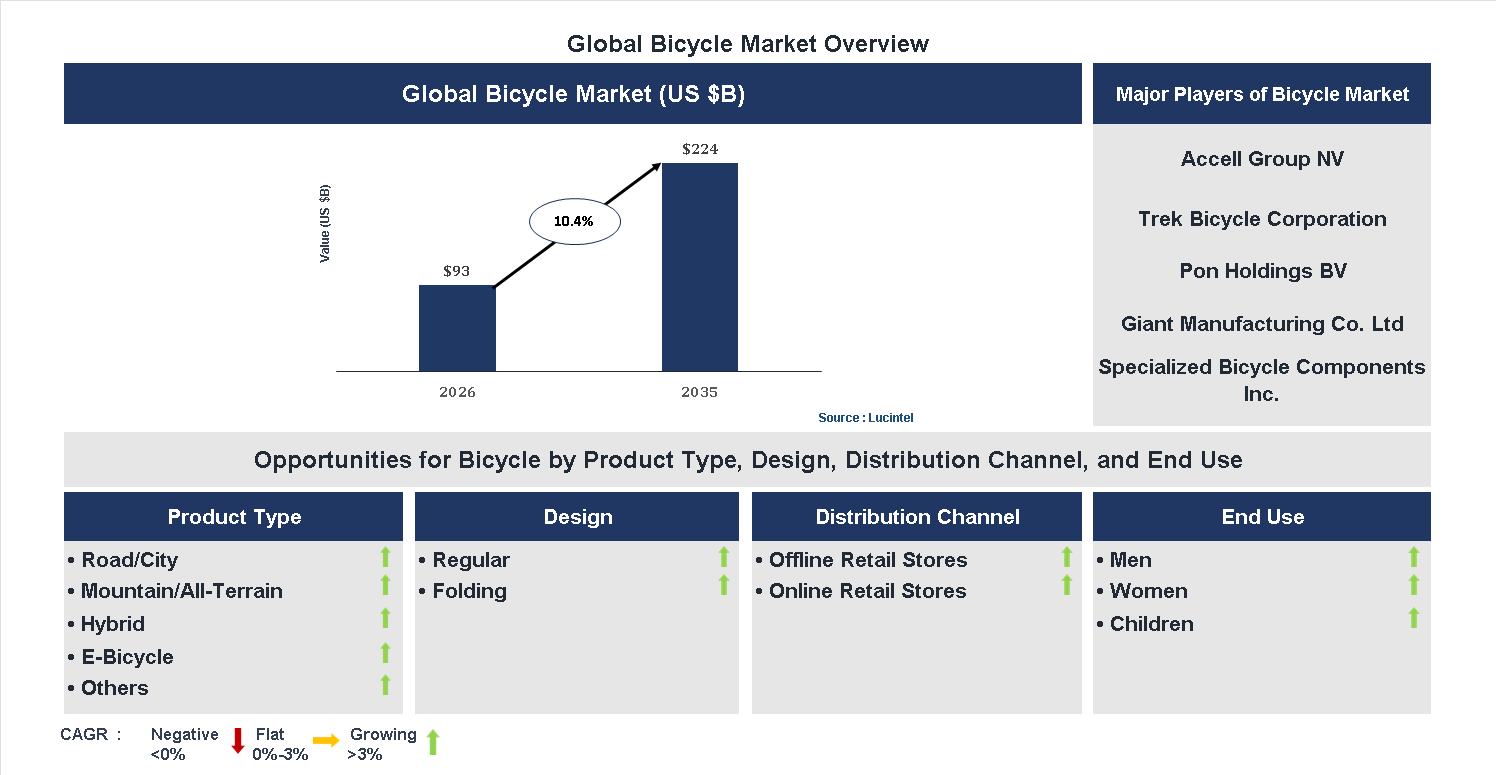
The future of the global bicycle market looks promising with opportunities in the offline retail store and online retail store markets. The global bicycle market is expected to reach an estimated $224 billion by 2035 with a CAGR of 10.4% from 2026 to 2035. The major drivers for this market are the rising adoption of bicycles for short distance transportation, the growing popularity of cycling as recreational & sports activity, and the increasing health awareness & fitness activities among people.• Lucintel forecasts that, within the product type category, hybrid is expected to witness the highest growth over the forecast period.
• Within the distribution channel category, offline retail stores is expected to witness higher growth.
• In terms of region, APAC is expected to witness the highest growth over the forecast period. Gain valuable insights for your business decisions with our comprehensive 150+ page report. Sample figures with some insights are shown below.
Emerging Trends in the Bicycle Market
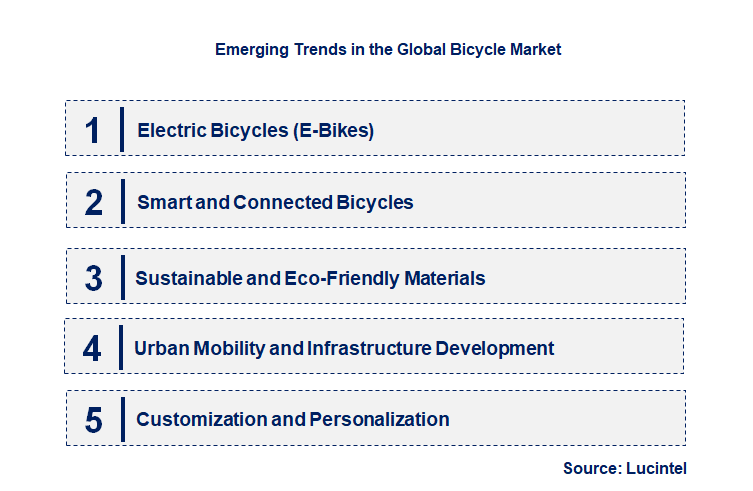
The bicycle market is experiencing rapid transformation driven by technological advancements, changing consumer preferences, and increasing environmental awareness. As urbanization accelerates and health consciousness rises, the industry is adapting to meet new demands for sustainable, innovative, and convenient transportation options. Emerging trends are shaping product development, marketing strategies, and distribution channels, creating a dynamic landscape that offers significant opportunities for growth and innovation. Stakeholders must stay attuned to these developments to capitalize on emerging opportunities and address evolving consumer needs effectively.• Electric Bicycles (E-bikes): The surge in e-bike popularity is driven by their convenience, eco-friendliness, and ability to reduce commuting time. Advances in battery technology have made e-bikes more affordable and longer-lasting, appealing to a broader demographic. Urban areas are seeing increased adoption as a sustainable alternative to cars, especially for short to medium distances. E-bikes are also expanding into recreational and fitness markets, further boosting sales. This trend is prompting manufacturers to innovate with lightweight designs, improved battery life, and smart features, transforming the traditional bicycle into a high-tech mobility solution.
• Smart and Connected Bicycles: Integration of IoT and smart technology is revolutionizing the bicycle industry. Features like GPS tracking, anti-theft systems, real-time performance monitoring, and app connectivity enhance user experience and safety. These bicycles appeal to tech-savvy consumers seeking personalized and data-driven riding experiences. Manufacturers are developing bikes with integrated sensors and connectivity options, enabling remote diagnostics and maintenance alerts. This trend not only improves rider safety and convenience but also opens new revenue streams through software updates and subscription services, making bicycles more integrated into the digital lifestyle.
• Sustainable and Eco-Friendly Materials: Growing environmental concerns are pushing manufacturers to adopt sustainable materials such as recycled metals, biodegradable plastics, and bamboo. These eco-friendly materials reduce the carbon footprint of bicycle production and appeal to environmentally conscious consumers. Innovations in lightweight, durable, and recyclable components are also enhancing bike performance while maintaining sustainability. This trend aligns with global efforts to promote green transportation and corporate social responsibility, influencing product design and manufacturing processes. As sustainability becomes a key purchasing criterion, brands investing in eco-friendly materials are gaining competitive advantage.
• Urban Mobility and Infrastructure Development: The rise of urbanization is prompting cities worldwide to develop dedicated cycling lanes and infrastructure to promote cycling as a primary mode of transportation. Governments are investing in bike-sharing programs and creating bike-friendly policies to reduce traffic congestion and pollution. This infrastructure development encourages more people to choose bicycles for daily commuting, boosting market demand. Additionally, the integration of bicycles into multimodal transport systems enhances urban mobility. This trend is fostering a shift towards sustainable city planning, making cycling safer, more accessible, and an integral part of urban transportation networks.
• Customization and Personalization: Consumers increasingly seek personalized bicycles tailored to their specific needs and preferences. Manufacturers are offering customizable options in terms of frame design, color, accessories, and performance features. This trend is driven by a desire for unique, stylish, and functional bikes that reflect individual identity. Advances in manufacturing technologies like 3D printing and modular design facilitate rapid customization. Personalization enhances customer satisfaction and brand loyalty, while also allowing companies to differentiate themselves in a competitive market. As consumers demand more tailored products, the market is shifting towards flexible, customer-centric solutions. These emerging trends are reshaping the bicycle market by emphasizing sustainability, technological integration, urban infrastructure, and personalized experiences. They are driving innovation, expanding market segments, and promoting bicycles as a versatile, eco-friendly transportation option. As these developments continue, the industry is poised for significant growth and transformation, aligning with broader societal shifts towards sustainability and smart mobility.
Recent Development in the Bicycle Market
The bicycle market is experiencing rapid growth driven by increasing health consciousness, urbanization, and environmental concerns. Innovations in technology and design are expanding product offerings, attracting diverse consumer segments. Governments are promoting cycling as a sustainable transportation option, further boosting demand. The rise of e-bikes and smart bicycles is transforming the industry landscape. These developments are creating new opportunities for manufacturers, retailers, and investors, shaping the future of urban mobility and recreational activities worldwide.• Growing Popularity of E-Bikes: The surge in electric bicycles is revolutionizing the market by offering easier commuting options, especially in urban areas. E-bikes appeal to a broader demographic, including older adults and commuters seeking eco-friendly alternatives. This growth is driven by technological advancements, affordability, and supportive government policies. As a result, e-bikes are capturing a significant market share, encouraging manufacturers to innovate and expand their product lines, ultimately transforming urban transportation and recreational cycling.
• Technological Innovations Enhancing Performance: Advances in materials, battery technology, and smart features are significantly improving bicycle performance and user experience. Lightweight frames, durable components, and longer-lasting batteries are making bikes more efficient and appealing. Smart features like GPS, fitness tracking, and connectivity are attracting tech-savvy consumers. These innovations are increasing product differentiation, boosting sales, and encouraging brand loyalty. The integration of technology is positioning bicycles as high-tech, versatile mobility solutions, expanding their market reach.
• Urbanization Driving Demand for Compact Bikes: Rapid urban growth is increasing demand for compact, portable bicycles suitable for city commuting. Folding bikes and mini bikes are gaining popularity due to their convenience and storage efficiency. Urban dwellers prefer these bikes for last-mile connectivity and avoiding traffic congestion. Manufacturers are focusing on designing lightweight, stylish, and easy-to-store models to meet this demand. This trend is expanding the market by attracting new users and encouraging sustainable urban mobility solutions.
• Government Initiatives Promoting Cycling Infrastructure: Governments worldwide are investing in cycling infrastructure to promote sustainable transportation. Initiatives include dedicated bike lanes, parking facilities, and cycling-friendly policies. These measures are encouraging more people to choose bicycles over motor vehicles, reducing traffic congestion and pollution. Increased infrastructure investment is also boosting sales of bicycles and related accessories. Such policies are fostering a cycling culture, expanding market opportunities, and supporting the shift toward eco-friendly urban mobility.
• Rise of Online Retail and Direct-to-Consumer Sales: The growth of e-commerce platforms is transforming bicycle distribution channels. Consumers now prefer purchasing bikes online for convenience, variety, and competitive pricing. Direct-to-consumer brands are gaining market share by offering customized bikes and better after-sales service. This shift is reducing reliance on traditional retail outlets, increasing market accessibility, and expanding customer reach. The online sales trend is also encouraging brands to innovate in marketing and customer engagement, further fueling market growth. The overall impact of these developments is a dynamic, expanding bicycle market characterized by innovation, increased accessibility, and sustainability. These opportunities are driving industry growth, attracting new consumer segments, and fostering urban mobility solutions. As a result, the market is poised for continued expansion, with technological advancements and supportive policies playing crucial roles in shaping its future trajectory.
Strategic Growth Opportunities in the Bicycle Market
The bicycle market is experiencing significant growth driven by increasing health consciousness, urbanization, and environmental concerns. Innovations in e-bikes and smart bicycles are expanding consumer interest, while government initiatives promote cycling infrastructure. The markets evolution is also influenced by rising demand for recreational activities and sustainable transportation options. Companies are focusing on product diversification and technological advancements to capture new customer segments, creating a dynamic landscape with substantial growth potential across various applications and regions.• Expansion of E-Bike Segments to Meet Urban Commuting Needs: The rising popularity of electric bicycles offers a sustainable alternative to traditional transportation, especially in congested cities. E-bikes provide ease of use, affordability, and reduced environmental impact, attracting a broader consumer base. Manufacturers are investing in battery technology and design improvements to enhance range and performance, fueling market growth. Urban infrastructure developments and government incentives further support the adoption of e-bikes, making them a key growth driver in the bicycle market.
• Increasing Demand for Bicycles in the Recreational and Fitness Sectors: Growing health awareness and fitness trends are boosting bicycle sales for recreational and exercise purposes. Consumers seek versatile, durable bikes suitable for outdoor activities, mountain biking, and fitness routines. The development of specialized bicycles, such as hybrid and mountain bikes, caters to this demand. Retailers and brands are expanding product lines and marketing efforts to target fitness-conscious consumers, contributing to sustained growth in the recreational bicycle segment.
• Adoption of Smart and Connected Bicycles for Enhanced User Experience: Integration of IoT and smart technology into bicycles is transforming user engagement. Features like GPS tracking, fitness monitoring, and app connectivity improve safety, convenience, and personalization. Manufacturers are investing in R&D to develop intelligent bicycles that appeal to tech-savvy consumers. The rise of connected bicycles also opens new revenue streams through software updates and subscription services, positioning smart bicycles as a significant growth opportunity in the evolving market landscape.
• Development of Sustainable and Eco-Friendly Manufacturing Practices: Environmental concerns are prompting manufacturers to adopt greener production methods, such as using recycled materials and reducing carbon footprints. Eco-friendly bicycles, including those made from sustainable materials, are gaining popularity among environmentally conscious consumers. Certification programs and government regulations incentivize sustainable practices, encouraging industry-wide adoption. This shift not only enhances brand reputation but also aligns with global sustainability goals, fostering long-term growth in the bicycle market.
• Expansion of Cycling Infrastructure and Government Initiatives Promoting Cycling: Governments worldwide are investing in cycling lanes, bike-sharing programs, and related infrastructure to promote sustainable urban mobility. These initiatives increase accessibility and safety, encouraging more people to choose bicycles over motor vehicles. Public awareness campaigns and subsidies further incentivize cycling adoption. As infrastructure improves, market demand for bicycles is expected to rise significantly, supporting industry growth and fostering a shift toward healthier, eco-friendly transportation options. The overall impact of these opportunities is a robust expansion of the bicycle market, driven by technological innovation, sustainability efforts, and supportive infrastructure. These factors collectively enhance consumer interest and accessibility, ensuring sustained growth and diversification across applications. Companies that capitalize on these opportunities will strengthen their market position, contributing to a more sustainable and health-oriented transportation ecosystem worldwide.
Bicycle Market Driver and Challenges
The bicycle market is influenced by a variety of technological, economic, and regulatory factors that shape its growth and development. Advances in manufacturing technology have led to more innovative and affordable bicycles, expanding consumer access. Economic factors such as rising fuel prices and increasing health consciousness are driving demand for eco-friendly transportation options. Regulatory policies promoting sustainable mobility and reducing carbon emissions further support market expansion. Additionally, urbanization trends and infrastructure development encourage cycling as a practical and cost-effective mode of transport. However, the market also faces challenges related to safety concerns, high initial costs, and regulatory hurdles that could impede growth. Understanding these drivers and challenges is essential for stakeholders to navigate the evolving landscape effectively. The factors responsible for driving the bicycle market include:• Technological Innovation: The development of lightweight materials, advanced gear systems, and electric bicycles has revolutionized the market. These innovations improve performance, comfort, and accessibility, attracting a broader consumer base. E-bikes, in particular, have gained popularity among commuters and older adults, expanding market reach. Continuous R&D efforts are expected to further enhance features, making bicycles more appealing and functional. This technological progress not only boosts sales but also encourages manufacturers to invest in sustainable and user-friendly designs, fostering long-term growth.
• Rising Health and Environmental Awareness: Increasing awareness about health benefits associated with cycling, such as cardiovascular fitness and weight management, is a significant driver. Consumers are seeking active lifestyles, which boosts bicycle sales across various segments. Additionally, growing concerns over pollution and climate change are prompting governments and individuals to adopt eco-friendly transportation options. This shift towards sustainable mobility is supported by campaigns and incentives promoting cycling as a clean, healthy alternative to motor vehicles, thereby expanding the market.
• Urbanization and Infrastructure Development: Rapid urban growth has led to increased traffic congestion and pollution, making bicycles a practical solution for short-distance travel. Cities worldwide are investing in dedicated cycling lanes, bike-sharing programs, and parking facilities, which facilitate safer and more convenient cycling. These infrastructural improvements encourage more people to choose bicycles over cars, especially in densely populated areas. As urban areas continue to expand, the demand for bicycles is expected to rise, supported by government initiatives aimed at reducing urban pollution and promoting sustainable transportation.
• Government Policies and Incentives: Many governments are implementing policies to promote cycling as part of their sustainable mobility strategies. These include subsidies for e-bike purchases, tax benefits, and the development of cycling infrastructure. Such incentives lower the financial barriers for consumers and manufacturers, stimulating market growth. Regulatory frameworks also set safety standards and promote awareness campaigns, which enhance consumer confidence. These supportive policies are crucial in fostering a cycling-friendly environment, thereby accelerating market expansion and encouraging adoption across different regions.
• Growing E-commerce and Retail Expansion: The proliferation of online retail platforms has made bicycles more accessible to consumers worldwide. E-commerce offers a wide range of options, competitive pricing, and convenient purchasing experiences, boosting sales. Retail expansion, including specialty bike stores and large sporting goods chains, enhances product availability and after-sales services. This increased accessibility and consumer engagement are vital for market growth, especially in emerging markets where traditional retail channels are less developed. The digital shift also enables manufacturers to reach niche markets and customize offerings, further driving demand. The challenges facing the bicycle market include:
• Safety Concerns and Accidents: Despite the growing popularity of bicycles, safety remains a significant concern. Lack of dedicated cycling infrastructure in some regions leads to accidents and injuries, discouraging potential users. Safety issues are compounded by inadequate traffic regulations and driver awareness, increasing the risk of collisions. These concerns can hinder market growth, especially among hesitant or risk-averse consumers. Addressing safety through infrastructure improvements, awareness campaigns, and stricter regulations is essential to sustain and expand the market.
• High Initial Costs and Affordability: Although bicycles are generally cost-effective, high-quality models, especially electric bikes, can be expensive. The initial investment may deter price-sensitive consumers, limiting market penetration in developing regions. Additionally, maintenance and repair costs can add to the overall expense, impacting affordability. Manufacturers need to balance innovation with affordability to reach a broader audience. Financial incentives and financing options could mitigate this challenge, but without such measures, high costs may restrict market growth.
• Regulatory and Policy Barriers: Inconsistent regulations across regions pose challenges for market expansion. Some areas lack clear policies on cycling infrastructure, safety standards, and licensing, creating uncertainty for manufacturers and consumers. Regulatory hurdles can delay the implementation of supportive policies and infrastructure projects, impeding growth. Moreover, bureaucratic delays and lack of political will may hinder the development of cycling-friendly environments. Harmonizing regulations and establishing comprehensive policies are crucial for overcoming these barriers and fostering a conducive market environment. The bicycle market is driven by technological advancements, health and environmental awareness, urban infrastructure development, supportive policies, and e-commerce growth. However, safety concerns, high costs, and regulatory inconsistencies present notable challenges. These factors collectively influence market dynamics, with opportunities for expansion balanced by obstacles that require strategic interventions. Overall, the markets future depends on how effectively stakeholders can leverage drivers while addressing challenges to promote sustainable and inclusive growth.
List of Bicycle Companies
Companies in the market compete on the basis of product quality offered. Major players in this market focus on expanding their manufacturing facilities, R&D investments, infrastructural development, and leverage integration opportunities across the value chain. With these strategies bicycle companies cater increasing demand, ensure competitive effectiveness, develop innovative products & technologies, reduce production costs, and expand their customer base. Some of the bicycle companies profiled in this report include-• Accell Group NV
• Trek Bicycle Corporation
• Pon Holdings BV
• Giant Manufacturing Co. Ltd
• Specialized Bicycle Components Inc.
• Shimano Inc.
• Scott Sports SA
• Merida Industry Co. Ltd
• Stryder Cycle Private Limited
• Cycles Devinci inc.
Bicycle Market by Segment
The study includes a forecast for the global bicycle market by product type, design, distribution channel, end use, and region.Bicycle Market by Product Type [Value from 2019 to 2035]:
• Road/City
• Mountain/All-Terrain
• Hybrid
• E-Bicycle
• Others
Bicycle Market by Design [Value from 2019 to 2035]:
• Regular
• Folding
Bicycle Market by Distribution Channel [Value from 2019 to 2035]:
• Offline Retail Stores
• Online Retail Stores
Bicycle Market by End Use [Value from 2019 to 2035]:
• Men
• Women
• Children
Bicycle Market by Region [Value from 2019 to 2035]:
• North America
• Europe
• Asia Pacific
• The Rest of the World
Country Wise Outlook for the Bicycle Market
The bicycle market has experienced significant shifts globally, driven by increasing environmental awareness, urbanization, and technological innovations. Countries are adopting new policies to promote cycling as a sustainable transportation option, leading to rapid growth and diversification in product offerings. Advances in e-bikes, smart features, and lightweight materials are transforming the industry. Market dynamics vary across regions, influenced by government initiatives, consumer preferences, and infrastructure development. As urban centers seek eco-friendly mobility solutions, the bicycle market continues to expand, presenting new opportunities and challenges for manufacturers, retailers, and policymakers worldwide.• United States: The US bicycle market has seen a surge in e-bike popularity, driven by urban commuting needs and health trends. Major brands are investing in innovative designs and smart technology integration. Government initiatives promote cycling infrastructure, encouraging more riders. The market is also witnessing increased sales of high-performance and electric models, with online retail channels expanding rapidly. Urban areas are adopting bike-sharing programs, further boosting demand. Overall, the US market is characterized by a focus on sustainability, technological innovation, and infrastructure development to support cycling as a primary mode of transportation.
• China: China remains the largest bicycle market globally, with a strong emphasis on electric bikes, which account for a significant share of sales. Government policies favor eco-friendly transportation, leading to widespread adoption of e-bikes in urban centers. Domestic manufacturers are innovating with smart features and lightweight designs to meet rising consumer expectations. The market is also witnessing a shift towards premium and customized bicycles. Infrastructure improvements and urban planning initiatives support cycling growth. Additionally, the rise of shared e-bike services has contributed to increased urban mobility options, making China a leader in both traditional and electric bicycle markets.
• Germany: Germanys bicycle market is characterized by a focus on high-quality, durable, and eco-friendly bikes. The country has seen a rise in demand for e-bikes, driven by an aging population and environmental concerns. Government incentives and subsidies promote cycling infrastructure and e-bike adoption. German manufacturers are investing in innovative technologies, including smart connectivity and lightweight materials. Urban cycling initiatives and bike-friendly city planning are encouraging more residents to choose bicycles over cars. The market also benefits from a strong cycling culture and a growing interest in sustainable mobility solutions, positioning Germany as a key player in the European bicycle industry.
• India: The Indian bicycle market is experiencing rapid growth, fueled by increasing urbanization, rising disposable incomes, and government campaigns promoting cycling for health and environmental benefits. Affordable and durable bicycles are in high demand, especially in rural and semi-urban areas. The market is gradually shifting towards electric bicycles, with local manufacturers introducing cost-effective e-bike models. Infrastructure development and awareness campaigns are encouraging more people to adopt cycling. The industry is also seeing a rise in local manufacturing, reducing reliance on imports. Overall, India’s bicycle market is poised for substantial expansion, driven by a combination of affordability, government support, and changing consumer preferences.
• Japan: Japans bicycle market remains mature, with a strong emphasis on quality, safety, and innovation. E-bikes are increasingly popular, especially among older adults and urban commuters. The market benefits from advanced technology integration, such as smart locks and GPS tracking. Japanese manufacturers focus on lightweight, durable, and eco-friendly designs. Urban infrastructure improvements and government policies support cycling as a sustainable transportation option. The market also sees a steady demand for traditional bicycles for leisure and daily commuting. Overall, Japan continues to innovate within a stable market, emphasizing safety, convenience, and environmental sustainability.

Features of the Global Bicycle Market
Market Size Estimates: Bicycle market size estimation in terms of value ($B). Trend and Forecast Analysis: Market trends (2019 to 2025) and forecast (2026 to 2035) by various segments and regions. Segmentation Analysis: Bicycle market size by various segments, such as by product type, design, distribution channel, end use, and region in terms of value ($B). Regional Analysis: Bicycle market breakdown by North America, Europe, Asia Pacific, and Rest of the World. Growth Opportunities: Analysis of growth opportunities in different product types, designs, distribution channels, end uses, and regions for the bicycle market. Strategic Analysis: This includes M&A, new product development, and competitive landscape of the bicycle market. Analysis of competitive intensity of the industry based on Porter’s Five Forces model.
FAQ
Q1. What is the bicycle market size? Answer: The global bicycle market is expected to reach an estimated $224 billion by 2035. Q2. What is the growth forecast for bicycle market? Answer: The global bicycle market is expected to grow with a CAGR of 10.4% from 2026 to 2035. Q3. What are the major drivers influencing the growth of the bicycle market? Answer: The major drivers for this market are the rising adoption of bicycles for short distance transportation, the growing popularity of cycling as recreational & sports activity, and the increasing health awareness & fitness activities among people. Q4. What are the major segments for bicycle market? Answer: The future of the bicycle market looks promising with opportunities in the offline retail store and online retail store markets. Q5. Who are the key bicycle market companies? Answer: Some of the key bicycle companies are as follows:• Accell Group NV
• Trek Bicycle Corporation
• Pon Holdings BV
• Giant Manufacturing Co. Ltd
• Specialized Bicycle Components Inc.
• Shimano Inc.
• Scott Sports SA
• Merida Industry Co. Ltd
• Stryder Cycle Private Limited
• Cycles Devinci inc. Q6. Which bicycle market segment will be the largest in future? Answer: Lucintel forecasts that, within the product type category, hybrid is expected to witness the highest growth over the forecast period. Q7. In bicycle market, which region is expected to be the largest in next 5 years? Answer: In terms of region, APAC is expected to witness the highest growth over the forecast period. Q8. Do we receive customization in this report? Answer: Yes, Lucintel provides 10% customization without any additional cost.
Table of Contents
List of Figures
List of Tables
Methodology
- In-depth interviews of the major players in this market
- Detailed secondary research from competitors’ financial statements and published data
- Extensive searches of published works, market, and database information pertaining to industry news, company press releases, and customer intentions
- A compilation of the experiences, judgments, and insights of Lucintel’s professionals, who have analyzed and tracked this market over the years.


Buy Now
Choose a license that fits your team. Instant PDF delivery.
Prices exclude taxes. Instant delivery. Custom licensing available on request.
Key Questions
- • What are some of the most promising, high-growth opportunities for the bicycle market by product type (road/city, mountain/all-terrain, hybrid, e-bicycle, and others), design (regular and folding), distribution channel (offline retail stores and online retail stores), end use (men, women, and children), and region (North America, Europe, Asia Pacific, and the Rest of the World)?
- • Which segments will grow at a faster pace and why?
- • Which region will grow at a faster pace and why?
- • What are the key factors affecting market dynamics? What are the key challenges and business risks in this market?
- • What are the business risks and competitive threats in this market?
- • What are the emerging trends in this market and the reasons behind them?
- • What are some of the changing demands of customers in the market?
- • What are the new developments in the market? Which companies are leading these developments?
- • Who are the major players in this market? What strategic initiatives are key players pursuing for business growth?
- • What are some of the competing products in this market and how big of a threat do they pose for loss of market share by material or product substitution?
- • What M&A activity has occurred in the last 7 years and what has its impact been on the industry? For any questions related to Bicycle Market, Bicycle Market Size, Bicycle Market Growth, Bicycle Market Analysis, Bicycle Market Report, Bicycle Market Share, Bicycle Market Trends, Bicycle Market Forecast, Bicycle Companies, write Lucintel analyst at email: helpdesk@lucintel.com. We will be glad to get back to you soon.


