
Market Report · July 31, 2026

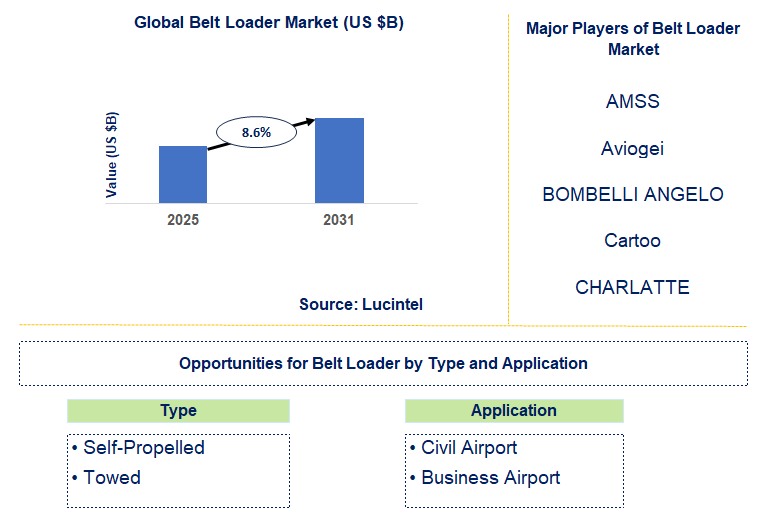
Key data points: The growth forecast = 8.6% annually for the next 7 years. Scroll below to get more insights. This market report covers trends, opportunities and forecasts in belt loader market to 2031 by type (self-propelled and towed), application (civil airport and business airport), and region (North America, Europe, Asia Pacific, and the Rest of the World)
We'll send your sample report shortly.
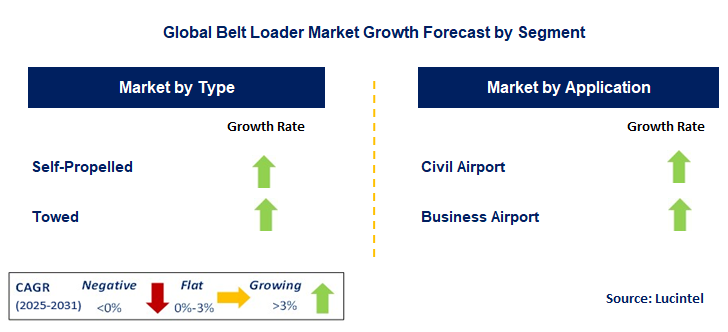
• Lucintel forecasts that, within the type category, self-propelled is expected to witness higher growth over the forecast period.
• Within the application category, civil airport is expected to witness higher growth.
• In terms of region, APAC is expected to witness the highest growth over the forecast period. Gain valuable insights for your business decisions with our comprehensive 150+ page report. Sample figures with some insights are shown below.
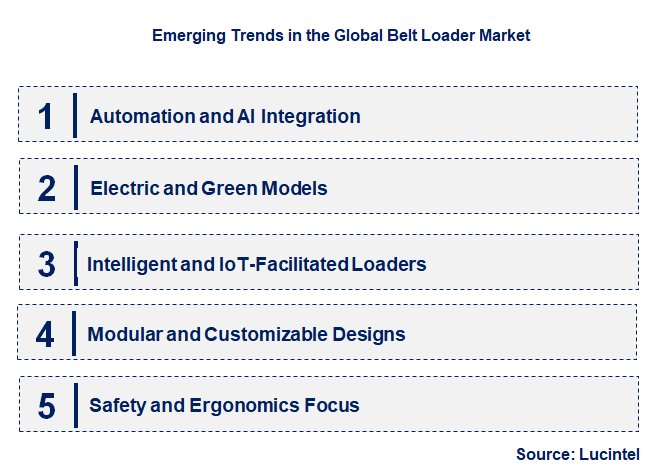
• Automation and AI Integration: Artificial Intelligence technology-equipped automated belt loaders are becoming more widely used to enhance efficiency. These machines minimize human error and expedite the loading and unloading of cargo. Integration of AI enables the collection and analysis of data in real-time, enabling operators to maximize performance and anticipate maintenance requirements, thereby enhancing efficiency and minimizing downtime. Automation decreases the cost of labor, and airports achieve quicker turnaround times, which is crucial to maintaining pace with the increasing demand for air cargo services.
• Electric and Green Models: There‘s an increasing trend towards electric belt loaders as logistics firms and airports work to decrease their carbon footprints. Electric models not just help achieve tough green regulations but also provide long-term economic benefits when it comes to fuel and maintenance. With an increasing focus on green technology, firms are investing more in sustainable options. These electric loaders are becoming an important component of airports‘ sustainability plans, which complement international objectives for cutting emissions in air transport.
• Intelligent and IoT-Facilitated Loaders: IoT-enabled belt loaders are revolutionizing ground handling by offering real-time insights into equipment performance, health, and cargo status. IoT belt loaders facilitate predictive maintenance and ensure optimal functioning of equipment. Smart belt loaders are able to interact directly with airport management systems to streamline workflows and enhance scheduling. This data-centric approach facilitates optimal resource planning, ultimately resulting in decreased operational delays and lower maintenance expenses.
• Modular and Customizable Designs: Modular belt loaders are becoming popular because they are highly flexible and can be customized. The units are versatile and can be modified for use with different types of cargo and operational requirements, enabling airports to efficiently scale their operations. With modular components, companies can customize the equipment to fit particular applications, decreasing overall cost. This trend will continue to increase as airports try to maximize their resources and service more diverse types of cargo needs.
• Safety and Ergonomics Focus: Safety features and ergonomic designs are gaining prominence in the belt loader market. Safety features such as collision detection, automatic braking, and simple controls are being integrated to enhance operator safety. Ergonomic designs also minimize worker strain and maximize productivity. With stricter regulations on safety, companies are prioritizing integrating these aspects into their belt loaders to meet compliance and enhance the user experience, thus making ground operations safer and more efficient. These new trends—sustainability, automation, intelligent technology, modular configurations, and safety—are transforming the belt loader market by fueling innovation and enhancing operational efficiency. In response to growing demand for greener, higher-technology solutions, airports and companies are investing in more advanced, customizable, and automated belt loaders. These trends will continue to lead the market, compelling manufacturers to create smarter, more efficient solutions that meet the changing demands of the logistics and air transport industries.
• Automation Advancements: Automation remains at the top of the trend, with numerous airports and logistics providers deploying automated Belt Loaders to maintain a more efficient workflow. These developments minimize the amount of labor needed, enhance safety, and increase working speeds. Automation is also being combined with AI technology for predictive maintenance and data analysis to support real-time tracking of performance and minimize downtime. This automation trend is revolutionizing ground operations and rendering airports more efficient.
• Introduction of Electric Belt Loaders: Electric belt loaders are quickly becoming the new buzz in town as a green alternative to conventional diesel-powered ones. Electric loaders have numerous benefits, ranging from decreased noise levels, no emissions, and lower operational costs. Airports globally are adopting electric belt loaders as part of their operations to achieve sustainability goals and adhere to green regulations. The trend is anticipated to gain momentum with increasing airports focusing on green technologies.
• Intelligent Features for Greater Efficiency: The use of intelligent features like IoT sensors, GPS tracking, and real-time monitoring has increased the efficiency of belt loaders. These intelligent systems enable operators to track equipment health, enhance cargo handling procedures, and lower downtime. Airports are integrating these features to enhance coordination in operations and increase tracking of cargo, which eventually leads to quicker turnaround and smoother logistics operations.
• Expansion of Global Infrastructure: With the growth in global airport infrastructure to support rising air traffic, belt loader demand has also increased. New terminals and logistics centers are being fitted with advanced Belt Loader technology to support efficient operation and respond to growing demands for air cargo transportation. This expansion is most notable in developing markets, where investments in new infrastructure are increasing.
• Emphasis on Safety Improvements: Safety remains a top priority for belt loader manufacturers, with many incorporating features like automatic collision detection, emergency braking, and operator protection systems. These safety innovations help prevent accidents and improve the overall safety of airport ground operations. As regulations around safety become stricter, manufacturers are continuously refining their designs to meet these evolving standards. These advancements are revolutionizing the belt loader market by bringing in greener, more efficient, and automated options. The increasing move to electric and intelligent technologies is expected to continue driving expansion, with operational efficiency and safety at the top of the agenda for innovation. Those manufacturers and stakeholders who are able to take advantage of these trends will be well placed to succeed in an increasingly competitive, technology-driven marketplace.
• Cargo Handling Automation: Automation in belt loader systems has vast growth potential through minimized labor requirements, enhanced efficiency, and enhanced working conditions. Automated belt loaders are gaining popularity among airports and logistics firms, which minimize turnaround and ease handling. This automation is a huge growth opportunity as it addresses the growing need for speedy, efficient air freight operations.
• Electric Belt Loaders for Green Airports: The need for electric belt loaders is increasing as airports seek to comply with environmental standards and lower their carbon emissions. The energy-efficient designs of these are a strong choice for airports seeking to save on operating expenses while complying with sustainability initiatives. With governments imposing stronger emissions standards, the electric belt loader market is likely to experience significant expansion.
• Airport Infrastructure Expansion: With growing air traffic across the globe, airports everywhere are upgrading their infrastructure to handle increasing flights. This increased demand is an opportunity for the growth of belt loader manufacturers, as new terminals and logistics centers need sophisticated ground handling equipment. Emerging market airports are investing most extensively in upgrading to modern belt loaders to address the demand for efficient cargo handling.
• Modular and Customized Belt Loaders: Modular belt loaders provide for customized solutions according to unique airport requirements. Such flexibility presents an enormous growth potential for manufacturers since they can fit the diversified client demands, either for moving certain kinds of cargo or for use in small spaces. Customizable belt loaders are gaining popularity since they are more versatile and efficient.
• Ergonomics and Safety in Worker-Focused Designs: With an increasing emphasis on employee safety and ergonomic development, there is a large market potential for belt loaders that promote operator comfort and security. Advancements like enhanced visibility, automatic braking, and collision avoidance systems are becoming the norm. These advances in safety not only align with regulatory mandates but also enhance the general user experience. These growth prospects—automation, electrification, infrastructure growth, customization, and safety—are spurring innovation and generating new market opportunities. Manufacturers that make investments in these areas will be well-positioned to meet future trends and respond to the increased demand for efficient, sustainable, and safe belt loaders. These aspects are transforming the belt loader market and paving the way for future growth.
• AMSS
• Aviogei
• BOMBELLI ANGELO
• Cartoo
• CHARLATTE MANUTENTION
• Darmec Technologies
• JBT AEROTECH
• TEMG
• TEXTRON
• TIPS D.O.O.
• Self-Propelled
• Towed
• Civil Airport
• Business Airport
• North America
• Europe
• Asia Pacific
• The Rest of the World
• United States: In the United States, new belt loader innovations center around automation, with airport authorities becoming increasingly invested in electric and autonomous designs to maximize operational efficiency. The reason behind this trend is mainly due to sustainability objectives and the reduction of operational costs. Additionally, the U.S. government has been providing incentives to promote environmentally friendly equipment in the logistics and aviation industries. In response, businesses are favoring energy-saving models that lower carbon emissions and maintenance expenditures. These technologies are transforming airport ground handling, resulting in quicker turnaround and less downtime.
• China: The Chinese belt loader industry is highly dependent on the rapid growth of airport infrastructure and logistics operations in China. With the aim of modernizing older facilities and accommodating a rising amount of domestic as well as international air traffic, Chinese manufacturers are heading ahead with cutting-edge automated belt loaders. There is also an important focus on incorporating AI and IoT technology for intelligence-based and efficient ground operations. The Chinese belt loader market is experiencing increased growth as the government focuses on investing in infrastructure expansion and environmental conservation programs.
• Germany: In Germany, belt loader technology has evolved with a focus on automation, operator safety, and energy savings. German producers are at the forefront of creating high-technology solutions, including the incorporation of sensors for improved operational safety and online monitoring systems. This trend is complemented by the national commitment to green technology and sustainability in airport operations. In addition, German airports are modernizing their ground support equipment to enhance turnaround times, fuel efficiency, and minimize disruptions in operations. The market is anticipated to grow as demand for these innovations increases.
• India: The Indian belt loader industry is witnessing growth with the rise in air passenger traffic and the growth of its aviation industry. Airports are becoming a modernizing infrastructure, and demand for belt loaders is on the increase, both in terms of affordability and efficiency. Indian manufacturers are creating economical solutions with emphasis on simplicity and reliability to cater to local demands. The go-ahead by the government for infrastructure development and the boom of low-cost carriers have also driven growth in this segment. This trend in growth is likely to continue as an increasing number of airports implement belt loaders for domestic and international use.
• Japan: The belt loader market in Japan focuses on the implementation of cutting-edge technology like automation and IoT integration. Japanese airports are making investments in belt loaders that increase productivity and satisfy stringent environmental standards. With an aging population in Japan and a dwindling workforce, there is a movement towards automation to minimize dependence on labor. The nation is also investing in the creation of eco-friendly belt loaders, particularly electric ones, to support its carbon-neutral targets. These are creating demand for superior, eco-friendly belt loader solutions in Japan.


• AMSS
• Aviogei
• BOMBELLI ANGELO
• Cartoo
• CHARLATTE MANUTENTION
• Darmec Technologies
• JBT AEROTECH
• TEMG
• TEXTRON
• TIPS D.O.O. Q5. Which belt loader market segment will be the largest in future? Answer: Lucintel forecasts that, within the type category, self-propelled is expected to witness higher growth over the forecast period. Q6. In belt loader market, which region is expected to be the largest in next 5 years? Answer: In terms of region, APAC is expected to witness the highest growth over the forecast period. Q7. Do we receive customization in this report? Answer: Yes, Lucintel provides 10% customization without any additional cost.


Choose a license that fits your team. Instant PDF delivery.
Prices exclude taxes. Instant delivery. Custom licensing available on request.
Market Report · July 31, 2026
Market Report · July 31, 2026
Market Report · July 31, 2026
Trusted partner for strategic intelligence and business growth


Receive a complimentary market analysis tailored to your industry. Our analysts will identify key growth opportunities and competitive dynamics specific to your business.

Market size, growth rate, and key trend analysis for your specific sector.

Top competitor positioning and market share analysis.

Strategic recommendations backed by data-driven insights.
Get curated market intelligence and competitive moves straight to your inbox.
By subscribing, you agree to receive our monthly insights. Unsubscribe anytime.
Receive a complimentary market analysis tailored to your industry. Our analysts will identify key growth opportunities and competitive dynamics specific to your business.
Market size, growth rate, and key trend analysis for your specific sector.
Top competitor positioning and market share analysis.
Strategic recommendations backed by data-driven insights.
Get curated market intelligence, emerging trends, and competitive moves straight to your inbox each month.
By subscribing, you agree to receive our monthly insights. Unsubscribe anytime.
We'll send your sample report shortly.