
Market Report · July 29, 2026

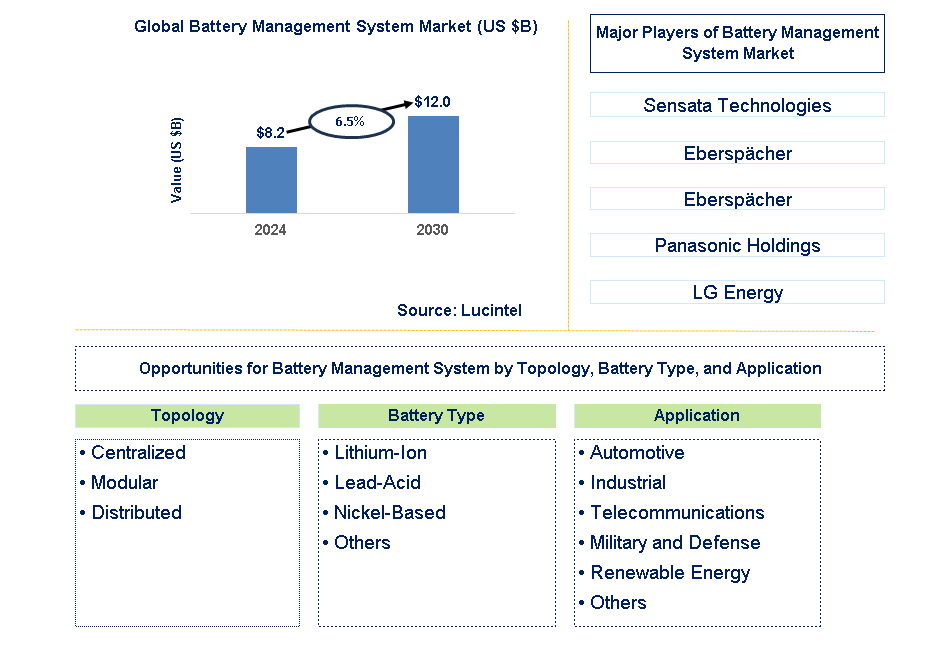
Key data points: The market size in 2031 = $12.8 billion, growth forecast = 6.5% annually for the next 7 years. Scroll below to get more insights. This market report covers trends, opportunities, and forecasts in the global battery management system market to 2031 by topology (centralized, modular, and distributed), battery type (lithium-ion, lead-acid, nickel-based, and others), application (automotive, industrial, telecommunications, military and defense, renewable energy, and others), and region (North America, Europe, Asia Pacific, and the Rest of the World)
We'll send your sample report shortly.
• Lucintel forecasts that, within the battery type category, lithium-ion will remain the largest segment over the forecast period.
• In terms of regions, APAC is expected to witness the highest growth over the forecast period due to rising demand for electric vehicles (EVs) and renewable energy solutions in this region. Gain valuable insights for your business decisions with our comprehensive 150+ page report.
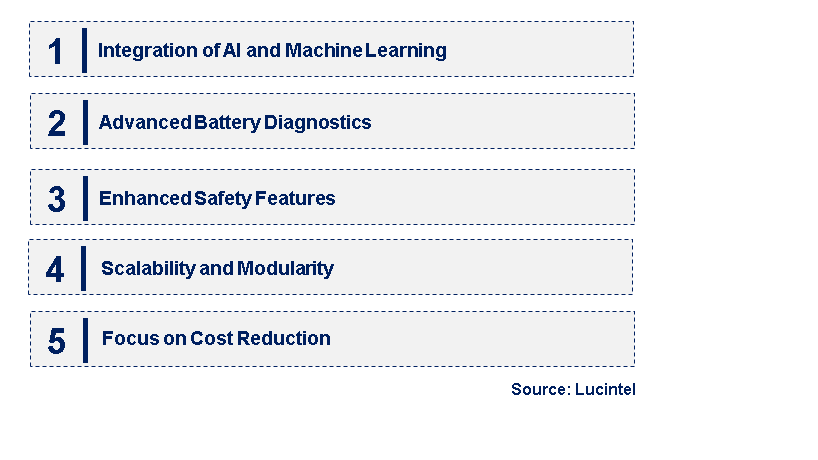
• Integration of AI and Machine Learning: The integration of AI and machine learning into BMS is a growing trend. These technologies enable predictive analytics and real-time optimization of battery performance. AI algorithms analyze data to forecast battery health and prevent failures, improving the reliability and lifespan of batteries in various applications.
• Advanced Battery Diagnostics: Advanced diagnostics are becoming a key feature in modern BMS solutions. Enhanced diagnostic capabilities allow for real-time monitoring of battery health, performance, and safety. This trend is crucial for identifying potential issues early and maintaining optimal battery operation, especially in critical applications like electric vehicles and renewable energy storage.
• Enhanced Safety Features: There is a strong focus on developing advanced safety features in BMS. This includes improvements in thermal management, overcharge protection, and fault detection. Enhanced safety measures are essential for preventing battery-related incidents and ensuring safe operation of energy storage systems in automotive and industrial applications.
• Scalability and Modularity: Scalability and modularity are becoming important trends in BMS development. Modular BMS designs allow for flexibility in various applications, from small consumer electronics to large-scale energy storage systems. This trend supports customization of BMS solutions to meet specific requirements and expand with growing energy demands.
• Focus on Cost Reduction: Reducing the cost of BMS solutions is a significant trend, driven by the need for affordable energy storage technologies. Companies are working on cost-effective manufacturing processes and materials to make BMS solutions more accessible for a wider range of applications, including budget-sensitive markets like electric vehicles in emerging economies. Emerging trends such as AI integration, advanced diagnostics, enhanced safety features, scalability, and cost reduction are reshaping the battery management system market. These trends are driving innovation and improving performance, safety, and affordability of BMS solutions across various applications.
• Advancement in AI and Predictive Analytics: Recent advancements in AI and predictive analytics have transformed BMS technology. AI algorithms are integrated into BMS to provide real-time analysis and optimize battery performance. This development improves the accuracy of battery health predictions and extends battery life, especially in electric vehicles and renewable energy storage systems.
• Development of Advanced Safety Mechanisms: The development of advanced safety mechanisms in BMS is a significant trend. New safety features, including improved thermal management and fault detection systems, are incorporated to enhance the safety and reliability of battery systems. This development is crucial for preventing battery-related incidents and ensuring safe operation in various applications.
• Increased Focus on Modular Designs: Modular BMS designs are gaining traction due to their flexibility and scalability. These designs allow for easy customization and expansion, making them suitable for a wide range of applications, from consumer electronics to large-scale energy storage. The focus on modularity supports the adaptation of BMS solutions to different energy storage needs.
• Enhanced Battery Diagnostics: Enhanced battery diagnostics are becoming a key feature of modern BMS solutions. Improved diagnostic capabilities enable real-time monitoring and assessment of battery health, performance, and safety. This development helps identify potential issues early and maintain optimal battery operation across various applications.
• Cost Reduction Efforts: Efforts to reduce the cost of BMS solutions are ongoing. Companies are developing cost-effective manufacturing processes and materials to make BMS technology more affordable. This development is essential for expanding the adoption of BMS in budget-sensitive markets, such as entry-level electric vehicles and consumer electronics. Recent developments, including advancements in AI, safety mechanisms, modular designs, battery diagnostics, and cost reduction, are impacting the battery management system market by improving performance, safety, flexibility, and affordability across various applications.
• Electric Vehicles: The electric vehicle market represents a significant growth opportunity for BMS solutions. As electric vehicle adoption increases, the demand for advanced BMS technology to optimize battery performance, safety, and lifespan is rising. This opportunity is driving innovation and investment in BMS solutions tailored for the automotive sector.
• Renewable Energy Storage: Renewable energy storage systems, including those for solar and wind energy, present a key growth opportunity. BMS solutions are crucial for managing and optimizing energy storage in these systems. The growth of renewable energy projects drives the need for efficient and reliable BMS technologies.
• Consumer Electronics: The consumer electronics market offers substantial growth potential for BMS solutions. As demand for high-performance batteries in smartphones, tablets, and other portable devices increases, BMS technology plays a vital role in enhancing battery life and performance. This market opportunity is driving development of advanced and cost-effective BMS solutions.
• Industrial Applications: Industrial applications, including power tools and equipment, represent a growing opportunity for BMS technology. The need for robust and high-capacity batteries in industrial settings drives demand for advanced BMS solutions that ensure battery reliability and performance in demanding environments.
• Grid Energy Storage: Grid energy storage systems, used for balancing supply and demand in power grids, offer a significant growth opportunity. BMS solutions are essential for managing large-scale energy storage systems and ensuring efficient operation. The expansion of grid energy storage projects supports growth of the BMS market. Strategic growth opportunities in the BMS market include applications in electric vehicles, renewable energy storage, consumer electronics, industrial applications, and grid energy storage. These opportunities are driving innovation and expansion in the market by addressing diverse needs and enhancing battery performance.
• Technological Advancements: Technological advancements in BMS, such as AI integration and advanced diagnostics, are driving market growth. Innovations in these areas enhance battery performance, safety, and lifespan, meeting the increasing demand for efficient energy storage solutions.
• Growth in Electric Vehicles: The rise in electric vehicle adoption is a major driver for the BMS market. Electric vehicles require advanced BMS solutions to manage battery performance and safety. The growing demand for electric vehicles fuels investment and innovation in BMS technology.
• Renewable Energy Expansion: The expansion of renewable energy sources, such as solar and wind, drives the need for efficient energy storage solutions. BMS technology plays a crucial role in managing and optimizing energy storage in renewable energy systems, supporting market growth.
• Increasing Demand for Consumer Electronics: The growing demand for high-performance consumer electronics, including smartphones and tablets, drives the need for advanced BMS solutions. Enhanced battery performance and longevity are essential for meeting consumer expectations, fueling market demand.
• Investment in Research and Development: Increased investment in research and development is a significant driver for the BMS market. Research and development efforts lead to innovations in BMS technology, improving performance, safety, and affordability. This investment supports market growth and advancement. Challenges in the battery management system market include:
• High Production Costs: High production costs associated with advanced BMS technology can hinder market growth. The use of expensive materials and complex manufacturing processes increases the overall cost of BMS solutions, impacting pricing and affordability. This challenge affects market accessibility, particularly in budget-sensitive segments.
• Complex Regulatory Compliance: Navigating complex regulatory requirements poses a significant challenge for BMS manufacturers. Compliance with various international standards and obtaining necessary certifications are essential for market entry, but can be time-consuming and costly. Regulatory hurdles can slow down innovation and affect market growth.
• Technological Integration Issues: Integrating advanced technologies, such as AI and real-time diagnostics, into BMS systems can present technical challenges. Ensuring the compatibility and reliability of these technologies is crucial for effective battery management. Integration issues can affect performance and delay the adoption of new technologies, impacting market dynamics. The battery management system market is driven by technological advancements, growth in electric vehicles, renewable energy expansion, increasing consumer electronics demand, and significant investment in research and development. However, challenges such as high production costs, complex regulatory compliance, and technological integration issues can impact market growth. Addressing these drivers and overcoming the challenges is essential for fostering innovation and achieving sustained growth in the BMS market.
• Sensata Technologies
• Eberspächer
• Eberspächer
• Panasonic Holdings
• LG Energy
• Texas Instruments
• Infineon Technologies
• Analog Devices
• Centralized
• Modular
• Distributed
• Lithium-Ion
• Lead-Acid
• Nickel-Based
• Others
• Automotive
• Industrial
• Telecommunications
• Military and Defense
• Renewable Energy
• Others
• North America
• Europe
• Asia Pacific
• The Rest of the World
• United States: In the U.S., advancements in BMS technology are focused on integrating AI and machine learning for predictive analytics and enhanced battery management. Companies are developing sophisticated algorithms to optimize battery performance and lifespan. Additionally, there is significant investment in BMS solutions for electric vehicles and renewable energy storage, aligning with the country’s push towards sustainable energy and smart transportation.
• China: China is rapidly advancing its BMS technology with a strong emphasis on improving battery efficiency and safety for electric vehicles and large-scale energy storage systems. Chinese companies are leading in the development of high-performance BMS solutions that incorporate real-time monitoring and advanced diagnostics. The government’s support for electric vehicle adoption and renewable energy is driving innovation and mass adoption of BMS technologies in the region.
• Germany: Germany is known for its high-quality engineering and precision in BMS development. Recent advancements include the integration of advanced materials and miniaturized components for improved efficiency and reliability. German manufacturers are also focusing on developing BMS solutions for automotive applications, particularly in electric and hybrid vehicles, to enhance battery management and safety.
• India: In India, the BMS market is evolving with a focus on affordability and local manufacturing. Indian companies are working on developing cost-effective BMS solutions to support the growing demand for electric vehicles and renewable energy projects. There is also a push towards improving the robustness and scalability of BMS technologies to cater to the diverse needs of the Indian market.
• Japan: Japan continues to lead in BMS technology with innovations in high-precision systems and integration with advanced battery technologies. Japanese firms are investing in research to enhance BMS capabilities, focusing on applications in electric vehicles and industrial energy storage. The emphasis is on achieving higher efficiency, longer battery life, and better safety features.


• Sensata Technologies
• Eberspächer
• Eberspächer
• Panasonic Holdings
• LG Energy
• Texas Instruments
• Infineon Technologies
• Analog Devices Q6. Which battery management system market segment will be the largest in future? Answer: Lucintel forecasts that lithium-ion will remain the largest segment over the forecast period. Q7. In battery management system market, which region is expected to be the largest in next 5 years? Answer: APAC is expected to witness highest growth over the forecast period due to rising demand for electric vehicles (EVs) and renewable energy solutions in this region. Q.8 Do we receive customization in this report? Answer: Yes, Lucintel provides 10% customization without any additional cost.


Choose a license that fits your team. Instant PDF delivery.
Prices exclude taxes. Instant delivery. Custom licensing available on request.
Market Report · July 29, 2026
Market Report · July 15, 2026
Market Report · July 13, 2026
Trusted partner for strategic intelligence and business growth


Receive a complimentary market analysis tailored to your industry. Our analysts will identify key growth opportunities and competitive dynamics specific to your business.

Market size, growth rate, and key trend analysis for your specific sector.

Top competitor positioning and market share analysis.

Strategic recommendations backed by data-driven insights.
Get curated market intelligence and competitive moves straight to your inbox.
By subscribing, you agree to receive our monthly insights. Unsubscribe anytime.
Receive a complimentary market analysis tailored to your industry. Our analysts will identify key growth opportunities and competitive dynamics specific to your business.
Market size, growth rate, and key trend analysis for your specific sector.
Top competitor positioning and market share analysis.
Strategic recommendations backed by data-driven insights.
Get curated market intelligence, emerging trends, and competitive moves straight to your inbox each month.
By subscribing, you agree to receive our monthly insights. Unsubscribe anytime.
We'll send your sample report shortly.