
Market Report · July 24, 2026

Key data points: The market size in 2023 = $17.7 billion, growth forecast = 7% annually next 7 years. Scroll below to get more insights. This market report covers trends, opportunities, and forecast in the global battery energy storage system market to 2030 by battery type (lithium-ion batteries, sodium–sulfur batteries, flow batteries, advanced, and lead-acid batteries), element (battery and hardware), ownership (utility owned, customer owned, and third-party owned), connection type (on-grid, connection, and off-grid connection), end use industry (residential, non-residential, utilities, and others), and region (North America, Europe, APAC and the Rest of the World)
We'll send your sample report shortly.
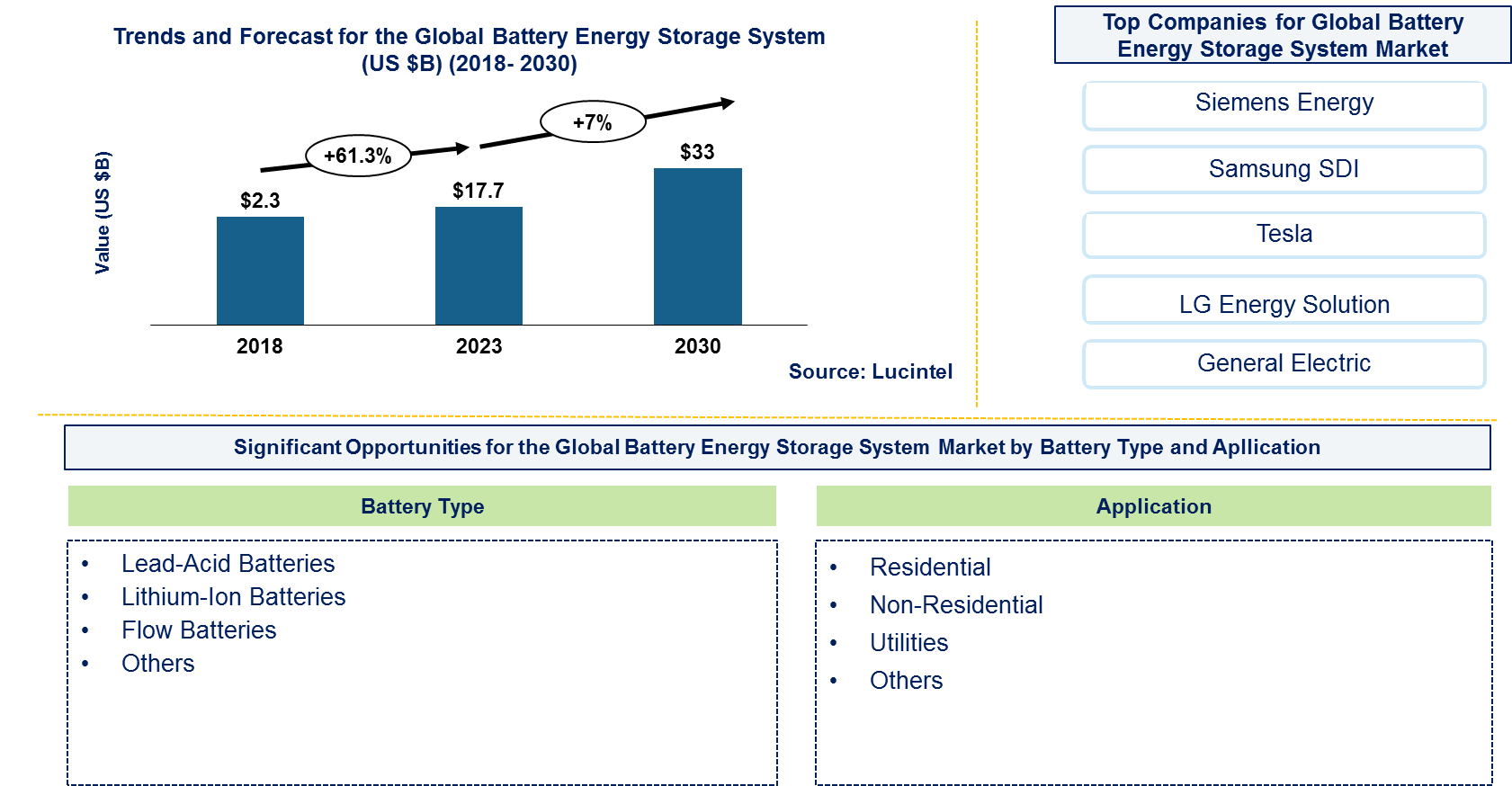
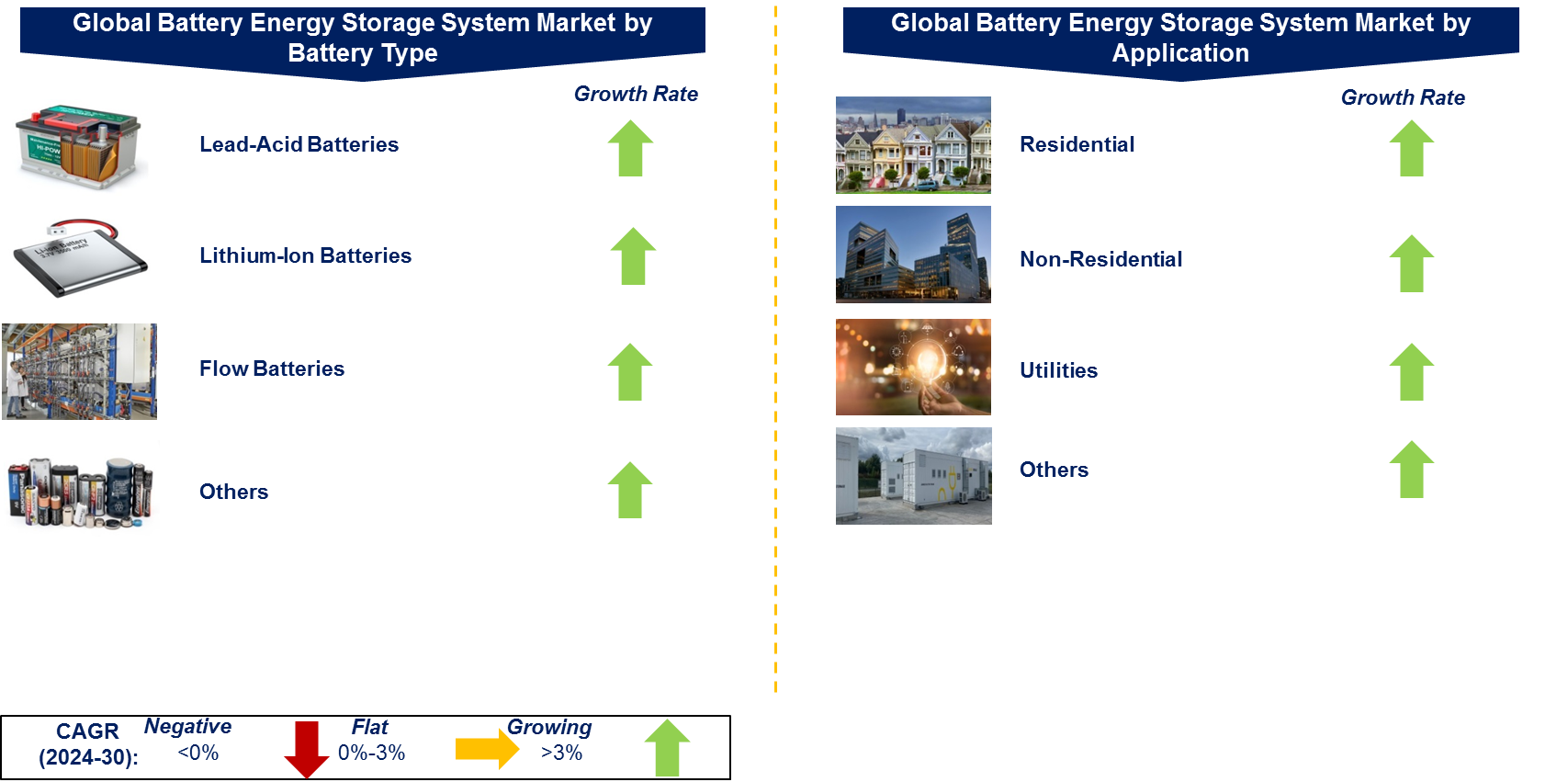
• Lucintel forecasts that lithium-ion batteries will remain the largest segment due to its features, such as, high energy and power density which leads to low standby losses and a high life expectancy.
• Utilities will remain the largest application due to the increasing demand for a reliable and efficient supply of electricity in most regions.
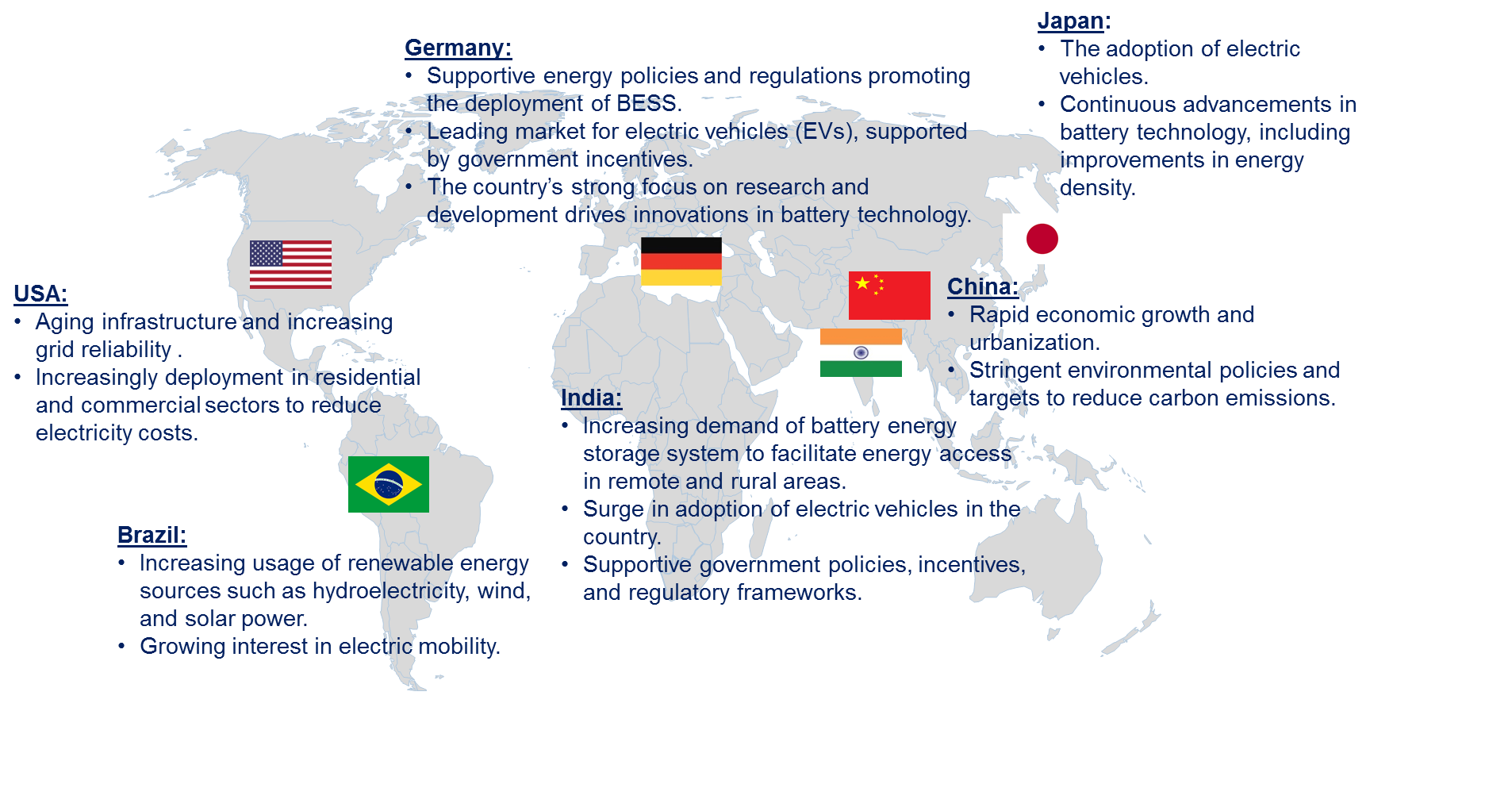
• North America will remain the largest market due to increasing industrialization and urbanization, new electrification targets, and renewable energy generation capacity
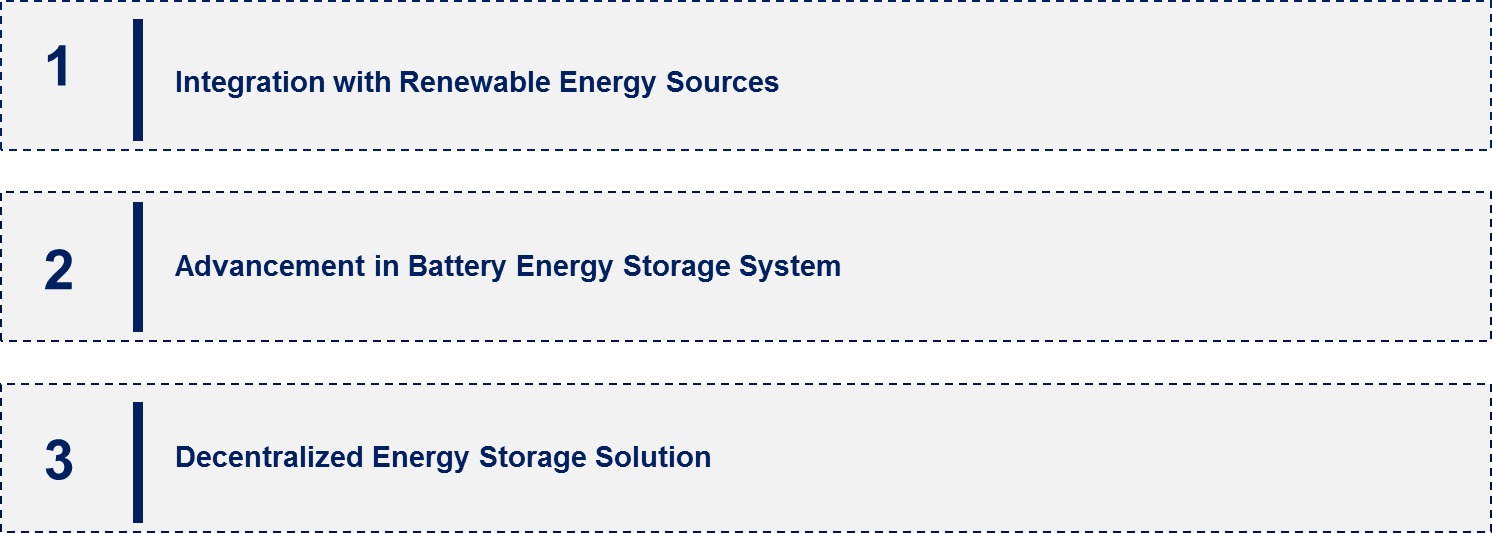
• Technological Advancements: Battery technology is advancing, and this includes lithium-ion batteries that possess a higher energy density, greater efficiency and reduced cost. Safety and performance are being improved through such innovations as solid-state batteries and next-generation chemistries.
• Decreasing Costs: Because of economies of scale and improvements in production methods, the price of battery storage systems is still going down. As a result, BESS become more affordable to people who use it for home purposes, commercial purposes or utility-scale applications thereby increasing its adoption rates.
• Grid Integration and Services: Currently, BESS is recognized as a provider of ancillary services to the grid like frequency regulation, voltage support, load shifting among others. By enhancing grid stability and reliability, these capabilities make energy storage an essential part of modern power systems.
• Government Policies and Incentives: Many nations have set up supportive policies as well financial incentives aimed at fostering adoption of energy storage solutions. This has led to investment in BESS technologies driven by programs that seek to reduce greenhouse gas emissions as well as promote renewable forms of energy.
• Expansion in Electric Vehicle (EV) Charging Infrastructure: The rise in electric vehicles has increased the need for integrated energy storage solutions. For example BESS is being used at EV charging stations to manage peak loads during charging so that there can be efficient usage thus contributing towards establishment of smart charging systems within countries.
• Hybrid Storage Solutions: These hybrid systems are growing popular with combinations such as batteries together with other technologies like supercapacitors or flywheels being applied in them. They have better performance than conventional ones used before because they respond much faster hence are more efficient in many areas.
• Increased Focus on Sustainability: In addition to circular economy principles, the industry also focuses more on sustainability especially when it comes to batteries materials recycling processes which must become improved or newer batteries be made with less environmental consequences.
• Emergence of Energy-as-a-Service (EaaS): There is a growing interest in the EaaS model which allows businesses and consumers to access energy storage solutions without having to make huge upfront investments. Through this model, BESS technologies can be easily adopted due to its flexible financing options as well.
• Utility-Scale Projects: The number of large-scale battery storage projects around the world has increased significantly. They are investing heavily in BESS, especially utilities at present, for grid support, renewable integration, and reliability in energy delivery.
• Resilience and Emergency Backup: Resilient power systems were underscored by the coronavirus disease outbreak which occurred recently. This has led to more businesses and homeowners purchasing battery storage as a backup source for emergency situations hence there has been an increase in demand for reliable sources of energy.
• Renewable Energy Integration: The prevalence of renewable energy sources is increasing. This means that BESS has to play a serious role in the integration of solar and wind power into the grid. An alternative way for such intermittent sources is developing solutions that would optimize their energy storage, which can be used as a great platform for growing.
• Development of Electric Vehicle (EV) Infrastructure: BESS has significant opportunities in the fast-growing EV market. Placing storage systems at charging stations could allow them to manage traffic peaks and contribute to grid services, thus promoting EVs adoption on a wider scale.
• Commercial and Industrial Applications: Energy storage is being acknowledged by more businesses as supportive to demand charge management and backup power provision. This calls for customization of the various forms of storages so as to fit commercial and industrial sectors hence promoting growth within these areas.
• Energy-as-a-Service (EaaS) Models: The emergence of EaaS enables customers to access energy storage solutions without any upfront costs. Moreover, this model will help gain acceptance on a larger scale while guaranteeing service providers sustainable revenues.
• Growing Demand for Renewable Energy Integration: The shift towards renewable energy sources like solar and wind is a significant driver. BESS helps store excess energy generated during peak production periods, ensuring a reliable supply when demand fluctuates.
• Decreasing Costs of Battery Technologies: Advances in technology and economies of scale have led to a dramatic decline in battery prices, making energy storage solutions more accessible and attractive for residential, commercial, and utility-scale applications.
• Government Incentives and Support: Many governments are implementing policies and incentives to promote energy storage solutions as part of their sustainability goals. Grants, tax credits, and renewable energy mandates encourage investments in BESS.
• Need for Grid Stability and Reliability: BESS provides essential grid services such as frequency regulation and demand response, enhancing grid stability. As energy systems become more complex, the role of energy storage in maintaining reliability grows.
• Increase in Electric Vehicle (EV) Adoption: The expanding EV market creates new opportunities for BESS. Energy storage systems can manage charging loads and facilitate vehicle-to-grid (V2G) technology, enhancing overall grid efficiency.
• High Initial Investment Costs: Despite decreasing prices, the upfront costs of battery storage systems can still be significant. This financial barrier may deter some potential users, especially in price-sensitive markets.
• Technological Limitations: Current battery technologies may have limitations in terms of energy density, cycle life, and safety. Addressing these technical challenges is essential for wider adoption and performance enhancement.
• Regulatory Hurdles: Navigating the complex regulatory landscape can pose challenges. Compliance with safety and environmental regulations can be time-consuming and costly for manufacturers and developers.
• Competition from Alternative Technologies: The BESS market faces competition from other energy storage technologies, such as pumped hydro and compressed air energy storage. These alternatives may be more suitable for specific applications or conditions.
• Supply Chain Vulnerabilities: The supply chain for battery components, particularly critical minerals like lithium and cobalt, can be unstable. Geopolitical factors and resource scarcity can lead to disruptions and increased costs.
The Battery Energy Storage System market is propelled by significant drivers, including the demand for renewable energy integration and declining costs. However, it also faces challenges such as high initial investments and regulatory complexities. Addressing these challenges while leveraging growth drivers will be essential for stakeholders to succeed in this evolving market.• Panasonic
• Samsung SDI
• AEG
• ABB
• LG
• General Electric
• Siemens
• Tesla
• Hitachi Energy
These companies have established themselves as leaders in the battery energy storage system industry, with extensive product portfolios, global presence, and strong research and development capabilities. They continually strive to enhance their market positions through strategic partnerships, mergers and acquisitions, and product innovations.• Smartphones and Tablets
• Computers
• Telecom/Datacom
• Consumer Electronics
• Automotive
• Others
• 4-6 Layer
• 8-10 Layer
• 10+ Layer
• 1+n+1
• 2+n+2
• 3+n+3
• Others
• North America
• Europe
• Asia Pacific
• The Rest of the World
• Market size estimates: Battery energy storage system market size estimation in terms of value ($M) shipment.
• Trend and forecast analysis: Market trend (2018-2023) and forecast (204-2030) by end use industry.
• Segmentation analysis: Market size by various segmentations such as by battery type, element, ownership, connection type, end use industry, and region.
• Regional analysis: Battery energy storage system market breakdown by North America, Europe, Asia Pacific, and the Rest of the World.
• Growth opportunities: Analysis on growth opportunities in different applications and regions for battery energy storage system in the battery energy storage system market.
• Strategic analysis: This includes M&A, new product development, and competitive landscape for, battery energy storage system in the Battery energy storage system market.
• Analysis of competitive intensity of the industry based on Porter’s Five Forces model.


Choose a license that fits your team. Instant PDF delivery.
Prices exclude taxes. Instant delivery. Custom licensing available on request.
Market Report · July 24, 2026
Market Report · July 20, 2026
Market Report · July 20, 2026
Trusted partner for strategic intelligence and business growth


Receive a complimentary market analysis tailored to your industry. Our analysts will identify key growth opportunities and competitive dynamics specific to your business.

Market size, growth rate, and key trend analysis for your specific sector.

Top competitor positioning and market share analysis.

Strategic recommendations backed by data-driven insights.
Get curated market intelligence and competitive moves straight to your inbox.
By subscribing, you agree to receive our monthly insights. Unsubscribe anytime.
Receive a complimentary market analysis tailored to your industry. Our analysts will identify key growth opportunities and competitive dynamics specific to your business.
Market size, growth rate, and key trend analysis for your specific sector.
Top competitor positioning and market share analysis.
Strategic recommendations backed by data-driven insights.
Get curated market intelligence, emerging trends, and competitive moves straight to your inbox each month.
By subscribing, you agree to receive our monthly insights. Unsubscribe anytime.
We'll send your sample report shortly.