
Market Report · July 29, 2026

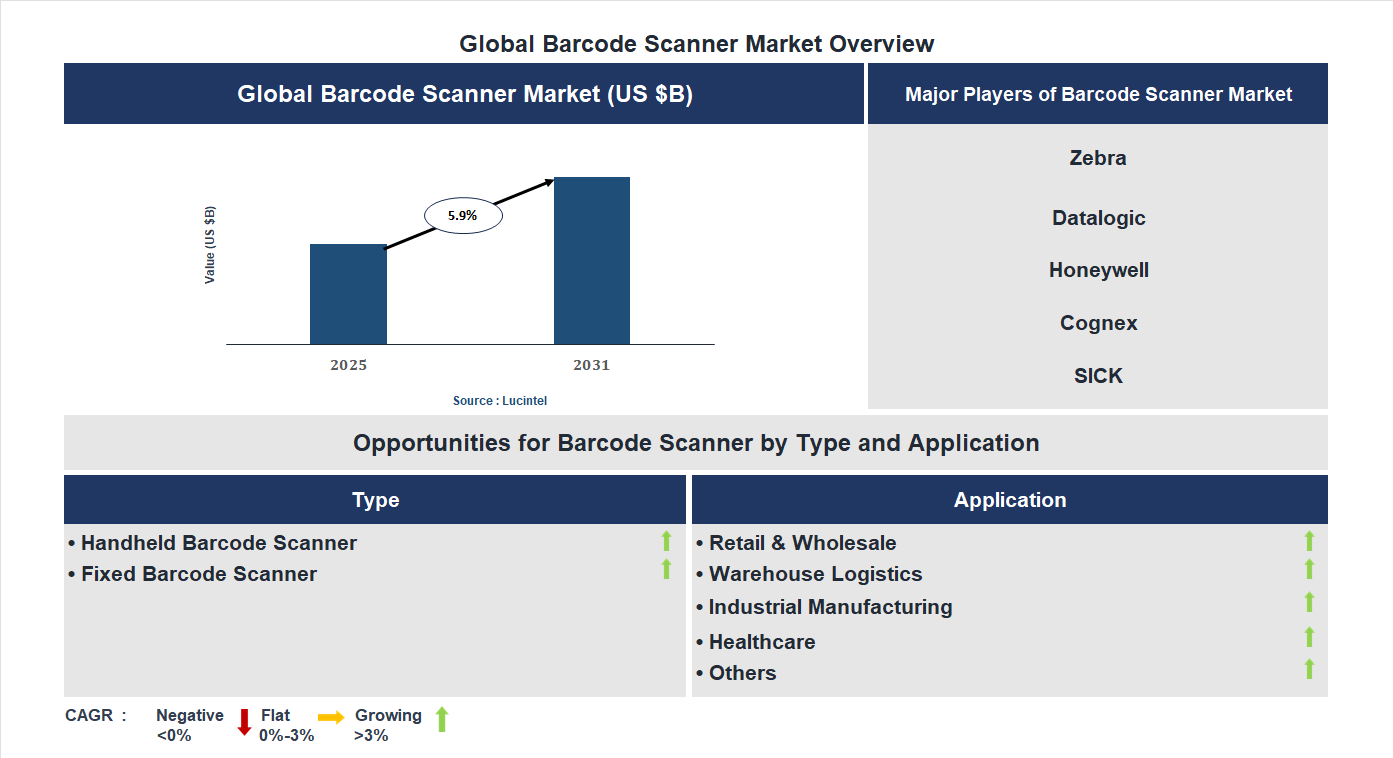
Key data points: The growth forecast = 5.9% annually for the next 7 years. Scroll below to get more insights. This market report covers trends, opportunities and forecasts in barcode scanner market to 2031 by type (handheld barcode scanner and fixed barcode scanner), application (retail & wholesale, warehouse logistics, industrial manufacturing, healthcare, and others), and region (North America, Europe, Asia Pacific, and the Rest of the World)
We'll send your sample report shortly.
• Lucintel forecasts that, within the type category, handheld barcode scanner is expected to witness higher growth over the forecast period.
• Within the application category, retail & wholesale is expected to witness the highest growth.
• In terms of region, APAC is expected to witness the highest growth over the forecast period. Gain valuable insights for your business decisions with our comprehensive 150+ page report. Sample figures with some insights are shown below.
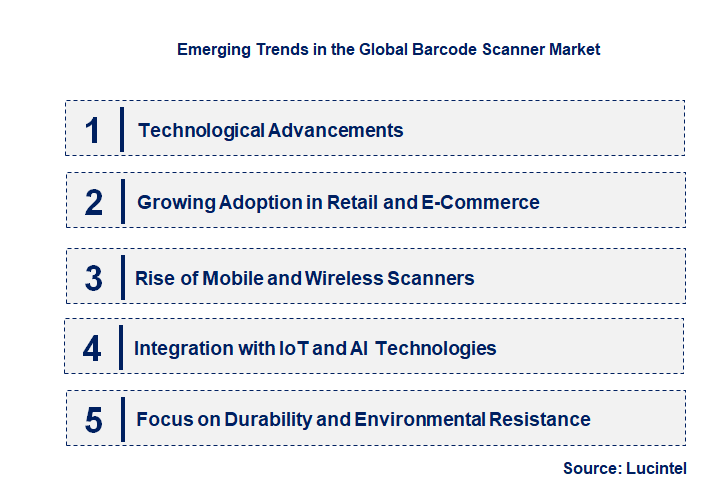
• Technological Advancements: Integration of wireless, Bluetooth, and RFID technologies is revolutionizing barcode scanners. These innovations enable real-time data transfer, increased mobility, and ease of use, reducing manual errors and improving operational efficiency. Wireless scanners facilitate seamless inventory management in large warehouses and retail environments, while RFID integration allows for faster scanning of multiple items simultaneously. As technology continues to evolve, the market is witnessing a shift towards smarter, more connected devices that enhance data accuracy and streamline workflows, ultimately driving growth and expanding application possibilities.
• Growing Adoption in Retail and E-commerce: The retail sector is increasingly adopting barcode scanners for inventory management, checkout processes, and supply chain operations. The surge in e-commerce has further accelerated this trend, requiring fast, reliable scanning solutions to handle high volumes of transactions and shipments. Retailers are investing in handheld and fixed scanners that support high-speed scanning and integration with POS systems. This trend improves customer experience, reduces checkout times, and enhances inventory accuracy. As online shopping continues to grow, the demand for advanced barcode scanning solutions is expected to rise, fueling market expansion.
• Rise of Mobile and Wireless Scanners: Mobile and wireless barcode scanners are gaining popularity due to their portability and flexibility. These devices allow workers to scan items on the go, improving efficiency in warehouses, logistics, and retail environments. Wireless connectivity reduces the need for physical cables, enabling seamless data transfer to central systems. The proliferation of smartphones and tablets with integrated scanning capabilities also contributes to this trend. As businesses seek more agile and scalable solutions, the adoption of mobile and wireless scanners is expected to increase, offering cost-effective and versatile options for various applications.
• Integration with IoT and AI Technologies: The incorporation of Internet of Things (IoT) and Artificial Intelligence (AI) into barcode scanners is creating smarter, more autonomous systems. IoT-enabled scanners can communicate with other devices and systems, providing real-time data analytics and predictive insights. AI enhances image recognition, enabling scanners to read damaged or poorly printed barcodes more accurately. This integration improves supply chain visibility, reduces errors, and optimizes inventory management. As IoT and AI become more accessible, their integration into barcode scanners is set to revolutionize operational workflows across industries, making processes more intelligent and efficient.
• Focus on Durability and Environmental Resistance: With increasing use in harsh environments such as manufacturing plants, outdoor logistics, and warehouses, there is a rising demand for durable barcode scanners. Manufacturers are developing rugged devices with features like waterproofing, dust resistance, and shockproof designs to withstand extreme conditions. These scanners ensure reliable performance in challenging settings, reducing downtime and maintenance costs. The focus on durability also extends to battery life and ergonomic design, supporting long shifts and heavy usage. This trend is crucial for industries requiring robust solutions, broadening the market scope and ensuring consistent performance in demanding environments. In summary, these trends are significantly reshaping the barcode scanner market by fostering innovation, enhancing operational efficiency, and expanding application areas. The integration of advanced technologies and focus on durability are driving market growth, making barcode scanning solutions more versatile, reliable, and aligned with modern business needs. As these developments continue, the market is poised for sustained expansion and transformation.
• Introduction of 2D Barcode Scanners: These scanners now support QR codes and other 2D barcodes, enabling faster data capture and supporting mobile payment systems. This development enhances versatility and improves user convenience, especially in retail and healthcare sectors, leading to increased adoption and expanding market reach.
• Integration of AI and Machine Learning: AI-powered barcode scanners offer improved accuracy, faster processing, and real-time data analysis. This integration helps businesses optimize inventory management, reduce errors, and streamline operations, thereby boosting overall productivity and reducing operational costs.
• Wireless and Bluetooth Connectivity: The shift towards wireless scanners provides greater flexibility and ease of use in dynamic environments. Bluetooth-enabled devices facilitate seamless data transfer to multiple devices, improving workflow efficiency in warehouses, retail stores, and logistics operations.
• Adoption of Rugged and Industrial Scanners: The development of durable, rugged scanners designed for harsh environments has expanded their use in manufacturing, logistics, and outdoor settings. These scanners offer long-term reliability and reduce downtime, supporting continuous operations in demanding conditions.
• Launch of Cloud-Based Data Management Solutions: Cloud integration allows real-time data synchronization and remote management of scanned data. This development enhances data security, accessibility, and analytics capabilities, enabling businesses to make informed decisions quickly and efficiently. In summary, these recent developments are significantly transforming the barcode scanner market by increasing functionality, improving operational efficiency, and expanding application areas. The integration of advanced technologies and flexible solutions is driving market growth and competitiveness, positioning the industry for continued innovation and expansion.
• Retail: Enhanced Point-of-Sale Efficiency : Advanced barcode scanners with faster processing speeds and omnichannel integration improve checkout experiences, reduce wait times, and support inventory management, leading to increased customer satisfaction and operational efficiency.
• Healthcare: Improved Patient Safety and Data Accuracy : High-precision scanners facilitate accurate patient identification, medication administration, and record keeping, minimizing errors and ensuring compliance with healthcare regulations.
• Logistics and Supply Chain: Real-Time Tracking and Automation : Rugged, wireless scanners enable real-time inventory tracking, automated sorting, and seamless data sharing across supply chain networks, boosting efficiency and reducing delays.
• Manufacturing: Quality Control and Asset Management : Barcode scanners integrated into manufacturing lines enhance quality assurance processes, track assets, and streamline production workflows, resulting in reduced downtime and improved product quality.
• Hospitality: Contactless and Mobile Scanning Solutions : Contactless barcode scanning and mobile-enabled devices support hygiene protocols, speed up check-in/check-out processes, and enhance guest experiences in hotels and restaurants. In summary, these growth opportunities are significantly impacting the barcode scanner market by driving technological innovation, expanding application scope, and improving operational efficiencies across industries. As businesses increasingly adopt advanced scanning solutions, market growth is expected to accelerate, fostering a more connected and efficient ecosystem.
• Technological Innovation: The rapid development of advanced barcode scanning technologies, such as 2D and 3D scanners, has significantly enhanced accuracy, speed, and versatility. These innovations enable businesses to streamline operations, improve inventory management, and enhance customer experiences. As technology continues to evolve, the market benefits from increased adoption in diverse sectors like retail, healthcare, and logistics. The integration of wireless and mobile scanning solutions further expands market reach, making barcode scanners more adaptable to various environments and applications.
• Growing E-commerce and Retail Sectors: The exponential growth of e-commerce and retail industries has been a major driver for barcode scanner adoption. Retailers rely heavily on barcode scanning for inventory management, checkout processes, and supply chain logistics. The need for real-time data accuracy and efficient operations has led to increased demand for reliable barcode scanning solutions. As online shopping continues to expand globally, the market for barcode scanners is expected to grow correspondingly, driven by the need for faster, more accurate checkout and inventory tracking.
• Increasing Automation in Supply Chain and Logistics: The push towards automation in supply chain management and logistics has significantly contributed to market growth. Barcode scanners are integral to automating inventory tracking, shipment verification, and warehouse management. The adoption of automated systems reduces human error, enhances efficiency, and accelerates processing times. As companies seek to optimize their supply chains amid rising global trade, the demand for robust barcode scanning solutions is expected to rise, supporting seamless operations and real-time data collection.
• Regulatory and Standardization Developments: Evolving regulatory standards and industry-specific compliance requirements are influencing the market. Governments and industry bodies are implementing stricter data security and privacy regulations, which necessitate advanced barcode scanning solutions with enhanced security features. Additionally, standardization efforts facilitate interoperability among different systems and devices, promoting wider adoption. Companies investing in compliant and standardized barcode scanners can avoid legal penalties and ensure smooth integration within their existing infrastructure, thus driving market growth. The challenges facing this barcode scanner market include:-
• Technological Obsolescence and Compatibility Issues: Rapid technological advancements can render existing barcode scanners obsolete, forcing companies to frequently upgrade their equipment. Compatibility issues between new and legacy systems pose integration challenges, increasing costs and complexity. Businesses must continuously invest in new hardware and software to stay current, which can be a significant financial burden, especially for small and medium-sized enterprises. This rapid pace of change can also lead to disruptions in operations during transition periods, impacting overall efficiency.
• Data Security and Privacy Concerns: As barcode scanners increasingly handle sensitive data, concerns over data security and privacy have intensified. Cybersecurity threats such as data breaches and hacking can compromise customer information and operational data. Ensuring secure data transmission and storage requires advanced encryption and security protocols, which can increase costs. Non-compliance with data protection regulations can result in legal penalties and damage to reputation, making data security a critical challenge for market participants.
• Regulatory Compliance and Standardization Challenges: Navigating complex regulatory landscapes across different regions can be challenging. Variations in standards and compliance requirements may hinder international expansion and interoperability. Companies must invest in compliance measures, which can be costly and time-consuming. Failure to meet regulatory standards can lead to legal issues, product recalls, and loss of market credibility. Keeping pace with evolving regulations requires ongoing monitoring and adaptation, adding to operational complexities. In summary, the barcode scanner market is driven by technological advancements, expanding retail and e-commerce sectors, automation in supply chains, and regulatory developments. However, it faces challenges such as rapid technological obsolescence, data security concerns, and complex regulatory compliance. These factors collectively influence market dynamics, requiring stakeholders to innovate continuously, invest in security and compliance, and adapt to changing technological landscapes. Overall, the markets growth prospects remain promising, provided these drivers are leveraged effectively and challenges are managed proactively.
• Zebra
• Datalogic
• Honeywell
• Cognex
• SICK
• Newland
• Code
• Omron
• Denso Wave
• Keyence
• Handheld Barcode Scanner
• Fixed Barcode Scanner
• Retail & Wholesale
• Warehouse Logistics
• Industrial Manufacturing
• Healthcare
• Others
• North America
• Europe
• Asia Pacific
• The Rest of the World
• United States: The US market has seen rapid adoption of wireless and 2D barcode scanners, driven by retail, healthcare, and logistics sectors. Companies are integrating AI-powered scanning solutions for improved accuracy and speed. The rise of contactless and mobile scanning technologies has further boosted demand, alongside increased investments in automation and smart inventory management systems.
• China: China is experiencing robust growth in barcode scanner adoption, especially in e-commerce, manufacturing, and logistics. The focus is on affordable, high-performance scanners with IoT connectivity. Local manufacturers are innovating with AI-enabled scanners and expanding their presence in the global market. Government initiatives supporting smart manufacturing are also propelling market expansion.
• Germany: The German market emphasizes high-quality, durable scanners suitable for industrial environments. There is a strong focus on integrating barcode scanners with Industry 4.0 initiatives, including automation and smart factory solutions. The adoption of 2D and omnidirectional scanners is increasing, driven by the automotive and manufacturing sectors seeking precision and reliability.
• India: India’s barcode scanner market is rapidly growing due to expanding retail, logistics, and healthcare sectors. Cost-effective solutions are in high demand, with a focus on mobile and wireless scanners. The government’s push for digital payments and cashless transactions is further fueling market growth, alongside increasing investments in supply chain digitization.
• Japan: Japan is advancing in the adoption of high-end, sophisticated barcode scanning solutions, especially in electronics, automotive, and retail industries. The market is characterized by the integration of scanners with IoT and AI for enhanced data collection and automation. There is also a trend toward miniaturization and rugged designs suitable for harsh environments, supporting Japan’s focus on quality and innovation.


• Zebra
• Datalogic
• Honeywell
• Cognex
• SICK
• Newland
• Code
• Omron
• Denso Wave
• Keyence Q5. Which barcode scanner market segment will be the largest in future? Answer: Lucintel forecasts that, within the type category, handheld barcode scanner is expected to witness higher growth over the forecast period. Q6. In barcode scanner market, which region is expected to be the largest in next 5 years? Answer: In terms of region, APAC is expected to witness the highest growth over the forecast period. Q7. Do we receive customization in this report? Answer: Yes, Lucintel provides 10% customization without any additional cost.


Choose a license that fits your team. Instant PDF delivery.
Prices exclude taxes. Instant delivery. Custom licensing available on request.
Market Report · July 29, 2026
Market Report · July 20, 2026
Market Report · July 20, 2026
Trusted partner for strategic intelligence and business growth


Receive a complimentary market analysis tailored to your industry. Our analysts will identify key growth opportunities and competitive dynamics specific to your business.

Market size, growth rate, and key trend analysis for your specific sector.

Top competitor positioning and market share analysis.

Strategic recommendations backed by data-driven insights.
Get curated market intelligence and competitive moves straight to your inbox.
By subscribing, you agree to receive our monthly insights. Unsubscribe anytime.
Receive a complimentary market analysis tailored to your industry. Our analysts will identify key growth opportunities and competitive dynamics specific to your business.
Market size, growth rate, and key trend analysis for your specific sector.
Top competitor positioning and market share analysis.
Strategic recommendations backed by data-driven insights.
Get curated market intelligence, emerging trends, and competitive moves straight to your inbox each month.
By subscribing, you agree to receive our monthly insights. Unsubscribe anytime.
We'll send your sample report shortly.