
Report Feature
Barcode Label Printer Market Trends and Forecast
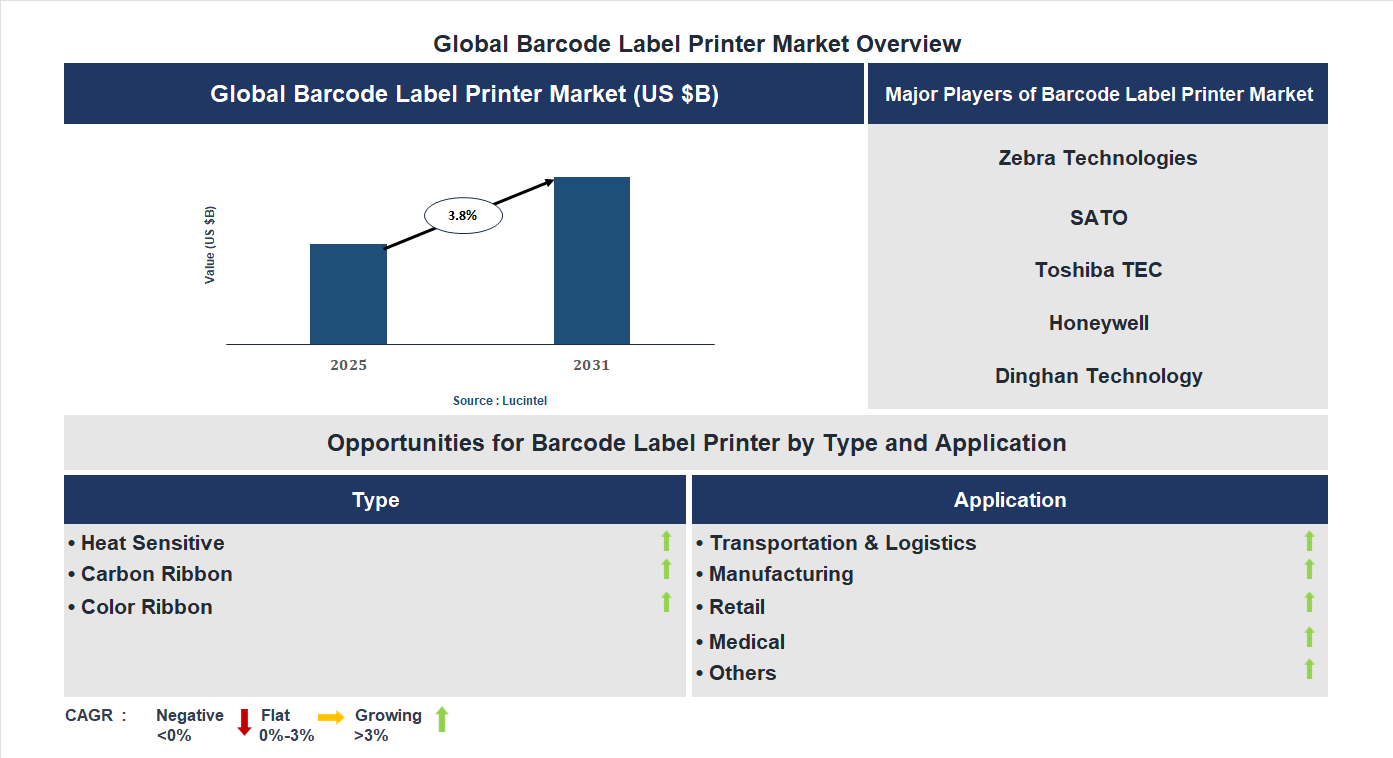
The future of the global barcode label printer market looks promising with opportunities in the transportation & logistics, manufacturing, retail, medical markets. The global barcode label printer market is expected to grow with a CAGR of 3.8% from 2025 to 2031. The major drivers for this market are the increasing adoption of automation in retail, the rising need for efficient inventory management, and the growing demand for durable & high-quality labels.• Lucintel forecasts that, within the type category, color ribbon is expected to witness the highest growth over the forecast period.
• Within the application category, retail is expected to witness the highest growth.
• In terms of region, APAC is expected to witness the highest growth over the forecast period. Gain valuable insights for your business decisions with our comprehensive 150+ page report. Sample figures with some insights are shown below.
Emerging Trends in the Barcode Label Printer Market
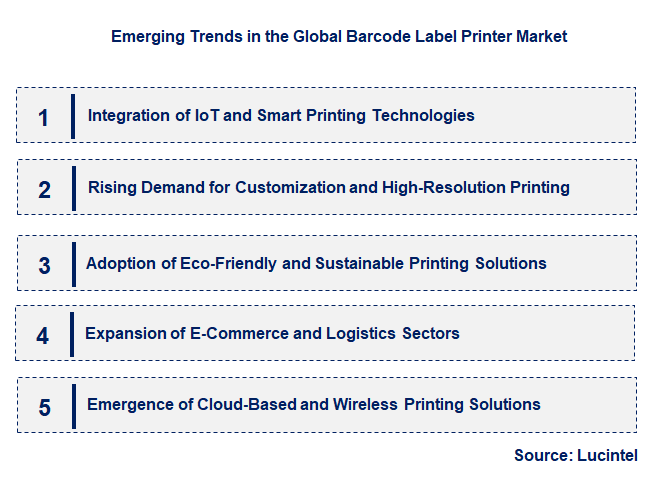
The barcode label printer market is experiencing rapid evolution driven by technological advancements, increasing demand for automation, and the need for efficient inventory management across various industries. As businesses seek to streamline operations and improve accuracy, innovative solutions are emerging to meet these needs. The market is also influenced by the growing adoption of smart printing technologies, sustainability concerns, and the expansion of e-commerce. These developments are transforming how companies produce, manage, and utilize barcode labels, leading to more efficient, cost-effective, and environmentally friendly practices. Understanding these trends is essential for stakeholders aiming to stay competitive in this dynamic landscape.• Integration of IoT and Smart Printing Technologies: The incorporation of Internet of Things (IoT) into barcode label printers enables real-time tracking, remote management, and enhanced connectivity. Smart printers can automatically update inventory data, reduce manual errors, and improve supply chain visibility. This trend enhances operational efficiency, reduces downtime, and provides valuable data analytics, empowering businesses to make informed decisions quickly. As IoT adoption grows, barcode printers are becoming more intelligent, facilitating seamless integration with enterprise systems and fostering a more connected, automated environment.
• Rising Demand for Customization and High-Resolution Printing: Businesses increasingly require customized labels with high-resolution graphics, variable data, and durable materials to meet branding and regulatory standards. Advanced printers now support a wide range of label sizes, materials, and printing techniques, allowing for tailored solutions across industries such as healthcare, retail, and manufacturing. This trend improves product identification, enhances brand visibility, and ensures compliance with industry regulations. The ability to produce high-quality, customized labels on demand is driving market growth and expanding application possibilities.
• Adoption of Eco-Friendly and Sustainable Printing Solutions: Environmental concerns are prompting manufacturers to develop eco-friendly label printing options, such as biodegradable labels, soy-based inks, and energy-efficient printers. These sustainable solutions reduce carbon footprints and waste, aligning with corporate social responsibility goals. As consumers and regulators demand greener practices, companies are increasingly investing in sustainable printing technologies. This shift not only benefits the environment but also enhances brand reputation and compliance, making eco-friendly options a key differentiator in the competitive market.
• Expansion of E-Commerce and Logistics Sectors: The explosive growth of e-commerce has significantly increased the demand for barcode labels to track shipments, manage inventory, and ensure accurate delivery. Logistics companies require fast, reliable, and scalable printing solutions to handle high volumes of labels efficiently. This trend drives innovation in high-speed printers, automation, and integration with warehouse management systems. As online shopping continues to expand globally, the market for barcode label printers is poised for sustained growth, with a focus on speed, accuracy, and integration capabilities to meet industry demands.
• Emergence of Cloud-Based and Wireless Printing Solutions: Cloud connectivity and wireless technology are transforming barcode label printing by enabling remote management, centralized control, and on-demand printing from multiple locations. These solutions facilitate real-time updates, reduce infrastructure costs, and improve flexibility for distributed operations. Businesses benefit from simplified maintenance, enhanced security, and scalability. As digital transformation accelerates, cloud-based and wireless printers are becoming essential for modern supply chains, offering greater agility and responsiveness in dynamic market environments. In summary, these emerging trends are reshaping the barcode label printer market by fostering greater connectivity, customization, sustainability, and efficiency. They enable businesses to adapt swiftly to changing market demands, improve operational workflows, and enhance customer satisfaction. As technology continues to advance, the market is expected to see continued innovation, driving growth and competitive advantage for industry players.
Recent Development in the Barcode Label Printer Market
The barcode label printer market has experienced significant growth driven by increasing demand for efficient inventory management, automation in retail and logistics, and technological advancements. As businesses seek to streamline operations and improve accuracy, the market is evolving rapidly with innovative solutions and expanding applications. Recent developments reflect a focus on sustainability, integration with digital systems, and enhanced printing capabilities. These trends are shaping the future landscape of barcode label printers, making them more versatile, cost-effective, and environmentally friendly. The following key developments highlight the major shifts influencing this dynamic market.• Adoption of eco-friendly materials: Companies are increasingly using biodegradable and recyclable label materials, reducing environmental impact and aligning with sustainability goals. This shift enhances brand reputation and meets regulatory standards, encouraging wider adoption of eco-conscious printing solutions.
• Integration with IoT and digital systems: Barcode label printers are now equipped with IoT connectivity, enabling real-time tracking, remote management, and seamless integration with enterprise resource planning (ERP) systems. This improves operational efficiency and data accuracy across supply chains.
• Advancements in printing technology: The introduction of high-resolution, fast-speed printers with enhanced durability allows for clearer, more durable labels suitable for harsh environments. These improvements support applications in logistics, manufacturing, and retail, boosting productivity.
• Expansion of portable and wireless printers: The market is witnessing increased demand for portable, wireless barcode label printers that offer flexibility and ease of use in various settings. This development benefits field operations, warehouses, and retail outlets by enabling on-the-spot printing.
• Focus on automation and smart features: Modern barcode label printers incorporate automation features such as automatic label cutting, batch printing, and smart sensors. These innovations reduce manual intervention, increase throughput, and minimize errors, leading to cost savings and improved workflow. In summary, these recent developments are transforming the barcode label printer market by enhancing sustainability, connectivity, efficiency, and versatility. The integration of advanced technologies and eco-friendly practices is driving growth, expanding application areas, and meeting the evolving needs of businesses worldwide.
Strategic Growth Opportunities in the Barcode Label Printer Market
The barcode label printer market is experiencing rapid expansion driven by increasing demand for efficient inventory management, automation, and traceability across various industries. As businesses seek to optimize operations and ensure compliance, innovative solutions are emerging to meet these needs. Key growth opportunities are emerging across different applications, offering significant potential for market players to capitalize on. These opportunities are shaping the future landscape of barcode label printers, fostering technological advancements and expanding market reach. Understanding these growth avenues is essential for stakeholders aiming to leverage emerging trends and maintain competitive advantage in this dynamic market.• Retail Sector: Enhanced Inventory Management : The retail industry is adopting advanced barcode label printers to streamline stock tracking, reduce errors, and improve customer experience. These printers enable quick labeling and re-labeling, supporting just-in-time inventory practices. As retail chains expand, the demand for high-speed, reliable printers increases, driving market growth. This trend enhances operational efficiency and reduces labor costs, making it a critical growth area.
• Healthcare Industry: Improved Patient and Asset Tracking : In healthcare, barcode label printers are vital for accurate patient identification, medication management, and equipment tracking. The need for compliance with strict regulations fuels demand for durable, high-quality labels. Innovations in antimicrobial and waterproof labels are expanding application scope, improving safety and reducing errors. This growth opportunity enhances healthcare operational efficiency and patient safety.
• Logistics and Supply Chain: Real-Time Shipment Tracking : The logistics sector relies heavily on barcode labels for real-time tracking of shipments and inventory. The adoption of high-speed, portable printers facilitates on-the-go labeling at warehouses and transit points. Integration with IoT and RFID technologies enhances visibility and traceability, reducing delays and losses. This trend significantly boosts supply chain transparency and efficiency.
• Manufacturing Sector: Automation and Quality Control : Manufacturers are increasingly deploying barcode label printers for automation in production lines, quality assurance, and inventory management. The ability to produce high-volume, precise labels supports lean manufacturing practices. Innovations in multi-color and variable data printing improve branding and product traceability. This growth opportunity promotes operational efficiency and product integrity.
• Food and Beverage Industry: Freshness and Traceability Labels : The food sector demands labels that withstand moisture, refrigeration, and handling. Barcode printers are used for labeling perishable goods, ensuring freshness and compliance with safety standards. The development of eco-friendly, biodegradable labels aligns with sustainability goals. This application enhances supply chain transparency, consumer trust, and regulatory compliance. In summary, these growth opportunities across key applications are significantly impacting the barcode label printer market by driving technological innovation, expanding application scope, and improving operational efficiencies. As industries increasingly prioritize automation, traceability, and compliance, the market is poised for sustained growth and diversification.
Barcode Label Printer Market Driver and Challenges
The barcode label printer market is influenced by a variety of technological, economic, and regulatory factors that shape its growth trajectory. Advances in printing technology, increasing demand for efficient inventory management, and stringent regulatory standards for product labeling are key drivers. Conversely, challenges such as high initial investment costs, rapid technological obsolescence, and regulatory compliance complexities pose significant hurdles. Understanding these drivers and challenges is essential for stakeholders to navigate the evolving landscape effectively and capitalize on emerging opportunities. The factors responsible for driving the barcode label printer market include:-• Technological Advancements: The continuous development of high-speed, high-resolution printers with wireless connectivity has significantly enhanced operational efficiency. These innovations enable real-time data management, reduce manual errors, and support integration with enterprise resource planning (ERP) systems. As businesses seek automation and accuracy, demand for advanced barcode label printers surges, fostering market growth. Moreover, the adoption of eco-friendly and energy-efficient printers aligns with sustainability goals, further propelling market expansion.
• Growing E-commerce and Retail Sectors: The exponential growth of e-commerce and retail industries has increased the need for accurate, durable, and quick labeling solutions. Barcode labels facilitate inventory tracking, order fulfillment, and supply chain transparency. Retailers and logistics providers are investing heavily in barcode label printers to streamline operations, reduce errors, and improve customer satisfaction. This sector-specific demand is a major driver, especially in regions experiencing rapid online shopping adoption.
• Regulatory Compliance and Standardization: Governments and industry bodies impose strict labeling standards for safety, traceability, and authenticity. Barcode labels are essential for compliance with regulations such as GS1 standards, FDA requirements, and serialization mandates in pharmaceuticals. The need to meet these standards drives organizations to upgrade their labeling infrastructure, thereby boosting demand for reliable barcode label printers capable of producing compliant labels.
• Cost Efficiency and Operational Optimization: Businesses are increasingly focusing on reducing operational costs through automation. Barcode label printers offer a cost-effective solution for inventory management, asset tracking, and product identification. The ability to produce labels on-demand minimizes waste and inventory holding costs. As companies seek to optimize supply chain processes, the market for efficient, versatile printers continues to expand, supporting overall growth.
• Integration with Industry 4.0 and IoT: The rise of Industry 4.0 and the Internet of Things (IoT) has transformed manufacturing and logistics. Barcode label printers integrated with IoT devices enable real-time data collection and seamless communication across supply chains. This integration enhances traceability, predictive maintenance, and inventory accuracy. As industries adopt smart manufacturing practices, the demand for connected printing solutions accelerates, driving market expansion. The challenges facing this barcode label printer market include:-
• High Initial Investment Costs: Implementing advanced barcode label printing systems requires substantial capital expenditure. Small and medium-sized enterprises (SMEs) often find the costs of high-end printers, software, and maintenance prohibitive. This financial barrier limits market penetration in emerging regions and among budget-conscious organizations, potentially slowing overall growth.
• Rapid Technological Obsolescence: The fast pace of technological innovation results in frequent product upgrades and short product life cycles. Companies face pressure to continually invest in the latest equipment to stay competitive, which can lead to increased operational costs and inventory obsolescence. This rapid evolution also complicates long-term planning and ROI calculations for businesses.
• Regulatory and Compliance Complexities: Navigating diverse regulatory standards across different regions can be challenging. Ensuring compliance with evolving labeling requirements demands ongoing updates to printing systems and processes. Non-compliance risks penalties, product recalls, and damage to brand reputation, making regulatory adherence a persistent challenge for market participants. In summary, the barcode label printer market is driven by technological innovations, expanding retail and e-commerce sectors, regulatory requirements, cost optimization efforts, and Industry 4.0 integration. However, high costs, rapid technological changes, and complex compliance standards pose significant challenges. These factors collectively influence market dynamics, requiring stakeholders to adapt strategically. While growth prospects remain promising, addressing these challenges is crucial for sustained development and competitive advantage in this evolving landscape.
List of Barcode Label Printer Companies
Companies in the market compete on the basis of product quality offered. Major players in this market focus on expanding their manufacturing facilities, R&D investments, infrastructural development, and leverage integration opportunities across the value chain. With these strategies barcode label printer companies cater increasing demand, ensure competitive effectiveness, develop innovative products & technologies, reduce production costs, and expand their customer base. Some of the barcode label printer companies profiled in this report include-• Zebra Technologies
• SATO
• Toshiba TEC
• Honeywell
• Dinghan Technology
• Shandong New Beiyang Information Technology
• citizen
• Epson
• Brady
• Kecheng
Barcode Label Printer Market by Segment
The study includes a forecast for the global barcode label printer market by type, application, and region.Barcode Label Printer Market by Type [Value from 2019 to 2031]:
• Heat Sensitive
• Carbon Ribbon
• Color Ribbon
Barcode Label Printer Market by Application [Value from 2019 to 2031]:
• Transportation & Logistics
• Manufacturing
• Retail
• Medical
• Others
Barcode Label Printer Market by Region [Value from 2019 to 2031]:
• North America
• Europe
• Asia Pacific
• The Rest of the World
Country Wise Outlook for the Barcode Label Printer Market
The barcode label printer market has experienced significant growth driven by increasing demand for automation, inventory management, and supply chain efficiency across various industries. Technological advancements, such as wireless connectivity and high-resolution printing, have enhanced product capabilities. Countries are adopting innovative solutions to meet evolving business needs, with government policies and industry standards influencing market dynamics. The following summaries highlight recent developments in the United States, China, Germany, India, and Japan, reflecting their unique market trends and technological progress.• United States: The US market has seen a surge in demand for high-speed, wireless barcode label printers, especially in retail, healthcare, and logistics sectors. Companies are investing in smart printing solutions integrated with cloud technology for real-time inventory tracking. Regulatory standards are encouraging eco-friendly and energy-efficient devices, boosting innovation. The adoption of RFID integration with barcode printers is also gaining momentum, enhancing supply chain transparency.
• China: China’s barcode label printer market is rapidly expanding due to the booming e-commerce and manufacturing sectors. Local manufacturers are focusing on cost-effective, multifunctional printers with high durability to cater to domestic and export markets. The government’s push for digital transformation and smart manufacturing is fostering innovation in printing technology. Additionally, the integration of IoT-enabled printers is improving automation and operational efficiency.
• Germany: The German market emphasizes precision, quality, and sustainability. There is a growing preference for industrial-grade printers capable of handling complex labeling requirements in automotive, pharmaceuticals, and logistics industries. Germany is also leading in adopting environmentally friendly printing solutions, with a focus on reducing waste and energy consumption. Technological advancements include the integration of barcode printers with enterprise resource planning (ERP) systems for seamless operations.
• India: India’s barcode label printer market is witnessing rapid growth driven by expanding retail, logistics, and manufacturing sectors. Affordable, portable, and easy-to-use printers are in high demand to support small and medium-sized enterprises. The government’s initiatives like Digital India and Make in India are promoting automation and digitalization, encouraging local innovation. There is also a rising trend of integrating printers with mobile devices for on-the-go labeling.
• Japan: Japan’s market is characterized by high-quality, reliable barcode label printers tailored for healthcare, electronics, and logistics industries. The focus is on advanced features such as high-resolution printing, durability, and integration with enterprise systems. Japan is also investing in eco-friendly printing technologies to align with sustainability goals. Innovations include the development of compact, energy-efficient printers suitable for space-constrained environments, along with enhanced connectivity options.

Features of the Global Barcode Label Printer Market
Market Size Estimates: Barcode label printer market size estimation in terms of value ($B). Trend and Forecast Analysis: Market trends (2019 to 2024) and forecast (2025 to 2031) by various segments and regions. Segmentation Analysis: Barcode label printer market size by type, application, and region in terms of value ($B). Regional Analysis: Barcode label printer market breakdown by North America, Europe, Asia Pacific, and Rest of the World. Growth Opportunities: Analysis of growth opportunities in different types, applications, and regions for the barcode label printer market. Strategic Analysis: This includes M&A, new product development, and competitive landscape of the barcode label printer market. Analysis of competitive intensity of the industry based on Porter’s Five Forces model.
FAQ
Q1. What is the growth forecast for barcode label printer market? Answer: The global barcode label printer market is expected to grow with a CAGR of 3.8% from 2025 to 2031. Q2. What are the major drivers influencing the growth of the barcode label printer market? Answer: The major drivers for this market are the increasing adoption of automation in retail, the rising need for efficient inventory management, and the growing demand for durable & high-quality labels. Q3. What are the major segments for barcode label printer market? Answer: The future of the barcode label printer market looks promising with opportunities in the transportation & logistics, manufacturing, retail, medical markets. Q4. Who are the key barcode label printer market companies? Answer: Some of the key barcode label printer companies are as follows:• Zebra Technologies
• SATO
• Toshiba TEC
• Honeywell
• Dinghan Technology
• Shandong New Beiyang Information Technology
• citizen
• Epson
• Brady
• Kecheng Q5. Which barcode label printer market segment will be the largest in future? Answer: Lucintel forecasts that, within the type category, color ribbon is expected to witness the highest growth over the forecast period. Q6. In barcode label printer market, which region is expected to be the largest in next 5 years? Answer: In terms of region, APAC is expected to witness the highest growth over the forecast period. Q7. Do we receive customization in this report? Answer: Yes, Lucintel provides 10% customization without any additional cost.
Table of Contents
List of Figures
List of Tables
Methodology
- In-depth interviews of the major players in this market
- Detailed secondary research from competitors’ financial statements and published data
- Extensive searches of published works, market, and database information pertaining to industry news, company press releases, and customer intentions
- A compilation of the experiences, judgments, and insights of Lucintel’s professionals, who have analyzed and tracked this market over the years.


Buy Now
Choose a license that fits your team. Instant PDF delivery.
Prices exclude taxes. Instant delivery. Custom licensing available on request.
Key Questions
- • What are some of the most promising, high-growth opportunities for the barcode label printer market by type (heat sensitive, carbon ribbon, and color ribbon), application (transportation & logistics, manufacturing, retail, medical, and others), and region (North America, Europe, Asia Pacific, and the Rest of the World)?
- • Which segments will grow at a faster pace and why?
- • Which region will grow at a faster pace and why?
- • What are the key factors affecting market dynamics? What are the key challenges and business risks in this market?
- • What are the business risks and competitive threats in this market?
- • What are the emerging trends in this market and the reasons behind them?
- • What are some of the changing demands of customers in the market?
- • What are the new developments in the market? Which companies are leading these developments?
- • Who are the major players in this market? What strategic initiatives are key players pursuing for business growth?
- • What are some of the competing products in this market and how big of a threat do they pose for loss of market share by material or product substitution?
- • What M&A activity has occurred in the last 5 years and what has its impact been on the industry? For any questions related to Barcode Label Printer Market, Barcode Label Printer Market Size, Barcode Label Printer Market Growth, Barcode Label Printer Market Analysis, Barcode Label Printer Market Report, Barcode Label Printer Market Share, Barcode Label Printer Market Trends, Barcode Label Printer Market Forecast, Barcode Label Printer Companies, write Lucintel analyst at email: helpdesk@lucintel.com. We will be glad to get back to you soon.


