
Report Feature
Barcode Decoder Market Trends and Forecast
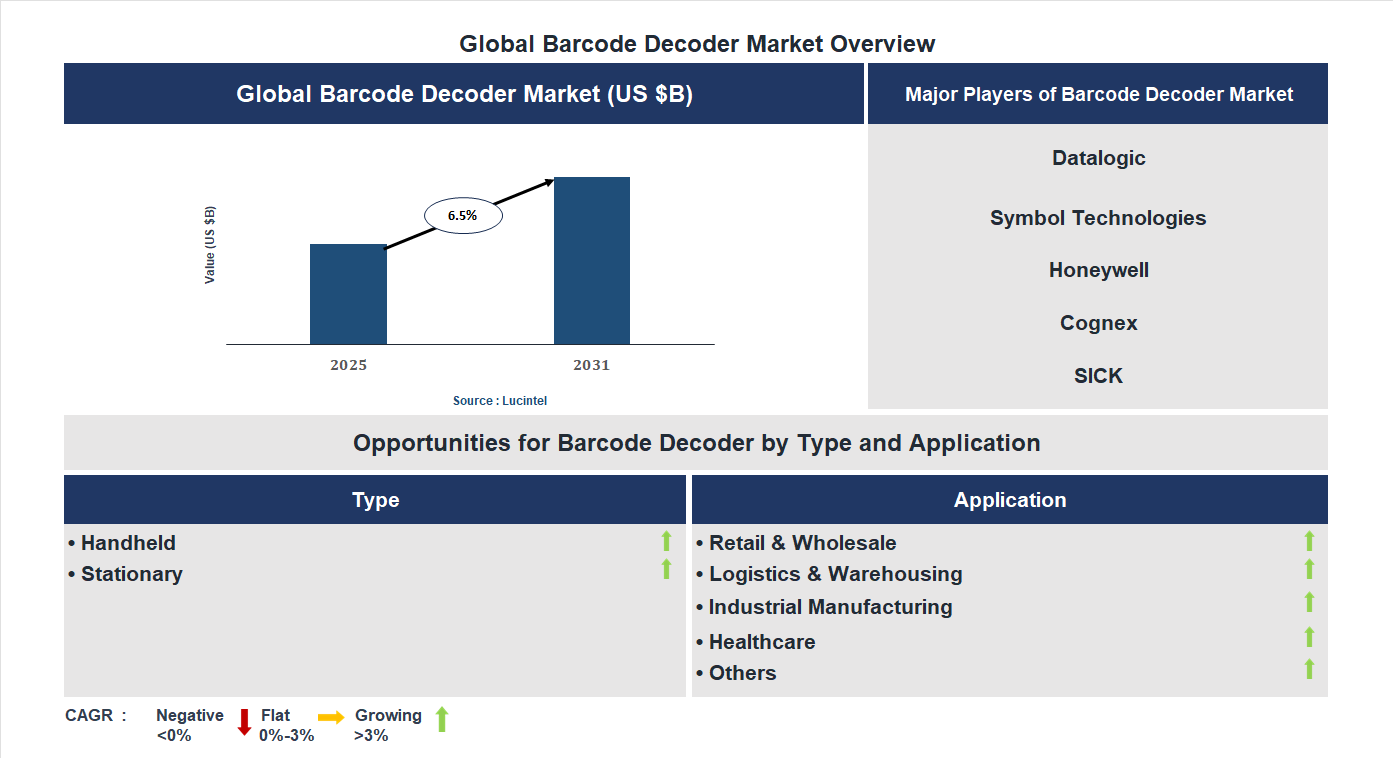
The future of the global barcode decoder market looks promising with opportunities in the retail & wholesale, logistics & warehousing, industrial manufacturing, and healthcare markets. The global barcode decoder market is expected to grow with a CAGR of 6.5% from 2025 to 2031. The major drivers for this market are the increasing demand for automated data processing, the rising adoption of barcode scanning technologies, and the growing need for efficient supply chain management.• Lucintel forecasts that, within the type category, handheld is expected to witness higher growth over the forecast period.
• Within the application category, retail & wholesale is expected to witness the highest growth.
• In terms of region, APAC is expected to witness the highest growth over the forecast period. Gain valuable insights for your business decisions with our comprehensive 150+ page report. Sample figures with some insights are shown below.
Emerging Trends in the Barcode Decoder Market
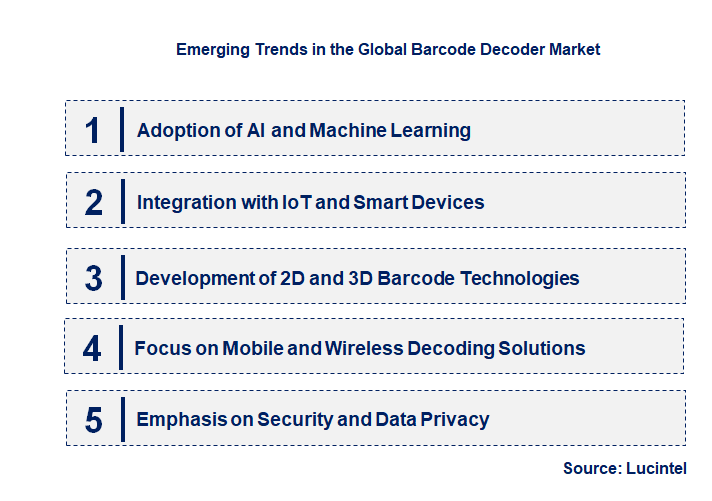
The barcode decoder market is experiencing rapid evolution driven by technological advancements, increasing demand for automation, and the need for efficient inventory management across various industries. As businesses seek faster, more accurate data capture solutions, innovative decoding technologies and integration with emerging digital systems are shaping the landscape. The market is also influenced by the growing adoption of IoT and AI, which enhance decoding capabilities and operational efficiency. These developments are transforming how companies manage assets, streamline workflows, and improve customer experiences. Understanding these key trends is essential for stakeholders aiming to stay competitive in this dynamic environment.• Adoption of AI and Machine Learning: This trend involves integrating AI and machine learning algorithms into barcode decoders to improve accuracy and speed. AI-powered decoders can recognize damaged or poorly printed barcodes, reducing errors and increasing reliability. Machine learning models continuously improve through data analysis, enabling smarter decoding processes. This advancement enhances operational efficiency, especially in complex environments like warehouses and retail stores, where quick and precise data capture is critical. As AI integration becomes more widespread, it will drive innovation and set new standards for decoding performance.
• Integration with IoT and Smart Devices: The rise of IoT devices and smart systems is significantly impacting the barcode decoder market. Decoders are now being embedded into connected devices, enabling real-time data sharing and automation across supply chains. This integration facilitates seamless inventory tracking, asset management, and automated checkout processes. It also allows for remote diagnostics and maintenance, reducing downtime. The synergy between barcode decoders and IoT enhances overall operational transparency and efficiency, making supply chains more responsive and adaptable to changing market demands.
• Development of 2D and 3D Barcode Technologies: The shift from traditional 1D barcodes to 2D and 3D barcode systems is a notable trend. These advanced barcodes can store significantly more data, including multimedia and geolocation information. Decoders capable of reading these complex codes are becoming more sophisticated, supporting applications in healthcare, logistics, and retail. The increased data capacity improves tracking accuracy and enables more detailed analytics. As 2D and 3D barcode adoption grows, decoder technology must evolve to handle higher data densities and complex imaging, driving innovation in the market.
• Focus on Mobile and Wireless Decoding Solutions: Mobile and wireless barcode decoding solutions are gaining popularity due to their flexibility and ease of use. Smartphone-based decoders and portable scanners allow workers to perform data capture anywhere, reducing dependency on fixed infrastructure. Wireless connectivity enables real-time data transfer to cloud systems, enhancing inventory management and customer service. This trend supports remote and on-the-go operations, especially in retail, logistics, and field services. As mobile technology advances, these solutions will become more affordable and feature-rich, further expanding their market presence and transforming traditional workflows.
• Emphasis on Security and Data Privacy: With increasing digitalization, security concerns related to barcode data are rising. Market players are focusing on developing secure decoding systems that protect sensitive information from cyber threats and unauthorized access. Encryption, secure data transmission, and authentication protocols are being integrated into decoding devices. This trend is particularly important for industries handling confidential data, such as healthcare and finance. Strengthening security measures ensures compliance with regulations and builds trust among users, ultimately supporting broader adoption of barcode decoding solutions in sensitive environments. In summary, these emerging trends are collectively reshaping the barcode decoder market by enhancing accuracy, connectivity, data capacity, mobility, and security. They are enabling businesses to operate more efficiently, respond swiftly to market changes, and leverage digital innovations for competitive advantage. As these trends continue to evolve, the market will see increased adoption of smarter, more integrated, and secure decoding solutions, driving sustained growth and technological progress.
Recent Development in the Barcode Decoder Market
The barcode decoder market has experienced significant growth driven by technological advancements and increasing demand across various industries such as retail, logistics, healthcare, and manufacturing. As businesses seek faster, more accurate data capture solutions, the market has seen innovations in hardware and software, integration with emerging technologies, and expansion into new sectors. These developments are shaping the future landscape of barcode decoding, making it more efficient, versatile, and accessible. Companies are investing heavily in R&D to stay competitive, leading to a dynamic environment that continuously adapts to changing industry needs and technological trends.• Introduction of 2D barcode decoders: These devices now support QR codes and Data Matrix, enabling more complex data to be captured quickly, improving operational efficiency and reducing errors in inventory management and point-of-sale systems.
• Integration of AI and machine learning: AI-powered barcode decoders can now interpret damaged or poorly printed codes, significantly reducing missed scans and increasing accuracy, which enhances productivity in logistics and retail sectors.
• Wireless and portable decoding solutions: The development of wireless handheld scanners and mobile apps allows for greater flexibility and mobility, facilitating real-time data collection in large warehouses, retail stores, and outdoor environments.
• Adoption of cloud-based decoding platforms: Cloud integration enables centralized data management, real-time analytics, and remote troubleshooting, streamlining operations and reducing downtime for businesses across industries.
• Expansion into healthcare and industrial sectors: Barcode decoders are increasingly used for patient identification, medication tracking, and industrial automation, broadening market scope and creating new revenue streams. These developments are collectively transforming the barcode decoder market by enhancing accuracy, speed, and versatility. They are enabling industries to optimize operations, improve data integrity, and adapt to digital transformation trends, ultimately driving market growth and innovation.
Strategic Growth Opportunities in the Barcode Decoder Market
The barcode decoder market is experiencing rapid expansion driven by technological advancements and increasing demand across various industries. As businesses seek efficient inventory management, enhanced security, and streamlined operations, the adoption of barcode decoding solutions is accelerating. Key applications such as retail, healthcare, logistics, manufacturing, and hospitality are pivotal in shaping market growth. These sectors are leveraging innovative decoding technologies to improve accuracy, speed, and integration capabilities. The evolving landscape presents numerous opportunities for market players to capitalize on emerging trends, optimize processes, and meet the rising needs of diverse industries. Understanding these growth opportunities is essential for strategic planning and competitive advantage.• Retail Sector Expansion: Increasing adoption of barcode decoding in retail enhances checkout efficiency and inventory accuracy, leading to improved customer experience and reduced operational costs. This growth supports omnichannel retail strategies and enables real-time stock management, boosting overall sales and customer satisfaction.
• Healthcare Industry Integration: Barcode decoders are vital for patient safety, medication management, and equipment tracking. Their deployment reduces errors, ensures compliance, and streamlines hospital workflows, significantly impacting healthcare quality and operational efficiency.
• Logistics and Supply Chain Optimization: The logistics sector relies heavily on barcode decoding for tracking shipments, inventory management, and warehouse automation. Advanced decoding solutions enable faster processing, reduce errors, and improve supply chain transparency, fostering timely deliveries and cost savings.
• Manufacturing Process Automation: In manufacturing, barcode decoders facilitate quality control, asset tracking, and production line automation. This enhances productivity, minimizes errors, and ensures compliance with industry standards, leading to more efficient manufacturing cycles.
• Hospitality and Service Industry Adoption: The hospitality sector uses barcode decoding for guest management, ticketing, and inventory control. This adoption improves operational efficiency, enhances guest experiences, and supports seamless service delivery, driving growth in this segment. In summary, these key growth opportunities are significantly impacting the barcode decoder market by driving technological innovation, expanding application scope, and improving operational efficiencies across industries. As businesses increasingly prioritize accuracy, speed, and integration, the market is poised for sustained growth and competitive evolution.
Barcode Decoder Market Driver and Challenges
The barcode decoder market is influenced by a variety of technological, economic, and regulatory factors that shape its growth and development. Advances in imaging technology, increasing automation in retail and logistics, and the need for efficient inventory management are key drivers. Simultaneously, regulatory standards for data security and privacy, economic fluctuations affecting capital expenditure, and technological obsolescence pose significant challenges. These factors collectively impact market dynamics, influencing innovation, adoption rates, and competitive strategies. Understanding these drivers and challenges is essential for stakeholders aiming to capitalize on opportunities and mitigate risks within this evolving industry landscape. The factors responsible for driving the barcode decoder market include:• Technological Advancements: The continuous evolution of barcode decoding technology, such as 2D imaging and high-speed scanners, enhances accuracy and speed. These innovations enable businesses to streamline operations, reduce errors, and improve customer experiences. As technology becomes more affordable and sophisticated, adoption rates increase across retail, healthcare, logistics, and manufacturing sectors. The integration of AI and machine learning further boosts decoding capabilities, making barcode scanners more versatile and reliable. This ongoing innovation sustains market growth by meeting the rising demand for efficient data capture solutions in various industries.
• Growing Adoption in Retail and E-commerce: The retail sector's shift towards automation and digitalization significantly propels the demand for barcode decoders. E-commerce platforms rely heavily on barcode scanning for inventory management, order processing, and checkout procedures. The need for quick, accurate, and contactless transactions has accelerated the deployment of barcode decoding solutions. Additionally, the expansion of omnichannel retail strategies and the rise of smart stores further drive the adoption of advanced barcode decoding systems, ensuring seamless customer experiences and operational efficiency.
• Expansion in Logistics and Supply Chain Management: The logistics industry increasingly depends on barcode decoding for tracking shipments, managing warehouse inventories, and streamlining supply chain operations. The rise of global trade and e-commerce has amplified the need for real-time data capture and tracking. Barcode decoders facilitate faster processing, reduce manual errors, and improve overall supply chain visibility. As companies seek to optimize their logistics networks, the demand for robust, high-speed barcode decoding solutions continues to grow, supporting the market's expansion.
• Regulatory and Data Security Standards: Stringent regulations concerning data privacy and security influence the development and deployment of barcode decoding systems. Compliance with standards such as GDPR and industry-specific regulations necessitates secure data handling and encryption features in barcode scanners. Manufacturers are investing in secure hardware and software solutions to meet these requirements, which can drive innovation but also pose challenges related to increased costs and complexity. Adapting to evolving regulatory landscapes is crucial for market players to maintain competitiveness and ensure customer trust.
• Integration with IoT and Industry 4.0: The rise of the Internet of Things (IoT) and Industry 4.0 initiatives fosters the integration of barcode decoders into smart manufacturing and automated systems. These technologies enable real-time data collection, predictive maintenance, and enhanced operational efficiency. Barcode decoders are becoming vital components in interconnected environments, supporting automation and data-driven decision-making. This integration opens new avenues for market growth but also demands advanced, compatible decoding solutions capable of functioning within complex IoT ecosystems. The challenges in the barcode decoder market are:
• Rapid Technological Obsolescence: The fast pace of technological innovation can render existing barcode decoding solutions obsolete quickly. Companies face pressure to continually upgrade hardware and software to stay competitive, which involves significant investment. This rapid obsolescence can lead to increased costs for businesses and may hinder adoption, especially among small and medium-sized enterprises with limited budgets. Additionally, compatibility issues may arise when integrating new technologies with legacy systems, complicating deployment and maintenance.
• High Cost of Advanced Systems: Cutting-edge barcode decoding solutions, such as 2D imagers and high-speed scanners, often come with high initial costs. These expenses can be prohibitive for small and medium-sized enterprises, limiting market penetration. The ongoing costs related to maintenance, upgrades, and training further add to the financial burden. This economic barrier can slow down the adoption rate in price-sensitive markets, restricting overall market growth and creating disparities between developed and developing regions.
• Regulatory and Security Challenges: Navigating complex regulatory environments and ensuring data security pose significant hurdles. Compliance with diverse international standards requires continuous updates and certifications, which can be resource-intensive. Moreover, increasing concerns over data breaches and cyber threats necessitate robust security measures, adding to the complexity and cost of barcode decoding solutions. Failure to meet regulatory requirements or security standards can result in legal penalties, loss of customer trust, and market setbacks for manufacturers and users alike. In summary, the barcode decoder market is driven by technological innovations, expanding applications in retail, logistics, and Industry 4.0, alongside regulatory compliance. However, rapid technological changes, high costs, and security challenges present notable obstacles. These factors collectively influence market growth, requiring stakeholders to innovate continuously, manage costs effectively, and prioritize security to capitalize on emerging opportunities. Overall, the market's future hinges on balancing these drivers and challenges to foster sustainable development and technological advancement.
List of Barcode Decoder Companies
Companies in the market compete on the basis of product quality offered. Major players in this market focus on expanding their manufacturing facilities, R&D investments, infrastructural development, and leverage integration opportunities across the value chain. With these strategies barcode decoder companies cater increasing demand, ensure competitive effectiveness, develop innovative products & technologies, reduce production costs, and expand their customer base. Some of the barcode decoder companies profiled in this report include-• Datalogic
• Symbol Technologies
• Honeywell
• Cognex
• SICK
• Newland
• Denso Wave
• Code
• Microscan
• Opticon Sensors
Barcode Decoder Market by Segment
The study includes a forecast for the global barcode decoder market by type, application, and region.Barcode Decoder Market by Type [Value from 2019 to 2031]:
• Handheld
• Stationary
Barcode Decoder Market by Application [Value from 2019 to 2031]:
• Retail & Wholesale
• Logistics & Warehousing
• Industrial Manufacturing
• Healthcare
• Others
Barcode Decoder Market by Region [Value from 2019 to 2031]:
• North America
• Europe
• Asia Pacific
• The Rest of the World
Country Wise Outlook for the Barcode Decoder Market
The barcode decoder market has experienced significant growth driven by technological advancements, increasing adoption across various industries, and the need for efficient inventory management. As digital transformation accelerates globally, countries are investing in innovative solutions to enhance operational efficiency and customer experience. The market's evolution is marked by the integration of AI, machine learning, and IoT, which are transforming traditional barcode decoding methods. Each country’s unique economic landscape and technological infrastructure influence their development trajectory, leading to diverse innovations and market strategies. Here is a country-specific overview of recent developments in the barcode decoder market.• United States: The US market has seen rapid adoption of AI-powered barcode decoders, especially in retail and logistics sectors. Major players are investing in advanced machine learning algorithms to improve decoding accuracy and speed. The integration of IoT devices with barcode systems is enhancing supply chain transparency. Additionally, the rise of contactless and mobile barcode solutions has gained momentum post-pandemic, emphasizing safety and convenience. The US government’s focus on smart manufacturing is further fueling market growth through increased automation initiatives.
• China: China’s barcode decoder market is expanding due to the booming e-commerce and retail sectors. Companies are adopting high-speed, multi-directional barcode scanners to handle large volumes of transactions efficiently. The government’s push for smart logistics and warehouse automation is driving demand for sophisticated decoding solutions. Chinese firms are also investing in R&D to develop AI-enabled decoders that can read damaged or poorly printed barcodes, improving operational reliability. The integration of barcode technology with mobile payment systems is another notable trend.
• Germany: Germany’s market is characterized by a focus on industrial automation and precision. The adoption of rugged, high-performance barcode decoders in manufacturing and automotive industries is prominent. German companies are emphasizing the development of eco-friendly and energy-efficient decoding solutions. The integration of barcode systems with Industry 4.0 initiatives is enhancing real-time data collection and process optimization. Additionally, there is a growing demand for wireless and handheld barcode scanners to improve flexibility and productivity in logistics and retail sectors.
• India: The Indian barcode decoder market is witnessing rapid growth driven by expanding retail, logistics, and healthcare sectors. Local manufacturers are developing cost-effective, portable barcode scanners suitable for small and medium enterprises. The government’s initiatives to promote digital payments and cashless transactions are boosting barcode technology adoption. There is also a rising trend of integrating barcode decoding with mobile apps for inventory management and tracking. Investments in smart city projects and warehouse automation are expected to further propel market expansion.
• Japan: Japan’s market is focused on high-precision, durable barcode decoders tailored for manufacturing and healthcare applications. The adoption of advanced imaging and 2D barcode decoding technologies is increasing. Japanese firms are investing in AI and machine learning to enhance decoding capabilities, especially for damaged or complex barcodes. The emphasis on automation and robotics in factories is driving demand for integrated barcode solutions. Additionally, the aging population has led to innovations in user-friendly, ergonomic barcode scanning devices to improve workplace safety and efficiency.

Features of the Global Barcode Decoder Market
Market Size Estimates: Barcode decoder market size estimation in terms of value ($B). Trend and Forecast Analysis: Market trends (2019 to 2024) and forecast (2025 to 2031) by various segments and regions. Segmentation Analysis: Barcode decoder market size by type, application, and region in terms of value ($B). Regional Analysis: Barcode decoder market breakdown by North America, Europe, Asia Pacific, and Rest of the World. Growth Opportunities: Analysis of growth opportunities in different types, applications, and regions for the barcode decoder market. Strategic Analysis: This includes M&A, new product development, and competitive landscape of the barcode decoder market. Analysis of competitive intensity of the industry based on Porter’s Five Forces model.
FAQ
Q1. What is the growth forecast for barcode decoder market? Answer: The global barcode decoder market is expected to grow with a CAGR of 6.5% from 2025 to 2031. Q2. What are the major drivers influencing the growth of the barcode decoder market? Answer: The major drivers for this market are the increasing demand for automated data processing, the rising adoption of barcode scanning technologies, and the growing need for efficient supply chain management. Q3. What are the major segments for barcode decoder market? Answer: The future of the barcode decoder market looks promising with opportunities in the retail & wholesale, logistics & warehousing, industrial manufacturing, and healthcare markets. Q4. Who are the key barcode decoder market companies? Answer: Some of the key barcode decoder companies are as follows:• Datalogic
• Symbol Technologies
• Honeywell
• Cognex
• SICK
• Newland
• Denso Wave
• Code
• Microscan
• Opticon Sensors Q5. Which barcode decoder market segment will be the largest in future? Answer: Lucintel forecasts that, within the type category, handheld is expected to witness higher growth over the forecast period. Q6. In barcode decoder market, which region is expected to be the largest in next 5 years? Answer: In terms of region, APAC is expected to witness the highest growth over the forecast period. Q7. Do we receive customization in this report? Answer: Yes, Lucintel provides 10% customization without any additional cost.
Table of Contents
List of Figures
List of Tables
Methodology
- In-depth interviews of the major players in this market
- Detailed secondary research from competitors’ financial statements and published data
- Extensive searches of published works, market, and database information pertaining to industry news, company press releases, and customer intentions
- A compilation of the experiences, judgments, and insights of Lucintel’s professionals, who have analyzed and tracked this market over the years.


Buy Now
Choose a license that fits your team. Instant PDF delivery.
Prices exclude taxes. Instant delivery. Custom licensing available on request.
Key Questions
- • What are some of the most promising, high-growth opportunities for the barcode decoder market by type (handheld and stationary), application (retail & wholesale, logistics & warehousing, industrial manufacturing, healthcare, and others), and region (North America, Europe, Asia Pacific, and the Rest of the World)?
- • Which segments will grow at a faster pace and why?
- • Which region will grow at a faster pace and why?
- • What are the key factors affecting market dynamics? What are the key challenges and business risks in this market?
- • What are the business risks and competitive threats in this market?
- • What are the emerging trends in this market and the reasons behind them?
- • What are some of the changing demands of customers in the market?
- • What are the new developments in the market? Which companies are leading these developments?
- • Who are the major players in this market? What strategic initiatives are key players pursuing for business growth?
- • What are some of the competing products in this market and how big of a threat do they pose for loss of market share by material or product substitution?
- • What M&A activity has occurred in the last 5 years and what has its impact been on the industry? For any questions related to Barcode Decoder Market, Barcode Decoder Market Size, Barcode Decoder Market Growth, Barcode Decoder Market Analysis, Barcode Decoder Market Report, Barcode Decoder Market Share, Barcode Decoder Market Trends, Barcode Decoder Market Forecast, Barcode Decoder Companies, write Lucintel analyst at email: helpdesk@lucintel.com. We will be glad to get back to you soon.


