
Market Report · July 22, 2026

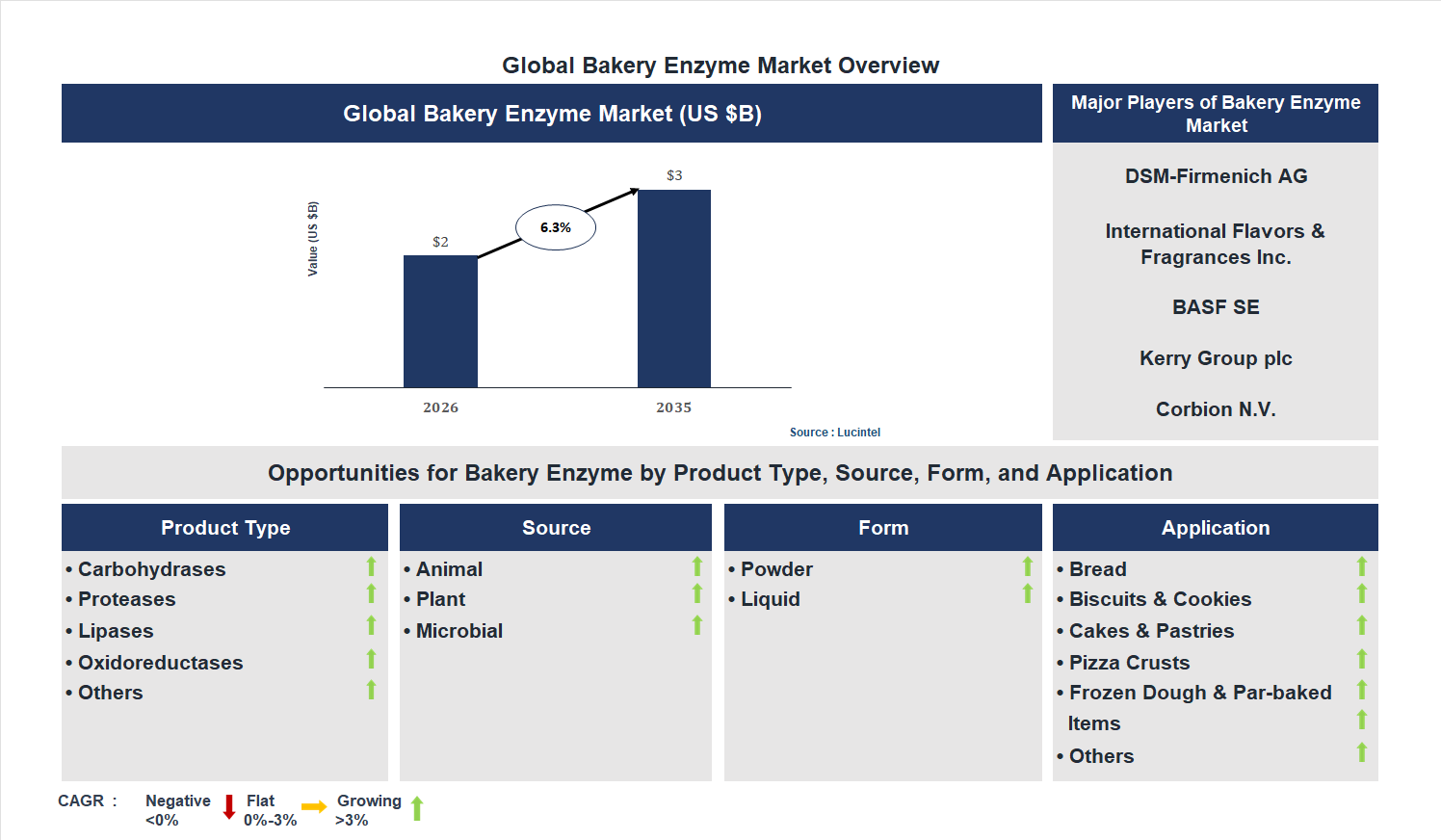
Key data points: The market size in 2035 = $3 billion, growth forecast = 6.3% annually for the next 8 years. Scroll below to get more insights. This market report covers trends, opportunities and forecasts in bakery enzyme market to 2035 by product type (carbohydrases, proteases, lipases, oxidoreductases, and others), source (animal, plant, and microbial), form (powder and liquid), application (bread, biscuits & cookies, cakes & pastries, pizza crusts, frozen dough & par-baked items, and others), and region (North America, Europe, Asia Pacific, and the Rest of the World)
We'll send your sample report shortly.
• Lucintel forecasts that, within the product type category, carbohydrase is expected to witness the highest growth over the forecast period.
• Within the application category, bread is expected to witness the highest growth.
• In terms of region, APAC is expected to witness the highest growth over the forecast period. Gain valuable insights for your business decisions with our comprehensive 150+ page report. Sample figures with some insights are shown below.
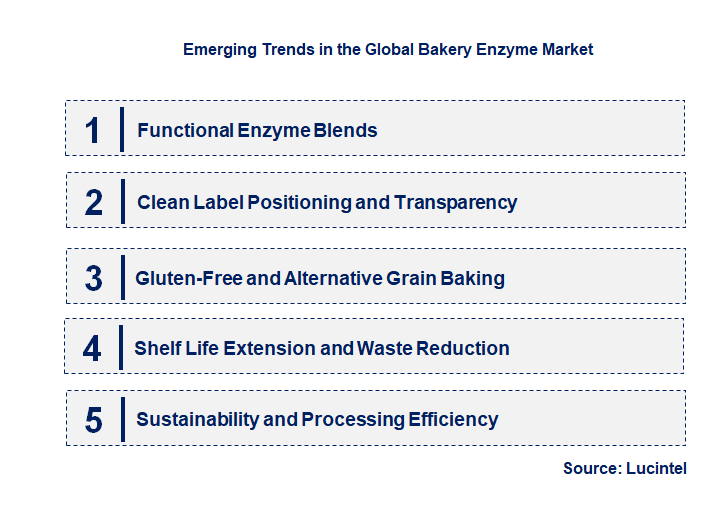
• Functional enzyme blends : Manufacturers are shifting from single-enzyme offerings to tailored blends that deliver reliable dough rheology, improved gas retention, and predictable crumb structure across different flour sources. This is especially valuable where wheat variability causes performance drift in large-scale plants. Common sub segments include bread improvers, cake and pastry systems, and frozen doughs, where controlled fermentation and thaw stability are critical. Enzyme blends also support lower yeast and water adjustments while maintaining machinability and volume, reducing cost volatility. As adoption grows, suppliers increasingly validate blends through bakery-specific trials, offering recipe-ready guidance and performance guarantees to speed commercialization.
• Clean label positioning and transparency : Enzyme suppliers are emphasizing natural origin, enzyme safety, and clearer labeling to match consumer and brand requirements. While enzymes are widely used, buyers are demanding more evidence on production method, allergen management, and traceability. Sub segments showing strong momentum include organic and “minimal ingredient” bread lines, premium artisan-style products that require consistent texture, and plant-forward baked goods. Many contracts now include documentation packages for regulatory compliance and audit readiness. The result is faster approvals by quality teams and increased adoption in retail and foodservice, where marketing claims influence purchasing decisions.
• Gluten-free and alternative grain baking : Enzymes are becoming a key enabler for gluten-free performance, helping address softness, moisture retention, and crumb cohesiveness that typical binders struggle to achieve. Suppliers target enzymes that improve starch behavior, water distribution, and structure formation in rice, corn, sorghum, and blends with legumes. Sub segments include gluten-free bread, buns, tortillas, and snack-style baked products, each requiring different texture and shelf-life profiles. Market impact includes higher enzyme dosage optimization, more formulation engineering, and increased collaboration between enzyme makers and gluten-free brand labs. This trend expands total addressable demand and drives new product development cycles.
• Shelf life extension and waste reduction : Bakeries face pressure to maintain softness while minimizing preservatives. Enzymes such as anti-staling and moisture-management solutions help slow staling and control texture degradation over storage. This supports longer distribution routes and fewer returns, improving profitability. Sub segments with strong adoption include sliced breads, sandwich products, and retail-ready packs where texture consistency after days on shelf is critical. Some processors also use enzymes to reduce the need for reformulation when seasonal flour changes affect water absorption. The market benefit is improved customer satisfaction and measurable waste reduction, which encourages broader uptake even where margins are tight.
• Sustainability and processing efficiency : Enzyme production and bakery operations are being evaluated through lower energy use, reduced ingredient waste, and improved dosing efficiency. Suppliers increasingly optimize fermentation processes, pursue renewable inputs where feasible, and reduce downstream processing impacts. On the buyer side, enzymes enable process improvements such as shorter mixing times, more stable fermentation, and tighter control of dough viscosity. Sub segments include high-throughput industrial bakeries, ready-to-bake production, and exporter supply chains that need stable performance with minimal disruption. Local or regionally diversified manufacturing and distribution plans are also emerging to reduce lead times and mitigate logistics risk, strengthening long-term customer relationships. These trends are reshaping the bakery enzyme market by raising expectations for performance reliability, accelerating development of specialized blends for modern product categories, and shifting marketing toward transparency and measurable outcomes. Growth is increasingly driven by challenging applications such as gluten-free and frozen or shelf-life-sensitive formats, while sustainability and supply resilience influence procurement decisions. Together, these forces are moving the market from commodity enzyme supply toward value-added, co-developed solutions that integrate technical validation, regulatory readiness, and operational efficiency across the baking value chain.
• Thermostable Enzyme Systems Enable Stable Automated Dough Handling: Thermostable, spray-dried enzyme preparations are increasingly engineered for stability during dough mixing retarding and high-throughput dosing Suppliers now provide standardized activity ranges better solubility and reduced dusting which improves accuracy in industrial bakeries This lowers batch variability supports faster proofing and reduces waste As automation and shelf-life expectations rise bakeries can justify premium enzyme systems that deliver repeatable crumb texture and crust development with minimal process changes including for frozen dough pre-mix lines and multi-shift production schedules across regions today
• Targeted Enzymes Improve Gluten-Free And Whole-Grain Texture: Specialty enzymes such as xylanases cellulases and proteases are being tailored for gluten-free and whole-grain formulas to improve viscosity water absorption and gas retention Recent enzyme blends also target starch damage and retrogradation helping maintain softness in rice sorghum and oat-based breads Manufacturers are offering trailable systems with clear dosing guidelines and objective dough tests accelerating formulation work for smaller brands This drives adoption by enabling cleaner labels fewer improvers and consistent consumer texture across batch sizes with reliable outcomes
• Fermentation-Derived Clean-Label Enzymes Replace Harsh Improvers: Demand for clean-label baking is pushing production toward fermentation-derived enzymes and transparent sourcing of raw materials New process controls reduce by-products such as residual proteins and adjust allergen-management documentation easing retailer audits Enzyme suppliers are also formulating with multi-enzyme synergy to achieve performance without added chemical oxidants or strengthening agents For cakes and pastries targeted amylases and lipases improve flavor development and moisture retention supporting longer shelf life These shifts help brands meet labeling rules while maintaining cost-effective functionality globally
• Sustainable Sourcing And Greener Production Expand Adoption: Enzyme manufacturers are investing in lower-impact upstream feedstocks and greener manufacturing operations including energy optimization water reuse and reduced solvent use in downstream recovery Some are exploring agro-industrial co-products as fermentation substrates lowering costs and supporting circular-economy narratives valued by buyers Enhanced enzyme concentration and shelf-stable formats cut transport weight and storage losses For bakeries this means fewer kilograms per ton of dough and less waste in reformulation cycles Sustainability-linked procurement broadens the addressable market for enzyme suppliers globally now
• Digital Formulation Support Speeds Compliance And Innovation: Regulatory expectations are driving data-driven enzyme solutions Suppliers provide application labs rapid-screening protocols and digital formulation tools that estimate dough rheology and shelf-life outcomes from enzyme type and dose Stricter allergen and traceability systems reduce compliance risk for retail and foodservice customers For industrial bakeries these tools shorten development timelines for seasonal products and new SKUs while improving consistency across procurement lots The outcome is faster innovation stronger customer retention and lower operational risk which supports premium pricing and scaling Conclusion (80 Words) – Conclude by summarizing the overall impact of these opportunities on the market. Together, these developments are making bakery enzyme performance more predictable enabling formulators to target gluten-free and whole-grain needs and supporting clean-label positioning without sacrificing functionality Advances in stability and automation reduce waste and improve throughput while sustainability-focused production strengthens brand and procurement appeal Better digital tools and compliance support accelerate product innovation and minimize regulatory friction Overall enzyme suppliers with tailored data-backed offerings gain share as bakeries adopt customized systems for cost quality and resilience in an increasingly demanding market
• Expand Clean-Label Enzyme Blends For Premium Bread: Develop clean-label enzyme blends from yeast-derived or microbial sources with transparent labeling and allergen-safe carrier systems. Target sub-segments such as pan bread, buns, and sweet rolls where bakers need predictable lift, softness, and flavor development without chemical dough conditioners. Offer standardized dosage ranges for improvers, plus optional omega-3 or wholegrain support via tailored amylase and xylanase blends. Partner with ingredient retailers and quality labs to provide documentation, allergen status, and shelf stability data, accelerating adoption across artisanal and industrial lines.
• Scale Enzyme Systems For Gluten-Free And Low-Gluten Products: Scale enzyme solutions for gluten-free and low-gluten formulations using enzymes that improve starch hydration, gas retention, and texture rebuilding. Prioritize sub-segments including rice- and corn-based breads, muffins, and frozen dough products where staling is rapid. Combine amylases, hemicellulases, and transglutaminase-like functionalities to strengthen structure, reduce grittiness, and support emulsifier-free recipes. Provide formulation toolkits with ingredient compatibility maps for hydrocolloids such as psyllium and guar. This enables brands to differentiate by taste and mouthfeel while meeting regulatory and labeling requirements globally.
• Extend Freshness Through Waste-Reducing Shelf-Life Enzymes: Offer enzyme systems that extend freshness and reduce bakery waste by slowing retrogradation and improving moisture retention. Focus on premium bread, sliced loaves, and cakes where staling drives discounting and returns. Deliver targeted beta-amylase, glucose oxidase, and protease blends that work with existing fermentation schedules and reduce the need for improver-heavy formulations. Include process optimization support for mixing time, temperature, and proofing to maximize performance in high-speed lines. Faster development with shelf stability lowers total cost per loaf and losses.
• Develop Modular Enzyme Packs For Frozen And Par-Baked Production: Create application-specific enzyme packs for high-throughput manufacturing, especially frozen and par-baked systems. Commercial bakers need repeatable dough rheology across fluctuating flour lots, so sell modular packages: yeast-handling enzymes, dough strengthening enzyme, and finishing enzymes for crust color. Target sub-segments like baguettes, burger buns, and croissants where consistency affects consumer acceptance. Provide integrated training for plant operators and digital dosing guidance to reduce trial-and-error. By lowering variability and enabling faster production changeovers, enzyme customization improves margins and supports large multi-site contracts.
• Expand Regional Adoption With Compliance-Ready, Flour-Specific Solutions: Expand into fast-growing regions by aligning enzyme offerings with local regulations and flour characteristics. Build distribution partnerships for bakery groups across Latin America, Asia-Pacific, and the Middle East as commercial baking scales. Segment products by flour type (soft wheat, hard wheat, blends) and bake style (yeasted bread, steamed buns, cake mixes) to ensure fast performance. Provide responsive technical service, shelf-life forecasting, and compliance documentation for audits. This reduces friction for new entrants, accelerates procurement cycles, and boosts customer retention significantly. Collectively, these five growth opportunities can raise adoption of bakery enzymes by addressing evolving consumer expectations and production realities. Clean-label systems improve trust and simplify formulation, while gluten-free enzyme packs expand category participation. Shelf-life-focused solutions cut waste and protect margins for bakers of bread and cakes. Industrial customization for frozen and par-baked formats increases consistency and speeds scale-up Finally, regional expansion supported by compliance-ready service accelerates entry and retention. Together, they strengthen supply performance, deepen innovation pipelines, and sustain growth.
• Demand for consistent quality and improved baking performance: Bakers and industrial operators rely on enzymes to deliver consistent dough rheology, better gas retention, and predictable fermentation outcomes. Enzymes such as amylases, proteases, and xylanases can reduce variability caused by flour differences, seasonal wheat quality, or supply chain changes. This consistency lowers batch rejection rates, improves yield, and helps producers meet tight production schedules. As retail and foodservice customers expect stable taste and texture, enzymes become a practical way to standardize outcomes across plants and shift patterns, making them valuable for scaling operations and reducing manual process adjustments.
• Growth of processed and convenience bakery products: The expansion of bread, buns, rolls, pastries, and frozen or parbaked products increases demand for functional ingredients that extend shelf life and optimize performance during industrial processing. Enzymes help support faster dough development, improved softness, and controlled staling through starch and protein modification. They also enable flexible production cycles, supporting logistics such as bulk mixing, chilled storage, and downstream finishing at different facilities. As manufacturers pursue higher throughput and automation, enzyme solutions that integrate smoothly with existing lines become more attractive, strengthening adoption across industrial bakeries and ingredient distributors.
• Rising need for cost efficiency and resource optimization: Ingredient and energy costs pressure bakery producers to maintain profitability without sacrificing quality. Enzymes can enable lower usage of certain additives, reduce fermentation time, and stabilize performance with varying flour blends, which helps mitigate raw material price swings. By improving dough strength and handling, enzymes can reduce waste from overmixing or failed proofing. Many operators also value formulations that support thinner processing margins, fewer labor interventions, and improved yield per batch. These economic benefits drive procurement decisions and encourage longer-term ingredient contracts.
• Technological advances in enzyme production and formulation: Advances in enzyme discovery, microbial strain engineering, and downstream processing enhance enzyme activity, stability, and suitability for diverse baking applications. Modern formulations often include blends tailored to specific product categories, flour types, and processing temperatures. Improved thermostability and pH tolerance reduce performance loss during mixing, baking, and storage. Additionally, better encapsulation or carrier systems can improve dosing accuracy and shelf life for distributors and bakery customers. These technical improvements increase the reliability of enzyme performance, which accelerates trial-to-adoption and supports broader penetration into new product lines and geographies.
• Regulatory clarity and consumer-driven labeling transparency: Food safety frameworks and clearer guidance on enzyme sourcing, manufacturing controls, and labeling practices can reduce uncertainty for buyers. When enzyme products are backed by robust safety dossiers, traceability, and quality management systems, producers gain confidence for procurement in regulated markets. At the same time, consumer preferences for clean-label positioning encourage the use of processing aids that do not function as traditional chemical additives. Enzymes are often perceived as functional, enabling manufacturers to rationalize ingredient lists while delivering performance, supporting market growth in regions where transparency and compliance are key purchase criteria. The challenges facing the bakery enzyme marketinclude:
• Regulatory and compliance requirements across regions: Enzyme products must meet varying standards for safety assessment, manufacturing practices, and approved uses depending on the country or trading bloc. Compliance challenges include differing requirements for documentation, maximum residue and contaminant limits, allergen management, and labeling conventions. If enzyme preparations use novel strains or fermentation substrates, additional scrutiny and longer approval cycles may be required. For multinational producers, maintaining consistent quality documentation across suppliers and production sites can increase administrative costs and slow product launches. Any change in regulations or public scrutiny around enzyme origins can disrupt market access and force reformulation or re-approval.
• Performance variability due to raw material differences and process conditions: Although enzymes are designed for reliable outcomes, performance can vary with flour composition, hydration levels, mixing intensity, yeast quality, and oven parameters. Wheat varieties differ in protein content, damaged starch, and pentosan levels, which can alter how enzymes function in dough. Tight timelines in industrial bakeries also limit the opportunity to retune dosing and process parameters after switching flour lots or enzyme suppliers. This creates risk of inconsistent texture, loaf volume, or shelf-life outcomes, leading to customer dissatisfaction or increased costs from trial batches. Managing variability requires technical support and active formulation stewardship.
• Supply chain risks and price volatility for biological inputs: Enzyme manufacturing depends on biological feedstocks, specialized chemicals, and fermentation capacity, all of which can be exposed to geopolitical disruptions, weather impacts, or logistics constraints. Raw material cost swings, energy price changes, and constraints in upstream fermentation supply can pressure margins for enzyme producers and buyers. Storage and handling requirements may also raise distribution complexity, especially for temperature-sensitive products or long supply routes. If availability tightens, bakeries may face delayed production, emergency substitutions, or higher enzyme pricing, which can slow adoption and strain procurement plans, particularly for smaller commercial operators. The bakery enzyme marketis shaped by strong adoption drivers including the need for consistent dough quality, expansion of processed and convenience bakery products, and cost efficiency pressures that favor performance-enhancing ingredients. Technological improvements in enzyme production and formulation further increase reliability and broaden application potential. Regulatory clarity can support market confidence, while consumer expectations for transparent processing aid use reinforce demand. However, growth is constrained by regulatory differences across regions, performance variability driven by flour and process changes, and supply chain and input price volatility. Overall, the market advances fastest where compliance is manageable and technical support reduces formulation risk.
• DSM-Firmenich AG
• International Flavors & Fragrances Inc.
• BASF SE
• Kerry Group plc
• Corbion N.V.
• Novozymes A/S
• Amano Enzyme Inc.
• Kerry Group plc
• Associated British Foods plc
• Lallemand Inc.
• Carbohydrases
• Proteases
• Lipases
• Oxidoreductases
• Others
• Animal
• Plant
• Microbial
• Powder
• Liquid
• Bread
• Biscuits & Cookies
• Cakes & Pastries
• Pizza Crusts
• Frozen Dough & Par-baked Items
• Others
• North America
• Europe
• Asia Pacific
• The Rest of the World
• United States: Bakeries are expanding the use of amylases, xylanases, and proteases to boost volume and softness while reducing traditional additives and improver load. Growth has been supported by demand for artisan-style breads, frozen dough, and better-performing mixes for in-store and industrial baking. Suppliers are emphasizing enzyme blends that tolerate variable flour quality and support faster fermentation schedules. In parallel, clean-label expectations are encouraging products positioned as natural processing aids, with stronger application support for proofing control, texture consistency, and shelf-life extension.
• China: China’s market is shifting toward higher-efficiency, locally produced enzyme preparations, with broader availability across industrial bread, mooncake and pastry sectors, and snack-biscuit manufacturing. Domestic producers are investing in strain development and fermentation capacity, improving cost competitiveness versus imports. Recent developments include more tailored enzyme systems for specific wheat blends and automated dosing at scale to stabilize output quality. Export opportunities are also strengthening as Chinese manufacturers refine documentation and technical service for overseas customers. Overall, adoption is rising where bakeries face labor constraints and need faster, more consistent production.
• Germany: German buyers are increasingly focused on process optimization and sustainability, driving demand for enzymes that improve yields, reduce waste, and lower energy intensity in baking lines. Development is centered on dough-functionality consistency for high-quality bread types, including better gluten development, controlled crumb structure, and extended freshness in commercial baking. Suppliers are also aligning offerings with European ingredient and processing-aid expectations, with emphasis on traceability and performance validation. Additionally, collaboration between enzyme producers and bakeries has increased, helping integrate enzymes into modern proofing, baking schedules, and quality assurance systems.
• India: India is seeing rising consumption of bakery products such as bread, buns, rusks, and biscuits, which is increasing enzyme usage to manage variability in wheat and flour characteristics. Bakers are adopting enzymes to improve dough extensibility, gas retention, and consistent rise, particularly in accelerated or high-throughput processes. Growth is supported by the expansion of organized retail and industrial bakery production, where reliability and shelf-life are key. Indian suppliers and distributors are strengthening formulation support and making enzyme solutions more accessible by offering application-specific blends at competitive price points. This is also encouraging broader use beyond premium segments.
• Japan: Japan’s market is characterized by premium positioning and demand for dependable texture and freshness, supporting continued use of enzymes such as amylases and maltogenic systems for softness retention and controlled staling. Recent developments include greater use of enzyme blends that work well with refined flour profiles and customized fermentation conditions used by large bakeries and specialized chains. Suppliers are providing improved guidance for uniform browning, crumb elasticity, and longer shelf stability under packaging constraints. Additionally, as Japanese bakeries innovate with new bread formats and seasonal items, enzyme manufacturers are responding with tailored solutions for consistent results and streamlined production planning.


• DSM-Firmenich AG
• International Flavors & Fragrances Inc.
• BASF SE
• Kerry Group plc
• Corbion N.V.
• Novozymes A/S
• Amano Enzyme Inc.
• Kerry Group plc
• Associated British Foods plc
• Lallemand Inc. Q6. Which bakery enzyme market segment will be the largest in future? Answer: Lucintel forecasts that, within the product type category, carbohydrase is expected to witness the highest growth over the forecast period. Q7. In bakery enzyme market, which region is expected to be the largest in next 8 years? Answer: In terms of region, APAC is expected to witness the highest growth over the forecast period. Q8. Do we receive customization in this report? Answer: Yes, Lucintel provides 10% customization without any additional cost.


Choose a license that fits your team. Instant PDF delivery.
Prices exclude taxes. Instant delivery. Custom licensing available on request.
Market Report · July 22, 2026
Market Report · July 22, 2026
Market Report · July 22, 2026
Trusted partner for strategic intelligence and business growth


Receive a complimentary market analysis tailored to your industry. Our analysts will identify key growth opportunities and competitive dynamics specific to your business.

Market size, growth rate, and key trend analysis for your specific sector.

Top competitor positioning and market share analysis.

Strategic recommendations backed by data-driven insights.
Get curated market intelligence and competitive moves straight to your inbox.
By subscribing, you agree to receive our monthly insights. Unsubscribe anytime.
Receive a complimentary market analysis tailored to your industry. Our analysts will identify key growth opportunities and competitive dynamics specific to your business.
Market size, growth rate, and key trend analysis for your specific sector.
Top competitor positioning and market share analysis.
Strategic recommendations backed by data-driven insights.
Get curated market intelligence, emerging trends, and competitive moves straight to your inbox each month.
By subscribing, you agree to receive our monthly insights. Unsubscribe anytime.
We'll send your sample report shortly.