
Close Lucintel Chat
Didn't Find What You're Looking for?
Call us at +1972 636 5056 or write at helpdesk@Lucintel.com
Ask an Expert Provide Custom Requirements Download Sample Report Search Available Reports
  • helpdesk@Lucintel.com
  • |
  • Call Lucintel +1 972 636 5056
  • |
  • Login
  • |
  • Register
  • |
  • Search
  • |
'
...

The Impact of COVID-19 is included in Baby Shampoo and Conditioner Market Report. Buy it today to get an advantage.

Request the impact of COVID-19 on your product or industry


Baby Shampoo and Conditioner Market Trends and Forecast

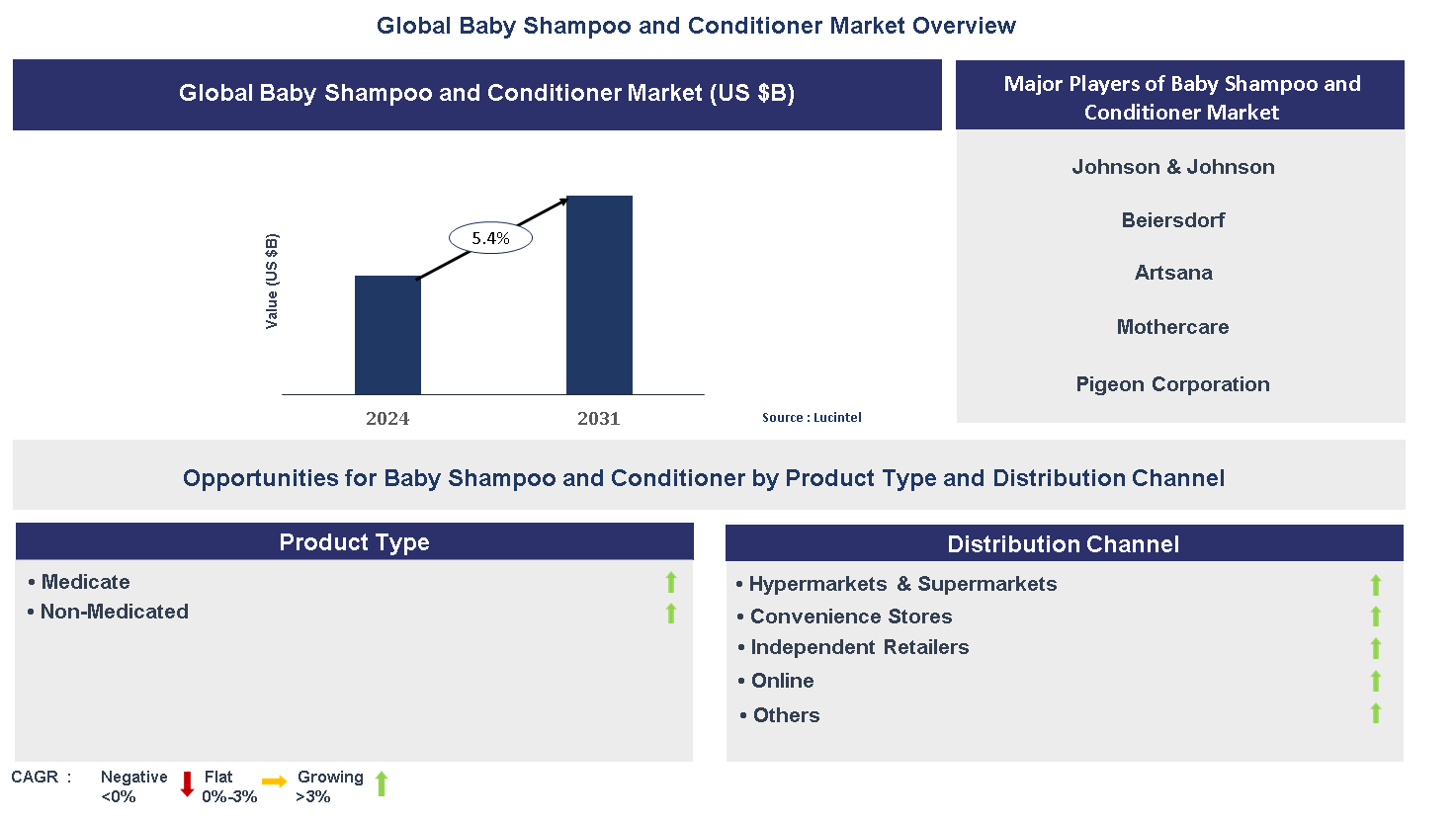
The future of the global baby shampoo and conditioner market looks promising with opportunities in the hypermarket & supermarket, convenience store, independent retailer, and online markets. The global baby shampoo and conditioner market is expected to grow with a CAGR of 5.4% from 2025 to 2031. The major drivers for this market are the increasing awareness about baby hair care, the rising demand for natural ingredients, and the growing focus on gentle baby products.

• Lucintel forecasts that, within the product type category, non-medicated is expected to witness higher growth over the forecast period.
• Within the distribution channel category, online is expected to witness the highest growth.
• In terms of region, APAC is expected to witness the highest growth over the forecast period.
Gain valuable insights for your business decisions with our comprehensive 150+ page report. Sample figures with some insights are shown below.
Baby Shampoo and Conditioner Market Trends and Forecast

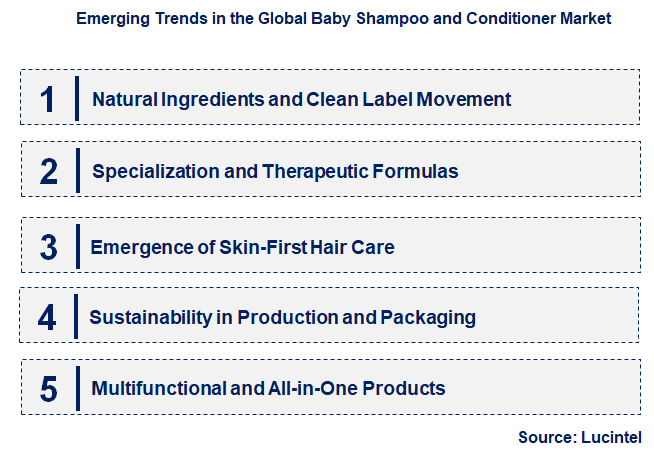
Emerging Trends in the Baby Shampoo and Conditioner Market

The baby shampoo and conditioner category is being redefined by some emerging trends that better understand the health of infants and contemporary parental values. Those days of generic, mass-market products are a thing of the past. People now want science-driven, specialized solutions that are consistent with larger considerations of sustainability and natural living. These trends are impacting everything from product development to advertising, making the industry a more specialized and consumer-driven business that is attentive to both safety and effectiveness.
• Natural Ingredients and Clean Label Movement: One of the major trends is the increased interest in products that have a "clean label," as they contain no toxic chemicals such as sulfates, parabens, phthalates, and artificial perfumes. Parents are going out of their way to find products containing natural, plant-based, and organic ingredients such as chamomile, aloe vera, and coconut oil. This movement is based on a need to limit exposure for a baby to potentially irritating or toxic chemicals. The result is a market shift in which companies are re-formulating products and emphasizing ingredient transparency as a means to gain consumer trust.
• Specialization and Therapeutic Formulas: The market shifts from generic items to specially formulated products that treat particular infant scalp and hair conditions. Demand increases for products specifically formulated to target such conditions as cradle cap, eczema, or dry and sensitive skin. These may include active, medicated ingredients or calming botanicals. This trend is establishing a new category of therapeutic baby hair care and is reinforced by expert advice from pediatricians and dermatologists.
• Emergence of Skin-First Hair Care: One of the key trends is the integrated approach to baby hair care as part of skin care. Parents are discovering that the scalp of a baby is a part of their sensitive skin and requires soothing, nourishing care. This is resulting in products that are pH-balanced, hypoallergenic, and designed to strengthen the skin barrier. The result is that brands now aim to produce gentle, non-irritating formulas that are just as good for the scalp as they are for the hair. This trend is fueled by an increased awareness of infant dermatological health.
• Sustainability in Production and Packaging: There is a growing trend toward sustainable behavior in the market. Brands are being forced to decrease their environmental impact, so they utilize environmentally friendly and biodegradable packaging and refillable products. More consumers are willing to pay a premium for brands that are committed to sustainability and responsible sourcing. The effect is a marketplace where sustainability becomes an important differentiator. This is the direction towards which a new generation of parents lean, who are environmentally aware.
• Multifunctional and All-in-One Products: Convenience-based is the trend that has resulted from the increase in multifunctional products. Parents increasingly choose all-in-one options that offer shampoo, body wash, and even conditioner combined into one product. This makes bath time easier and decreases the amount of bottles in the bathroom. The effect is a market segment appreciating efficiency and minimalism. This trend is especially desired by busy parents who are looking for products that save time but do not compromise product safety or effectiveness.
These new trends are essentially transforming the baby shampoo and conditioner market into a more consumer-focused, expert-level, and morally responsible one. The emphasis on therapeutic formulas and clean labels is elevating the bar for safety and effectiveness in products. Meanwhile, the trend toward a "skin-first" philosophy and sustainable methods is moving the industry more in line with the values of today’s parents. Ultimately, these trends are shifting the market toward a future in which baby hair care is a more conscious, integrated, and sustainable part of a family’s wellness routine.
Emerging Trends in the Baby Shampoo and Conditioner Market

Recent Development in the Baby Shampoo and Conditioner Market

The market for baby shampoo and conditioner is presently shaped by several leading recent trends that are shaping its growth and competitive dynamics. These trends are not standalone happenings but are interrelated, illustrating an emerging movement in consumer values and technology capabilities. The market is becoming increasingly advanced, fueled by scientific advancements, emphasis on efficacy and safety, and new means of connecting with consumers.
• Rollout of Specialized Hair and Scalp Formulas: The other important development is the industry-wide launch of specialized hair and scalp formulas. Brands are no longer stopping at mere "tear-free" offerings but are launching solutions for distinct conditions such as cradle cap, eczema, or sensitive scalps. This innovation caters to an old-standing desire for specialty baby care products. The effect is a more varied market that deals with a broader spectrum of customer requirements, thus enhancing customer satisfaction and brand loyalty. It also enables brands to establish themselves as authorities on infant hair and scalp care.
• Expanded Accessibility of Organic and Natural Goods: One big change is the increase in organic and natural baby shampoo and conditioner brands. Influenced by parent anxieties regarding synthetic chemicals, the products have been developed using ingredients derived from plants and contain no parabens, sulfates, or artificial fragrances. The effect is a large growth of the "clean label" space in the market. This trend is compelling mainstream brands to change their products so as to stay competitive and is opening up a new market for premium, environmentally friendly products.
• Direct-to-Consumer and Online Channel Rise: The rise of online retail and D2C models is a big trend. Brands now use e-commerce platforms and their own websites to target a larger audience without the restrictions of traditional retail. The effect is an extremely competitive market with more choices for consumers. This evolution also permits brands to own their brand message, communicate directly with customers, and collect valuable feedback to use in developing future products.
• Pediatrician and Dermatologist Collaborations: One of the most recent developments is that trend of brands partnering with medical experts. Brands now partner with pediatricians and dermatologists, whose endorsements appear on their packaging and marketing materials. This trend is in response to consumer demand for clinically tested and reputable products. The effect is the enhancement of consumer trust and confidence in the brand. This practice also enables brands to carve out differentiation in a crowded space and command a premium price.
• Sustainable Packaging Innovations: The market is experiencing a significant trend in the field of sustainable packaging. Brands are launching products in recyclable, biodegradable, and recycled packaging. A few are also providing refillable pouches and bigger, more economic sizes to cut back on plastic waste. This innovation is a clear response to pressure from consumers for being environmentally responsible. The effect is a more moral and sustainable business that is in sync with the values of contemporary parents, thus building brand reputation and creating long-term loyalty.
These developments together are collectively transforming the baby shampoo and conditioner market towards a more specialized, ethical, and consumer-led model. The emphasis on therapeutic formulations and partnerships with doctors is building product effectiveness and credibility. At the same time, the move towards online shopping and eco-friendly packaging is streamlining the distribution and ethics of the market, making it more poised for continued growth and competitiveness in front of a new generation of parents.

Strategic Growth Opportunities in the Baby Shampoo and Conditioner Market

Baby shampoo and conditioner industry offers several strategic opportunities for growth in its major uses. With changing consumer tastes and an emphasis on health and safety, companies can capitalize on these opportunities to innovate and gain new market share. These opportunities go beyond conventional product formulae and encompass innovation in marketing, distribution, and product specialization. Identifying and taking advantage of these strategic growth opportunities will be key for firms looking to attain long-term success in this changing market.
• Potential in the Premium and Medicated Segment: There is considerable growth potential in the premium and medicated product category. With an increase in parental income and awareness, there is increased willingness to spend on high-end products that provide specific therapeutic value. Businesses can take advantage of this by creating specialized, clinically proven products for ailments such as eczema or cradle cap. This enables brands to charge more, establish a reputation for excellence, and attract a niche consumer audience that is willing to pay more for health and effectiveness than for price.
• E-commerce and Direct-to-Consumer Channel Opportunity: The growth in e-commerce provides a significant opportunity. By creating a robust online presence and adopting direct-to-consumer (D2C) business models, brands are able to cut through the intermediaries of traditional retail and connect with more people. This method enables the company to be in charge of their brand story, talk directly to consumers via social media and content marketing, and make personalized product suggestions. It also allows for data-driven development, offering rich insights into how people behave and what they want to influence the next product creation.
• Sustainable and Green Product Opportunity: Increased consumer demand for sustainable products is a major opportunity. Businesses can gain a competitive edge by emphasizing eco-friendly ingredients, processes, and packaging. This involves the use of recycled or bioplastics, providing refillable pouches, and having responsibly sourced all materials. This approach not only accesses an increasing segment of environmentally aware parents but also creates a good brand reputation and long-term customer loyalty by associating with their values.
• Multifunctional and Convenient Formulations: One of the main growth opportunities is creating multifunctional products that are convenient. Brands can develop single-products like shampoo and body wash in one that make the bath routine simpler for time-pressed parents. This is solving a key consumer pain point and offering a useful time-saving solution. It also limits the amount of products a parent has to purchase, which makes the buying decision easier and faster.
• Personalization and Customization Opportunity: There is a growth opportunity in personalization offered by the market. Businesses can build platforms that enable parents to design customized formulas for their baby’s unique hair and skin requirements. This can be done in the form of an online quiz that suggests a customized product or even a subscription service that sends personalized solutions to their doorstep. This approach offers a differentiated value proposition and forms a robust, long-term connection with the customer.
These growth opportunities for strategy are set to propel the baby shampoo and conditioner market. By targeting high-end, specialized products and through direct-to-consumer platforms, firms are able to increase reach and generate new sources of revenue. The creation of sustainable and multifunctional products is also supportive of contemporary parental values, and the potential for customization heralds a future in which the market is not only bigger but also more innovative and customized to the specific requirements of every family.

Baby Shampoo and Conditioner Market Driver and Challenges

The market for baby shampoo and conditioner is shaped by a dynamic interplay of key drivers and challenges that are driving its path. The major drivers are mainly focused on shifting demographics, a greater emphasis on health and safety, and technology. The market is also confronted with tremendous challenges, though, such as price sensitivity, lack of awareness in certain areas, and the extreme competition from the extensive array of products. Understanding these aspects is critical for any business seeking to thrive in this changing marketplace.
The factors responsible for driving the baby shampoo and conditioner market include:
1. Growing Consciousness of Infant Hygiene and Health: A key driver is growing consciousness on the part of parents regarding infant health and hygiene. Today’s parents are better aware of the dangers posed by chemicals and are looking actively for gentle and safe products. This is resulting in increased demand for expert, dermatologist-approved, and hypoallergenic formulas. This driver is being supported by the ready availability of information via online platforms and social media, which is changing the consumer behavior.
2. Growing Disposable Income and Spending Power: The key driver is the worldwide increase in disposable income, especially in growing economies. With increasing financial capacity, people are ready to spend on high-quality and premium baby care products. This is a trend in the economy that is enabling brands to get a strong foothold in new markets and generate high-value products for a more mature consumer base, thus fueling market growth and profitability.
3. Growth of Online Retail and E-commerce: Growth in e-commerce websites is one of the most influential drivers. Baby shampoo and conditioner products have been made accessible to a larger global audience through online retail. The driver has reduced entry barriers for new brands and provided consumers with an increased choice. Online shopping convenience and product comparison and review-reading are significant drivers of purchasing behavior. This change is also allowing brands to market more precisely.
4. Increasing Urbanization and Nuclear Family Patterns: Urbanization trend and the popularity of nuclear families in most nations are key drivers. Urbanization tends to translate into a higher disposable income and higher exposure to international consumer patterns. The nuclear family also implies that parents will be more interested in convenience and willing to invest in those products that make everyday tasks easier, thus creating demand for baby care products.
5. Social Media and Parent Influencers Influence: Social media and parent influencer trends have a significant influence. Instagram and TikTok have made brands accessible to the consumer directly. Parenting habits and product recommendations shared by influencers have developed a strong online culture, and subsequently, demand for baby care items has been boosted. This driver is an influential brand builder and trust engine for engaging a new generation of parents.
Challenges in the baby shampoo and conditioner market are:
1. Developing Market Price Sensitivity: One of the major challenges is price sensitivity in most developing markets. There is an emerging segment of premium-paying consumers, but a considerable section of the population cannot afford them. This restricts market penetration and requires brands to come up with more affordable options, which can compromise on cutting-edge features and good-quality ingredients.
2. High Competition and Saturation of the Market: The market is highly competitive and in certain areas, it is saturated with numerous brands ranging from local to multinational companies. The high level of competition makes it challenging for new competitors to gain traction and for existing brands to hold market share. The challenge necessitates brands to spend a lot on marketing, innovation of products, and building the brand to make them differentiate from others.
3. Regulatory Obstacles and Deceptive Claims: Lack of a common regulatory framework in certain markets is a major obstacle. The market is exposed to unsubstantiated products and deceptive claims, which undermine consumer trust. Companies that create overblown claims regarding the safety or performance of their products can discredit the whole industry. This problem requires tougher regulations and emphasis on scientific proof of efficacy and safety in order to establish consumer confidence and long-term trust.
The market for conditioner and shampoo for babies is driven by robust drivers such as increasing incomes, concern about infant health, and the influence of e-commerce. These drivers are combining to create a positive growth and innovation environment. But the future of the market also depends on the manner in which it bridges its challenges. The exorbitant price of products, fierce competition, and regulatory challenges are major hurdles that need to be crossed.

List of Baby Shampoo and Conditioner Companies

Companies in the market compete on the basis of product quality offered. Major players in this market focus on expanding their manufacturing facilities, R&D investments, infrastructural development, and leverage integration opportunities across the value chain. With these strategies baby shampoo and conditioner companies cater increasing demand, ensure competitive effectiveness, develop innovative products & technologies, reduce production costs, and expand their customer base. Some of the baby shampoo and conditioner companies profiled in this report include-
• Johnson & Johnson
• Beiersdorf
• Artsana
• Mothercare
• Pigeon Corporation

Baby Shampoo and Conditioner Market by Segment

The study includes a forecast for the global baby shampoo and conditioner market by product type, distribution channel, and region.

Baby Shampoo and Conditioner Market by Product Type [Value from 2019 to 2031]:


• Medicate
• Non-Medicated

Baby Shampoo and Conditioner Market by Distribution Channel [Value from 2019 to 2031]:


• Hypermarkets & Supermarkets
• Convenience Stores
• Independent Retailers
• Online
• Others

Baby Shampoo and Conditioner Market by Region [Value from 2019 to 2031]:


• North America
• Europe
• Asia Pacific
• The Rest of the World

Country Wise Outlook for the Baby Shampoo and Conditioner Market

The worldwide baby shampoo and conditioner market is witnessing a drastic shift today, propelled by greater emphasis on product safety, naturalness, and specialized formulation. Today’s parents, especially millennials and Gen Z, are better informed and health-oriented, compelling brands to shift away from conventional "tear-free" technologies to a new age of clean-label and sustainable products. This market transformation is also driven by the growth of e-commerce, which is making a broader variety of products more accessible and creating a more competitive and innovative environment in the world.
• United States: The baby shampoo and conditioner market in the United States is mature but intensely dynamic, with a high consumer demand for premium, natural, and organic products. The new trend is brands that are open about their ingredients, providing formulations that are sulfate-free, paraben-free, and phthalate-free. The market is also witnessing more product launches for specific hair needs and scalp conditions, including cradle cap or eczema. Pediatricians and dermatologists are a major force, with parents looking to buy products that are professionally recommended and clinically proven.
• China: China’s baby conditioner and baby shampoo market is witnessing strong expansion, driven by a vast, fast-growing, and increasingly affluent population. One of the most important developments is the exploding demand for premium, foreign-branded baby shampoo and conditioners, which are viewed as safer and superior in quality. Still, local brands are not far behind, innovating at breakneck speed, paying attention to natural ingredients and leveraging digital marketing, especially live-streaming and social media, to establish trust and market share.
• Germany: The German market for baby shampoo and conditioner is dominated by a focus on product quality, safety, and scientific standard. German consumers are extremely discerning and look for products that have clear ingredient labeling and few additives. An interesting trend is the increasing use of "derma-cosmetics" for infants, which are products that tackle specific skin and scalp conditions. The market also prefers products that have environmentally friendly certifications and sustainable packaging.
• India: India’s baby conditioner and shampoo market is in the process of explosive growth, fueled by a growing middle class and increasing concern for infant cleanliness. One major trend is the growth of local brands that specialize in Ayurvedic and herbal-based products, reflecting traditional consumer values. Meanwhile, multinational brands are increasing their presence, frequently through online platforms, with greater product offerings. The market is also witnessing a move towards a more advanced consumer base that is prepared to spend on superior products with certain value propositions over and above pure cleansing.
• Japan: Japan’s conditioner and baby shampoo market is very advanced and influenced by a culture of careful attention and a need for high-quality, mild products. Recent trends involve a high emphasis on hypoallergenic and pH-balanced products that shield the baby’s sensitive skin and hair. The market also prefers products with delicate, natural scents and simple, sophisticated packaging. Companies are pushing boundaries to develop products that are not only safe but also give both the parent and baby a pleasing sensory experience, underscoring the ritual of the bath time.

Lucintel Analytics Dashboard

Features of the Global Baby Shampoo and Conditioner Market

Market Size Estimates: Baby shampoo and conditioner market size estimation in terms of value ($B).
Trend and Forecast Analysis: Market trends (2019 to 2024) and forecast (2025 to 2031) by various segments and regions.
Segmentation Analysis: Baby shampoo and conditioner market size by product type, distribution channel, and region in terms of value ($B).
Regional Analysis: Baby shampoo and conditioner market breakdown by North America, Europe, Asia Pacific, and Rest of the World.
Growth Opportunities: Analysis of growth opportunities in different product types, distribution channels, and regions for the baby shampoo and conditioner market.
Strategic Analysis: This includes M&A, new product development, and competitive landscape of the baby shampoo and conditioner market.
Analysis of competitive intensity of the industry based on Porter’s Five Forces model.

Lucintel Consulting Services

FAQ

Q1. What is the growth forecast for baby shampoo and conditioner market?
Answer: The global baby shampoo and conditioner market is expected to grow with a CAGR of 5.4% from 2025 to 2031.
Q2. What are the major drivers influencing the growth of the baby shampoo and conditioner market?
Answer: The major drivers for this market are the increasing awareness about baby hair care, the rising demand for natural ingredients, and the growing focus on gentle baby products.
Q3. What are the major segments for baby shampoo and conditioner market?
Answer: The future of the baby shampoo and conditioner market looks promising with opportunities in the hypermarket & supermarket, convenience store, independent retailer, and online markets.
Q4. Who are the key baby shampoo and conditioner market companies?
Answer: Some of the key baby shampoo and conditioner companies are as follows:
• Johnson & Johnson
• Beiersdorf
• Artsana
• Mothercare
• Pigeon Corporation
Q5. Which baby shampoo and conditioner market segment will be the largest in future?
Answer: Lucintel forecasts that, within the product type category, non-medicated is expected to witness higher growth over the forecast period.
Q6. In baby shampoo and conditioner market, which region is expected to be the largest in next 5 years?
Answer: In terms of region, APAC is expected to witness the highest growth over the forecast period.
Q7. Do we receive customization in this report?
Answer: Yes, Lucintel provides 10% customization without any additional cost.

This report answers following 11 key questions:

Q.1. What are some of the most promising, high-growth opportunities for the baby shampoo and conditioner market by product type (medicate and non-medicated), distribution channel (hypermarkets & supermarkets, convenience stores, independent retailers, online, and others), and region (North America, Europe, Asia Pacific, and the Rest of the World)?
Q.2. Which segments will grow at a faster pace and why?
Q.3. Which region will grow at a faster pace and why?
Q.4. What are the key factors affecting market dynamics? What are the key challenges and business risks in this market?
Q.5. What are the business risks and competitive threats in this market?
Q.6. What are the emerging trends in this market and the reasons behind them?
Q.7. What are some of the changing demands of customers in the market?
Q.8. What are the new developments in the market? Which companies are leading these developments?
Q.9. Who are the major players in this market? What strategic initiatives are key players pursuing for business growth?
Q.10. What are some of the competing products in this market and how big of a threat do they pose for loss of market share by material or product substitution?
Q.11. What M&A activity has occurred in the last 5 years and what has its impact been on the industry?

For any questions related to Baby Shampoo and Conditioner Market, Baby Shampoo and Conditioner Market Size, Baby Shampoo and Conditioner Market Growth, Baby Shampoo and Conditioner Market Analysis, Baby Shampoo and Conditioner Market Report, Baby Shampoo and Conditioner Market Share, Baby Shampoo and Conditioner Market Trends, Baby Shampoo and Conditioner Market Forecast, Baby Shampoo and Conditioner Companies, write Lucintel analyst at email: helpdesk@lucintel.com. We will be glad to get back to you soon.
                                           Table of Contents

            1. Executive Summary

            2. Market Overview

                        2.1 Background and Classifications
                        2.2 Supply Chain

            3. Market Trends & Forecast Analysis

                        3.1 Macroeconomic Trends and Forecasts
                        3.2 Industry Drivers and Challenges
                        3.3 PESTLE Analysis
                        3.4 Patent Analysis
                        3.5 Regulatory Environment
                        3.6 Global Baby Shampoo and Conditioner Market Trends and Forecast

            4. Global Baby Shampoo and Conditioner Market by Product Type

                        4.1 Overview
                        4.2 Attractiveness Analysis by Product Type
                        4.3 Medicate : Trends and Forecast 2025 to 2031
                        4.4 Non-Medicated : Trends and Forecast 2025 to 2031

            5. Global Baby Shampoo and Conditioner Market by Distribution Channel

                        5.1 Overview
                        5.2 Attractiveness Analysis by Distribution Channel
                        5.3 Hypermarkets & Supermarkets : Trends and Forecast 2025 to 2031
                        5.4 Convenience Stores : Trends and Forecast 2025 to 2031
                        5.5 Independent Retailers : Trends and Forecast 2025 to 2031
                        5.6 Online : Trends and Forecast 2025 to 2031
                        5.7 Others : Trends and Forecast 2025 to 2031

            6. Regional Analysis

                        6.1 Overview
                        6.2 Global Baby Shampoo and Conditioner Market by Region

            7. North American Baby Shampoo and Conditioner Market

                        7.1 Overview
                        7.2 North American Baby Shampoo and Conditioner Market by Product Type
                        7.3 North American Baby Shampoo and Conditioner Market by Distribution Channel
                        7.4 The United States Baby Shampoo and Conditioner Market
                        7.5 Canadian Baby Shampoo and Conditioner Market
                        7.6 Mexican Baby Shampoo and Conditioner Market

            8. European Baby Shampoo and Conditioner Market

                        8.1 Overview
                        8.2 European Baby Shampoo and Conditioner Market by Product Type
                        8.3 European Baby Shampoo and Conditioner Market by Distribution Channel
                        8.4 German Baby Shampoo and Conditioner Market
                        8.5 French Baby Shampoo and Conditioner Market
                        8.6 Italian Baby Shampoo and Conditioner Market
                        8.7 Spanish Baby Shampoo and Conditioner Market
                        8.8 The United Kingdom Baby Shampoo and Conditioner Market

            9. APAC Baby Shampoo and Conditioner Market

                        9.1 Overview
                        9.2 APAC Baby Shampoo and Conditioner Market by Product Type
                        9.3 APAC Baby Shampoo and Conditioner Market by Distribution Channel
                        9.4 Chinese Baby Shampoo and Conditioner Market
                        9.5 Indian Baby Shampoo and Conditioner Market
                        9.6 Japanese Baby Shampoo and Conditioner Market
                        9.7 South Korean Baby Shampoo and Conditioner Market
                        9.8 Indonesian Baby Shampoo and Conditioner Market

            10. ROW Baby Shampoo and Conditioner Market

                        10.1 Overview
                        10.2 ROW Baby Shampoo and Conditioner Market by Product Type
                        10.3 ROW Baby Shampoo and Conditioner Market by Distribution Channel
                        10.4 Middle Eastern Baby Shampoo and Conditioner Market
                        10.5 South American Baby Shampoo and Conditioner Market
                        10.6 African Baby Shampoo and Conditioner Market

            11. Competitor Analysis

                        11.1 Product Portfolio Analysis
                        11.2 Operational Integration
                        11.3 Porter’s Five Forces Analysis
                                    • Competitive Rivalry
                                    • Bargaining Power of Buyers
                                    • Bargaining Power of Suppliers
                                    • Threat of Substitutes
                                    • Threat of New Entrants
                        11.4 Market Share Analysis

            12. Opportunities & Strategic Analysis

                        12.1 Value Chain Analysis
                        12.2 Growth Opportunity Analysis
                                    12.2.1 Growth Opportunity by Product Type
                                    12.2.2 Growth Opportunity by Distribution Channel
                        12.3 Emerging Trends in the Global Baby Shampoo and Conditioner Market
                        12.4 Strategic Analysis
                                    12.4.1 New Product Development
                                    12.4.2 Certification and Licensing
                                    12.4.3 Mergers, Acquisitions, Agreements, Collaborations, and Joint Ventures

            13. Company Profiles of the Leading Players Across the Value Chain

                        13.1 Competitive Analysis
                        13.2 Johnson & Johnson
                                    • Company Overview
                                    • Baby Shampoo and Conditioner Market Business Overview
                                    • New Product Development
                                    • Merger, Acquisition, and Collaboration
                                    • Certification and Licensing
                        13.3 Beiersdorf
                                    • Company Overview
                                    • Baby Shampoo and Conditioner Market Business Overview
                                    • New Product Development
                                    • Merger, Acquisition, and Collaboration
                                    • Certification and Licensing
                        13.4 Artsana
                                    • Company Overview
                                    • Baby Shampoo and Conditioner Market Business Overview
                                    • New Product Development
                                    • Merger, Acquisition, and Collaboration
                                    • Certification and Licensing
                        13.5 Mothercare
                                    • Company Overview
                                    • Baby Shampoo and Conditioner Market Business Overview
                                    • New Product Development
                                    • Merger, Acquisition, and Collaboration
                                    • Certification and Licensing
                        13.6 Pigeon Corporation
                                    • Company Overview
                                    • Baby Shampoo and Conditioner Market Business Overview
                                    • New Product Development
                                    • Merger, Acquisition, and Collaboration
                                    • Certification and Licensing

            14. Appendix

                        14.1 List of Figures
                        14.2 List of Tables
                        14.3 Research Methodology
                        14.4 Disclaimer
                        14.5 Copyright
                        14.6 Abbreviations and Technical Units
                        14.7 About Us
                        14.8 Contact Us

                                               List of Figures


            Chapter 1

                        Figure 1.1: Trends and Forecast for the Global Baby Shampoo and Conditioner Market

            Chapter 2

                        Figure 2.1: Usage of Baby Shampoo and Conditioner Market
                        Figure 2.2: Classification of the Global Baby Shampoo and Conditioner Market
                        Figure 2.3: Supply Chain of the Global Baby Shampoo and Conditioner Market

            Chapter 3

                        Figure 3.1: Trends of the Global GDP Growth Rate
                        Figure 3.2: Trends of the Global Population Growth Rate
                        Figure 3.3: Trends of the Global Inflation Rate
                        Figure 3.4: Trends of the Global Unemployment Rate
                        Figure 3.5: Trends of the Regional GDP Growth Rate
                        Figure 3.6: Trends of the Regional Population Growth Rate
                        Figure 3.7: Trends of the Regional Inflation Rate
                        Figure 3.8: Trends of the Regional Unemployment Rate
                        Figure 3.9: Trends of Regional Per Capita Income
                        Figure 3.10: Forecast for the Global GDP Growth Rate
                        Figure 3.11: Forecast for the Global Population Growth Rate
                        Figure 3.12: Forecast for the Global Inflation Rate
                        Figure 3.13: Forecast for the Global Unemployment Rate
                        Figure 3.14: Forecast for the Regional GDP Growth Rate
                        Figure 3.15: Forecast for the Regional Population Growth Rate
                        Figure 3.16: Forecast for the Regional Inflation Rate
                        Figure 3.17: Forecast for the Regional Unemployment Rate
                        Figure 3.18: Forecast for Regional Per Capita Income
                        Figure 3.19: Driver and Challenges of the Baby Shampoo and Conditioner Market

            Chapter 4

                        Figure 4.1: Global Baby Shampoo and Conditioner Market by Product Type in 2019, 2024, and 2031
                        Figure 4.2: Trends of the Global Baby Shampoo and Conditioner Market ($B) by Product Type
                        Figure 4.3: Forecast for the Global Baby Shampoo and Conditioner Market ($B) by Product Type
                        Figure 4.4: Trends and Forecast for Medicate in the Global Baby Shampoo and Conditioner Market (2019-2031)
                        Figure 4.5: Trends and Forecast for Non-Medicated in the Global Baby Shampoo and Conditioner Market (2019-2031)

            Chapter 5

                        Figure 5.1: Global Baby Shampoo and Conditioner Market by Distribution Channel in 2019, 2024, and 2031
                        Figure 5.2: Trends of the Global Baby Shampoo and Conditioner Market ($B) by Distribution Channel
                        Figure 5.3: Forecast for the Global Baby Shampoo and Conditioner Market ($B) by Distribution Channel
                        Figure 5.4: Trends and Forecast for Hypermarkets & Supermarkets in the Global Baby Shampoo and Conditioner Market (2019-2031)
                        Figure 5.5: Trends and Forecast for Convenience Stores in the Global Baby Shampoo and Conditioner Market (2019-2031)
                        Figure 5.6: Trends and Forecast for Independent Retailers in the Global Baby Shampoo and Conditioner Market (2019-2031)
                        Figure 5.7: Trends and Forecast for Online in the Global Baby Shampoo and Conditioner Market (2019-2031)
                        Figure 5.8: Trends and Forecast for Others in the Global Baby Shampoo and Conditioner Market (2019-2031)

            Chapter 6

                        Figure 6.1: Trends of the Global Baby Shampoo and Conditioner Market ($B) by Region (2019-2024)
                        Figure 6.2: Forecast for the Global Baby Shampoo and Conditioner Market ($B) by Region (2025-2031)

            Chapter 7

                        Figure 7.1: Trends and Forecast for the North American Baby Shampoo and Conditioner Market (2019-2031)
                        Figure 7.2: North American Baby Shampoo and Conditioner Market by Product Type in 2019, 2024, and 2031
                        Figure 7.3: Trends of the North American Baby Shampoo and Conditioner Market ($B) by Product Type (2019-2024)
                        Figure 7.4: Forecast for the North American Baby Shampoo and Conditioner Market ($B) by Product Type (2025-2031)
                        Figure 7.5: North American Baby Shampoo and Conditioner Market by Distribution Channel in 2019, 2024, and 2031
                        Figure 7.6: Trends of the North American Baby Shampoo and Conditioner Market ($B) by Distribution Channel (2019-2024)
                        Figure 7.7: Forecast for the North American Baby Shampoo and Conditioner Market ($B) by Distribution Channel (2025-2031)
                        Figure 7.8: Trends and Forecast for the United States Baby Shampoo and Conditioner Market ($B) (2019-2031)
                        Figure 7.9: Trends and Forecast for the Mexican Baby Shampoo and Conditioner Market ($B) (2019-2031)
                        Figure 7.10: Trends and Forecast for the Canadian Baby Shampoo and Conditioner Market ($B) (2019-2031)

            Chapter 8

                        Figure 8.1: Trends and Forecast for the European Baby Shampoo and Conditioner Market (2019-2031)
                        Figure 8.2: European Baby Shampoo and Conditioner Market by Product Type in 2019, 2024, and 2031
                        Figure 8.3: Trends of the European Baby Shampoo and Conditioner Market ($B) by Product Type (2019-2024)
                        Figure 8.4: Forecast for the European Baby Shampoo and Conditioner Market ($B) by Product Type (2025-2031)
                        Figure 8.5: European Baby Shampoo and Conditioner Market by Distribution Channel in 2019, 2024, and 2031
                        Figure 8.6: Trends of the European Baby Shampoo and Conditioner Market ($B) by Distribution Channel (2019-2024)
                        Figure 8.7: Forecast for the European Baby Shampoo and Conditioner Market ($B) by Distribution Channel (2025-2031)
                        Figure 8.8: Trends and Forecast for the German Baby Shampoo and Conditioner Market ($B) (2019-2031)
                        Figure 8.9: Trends and Forecast for the French Baby Shampoo and Conditioner Market ($B) (2019-2031)
                        Figure 8.10: Trends and Forecast for the Spanish Baby Shampoo and Conditioner Market ($B) (2019-2031)
                        Figure 8.11: Trends and Forecast for the Italian Baby Shampoo and Conditioner Market ($B) (2019-2031)
                        Figure 8.12: Trends and Forecast for the United Kingdom Baby Shampoo and Conditioner Market ($B) (2019-2031)

            Chapter 9

                        Figure 9.1: Trends and Forecast for the APAC Baby Shampoo and Conditioner Market (2019-2031)
                        Figure 9.2: APAC Baby Shampoo and Conditioner Market by Product Type in 2019, 2024, and 2031
                        Figure 9.3: Trends of the APAC Baby Shampoo and Conditioner Market ($B) by Product Type (2019-2024)
                        Figure 9.4: Forecast for the APAC Baby Shampoo and Conditioner Market ($B) by Product Type (2025-2031)
                        Figure 9.5: APAC Baby Shampoo and Conditioner Market by Distribution Channel in 2019, 2024, and 2031
                        Figure 9.6: Trends of the APAC Baby Shampoo and Conditioner Market ($B) by Distribution Channel (2019-2024)
                        Figure 9.7: Forecast for the APAC Baby Shampoo and Conditioner Market ($B) by Distribution Channel (2025-2031)
                        Figure 9.8: Trends and Forecast for the Japanese Baby Shampoo and Conditioner Market ($B) (2019-2031)
                        Figure 9.9: Trends and Forecast for the Indian Baby Shampoo and Conditioner Market ($B) (2019-2031)
                        Figure 9.10: Trends and Forecast for the Chinese Baby Shampoo and Conditioner Market ($B) (2019-2031)
                        Figure 9.11: Trends and Forecast for the South Korean Baby Shampoo and Conditioner Market ($B) (2019-2031)
                        Figure 9.12: Trends and Forecast for the Indonesian Baby Shampoo and Conditioner Market ($B) (2019-2031)

            Chapter 10

                        Figure 10.1: Trends and Forecast for the ROW Baby Shampoo and Conditioner Market (2019-2031)
                        Figure 10.2: ROW Baby Shampoo and Conditioner Market by Product Type in 2019, 2024, and 2031
                        Figure 10.3: Trends of the ROW Baby Shampoo and Conditioner Market ($B) by Product Type (2019-2024)
                        Figure 10.4: Forecast for the ROW Baby Shampoo and Conditioner Market ($B) by Product Type (2025-2031)
                        Figure 10.5: ROW Baby Shampoo and Conditioner Market by Distribution Channel in 2019, 2024, and 2031
                        Figure 10.6: Trends of the ROW Baby Shampoo and Conditioner Market ($B) by Distribution Channel (2019-2024)
                        Figure 10.7: Forecast for the ROW Baby Shampoo and Conditioner Market ($B) by Distribution Channel (2025-2031)
                        Figure 10.8: Trends and Forecast for the Middle Eastern Baby Shampoo and Conditioner Market ($B) (2019-2031)
                        Figure 10.9: Trends and Forecast for the South American Baby Shampoo and Conditioner Market ($B) (2019-2031)
                        Figure 10.10: Trends and Forecast for the African Baby Shampoo and Conditioner Market ($B) (2019-2031)

            Chapter 11

                        Figure 11.1: Porter’s Five Forces Analysis of the Global Baby Shampoo and Conditioner Market
                        Figure 11.2: Market Share (%) of Top Players in the Global Baby Shampoo and Conditioner Market (2024)

            Chapter 12

                        Figure 12.1: Growth Opportunities for the Global Baby Shampoo and Conditioner Market by Product Type
                        Figure 12.2: Growth Opportunities for the Global Baby Shampoo and Conditioner Market by Distribution Channel
                        Figure 12.3: Growth Opportunities for the Global Baby Shampoo and Conditioner Market by Region
                        Figure 12.4: Emerging Trends in the Global Baby Shampoo and Conditioner Market

                                               List of Tables


            Chapter 1

                        Table 1.1: Growth Rate (%, 2023-2024) and CAGR (%, 2025-2031) of the Baby Shampoo and Conditioner Market by Product Type and Distribution Channel
                        Table 1.2: Attractiveness Analysis for the Baby Shampoo and Conditioner Market by Region
                        Table 1.3: Global Baby Shampoo and Conditioner Market Parameters and Attributes

            Chapter 3

                        Table 3.1: Trends of the Global Baby Shampoo and Conditioner Market (2019-2024)
                        Table 3.2: Forecast for the Global Baby Shampoo and Conditioner Market (2025-2031)

            Chapter 4

                        Table 4.1: Attractiveness Analysis for the Global Baby Shampoo and Conditioner Market by Product Type
                        Table 4.2: Market Size and CAGR of Various Product Type in the Global Baby Shampoo and Conditioner Market (2019-2024)
                        Table 4.3: Market Size and CAGR of Various Product Type in the Global Baby Shampoo and Conditioner Market (2025-2031)
                        Table 4.4: Trends of Medicate in the Global Baby Shampoo and Conditioner Market (2019-2024)
                        Table 4.5: Forecast for Medicate in the Global Baby Shampoo and Conditioner Market (2025-2031)
                        Table 4.6: Trends of Non-Medicated in the Global Baby Shampoo and Conditioner Market (2019-2024)
                        Table 4.7: Forecast for Non-Medicated in the Global Baby Shampoo and Conditioner Market (2025-2031)

            Chapter 5

                        Table 5.1: Attractiveness Analysis for the Global Baby Shampoo and Conditioner Market by Distribution Channel
                        Table 5.2: Market Size and CAGR of Various Distribution Channel in the Global Baby Shampoo and Conditioner Market (2019-2024)
                        Table 5.3: Market Size and CAGR of Various Distribution Channel in the Global Baby Shampoo and Conditioner Market (2025-2031)
                        Table 5.4: Trends of Hypermarkets & Supermarkets in the Global Baby Shampoo and Conditioner Market (2019-2024)
                        Table 5.5: Forecast for Hypermarkets & Supermarkets in the Global Baby Shampoo and Conditioner Market (2025-2031)
                        Table 5.6: Trends of Convenience Stores in the Global Baby Shampoo and Conditioner Market (2019-2024)
                        Table 5.7: Forecast for Convenience Stores in the Global Baby Shampoo and Conditioner Market (2025-2031)
                        Table 5.8: Trends of Independent Retailers in the Global Baby Shampoo and Conditioner Market (2019-2024)
                        Table 5.9: Forecast for Independent Retailers in the Global Baby Shampoo and Conditioner Market (2025-2031)
                        Table 5.10: Trends of Online in the Global Baby Shampoo and Conditioner Market (2019-2024)
                        Table 5.11: Forecast for Online in the Global Baby Shampoo and Conditioner Market (2025-2031)
                        Table 5.12: Trends of Others in the Global Baby Shampoo and Conditioner Market (2019-2024)
                        Table 5.13: Forecast for Others in the Global Baby Shampoo and Conditioner Market (2025-2031)

            Chapter 6

                        Table 6.1: Market Size and CAGR of Various Regions in the Global Baby Shampoo and Conditioner Market (2019-2024)
                        Table 6.2: Market Size and CAGR of Various Regions in the Global Baby Shampoo and Conditioner Market (2025-2031)

            Chapter 7

                        Table 7.1: Trends of the North American Baby Shampoo and Conditioner Market (2019-2024)
                        Table 7.2: Forecast for the North American Baby Shampoo and Conditioner Market (2025-2031)
                        Table 7.3: Market Size and CAGR of Various Product Type in the North American Baby Shampoo and Conditioner Market (2019-2024)
                        Table 7.4: Market Size and CAGR of Various Product Type in the North American Baby Shampoo and Conditioner Market (2025-2031)
                        Table 7.5: Market Size and CAGR of Various Distribution Channel in the North American Baby Shampoo and Conditioner Market (2019-2024)
                        Table 7.6: Market Size and CAGR of Various Distribution Channel in the North American Baby Shampoo and Conditioner Market (2025-2031)
                        Table 7.7: Trends and Forecast for the United States Baby Shampoo and Conditioner Market (2019-2031)
                        Table 7.8: Trends and Forecast for the Mexican Baby Shampoo and Conditioner Market (2019-2031)
                        Table 7.9: Trends and Forecast for the Canadian Baby Shampoo and Conditioner Market (2019-2031)

            Chapter 8

                        Table 8.1: Trends of the European Baby Shampoo and Conditioner Market (2019-2024)
                        Table 8.2: Forecast for the European Baby Shampoo and Conditioner Market (2025-2031)
                        Table 8.3: Market Size and CAGR of Various Product Type in the European Baby Shampoo and Conditioner Market (2019-2024)
                        Table 8.4: Market Size and CAGR of Various Product Type in the European Baby Shampoo and Conditioner Market (2025-2031)
                        Table 8.5: Market Size and CAGR of Various Distribution Channel in the European Baby Shampoo and Conditioner Market (2019-2024)
                        Table 8.6: Market Size and CAGR of Various Distribution Channel in the European Baby Shampoo and Conditioner Market (2025-2031)
                        Table 8.7: Trends and Forecast for the German Baby Shampoo and Conditioner Market (2019-2031)
                        Table 8.8: Trends and Forecast for the French Baby Shampoo and Conditioner Market (2019-2031)
                        Table 8.9: Trends and Forecast for the Spanish Baby Shampoo and Conditioner Market (2019-2031)
                        Table 8.10: Trends and Forecast for the Italian Baby Shampoo and Conditioner Market (2019-2031)
                        Table 8.11: Trends and Forecast for the United Kingdom Baby Shampoo and Conditioner Market (2019-2031)

            Chapter 9

                        Table 9.1: Trends of the APAC Baby Shampoo and Conditioner Market (2019-2024)
                        Table 9.2: Forecast for the APAC Baby Shampoo and Conditioner Market (2025-2031)
                        Table 9.3: Market Size and CAGR of Various Product Type in the APAC Baby Shampoo and Conditioner Market (2019-2024)
                        Table 9.4: Market Size and CAGR of Various Product Type in the APAC Baby Shampoo and Conditioner Market (2025-2031)
                        Table 9.5: Market Size and CAGR of Various Distribution Channel in the APAC Baby Shampoo and Conditioner Market (2019-2024)
                        Table 9.6: Market Size and CAGR of Various Distribution Channel in the APAC Baby Shampoo and Conditioner Market (2025-2031)
                        Table 9.7: Trends and Forecast for the Japanese Baby Shampoo and Conditioner Market (2019-2031)
                        Table 9.8: Trends and Forecast for the Indian Baby Shampoo and Conditioner Market (2019-2031)
                        Table 9.9: Trends and Forecast for the Chinese Baby Shampoo and Conditioner Market (2019-2031)
                        Table 9.10: Trends and Forecast for the South Korean Baby Shampoo and Conditioner Market (2019-2031)
                        Table 9.11: Trends and Forecast for the Indonesian Baby Shampoo and Conditioner Market (2019-2031)

            Chapter 10

                        Table 10.1: Trends of the ROW Baby Shampoo and Conditioner Market (2019-2024)
                        Table 10.2: Forecast for the ROW Baby Shampoo and Conditioner Market (2025-2031)
                        Table 10.3: Market Size and CAGR of Various Product Type in the ROW Baby Shampoo and Conditioner Market (2019-2024)
                        Table 10.4: Market Size and CAGR of Various Product Type in the ROW Baby Shampoo and Conditioner Market (2025-2031)
                        Table 10.5: Market Size and CAGR of Various Distribution Channel in the ROW Baby Shampoo and Conditioner Market (2019-2024)
                        Table 10.6: Market Size and CAGR of Various Distribution Channel in the ROW Baby Shampoo and Conditioner Market (2025-2031)
                        Table 10.7: Trends and Forecast for the Middle Eastern Baby Shampoo and Conditioner Market (2019-2031)
                        Table 10.8: Trends and Forecast for the South American Baby Shampoo and Conditioner Market (2019-2031)
                        Table 10.9: Trends and Forecast for the African Baby Shampoo and Conditioner Market (2019-2031)

            Chapter 11

                        Table 11.1: Product Mapping of Baby Shampoo and Conditioner Suppliers Based on Segments
                        Table 11.2: Operational Integration of Baby Shampoo and Conditioner Manufacturers
                        Table 11.3: Rankings of Suppliers Based on Baby Shampoo and Conditioner Revenue

            Chapter 12

                        Table 12.1: New Product Launches by Major Baby Shampoo and Conditioner Producers (2019-2024)
                        Table 12.2: Certification Acquired by Major Competitor in the Global Baby Shampoo and Conditioner Market

.

Buy full report or by chapter as follows

Limited Time Offer

Price by License Type:
[-] Hide Chapter Details
[Chapter Number] [Chapter Name] [Chapter Number Of Pages] [Chapter Price]
Title/Chapter Name Pages Price
Full Report: Baby Shampoo and Conditioner Market Report: Trends, Forecast and Competitive Analysis to 2031 Full Report $ 2,990
A 150 Page Report
Lucintel has been in the business of market research and management consulting since 2000 and has published over 1000 market intelligence reports in various markets / applications and served over 1,000 clients worldwide. This study is a culmination of four months of full-time effort performed by Lucintel's analyst team. The analysts used the following sources for the creation and completion of this valuable report:
  • In-depth interviews of the major players in this market
  • Detailed secondary research from competitors’ financial statements and published data 
  • Extensive searches of published works, market, and database information pertaining to industry news, company press releases, and customer intentions
  • A compilation of the experiences, judgments, and insights of Lucintel’s professionals, who have analyzed and tracked this market over the years.
Extensive research and interviews are conducted across the supply chain of this market to estimate market share, market size, trends, drivers, challenges, and forecasts. Below is a brief summary of the primary interviews that were conducted by job function for this report.
 
Thus, Lucintel compiles vast amounts of data from numerous sources, validates the integrity of that data, and performs a comprehensive analysis. Lucintel then organizes the data, its findings, and insights into a concise report designed to support the strategic decision-making process. The figure below is a graphical representation of Lucintel’s research process. 
 

Please sign in below to get report brochure - Baby Shampoo and Conditioner Market Report.

At Lucintel, we respect your privacy and maintain the confidentiality of information / data provided by you
(Please enter your corporate email. * These fields are mandatory )

Follow us on