
Market Report · July 20, 2026

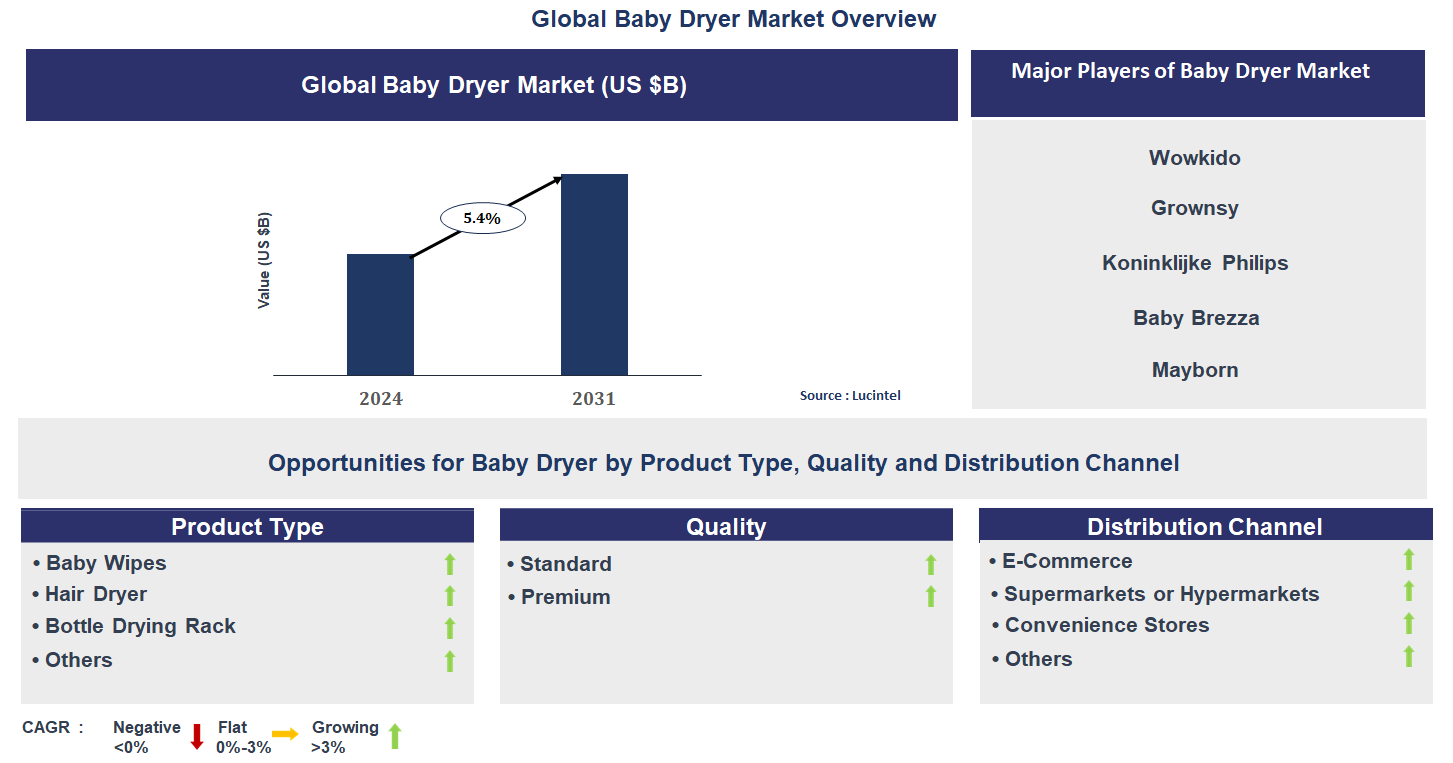
Key data points: The growth forecast = 5.4% annually for the next 7 years. Scroll below to get more insights. This market report covers trends, opportunities and forecasts in baby dryer market to 2031 by product type (baby wipes, hair dryer, bottle drying rack, and others), quality (standard and premium), distribution channel (e-commerce, supermarkets or hypermarkets, convenience stores, and others), and region (North America, Europe, Asia Pacific, and the Rest of the World)
We'll send your sample report shortly.
• Lucintel forecasts that, within the product type category, baby wipe is expected to witness the highest growth over the forecast period.
• Within the distribution channel category, e-commerce is expected to witness the highest growth.
• In terms of region, APAC is expected to witness the highest growth over the forecast period. Gain valuable insights for your business decisions with our comprehensive 150+ page report. Sample figures with some insights are shown below.
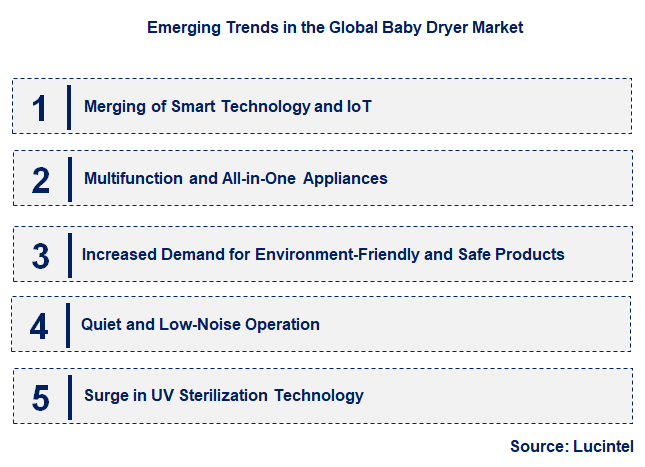
• Merging of Smart Technology and IoT: One of the most important trends is the merging of smart technology with IoT. New products are arriving with Wi-Fi connectivity, app-based functionality, and aspects enabling parents to control and check the drying process from afar. This trend meets the demand for convenience and an efficient parenting experience. The effect is substantial, as it turns a simple appliance into a smart, connected device with real-time feedback, usage information, and enhanced control.
• Multifunction and All-in-One Appliances: The industry is witnessing a strong movement in the direction of multifunctional machines that put together sterilization, drying, and at times bottle warming as well in one machine. This movement is a response to the desire for space-saving gadgets and minimizing home clutter. The effect is an efficient product that conserves both counter space and time for busy parents. It also reflects the changing consumer preference for single-function devices towards multi-functional solutions that provide better value and convenience.
• Increased Demand for Environment-Friendly and Safe Products: Parents are increasingly aware of the environmental footprint and safety of the products they use for their infants. This has created a new trend towards environment-friendly and safe products. There is increased demand for dryers produced using BPA-free plastics, silicone, and other non-toxic substances. The effect is that companies are currently emphasizing sustainability and clear supply chain sourcing, which not only increases consumer confidence but also contributes to making the market more ethical and responsible.
• Quiet and Low-Noise Operation: Another area of focus has been in the production of baby dryers that operate with low noise. Parents are looking more and more for appliances that will not wake a sleeping baby or break the quiet of the home. It fills an identified pain point for new parents and is reshaping product development. The result is a new competitive benefit for brands that can provide quiet, effective performance. It reflects a market that is more sensitive to the lifestyle and comfort requirements of the whole family.
• Surge in UV Sterilization Technology: The market is following a robust trend towards UV sterilization, which kills germs using ultraviolet radiation without heating or the use of steam. This technology is seen as a cleaner and more efficient way. It is popular among parents who have a huge anxiety about hygiene and germ-free surroundings for their babies. The effect is the introduction of a new generation of high-tech baby dryers with advanced sterilization, which sets them apart from old heat-based ones and at a premium price. These trends are deeply transforming the baby dryer business. They are shifting it from a plain utility industry to a high-tech, multi-functional, and consumer-oriented one. The need for convenience and efficiency in parenting is driving the incorporation of smart technology, the promotion of quiet operation, and the development of multifunctional products. While the stress on eco-mate materials and UV sterilization answers the call for increased safety, hygiene, and sustainability, the market remains driven to innovate and expand.
• Integrated Sterilizer and Dryer Unit Launch: One of the major developments is the industry-wide changeover to integrated sterilizer and dryer units. Sold individually in the past, manufacturers are now integrating these capabilities into a single appliance. The innovation responds to the demands for convenience and space-saving, which are imperative for new parents. The effect is an updated and more efficient product line. It has become a standard element of new product releases and has given rise to a new category of high-value, all-in-one baby care appliances.
• Use of Advanced UV-C Sterilization Technology: One of the key developments is the extensive use of UV-C light technology for sterilization. As opposed to conventional steam sterilizers that incorporate high heat, UV-C sterilizers utilize ultraviolet light to destroy germs and bacteria. This development provides a safer and more effective solution. The effect is the creation of a premium segment within the market, with UV technology’s germ-killing ability being used by brands to emphasize. This movement is affecting consumer preference by placing value on cleanliness and safety.
• Inception of Smart Features and App Connectivity: A recent trend is the incorporation of smart features and app connectivity into baby dryers. New models now come equipped with Wi-Fi, touch screens, and companion apps that enable parents to operate the appliance remotely from their smartphones. The result is a more convenient and easier-to-use experience, giving parents a feeling of control and reassurance. This evolution is fueling demand from digitally savvy millennials and Gen Z parents who look for smart home connectivity in their appliances.
• Increase in Direct-to-Consumer and Online Sales Channels: Online retail and direct-to-consumer (D2C) models represent a significant trend. Companies now use e-commerce platforms to distribute their products to a broader market without relying on physical stores. This has opened up a wide variety of products from multiple brands to anyone. The effect is a more competitive market with more choices for consumers and more emphasis on internet marketing and online customer interaction.
• Emphasis on Sustainable and Non-Toxic Materials: One of the developments is that there is more focus on sustainability and non-toxic materials by the industry. Parents now worry about the safety of plastics and other materials employed in infant products. The effect is that brands now market their products as BPA-free, PVC-free, and phthalate-free, most of the time with credentials to support such assertions. This trend is changing the way products are designed and materials are chosen, and is leading to an ethical and transparent marketplace. All these recent trends are generally redefining the baby dryer market to become more technologically sophisticated, convenient, and safety-oriented. The emphasis on single-unit devices and intelligent capabilities is meeting the demand for convenience in contemporary parenting. In addition, the transition to UV sterilization and toxin-free materials is catering to increased calls for higher levels of hygiene and safety. The growth of e-commerce is also leveling the playing field for access to these new technologies, guaranteeing the market’s ongoing growth and development.
• Premium and High-Tech Products Opportunity: There lies a huge growth opportunity in the premium segment of the market. Parents are eager to spend more on high-tech and premium products that provide better performance, convenience, and safety. Businesses can take advantage of this by creating baby dryers with innovative features such as smart sensors, app control, and UV sterilization. This approach enables brands to charge premium prices, establish a reputation for innovation and quality, and target a profitable consumer segment that seeks high-end appliances.
• Multifunctional Appliances Opportunity: One of the most important growth opportunities is in the creation of multifunctional, single-unit appliances. By integrating the functions of a sterilizer, dryer, and bottle warmer into one convenient, space-saving unit, businesses are able to provide a solution that conserves space and time for harried parents. This solution meets a core consumer pain point and represents a major competitive benefit. This strategy also makes the purchase process easier for customers, as they can purchase one product fulfilling various needs, thus enhancing customer satisfaction and loyalty.
• Sustainable and Eco-Friendly Products Opportunity: One of the key strategic opportunities is to target the increasing number of green-conscious parents. Firms can segment their products by emphasizing sustainable production methods, use of recyclable materials, and energy-efficient products. Promoting an environmental responsibility commitment resonates with today’s consumers and constructs a strong brand image. This approach not only addresses an expanding market but also assists in the development of a more ethical and sustainable supply chain for the long term.
• Potential for Personalized and Modular Designs: The marketplace has potential for providing more personalized and modular designs. Companies can develop baby dryers with customizable settings or with modular components that can be adapted to a family’s changing needs. This could include interchangeable racks for different bottle sizes or parts that can be added or removed as the baby grows. This approach enhances the product’s versatility and lifespan, appealing to consumers who prioritize long-term value. This strategy creates a niche market for highly adaptable and consumer-centric products.
• Niche Market and Specialized Product Opportunity: There is a strategic chance to reach niche markets, i.e., those with special medical requirements or those who travel extensively. Brands can create portable, compact baby dryers for travel or specialty dryers for medical devices like breast pump accessories. This enables brands to fulfill distinctive customer requirements that are not covered by mass-market products. This approach can establish a loyal customer base and reputation in a particular segment, yielding a rich source of competitive advantage. Such strategic growth potential has the potential to propel the baby dryer industry. With a focus on high-end products, multiple functions, and eco-friendly operations, businesses can develop a richer and consumer-oriented product. Personalized and niche product development also permits increased diversification of markets as well as highly loyal customer bases. Finally, these possibilities suggest a future in which the market is not only bigger but also more innovative, specialized, and values-oriented toward contemporary parents.
• Wowkido
• Grownsy
• Koninklijke Philips
• Baby Brezza
• Mayborn
• Baby Wipes
• Hair Dryer
• Bottle Drying Rack
• Others
• Standard
• Premium
• E-Commerce
• Supermarkets or Hypermarkets
• Convenience Stores
• Others
• North America
• Europe
• Asia Pacific
• The Rest of the World
• United States: United States baby dryer market is a mature and highly competitive market. The main trends are a high demand for products with intelligent features and ones that provide multi-functionality, e.g., sterilizing and drying bottles in one unit. There is increasing demand for products that are BPA-free and constructed of safe, non-toxic materials. The market also tends towards premium brands, and parents are willing to pay for products that are efficient as well as pleasing to the eye.
• China: The baby dryer market in China is a growth powerhouse, driven by high population numbers and an increasing disposable income. A key trend is the accelerated take-up of high-tech and intelligent baby products. Chinese consumers are heavily impacted by word of mouth from online reviews and live-streaming platforms, which are key drivers of consumer trends. The market is driven by a need for hygiene and health, with a high demand for clinically tested products that are germ-killing.
• Germany: The baby dryer market in Germany is stable and gives high priority to product safety, longevity, and energy efficiency. German consumers are extremely demanding and value products with longevity and those that adhered to high safety standards. One of the emerging trends is an increase in the popularity of environmentally friendly and sustainable products, where companies emphasize the use of recyclable materials and cutting down on energy.
• India: The Indian market for baby dryers is on the rise, driven by fast-paced urbanization, a rise in dual-income households, and improved awareness of infant cleanliness. One notable development has been the penetration of online platforms, which has led to improved availability of products from international and domestic brands. Although the market remains price-conscious, an emerging middle class is willing to pay more for convenient and sanitary baby items. Marketing, which highlights the convenience of saving time for working parents, also fuels growth.
• Japan: The Japanese market for baby dryers is marked by precision, portability, and technological sophistication. Having minimal living space, Japanese consumers prefer space-efficient, multi-functional products. Recent innovations involve the launch of high-end, quiet-operation dryers and models that have integrated advanced sterilization technology. Japanese parents are very detail-conscious and look for products that are not only effective but also fit in perfectly with their homes. Convenience, cleanliness, and understated, elegant design drive the market in this country.


• Wowkido
• Grownsy
• Koninklijke Philips
• Baby Brezza
• Mayborn Q5. Which baby dryer market segment will be the largest in future? Answer: Lucintel forecasts that, within the product type category, baby wipe is expected to witness the highest growth over the forecast period. Q6. In baby dryer market, which region is expected to be the largest in next 5 years? Answer: In terms of region, APAC is expected to witness the highest growth over the forecast period. Q7. Do we receive customization in this report? Answer: Yes, Lucintel provides 10% customization without any additional cost.


Choose a license that fits your team. Instant PDF delivery.
Prices exclude taxes. Instant delivery. Custom licensing available on request.
Market Report · July 20, 2026
Market Report · July 15, 2026
Market Report · July 15, 2026
Trusted partner for strategic intelligence and business growth


Receive a complimentary market analysis tailored to your industry. Our analysts will identify key growth opportunities and competitive dynamics specific to your business.

Market size, growth rate, and key trend analysis for your specific sector.

Top competitor positioning and market share analysis.

Strategic recommendations backed by data-driven insights.
Get curated market intelligence and competitive moves straight to your inbox.
By subscribing, you agree to receive our monthly insights. Unsubscribe anytime.
Receive a complimentary market analysis tailored to your industry. Our analysts will identify key growth opportunities and competitive dynamics specific to your business.
Market size, growth rate, and key trend analysis for your specific sector.
Top competitor positioning and market share analysis.
Strategic recommendations backed by data-driven insights.
Get curated market intelligence, emerging trends, and competitive moves straight to your inbox each month.
By subscribing, you agree to receive our monthly insights. Unsubscribe anytime.
We'll send your sample report shortly.