
Market Report · July 31, 2026

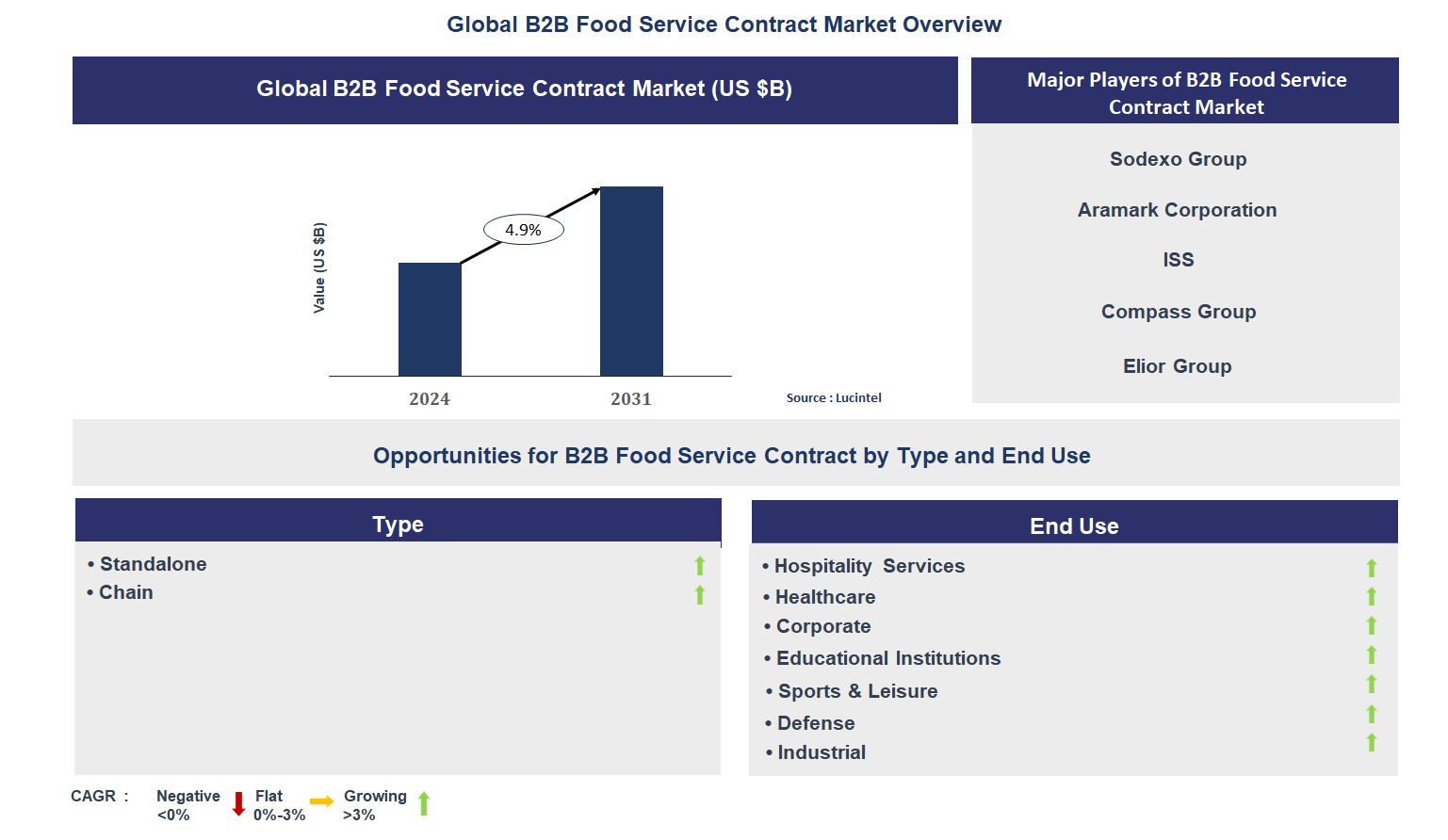
Key data points: The growth forecast = 4.9% annually for the next 7 years. Scroll below to get more insights. This market report covers trends, opportunities and forecasts in B2B food service contract market to 2031 by type (standalone and chain), end use (hospitality services, healthcare, corporate, educational institutions, sports & leisure, defense, and industrial), and region (North America, Europe, Asia Pacific, and the Rest of the World)
We'll send your sample report shortly.
• Lucintel forecasts that, within the type category, chain is expected to witness higher growth over the forecast period.
• Within the end use category, educational institution is expected to witness the highest growth.
• In terms of region, APAC is expected to witness the highest growth over the forecast period. Gain valuable insights for your business decisions with our comprehensive 150+ page report. Sample figures with some insights are shown below.
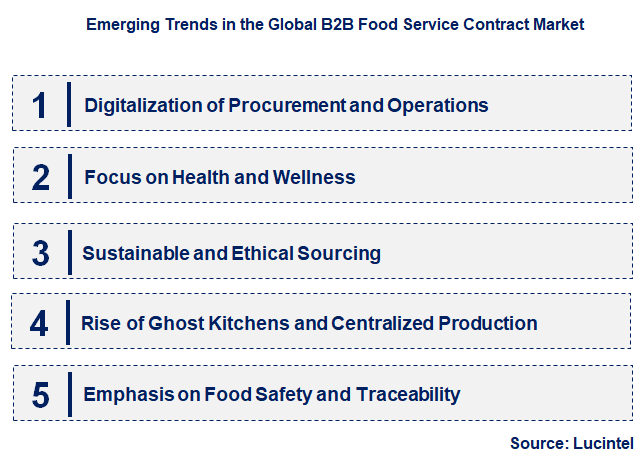
• Digitalization of Procurement and Operations: A key trend is the digitalization of the entire B2B food service value chain, from ordering to delivery. Companies are adopting online marketplaces, e-procurement platforms, and AI-powered inventory management systems. This trend is streamlining processes, reducing administrative overhead, and improving the accuracy and speed of order fulfillment for both buyers and suppliers.
• Focus on Health and Wellness: There is a significant trend toward offering healthier, more nutritious, and customized food options. Clients are increasingly demanding products that cater to specific dietary needs, such as plant-based, gluten-free, or low-sugar meals. This trend is driven by a broader societal focus on health and is leading to more specialized and diverse menus.
• Sustainable and Ethical Sourcing: The market is seeing a growing trend toward sustainable and ethically sourced ingredients. Clients are increasingly demanding transparency about where their food comes from, including its environmental and social impact. This trend is pushing suppliers to adopt more responsible practices and to provide certifications for their products.
• Rise of Ghost Kitchens and Centralized Production: The emergence of ghost kitchens and centralized production facilities is a major trend. These facilities, which are optimized for large-scale production and delivery, allow food service providers to streamline their operations, reduce costs, and maintain consistent quality across multiple locations. This trend is enhancing scalability and efficiency.
• Emphasis on Food Safety and Traceability: A critical trend is the heightened focus on food safety and traceability. Companies are implementing technologies like blockchain to create a transparent, immutable record of a product’s journey from farm to table. This not only builds client trust but also allows for rapid product recalls and a more resilient supply chain. These emerging trends are fundamentally reshaping the B2B food service market by prioritizing efficiency, health, and sustainability. The digitalization of operations and the rise of ghost kitchens are enhancing logistical capabilities, while the focus on wellness and ethical sourcing is aligning the industry with modern consumer values. This is creating a more innovative, transparent, and resilient market.
• Expansion of Digital Procurement Platforms: A key recent development is the rapid expansion of digital procurement platforms. These platforms serve as online marketplaces where businesses can easily find, compare, and order food supplies from a wide network of suppliers. This development is streamlining the purchasing process, reducing administrative costs, and enhancing transparency in pricing.
• Growth in Customized and Specialized Menus: There has been a significant development in the offering of customized and specialized meal plans. Contract caterers are now providing a wider range of options, including allergen-free, vegan, and regional cuisine menus, to cater to the diverse needs of corporate and institutional clients. This is a direct response to a more health-conscious workforce.
• Increased Investment in Cold Chain Logistics: A recent development is the increased investment in advanced cold chain logistics. Companies are using IoT-enabled sensors to monitor the temperature and condition of food during transport. This ensures the safety and quality of perishable goods, reduces spoilage, and helps to build trust and reliability with clients who prioritize food safety.
• Rise of Automated Kitchens and Robotics: The market is witnessing a notable development in the use of automated kitchens and robotics. These technologies are being used for repetitive tasks like ingredient preparation and portioning. This innovation is not only improving efficiency and reducing labor costs but also ensuring consistent quality and hygiene in large-scale food production.
• Strategic Partnerships and Collaborations: A recent development is the formation of strategic partnerships between food service providers and technology companies. These collaborations aim to integrate new technologies, such as AI for demand forecasting or blockchain for traceability, into the food service supply chain. This is accelerating innovation and giving companies a competitive edge in the market. These recent developments are profoundly impacting the B2B food service market by elevating the standards of efficiency, safety, and customization. The shift toward digital platforms and automation is enhancing operational capabilities, while the focus on specialized menus and advanced logistics is aligning the industry with modern consumer demands and expectations for quality and safety.
• Corporate and Business Sector Catering: The corporate sector presents a prime growth opportunity. As more companies focus on employee wellness, there is a growing demand for high-quality, on-site catering and pantry services. Offering customized, healthy, and diverse meal plans for daily office consumption and corporate events is a key area for market expansion.
• Healthcare and Institutional Food Services: The healthcare sector, including hospitals and senior care facilities, offers a significant growth opportunity. These institutions require specialized, nutritionally balanced, and often medically tailored meal plans. Providing high-quality, reliable, and safe food services for this segment is a high-value, long-term opportunity that builds trust and loyalty.
• Education Sector Contract Catering: The education sector, including schools and universities, is a major growth area. There is an increasing demand for healthy, appealing, and cost-effective meal plans for students. Strategic opportunities lie in providing innovative menus that cater to diverse tastes and dietary restrictions while adhering to nutritional guidelines.
• Travel and Hospitality Segment: The travel and hospitality market, including airlines, hotels, and event venues, is a high-growth segment. These businesses require consistent, high-quality food services to meet the demands of their guests. Providing customized, on-demand, and visually appealing food solutions for these applications is key to securing large contracts.
• Sports and Event Catering: The sports and event catering market offers a lucrative opportunity. Large-scale events, from concerts to sporting matches, require efficient and diverse food service solutions for attendees. Companies can specialize in providing a wide range of offerings, from quick-service food to premium catering, to meet the unique needs of this dynamic sector. Strategic growth opportunities in the B2B food service market are concentrated in high-value, consumer-centric segments. By focusing on corporate, healthcare, education, travel, and event applications, companies can align their strategies with the most dynamic parts of the market. This targeted approach will drive product innovation and market leadership, ensuring sustained growth and profitability.
• Sodexo Group
• Aramark Corporation
• ISS
• Compass Group
• Elior Group
• Camst Group
• Caterleisure
• Standalone
• Chain
• Hospitality Services
• Healthcare
• Corporate
• Educational Institutions
• Sports & Leisure
• Defense
• Industrial
• North America
• Europe
• Asia Pacific
• The Rest of the World
• United States: The U.S. market is being reshaped by the rapid adoption of digital procurement platforms and supply chain management software. This has led to improved efficiency, real-time inventory tracking, and a move toward more streamlined vendor-client relationships. There is a strong demand for "clean label" and sustainable food products to meet corporate wellness and social responsibility goals.
• China: China’s B2B food service market is experiencing robust growth, fueled by rapid urbanization and a booming corporate sector. Recent developments include a significant investment in automated logistics and cold chain infrastructure to support large-scale contract catering. There is a growing interest in food safety and traceability, with clients increasingly demanding products with verifiable origins.
• Germany: Germany’s market is characterized by a strong focus on quality, sustainability, and regional sourcing. Recent developments show a move toward contracts that emphasize eco-friendly packaging and reduced food waste. The market is also seeing an increase in customized meal plans and "grab-and-go" solutions for corporate and institutional clients, catering to modern work lifestyles.
• India: India’s B2B food service market is in a rapid growth phase, driven by a growing corporate culture and an increase in contract catering for schools, hospitals, and factories. Recent developments include the emergence of online B2B marketplaces that connect suppliers with businesses. There is also a growing demand for healthier and diverse meal options to meet the needs of a more health-conscious workforce.
• Japan: Japan’s B2B food service market is highly sophisticated, focusing on precision, efficiency, and food quality. Recent developments include a greater emphasis on specialized and nutritionally balanced meal plans, particularly for senior care and hospital sectors. There is also a strong push toward automation and technology, such as AI-powered menu planning and inventory systems.


• Sodexo Group
• Aramark Corporation
• ISS
• Compass Group
• Elior Group
• Camst Group
• Caterleisure Q5. Which B2B food service contract market segment will be the largest in future? Answer: Lucintel forecasts that, within the type category, chain is expected to witness higher growth over the forecast period. Q6. In B2B food service contract market, which region is expected to be the largest in next 5 years? Answer: In terms of region, APAC is expected to witness the highest growth over the forecast period. Q7. Do we receive customization in this report? Answer: Yes, Lucintel provides 10% customization without any additional cost.


Choose a license that fits your team. Instant PDF delivery.
Prices exclude taxes. Instant delivery. Custom licensing available on request.
Market Report · July 31, 2026
Market Report · July 31, 2026
Market Report · July 31, 2026
Trusted partner for strategic intelligence and business growth


Receive a complimentary market analysis tailored to your industry. Our analysts will identify key growth opportunities and competitive dynamics specific to your business.

Market size, growth rate, and key trend analysis for your specific sector.

Top competitor positioning and market share analysis.

Strategic recommendations backed by data-driven insights.
Get curated market intelligence and competitive moves straight to your inbox.
By subscribing, you agree to receive our monthly insights. Unsubscribe anytime.
Receive a complimentary market analysis tailored to your industry. Our analysts will identify key growth opportunities and competitive dynamics specific to your business.
Market size, growth rate, and key trend analysis for your specific sector.
Top competitor positioning and market share analysis.
Strategic recommendations backed by data-driven insights.
Get curated market intelligence, emerging trends, and competitive moves straight to your inbox each month.
By subscribing, you agree to receive our monthly insights. Unsubscribe anytime.
We'll send your sample report shortly.