
Market Report · July 31, 2026

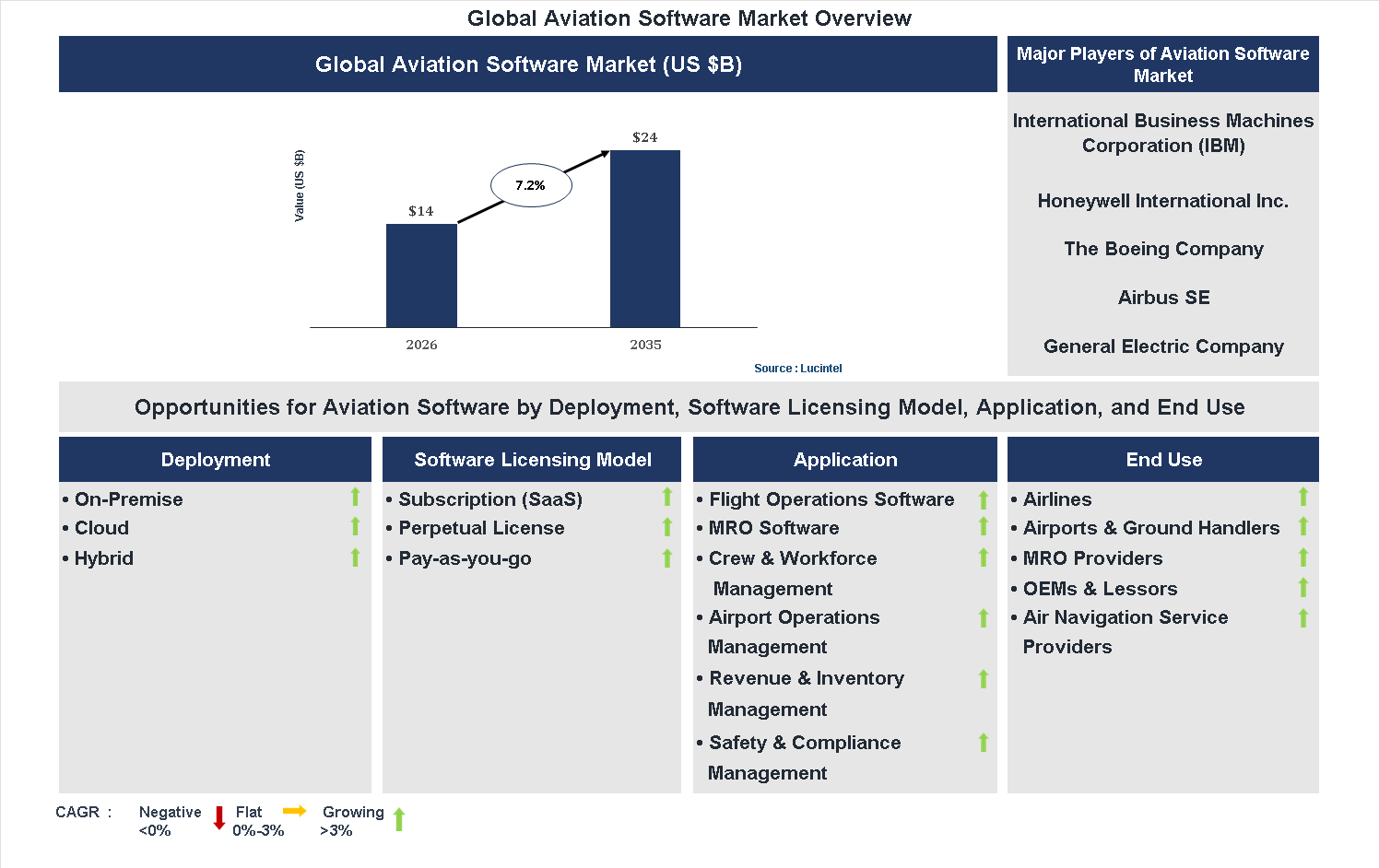
Key data points: The market size in 2035 = $24 billion, growth forecast = 7.2% annually for the next 8 years. Scroll below to get more insights. This market report covers trends, opportunities and forecasts in aviation software market to 2035 by deployment (on-premise, cloud, and hybrid), software licensing model (subscription (SaaS), perpetual licence, and pay-as-you-go), application (flight operations software, MRO software, crew and workforce management, airport operations management, revenue & inventory management, and safety & compliance management), end use (airlines, airports & ground handlers, MRO providers, OEMs & lessors, and air navigation service providers), and region (North America, Europe, Asia Pacific, and the Rest of the World)
We'll send your sample report shortly.
• Lucintel forecasts that, within the deployment category, cloud is expected to witness the highest growth over the forecast period.
• Within the end use category, airline is expected to witness the highest growth.
• In terms of region, APAC is expected to witness the highest growth over the forecast period. Gain valuable insights for your business decisions with our comprehensive 150+ page report. Sample figures with some insights are shown below.
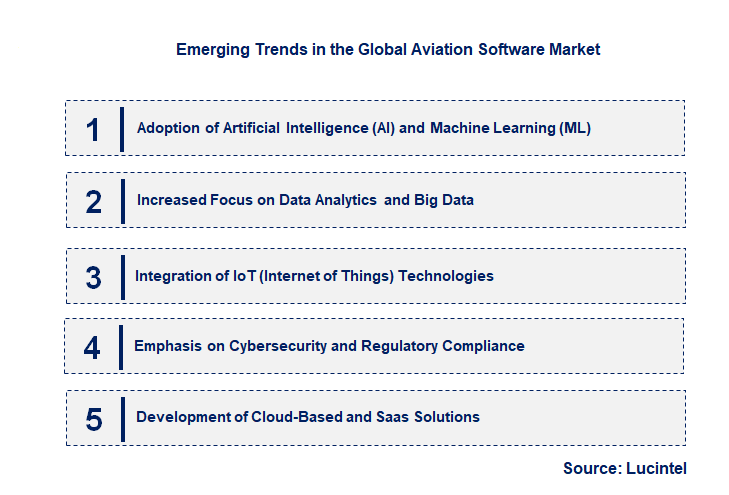
• Adoption of Artificial Intelligence (AI) and Machine Learning (ML): AI and ML are revolutionizing aviation software by enabling predictive maintenance, real-time analytics, and personalized passenger services. These technologies help airlines anticipate equipment failures, optimize flight routes, and enhance safety protocols. The integration of AI-driven chatbots and virtual assistants improves customer service, reducing operational costs and increasing passenger satisfaction. As AI becomes more sophisticated, its role in automating complex decision-making processes will expand, leading to smarter, more responsive aviation systems.
• Increased Focus on Data Analytics and Big Data: The aviation industry generates vast amounts of data from various sources, including flight operations, passenger interactions, and maintenance logs. Advanced data analytics tools are being employed to extract actionable insights, improve operational efficiency, and enhance safety. Big data analytics facilitate predictive maintenance, fuel optimization, and personalized marketing strategies. This trend enables airlines and airports to make data-driven decisions, reduce costs, and improve overall service quality, ultimately leading to more competitive and resilient operations.
• Integration of IoT (Internet of Things) Technologies: IoT devices are increasingly embedded in aircraft, ground equipment, and airport infrastructure, creating interconnected ecosystems. This connectivity allows for real-time monitoring of equipment health, streamlined baggage handling, and improved security measures. IoT integration enhances operational transparency, reduces delays, and minimizes maintenance costs through predictive insights. As IoT adoption grows, it will enable more autonomous and efficient airport and airline operations, transforming the passenger experience and operational workflows.
• Emphasis on Cybersecurity and Regulatory Compliance: As aviation software becomes more interconnected and reliant on digital systems, cybersecurity threats pose significant risks. The industry is investing heavily in robust cybersecurity measures to protect sensitive data and ensure operational continuity. Additionally, compliance with evolving regulatory standards, such as data privacy laws and safety protocols, is critical. This trend drives the development of secure, compliant software solutions that safeguard passenger and operational data, fostering trust and resilience in aviation operations amid increasing digitalization.
• Development of Cloud-Based and SaaS Solutions: Cloud computing and Software-as-a-Service (SaaS) models are gaining popularity due to their scalability, cost-effectiveness, and ease of deployment. Cloud-based aviation software enables real-time data sharing across multiple stakeholders, enhances collaboration, and reduces infrastructure costs. SaaS solutions facilitate rapid updates and integration with other systems, ensuring airlines and airports stay agile in a competitive environment. This trend supports digital transformation initiatives, allowing organizations to adopt innovative technologies quickly and efficiently, ultimately improving operational agility and customer service. These emerging trends are fundamentally reshaping the aviation software market by fostering greater automation, data utilization, connectivity, security, and flexibility. They are driving a more efficient, safe, and passenger-centric industry, positioning aviation stakeholders to better meet future challenges and opportunities.
• Advanced Data Analytics: Improving operational efficiency and decision-making data analytics tools enable airlines and airports to analyze vast amounts of operational data in real-time, leading to better scheduling, maintenance, and resource allocation. This enhances overall efficiency, reduces delays, and optimizes fuel consumption. The ability to predict maintenance needs minimizes downtime and costs. As data-driven decision-making becomes standard, the market sees increased adoption of analytics solutions, fostering innovation and competitive advantage for industry players.
• AI and Machine Learning Integration: Enhancing safety and automation AI and machine learning are revolutionizing aviation software by enabling predictive maintenance, automated scheduling, and real-time safety monitoring. These technologies reduce human error, improve response times, and enhance passenger safety. Airlines benefit from cost savings and operational reliability, while airports experience streamlined processes. The integration of AI-driven solutions is accelerating, creating new opportunities for software providers and transforming traditional aviation operations into smarter, more autonomous systems.
• Cloud-Based Solutions Adoption: Increasing flexibility and scalability cloud computing offers scalable, cost-effective, and accessible software solutions for aviation stakeholders. Cloud-based platforms facilitate seamless data sharing, remote management, and real-time updates across multiple locations. This reduces infrastructure costs and enhances collaboration among airlines, airports, and service providers. The shift towards cloud solutions supports digital transformation initiatives, enabling faster deployment of new features and ensuring compliance with evolving regulatory standards, thus boosting market growth.
• Enhanced Passenger Experience Platforms: Focusing on personalization and convenience modern aviation software emphasizes passenger-centric features such as personalized services, real-time updates, and seamless check-in processes. These platforms leverage data analytics and mobile technology to improve customer satisfaction and loyalty. Airlines and airports investing in these solutions see increased revenue through targeted marketing and improved operational efficiency. As passenger expectations rise, the market is driven to develop more sophisticated, user-friendly platforms that differentiate service offerings and foster competitive advantage.
• Regulatory Compliance and Security Enhancements: Ensuring safety and legal adherence evolving regulations require robust software solutions for compliance and security management. Recent developments include advanced cybersecurity measures, digital documentation, and automated reporting tools. These ensure data integrity, protect against cyber threats, and streamline regulatory processes. Compliance-focused software reduces legal risks and penalties, while enhancing trust among stakeholders. As security concerns grow, the market sees increased demand for integrated compliance solutions, supporting safer and more transparent aviation operations globally. The overall impact of these developments is a more efficient, safe, and customer-focused aviation software market. They drive innovation, reduce costs, and improve operational agility, positioning the industry for sustained growth and competitive advantage in a rapidly evolving landscape.
• Cloud-Based Aviation Management Systems: Cloud technology offers scalable, cost-effective solutions for airlines and airports to manage operations, maintenance, and passenger services. These systems enable real-time data sharing, improve collaboration, and reduce infrastructure costs. The shift to cloud-based platforms enhances flexibility, security, and accessibility, allowing organizations to adapt quickly to changing market conditions and regulatory requirements, ultimately driving efficiency and customer satisfaction.
• Implementation of AI and Machine Learning for Predictive Maintenance: AI-driven analytics enable airlines and maintenance providers to predict equipment failures before they occur, minimizing downtime and reducing maintenance costs. Machine learning algorithms analyze vast amounts of operational data to identify patterns and anomalies. This proactive approach improves safety, optimizes resource allocation, and extends the lifespan of aircraft components, providing a significant competitive advantage in operational reliability and cost management.
• Development of Integrated Passenger Experience Platforms: Airlines and airports are investing in comprehensive digital platforms that enhance passenger engagement through personalized services, seamless check-ins, and real-time updates. These platforms integrate mobile apps, biometric security, and loyalty programs to improve convenience and satisfaction. By offering tailored experiences, companies can boost brand loyalty, increase ancillary revenue, and differentiate themselves in a competitive market.
• Adoption of Cybersecurity Solutions for Aviation Operations: As digital transformation accelerates, protecting sensitive data and operational systems from cyber threats becomes critical. Advanced cybersecurity solutions tailored for aviation safeguard passenger information, flight control systems, and corporate data. Implementing robust security measures reduces the risk of cyberattacks, ensures regulatory compliance, and maintains operational integrity, which is vital for maintaining trust and safety in the increasingly digital aviation ecosystem.
• Expansion of Data Analytics for Operational Optimization: Data analytics tools enable airlines and airports to analyze vast datasets for insights into flight operations, passenger flow, and resource utilization. These insights facilitate informed decision-making, improve scheduling, and optimize staffing levels. Enhanced data-driven strategies lead to increased efficiency, reduced costs, and better service delivery, positioning organizations to respond swiftly to market changes and improve overall operational performance. These growth opportunities are transforming the aviation software market by fostering innovation, enhancing safety, and improving operational efficiency. Embracing cloud solutions, AI, integrated passenger platforms, cybersecurity, and data analytics will enable industry stakeholders to remain competitive and meet evolving customer and regulatory demands. The strategic adoption of these technologies will drive sustainable growth and shape the future landscape of aviation.
• Technological Innovation: The rapid development of advanced software solutions such as AI, machine learning, and IoT enhances aircraft maintenance, flight operations, and passenger management, leading to increased efficiency and safety. Airlines and airports are adopting these technologies to optimize resource utilization, reduce delays, and improve customer experience, which significantly propels market growth.
• Increasing Air Traffic: The surge in global air travel, driven by rising disposable incomes and tourism, necessitates sophisticated software systems for managing complex operations. This growth demands scalable, integrated software solutions for scheduling, ticketing, and baggage handling, fueling market expansion.
• Regulatory Compliance and Safety Standards: Stringent government regulations and safety standards compel airlines and airports to implement compliant software solutions. These systems ensure adherence to safety protocols, environmental regulations, and data security, creating a steady demand for specialized aviation software.
• Digital Transformation in Aviation: The ongoing digital transformation across the aviation industry encourages the adoption of integrated software platforms for enterprise resource planning, customer relationship management, and real-time analytics. This shift enhances operational transparency and decision-making, further driving market growth. The challenges in the aviation software market are:
• High Implementation and Maintenance Costs: Deploying advanced aviation software involves significant capital investment and ongoing maintenance expenses. Smaller airlines and airports may find these costs prohibitive, limiting market penetration and slowing adoption rates.
• Regulatory and Data Security Concerns: The aviation industry faces strict regulatory requirements and increasing cybersecurity threats. Ensuring data privacy and system integrity is complex and costly, often delaying software deployment and increasing operational risks.
• Rapid Technological Changes: The fast-paced evolution of technology can render existing software obsolete quickly. Companies must continuously invest in upgrades and innovations, which can strain budgets and resources, creating uncertainty and hindering long-term planning. The aviation software market is driven by technological advancements, increasing air traffic, regulatory demands, and digital transformation initiatives. However, high costs, security concerns, and rapid technological changes pose significant challenges. These factors collectively influence the markets growth, requiring stakeholders to balance innovation with risk management. Strategic adaptation to these drivers and challenges will be crucial for sustained success in this evolving industry.
• International Business Machines Corporation (IBM)
• Honeywell International Inc.
• The Boeing Company
• Airbus SE
• General Electric Company
• SAP SE
• Sabre GLBL Inc.
• Lufthansa Systems GmbH (Deutsche Lufthansa AG)
• Collins Aerospace (RTX Corporation)
• Ramco Systems Ltd.
• On-Premise
• Cloud
• Hybrid
• Subscription (SaaS)
• Perpetual Licence
• Pay-as-you-go
• Flight Operations Software
• MRO Software
• Crew & Workforce Management
• Airport Operations Management
• Revenue & Inventory Management
• Safety & Compliance Management
• Airlines
• Airports & Ground Handlers
• MRO Providers
• OEMs & Lessors
• Air Navigation Service Providers
• North America
• Europe
• Asia Pacific
• The Rest of the World
• United States: The US aviation software market has seen significant advancements in AI-driven maintenance systems and real-time data analytics. Major airlines are investing in predictive maintenance to reduce downtime and operational costs. The Federal Aviation Administration (FAA) has implemented new regulations encouraging digital safety management systems. Cloud-based solutions are increasingly adopted for passenger management and baggage handling, improving efficiency and customer experience. Additionally, US startups are pioneering innovative cybersecurity solutions tailored for aviation networks, ensuring data protection amid rising cyber threats.
• China: China’s aviation software market is rapidly expanding, driven by government initiatives to modernize its aviation infrastructure. The country is investing heavily in integrated airport management systems and smart airport technologies, including facial recognition and automated check-ins. Chinese airlines are adopting advanced fleet management and scheduling software to optimize operations. The government’s focus on digital transformation is fostering local software development, with partnerships between tech giants and aviation authorities. The market is also witnessing increased use of big data analytics to enhance safety and operational efficiency across the sector.
• Germany: Germany’s aviation software market emphasizes sustainability and digital innovation. The country is adopting advanced simulation and training software for pilots and maintenance crews, improving safety standards. German airports are deploying smart systems for passenger flow management and security screening. The aviation industry is also integrating environmental monitoring tools to meet stringent EU regulations on emissions. Furthermore, Germany is investing in cybersecurity solutions to protect critical aviation infrastructure from cyber threats, aligning with its broader digital transformation goals within the European Union.
• India: India’s aviation software market is experiencing rapid growth due to increasing air travel demand and modernization efforts. Airlines are deploying advanced reservation and revenue management systems to maximize profitability. The government’s Digital India initiative is promoting the adoption of integrated airport management solutions and contactless check-in technologies. Startups are developing innovative solutions for baggage handling and real-time flight tracking. The sector is also focusing on enhancing safety through predictive maintenance and data analytics, supported by investments in digital infrastructure and regulatory reforms aimed at boosting the aviation industry’s growth.
• Japan: Japan’s aviation software market is characterized by technological innovation and safety enhancements. The country is adopting AI-powered systems for air traffic control and flight operations management. Japanese airports are implementing smart security and passenger management systems to streamline operations. The market is also focusing on sustainability, with software solutions supporting energy-efficient airport operations and emissions monitoring. Japan’s emphasis on cybersecurity is evident through investments in protecting aviation networks from cyber threats. The country’s technological expertise continues to drive advancements in aviation software, aligning with its goal of maintaining high safety standards and operational efficiency.


• International Business Machines Corporation (IBM)
• Honeywell International Inc.
• The Boeing Company
• Airbus SE
• General Electric Company
• SAP SE
• Sabre GLBL Inc.
• Lufthansa Systems GmbH (Deutsche Lufthansa AG)
• Collins Aerospace (RTX Corporation)
• Ramco Systems Ltd. Q6. Which aviation software market segment will be the largest in future? Answer: Lucintel forecasts that, within the deployment category, cloud is expected to witness the highest growth over the forecast period. Q7. In aviation software market, which region is expected to be the largest in next 8 years? Answer: In terms of region, APAC is expected to witness the highest growth over the forecast period. Q8. Do we receive customization in this report? Answer: Yes, Lucintel provides 10% customization without any additional cost.


Choose a license that fits your team. Instant PDF delivery.
Prices exclude taxes. Instant delivery. Custom licensing available on request.
Market Report · July 31, 2026
Market Report · July 31, 2026
Market Report · July 22, 2026
Trusted partner for strategic intelligence and business growth


Receive a complimentary market analysis tailored to your industry. Our analysts will identify key growth opportunities and competitive dynamics specific to your business.

Market size, growth rate, and key trend analysis for your specific sector.

Top competitor positioning and market share analysis.

Strategic recommendations backed by data-driven insights.
Get curated market intelligence and competitive moves straight to your inbox.
By subscribing, you agree to receive our monthly insights. Unsubscribe anytime.
Receive a complimentary market analysis tailored to your industry. Our analysts will identify key growth opportunities and competitive dynamics specific to your business.
Market size, growth rate, and key trend analysis for your specific sector.
Top competitor positioning and market share analysis.
Strategic recommendations backed by data-driven insights.
Get curated market intelligence, emerging trends, and competitive moves straight to your inbox each month.
By subscribing, you agree to receive our monthly insights. Unsubscribe anytime.
We'll send your sample report shortly.