
Market Report · July 31, 2026

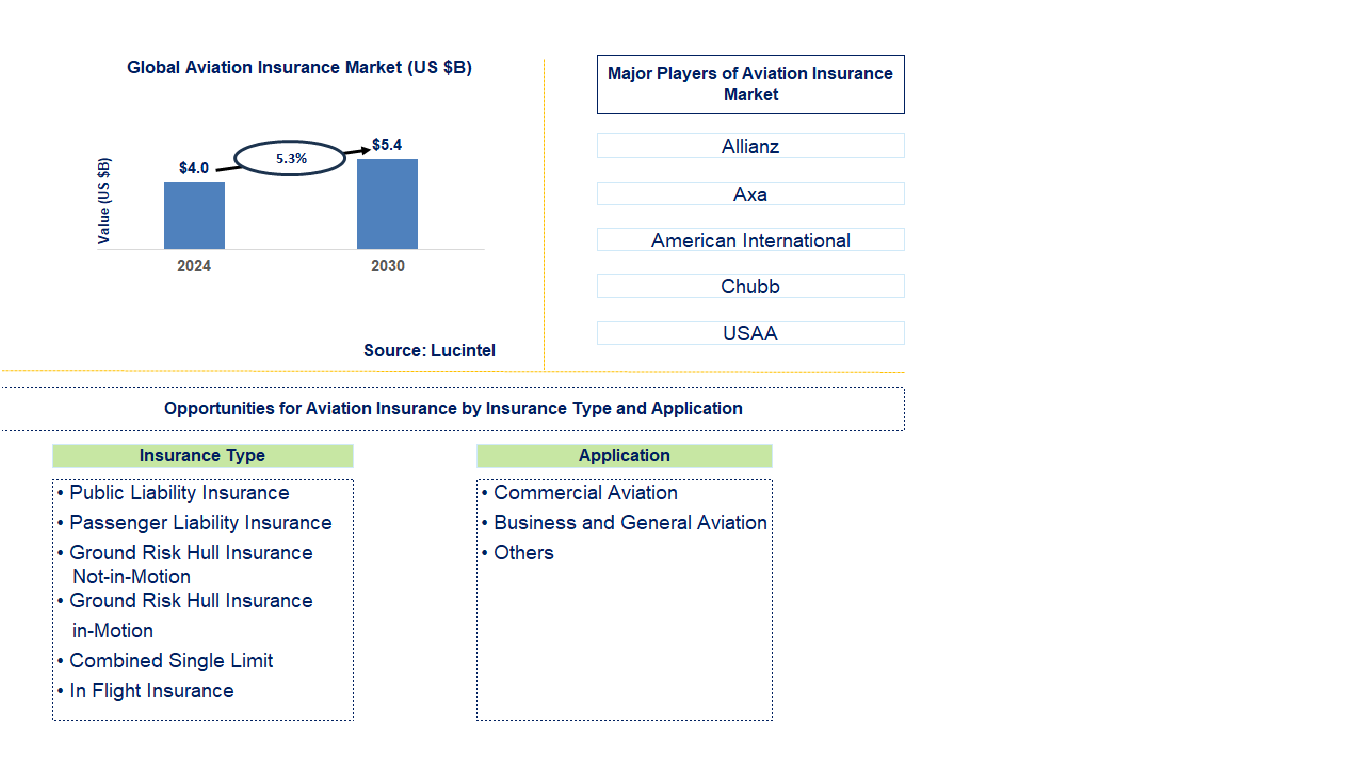
Key data points: The market size in 2030 = $5.4 billion, growth forecast = 5.3% annually for the next 6 years. Scroll below to get more insights. This market report covers trends, opportunities, and forecasts in the global aviation insurance market to 2030 by insurance type (public liability insurance, passenger liability insurance, ground risk hull insurance not-in-motion, ground risk hull insurance in-motion, combined single limit, and in flight insurance), application (commercial aviation, business and general aviation, and others), and region (North America, Europe, Asia Pacific, and the Rest of the World)
We'll send your sample report shortly.
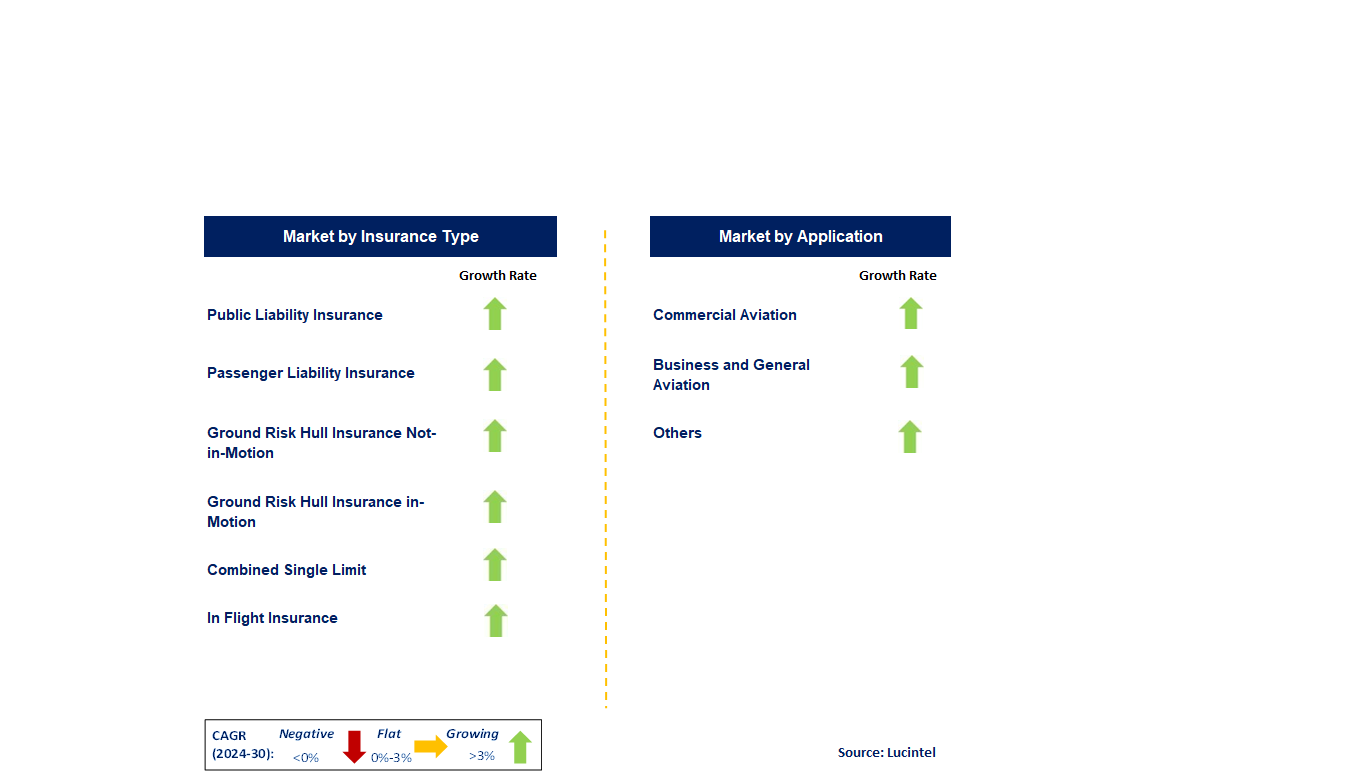
• Lucintel forecasts that, within the insurance type category, passenger liability insurance is expected to witness the highest growth over the forecast period due to strict government regulations.
• Within the application category, commercial aviation will remain a larger segment due to high risk of accidents and large number of passengers and crew.
• In terms of regions, APAC is expected to witness the highest growth over the forecast period due to rising government regulations and significantly growing air travel in the region. Gain valuable insights for your business decisions with our comprehensive 150+ page report.
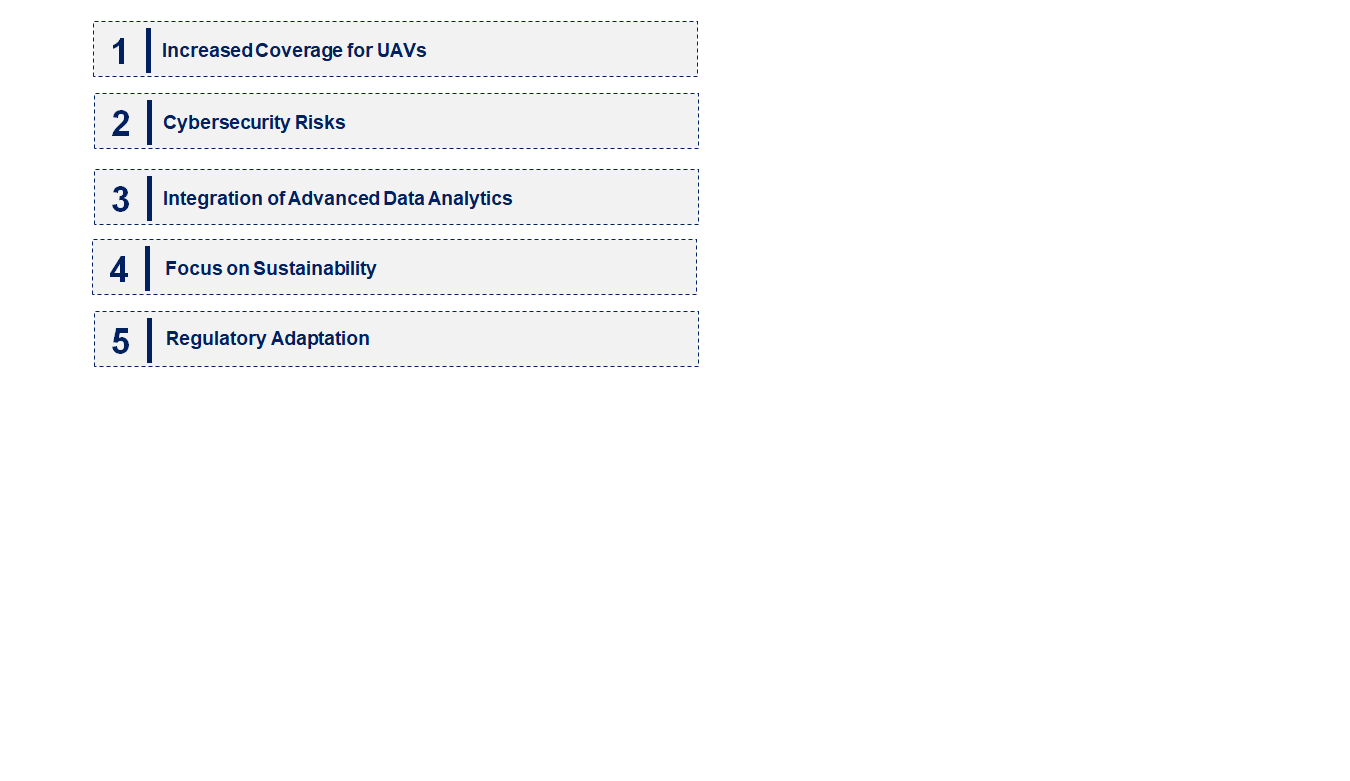
• Increased Coverage for UAVs: Advanced policy wordings that cover a broad range of UAV operations, including commercial use and recreational purposes, have been developed by underwriters since their advent.
• Cybersecurity Risks: The increasing ubiquity of information technology within aviation has resulted in greater emphasis on cybersecurity issues within insurance policies. This includes breaches of data protection, hacking into aviation systems, and other related concerns.
• Integration of Advanced Data Analytics: Insurers today employ big data to maximize precision in risk assessment and pricing decisions. There is therefore a trend toward relying heavily on accurate risk evaluations and pricing models based on big data analysis.
• Focus on Sustainability: The push toward greener aviation technologies shapes the structure of insurance products. In this context, insurers provide products that encourage environmental practices, such as carbon offsetting or even insurance for sustainable aircraft technologies.
• Regulatory Adaptation: New standards set out by regulators around the world mean that insurers must adjust their policies accordingly. This may involve compliance with international norms or adapting to legislative changes specific to certain regions. These include the impact of new technology, economic conditions, and changes in regulation. As a result of these factors, the aviation insurance industry is experiencing a shift.
• Expansion of UAV Insurance: The rapid growth of UAVs has led to an expansion in insurance coverage tailored to unmanned aerial operations, addressing risks unique to these technologies.
• Enhanced Cybersecurity Coverage: Increased concerns over cyber threats have prompted insurers to develop specialized policies that cover cybersecurity risks, including potential data breaches and system attacks.
• Advanced Data Analytics Integration: Insurers are adopting advanced data analytics tools to improve risk assessment and underwriting processes, leading to more accurate pricing and better risk management.
• Sustainability and Green Aviation: There is a growing focus on integrating sustainability into insurance policies, with products designed to support green aviation technologies and carbon offset initiatives.
• Regulatory Compliance and Adaptation: The industry is adapting to evolving regulatory requirements, both regionally and internationally, ensuring that policies remain compliant with new legal standards and practices. These key developments are driving transformation in the aviation insurance sector. The expansion of coverage for UAVs, enhanced cybersecurity measures, and integration of data analytics are improving risk management and policy offerings. Additionally, a focus on sustainability and regulatory compliance is shaping the industry's response to new challenges and opportunities.
• UAV and Drone Insurance: The increasing use of UAVs and drones presents a significant growth opportunity. Insurers can develop specialized policies to cover the diverse risks associated with these technologies, including commercial and recreational uses.
• Cybersecurity Insurance: As aviation technology becomes more interconnected, there is a growing need for cybersecurity insurance. Offering comprehensive coverage for cyber threats and data breaches can attract a broader range of clients.
• Green Aviation Policies: With a focus on sustainability, insurers have the opportunity to develop products that support green aviation technologies and initiatives, such as carbon offset programs and coverage for sustainable aircraft.
• Advanced Risk Management Solutions: Utilizing advanced data analytics and AI to enhance risk assessment and underwriting processes presents an opportunity to improve pricing accuracy and risk management capabilities.
• Emerging Markets: Expanding into emerging markets with growing aviation sectors offers opportunities for insurers to capture new business. Tailoring policies to meet the specific needs of these markets can drive growth. These growth opportunities highlight the potential for expansion and innovation in the aviation insurance industry. By focusing on UAV insurance, cybersecurity, green aviation, advanced risk management, and emerging markets, insurers can adapt to changing market conditions and meet the evolving needs of the aviation sector.
• Technological Innovation: This includes developments in aviation technology such as AI and UAVs, which have created demand for specialized types of insurance products and advanced risk management solutions.
• Increased Air Traffic: Along with the expansion of aviation markets, this has resulted in a surge in global air traffic, thereby presenting opportunities for insurers to introduce new policies or expand coverage options.
• Regulatory Changes: The regulations governing the insurance industry are evolving and aligning with international standards, forcing insurers to change their policies, procedures, and practices in order to be compliant.
• Focus on Cybersecurity: The upsurge in cyber threats in aviation necessitates the development of specific types of insurance products to address these risks. Data breaches thus call for specific measures tailored toward cyber liability.
• Sustainability Trends: In addition, there is a strong drive toward greener aviation technologies that require insurance products to facilitate sustainability initiatives and environmentally friendly practices. Challenges in the aviation insurance market are:
• Regulatory Uncertainty: In addition to being highly complex, regulatory environments are fluid, resulting in possible challenges during the policy development stage, which can affect compliance.
• Cybersecurity Risks: Cybersecurity risks associated with changing patterns of attacks require constant renewals as well as innovative cyber insurance products. High Development Costs: Furthermore, high development costs can deter growth, considering the large amounts needed when creating new technological devices or policies related to the insurance sector.
• Complex Risk Assessment: There is difficulty in accurately evaluating and dealing with the risks connected to modernized aviation technology or market changes.
• Market Competition: Pricing and profitability are influenced by stiff competition among insurers, so they need strategies aimed at setting themselves apart from others through product diversification and other forms of innovation. The drivers and challenges facing the aircraft liability sector define its growth rate and direction. Technological innovation, increased air traffic, regulatory alterations, cybersecurity focus, and sustainability trends constitute the causes, while regulatory uncertainty, cybersecurity risks, high development costs, complex risk assessment, and market competition represent the challenges. It is therefore necessary to manage these factors adequately for the sector to achieve continuous success and adaptability.
• Allianz
• Axa
• American International
• Chubb
• USAA
• Marsh
• Aon
• Public Liability Insurance
• Passenger Liability Insurance
• Ground Risk Hull Insurance Not-in-Motion
• Ground Risk Hull Insurance in-Motion
• Combined Single Limit
• In Flight Insurance
• Commercial Aviation
• Business and General Aviation
• Others
• North America
• Europe
• Asia Pacific
• The Rest of the World
• United States: In the United States of America (USA), for instance, unmanned aerial vehicles (UAVs) have changed the face of aviation insurance, resulting in significant adjustments. At that time, coverage relating to UAVs was introduced by insurers into their policies, as well as creating specific policies designed to address cyber threats. Moreover, the current industry has now integrated advanced data analytics to enhance risk assessment and the underwriting process.
• China: China's expanding air travel and manufacturing sectors have resulted in rapid growth in its aviation insurance market. This includes increased attention on the inclusion of new aircraft types and tighter regulation compliance. Insurers are forming partnerships with technology companies to better understand the risks associated with the rapidly evolving aviation landscape.
• Germany: Germany's eco-friendly policy-making drive is influencing the aviation insurance industry. Policy formulation is being shaped by the uptake of green technologies and carbon offsetting, which are receiving more emphasis than before. Additionally, insurers are adapting to EU regulations while increasing coverage options for innovative aircraft technologies.
• India: As India's aviation sector grows, so does its insurance market. Examples include improved protection for small regional carriers and revised coverage for emerging technologies within the aviation industry, among other developments. The sector is also responding to changes in regulations and rising demands for insurers to offer specialized products tailored to India's needs.
• Japan: Continuous innovation in Japan necessitates advanced forms of risk management solutions in its airline insurance sector. Incorporating AI and machine learning into insurers' systems has enabled them to refine risk evaluation criteria, leading to comprehensive compensation plans, especially for high-tech planes and drones.


• Allianz
• Axa
• American International
• Chubb
• USAA
• Marsh
• Aon Q6. Which aviation insurance market segment will be the largest in future? Answer: Lucintel forecasts that passenger liability insurance is expected to witness the highest growth over the forecast period due to strict government regulations. Q7. In aviation insurance market, which region is expected to be the largest in next 5 years? Answer: APAC is expected to witness highest growth over the forecast period due to rising government regulations and significantly growing air travel in the region. Q8. Do we receive customization in this report? Answer: Yes, Lucintel provides 10% customization without any additional cost.


Choose a license that fits your team. Instant PDF delivery.
Prices exclude taxes. Instant delivery. Custom licensing available on request.
Market Report · July 31, 2026
Market Report · July 31, 2026
Market Report · July 22, 2026
Trusted partner for strategic intelligence and business growth


Receive a complimentary market analysis tailored to your industry. Our analysts will identify key growth opportunities and competitive dynamics specific to your business.

Market size, growth rate, and key trend analysis for your specific sector.

Top competitor positioning and market share analysis.

Strategic recommendations backed by data-driven insights.
Get curated market intelligence and competitive moves straight to your inbox.
By subscribing, you agree to receive our monthly insights. Unsubscribe anytime.
Receive a complimentary market analysis tailored to your industry. Our analysts will identify key growth opportunities and competitive dynamics specific to your business.
Market size, growth rate, and key trend analysis for your specific sector.
Top competitor positioning and market share analysis.
Strategic recommendations backed by data-driven insights.
Get curated market intelligence, emerging trends, and competitive moves straight to your inbox each month.
By subscribing, you agree to receive our monthly insights. Unsubscribe anytime.
We'll send your sample report shortly.