
'
...

The Impact of COVID-19 is included in Aviation Analytics Market Report. Buy it today to get an advantage.

Request the impact of COVID-19 on your product or industry


Aviation Analytics Market Trends and Forecast

The future of the global aviation analytics market looks promising with opportunities in the finance, operation, marketing & sales, and maintenance & support markets. The global aviation analytics market is expected to reach an estimated $8 billion by 2035 with a CAGR of 10.1% from 2026 to 2035. The major drivers for this market are the increasing need for operational efficiency improvements, the rising demand for predictive maintenance solutions, and the growing adoption of data-driven decision making.

• Lucintel forecasts that, within the deployment category, cloud is expected to witness higher growth over the forecast period.
• Within the function category, operation is expected to witness the highest growth.
• In terms of region, North America is expected to witness the highest growth over the forecast period.
Gain valuable insights for your business decisions with our comprehensive 150+ page report. Sample figures with some insights are shown below.
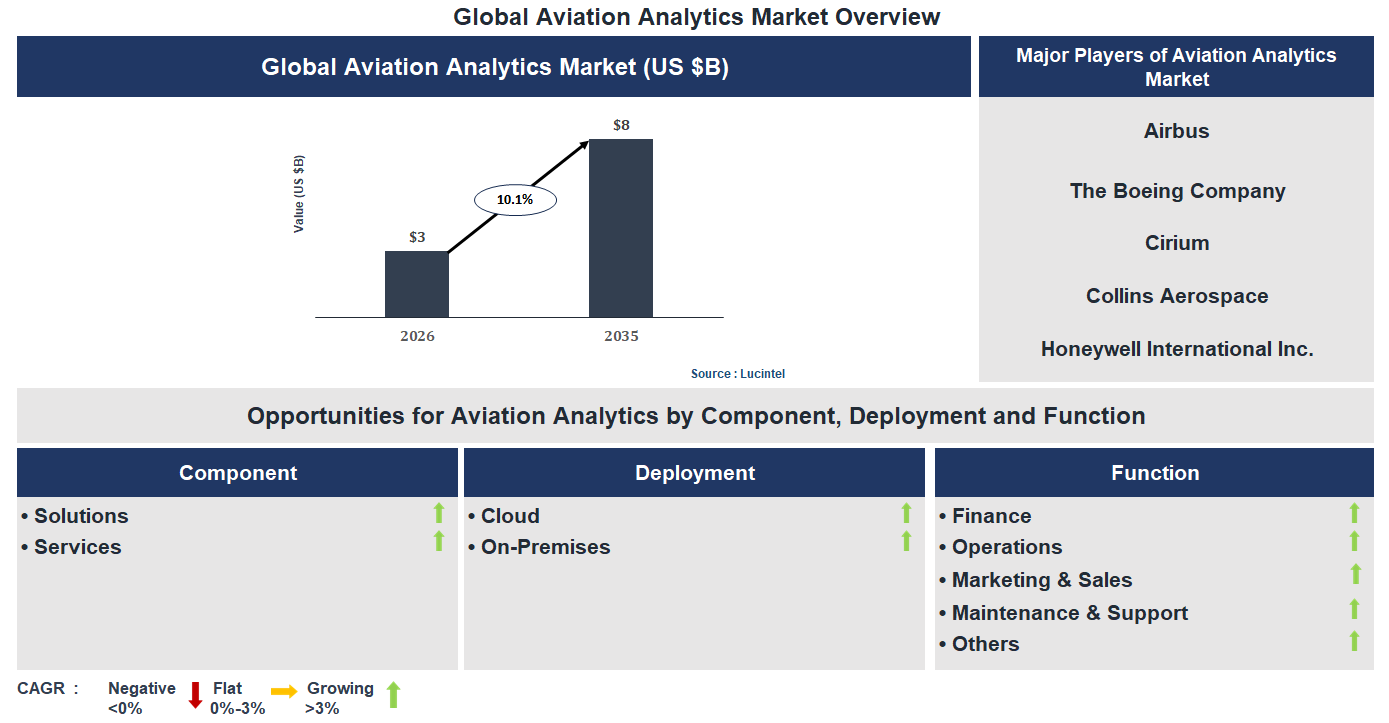
Aviation Analytics Market Trends and Forecast

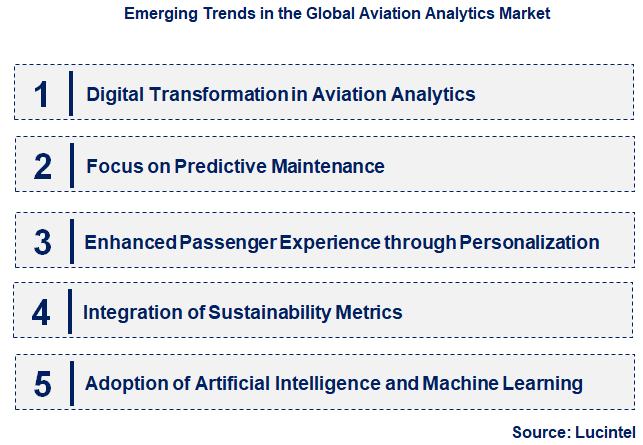
Emerging Trends in the Aviation Analytics Market

The aviation analytics market is experiencing rapid transformation driven by technological advancements, increasing data generation, and the need for enhanced operational efficiency. Airlines, airports, and related stakeholders are leveraging analytics to optimize routes, improve safety, reduce costs, and enhance customer experience. As the industry navigates post-pandemic recovery and sustainability goals, innovative data-driven solutions are becoming essential. These developments are not only reshaping operational strategies but also redefining competitive dynamics within the aviation sector. The following key trends highlight the major shifts influencing this markets evolution and future trajectory.

• Digital Transformation in Aviation Analytics: The industry is increasingly adopting digital tools and platforms to collect, analyze, and interpret vast amounts of data. Cloud computing, IoT sensors, and AI-driven analytics enable real-time decision-making, predictive maintenance, and personalized customer services. This shift enhances operational efficiency, reduces downtime, and improves safety standards. Digital transformation also facilitates seamless integration across various aviation functions, fostering a more agile and responsive industry environment. As a result, stakeholders can better anticipate disruptions and optimize resource allocation.
• Focus on Predictive Maintenance: Predictive analytics is revolutionizing aircraft maintenance by forecasting potential failures before they occur. Using data from sensors and historical records, airlines can schedule maintenance proactively, minimizing unscheduled repairs and reducing costs. This trend improves aircraft availability and safety, leading to increased operational reliability. Additionally, predictive maintenance supports sustainability efforts by optimizing fuel efficiency and reducing waste. The adoption of advanced analytics tools in maintenance processes is becoming a competitive differentiator, driving overall industry performance.
• Enhanced Passenger Experience through Personalization: Airlines are leveraging analytics to deliver tailored services, from personalized offers to customized in-flight experiences. Data on passenger preferences, travel history, and behavior enables airlines to create targeted marketing campaigns and improve customer satisfaction. This trend fosters brand loyalty and increases revenue through upselling and cross-selling opportunities. Moreover, personalized services contribute to smoother travel experiences, reducing friction points and enhancing overall passenger comfort. As customer expectations evolve, analytics-driven personalization is becoming a key differentiator in the competitive aviation market.
• Integration of Sustainability Metrics: Environmental concerns are prompting the aviation industry to incorporate sustainability analytics into their operations. Data on fuel consumption, emissions, and operational efficiency helps airlines identify areas for improvement and meet regulatory requirements. Analytics support the development of greener flight routes, optimized scheduling, and sustainable fuel usage. This trend not only reduces the environmental footprint but also aligns with corporate social responsibility goals. As sustainability becomes a core industry focus, analytics-driven insights are essential for balancing economic performance with ecological responsibility.
• Adoption of Artificial Intelligence and Machine Learning: AI and ML are increasingly integrated into aviation analytics to enhance predictive capabilities and automate complex decision-making processes. These technologies enable more accurate demand forecasting, dynamic pricing, and real-time operational adjustments. AI-driven chatbots and virtual assistants improve customer service, while machine learning models optimize flight operations and maintenance schedules. The adoption of AI and ML accelerates innovation, reduces operational costs, and enhances safety. As these technologies mature, their influence will expand, further transforming how the aviation industry manages data and drives strategic initiatives.

These emerging trends are collectively reshaping the aviation analytics market by fostering greater efficiency, safety, personalization, and sustainability. They enable stakeholders to make smarter, data-driven decisions, ultimately leading to a more resilient and competitive aviation industry poised for future growth.
Emerging Trends in the Aviation Analytics Market

Recent Development in the Aviation Analytics Market

The aviation analytics market is experiencing rapid growth driven by technological advancements, increasing data generation, and the need for operational efficiency. Airlines and airports are leveraging analytics to optimize routes, improve safety, and enhance customer experience. The integration of AI and big data is transforming decision-making processes, leading to cost savings and better resource management. As the industry recovers from recent disruptions, these developments are shaping a more resilient and data-driven aviation sector.

• Growing Adoption of Predictive Analytics: The aviation industry is increasingly utilising predictive analytics to forecast maintenance needs, optimize flight schedules, and enhance safety protocols. This proactive approach reduces downtime, minimizes delays, and lowers operational costs. Airlines can better anticipate equipment failures, leading to improved safety and customer satisfaction. The integration of predictive models is also enabling more accurate demand forecasting, helping airlines allocate resources efficiently. Overall, predictive analytics is a key driver of operational excellence and cost reduction in aviation.
• Expansion of Real-Time Data Monitoring: Real-time data monitoring is transforming aviation operations by providing instant insights into aircraft performance, weather conditions, and passenger flow. This development allows for immediate decision-making, reducing delays and improving safety measures. Airports and airlines can respond swiftly to disruptions, optimize ground operations, and enhance passenger experience. The deployment of IoT sensors and advanced data platforms is facilitating seamless data collection and analysis. Consequently, real-time monitoring is increasing operational agility and resilience across the aviation sector.
• Integration of Artificial Intelligence and Machine Learning: AI and ML are revolutionizing aviation analytics by enabling advanced data processing, pattern recognition, and automation. These technologies support predictive maintenance, personalized customer services, and optimized flight planning. AI-driven chatbots and virtual assistants improve passenger engagement, while machine learning models enhance safety protocols. The adoption of AI and ML is also reducing manual workload and increasing accuracy in decision-making. This integration is fostering innovation, efficiency, and competitive advantage within the aviation industry.
• Focus on Sustainability and Emission Reduction: Aviation analytics is playing a crucial role in promoting sustainability by optimizing fuel consumption, reducing emissions, and supporting eco-friendly initiatives. Data-driven insights help airlines identify more efficient routes, improve aircraft performance, and adopt alternative fuels. Governments and industry stakeholders are leveraging analytics to meet environmental regulations and sustainability goals. This focus on eco-efficiency not only benefits the environment but also aligns with consumer preferences for greener travel options, positioning the industry for long-term sustainable growth.
• Increasing Use of Big Data and Cloud Computing: The deployment of big data and cloud computing solutions is enabling scalable, secure, and cost-effective analytics in aviation. Airlines and airports can process vast amounts of data from various sources, gaining comprehensive insights into operations, customer behavior, and market trends. Cloud platforms facilitate collaboration and data sharing across stakeholders, enhancing decision-making and innovation. This technological shift is accelerating digital transformation, improving operational efficiency, and supporting the development of new revenue streams in the aviation market.

The overall impact of these developments is a more efficient, safe, and sustainable aviation industry. Enhanced data capabilities are driving operational improvements, customer satisfaction, and environmental responsibility. As these technologies mature, the market is expected to see increased competitiveness, innovation, and resilience, positioning aviation for a more connected and data-driven future.

Strategic Growth Opportunities in the Aviation Analytics Market

The aviation analytics market is experiencing rapid expansion driven by technological advancements, increasing data generation, and the need for operational efficiency. Airlines, airports, and service providers leverage analytics to optimize routes, improve safety, and enhance customer experience. Growing investments in digital transformation and predictive maintenance further fuel this growth. As the industry seeks to reduce costs and environmental impact, analytics solutions become essential for strategic decision-making, creating significant opportunities for market players to innovate and capture new revenue streams.

• Growing Adoption of Predictive Maintenance to Reduce Downtime and Costs: The increasing use of predictive analytics in aviation maintenance allows operators to forecast equipment failures before they occur. This proactive approach minimizes unscheduled repairs, reduces downtime, and lowers maintenance costs. Airlines and MROs are investing heavily in sensor data collection and machine learning algorithms to enhance reliability and safety. The shift toward predictive maintenance is a key driver, enabling more efficient fleet management and operational continuity.
• Increasing Use of Passenger Data Analytics to Enhance Customer Experience: Airlines and airports are harnessing passenger data to personalize services, streamline check-ins, and improve loyalty programs. Advanced analytics help understand traveler preferences, behaviors, and spending patterns, leading to tailored marketing and service offerings. This personalization boosts customer satisfaction, retention, and revenue. As data collection becomes more sophisticated, the market for passenger analytics solutions is expected to grow, supporting airlines’ competitive differentiation and operational efficiency.
• Expansion of Real-Time Data Analytics for Operational Optimization: Real-time analytics enable airlines and airports to monitor and respond to operational variables instantly. This includes managing air traffic, optimizing gate assignments, and improving baggage handling. Real-time insights facilitate quicker decision-making, reduce delays, and enhance safety protocols. The integration of IoT devices and advanced sensors accelerates this trend, making real-time analytics a critical component for operational excellence and resilience in the aviation industry.
• Rising Focus on Sustainability and Fuel Efficiency through Data Insights: Environmental concerns and fuel costs are prompting airlines to adopt analytics for sustainability initiatives. Data-driven insights help optimize flight paths, reduce fuel consumption, and monitor emissions. Analytics also support the development of eco-friendly practices and compliance with regulations. This focus on sustainability not only reduces costs but also enhances brand reputation. The market for green analytics solutions is expected to grow as the industry aims for more sustainable operations.
• Growing Investment in Data Security and Privacy Solutions: As aviation analytics relies heavily on sensitive data, ensuring cybersecurity is paramount. Increasing cyber threats and regulatory requirements drive demand for advanced security measures. Airlines and airports are investing in encryption, threat detection, and compliance tools to protect passenger and operational data. Strengthening data security enhances trust and mitigates risks associated with data breaches. This investment is crucial for the sustainable growth of the aviation analytics market, ensuring data integrity and regulatory adherence.

These growth opportunities collectively position the aviation analytics market for substantial expansion, driven by technological innovation, operational demands, and sustainability goals. As stakeholders increasingly leverage data-driven insights, the industry will see enhanced safety, efficiency, and customer satisfaction. Continuous investment in predictive, real-time, and security solutions will be vital for maintaining competitive advantage and achieving long-term growth in this dynamic market.

Aviation Analytics Market Driver and Challenges

The aviation analytics market is influenced by a complex interplay of technological advancements, economic shifts, and regulatory changes. As the aviation industry seeks to optimize operations, enhance safety, and reduce costs, analytics solutions become increasingly vital. Rapid technological innovations such as big data, artificial intelligence, and IoT are transforming data collection and analysis capabilities. Economic factors like rising fuel prices and fluctuating passenger demand also impact market growth. Additionally, evolving regulatory frameworks aim to improve safety standards and data privacy, shaping how analytics are implemented. Navigating these drivers and challenges is crucial for stakeholders aiming to capitalize on the markets potential.

The factors responsible for driving the aviation analytics market include:
• Technological Innovation: The rapid development of big data, artificial intelligence, and IoT technologies enables airlines and airports to analyze vast amounts of data efficiently. These innovations facilitate predictive maintenance, optimize flight routes, and improve passenger experiences. As technology becomes more accessible and affordable, adoption rates increase, leading to enhanced operational efficiency and safety. The integration of real-time analytics allows for quicker decision-making, reducing delays and operational costs. This continuous technological evolution is a primary driver, fostering a competitive edge for early adopters and expanding market opportunities globally.
• Rising Need for Operational Efficiency: Airlines and airports face mounting pressure to reduce costs and improve efficiency amid fluctuating fuel prices and competitive markets. Analytics solutions help identify inefficiencies in scheduling, maintenance, and resource allocation. By leveraging data-driven insights, organizations can streamline operations, minimize downtime, and optimize crew and aircraft utilization. This not only reduces operational expenses but also enhances customer satisfaction through timely services. The growing emphasis on efficiency is a significant driver, encouraging investments in analytics tools that deliver measurable performance improvements and support sustainable growth.
• Safety and Compliance Regulations: Stringent safety standards and regulatory requirements compel the aviation industry to adopt advanced analytics for compliance and risk management. Analytics enable proactive identification of safety hazards, monitoring of maintenance schedules, and adherence to regulatory reporting. Governments and industry bodies increasingly mandate data-driven safety protocols, making analytics indispensable. This regulatory landscape drives market growth by necessitating sophisticated analytics solutions that ensure safety, reduce liabilities, and meet legal standards. As safety remains a top priority, the demand for compliant analytics tools continues to rise, fostering innovation and market expansion.
• Growing Passenger Data and Personalization: The surge in passenger data collection through digital channels offers opportunities for personalized services and targeted marketing. Airlines utilize analytics to understand customer preferences, enhance loyalty programs, and tailor offerings, thereby increasing revenue and customer satisfaction. The demand for personalized experiences drives investments in analytics platforms capable of processing large datasets efficiently. This trend not only boosts revenue streams but also strengthens customer relationships, providing a competitive advantage. As passenger expectations evolve, the market for advanced analytics solutions focused on personalization is expected to expand significantly.
• Digital Transformation Initiatives: The aviation industry’s shift towards digitalization accelerates the adoption of analytics solutions. Airlines and airports are investing in integrated digital platforms to unify data sources and improve decision-making processes. These initiatives support automation, real-time monitoring, and predictive analytics, leading to smarter operations. Digital transformation also facilitates better collaboration across departments and stakeholders, enhancing overall efficiency. The push for digital maturity acts as a catalyst for market growth, encouraging vendors to develop innovative analytics tools aligned with industry needs. This ongoing transformation is vital for maintaining competitiveness in a rapidly evolving landscape.

The challenges facing the aviation analytics market include:
• Data Privacy and Security Concerns: The increasing reliance on data analytics raises significant concerns regarding data privacy and cybersecurity. Sensitive passenger and operational data are vulnerable to breaches, which can lead to legal penalties and reputational damage. Strict data protection regulations, such as GDPR, impose compliance requirements that complicate data sharing and storage. Ensuring robust security measures while maintaining data accessibility is a complex balancing act. These concerns may hinder the adoption of analytics solutions, especially in regions with stringent privacy laws, thereby slowing market growth and innovation.
• High Implementation Costs: Deploying advanced analytics systems involves substantial investment in technology, infrastructure, and skilled personnel. Small and medium-sized airlines and airports may find these costs prohibitive, limiting their ability to adopt such solutions. Additionally, integration with existing legacy systems can be complex and costly, requiring significant customization and downtime. The high initial expenditure can deter organizations from embracing analytics, especially in markets with tight budgets. Overcoming these financial barriers is essential for broader market penetration and long-term growth.
• Skill Gap and Change Management: The successful implementation of aviation analytics depends on skilled personnel capable of managing and interpreting complex data. A shortage of data scientists, analysts, and IT specialists poses a significant challenge. Furthermore, resistance to change within organizations can impede adoption, as staff may be reluctant to alter established workflows. Training and change management initiatives are necessary but can be time-consuming and costly. Addressing the skill gap and fostering a data-driven culture are critical for realizing the full benefits of analytics solutions, impacting overall market development.

The aviation analytics market is driven by technological innovation, operational efficiency needs, regulatory compliance, passenger data utilization, and digital transformation efforts. However, challenges such as data security, high implementation costs, and skill shortages pose significant hurdles. These factors collectively influence the pace and scope of market growth. While opportunities for enhanced safety, efficiency, and customer experience are substantial, overcoming the challenges requires strategic investments and regulatory clarity. Overall, the markets evolution will depend on balancing technological advancements with effective risk management and workforce development, shaping a resilient and innovative aviation industry.

List of Aviation Analytics Companies

Companies in the market compete on the basis of product quality offered. Major players in this market focus on expanding their manufacturing facilities, R&D investments, infrastructural development, and leverage integration opportunities across the value chain. With these strategies aviation analytics companies cater increasing demand, ensure competitive effectiveness, develop innovative products & technologies, reduce production costs, and expand their customer base. Some of the aviation analytics companies profiled in this report include-
• Airbus
• The Boeing Company
• Cirium
• Collins Aerospace
• Honeywell International Inc.
• Lufthansa Technik
• Booz Allen Hamilton
• GE Aerospace
• IBM
• General Oracle

Aviation Analytics Market by Segment

The study includes a forecast for the global aviation analytics market by component, deployment, function, and region.

Aviation Analytics Market by Component [Value from 2019 to 2035]:


• Solutions
• Services

Aviation Analytics Market by Deployment [Value from 2019 to 2035]:


• Cloud
• On-Premises

Aviation Analytics Market by Function [Value from 2019 to 2035]:


• Finance
• Operations
• Marketing & Sales
• Maintenance & Support
• Others

Aviation Analytics Market by Region [Value from 2019 to 2035]:


• North America
• Europe
• Asia Pacific
• The Rest of the World

Country Wise Outlook for the Aviation Analytics Market

The aviation analytics market has experienced significant growth driven by technological advancements, increasing data availability, and the need for enhanced operational efficiency across the globe. Countries are adopting innovative solutions to optimize flight operations, improve safety, and reduce costs. The markets evolution is influenced by regulatory changes, digital transformation initiatives, and the rising demand for predictive analytics. As aviation becomes more data-driven, key players are investing in AI, machine learning, and big data analytics to stay competitive. This global trend reflects a strategic shift towards smarter, more efficient aviation systems, with each country contributing uniquely based on its technological landscape and industry needs.

• United States: The US leads in aviation analytics adoption, with major airlines and airports investing heavily in data-driven solutions. Innovations include predictive maintenance, real-time flight tracking, and passenger experience enhancements. The Federal Aviation Administration (FAA) has implemented advanced analytics for safety monitoring and air traffic management. US-based tech giants are developing AI-powered analytics platforms, fostering a competitive environment. The market is also driven by increased focus on sustainability and operational efficiency, with analytics playing a crucial role in reducing fuel consumption and emissions.
• China: China is rapidly expanding its aviation analytics capabilities, supported by government initiatives to modernize its aviation infrastructure. The country is focusing on integrating big data and AI to improve air traffic management and airport operations. Major Chinese airlines are adopting predictive analytics for maintenance and customer service improvements. The development of smart airports equipped with IoT and analytics solutions is a key trend. Chinas strategic investments aim to boost domestic aviation safety, efficiency, and competitiveness in the global market.
• Germany: Germanys aviation analytics market is characterized by a strong emphasis on safety, regulatory compliance, and environmental sustainability. Leading airlines and airports are deploying analytics for predictive maintenance, route optimization, and passenger flow management. The country benefits from a robust technological ecosystem and collaborations between industry and research institutions. German companies are also exploring AI-driven solutions to enhance aircraft maintenance and operational decision-making, aligning with EU regulations and sustainability goals.
• India: India is witnessing rapid growth in aviation analytics, driven by expanding air travel and infrastructure development. Airlines are leveraging analytics for revenue management, customer insights, and operational efficiency. The government’s focus on digital transformation and smart airports is accelerating adoption. Indian startups and tech firms are developing innovative analytics solutions tailored to local needs, such as predictive maintenance and passenger experience enhancement. The market is poised for substantial growth as the country aims to become a major global aviation hub.
• Japan: Japans aviation analytics market is characterized by technological innovation and a focus on safety and efficiency. Airlines and airports are adopting analytics for predictive maintenance, fuel optimization, and passenger management. The country’s advanced technological infrastructure supports the integration of AI and IoT solutions. Japan is also exploring analytics to improve disaster response and resilience in aviation operations. Collaborations between government agencies and private firms are fostering the development of smart, sustainable aviation systems aligned with Japan’s environmental commitments.

Lucintel Analytics Dashboard

Features of the Global Aviation Analytics Market

Market Size Estimates: Aviation analytics market size estimation in terms of value ($B).
Trend and Forecast Analysis: Market trends (2019 to 2025) and forecast (2026 to 2035) by various segments and regions.
Segmentation Analysis: Aviation analytics market size by component, deployment, function, and region in terms of value ($B).
Regional Analysis: Aviation analytics market breakdown by North America, Europe, Asia Pacific, and Rest of the World.
Growth Opportunities: Analysis of growth opportunities in different components, deployments, functions, and regions for the aviation analytics market.
Strategic Analysis: This includes M&A, new product development, and competitive landscape of the aviation analytics market.
Analysis of competitive intensity of the industry based on Porter’s Five Forces model.

Lucintel Consulting Services

FAQ

Q1. What is the aviation analytics market size?
Answer: The global aviation analytics market is expected to reach an estimated $8 billion by 2035.
Q2. What is the growth forecast for aviation analytics market?
Answer: The global aviation analytics market is expected to grow with a CAGR of 10.1% from 2026 to 2035.
Q3. What are the major drivers influencing the growth of the aviation analytics market?
Answer: The major drivers for this market are the increasing need for operational efficiency improvements, the rising demand for predictive maintenance solutions, and the growing adoption of data-driven decision making.
Q4. What are the major segments for aviation analytics market?
Answer: The future of the aviation analytics market looks promising with opportunities in the finance, operation, marketing & sales, and maintenance & support markets.
Q5. Who are the key aviation analytics market companies?
Answer: Some of the key aviation analytics companies are as follows:
• Airbus
• The Boeing Company
• Cirium
• Collins Aerospace
• Honeywell International Inc.
• Lufthansa Technik
• Booz Allen Hamilton
• GE Aerospace
• IBM
• General Oracle
Q6. Which aviation analytics market segment will be the largest in future?
Answer: Lucintel forecasts that, within the deployment category, cloud is expected to witness higher growth over the forecast period.
Q7. In aviation analytics market, which region is expected to be the largest in next 8 years?
Answer: In terms of region, North America is expected to witness the highest growth over the forecast period.
Q8. Do we receive customization in this report?
Answer: Yes, Lucintel provides 10% customization without any additional cost.

This report answers following 11 key questions:

Q.1. What are some of the most promising, high-growth opportunities for the aviation analytics market by component (solutions and services), deployment (cloud and on-premises), function (finance, operations, marketing & sales, maintenance & support, and others), and region (North America, Europe, Asia Pacific, and the Rest of the World)?
Q.2. Which segments will grow at a faster pace and why?
Q.3. Which region will grow at a faster pace and why?
Q.4. What are the key factors affecting market dynamics? What are the key challenges and business risks in this market?
Q.5. What are the business risks and competitive threats in this market?
Q.6. What are the emerging trends in this market and the reasons behind them?
Q.7. What are some of the changing demands of customers in the market?
Q.8. What are the new developments in the market? Which companies are leading these developments?
Q.9. Who are the major players in this market? What strategic initiatives are key players pursuing for business growth?
Q.10. What are some of the competing products in this market and how big of a threat do they pose for loss of market share by material or product substitution?
Q.11. What M&A activity has occurred in the last 5 years and what has its impact been on the industry?

For any questions related to Aviation Analytics Market, Aviation Analytics Market Size, Aviation Analytics Market Growth, Aviation Analytics Market Analysis, Aviation Analytics Market Report, Aviation Analytics Market Share, Aviation Analytics Market Trends, Aviation Analytics Market Forecast, Aviation Analytics Companies, write Lucintel analyst at email: helpdesk@lucintel.com. We will be glad to get back to you soon.
                                           Table of Contents

            1. Executive Summary

            2. Market Overview

                        2.1 Background and Classifications
                        2.2 Supply Chain

            3. Market Trends & Forecast Analysis

                        3.1 Macroeconomic Trends and Forecasts
                        3.2 Industry Drivers and Challenges
                        3.3 PESTLE Analysis
                        3.4 Patent Analysis
                        3.5 Regulatory Environment
                        3.6 Global Aviation Analytics Market Trends and Forecast

            4. Global Aviation Analytics Market by Component

                        4.1 Overview
                        4.2 Attractiveness Analysis by Component
                        4.3 Solutions : Trends and Forecast (2019 to 2035)
                        4.4 Services : Trends and Forecast (2019 to 2035)

            5. Global Aviation Analytics Market by Deployment

                        5.1 Overview
                        5.2 Attractiveness Analysis by Deployment
                        5.3 Cloud : Trends and Forecast (2019 to 2035)
                        5.4 On-Premises : Trends and Forecast (2019 to 2035)

            6. Global Aviation Analytics Market by Function

                        6.1 Overview
                        6.2 Attractiveness Analysis by Function
                        6.3 Finance : Trends and Forecast (2019 to 2035)
                        6.4 Operations : Trends and Forecast (2019 to 2035)
                        6.5 Marketing & Sales : Trends and Forecast (2019 to 2035)
                        6.6 Maintenance & Support : Trends and Forecast (2019 to 2035)
                        6.7 Others : Trends and Forecast (2019 to 2035)

            7. Regional Analysis

                        7.1 Overview
                        7.2 Global Aviation Analytics Market by Region

            8. North American Aviation Analytics Market

                        8.1 Overview
                        8.2 North American Aviation Analytics Market by Deployment
                        8.3 North American Aviation Analytics Market by Function
                        8.4 The United States Aviation Analytics Market
                        8.5 Canadian Aviation Analytics Market
                        8.6 Mexican Aviation Analytics Market

            9. European Aviation Analytics Market

                        9.1 Overview
                        9.2 European Aviation Analytics Market by Deployment
                        9.3 European Aviation Analytics Market by Function
                        9.4 German Aviation Analytics Market
                        9.5 French Aviation Analytics Market
                        9.6 Italian Aviation Analytics Market
                        9.7 Spanish Aviation Analytics Market
                        9.8 The United Kingdom Aviation Analytics Market

            10. APAC Aviation Analytics Market

                        10.1 Overview
                        10.2 APAC Aviation Analytics Market by Deployment
                        10.3 APAC Aviation Analytics Market by Function
                        10.4 Chinese Aviation Analytics Market
                        10.5 Indian Aviation Analytics Market
                        10.6 Japanese Aviation Analytics Market
                        10.7 South Korean Aviation Analytics Market
                        10.8 Indonesian Aviation Analytics Market

            11. ROW Aviation Analytics Market

                        11.1 Overview
                        11.2 ROW Aviation Analytics Market by Deployment
                        11.3 ROW Aviation Analytics Market by Function
                        11.4 Middle Eastern Aviation Analytics Market
                        11.5 South American Aviation Analytics Market
                        11.6 African Aviation Analytics Market

            12. Competitor Analysis

                        12.1 Product Portfolio Analysis
                        12.2 Operational Integration
                        12.3 Porter’s Five Forces Analysis
                                    • Competitive Rivalry
                                    • Bargaining Power of Buyers
                                    • Bargaining Power of Suppliers
                                    • Threat of Substitutes
                                    • Threat of New Entrants
                        12.4 Market Share Analysis

            13. Opportunities & Strategic Analysis

                        13.1 Value Chain Analysis
                        13.2 Growth Opportunity Analysis
                                    13.2.1 Growth Opportunity by Component
                                    13.2.2 Growth Opportunity by Deployment
                                    13.2.3 Growth Opportunity by Function
                                    13.2.4 Growth Opportunity by Region
                        13.3 Emerging Trends in the Global Aviation Analytics Market
                        13.4 Strategic Analysis
                                    13.4.1 New Product Development
                                    13.4.2 Certification and Licensing
                                    13.4.3 Mergers, Acquisitions, Agreements, Collaborations, and Joint Ventures

            14. Company Profiles of the Leading Players Across the Value Chain

                        14.1 Competitive Analysis Overview
                        14.2 Airbus
                                    • Company Overview
                                    • Aviation Analytics Market Business Overview
                                    • New Product Development
                                    • Merger, Acquisition, and Collaboration
                                    • Certification and Licensing
                        14.3 The Boeing Company
                                    • Company Overview
                                    • Aviation Analytics Market Business Overview
                                    • New Product Development
                                    • Merger, Acquisition, and Collaboration
                                    • Certification and Licensing
                        14.4 Cirium
                                    • Company Overview
                                    • Aviation Analytics Market Business Overview
                                    • New Product Development
                                    • Merger, Acquisition, and Collaboration
                                    • Certification and Licensing
                        14.5 Collins Aerospace
                                    • Company Overview
                                    • Aviation Analytics Market Business Overview
                                    • New Product Development
                                    • Merger, Acquisition, and Collaboration
                                    • Certification and Licensing
                        14.6 Honeywell International Inc.
                                    • Company Overview
                                    • Aviation Analytics Market Business Overview
                                    • New Product Development
                                    • Merger, Acquisition, and Collaboration
                                    • Certification and Licensing
                        14.7 Lufthansa Technik
                                    • Company Overview
                                    • Aviation Analytics Market Business Overview
                                    • New Product Development
                                    • Merger, Acquisition, and Collaboration
                                    • Certification and Licensing
                        14.8 Booz Allen Hamilton
                                    • Company Overview
                                    • Aviation Analytics Market Business Overview
                                    • New Product Development
                                    • Merger, Acquisition, and Collaboration
                                    • Certification and Licensing
                        14.9 GE Aerospace
                                    • Company Overview
                                    • Aviation Analytics Market Business Overview
                                    • New Product Development
                                    • Merger, Acquisition, and Collaboration
                                    • Certification and Licensing
                        14.10 IBM
                                    • Company Overview
                                    • Aviation Analytics Market Business Overview
                                    • New Product Development
                                    • Merger, Acquisition, and Collaboration
                                    • Certification and Licensing
                        14.11 General Oracle
                                    • Company Overview
                                    • Aviation Analytics Market Business Overview
                                    • New Product Development
                                    • Merger, Acquisition, and Collaboration
                                    • Certification and Licensing

            15. Appendix

                        15.1 List of Figures
                        15.2 List of Tables
                        15.3 Research Methodology
                        15.4 Disclaimer
                        15.5 Copyright
                        15.6 Abbreviations and Technical Units
                        15.7 About Us
                        15.8 Contact Us

                                               List of Figures


            Chapter 1

                        Figure 1.1: Trends and Forecast for the Global Aviation Analytics Market

            Chapter 2

                        Figure 2.1: Usage of Aviation Analytics Market
                        Figure 2.2: Classification of the Global Aviation Analytics Market
                        Figure 2.3: Supply Chain of the Global Aviation Analytics Market

            Chapter 3

                        Figure 3.1: Trends of the Global GDP Growth Rate
                        Figure 3.2: Trends of the Global Population Growth Rate
                        Figure 3.3: Trends of the Global Inflation Rate
                        Figure 3.4: Trends of the Global Unemployment Rate
                        Figure 3.5: Trends of the Regional GDP Growth Rate
                        Figure 3.6: Trends of the Regional Population Growth Rate
                        Figure 3.7: Trends of the Regional Inflation Rate
                        Figure 3.8: Trends of the Regional Unemployment Rate
                        Figure 3.9: Trends of Regional Per Capita Income
                        Figure 3.10: Forecast for the Global GDP Growth Rate
                        Figure 3.11: Forecast for the Global Population Growth Rate
                        Figure 3.12: Forecast for the Global Inflation Rate
                        Figure 3.13: Forecast for the Global Unemployment Rate
                        Figure 3.14: Forecast for the Regional GDP Growth Rate
                        Figure 3.15: Forecast for the Regional Population Growth Rate
                        Figure 3.16: Forecast for the Regional Inflation Rate
                        Figure 3.17: Forecast for the Regional Unemployment Rate
                        Figure 3.18: Forecast for Regional Per Capita Income
                        Figure 3.19: Driver and Challenges of the Aviation Analytics Market

            Chapter 4

                        Figure 4.1: Global Aviation Analytics Market by Component in 2019, 2025, and 2035
                        Figure 4.2: Trends of the Global Aviation Analytics Market ($B) by Component
                        Figure 4.3: Forecast for the Global Aviation Analytics Market ($B) by Component
                        Figure 4.4: Trends and Forecast for Solutions in the Global Aviation Analytics Market (2019-2035)
                        Figure 4.5: Trends and Forecast for Services in the Global Aviation Analytics Market (2019-2035)

            Chapter 5

                        Figure 5.1: Global Aviation Analytics Market by Deployment in 2019, 2025, and 2035
                        Figure 5.2: Trends of the Global Aviation Analytics Market ($B) by Deployment
                        Figure 5.3: Forecast for the Global Aviation Analytics Market ($B) by Deployment
                        Figure 5.4: Trends and Forecast for Cloud in the Global Aviation Analytics Market (2019-2035)
                        Figure 5.5: Trends and Forecast for On-Premises in the Global Aviation Analytics Market (2019-2035)

            Chapter 6

                        Figure 6.1: Global Aviation Analytics Market by Function in 2019, 2025, and 2035
                        Figure 6.2: Trends of the Global Aviation Analytics Market ($B) by Function
                        Figure 6.3: Forecast for the Global Aviation Analytics Market ($B) by Function
                        Figure 6.4: Trends and Forecast for Finance in the Global Aviation Analytics Market (2019-2035)
                        Figure 6.5: Trends and Forecast for Operations in the Global Aviation Analytics Market (2019-2035)
                        Figure 6.6: Trends and Forecast for Marketing & Sales in the Global Aviation Analytics Market (2019-2035)
                        Figure 6.7: Trends and Forecast for Maintenance & Support in the Global Aviation Analytics Market (2019-2035)
                        Figure 6.8: Trends and Forecast for Others in the Global Aviation Analytics Market (2019-2035)

            Chapter 7

                        Figure 7.1: Trends of the Global Aviation Analytics Market ($B) by Region (2019-2025)
                        Figure 7.2: Forecast for the Global Aviation Analytics Market ($B) by Region (2026-2035)

            Chapter 8

                        Figure 8.1: Trends and Forecast for the North American Aviation Analytics Market (2019-2035)
                        Figure 8.2: North American Aviation Analytics Market by Component in 2019, 2025, and 2035
                        Figure 8.3: Trends of the North American Aviation Analytics Market ($B) by Component (2019-2025)
                        Figure 8.4: Forecast for the North American Aviation Analytics Market ($B) by Component (2026-2035)
                        Figure 8.5: North American Aviation Analytics Market by Deployment in 2019, 2025, and 2035
                        Figure 8.6: Trends of the North American Aviation Analytics Market ($B) by Deployment (2019-2025)
                        Figure 8.7: Forecast for the North American Aviation Analytics Market ($B) by Deployment (2026-2035)
                        Figure 8.8: Trends and Forecast for the United States Aviation Analytics Market ($B) (2019-2035)
                        Figure 8.9: Trends and Forecast for the Mexican Aviation Analytics Market ($B) (2019-2035)
                        Figure 8.10: Trends and Forecast for the Canadian Aviation Analytics Market ($B) (2019-2035)

            Chapter 9

                        Figure 9.1: Trends and Forecast for the European Aviation Analytics Market (2019-2035)
                        Figure 9.2: European Aviation Analytics Market by Component in 2019, 2025, and 2035
                        Figure 9.3: Trends of the European Aviation Analytics Market ($B) by Component (2019-2025)
                        Figure 9.4: Forecast for the European Aviation Analytics Market ($B) by Component (2026-2035)
                        Figure 9.5: European Aviation Analytics Market by Deployment in 2019, 2025, and 2035
                        Figure 9.6: Trends of the European Aviation Analytics Market ($B) by Deployment (2019-2025)
                        Figure 9.7: Forecast for the European Aviation Analytics Market ($B) by Deployment (2026-2035)
                        Figure 9.8: Trends and Forecast for the German Aviation Analytics Market ($B) (2019-2035)
                        Figure 9.9: Trends and Forecast for the French Aviation Analytics Market ($B) (2019-2035)
                        Figure 9.10: Trends and Forecast for the Spanish Aviation Analytics Market ($B) (2019-2035)
                        Figure 9.11: Trends and Forecast for the Italian Aviation Analytics Market ($B) (2019-2035)
                        Figure 9.12: Trends and Forecast for the United Kingdom Aviation Analytics Market ($B) (2019-2035)

            Chapter 10

                        Figure 10.1: Trends and Forecast for the APAC Aviation Analytics Market (2019-2035)
                        Figure 10.2: APAC Aviation Analytics Market by Component in 2019, 2025, and 2035
                        Figure 10.3: Trends of the APAC Aviation Analytics Market ($B) by Component (2019-2025)
                        Figure 10.4: Forecast for the APAC Aviation Analytics Market ($B) by Component (2026-2035)
                        Figure 10.5: APAC Aviation Analytics Market by Deployment in 2019, 2025, and 2035
                        Figure 10.6: Trends of the APAC Aviation Analytics Market ($B) by Deployment (2019-2025)
                        Figure 10.7: Forecast for the APAC Aviation Analytics Market ($B) by Deployment (2026-2035)
                        Figure 10.8: Trends and Forecast for the Japanese Aviation Analytics Market ($B) (2019-2035)
                        Figure 10.9: Trends and Forecast for the Indian Aviation Analytics Market ($B) (2019-2035)
                        Figure 10.10: Trends and Forecast for the Chinese Aviation Analytics Market ($B) (2019-2035)
                        Figure 10.11: Trends and Forecast for the South Korean Aviation Analytics Market ($B) (2019-2035)
                        Figure 10.12: Trends and Forecast for the Indonesian Aviation Analytics Market ($B) (2019-2035)

            Chapter 11

                        Figure 11.1: Trends and Forecast for the ROW Aviation Analytics Market (2019-2035)
                        Figure 11.2: ROW Aviation Analytics Market by Component in 2019, 2025, and 2035
                        Figure 11.3: Trends of the ROW Aviation Analytics Market ($B) by Component (2019-2025)
                        Figure 11.4: Forecast for the ROW Aviation Analytics Market ($B) by Component (2026-2035)
                        Figure 11.5: ROW Aviation Analytics Market by Deployment in 2019, 2025, and 2035
                        Figure 11.6: Trends of the ROW Aviation Analytics Market ($B) by Deployment (2019-2025)
                        Figure 11.7: Forecast for the ROW Aviation Analytics Market ($B) by Deployment (2026-2035)
                        Figure 11.8: Trends and Forecast for the Middle Eastern Aviation Analytics Market ($B) (2019-2035)
                        Figure 11.9: Trends and Forecast for the South American Aviation Analytics Market ($B) (2019-2035)
                        Figure 11.10: Trends and Forecast for the African Aviation Analytics Market ($B) (2019-2035)

            Chapter 12

                        Figure 12.1: Porter’s Five Forces Analysis of the Global Aviation Analytics Market
                        Figure 12.2: Market Share (%) of Top Players in the Global Aviation Analytics Market (2025)

            Chapter 13

                        Figure 13.1: Growth Opportunities for the Global Aviation Analytics Market by Component
                        Figure 13.2: Growth Opportunities for the Global Aviation Analytics Market by Deployment
                        Figure 13.3: Growth Opportunities for the Global Aviation Analytics Market by Function
                        Figure 13.4: Growth Opportunities for the Global Aviation Analytics Market by Region
                        Figure 13.5: Emerging Trends in the Global Aviation Analytics Market

                                               List of Tables


            Chapter 1

                        Table 1.1: Growth Rate (%, 2024-2025) and CAGR (%, 2026-2035) of the Aviation Analytics Market by Component, Deployment, and Function
                        Table 1.2: Attractiveness Analysis for the Aviation Analytics Market by Region
                        Table 1.3: Global Aviation Analytics Market Parameters and Attributes

            Chapter 3

                        Table 3.1: Trends of the Global Aviation Analytics Market (2019-2025)
                        Table 3.2: Forecast for the Global Aviation Analytics Market (2026-2035)

            Chapter 4

                        Table 4.1: Attractiveness Analysis for the Global Aviation Analytics Market by Component
                        Table 4.2: Market Size and CAGR of Various Component in the Global Aviation Analytics Market (2019-2025)
                        Table 4.3: Market Size and CAGR of Various Component in the Global Aviation Analytics Market (2026-2035)
                        Table 4.4: Trends of Solutions in the Global Aviation Analytics Market (2019-2025)
                        Table 4.5: Forecast for Solutions in the Global Aviation Analytics Market (2026-2035)
                        Table 4.6: Trends of Services in the Global Aviation Analytics Market (2019-2025)
                        Table 4.7: Forecast for Services in the Global Aviation Analytics Market (2026-2035)

            Chapter 5

                        Table 5.1: Attractiveness Analysis for the Global Aviation Analytics Market by Deployment
                        Table 5.2: Market Size and CAGR of Various Deployment in the Global Aviation Analytics Market (2019-2025)
                        Table 5.3: Market Size and CAGR of Various Deployment in the Global Aviation Analytics Market (2026-2035)
                        Table 5.4: Trends of Cloud in the Global Aviation Analytics Market (2019-2025)
                        Table 5.5: Forecast for Cloud in the Global Aviation Analytics Market (2026-2035)
                        Table 5.6: Trends of On-Premises in the Global Aviation Analytics Market (2019-2025)
                        Table 5.7: Forecast for On-Premises in the Global Aviation Analytics Market (2026-2035)

            Chapter 6

                        Table 6.1: Attractiveness Analysis for the Global Aviation Analytics Market by Function
                        Table 6.2: Market Size and CAGR of Various Function in the Global Aviation Analytics Market (2019-2025)
                        Table 6.3: Market Size and CAGR of Various Function in the Global Aviation Analytics Market (2026-2035)
                        Table 6.4: Trends of Finance in the Global Aviation Analytics Market (2019-2025)
                        Table 6.5: Forecast for Finance in the Global Aviation Analytics Market (2026-2035)
                        Table 6.6: Trends of Operations in the Global Aviation Analytics Market (2019-2025)
                        Table 6.7: Forecast for Operations in the Global Aviation Analytics Market (2026-2035)
                        Table 6.8: Trends of Marketing & Sales in the Global Aviation Analytics Market (2019-2025)
                        Table 6.9: Forecast for Marketing & Sales in the Global Aviation Analytics Market (2026-2035)
                        Table 6.10: Trends of Maintenance & Support in the Global Aviation Analytics Market (2019-2025)
                        Table 6.11: Forecast for Maintenance & Support in the Global Aviation Analytics Market (2026-2035)
                        Table 6.12: Trends of Others in the Global Aviation Analytics Market (2019-2025)
                        Table 6.13: Forecast for Others in the Global Aviation Analytics Market (2026-2035)

            Chapter 7

                        Table 7.1: Market Size and CAGR of Various Regions in the Global Aviation Analytics Market (2019-2025)
                        Table 7.2: Market Size and CAGR of Various Regions in the Global Aviation Analytics Market (2026-2035)

            Chapter 8

                        Table 8.1: Trends of the North American Aviation Analytics Market (2019-2025)
                        Table 8.2: Forecast for the North American Aviation Analytics Market (2026-2035)
                        Table 8.3: Market Size and CAGR of Various Component in the North American Aviation Analytics Market (2019-2025)
                        Table 8.4: Market Size and CAGR of Various Component in the North American Aviation Analytics Market (2026-2035)
                        Table 8.5: Market Size and CAGR of Various Deployment in the North American Aviation Analytics Market (2019-2025)
                        Table 8.6: Market Size and CAGR of Various Deployment in the North American Aviation Analytics Market (2026-2035)
                        Table 8.7: Trends and Forecast for the United States Aviation Analytics Market (2019-2035)
                        Table 8.8: Trends and Forecast for the Mexican Aviation Analytics Market (2019-2035)
                        Table 8.9: Trends and Forecast for the Canadian Aviation Analytics Market (2019-2035)

            Chapter 9

                        Table 9.1: Trends of the European Aviation Analytics Market (2019-2025)
                        Table 9.2: Forecast for the European Aviation Analytics Market (2026-2035)
                        Table 9.3: Market Size and CAGR of Various Component in the European Aviation Analytics Market (2019-2025)
                        Table 9.4: Market Size and CAGR of Various Component in the European Aviation Analytics Market (2026-2035)
                        Table 9.5: Market Size and CAGR of Various Deployment in the European Aviation Analytics Market (2019-2025)
                        Table 9.6: Market Size and CAGR of Various Deployment in the European Aviation Analytics Market (2026-2035)
                        Table 9.7: Trends and Forecast for the German Aviation Analytics Market (2019-2035)
                        Table 9.8: Trends and Forecast for the French Aviation Analytics Market (2019-2035)
                        Table 9.9: Trends and Forecast for the Spanish Aviation Analytics Market (2019-2035)
                        Table 9.10: Trends and Forecast for the Italian Aviation Analytics Market (2019-2035)
                        Table 9.11: Trends and Forecast for the United Kingdom Aviation Analytics Market (2019-2035)

            Chapter 10

                        Table 10.1: Trends of the APAC Aviation Analytics Market (2019-2025)
                        Table 10.2: Forecast for the APAC Aviation Analytics Market (2026-2035)
                        Table 10.3: Market Size and CAGR of Various Component in the APAC Aviation Analytics Market (2019-2025)
                        Table 10.4: Market Size and CAGR of Various Component in the APAC Aviation Analytics Market (2026-2035)
                        Table 10.5: Market Size and CAGR of Various Deployment in the APAC Aviation Analytics Market (2019-2025)
                        Table 10.6: Market Size and CAGR of Various Deployment in the APAC Aviation Analytics Market (2026-2035)
                        Table 10.7: Trends and Forecast for the Japanese Aviation Analytics Market (2019-2035)
                        Table 10.8: Trends and Forecast for the Indian Aviation Analytics Market (2019-2035)
                        Table 10.9: Trends and Forecast for the Chinese Aviation Analytics Market (2019-2035)
                        Table 10.10: Trends and Forecast for the South Korean Aviation Analytics Market (2019-2035)
                        Table 10.11: Trends and Forecast for the Indonesian Aviation Analytics Market (2019-2035)

            Chapter 11

                        Table 11.1: Trends of the ROW Aviation Analytics Market (2019-2025)
                        Table 11.2: Forecast for the ROW Aviation Analytics Market (2026-2035)
                        Table 11.3: Market Size and CAGR of Various Component in the ROW Aviation Analytics Market (2019-2025)
                        Table 11.4: Market Size and CAGR of Various Component in the ROW Aviation Analytics Market (2026-2035)
                        Table 11.5: Market Size and CAGR of Various Deployment in the ROW Aviation Analytics Market (2019-2025)
                        Table 11.6: Market Size and CAGR of Various Deployment in the ROW Aviation Analytics Market (2026-2035)
                        Table 11.7: Trends and Forecast for the Middle Eastern Aviation Analytics Market (2019-2035)
                        Table 11.8: Trends and Forecast for the South American Aviation Analytics Market (2019-2035)
                        Table 11.9: Trends and Forecast for the African Aviation Analytics Market (2019-2035)

            Chapter 12

                        Table 12.1: Product Mapping of Aviation Analytics Suppliers Based on Segments
                        Table 12.2: Operational Integration of Aviation Analytics Manufacturers
                        Table 12.3: Rankings of Suppliers Based on Aviation Analytics Revenue

            Chapter 13

                        Table 13.1: New Product Launches by Major Aviation Analytics Producers (2019-2025)
                        Table 13.2: Certification Acquired by Major Competitor in the Global Aviation Analytics Market

.

Buy full report or by chapter as follows

Price by License Type:
[-] Hide Chapter Details
[Chapter Number] [Chapter Name] [Chapter Number Of Pages] [Chapter Price]
Title/Chapter Name Pages Price
Full Report: Aviation Analytics Market Report: Trends, Forecast and Competitive Analysis to 2035 Full Report $ 4,850
A 150 Page Report
Lucintel has been in the business of market research and management consulting since 2000 and has published over 1000 market intelligence reports in various markets / applications and served over 1,000 clients worldwide. This study is a culmination of four months of full-time effort performed by Lucintel's analyst team. The analysts used the following sources for the creation and completion of this valuable report:
  • In-depth interviews of the major players in this market
  • Detailed secondary research from competitors’ financial statements and published data 
  • Extensive searches of published works, market, and database information pertaining to industry news, company press releases, and customer intentions
  • A compilation of the experiences, judgments, and insights of Lucintel’s professionals, who have analyzed and tracked this market over the years.
Extensive research and interviews are conducted across the supply chain of this market to estimate market share, market size, trends, drivers, challenges, and forecasts. Below is a brief summary of the primary interviews that were conducted by job function for this report.
 
Thus, Lucintel compiles vast amounts of data from numerous sources, validates the integrity of that data, and performs a comprehensive analysis. Lucintel then organizes the data, its findings, and insights into a concise report designed to support the strategic decision-making process. The figure below is a graphical representation of Lucintel’s research process. 
 

Please sign in below to get report brochure - Aviation Analytics Market Report.

At Lucintel, we respect your privacy and maintain the confidentiality of information / data provided by you
(Please enter your corporate email. * These fields are mandatory )

Follow us on

