
Report Feature
Autonomous Last Mile Delivery Market Trends and Forecast
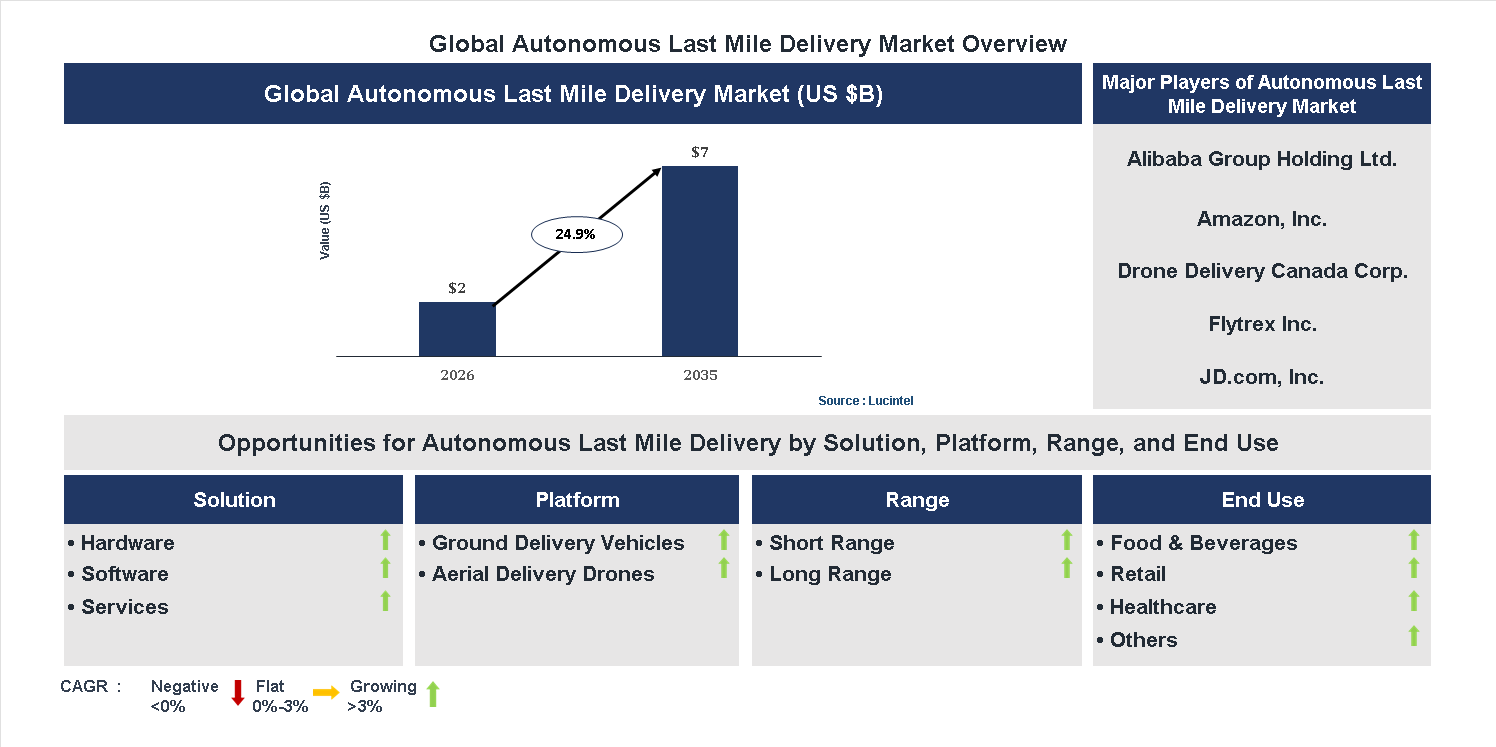
The future of the global autonomous last mile delivery market looks promising with opportunities in the food & beverage, retail, and healthcare markets. The global autonomous last mile delivery market is expected to reach an estimated $7 billion by 2035 with a CAGR of 24.9% from 2026 to 2035. The major drivers for this market are the increasing demand for efficient last mile delivery solutions, the rising adoption of autonomous delivery technologies, and the growing investment in smart logistics infrastructure.• Lucintel forecasts that, within the solution category, hardware is expected to witness the highest growth over the forecast period.
• Within the end use category, food & beverage is expected to witness the highest growth.
• In terms of region, North America is expected to witness the highest growth over the forecast period. Gain valuable insights for your business decisions with our comprehensive 150+ page report. Sample figures with some insights are shown below.
Emerging Trends in the Autonomous Last Mile Delivery Market
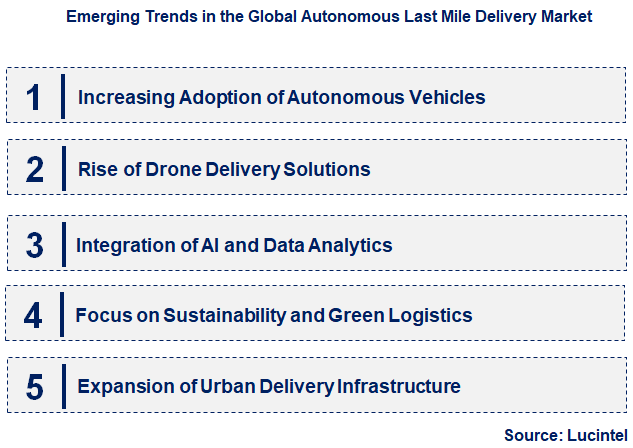
The autonomous last mile delivery market is experiencing rapid growth driven by technological advancements, changing consumer expectations, and the need for efficient logistics solutions. As e-commerce continues to expand globally, companies are seeking innovative ways to reduce delivery times and costs while improving customer satisfaction. Autonomous delivery vehicles, drones, and AI-powered logistics systems are transforming traditional delivery models, making last mile delivery faster, safer, and more sustainable. These developments are not only reshaping the competitive landscape but also creating new opportunities and challenges for market players. Understanding these emerging trends is crucial for stakeholders aiming to capitalize on this evolving market.• Increasing Adoption of Autonomous Vehicles: The deployment of autonomous delivery vehicles is accelerating due to advancements in AI, sensor technology, and regulatory support. These vehicles reduce labor costs, enhance delivery efficiency, and operate around the clock, providing a competitive edge. Companies are investing heavily in autonomous trucks, vans, and robots to streamline last mile logistics, especially in urban areas where traffic congestion and delivery density are high. This trend is expected to significantly lower operational costs and improve delivery speed, making autonomous vehicles a cornerstone of future last mile solutions.
• Rise of Drone Delivery Solutions: Drones are becoming a popular option for last mile delivery, especially for small packages and in hard-to-reach areas. They offer rapid delivery times, reduce traffic congestion, and lower carbon emissions. Major players are conducting pilot programs and regulatory bodies are gradually establishing frameworks for commercial drone operations. The integration of drones into delivery networks promises to enhance service levels, especially in rural or congested urban environments, and is poised to revolutionize the speed and efficiency of last mile logistics.
• Integration of AI and Data Analytics: AI-driven algorithms and data analytics are optimizing delivery routes, predicting demand, and managing fleet operations more effectively. These technologies enable real-time tracking, dynamic scheduling, and predictive maintenance, reducing delays and operational costs. Companies leveraging AI can better anticipate customer needs, personalize delivery options, and improve overall efficiency. This trend is transforming traditional logistics into a highly intelligent, data-driven ecosystem, leading to smarter decision-making and enhanced customer experiences.
• Focus on Sustainability and Green Logistics: Environmental concerns are prompting companies to adopt eco-friendly delivery methods. Electric autonomous vehicles, drones powered by renewable energy, and optimized routing to reduce emissions are gaining prominence. Sustainable practices not only meet regulatory requirements but also appeal to environmentally conscious consumers. The market is witnessing increased investments in green technology, with companies aiming to reduce their carbon footprint while maintaining cost-effective delivery solutions, thus aligning profitability with sustainability goals.
• Expansion of Urban Delivery Infrastructure: To support autonomous last mile delivery, cities are developing dedicated infrastructure such as drone ports, charging stations, and smart delivery hubs. These facilities facilitate seamless integration of autonomous vehicles and drones into existing logistics networks. Urban planning is increasingly incorporating smart city concepts to accommodate autonomous delivery systems, improving safety and efficiency. This infrastructure expansion is critical for scaling autonomous delivery services and ensuring reliable, rapid deliveries in densely populated areas. These emerging trends are fundamentally transforming the autonomous last mile delivery market by enhancing efficiency, reducing costs, and promoting sustainability. The integration of autonomous vehicles and drones, powered by AI and supported by new infrastructure, is reshaping how goods are delivered, creating a more agile, eco-friendly, and customer-centric logistics landscape. As these trends continue to evolve, they will unlock new opportunities and challenges, driving innovation and competition in the market.
Recent Development in the Autonomous Last Mile Delivery Market
The autonomous last mile delivery market is experiencing rapid growth driven by technological advancements, increasing e-commerce demand, and the need for cost-effective logistics solutions. Companies are investing heavily in autonomous vehicle technology to enhance delivery efficiency and reduce operational costs. Regulatory frameworks are evolving to accommodate autonomous systems, fostering innovation. Consumer expectations for faster, contactless delivery are also propelling market expansion. These developments are reshaping logistics, creating new opportunities, and challenging traditional delivery models, ultimately transforming the last mile delivery landscape globally.• Growing Adoption of Autonomous Vehicles: The integration of autonomous vehicles in last mile delivery is expanding rapidly, driven by technological improvements and cost savings. Companies like Amazon and FedEx are testing and deploying autonomous delivery robots and drones, reducing delivery times and operational costs. This shift enhances efficiency, especially in urban areas, and addresses labor shortages. The market is witnessing increased investments, regulatory support, and consumer acceptance, making autonomous vehicles a cornerstone of future logistics strategies.
• Advances in AI and Machine Learning: AI and machine learning are revolutionizing last mile delivery by optimizing routes, predicting delivery times, and improving fleet management. These technologies enable real-time decision-making, reducing delays and fuel consumption. Companies leveraging AI can better handle dynamic urban environments and customer preferences. The impact includes increased delivery accuracy, enhanced customer satisfaction, and reduced operational costs, positioning AI as a critical enabler for scalable autonomous delivery solutions.
• Regulatory Frameworks and Policy Developments: Governments worldwide are establishing regulations to facilitate autonomous delivery operations. Clear policies on safety standards, licensing, and data security are emerging, encouraging industry growth. Regulatory support reduces legal uncertainties, accelerates deployment, and fosters innovation. As policies evolve, more companies can expand autonomous delivery services, leading to broader market adoption and increased competition, ultimately shaping a more structured and secure autonomous last mile delivery ecosystem.
• Rising Consumer Demand for Contactless Delivery: The COVID-19 pandemic accelerated consumer preference for contactless delivery options, boosting autonomous last mile solutions. Customers seek faster, safer, and more convenient delivery methods, prompting companies to adopt autonomous vehicles and drones. This demand drives market growth, encourages technological innovation, and enhances service accessibility. The trend is expected to continue, influencing consumer expectations and pushing the industry toward fully autonomous, contactless delivery networks.
• Investment and Strategic Partnerships: Significant investments from venture capital, tech giants, and logistics firms are fueling market growth. Strategic partnerships aim to develop integrated autonomous delivery ecosystems, combining hardware, software, and logistics expertise. These collaborations accelerate innovation, reduce time-to-market, and expand deployment scale. Increased funding and partnerships are vital for overcoming technical and regulatory challenges, ensuring sustainable growth, and establishing competitive advantages in the evolving autonomous last mile delivery landscape. The overall impact of these developments is a more efficient, cost-effective, and consumer-centric last mile delivery market. Enhanced technological capabilities, supportive regulations, and rising demand are driving rapid industry transformation. Companies that adapt early will gain competitive advantages, leading to increased market share and innovation. As these trends continue, autonomous last mile delivery is poised to become the dominant logistics model, reshaping the future of urban and rural deliveries worldwide.
Strategic Growth Opportunities in the Autonomous Last Mile Delivery Market
The autonomous last mile delivery market is experiencing rapid growth driven by technological advancements, rising e-commerce demand, and the need for cost-effective, efficient delivery solutions. Companies are investing heavily in autonomous vehicle technology to reduce delivery times and operational costs. The integration of AI, IoT, and robotics is transforming logistics, creating new opportunities for market expansion. As consumer expectations evolve, businesses seek innovative delivery methods to enhance customer satisfaction and gain competitive advantage in a dynamic environment.• Expansion of Autonomous Delivery Vehicles in Urban Areas: The increasing adoption of autonomous delivery vehicles in densely populated urban regions offers significant growth potential. These vehicles can navigate complex city environments, reduce delivery times, and lower labor costs. Urban infrastructure improvements and supportive regulations further facilitate deployment. Companies are focusing on integrating autonomous vans and drones to meet rising e-commerce demands, making last mile delivery faster, more reliable, and cost-efficient in metropolitan settings.
• Integration of AI and Machine Learning for Route Optimization: AI-driven algorithms are revolutionizing route planning by enabling real-time adjustments based on traffic, weather, and delivery priorities. This enhances efficiency, reduces fuel consumption, and minimizes delivery times. Advanced machine learning models improve predictive analytics for demand forecasting, allowing better resource allocation. As AI technology matures, its application in autonomous last mile delivery will optimize operations, increase scalability, and provide a competitive edge for logistics providers.
• Adoption of Electric and Sustainable Delivery Solutions: The shift towards electric autonomous vehicles aligns with global sustainability goals and regulatory pressures to reduce carbon emissions. Electric delivery robots and drones offer eco-friendly alternatives to traditional fuel-powered vehicles. This transition not only reduces environmental impact but also lowers operational costs associated with fuel and maintenance. Growing consumer awareness and government incentives are accelerating adoption, positioning sustainable autonomous delivery as a key growth driver in the market.
• Development of Advanced Robotics and Drones for Last Mile Delivery: Robotics and drone technology are advancing rapidly, enabling faster, more flexible delivery options. Autonomous drones can access hard-to-reach areas and perform quick deliveries, especially in rural or congested urban zones. Robotics are being integrated into warehouses and delivery hubs for seamless package handling. These innovations improve delivery speed, reduce human intervention, and expand service coverage, making autonomous last mile delivery more efficient and scalable across diverse environments.
• Enhancement of Regulatory Frameworks and Industry Standards: Evolving regulations and standards are crucial for the widespread adoption of autonomous delivery solutions. Governments and industry bodies are establishing safety, security, and operational guidelines to ensure reliable deployment. Clear regulatory pathways reduce legal uncertainties, encourage investment, and foster innovation. As regulatory frameworks mature, they will facilitate faster market entry, promote interoperability, and build consumer trust, ultimately accelerating the growth and acceptance of autonomous last mile delivery services. The overall impact of these opportunities will significantly transform the last mile delivery landscape, making it more efficient, sustainable, and customer-centric. Companies that leverage these growth avenues will gain competitive advantages, expand their market presence, and meet the evolving demands of consumers and regulatory bodies. This dynamic environment promises substantial market expansion and technological innovation in the coming years.
Autonomous Last Mile Delivery Market Driver and Challenges
The autonomous last mile delivery market is influenced by a variety of technological, economic, and regulatory factors that shape its growth and development. Advances in robotics, artificial intelligence, and GPS technology are enabling more efficient and cost-effective delivery solutions. Economic factors such as rising consumer demand for quick delivery and the expansion of e-commerce are fueling market expansion. Regulatory frameworks around safety, data privacy, and urban mobility also play a crucial role in shaping operational standards and market entry. However, the market faces challenges related to technological limitations, regulatory hurdles, and infrastructure requirements that could impede growth. Understanding these drivers and challenges is essential for stakeholders aiming to capitalize on this evolving industry. The factors responsible for driving the autonomous last mile delivery market include:• Technological Innovation: The rapid development of autonomous vehicles, drones, and AI algorithms enhances delivery efficiency and reduces operational costs. These innovations enable companies to offer faster, more reliable services, especially in urban environments where traffic congestion is a concern. As technology matures, the scalability and safety of autonomous delivery solutions improve, encouraging wider adoption. The integration of IoT and sensor technologies further optimizes route planning and real-time monitoring, making autonomous delivery more viable and appealing to retailers and consumers alike.
• E-commerce Growth: The exponential increase in online shopping has created a surge in demand for quick and reliable delivery services. Consumers now expect same-day or next-day delivery, pushing companies to seek innovative solutions like autonomous delivery to meet these expectations cost-effectively. This growth has expanded the market size and incentivized logistics providers to invest in autonomous technologies, aiming to reduce labor costs and improve delivery speed, especially in densely populated urban areas.
• Cost Reduction and Operational Efficiency: Autonomous delivery vehicles and drones significantly lower labor costs and reduce the need for human drivers, which is a major advantage in the competitive logistics landscape. These technologies also enable 24/7 operations, increasing delivery capacity and reducing delays. Additionally, autonomous systems can optimize routes dynamically, minimizing fuel consumption and vehicle wear and tear. This efficiency translates into lower prices for consumers and higher profit margins for companies, making autonomous last mile delivery a financially attractive option.
• Urbanization and Infrastructure Development: Rapid urbanization has increased the demand for efficient last mile delivery solutions capable of navigating complex city environments. Investments in smart city infrastructure, such as dedicated drone corridors and autonomous vehicle lanes, facilitate smoother operations. These developments support the deployment of autonomous delivery systems by providing necessary infrastructure, reducing logistical challenges, and improving safety standards. As cities continue to grow, the need for innovative delivery methods becomes more critical, driving market expansion.
• Regulatory Support and Policy Frameworks: Governments and regulatory bodies are increasingly recognizing the potential benefits of autonomous delivery and are developing policies to facilitate their deployment. Clear regulations around safety standards, airspace management for drones, and data privacy are essential for market growth. Supportive policies, pilot programs, and public-private partnerships help accelerate adoption by reducing legal uncertainties and fostering innovation. Regulatory clarity ensures that companies can deploy autonomous delivery solutions confidently, boosting market confidence and investment. The challenges facing the autonomous last mile delivery market include:
• Technological Limitations: Despite significant advancements, autonomous delivery systems still face technical hurdles such as navigation in complex environments, obstacle detection, and weather resilience. These limitations can lead to safety concerns and operational disruptions, hindering widespread adoption. Developing robust, reliable, and adaptable autonomous systems requires substantial investment in research and development, which can delay deployment timelines and increase costs.
• Regulatory and Legal Barriers: The lack of comprehensive regulations and inconsistent policies across regions pose significant challenges. Regulatory uncertainty regarding safety standards, liability, and airspace management can delay market entry and expansion. Additionally, navigating legal frameworks related to data privacy, licensing, and urban mobility rights complicates deployment strategies, requiring companies to invest heavily in compliance and lobbying efforts.
• Infrastructure and Investment Requirements: Implementing autonomous last mile delivery solutions demands significant infrastructure investments, including charging stations, drone corridors, and smart city integrations. These costs can be prohibitive, especially for smaller players. Moreover, the need for reliable internet connectivity and real-time data management systems adds to the complexity. Insufficient infrastructure can limit operational efficiency and scalability, slowing overall market growth. The autonomous last mile delivery market is driven by technological innovation, e-commerce expansion, cost efficiencies, urban infrastructure development, and supportive policies. However, technological challenges, regulatory uncertainties, and infrastructure investments pose significant hurdles. The interplay of these factors will determine the pace and extent of market growth. While opportunities are substantial, addressing these challenges through innovation, regulation, and infrastructure development is crucial for sustainable industry advancement.
List of Autonomous Last Mile Delivery Companies
Companies in the market compete on the basis of product quality offered. Major players in this market focus on expanding their manufacturing facilities, R&D investments, infrastructural development, and leverage integration opportunities across the value chain. With these strategies autonomous last mile delivery companies cater increasing demand, ensure competitive effectiveness, develop innovative products & technologies, reduce production costs, and expand their customer base. Some of the autonomous last mile delivery companies profiled in this report include-• Alibaba Group Holding Ltd.
• Amazon, Inc.
• Drone Delivery Canada Corp.
• Flytrex Inc.
• JD.com, Inc.
• Kiwi Campus
• Nuro, Inc.
• Refraction AI
• Shenzhen Yiqing Innovation Technology Co., Ltd.
• Starship Technologies
Autonomous Last Mile Delivery Market by Segment
The study includes a forecast for the global autonomous last mile delivery market by solution, platform, range, end use, and region.Autonomous Last Mile Delivery Market by Solution [Value from 2019 to 2035]:
• Hardware
• Software
• Services
Autonomous Last Mile Delivery Market by Platform [Value from 2019 to 2035]:
• Ground Delivery Vehicles
• Aerial Delivery Drones
Autonomous Last Mile Delivery Market by Range [Value from 2019 to 2035]:
• Short Range
• Long Range
Autonomous Last Mile Delivery Market by End Use [Value from 2019 to 2035]:
• Food & Beverages
• Retail
• Healthcare
• Others
Autonomous Last Mile Delivery Market by Region [Value from 2019 to 2035]:
• North America
• Europe
• Asia Pacific
• The Rest of the World
Country Wise Outlook for the Autonomous Last Mile Delivery Market
The autonomous last mile delivery market has experienced rapid growth driven by technological advancements, increasing e-commerce demand, and the need for efficient logistics solutions worldwide. Countries are adopting innovative autonomous delivery solutions to reduce costs, improve delivery times, and address urban congestion. Regulatory frameworks are evolving to accommodate these technologies, while partnerships between tech firms and logistics providers are expanding. The markets development varies across regions, influenced by infrastructure, consumer acceptance, and government policies. As the sector matures, new business models and integration strategies are emerging, shaping the future of last mile delivery globally.• United States: The U.S. market has seen significant investments in autonomous delivery startups and major tech companies expanding their autonomous vehicle fleets. Regulatory progress is ongoing, with pilot programs in several cities demonstrating feasibility. Companies like Amazon and FedEx are testing drone and robot deliveries, focusing on urban and suburban areas. Consumer acceptance is growing, driven by convenience and safety concerns. Infrastructure improvements, such as dedicated delivery zones, are being implemented to support autonomous operations. Overall, the U.S. leads in technological innovation and pilot testing for autonomous last mile delivery solutions.
• China: China has rapidly advanced in autonomous delivery, leveraging its robust e-commerce ecosystem and supportive government policies. Major players like JD.com and Alibaba are deploying autonomous robots and drones for last mile delivery in urban centers. The government encourages innovation through subsidies and pilot zones, accelerating deployment. Urban congestion and labor shortages further drive adoption. Integration with existing logistics networks is seamless, and local manufacturing of autonomous vehicles is expanding. Consumer acceptance is high, especially in densely populated cities. China is positioning itself as a leader in autonomous delivery technology and infrastructure.
• Germany: Germany emphasizes regulatory compliance and technological reliability in its autonomous delivery developments. Several pilot projects focus on integrating autonomous vehicles into urban logistics, especially in Berlin and Munich. Partnerships between automotive giants and tech firms are fostering innovation. The country’s focus on sustainability is leading to the adoption of electric autonomous delivery vehicles. Infrastructure upgrades, including smart traffic management systems, support autonomous operations. Consumer trust and data security are priorities, influencing deployment strategies. Germany aims to balance technological advancement with safety standards, positioning itself as a European leader in autonomous last mile delivery.
• India: India’s autonomous last mile delivery market is emerging, driven by rapid e-commerce growth and urbanization. Startups are experimenting with low-cost autonomous robots and drones to reach underserved areas. Regulatory frameworks are still evolving, with pilot projects gaining approval in select cities. Infrastructure challenges, such as traffic congestion and inconsistent road quality, pose hurdles. However, the large rural population and expanding digital infrastructure present opportunities for innovative delivery models. Local manufacturing and adaptation to regional needs are key strategies. The market is expected to grow as government policies become more supportive and technology matures.
• Japan: Japan is focusing on integrating autonomous delivery solutions within its highly developed logistics network. Pilot programs in Tokyo and Osaka test autonomous robots and drones for urban deliveries. The country’s aging population and labor shortages accelerate the adoption of automation. Companies like Yamato and Sagawa are investing in autonomous vehicle technology to enhance efficiency. Regulatory frameworks are being refined to ensure safety and reliability. Japan emphasizes high-quality, secure delivery services, with a focus on technological reliability and customer trust. The market is poised for steady growth, leveraging Japan’s technological expertise and infrastructure readiness.

Features of the Global Autonomous Last Mile Delivery Market
Market Size Estimates: Autonomous last mile delivery market size estimation in terms of value ($B). Trend and Forecast Analysis: Market trends (2019 to 2025) and forecast (2026 to 2035) by various segments and regions. Segmentation Analysis: Autonomous last mile delivery market size by various segments, such as by solution, platform, range, end use, and region in terms of value ($B). Regional Analysis: Autonomous last mile delivery market breakdown by North America, Europe, Asia Pacific, and Rest of the World. Growth Opportunities: Analysis of growth opportunities in different solutions, platforms, ranges, end uses, and regions for the autonomous last mile delivery market. Strategic Analysis: This includes M&A, new product development, and competitive landscape of the autonomous last mile delivery market. Analysis of competitive intensity of the industry based on Porter’s Five Forces model.
FAQ
Q1. What is the autonomous last mile delivery market size? Answer: The global autonomous last mile delivery market is expected to reach an estimated $7 billion by 2035. Q2. What is the growth forecast for autonomous last mile delivery market? Answer: The global autonomous last mile delivery market is expected to grow with a CAGR of 24.9% from 2026 to 2035. Q3. What are the major drivers influencing the growth of the autonomous last mile delivery market? Answer: The major drivers for this market are the increasing demand for efficient last mile delivery solutions, the rising adoption of autonomous delivery technologies, and the growing investment in smart logistics infrastructure. Q4. What are the major segments for autonomous last mile delivery market? Answer: The future of the autonomous last mile delivery market looks promising with opportunities in the food & beverage, retail, and healthcare markets. Q5. Who are the key autonomous last mile delivery market companies? Answer: Some of the key autonomous last mile delivery companies are as follows:• Alibaba Group Holding Ltd.
• Amazon, Inc.
• Drone Delivery Canada Corp.
• Flytrex Inc.
• JD.com, Inc.
• Kiwi Campus
• Nuro, Inc.
• Refraction AI
• Shenzhen Yiqing Innovation Technology Co., Ltd.
• Starship Technologies Q6. Which autonomous last mile delivery market segment will be the largest in future? Answer: Lucintel forecasts that, within the solution category, hardware is expected to witness the highest growth over the forecast period. Q7. In autonomous last mile delivery market, which region is expected to be the largest in next 8 years? Answer: In terms of region, North America is expected to witness the highest growth over the forecast period. Q8. Do we receive customization in this report? Answer: Yes, Lucintel provides 10% customization without any additional cost.
Table of Contents
List of Figures
List of Tables
Methodology
- In-depth interviews of the major players in this market
- Detailed secondary research from competitors’ financial statements and published data
- Extensive searches of published works, market, and database information pertaining to industry news, company press releases, and customer intentions
- A compilation of the experiences, judgments, and insights of Lucintel’s professionals, who have analyzed and tracked this market over the years.


Buy Now
Choose a license that fits your team. Instant PDF delivery.
Prices exclude taxes. Instant delivery. Custom licensing available on request.
Key Questions
- • What are some of the most promising, high-growth opportunities for the autonomous last mile delivery market by solution (hardware, software, and services), platform (ground delivery vehicles and aerial delivery drones), range (short range and long range), end use (food & beverages, retail, healthcare, and others), and region (North America, Europe, Asia Pacific, and the Rest of the World)?
- • Which segments will grow at a faster pace and why?
- • Which region will grow at a faster pace and why?
- • What are the key factors affecting market dynamics? What are the key challenges and business risks in this market?
- • What are the business risks and competitive threats in this market?
- • What are the emerging trends in this market and the reasons behind them?
- • What are some of the changing demands of customers in the market?
- • What are the new developments in the market? Which companies are leading these developments?
- • Who are the major players in this market? What strategic initiatives are key players pursuing for business growth?
- • What are some of the competing products in this market and how big of a threat do they pose for loss of market share by material or product substitution?
- • What M&A activity has occurred in the last 5 years and what has its impact been on the industry? For any questions related to Autonomous Last Mile Delivery Market, Autonomous Last Mile Delivery Market Size, Autonomous Last Mile Delivery Market Growth, Autonomous Last Mile Delivery Market Analysis, Autonomous Last Mile Delivery Market Report, Autonomous Last Mile Delivery Market Share, Autonomous Last Mile Delivery Market Trends, Autonomous Last Mile Delivery Market Forecast, Autonomous Last Mile Delivery Companies, write Lucintel analyst at email: helpdesk@lucintel.com. We will be glad to get back to you soon.


