
Report Feature
Autonomous Driving Market Trends and Forecast
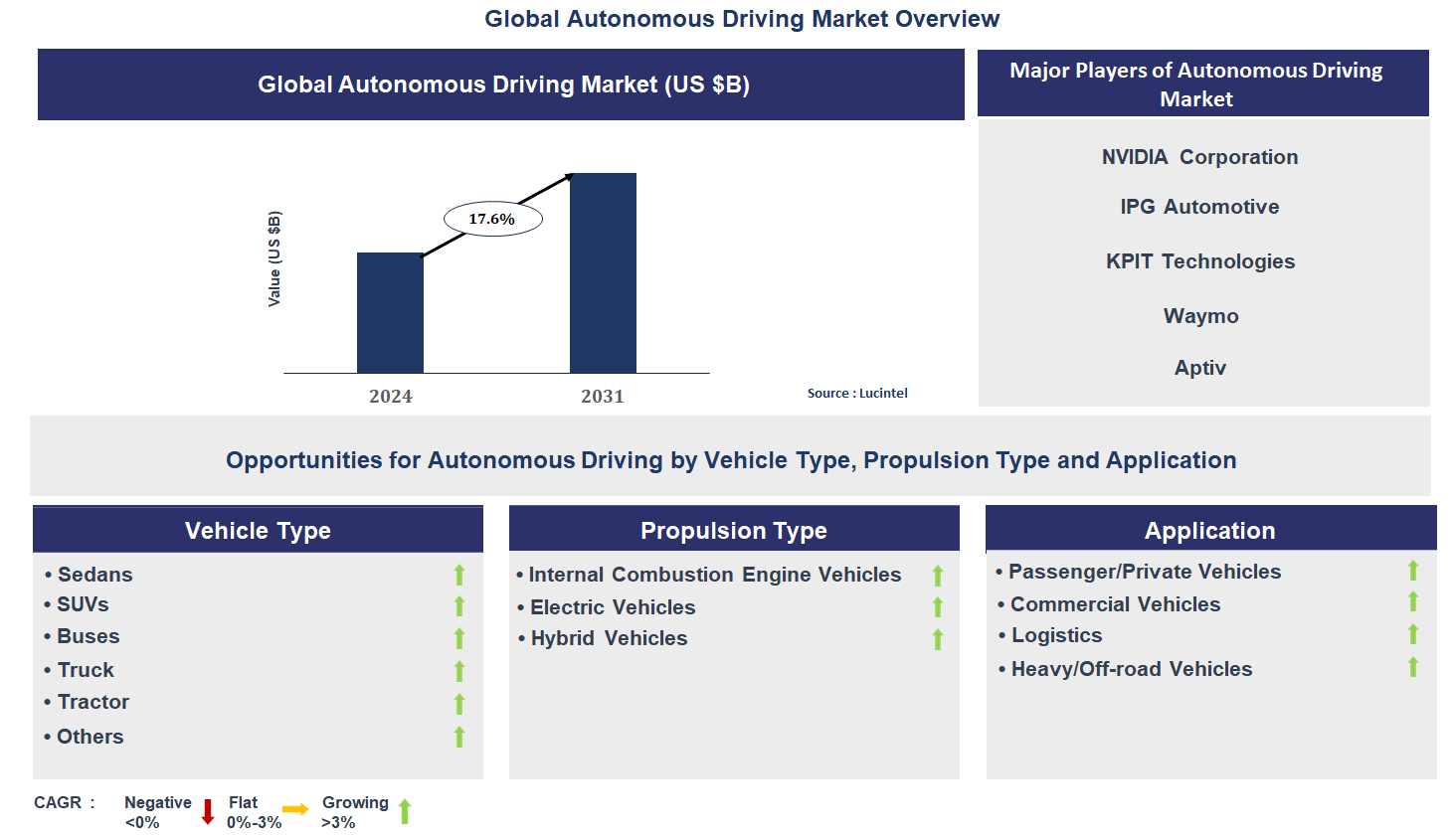
The future of the global autonomous driving market looks promising with opportunities in the passenger/private vehicle, commercial vehicle, logistic, and heavy/off-road vehicle markets. The global autonomous driving market is expected to grow with a CAGR of 17.6% from 2025 to 2031. The major drivers for this market are the increasing demand for safer transportation solutions, the rising adoption of electric vehicles in market, and the growing advancements in machine learning.• Lucintel forecasts that, within the vehicle type category, SUV is expected to witness the highest growth over the forecast period.
• Within the application category, passenger/private vehicle is expected to witness the highest growth.
• In terms of region, APAC is expected to witness the highest growth over the forecast period. Gain valuable insights for your business decisions with our comprehensive 150+ page report. Sample figures with some insights are shown below.
Emerging Trends in the Autonomous Driving Market
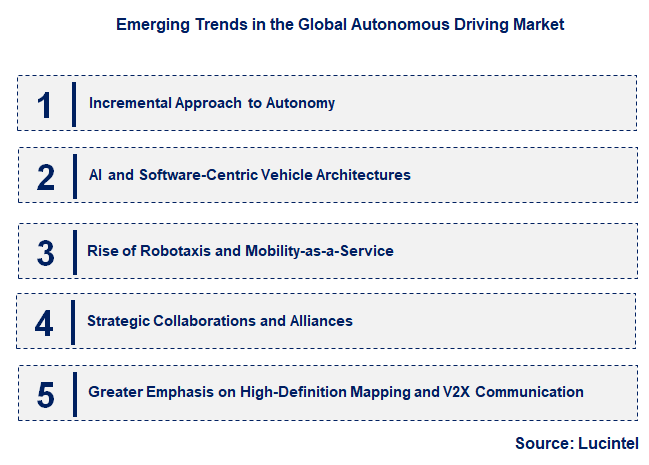
The autonomous driving industry is in the midst of dramatic change, with a number of key trends defining its future. The early emphasis on reaching complete autonomy (Level 5) has been replaced by a more realistic and step-by-step strategy. The business is now focusing on commercialization of more achievable and realistic levels of autonomy and working to solve the complex challenges of safety, data, and public acceptance. These trends are propelling the market towards an integrated ecosystem in which cars, infrastructure, and software collaborate to provide safer, more efficient, and connected mobility.• Incremental Approach to Autonomy: The market is moving away from the Level 5 "all-or-nothing" objective to a more realistic, incremental strategy. This trend is centered on the mass deployment of Level 2+ (L2 with improved features such as highway assist) and Level 3 (conditional automation) systems. This has an effect on the market in that it delivers instant, concrete value to consumers and creates huge revenue for automakers and suppliers. Rather than awaiting a fully autonomous future, firms are maturing and commoditizing current technologies, establishing a foundation of consumer confidence and data essential to continued growth.
• AI and Software-Centric Vehicle Architectures: The transition from hardware-centric to software-defined vehicles is a significant trend. Autonomous driving solutions are becoming more dependent on high-performance AI and machine learning algorithms that process huge volumes of sensor data in real-time. This affects the market by establishing software as a source of differentiator and competitive advantage. It further demands a new style of vehicle design, with centralized computing platforms instead of the conventional network of distributed electronic control units.
• Rise of Robotaxis and Mobility-as-a-Service: One of the principal trends is the commercialization of autonomous driving through shared mobility platforms. Companies are bypassing the challenge of selling expensive, fully autonomous cars to individual consumers by launching robotaxi and autonomous shuttle services in geo-fenced areas. This impacts the market by creating a clear business model for high-level autonomy and accelerating its real-world deployment. The emphasis is on the operational and logistical issues of keeping a fleet running, which enables companies to gather enormous amounts of useful data and hone their technology in a controlled, commercial setting.
• Strategic Collaborations and Alliances: The gigantic expense and technical complexity of creating autonomous driving technology are pushing toward strategic collaborations and alliances between tech companies and automakers. Automakers contribute their vehicle manufacturing and safety expertise, and tech companies contribute the AI, software, and sensor knowledge. This affects the market by driving the speed of innovation and distributing the cost. These partnerships allow companies to use each other’s capabilities to develop, test, and deliver autonomous systems at a faster and more cost-effective rate than they would have been able to do individually.
• Greater Emphasis on High-Definition Mapping and V2X Communication: Autonomous vehicles need to have a very accurate understanding of their surroundings in order to drive safely. This trend encompasses greater emphasis on HD mapping, which gives a high-resolution, lane-level map of the road, and V2X (Vehicle-to-Everything) communication, which enables vehicles to exchange information with other vehicles as well as with road infrastructure. This affects the market by generating a demand for new data infrastructure and services. It is necessary for guaranteeing the dependability of autonomous systems, particularly in highly complex urban environments and in poor weather conditions. These trends are all driving the autonomous driving space from a research-and-development-driven phase to one of commercialization and scale. The emphasis is on developing viable business models and technological paths that will introduce this disruptive technology to the public in stages, establish trust, and unlock its full potential.
Recent Development in the Autonomous Driving Market
The market for autonomous driving is seeing a sequence of major developments that are taking the technology from the pages of science fiction and propelling it into daily life. These are not merely developments in new cars but also in the supporting technology, the regulatory framework, and the business models that will sustain a self-driving world. The emphasis is on building a strong and secure ecosystem able to integrate driverless cars easily into current transportation infrastructure.• Commercial Launch and Rollout of Robotaxi Services: Another important advancement is the rollout of commercial robotaxi services by firms like Waymo and Cruise in several cities in the United States. This is an important move for the market since it shifts the technology from testing to revenue to demonstrate an operational business model. The progressive rollout into new cities and the extension of operating hours are giving priceless information and proving the technology’s reliability to the masses.
• Clearance of Level 3 Autonomous Driving in Important Markets: Clearance of Level 3 systems in Germany and Japan is a milestone achievement. This allows drivers to legally take their hands off the wheel and their eyes off the road under specific, predefined conditions, such as in slow-moving traffic on certain highways. This development impacts the market by setting a new benchmark for consumer-facing autonomy. It takes a huge technological breakthrough to guarantee a smooth handing over of control between the car and the driver and, at the same time, set a legal precedent for responsibility and liability.
• Sensor Technology and AI Fusion: Advances in sensor technology, especially in solid-state LiDAR and high-resolution cameras, are making a deep impact. These new sensors are more efficient, cost-effective, and powerful compared to their older counterparts. This is aided by progress in AI and sensor fusion software that is capable of fusing together data from different types of sensors to develop a better and more resilient environmental model.
• Greater Investment and Partnerships in the Logistics Industry: Autonomous driving is experiencing major emphasis on the commercial trucking and logistics industries. They are spending billions on self-driving trucks, which have the potential to reduce costs dramatically and ensure greater safety on long-distance hauls. Collaborations between technology firms and logistics companies are helping push the development and roll-out of this technology.
• Over-the-Air Integration of Updates for Autonomous Capabilities: The capacity to update the software in a vehicle remotely is turning into an ordinary capability for autonomous vehicles. This is a significant development for a number of reasons. Firstly, it enables manufacturers to make their autonomous systems better performing and safer continuously, introduce new capabilities, and close security loopholes without needing a physical trip to a dealer. These advancements are cumulatively contributing, inching the market toward mass adoption. Attention is being given to incremental advancements, commercial feasibility, and a robust focus on safety and security. The market is establishing a foundation of trustworthiness that will prove vital for future phases of autonomous driving.
Strategic Growth Opportunities in the Autonomous Driving Market
The market for autonomous driving offers tremendous strategic growth opportunities across numerous applications. As the technology advances, firms are finding and taking advantage of targeted segments where autonomous systems will bring the greatest benefit, be it safety, efficiency, or convenience. These opportunities are propelling the market from merely passenger cars to a wider transportation ecosystem, such as logistics, public transport, and specialized services.• Robo-Shuttles and Last-Mile Delivery: This represents one prime growth area, especially in urban and campus settings. Autonomous shuttles have the capability to offer efficient, on-demand transportation to address last-mile connectivity problems. In a similar vein, autonomous delivery vehicles and robots are set to disrupt logistics and e-commerce by cutting down on delivery times and expenses. This is a low-risk, high-reward use of autonomous technology since such vehicles are in controlled environments and travel slowly.
• Autonomous Commercial Trucking and Logistics: This is a high-growth sector with significant economic potential. Autonomous trucks have the potential to solve the continuing driver shortage, enhance fuel efficiency, and enhance safety on long-haul routes. By automating driving on highways, firms can cut down on costs and develop a more streamlined supply chain. This use case is very appealing since driving on highways is less sophisticated compared to driving in the city, with fewer variables such as pedestrians and bicyclists.
• Mobility-as-a-Service Platforms: Autonomous vehicle development is fueling the expansion of MaaS, with customers able to utilize multiple modes of transport using one platform. The business opportunity comes in developing and running the platforms, which will ultimately be driven by fleets of shuttles and robotaxis. Businesses can reap revenue not only from the vehicles themselves but from data, software, and services.
• Passenger Cars with Advanced ADAS (L2+ and L3): While fully autonomous vehicles are the ultimate goal, the most immediate growth opportunity is in passenger vehicles equipped with advanced driver-assistance systems. These L2+ and L3 systems offer a tangible benefit to consumers today, enhancing safety and convenience. The strategic potential is to create and market these capabilities, which are revenue-generating and also serve as a transition to higher levels of autonomy.
• Infrastructure-to-Vehicle Communication and Smart Infrastructure: Autonomous driving’s true potential can only be fulfilled with the advancement of smart infrastructure. This constitutes traffic lights, roadside sensors, and communication networks that can exchange real-time data with autonomous vehicles. The strategic opportunity lies in developing the I2V technology as well as the infrastructure itself. This will allow vehicles to make better decisions, such as predicting a red light or a traffic jam ahead, resulting in a smoother and safer movement of traffic. It is a key enabler for the large-scale deployment of autonomous vehicles in a networked city. Such opportunity to grow is transforming the market for autonomous driving by centering on those applications with a definable business case and great potential for near-term impact. The industry is shifting toward a future with autonomous technology being embedded in all modes of transportation, ranging from personal mobility to worldwide supply chains.
Autonomous Driving Market Driver and Challenges
The autonomous driving market is at a watershed point, driven by strong drivers and held back by major hurdles. The drivers are largely technological and economic in nature, such as the demand for increased safety, the potential for new business models, and the fast pace of advancement in artificial intelligence and sensor technology. They are building a strong argument for broad adoption of autonomous vehicles. Nevertheless, the journey to commercialization is filled with obstacles, such as regulatory uncertainty, substantial development expense, and perhaps most important, public trust. The factors responsible for driving the autonomous driving market include: 1. Improved Safety and Reduced Accidents: This is the strongest driver of the autonomous driving segment. Human fault is responsible for the majority of traffic accidents. Autonomous vehicles, with their capacity to respond quicker and work without distraction, can radically minimize crashes, save lives, and reduce insurance premiums. This potential is a great enabler for governments and consumers alike, who want safer ways of moving around. 2. Economic and Operational Efficiency: Autonomous cars can bring about huge economic gains. In the trucking industry, autonomous trucks can run 24/7 with no driver, saving on labor and enhancing delivery times. For ride-hailing companies, autonomous robotaxis can save on driver wages, the biggest operational cost. Such efficiencies are a prime motivator for businesses looking to maximize their business models and get a competitive advantage. 3. Technological Developments in Sensors and AI: The fast-paced development of AI, machine learning, and sensor technologies such as LiDAR and high-definition cameras is the root cause of driving the market. These technologies are transforming autonomous systems into more capable, reliable, and affordable systems. AI algorithms are increasingly able to handle complex data and make decisions in real time, while new sensors are giving a better and more detailed understanding of the vehicle’s environment. 4. Smart City Initiatives and Urbanization: With an expanding world population and urbanization, a compelling requirement exists for more sustainable and efficient transportation. Autonomous transport is a principal feature of smart city projects to minimize traffic congestion, streamline public transport, and make cities more habitable. This driver is generating a public sector pull for autonomous solutions, with cities and governments seeking technologies that will enable them to address complicated urban mobility issues. 5. Emergence of the Mobility-as-a-Service Model: The movement away from private car ownership to a shared model of mobility is a key driver. MaaS platforms, which provide a suite of transport modes from ride-hailing to bike sharing, are ideally suited for autonomous vehicles. This model enables companies to roll out autonomous vehicle fleets and manage them in an efficient manner. Challenges in the autonomous driving market are: 1. Regulatory and Legal Uncertainty: One of the most significant challenges is the absence of a consistent, clear, and international regulatory system. Varying rules exist across countries and even cities or states, making the operating environment fragmented and challenging. Even legal problems, including liability in case of an accident, are unresolved. Regulatory uncertainty can hinder development and render it challenging for companies to expand their operations. 2. High Technology Cost: The hardware and software needed for high-level autonomy are very costly. High-end computing systems, LiDAR sensors, and sophisticated software packages are not cheap. Their high cost is a large hurdle to consumer uptake and hinders the ability to achieve economies of scale. Though costs are reducing, they are still a large obstacle that needs to be overcome in order to enable mass commercialization. 3. Public Skepticism and Safety Issues: Even with the promise of greater safety, the public is skeptical about autonomous cars. High-profile crashes during the testing stage have led to public mistrust. Dissolving this skepticism is a key challenge. It demands a collaborative effort by the industry to educate the public, show the safety of the technology, and be open about its constraints. The journey towards consumer acceptance is as crucial as technological development. In short, the autonomous car market is being driven by the vision of a safer, more efficient, and more convenient tomorrow. But it is at the same time being confronted by severe challenges that are not only technological but also legal, economic, and social. The combined effect of these drivers and challenges is a market that is in the midst of dramatic and intense change, with organizations competing to innovate and address these multifaceted challenges in order to realize the full potential of autonomous mobility.List of Autonomous Driving Companies
Companies in the market compete on the basis of product quality offered. Major players in this market focus on expanding their manufacturing facilities, R&D investments, infrastructural development, and leverage integration opportunities across the value chain. With these strategies autonomous driving companies cater increasing demand, ensure competitive effectiveness, develop innovative products & technologies, reduce production costs, and expand their customer base. Some of the autonomous driving companies profiled in this report include-• NVIDIA Corporation
• IPG Automotive
• KPIT Technologies
• Waymo
• Aptiv
• Infineon Technologies
• Motional
Autonomous Driving Market by Segment
The study includes a forecast for the global autonomous driving market by vehicle type, propulsion type, application, and region.Autonomous Driving Market by Vehicle Type [Value from 2019 to 2031]:
• Sedans
• SUVs
• Buses
• Truck
• Tractor
• Others
Autonomous Driving Market by Propulsion Type [Value from 2019 to 2031]:
• Internal Combustion Engine Vehicles
• Electric Vehicles
• Hybrid Vehicles
Autonomous Driving Market by Application [Value from 2019 to 2031]:
• Passenger/Private Vehicles
• Commercial Vehicles
• Logistics
• Heavy/Off-road Vehicles
Autonomous Driving Market by Region [Value from 2019 to 2031]:
• North America
• Europe
• Asia Pacific
• The Rest of the World
Country Wise Outlook for the Autonomous Driving Market
The autonomous driving market is currently undergoing a phase of intense and diversified development, moving from a theoretical idea to a concrete reality. This is characterized by an international race for countries and companies to progress to the next level of automation. The principal drivers are both technological advances, especially in the case of AI and sensor technology, and conducive regulatory environments. This is not merely a competition to develop autonomous vehicles, but to develop the whole ecosystem, from infrastructure and mapping to consumer confidence, that will in the end dictate the rate and extent of adoption. What follows are recent milestones in key nations and the larger trends that are influencing this vital sector.• United States: The American market is leading in autonomous vehicle development, led by a two-pronged strategy targeting consumer-owned cars with sophisticated features and commercial robotaxi operations. Waymo and Cruise are pioneering the rollout of Level 4 autonomous hailing services in major metro areas, which is generating real-world data and establishing consumer acceptance. In the consumer market, OEMs such as General Motors and Ford are also growing Level 2+ and Level 3 offerings, including Super Cruise and Blue Cruise. The US government is also advocating a national standard for AV regulations to bring clarity and speed up deployment.
• China: China is a world leader in autonomous vehicle deployment due to robust government backing and smart city integration focus. The country possesses a strong regulatory environment that favors mass testing and commercialization. Chinese technology giants such as Baidu and firms such as Pony.ai are quickly scaling up their robotaxi services in many cities. The government’s proactive role has resulted in the creation of special autonomous vehicle test areas and inclusion of V2X (vehicle to everything) infrastructure. This top-down strategy and the size of the domestic market are allowing China to move rapidly in the industry.
• Germany: Germany, a hub of traditional automotive engineering expertise, is driving the development of Level 3 autonomous driving for consumer cars. German automakers like Mercedes-Benz and BMW have been in the vanguard in getting regulatory approval for their Level 3 systems on public roads under certain conditions, such as traffic jams. The emphasis is placed on making the handover between driver and car safe and smooth, capitalizing on the nation’s reputation for precision and security. The plan is more cautious than a robotaxi-first policy elsewhere but seeks to introduce the technology to a large number of premium vehicles.
• India: India’s autonomous vehicle market is in its infancy, and the emphasis is mainly on using automation for commercial transport and public transit. The distinctively chaotic nature of India’s traffic poses a challenge, and hence the emphasis on creating special solutions for Indian roads. Private and government initiatives involve pilot programs on autonomous trucks and buses to enhance logistics efficiency and public safety. Research is focused on AI and sensor fusion technologies able to reliably cope with the unpredictability of mixed traffic, pedestrians, and animals that are prevalent on Indian roads.
• Japan: The autonomous driving market in Japan is spurred by a social imperative to solve an aging population and driver shortage issue in the logistics and public transport industries. The authorities have established a conducive regulatory environment, such as recent law that allows Level 3 autonomous driving. Japanese manufacturers such as Honda and Nissan are increasingly working on and testing systems, frequently in collaboration with global partners. The emphasis lies on phasing, with the first deployments in contained environments such as airports and dedicated transit corridors, before a broader rollout on public roads.

Features of the Global Autonomous Driving Market
Market Size Estimates: Autonomous driving market size estimation in terms of value ($B). Trend and Forecast Analysis: Market trends (2019 to 2024) and forecast (2025 to 2031) by various segments and regions. Segmentation Analysis: Autonomous driving market size by vehicle type, propulsion type, application, and region in terms of value ($B). Regional Analysis: Autonomous driving market breakdown by North America, Europe, Asia Pacific, and Rest of the World. Growth Opportunities: Analysis of growth opportunities in different vehicle types, propulsion types, applications, and regions for the autonomous driving market. Strategic Analysis: This includes M&A, new product development, and competitive landscape of the autonomous driving market. Analysis of competitive intensity of the industry based on Porter’s Five Forces model.
FAQ
Q1. What is the growth forecast for autonomous driving market? Answer: The global autonomous driving market is expected to grow with a CAGR of 17.6% from 2025 to 2031. Q2. What are the major drivers influencing the growth of the autonomous driving market? Answer: The major drivers for this market are the increasing demand for safer transportation solutions, the rising adoption of electric vehicles in market, and the growing advancements in machine learning. Q3. What are the major segments for autonomous driving market? Answer: The future of the autonomous driving market looks promising with opportunities in the passenger/private vehicle, commercial vehicle, logistic, and heavy/off-road vehicle markets. Q4. Who are the key autonomous driving market companies? Answer: Some of the key autonomous driving companies are as follows:• NVIDIA Corporation
• IPG Automotive
• KPIT Technologies
• Waymo
• Aptiv
• Infineon Technologies
• Motional Q5. Which autonomous driving market segment will be the largest in future? Answer: Lucintel forecasts that, within the vehicle type category, SUV is expected to witness the highest growth over the forecast period. Q6. In autonomous driving market, which region is expected to be the largest in next 5 years? Answer: In terms of region, APAC is expected to witness the highest growth over the forecast period. Q7. Do we receive customization in this report? Answer: Yes, Lucintel provides 10% customization without any additional cost.
Table of Contents
List of Figures
List of Tables
Methodology
- In-depth interviews of the major players in this market
- Detailed secondary research from competitors’ financial statements and published data
- Extensive searches of published works, market, and database information pertaining to industry news, company press releases, and customer intentions
- A compilation of the experiences, judgments, and insights of Lucintel’s professionals, who have analyzed and tracked this market over the years.


Buy Now
Choose a license that fits your team. Instant PDF delivery.
Prices exclude taxes. Instant delivery. Custom licensing available on request.
Key Questions
- • What are some of the most promising, high-growth opportunities for the autonomous driving market by vehicle type (sedans, SUVs, buses, truck, tractor, and others), propulsion type (internal combustion engine vehicles, electric vehicles, and hybrid vehicles), application (passenger/private vehicles, commercial vehicles, logistics, and heavy/off-road vehicles), and region (North America, Europe, Asia Pacific, and the Rest of the World)?
- • Which segments will grow at a faster pace and why?
- • Which region will grow at a faster pace and why?
- • What are the key factors affecting market dynamics? What are the key challenges and business risks in this market?
- • What are the business risks and competitive threats in this market?
- • What are the emerging trends in this market and the reasons behind them?
- • What are some of the changing demands of customers in the market?
- • What are the new developments in the market? Which companies are leading these developments?
- • Who are the major players in this market? What strategic initiatives are key players pursuing for business growth?
- • What are some of the competing products in this market and how big of a threat do they pose for loss of market share by material or product substitution?
- • What M&A activity has occurred in the last 5 years and what has its impact been on the industry? For any questions related to Autonomous Driving Market, Autonomous Driving Market Size, Autonomous Driving Market Growth, Autonomous Driving Market Analysis, Autonomous Driving Market Report, Autonomous Driving Market Share, Autonomous Driving Market Trends, Autonomous Driving Market Forecast, Autonomous Driving Companies, write Lucintel analyst at email: helpdesk@lucintel.com. We will be glad to get back to you soon.


