
Report Feature
Automotive Surround-View System Market Trends and Forecast
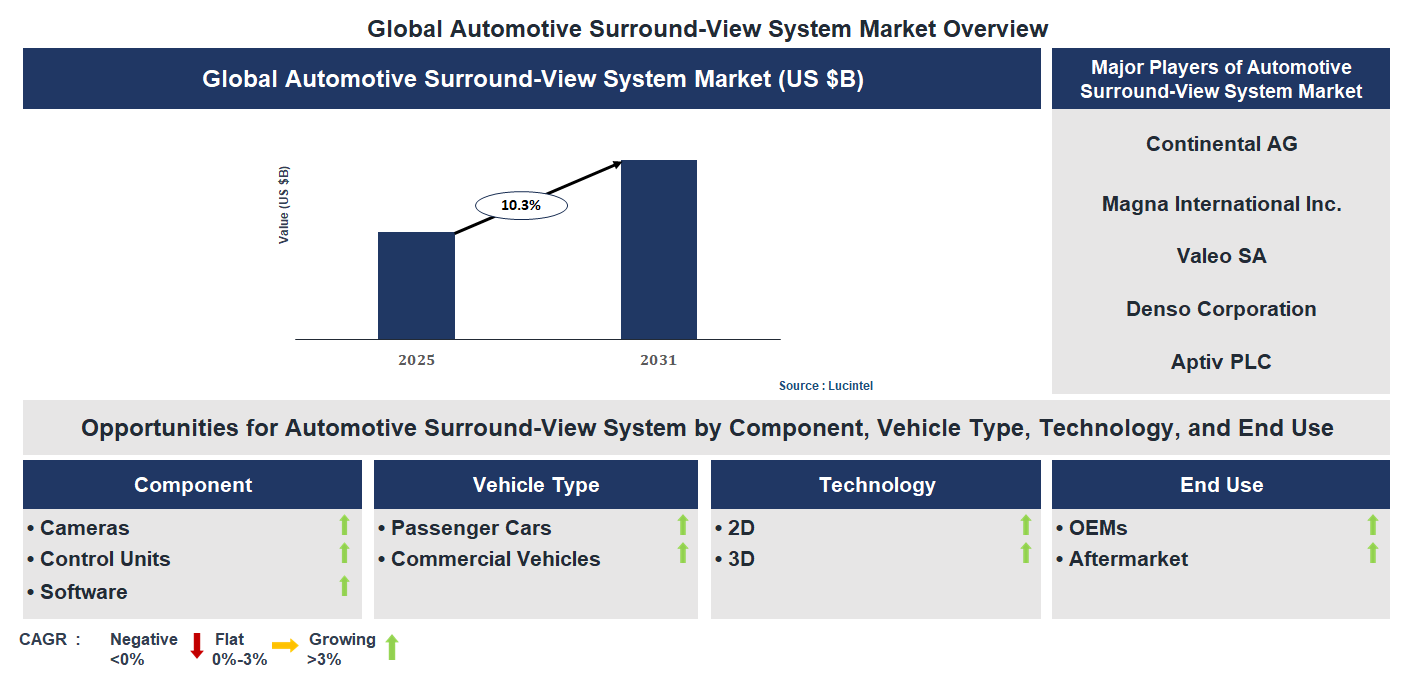
The future of the global automotive surround-view system market looks promising with opportunities in the passenger car and commercial vehicle markets. The global automotive surround-view system market is expected to grow with a CAGR of 10.3% from 2025 to 2031. The major drivers for this market are the increasing demand for vehicle safety features, the rising adoption of advanced driver assistance systems, and the growing integration of IoT in vehicles.• Lucintel forecasts that, within the component category, camera is expected to witness the highest growth over the forecast period.
• Within the vehicle type category, passenger car is expected to witness higher growth.
• In terms of region, APAC is expected to witness the highest growth over the forecast period. Gain valuable insights for your business decisions with our comprehensive 150+ page report. Sample figures with some insights are shown below.
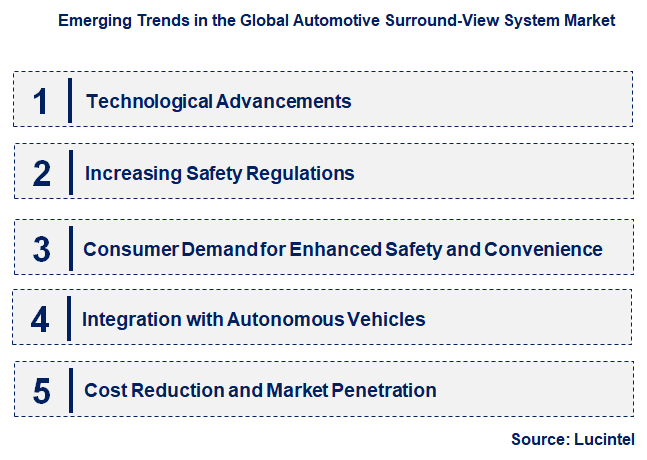
Emerging Trends in the Automotive Surround-View System Market
The automotive surround-view system market is experiencing rapid growth driven by technological advancements, increasing safety regulations, and consumer demand for enhanced driving experiences. As vehicles become smarter and more connected, surround-view systems are transforming from luxury features into essential safety components. Innovations in camera technology, artificial intelligence, and integration with other vehicle systems are shaping the future landscape. Market players are investing heavily in R&D to develop more sophisticated, affordable, and user-friendly solutions. These developments are not only improving vehicle safety but also influencing design trends and consumer preferences, ultimately redefining the automotive landscape.• Technological Advancements: The integration of high-resolution cameras, AI, and machine learning enhances system accuracy and reliability. These innovations enable real-time object detection, improved image stitching, and better obstacle recognition, leading to safer driving experiences. As technology advances, costs decrease, making surround-view systems more accessible to a broader consumer base. The evolution of sensor technology and data processing capabilities is crucial for delivering seamless, high-quality visuals, which are essential for driver confidence and safety.
• Increasing Safety Regulations: Governments worldwide are implementing stricter safety standards that mandate advanced driver assistance systems (ADAS), including surround-view cameras. These regulations push automakers to incorporate surround-view systems as standard features, boosting market growth. Enhanced safety protocols reduce accidents and fatalities, encouraging consumers to prioritize vehicles equipped with such systems. Regulatory compliance also drives innovation, prompting manufacturers to develop more comprehensive and integrated safety solutions that meet evolving legal requirements.
• Consumer Demand for Enhanced Safety and Convenience: Modern consumers seek vehicles that offer superior safety features and convenience. Surround-view systems provide a 360-degree view, aiding in parking, maneuvering in tight spaces, and avoiding obstacles. This demand is particularly strong among urban drivers and those purchasing luxury vehicles. The desire for a safer, more comfortable driving experience is fueling market expansion, prompting automakers to embed these systems as standard or optional features, thus influencing vehicle design and marketing strategies.
• Integration with Autonomous Vehicles: The rise of autonomous and semi-autonomous vehicles heavily relies on surround-view systems for environment perception. These systems serve as critical sensors that enable vehicles to navigate complex environments safely. As autonomous technology advances, the demand for highly accurate, real-time surround-view systems increases. This integration accelerates the development of fully autonomous vehicles, transforming the automotive industry by shifting focus from traditional driving to automated mobility solutions.
• Cost Reduction and Market Penetration: As technology matures, the cost of manufacturing surround-view systems decreases, making them more affordable for mass-market vehicles. Economies of scale, improved manufacturing processes, and component standardization contribute to price reductions. This affordability broadens market reach beyond luxury segments to mid-range and economy vehicles, significantly expanding the customer base. Increased adoption drives further innovation and competition among manufacturers, fostering a more dynamic and competitive market environment. In summary, these trends are collectively reshaping the automotive surround-view system market by making advanced safety features more accessible, reliable, and integrated with emerging autonomous technologies. The market is shifting from luxury to essential safety equipment, driven by technological innovation, regulatory pressures, and changing consumer preferences. This evolution is fostering safer, smarter, and more connected vehicles, ultimately transforming the future of automotive safety and mobility.
Recent Development in the Automotive Surround-View System Market
The automotive surround-view system market has experienced rapid growth driven by advancements in vehicle safety, increasing consumer demand for enhanced driving experiences, and technological innovations. As automakers focus on integrating sophisticated camera and sensor technologies, the market is evolving swiftly. These developments are shaping the future of vehicle safety and driver assistance systems, making driving safer and more convenient. The markets expansion is also influenced by regulatory pressures and the rising adoption of autonomous vehicles. This dynamic environment presents numerous opportunities and challenges for industry stakeholders, prompting continuous innovation and strategic investments to stay competitive.• Technological Advancements: Integration of AI and machine learning has improved image processing and real-time data analysis, enhancing system accuracy and reliability. This development boosts consumer confidence and accelerates adoption, leading to increased market penetration and new product launches.
• Cost Reduction Strategies: Manufacturers are focusing on reducing component costs through economies of scale and innovative manufacturing techniques. Lower costs make surround-view systems more accessible to mid-range vehicles, expanding the customer base and driving market growth.
• Regulatory and Safety Standards: Governments worldwide are implementing stricter safety regulations that mandate advanced driver-assistance systems, including surround-view cameras. These policies compel automakers to incorporate such systems, fueling market demand and technological innovation.
• Integration with Autonomous Vehicles: The rise of autonomous and semi-autonomous vehicles has increased the need for comprehensive surround-view systems. This integration enhances vehicle perception capabilities, supporting safer navigation and boosting market prospects in the autonomous vehicle segment.
• Market Expansion in Emerging Economies: Growing vehicle production and rising consumer awareness in regions like Asia-Pacific and Latin America are expanding the market footprint. Local manufacturers are adopting surround-view systems to meet global safety standards, fostering regional market growth. The recent developments in the automotive surround-view system market are significantly impacting the industry by enhancing vehicle safety, reducing manufacturing costs, and supporting the transition toward autonomous driving. These trends are driving increased adoption across various vehicle segments and regions, leading to a more competitive and innovative market landscape. As technology continues to evolve, the market is poised for sustained growth, with automakers and suppliers investing heavily in advanced surround-view solutions to meet consumer and regulatory demands.
Strategic Growth Opportunities in the Automotive Surround-View System Market
The automotive surround-view system market is experiencing rapid growth driven by advancements in vehicle safety, automation, and consumer demand for enhanced driving experiences. As automakers focus on integrating sophisticated camera and sensor technologies, the market presents numerous opportunities across various applications. These growth avenues are shaping the future of vehicle safety, convenience, and autonomous driving capabilities. Companies that capitalize on these opportunities can gain a competitive edge in this evolving landscape. The following are five key growth opportunities by application that are expected to significantly influence the market trajectory.• Enhanced Safety Systems: Improving driver awareness and accident prevention through advanced surround-view camera integration, leading to reduced collisions and increased consumer trust.
• Autonomous Vehicle Development: Supporting the deployment of autonomous vehicles by providing comprehensive 360-degree environmental awareness, essential for navigation and obstacle detection.
• Premium Vehicle Offerings: Differentiating luxury and premium vehicles with advanced surround-view systems, boosting brand value and customer appeal in high-end segments.
• Commercial Fleet Optimization: Implementing surround-view systems in commercial vehicles to enhance safety, reduce operational costs, and improve fleet management efficiency.
• Urban Mobility Solutions: Facilitating safer and more efficient urban transportation by integrating surround-view systems into shared mobility and public transport vehicles. In summary, these growth opportunities are significantly impacting the automotive surround-view system market by driving technological innovation, expanding application scope, and meeting increasing safety and automation demands. This evolution is fostering market expansion, encouraging new product development, and shaping the future landscape of intelligent vehicle systems.
Automotive Surround-View System Market Driver and Challenges
The automotive surround-view system market is influenced by a variety of technological, economic, and regulatory factors. Rapid advancements in camera and sensor technologies, increasing vehicle safety standards, and consumer demand for enhanced driving experiences are key drivers. Additionally, government regulations promoting vehicle safety and the integration of autonomous driving features are shaping market growth. However, the market also faces challenges such as high system costs, technical complexities, and regulatory hurdles that can impede widespread adoption. Understanding these drivers and challenges is essential for stakeholders aiming to capitalize on emerging opportunities and navigate potential risks within this dynamic industry. The factors responsible for driving the automotive surround-view system market include:-• Technological Advancements: The continuous development of high-resolution cameras, sensors, and AI-driven image processing has significantly improved the accuracy and reliability of surround-view systems. These innovations enable real-time, 360-degree vehicle monitoring, enhancing safety and driver convenience. As technology becomes more affordable and sophisticated, automakers are increasingly integrating these systems into a broader range of vehicle segments, from luxury to economy models. The proliferation of connected vehicle technologies further accelerates this trend, fostering smarter, more integrated systems that support autonomous driving features and advanced driver-assistance systems (ADAS). This technological evolution is pivotal in driving market expansion and meeting consumer expectations for safer, smarter vehicles.
• Increasing Vehicle Safety Regulations: Governments worldwide are implementing stringent safety standards that mandate or encourage the adoption of advanced driver-assistance systems, including surround-view cameras. Regulations such as Euro NCAP safety ratings and mandates for backup cameras in various regions incentivize automakers to incorporate surround-view systems to meet compliance and improve vehicle safety scores. These regulatory pressures not only boost demand but also push manufacturers to innovate and improve system performance. As safety regulations become more comprehensive and widespread, the market for surround-view systems is expected to grow steadily, driven by the need to meet legal requirements and enhance overall vehicle safety.
• Rising Consumer Preference for Safety and Convenience: Modern consumers prioritize safety features and convenience in their vehicle choices. The surround-view system offers a significant advantage by providing a comprehensive view around the vehicle, reducing blind spots, and aiding in parking and maneuvering in tight spaces. This aligns with consumer demand for advanced safety features and enhances the overall driving experience. Automakers are responding by offering these systems as standard or optional features, especially in mid-range and premium vehicles. The increasing awareness of road safety and the desire for technological convenience are key factors propelling market growth, making surround-view systems a critical component of modern vehicle design.
• Growth in Autonomous and Semi-Autonomous Vehicles: The development and deployment of autonomous and semi-autonomous vehicles heavily rely on surround-view systems for environment perception and navigation. These systems provide critical data that support safe operation without human intervention. As automakers and technology companies invest heavily in autonomous vehicle technology, the demand for reliable surround-view systems surges. This integration not only enhances safety but also facilitates complex maneuvers and obstacle detection, which are essential for autonomous driving. The push toward fully autonomous vehicles is a major driver, positioning surround-view systems as a foundational technology in the future of mobility. The challenges facing this automotive surround-view system market include:-
• High System Costs: The integration of surround-view systems involves advanced cameras, sensors, and sophisticated software, which can be expensive. These costs are often passed on to consumers, making the systems less accessible in lower-cost vehicle segments. Automakers face the challenge of balancing system performance with affordability to ensure widespread adoption. Additionally, ongoing maintenance and calibration costs can further increase the total cost of ownership. As a result, high system costs remain a significant barrier, especially in emerging markets where price sensitivity is high, potentially limiting market growth and adoption rates.
• Technical Complexities and Integration Issues: Developing surround-view systems that operate seamlessly across diverse vehicle platforms presents technical challenges. Ensuring system reliability, real-time data processing, and integration with other vehicle systems requires advanced engineering and rigorous testing. Variations in vehicle size, shape, and sensor placement can affect system performance, necessitating customized solutions. Moreover, issues such as sensor obstruction, adverse weather conditions, and system calibration can compromise effectiveness. These technical complexities can delay deployment, increase development costs, and hinder widespread adoption, posing a significant challenge for manufacturers aiming for scalable solutions.
• Regulatory and Standardization Barriers: The lack of uniform standards and regulations across different regions complicates the deployment of surround-view systems. Variations in safety standards, certification processes, and legal requirements can delay market entry and increase compliance costs. Additionally, concerns over data privacy and cybersecurity pose regulatory challenges that need addressing to ensure consumer trust and legal compliance. The evolving regulatory landscape requires manufacturers to adapt quickly, which can be resource-intensive. These barriers can slow down innovation, increase costs, and limit the global expansion of surround-view systems, impacting overall market growth. In summary, the automotive surround-view system market is driven by technological innovations, safety regulations, consumer preferences, and autonomous vehicle development. However, high costs, technical challenges, and regulatory complexities pose significant hurdles. The interplay of these factors will shape the market’s trajectory, requiring stakeholders to innovate and adapt strategically. Overall, the market is poised for growth, but overcoming these challenges is essential for widespread adoption and long-term success.
List of Automotive Surround-View System Companies
Companies in the market compete on the basis of product quality offered. Major players in this market focus on expanding their manufacturing facilities, R&D investments, infrastructural development, and leverage integration opportunities across the value chain. With these strategies automotive surround-view system companies cater increasing demand, ensure competitive effectiveness, develop innovative products & technologies, reduce production costs, and expand their customer base. Some of the automotive surround-view system companies profiled in this report include-• Continental AG
• Magna International Inc.
• Valeo SA
• Denso Corporation
• Aptiv PLC
• Robert Bosch GmbH
• Hyundai Mobis
• Fujitsu Limited
• Clarion Co., Ltd.
• Texas Instruments Incorporated
Automotive Surround-View System Market by Segment
The study includes a forecast for the global automotive surround-view system market by component, vehicle type, technology, end use, and region.Automotive Surround-View System Market by Component [Value from 2019 to 2031]:
• Cameras
• Control Units
• Software
Automotive Surround-View System Market by Vehicle Type [Value from 2019 to 2031]:
• Passenger Cars
• Commercial Vehicles
Automotive Surround-View System Market by Technology [Value from 2019 to 2031]:
• 2D
• 3D
Automotive Surround-View System Market by End Use [Value from 2019 to 2031]:
• OEMs
• Aftermarket
Automotive Surround-View System Market by Region [Value from 2019 to 2031]:
• North America
• Europe
• Asia Pacific
• The Rest of the World
Country Wise Outlook for the Automotive Surround-View System Market
The automotive surround-view system market has experienced rapid growth driven by technological advancements, increasing safety regulations, and consumer demand for enhanced driving experiences. As vehicles become more connected and autonomous, the integration of surround-view systems has become a key feature for automakers worldwide. This markets evolution reflects broader trends in automotive innovation, including the adoption of AI, sensor technology, and improved user interfaces. Countries are investing heavily in research and development to stay competitive, leading to significant regional variations and strategic partnerships. The following summaries highlight recent developments in the United States, China, Germany, India, and Japan.• United States: The U.S. market has seen significant advancements with major automakers integrating surround-view systems into mid-range and luxury vehicles. Innovations include AI-powered object detection and enhanced camera resolution. Collaborations between tech firms and automakers are accelerating the deployment of autonomous features, with increased focus on cybersecurity and data privacy. Regulatory support and consumer awareness are driving adoption, and startups are emerging to develop advanced sensor and imaging technologies.
• China: China remains a leader in automotive technology adoption, with rapid growth in surround-view system integration across both domestic and international brands. The government’s push for smart and connected vehicles has spurred investments in AI and sensor technology. Local companies are developing cost-effective solutions, making these systems more accessible. Additionally, China’s focus on electric vehicles (EVs) is encouraging the integration of surround-view systems to enhance safety and user experience in EV models.
• Germany: Germany’s automotive industry is emphasizing high-quality, reliable surround-view systems, especially in premium vehicles from brands like BMW, Mercedes-Benz, and Audi. The focus is on integrating these systems with advanced driver-assistance systems (ADAS) and autonomous driving features. German automakers are investing in R&D to improve system accuracy, sensor fusion, and seamless integration with other vehicle systems. Partnerships with tech firms are common to develop innovative imaging and AI solutions.
• India: The Indian automotive market is witnessing increasing adoption of surround-view systems, primarily in premium and mid-range vehicles. Manufacturers are focusing on affordability without compromising quality, leading to the development of cost-effective camera and sensor solutions. The growth is driven by rising safety awareness and government initiatives promoting vehicle safety standards. Local startups are also entering the market, offering innovative, affordable surround-view technologies tailored to the Indian driving environment.
• Japan: Japan’s market is characterized by the integration of surround-view systems in both domestic and export vehicles, with a focus on reliability and advanced features. Japanese automakers are investing in sensor fusion, AI, and high-definition imaging to improve system performance. The emphasis is on enhancing safety features and supporting autonomous driving capabilities. Collaborations with technology firms and continuous R&D efforts are driving innovations, making Japan a key player in the global surround-view system market.

Features of the Global Automotive Surround-View System Market
Market Size Estimates: Automotive surround-view system market size estimation in terms of value ($B). Trend and Forecast Analysis: Market trends (2019 to 2024) and forecast (2025 to 2031) by various segments and regions. Segmentation Analysis: Automotive surround-view system market size by various segments, such as by component, vehicle type, technology, end use, and region in terms of value ($B). Regional Analysis: Automotive surround-view system market breakdown by North America, Europe, Asia Pacific, and Rest of the World. Growth Opportunities: Analysis of growth opportunities in different components, vehicle types, technologies, end uses, and regions for the automotive surround-view system market. Strategic Analysis: This includes M&A, new product development, and competitive landscape of the automotive surround-view system market. Analysis of competitive intensity of the industry based on Porter’s Five Forces model.
FAQ
Q1. What is the growth forecast for automotive surround-view system market? Answer: The global automotive surround-view system market is expected to grow with a CAGR of 10.3% from 2025 to 2031. Q2. What are the major drivers influencing the growth of the automotive surround-view system market? Answer: The major drivers for this market are the increasing demand for vehicle safety features, the rising adoption of advanced driver assistance systems, and the growing integration of iot in vehicles. Q3. What are the major segments for automotive surround-view system market? Answer: The future of the automotive surround-view system market looks promising with opportunities in the passenger car and commercial vehicle markets. Q4. Who are the key automotive surround-view system market companies? Answer: Some of the key automotive surround-view system companies are as follows:• Continental AG
• Magna International Inc.
• Valeo SA
• Denso Corporation
• Aptiv PLC
• Robert Bosch GmbH
• Hyundai Mobis
• Fujitsu Limited
• Clarion Co., Ltd.
• Texas Instruments Incorporated Q5. Which automotive surround-view system market segment will be the largest in future? Answer: Lucintel forecasts that, within the component category, camera is expected to witness the highest growth over the forecast period. Q6. In automotive surround-view system market, which region is expected to be the largest in next 5 years? Answer: In terms of region, APAC is expected to witness the highest growth over the forecast period. Q7. Do we receive customization in this report? Answer: Yes, Lucintel provides 10% customization without any additional cost.
Table of Contents
List of Figures
List of Tables
Methodology
- In-depth interviews of the major players in this market
- Detailed secondary research from competitors’ financial statements and published data
- Extensive searches of published works, market, and database information pertaining to industry news, company press releases, and customer intentions
- A compilation of the experiences, judgments, and insights of Lucintel’s professionals, who have analyzed and tracked this market over the years.


Buy Now
Choose a license that fits your team. Instant PDF delivery.
Prices exclude taxes. Instant delivery. Custom licensing available on request.
Key Questions
- • What are some of the most promising, high-growth opportunities for the automotive surround-view system market by component (cameras, control units, and software), vehicle type (passenger cars and commercial vehicles), technology (2D and 3D), end use (OEMs and aftermarket), and region (North America, Europe, Asia Pacific, and the Rest of the World)?
- • Which segments will grow at a faster pace and why?
- • Which region will grow at a faster pace and why?
- • What are the key factors affecting market dynamics? What are the key challenges and business risks in this market?
- • What are the business risks and competitive threats in this market?
- • What are the emerging trends in this market and the reasons behind them?
- • What are some of the changing demands of customers in the market?
- • What are the new developments in the market? Which companies are leading these developments?
- • Who are the major players in this market? What strategic initiatives are key players pursuing for business growth?
- • What are some of the competing products in this market and how big of a threat do they pose for loss of market share by material or product substitution?
- • What M&A activity has occurred in the last 5 years and what has its impact been on the industry? For any questions related to Automotive Surround-View System Market, Automotive Surround-View System Market Size, Automotive Surround-View System Market Growth, Automotive Surround-View System Market Analysis, Automotive Surround-View System Market Report, Automotive Surround-View System Market Share, Automotive Surround-View System Market Trends, Automotive Surround-View System Market Forecast, Automotive Surround-View System Companies, write Lucintel analyst at email: helpdesk@lucintel.com. We will be glad to get back to you soon.


