
Report Feature
Automotive SiC Power Module Market Trends and Forecast
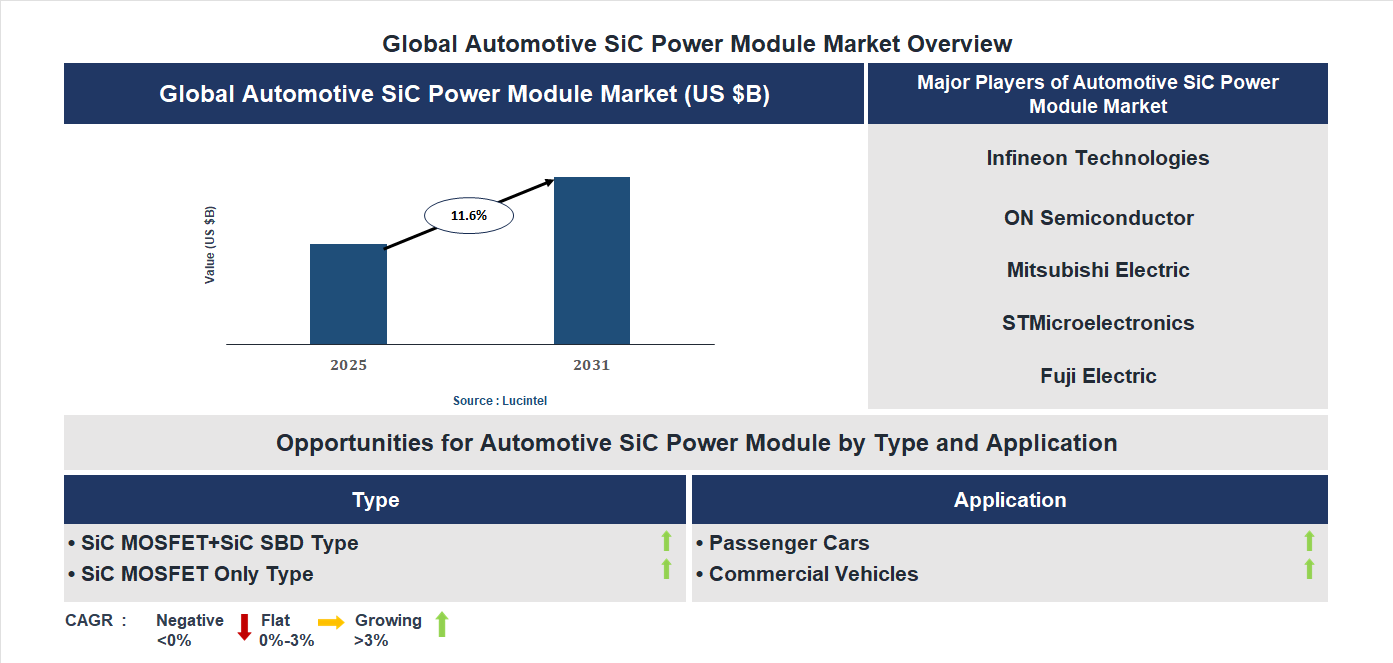
The future of the global automotive SiC power module market looks promising with opportunities in the passenger car and commercial vehicle markets. The global automotive SiC power module market is expected to grow with a CAGR of 11.6% from 2025 to 2031. The major drivers for this market are the increasing adoption of electric powertrains, the rising demand for high efficiency power electronics, and the growing focus on vehicle energy efficiency.• Lucintel forecasts that, within the type category, SiC MOSFET+SiC SBD type is expected to witness higher growth over the forecast period.
• Within the application category, passenger car is expected to witness higher growth.
• In terms of region, APAC is expected to witness the highest growth over the forecast period. Gain valuable insights for your business decisions with our comprehensive 150+ page report. Sample figures with some insights are shown below.
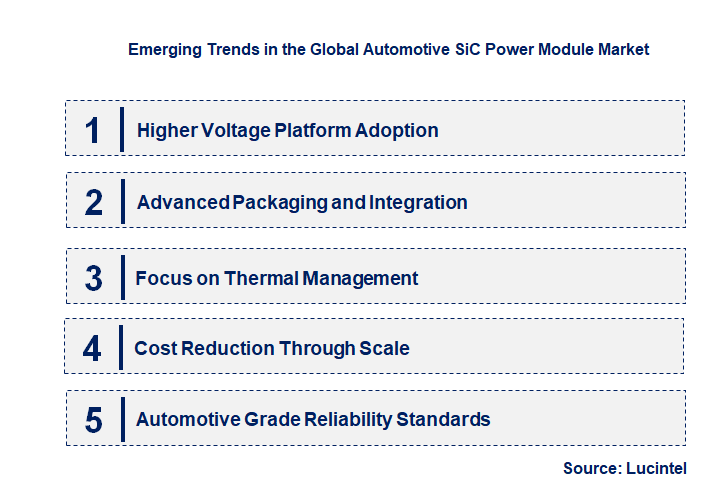
Emerging Trends in the Automotive SiC Power Module Market
Emerging trends in the automotive SiC power module market reflect the industry’s shift toward higher efficiency, compact designs, and scalable production. These trends are shaping how SiC technology is adopted across electric and hybrid vehicle platforms.• Higher Voltage Platform Adoption: Automotive manufacturers are increasingly adopting higher voltage architectures to improve efficiency and driving range. SiC power modules enable lower losses and compact designs, making them critical for next-generation electric vehicle platforms.
• Advanced Packaging And Integration: Integration of SiC devices into advanced module packages is a key trend. Improved packaging enhances thermal performance, reduces parasitic losses, and supports higher power density within limited vehicle space.
• Focus On Thermal Management: Enhanced thermal solutions are gaining importance to support high power operation. Innovations in substrates, cooling structures, and materials help maintain reliability under demanding automotive conditions.
• Cost Reduction Through Scale: Manufacturers are focusing on scaling production to reduce costs. Process optimization and yield improvement are making SiC modules more viable for broader vehicle segments beyond premium models.
• Automotive Grade Reliability Standards: Increasing emphasis on stringent reliability and qualification standards is shaping product development. SiC modules are being designed to meet long-term durability and safety expectations in automotive environments. These trends are reshaping the automotive SiC power module market by improving efficiency, scalability, and reliability. They are accelerating the transition of SiC technology from niche to mainstream automotive adoption.
Recent Development in the Automotive SiC Power Module Market
Recent developments in the automotive SiC power module market highlight continuous progress in technology, manufacturing, and collaboration. These advancements aim to address performance demands and accelerate electric vehicle deployment.• Expansion Of SiC Manufacturing Capacity: Suppliers are expanding production capabilities to meet growing automotive demand.
• Integration Into Electric Powertrains: SiC modules are increasingly integrated into inverters and onboard charging systems.
• Improved Module Reliability Testing: Enhanced testing methods ensure long-term performance under automotive conditions.
• Collaborative Development Programs: Joint development between automakers and suppliers accelerates innovation cycles.
• Material Quality And Yield Improvements: Focus on defect reduction improves consistency and performance of SiC modules. These developments are strengthening the automotive SiC power module market by improving supply readiness, performance reliability, and system integration across electric vehicle platforms.
Strategic Growth Opportunities in the Automotive SiC Power Module Market
Strategic growth opportunities in the automotive SiC power module market are driven by expanding electrified vehicle applications. Different automotive systems are creating demand for tailored SiC solutions.• Traction Inverter Systems Application: High efficiency and compact SiC modules enhance electric motor performance.
• Onboard Charger Integration Application: SiC modules enable faster charging and reduced system losses.
• DC Converter Systems Application: Improved power density supports efficient voltage conversion in vehicles.
• Hybrid Vehicle Power Systems Application: SiC modules improve efficiency and thermal performance in hybrid architectures.
• Commercial Electric Vehicle Platforms Application: High power handling supports buses and heavy-duty electric vehicles. Application-specific growth opportunities are expanding the automotive SiC power module market, enabling broader adoption across passenger, hybrid, and commercial electric vehicles.
Automotive SiC Power Module Market Driver and Challenges
The automotive SiC power module market is influenced by technological progress, economic considerations, and regulatory frameworks. Strong drivers support growth, while challenges shape adoption pace and investment decisions. The factors responsible for driving the automotive SiC power module market include: 1. Growing Electric Vehicle Adoption: Rising electrification increases demand for efficient power electronics. 2. Need For Higher Energy Efficiency: SiC modules reduce losses and improve vehicle range. 3. Advances In Power Semiconductor Technology: Continuous innovation enhances performance and reliability. 4. Automotive Lightweighting Trends: Compact SiC modules support vehicle weight reduction goals. 5. Regulatory Support For Electrification: Emission reduction policies encourage electric powertrain adoption. Challenges in the automotive SiC power module market are: 1. High Material And Processing Costs: SiC substrates and processing remain expensive. 2. Manufacturing Complexity And Yield: Precision processes increase production difficulty. 3. Supply Chain Dependence Risks: Limited supplier base creates sourcing challenges. The automotive SiC power module market benefits from strong electrification drivers and efficiency demands. Overcoming cost, manufacturing, and supply chain challenges will be critical to sustaining long-term growth and broader market penetration.List of Automotive SiC Power Module Companies
Companies in the market compete on the basis of product quality offered. Major players in this market focus on expanding their manufacturing facilities, R&D investments, infrastructural development, and leverage integration opportunities across the value chain. With these strategies automotive SiC power module companies cater increasing demand, ensure competitive effectiveness, develop innovative products & technologies, reduce production costs, and expand their customer base. Some of the automotive SiC power module companies profiled in this report include-• Infineon Technologies
• ON Semiconductor
• Mitsubishi Electric
• STMicroelectronics
• Fuji Electric
• Cree
• Texas Instruments
• Renesas Electronics
• Power Integrations
• Toshiba
Automotive SiC Power Module Market by Segment
The study includes a forecast for the global automotive SiC power module market by type, application, and region.Automotive SiC Power Module Market by Type [Value from 2019 to 2031]:
• SiC MOSFET+SiC SBD Type
• SiC MOSFET Only Type
Automotive SiC Power Module Market by Application [Value from 2019 to 2031]:
• Passenger Cars
• Commercial Vehicles
Automotive SiC Power Module Market by Region [Value from 2019 to 2031]:
• North America
• Europe
• Asia Pacific
• The Rest of the World
Country Wise Outlook for the Automotive SiC Power Module Market
The automotive silicon carbide power module market is gaining momentum as vehicle electrification accelerates worldwide. Automakers and suppliers are focusing on higher efficiency, compact power electronics, and thermal performance improvements. Regional developments reflect differing priorities, ranging from supply chain localization to advanced manufacturing and system integration.• United States: The United States market is advancing through strong collaboration between automakers, power semiconductor suppliers, and research institutions. Developments emphasize high-performance SiC modules for electric drivetrains, improved thermal management, and system-level integration. Domestic supply chain strengthening and focus on reliability standards are supporting adoption in premium and commercial electric vehicles.
• China: China is rapidly advancing the automotive SiC power module market through localized production and aggressive technology adoption. Developments focus on cost optimization, high-volume manufacturing, and integration into mass-market electric vehicles. Strong government support for electrification and a robust domestic semiconductor ecosystem are accelerating commercialization and supplier expansion.
• Germany: Germany’s market developments center on precision engineering and automotive-grade reliability. Focus areas include high-voltage SiC modules, advanced packaging, and integration with powertrain systems. Strong ties between automotive manufacturers and component suppliers support continuous refinement of performance, efficiency, and durability for premium electric vehicles.
• India: India is at an early stage of SiC power module development, driven by growing electric vehicle adoption and policy support. Recent efforts focus on capability building, pilot manufacturing, and partnerships with global suppliers. Emphasis is placed on cost-effective solutions suitable for local mobility and infrastructure needs.
• Japan: Japan continues to lead in SiC material quality and manufacturing processes. Developments emphasize wafer quality, module miniaturization, and long-term reliability. Strong expertise in power electronics and automotive systems supports steady integration of SiC modules into hybrid and electric vehicle platforms.

Features of the Global Automotive SiC Power Module Market
Market Size Estimates: Automotive SiC power module market size estimation in terms of value ($B). Trend and Forecast Analysis: Market trends (2019 to 2024) and forecast (2025 to 2031) by various segments and regions. Segmentation Analysis: Automotive SiC power module market size by type, application, and region in terms of value ($B). Regional Analysis: Automotive SiC power module market breakdown by North America, Europe, Asia Pacific, and Rest of the World. Growth Opportunities: Analysis of growth opportunities in different types, applications, and regions for the automotive SiC power module market. Strategic Analysis: This includes M&A, new product development, and competitive landscape of the automotive SiC power module market. Analysis of competitive intensity of the industry based on Porter’s Five Forces model.
FAQ
Q1. What is the growth forecast for automotive SiC power module market? Answer: The global automotive SiC power module market is expected to grow with a CAGR of 11.6% from 2025 to 2031. Q2. What are the major drivers influencing the growth of the automotive SiC power module market? Answer: The major drivers for this market are the increasing adoption of electric powertrains, the rising demand for high efficiency power electronics, and the growing focus on vehicle energy efficiency. Q3. What are the major segments for automotive SiC power module market? Answer: The future of the automotive SiC power module market looks promising with opportunities in the passenger car and commercial vehicle markets. Q4. Who are the key automotive SiC power module market companies? Answer: Some of the key automotive SiC power module companies are as follows:• Infineon Technologies
• ON Semiconductor
• Mitsubishi Electric
• STMicroelectronics
• Fuji Electric
• Cree
• Texas Instruments
• Renesas Electronics
• Power Integrations
• Toshiba Q5. Which automotive SiC power module market segment will be the largest in future? Answer: Lucintel forecasts that, within the type category, SiC MOSFET+SiC SBD type is expected to witness higher growth over the forecast period. Q6. In automotive SiC power module market, which region is expected to be the largest in next 5 years? Answer: In terms of region, APAC is expected to witness the highest growth over the forecast period. Q7. Do we receive customization in this report? Answer: Yes, Lucintel provides 10% customization without any additional cost.
Table of Contents
List of Figures
List of Tables
Methodology
- In-depth interviews of the major players in this market
- Detailed secondary research from competitors’ financial statements and published data
- Extensive searches of published works, market, and database information pertaining to industry news, company press releases, and customer intentions
- A compilation of the experiences, judgments, and insights of Lucintel’s professionals, who have analyzed and tracked this market over the years.


Buy Now
Choose a license that fits your team. Instant PDF delivery.
Prices exclude taxes. Instant delivery. Custom licensing available on request.
Key Questions
- • What are some of the most promising, high-growth opportunities for the automotive SiC power module market by type (SiC MOSFET+SiC SBD type and SiC MOSFET only type), application (passenger cars and commercial vehicles), and region (North America, Europe, Asia Pacific, and the Rest of the World)?
- • Which segments will grow at a faster pace and why?
- • Which region will grow at a faster pace and why?
- • What are the key factors affecting market dynamics? What are the key challenges and business risks in this market?
- • What are the business risks and competitive threats in this market?
- • What are the emerging trends in this market and the reasons behind them?
- • What are some of the changing demands of customers in the market?
- • What are the new developments in the market? Which companies are leading these developments?
- • Who are the major players in this market? What strategic initiatives are key players pursuing for business growth?
- • What are some of the competing products in this market and how big of a threat do they pose for loss of market share by material or product substitution?
- • What M&A activity has occurred in the last 5 years and what has its impact been on the industry? For any questions related to Automotive SiC Power Module Market, Automotive SiC Power Module Market Size, Automotive SiC Power Module Market Growth, Automotive SiC Power Module Market Analysis, Automotive SiC Power Module Market Report, Automotive SiC Power Module Market Share, Automotive SiC Power Module Market Trends, Automotive SiC Power Module Market Forecast, Automotive SiC Power Module Companies, write Lucintel analyst at email: helpdesk@lucintel.com. We will be glad to get back to you soon.


