
Market Report · May 18, 2026

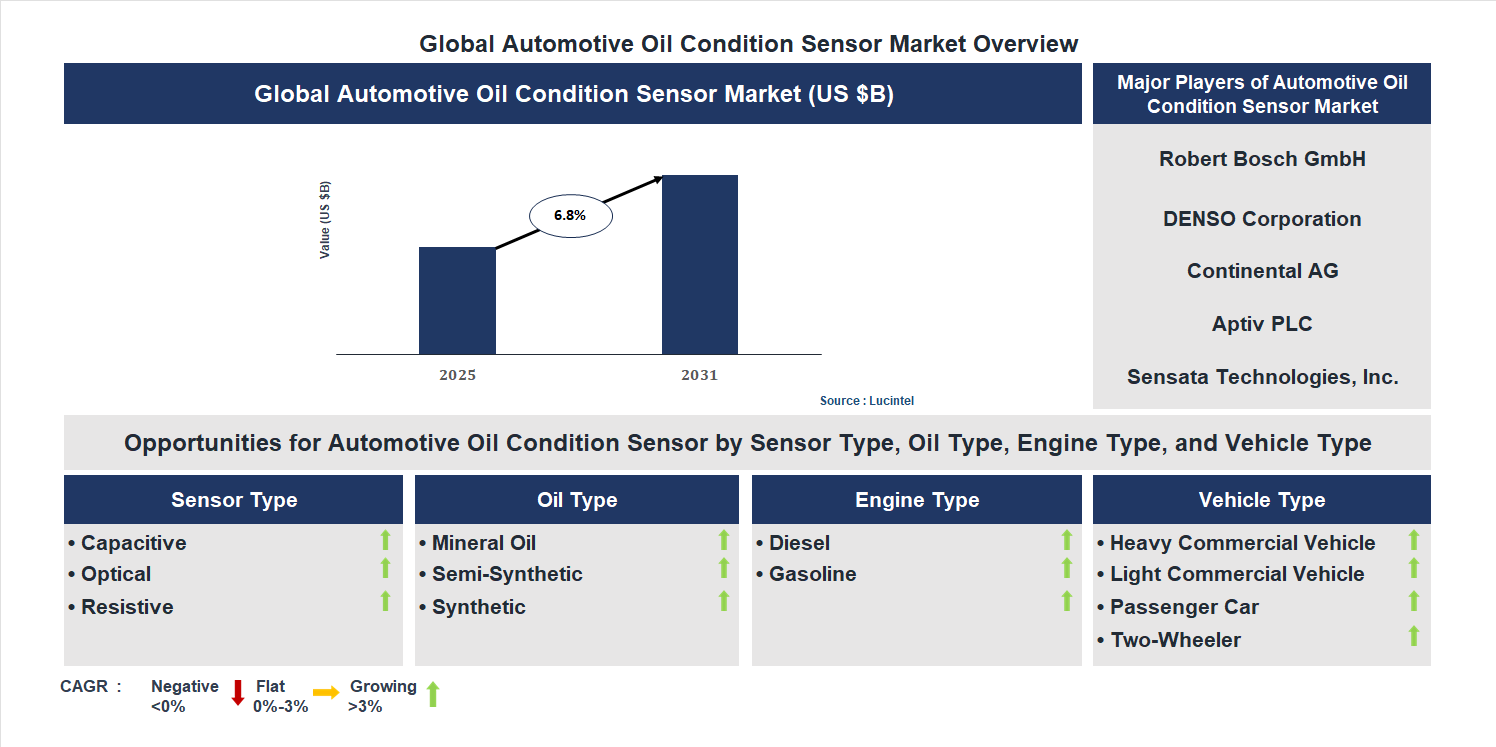
Key data points: The growth forecast = 6.8% annually for the next 7 years. Scroll below to get more insights. This market report covers trends, opportunities and forecasts in automotive oil condition sensor market to 2031 by sensor type (capacitive, optical, and resistive), oil type (mineral oil, semi-synthetic, and synthetic), engine type (diesel and gasoline), vehicle type (heavy commercial vehicle, light commercial vehicle, passenger car, and two-wheeler), and region (North America, Europe, Asia Pacific, and the Rest of the World)
We'll send your sample report shortly.
• Lucintel forecasts that, within the sensor type category, capacitive is expected to witness the highest growth over the forecast period.
• Within the vehicle type category, light commercial vehicle is expected to witness the highest growth.
• In terms of region, APAC is expected to witness the highest growth over the forecast period. Gain valuable insights for your business decisions with our comprehensive 150+ page report. Sample figures with some insights are shown below.
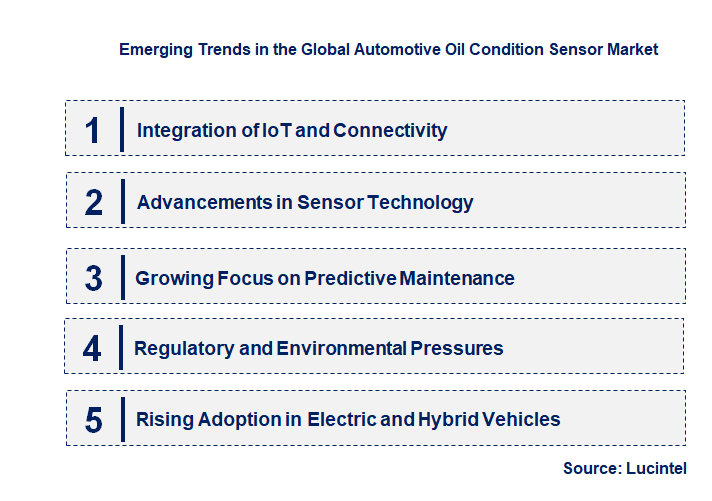
• Integration of IoT and Connectivity: The adoption of Internet of Things (IoT) technology enables real-time data transmission from oil sensors to cloud platforms, facilitating predictive maintenance and remote diagnostics. This connectivity improves vehicle uptime, reduces unexpected breakdowns, and enhances user experience. Automakers are increasingly embedding these sensors into connected vehicle systems, which allows for proactive servicing and better fleet management. The integration also supports data-driven insights, helping manufacturers optimize product design and maintenance schedules, ultimately leading to cost savings and improved vehicle longevity.
• Advancements in Sensor Technology: Innovations in sensor materials and design have led to more accurate, durable, and cost-effective oil condition sensors. These sensors now offer higher sensitivity to contaminants, viscosity changes, and additive depletion, providing precise data for maintenance decisions. The development of miniaturized sensors with longer lifespan and better resistance to harsh engine conditions has expanded their application scope. As a result, automakers can incorporate these sensors into a wider range of vehicles, from economy to luxury models, enhancing overall vehicle health monitoring and customer satisfaction.
• Growing Focus on Predictive Maintenance: The shift from reactive to predictive maintenance is a key trend, driven by the need to reduce downtime and maintenance costs. Oil condition sensors provide critical data that enable early detection of engine issues, allowing timely interventions before major failures occur. This approach minimizes repair costs, extends engine life, and improves fuel efficiency. The market is witnessing increased adoption of predictive analytics platforms that leverage sensor data, empowering fleet operators and individual vehicle owners to make informed maintenance decisions and optimize operational efficiency.
• Regulatory and Environmental Pressures: Stricter emissions standards and environmental regulations are pushing automakers to adopt advanced sensor technologies that ensure optimal engine performance and lower emissions. Oil condition sensors help maintain engine efficiency by preventing oil degradation, which can lead to increased emissions and engine wear. Compliance with these regulations not only avoids penalties but also enhances brand reputation. The market is thus witnessing increased demand for sensors that support eco-friendly vehicle operation, including hybrid and electric vehicles, which require sophisticated monitoring systems to ensure sustainability.
• Rising Adoption in Electric and Hybrid Vehicles: As electric and hybrid vehicles gain popularity, the role of oil condition sensors is evolving. While traditional oil sensors are less relevant for fully electric vehicles, hybrid models still require oil monitoring for their internal combustion engines. The market is expanding to include sensors tailored for electric powertrains, such as battery health sensors and thermal management systems. This diversification is opening new avenues for growth, as automakers seek integrated sensor solutions to enhance vehicle reliability, safety, and performance across a broader range of powertrain configurations. In summary, these emerging trends are fundamentally reshaping the automotive oil condition sensor market by fostering smarter, more connected, and environmentally compliant vehicles. The integration of IoT, technological innovations, predictive maintenance, regulatory compliance, and the expansion into electric and hybrid vehicles are collectively driving market growth and transforming traditional automotive maintenance paradigms.
• Integration of IoT Technology: The incorporation of Internet of Things (IoT) connectivity into oil sensors allows real-time data transmission to cloud platforms, enabling predictive maintenance and reducing vehicle downtime. This development improves vehicle reliability, lowers maintenance costs, and enhances user experience by providing timely alerts for oil changes and potential engine issues.
• Advancements in Sensor Materials: New materials such as nanocomposites and advanced polymers are being used to develop more durable and sensitive oil sensors. These materials extend sensor lifespan, improve accuracy under extreme conditions, and reduce manufacturing costs, thereby making sensors more accessible and reliable for automotive applications.
• Miniaturization of Sensors: The trend towards smaller, more compact sensors facilitates easier integration into various vehicle models without compromising space or design. Miniaturized sensors enable manufacturers to incorporate multiple sensors in a single vehicle, improving overall engine health monitoring and contributing to the development of smart, connected vehicles.
• Development of Multi-Function Sensors: Recent innovations include sensors capable of monitoring multiple parameters such as oil quality, temperature, and pressure simultaneously. These multi-function sensors provide comprehensive data, streamline maintenance processes, and reduce the need for multiple discrete sensors, leading to cost savings and enhanced diagnostic capabilities.
• Adoption of AI and Machine Learning: The integration of artificial intelligence and machine learning algorithms enhances data analysis from oil sensors, enabling more accurate predictions of oil degradation and engine health. This development supports proactive maintenance strategies, reduces unexpected breakdowns, and optimizes vehicle performance over its lifespan. In summary, these recent developments are significantly impacting the automotive oil condition sensor market by improving sensor accuracy, durability, and connectivity. They are driving the adoption of smarter, more efficient vehicle maintenance solutions, fostering growth in connected vehicle technologies, and supporting stricter environmental standards. As a result, the market is poised for continued expansion, innovation, and increased integration into modern automotive systems.
• Expansion in Passenger Vehicles: Market growth is driven by rising consumer demand for reliable vehicle performance. Oil sensors enable real-time monitoring, reducing maintenance costs and preventing engine failures. Automakers are integrating these sensors into new models to meet consumer expectations for durability and efficiency, boosting sales and market penetration.
• Commercial Vehicle Adoption: The commercial vehicle segment benefits from the need for enhanced fleet management and reduced operational costs. Oil condition sensors facilitate predictive maintenance, minimizing downtime and repair expenses. This adoption improves fleet efficiency and compliance with safety regulations, creating a substantial growth avenue.
• Electric and Hybrid Vehicles: As electric and hybrid vehicles gain popularity, the need for advanced oil monitoring systems persists, especially in hybrid models with internal combustion engines. These sensors help optimize engine performance and extend component lifespan, supporting the transition to cleaner transportation.
• Aftermarket and Remanufacturing: The aftermarket segment offers significant growth potential through the sale of retrofit sensors and maintenance services. Consumers and repair shops seek cost-effective solutions for vehicle diagnostics, driving demand for easy-to-install sensors that improve vehicle health monitoring.
• Integration with IoT and Data Analytics: Incorporating oil sensors with IoT platforms enables real-time data collection and analysis. This integration supports predictive maintenance, reduces breakdowns, and enhances vehicle management systems. It also opens new revenue streams for sensor manufacturers through data-driven services. In summary, these growth opportunities are transforming the automotive oil condition sensor market by fostering innovation, improving vehicle performance, and enabling smarter maintenance solutions. The integration of advanced sensors across applications is driving market expansion, creating value for automakers, service providers, and consumers alike. This evolution is set to redefine automotive diagnostics and maintenance practices, ensuring a more efficient and sustainable future for the industry.
• Technological Innovation: The development of advanced, accurate, and cost-effective sensors has significantly enhanced oil condition monitoring capabilities. These sensors enable real-time data collection, improving vehicle performance and maintenance efficiency. As automakers integrate these sensors into new models, demand surges, fostering market growth. Continuous innovation also allows for miniaturization and increased durability, making sensors suitable for various vehicle types. The rise of IoT and connected vehicle technologies further amplifies the importance of oil sensors, creating a robust ecosystem for growth.
• Increasing Vehicle Electrification: The shift towards electric vehicles (EVs) and hybrid models is a major driver. EVs require sophisticated monitoring systems to ensure optimal battery and motor performance, including oil condition sensors for hybrid engines. As governments enforce stricter emission standards and promote EV adoption, automakers incorporate advanced sensors to meet these regulations. This transition not only expands the market but also encourages the development of specialized sensors tailored for electric and hybrid vehicles, opening new revenue streams.
• Stringent Regulatory Standards: Governments worldwide are implementing strict regulations related to vehicle safety, emissions, and maintenance. These standards compel automakers to adopt advanced sensor technologies, including oil condition sensors, to ensure compliance. For instance, regulations requiring real-time monitoring of engine health and emissions management push manufacturers to integrate these sensors into their vehicles. This regulatory environment fosters innovation and accelerates market adoption, ensuring vehicles operate efficiently and within legal parameters, ultimately benefiting consumers and the environment.
• Growing Awareness of Vehicle Maintenance: Increasing consumer awareness about vehicle health and maintenance costs is driving demand for proactive monitoring solutions. Oil condition sensors provide real-time insights into engine health, enabling timely maintenance and preventing costly repairs. As vehicle owners become more informed and seek to extend their vehicle lifespan, the adoption of such sensors rises. This trend is supported by digital platforms and telematics, which facilitate remote diagnostics and maintenance scheduling, further boosting market growth.
• Expansion of Aftermarket Services: The aftermarket segment is witnessing rapid growth due to rising vehicle age and maintenance needs. Oil condition sensors are increasingly being integrated into aftermarket repair and maintenance services, offering vehicle owners affordable options for monitoring engine health. This expansion is driven by the increasing number of aging vehicles and the demand for cost-effective maintenance solutions. Manufacturers are developing easy-to-install sensors compatible with a wide range of vehicle models, thus broadening market reach and creating new revenue opportunities. The challenges facing this automotive oil condition sensor market include:-
• High Sensor Costs: Despite technological advancements, the cost of developing and integrating sophisticated oil condition sensors remains high. This can limit adoption, especially among budget-conscious consumers and small-scale automakers. High costs hinder widespread deployment in entry-level vehicles, restricting market growth. Manufacturers face the challenge of balancing sensor accuracy and durability with affordability, which requires ongoing innovation and economies of scale to reduce prices.
• Integration Complexities: Incorporating oil condition sensors into existing vehicle architectures can be complex and costly. Compatibility issues with various engine types and vehicle models pose significant hurdles. Additionally, integrating sensors with vehicle electronic control units (ECUs) requires advanced engineering and software development, increasing development time and costs. These complexities can delay product launches and reduce the overall market penetration, especially in older vehicle fleets where retrofitting is necessary.
• Data Security and Privacy Concerns: As oil sensors generate vast amounts of data for real-time analysis, concerns about data security and privacy arise. Unauthorized access or hacking of vehicle data can lead to safety risks and privacy breaches. Regulatory frameworks around data protection are evolving, and automakers must invest in secure data management systems. Addressing these concerns is crucial for consumer trust and widespread adoption, but it also adds to the overall cost and complexity of deploying sensor solutions. In summary, the automotive oil condition sensor market is driven by technological advancements, the shift towards electric vehicles, regulatory pressures, increased maintenance awareness, and aftermarket growth. However, high costs, integration challenges, and data security issues pose significant hurdles. These drivers and challenges collectively influence the market’s growth trajectory, requiring strategic innovation and regulatory compliance. The market’s future will depend on how effectively industry players can leverage technological opportunities while overcoming these obstacles to meet evolving consumer and regulatory demands.
• Robert Bosch GmbH
• DENSO Corporation
• Continental AG
• Aptiv PLC
• Sensata Technologies, Inc.
• Infineon Technologies AG
• NXP Semiconductors N.V.
• Vitesco Technologies GmbH
• Hella GmbH & Co. KGaA
• Schaeffler
• Capacitive
• Optical
• Resistive
• Mineral Oil
• Semi-Synthetic
• Synthetic
• Diesel
• Gasoline
• Heavy Commercial Vehicle
• Light Commercial Vehicle
• Passenger Car
• Two-Wheeler
• North America
• Europe
• Asia Pacific
• The Rest of the World
• United States: The U.S. market has seen significant adoption of advanced oil sensors integrated with vehicle telematics systems, driven by increasing consumer demand for vehicle maintenance data and OEM investments in smart vehicle technologies. Regulatory agencies are also promoting standards for vehicle health monitoring, boosting sensor deployment. Major automakers are incorporating these sensors into new models to enhance vehicle diagnostics and reduce maintenance costs. Additionally, startups are innovating with IoT-enabled sensors that provide real-time oil condition monitoring via mobile apps, expanding market reach.
• China: China’s automotive market is rapidly adopting oil condition sensors, fueled by government initiatives promoting smart vehicle technologies and environmental regulations aimed at reducing emissions. Local manufacturers are investing heavily in sensor R&D to meet the rising demand for vehicle health monitoring systems. The growth of electric vehicles (EVs) and hybrid models has also spurred innovations in sensor technology to optimize maintenance and performance. Moreover, increasing consumer awareness about vehicle maintenance is driving aftermarket sales of oil sensors, supported by expanding automotive service networks.
• Germany: Germany’s automotive industry is focusing on integrating oil condition sensors into high-end and luxury vehicles, emphasizing precision and reliability. The market benefits from stringent EU regulations on vehicle emissions and maintenance, encouraging automakers to adopt advanced sensor solutions. German companies are leading in developing sensors with enhanced durability and accuracy, often incorporating IoT connectivity for predictive maintenance. The emphasis on sustainability and vehicle longevity is also fostering collaborations between sensor manufacturers and automotive OEMs to develop innovative solutions.
• India: The Indian automotive market is witnessing rapid growth in oil sensor adoption, driven by increasing vehicle ownership and rising awareness of vehicle maintenance. Cost-effective sensor solutions are gaining popularity among OEMs and aftermarket players to cater to the price-sensitive market. Government initiatives promoting vehicle safety and emissions standards are encouraging automakers to incorporate oil condition sensors. The expanding automotive service infrastructure and the growth of fleet vehicles further contribute to the rising demand for reliable, affordable oil monitoring systems, with local startups entering the market with innovative offerings.
• Japan: Japan’s market is characterized by the integration of sophisticated oil sensors in hybrid and electric vehicles, aligning with the country’s focus on sustainable mobility. Japanese automakers are investing in sensor technologies that enable precise oil condition monitoring to optimize engine performance and reduce emissions. The market benefits from advanced manufacturing capabilities and a strong emphasis on quality and reliability. Additionally, collaborations between sensor manufacturers and automotive companies are fostering the development of next-generation sensors with enhanced connectivity features, supporting Japan’s leadership in automotive innovation and environmental sustainability.


• Robert Bosch GmbH
• DENSO Corporation
• Continental AG
• Aptiv PLC
• Sensata Technologies, Inc.
• Infineon Technologies AG
• NXP Semiconductors N.V.
• Vitesco Technologies GmbH
• Hella GmbH & Co. KGaA
• Schaeffler Q5. Which automotive oil condition sensor market segment will be the largest in future? Answer: Lucintel forecasts that, within the sensor type category, capacitive is expected to witness the highest growth over the forecast period. Q6. In automotive oil condition sensor market, which region is expected to be the largest in next 5 years? Answer: In terms of region, APAC is expected to witness the highest growth over the forecast period. Q7. Do we receive customization in this report? Answer: Yes, Lucintel provides 10% customization without any additional cost.


Choose a license that fits your team. Instant PDF delivery.
Prices exclude taxes. Instant delivery. Custom licensing available on request.
Market Report · May 18, 2026
Market Report · May 18, 2026
Market Report · May 18, 2026
Trusted partner for strategic intelligence and business growth


Receive a complimentary market analysis tailored to your industry. Our analysts will identify key growth opportunities and competitive dynamics specific to your business.

Market size, growth rate, and key trend analysis for your specific sector.

Top competitor positioning and market share analysis.

Strategic recommendations backed by data-driven insights.
Get curated market intelligence and competitive moves straight to your inbox.
By subscribing, you agree to receive our monthly insights. Unsubscribe anytime.
Receive a complimentary market analysis tailored to your industry. Our analysts will identify key growth opportunities and competitive dynamics specific to your business.
Market size, growth rate, and key trend analysis for your specific sector.
Top competitor positioning and market share analysis.
Strategic recommendations backed by data-driven insights.
Get curated market intelligence, emerging trends, and competitive moves straight to your inbox each month.
By subscribing, you agree to receive our monthly insights. Unsubscribe anytime.
We'll send your sample report shortly.