
Report Feature
Automotive Multimedia Touchpad Market Trends and Forecast
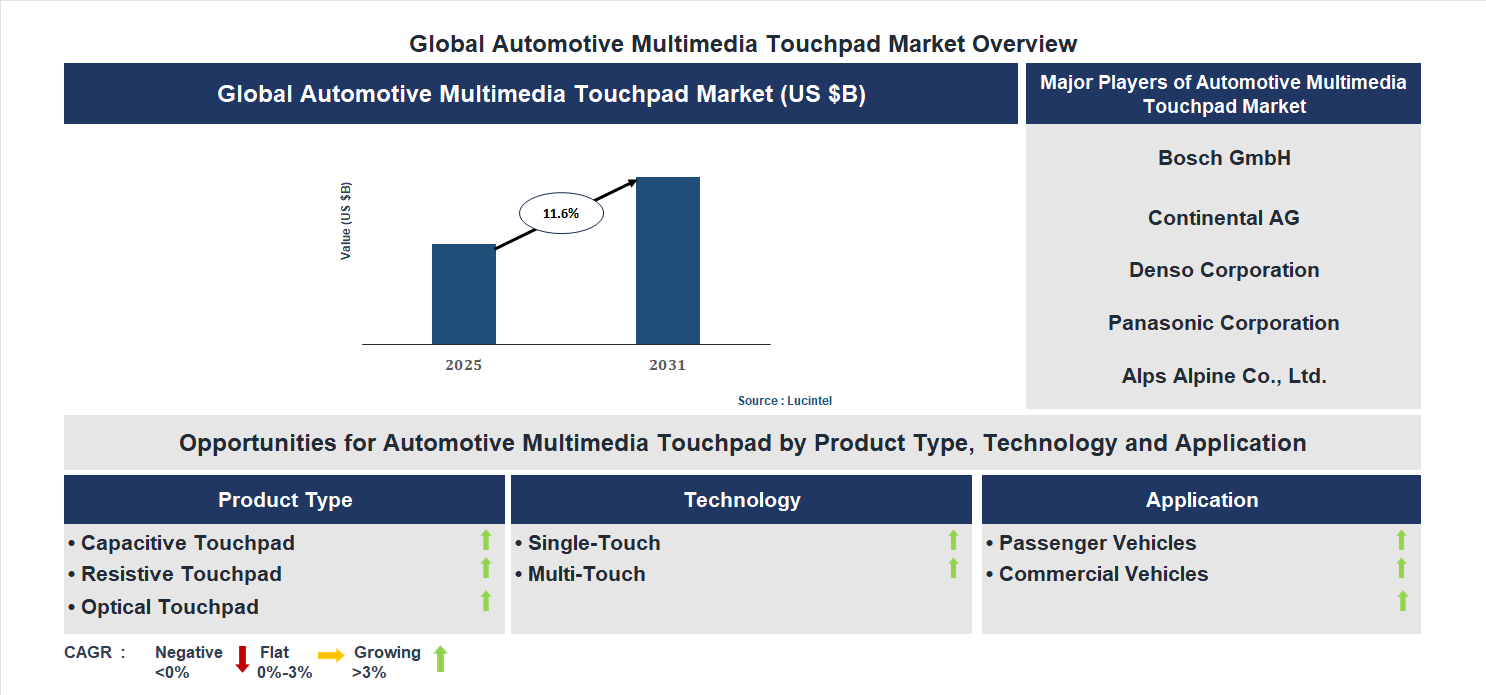
The future of the global automotive multimedia touchpad market looks promising with opportunities in the passenger vehicle and commercial vehicle markets. The global automotive multimedia touchpad market is expected to grow with a CAGR of 11.6% from 2025 to 2031. The major drivers for this market are the increasing demand for intuitive in car interfaces, the rising adoption of connected vehicle technologies, and the growing need for enhanced driver interaction systems.• Lucintel forecasts that, within the product type category, capacitive touchpad is expected to witness the highest growth over the forecast period.
• Within the application category, passenger vehicle is expected to witness higher growth.
• In terms of region, APAC is expected to witness the highest growth over the forecast period. Gain valuable insights for your business decisions with our comprehensive 150+ page report. Sample figures with some insights are shown below.
Emerging Trends in the Automotive Multimedia Touchpad Market
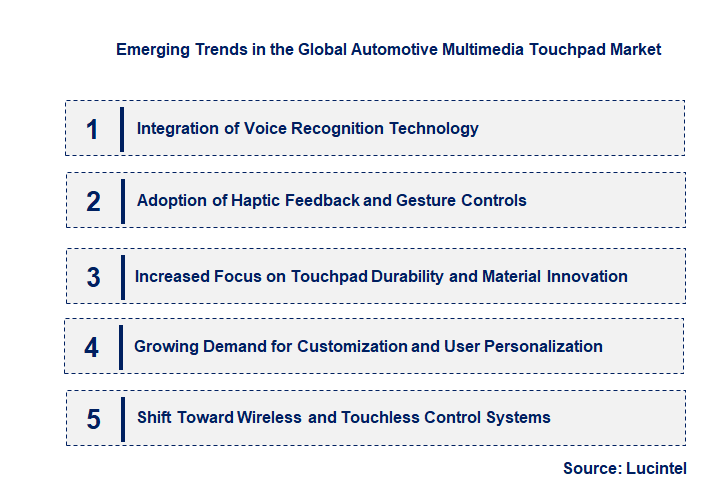
The automotive multimedia touchpad market is experiencing rapid evolution driven by technological advancements, changing consumer preferences, and the push toward smarter, more integrated vehicle systems. As automakers focus on enhancing user experience and safety, innovative touchpad solutions are becoming central to vehicle infotainment and control systems. These developments are not only transforming how drivers interact with their vehicles but also influencing market dynamics, competitive strategies, and product offerings. The following key trends highlight the major shifts shaping this market, reflecting a move toward more intuitive, connected, and sustainable automotive environments.• Integration of Voice Recognition Technology: Voice recognition is increasingly embedded into automotive touchpads, enabling hands-free control of multimedia functions. This trend enhances safety by reducing driver distraction and offers a more seamless user experience. Advanced voice AI systems can understand natural language commands, allowing drivers to operate navigation, entertainment, and communication features effortlessly. As voice technology becomes more sophisticated and accurate, it is expected to become a standard feature, significantly impacting user interaction and market competitiveness.
• Adoption of Haptic Feedback and Gesture Controls: Haptic feedback provides tactile responses to touch inputs, improving accuracy and user satisfaction. Gesture controls allow drivers to operate multimedia systems through simple hand movements, reducing the need for physical contact with touchpads. These innovations enhance safety by minimizing driver distraction and offer a more intuitive interface. As automakers seek to create more engaging and user-friendly controls, the integration of haptic and gesture technologies is set to become a key differentiator in the market, influencing product design and consumer preferences.
• Increased Focus on Touchpad Durability and Material Innovation: With the rise of touch-based controls, manufacturers are prioritizing durability and material quality to withstand harsh automotive environments. Innovations include the use of scratch-resistant surfaces, temperature-resistant materials, and anti-glare coatings. These improvements ensure longevity and consistent performance, reducing maintenance costs and enhancing user satisfaction. As vehicle interiors become more sophisticated, durable touchpads are critical for maintaining aesthetic appeal and functional reliability, thereby shaping product development strategies across the industry.
• Growing Demand for Customization and User Personalization: Consumers increasingly seek personalized multimedia experiences, prompting automakers to offer customizable touchpad interfaces. This includes adjustable layouts, personalized shortcuts, and adaptive controls based on user preferences. Such customization enhances user engagement and satisfaction, fostering brand loyalty. The ability to tailor multimedia controls to individual needs is becoming a competitive advantage, influencing market offerings and driving innovation in interface design and software development.
• Shift Toward Wireless and Touchless Control Systems: The trend toward wireless connectivity and touchless controls aims to reduce clutter and improve ease of use. Technologies like proximity sensors, infrared, and Bluetooth enable drivers to operate multimedia functions without direct contact. This shift not only enhances hygiene and safety but also aligns with the broader move toward connected, smart vehicle ecosystems. As wireless and touchless solutions become more reliable and affordable, they are poised to redefine user interaction paradigms and expand the scope of automotive multimedia control options. In summary, these emerging trends are collectively transforming the automotive multimedia touchpad market by making vehicle controls more intuitive, durable, personalized, and connected. They are driving innovation, improving safety, and elevating the overall driving experience, ultimately reshaping how automakers design and implement multimedia interfaces in vehicles.
Recent Development in the Automotive Multimedia Touchpad Market
The automotive multimedia touchpad market has experienced significant growth driven by advancements in vehicle connectivity, user interface innovations, and increasing consumer demand for enhanced in-car entertainment. As automakers focus on integrating smarter, more intuitive controls, the market is evolving rapidly. Technological advancements, changing consumer preferences, and the push toward autonomous vehicles are shaping this landscape. Key developments include the integration of touchpad technology with voice control, the adoption of haptic feedback, the rise of wireless connectivity, the implementation of AI-driven personalization, and the expansion into electric and autonomous vehicle segments. These trends are transforming how drivers interact with their vehicles, making in-car experiences more seamless and engaging.• Integration of Touchpad with Voice Control: This development allows drivers to operate multimedia systems via voice commands combined with touchpad inputs, enhancing safety and convenience. It reduces driver distraction by enabling hands-free control, leading to improved user experience and compliance with safety regulations. Automakers are investing in voice recognition technology to complement touchpad interfaces, making interactions more intuitive. This integration is expected to set new standards for in-car control systems, fostering safer and more efficient driving experiences.
• Adoption of Haptic Feedback Technology: Haptic feedback provides tactile responses to touchpad interactions, mimicking physical button presses. This enhances user confidence and reduces errors while operating multimedia systems. It also improves the overall user experience by making controls more intuitive and satisfying. Automakers are increasingly incorporating haptic technology to create more responsive and engaging interfaces, which can be customized for different vehicle models. This innovation is expected to boost driver satisfaction and reduce learning curves associated with new multimedia systems.
• Rise of Wireless Connectivity: Wireless technologies such as Bluetooth, Wi-Fi, and 5G are enabling seamless integration of multimedia touchpads with smartphones and cloud services. This facilitates real-time updates, streaming, and remote control features, enriching the in-car entertainment experience. Wireless connectivity also reduces clutter by eliminating cables, making the interior more streamlined. Automakers are focusing on developing robust, secure wireless systems to support these features, which are crucial for connected and autonomous vehicles. This trend is significantly enhancing the flexibility and functionality of automotive multimedia systems.
• AI-Driven Personalization: Artificial intelligence is being used to tailor multimedia content and interface preferences based on driver behavior and preferences. This creates a more personalized and engaging in-car experience, increasing driver satisfaction and loyalty. AI algorithms analyze usage patterns to optimize system responses, suggest content, and adjust settings automatically. Automakers are integrating AI to enable smarter, more adaptive interfaces that learn from user interactions. This development is transforming the automotive multimedia landscape into a more intuitive and user-centric environment.
• Expansion into Electric and Autonomous Vehicles: The growth of electric and autonomous vehicles is driving the demand for advanced multimedia touchpad systems that support complex functionalities and enhanced user interfaces. These vehicles require sophisticated control systems for navigation, entertainment, and vehicle management, which are often centered around touchpad interfaces. The integration of multimedia touchpads in these segments is accelerating innovation, with a focus on safety, connectivity, and user experience. This expansion is positioning the market for long-term growth as these vehicle types become more prevalent. In summary, these developments are collectively transforming the automotive multimedia touchpad market by making in-car systems more intuitive, connected, and personalized. They are enhancing safety, convenience, and entertainment, which are critical factors influencing consumer preferences and automaker strategies. As these trends continue, the market is poised for sustained growth, driven by technological innovation and evolving vehicle designs.
Strategic Growth Opportunities in the Automotive Multimedia Touchpad Market
The automotive multimedia touchpad market is experiencing rapid growth driven by advancements in vehicle connectivity, increasing consumer demand for enhanced in-car entertainment, and the integration of smart technologies. As automakers focus on improving user experience and safety, the adoption of multimedia touchpads is expanding across various vehicle segments. This evolution presents significant opportunities for manufacturers to innovate and capture market share. Key applications such as infotainment systems, navigation, driver assistance, vehicle control, and connectivity are at the forefront of this growth. Exploring these areas reveals strategic avenues for companies aiming to capitalize on emerging trends and consumer preferences in the automotive industry.• Infotainment Systems: Enhanced user interfaces and seamless connectivity are driving demand for advanced multimedia touchpads, improving driver engagement and entertainment options, thereby increasing market penetration and customer satisfaction.
• Navigation: Integration of touchpads with real-time data and voice recognition enhances navigation accuracy and ease of use, leading to better driver experience and increased adoption in premium and mid-range vehicles.
• Driver Assistance: Touchpads facilitate intuitive control of driver assistance features such as adaptive cruise control and lane-keeping, contributing to improved safety and fostering trust in automated driving technologies.
• Vehicle Control: Touchpads enable centralized control of various vehicle functions, reducing driver distraction and streamlining in-car operations, which boosts overall vehicle appeal and user convenience.
• Connectivity: As vehicles become more connected, multimedia touchpads serve as critical interfaces for managing smartphone integration, internet access, and app usage, supporting the shift toward smarter, more integrated vehicles. In summary, these growth opportunities are significantly impacting the automotive multimedia touchpad market by driving innovation, enhancing user experience, and supporting the development of smarter, safer vehicles. Companies that leverage these applications effectively will be well-positioned to capture emerging demand and sustain competitive advantage in this evolving landscape.
Automotive Multimedia Touchpad Market Driver and Challenges
The automotive multimedia touchpad market is influenced by a variety of technological, economic, and regulatory factors that shape its growth and development. Rapid advancements in vehicle infotainment systems, increasing consumer demand for enhanced in-car experiences, and the push for connected and autonomous vehicles are key drivers. Simultaneously, regulatory standards related to safety and data security, along with economic fluctuations affecting automotive production, pose significant challenges. The interplay of these factors determines the markets trajectory, requiring stakeholders to adapt swiftly to technological innovations and regulatory changes while managing economic uncertainties. The factors responsible for driving the automotive multimedia touchpad market include:-• Technological Innovation: The continuous evolution of touchpad technology, including haptic feedback and multi-touch capabilities, enhances user experience and drives adoption. Automakers seek advanced interfaces to meet consumer expectations for seamless connectivity and intuitive controls, fueling market growth. Integration with voice assistants and AI further boosts the appeal of multimedia touchpads, making vehicles more connected and user-friendly.
• Increasing Vehicle Electrification and Connectivity: The shift towards electric vehicles (EVs) and connected cars necessitates sophisticated multimedia systems. Touchpads serve as central control units for infotainment, navigation, and vehicle settings, aligning with the trend of digitization. As automakers focus on providing integrated digital ecosystems, the demand for advanced touchpad interfaces rises, supporting market expansion.
• Consumer Preference for Enhanced In-Car Experience: Modern consumers prioritize comfort, convenience, and entertainment during travel. Automotive multimedia touchpads offer customizable interfaces, quick access to apps, and multimedia content, meeting these demands. This consumer-driven shift encourages automakers to incorporate more sophisticated touchpad solutions, thereby expanding the market.
• Regulatory and Safety Standards: Stringent safety regulations require automakers to develop interfaces that minimize driver distraction. Touchpads with ergonomic design, tactile feedback, and voice control are increasingly adopted to ensure compliance. These standards influence product development, pushing manufacturers to innovate while maintaining safety, which in turn impacts market dynamics. The challenges in the automotive multimedia touchpad market are:
• Data Security and Privacy Concerns: As vehicles become more connected, the risk of cyberattacks and data breaches increases. Protecting user data and ensuring secure communication channels are critical, yet challenging. Regulatory compliance related to data privacy adds complexity, and any security lapses can damage brand reputation and consumer trust, hindering market growth.
• High Cost of Advanced Touchpad Systems: Incorporating cutting-edge features such as haptic feedback, high-resolution displays, and AI integration significantly increases manufacturing costs. These costs can translate into higher vehicle prices, potentially limiting adoption among cost-sensitive consumers and restraining market expansion.
• Compatibility and Standardization Issues: The lack of universal standards for multimedia interfaces creates integration challenges across different vehicle models and brands. Compatibility issues can lead to increased development time and costs, and may result in consumer dissatisfaction if systems are not seamless. Standardization efforts are ongoing but slow, posing a barrier to widespread adoption. In summary, the automotive multimedia touchpad market is driven by technological advancements, increasing vehicle connectivity, and consumer preferences for enhanced in-car experiences. However, challenges such as data security, high costs, and standardization issues pose significant hurdles. The overall market outlook depends on how effectively stakeholders can innovate while addressing these challenges. Successful navigation of these factors will determine the pace of growth and the future landscape of automotive multimedia interfaces.
List of Automotive Multimedia Touchpad Companies
Companies in the market compete on the basis of product quality offered. Major players in this market focus on expanding their manufacturing facilities, R&D investments, infrastructural development, and leverage integration opportunities across the value chain. With these strategies automotive multimedia touchpad companies cater increasing demand, ensure competitive effectiveness, develop innovative products & technologies, reduce production costs, and expand their customer base. Some of the automotive multimedia touchpad companies profiled in this report include-• Bosch GmbH
• Continental AG
• Denso Corporation
• Panasonic Corporation
• Alps Alpine Co., Ltd.
• Delphi Technologies
• Harman International Industries, Inc.
• Valeo SA
• Mitsubishi Electric Corporation
• LG Electronics Inc.
Automotive Multimedia Touchpad Market by Segment
The study includes a forecast for the global automotive multimedia touchpad market by product type, technology, application, and region.Automotive Multimedia Touchpad Market by Product Type [Value from 2019 to 2031]:
• Capacitive Touchpad
• Resistive Touchpad
• Optical Touchpad
Automotive Multimedia Touchpad Market by Technology [Value from 2019 to 2031]:
• Single-Touch
• Multi-Touch
Automotive Multimedia Touchpad Market by Application [Value from 2019 to 2031]:
• Passenger Vehicles
• Commercial Vehicles
Automotive Multimedia Touchpad Market by Region [Value from 2019 to 2031]:
• North America
• Europe
• Asia Pacific
• The Rest of the World
Country Wise Outlook for the Automotive Multimedia Touchpad Market
The automotive multimedia touchpad market has experienced significant growth driven by technological advancements, increasing consumer demand for enhanced in-car entertainment, and the integration of smart features in vehicles. As automakers focus on improving user experience and connectivity, the market landscape is evolving rapidly across major regions. Innovations in touchpad technology, such as haptic feedback and gesture controls, are shaping the future of in-car interfaces. The following summaries highlight recent developments in the United States, China, Germany, India, and Japan, reflecting regional trends and strategic initiatives.• United States: The U.S. market has seen a surge in adoption of advanced touchpad systems with integrated voice recognition and AI capabilities. Major automakers are partnering with tech firms to develop seamless, intuitive interfaces, emphasizing safety and user experience. Electric vehicle manufacturers are also incorporating sophisticated multimedia controls to enhance driver engagement. Additionally, there is a growing focus on cybersecurity measures to protect connected vehicle systems.
• China: China remains a leader in automotive multimedia innovation, with rapid integration of touchpad technology in electric and autonomous vehicles. Local companies are investing heavily in R&D to develop cost-effective, high-performance touch interfaces. The government’s support for smart vehicle initiatives has accelerated market growth, with a focus on integrating 5G connectivity and IoT features. Chinese automakers are also emphasizing customization and multilingual support to cater to diverse consumer preferences.
• Germany: The German automotive industry is prioritizing high-quality, durable touchpad solutions aligned with premium vehicle standards. Automakers are adopting haptic feedback technology to improve tactile response and reduce driver distraction. There is a strong emphasis on integrating multimedia touchpads with advanced driver-assistance systems (ADAS). German companies are also exploring sustainable manufacturing practices and the use of eco-friendly materials in touchpad production.
• India: The Indian market is witnessing increasing adoption of affordable multimedia touchpad systems, driven by rising vehicle sales and urbanization. Local manufacturers are focusing on cost-effective solutions with basic functionalities, while international brands are introducing premium features. The growth of connected car services and infotainment options is expanding rapidly, supported by government initiatives promoting smart mobility. There is also a rising trend of integrating touchpads with smartphone connectivity for enhanced user experience.
• Japan: Japan’s automotive sector is advancing in the development of highly integrated multimedia touchpad systems with a focus on reliability and precision. Automakers are incorporating gesture controls and multi-touch functionalities to improve usability. The emphasis on safety features, such as minimizing driver distraction, is leading to innovations in touchpad design. Japanese companies are also investing in research to enhance touchpad durability and resistance to environmental factors like temperature and humidity.

Features of the Global Automotive Multimedia Touchpad Market
Market Size Estimates: Automotive multimedia touchpad market size estimation in terms of value ($B). Trend and Forecast Analysis: Market trends (2019 to 2024) and forecast (2025 to 2031) by various segments and regions. Segmentation Analysis: Automotive multimedia touchpad market size by product type, technology, application, and region in terms of value ($B). Regional Analysis: Automotive multimedia touchpad market breakdown by North America, Europe, Asia Pacific, and Rest of the World. Growth Opportunities: Analysis of growth opportunities in different product types, technologies, applications, and regions for the automotive multimedia touchpad market. Strategic Analysis: This includes M&A, new product development, and competitive landscape of the automotive multimedia touchpad market. Analysis of competitive intensity of the industry based on Porter’s Five Forces model.
FAQ
Q1. What is the growth forecast for automotive multimedia touchpad market? Answer: The global automotive multimedia touchpad market is expected to grow with a CAGR of 11.6% from 2025 to 2031. Q2. What are the major drivers influencing the growth of the automotive multimedia touchpad market? Answer: The major drivers for this market are the increasing demand for intuitive in car interfaces, the rising adoption of connected vehicle technologies, and the growing need for enhanced driver interaction systems. Q3. What are the major segments for automotive multimedia touchpad market? Answer: The future of the automotive multimedia touchpad market looks promising with opportunities in the passenger vehicle and commercial vehicle markets. Q4. Who are the key automotive multimedia touchpad market companies? Answer: Some of the key automotive multimedia touchpad companies are as follows:• Bosch GmbH
• Continental AG
• Denso Corporation
• Panasonic Corporation
• Alps Alpine Co., Ltd.
• Delphi Technologies
• Harman International Industries, Inc.
• Valeo SA
• Mitsubishi Electric Corporation
• LG Electronics Inc. Q5. Which automotive multimedia touchpad market segment will be the largest in future? Answer: Lucintel forecasts that, within the product type category, capacitive touchpad is expected to witness the highest growth over the forecast period. Q6. In automotive multimedia touchpad market, which region is expected to be the largest in next 5 years? Answer: In terms of region, APAC is expected to witness the highest growth over the forecast period. Q7. Do we receive customization in this report? Answer: Yes, Lucintel provides 10% customization without any additional cost.
Table of Contents
List of Figures
List of Tables
Methodology
- In-depth interviews of the major players in this market
- Detailed secondary research from competitors’ financial statements and published data
- Extensive searches of published works, market, and database information pertaining to industry news, company press releases, and customer intentions
- A compilation of the experiences, judgments, and insights of Lucintel’s professionals, who have analyzed and tracked this market over the years.


Buy Now
Choose a license that fits your team. Instant PDF delivery.
Prices exclude taxes. Instant delivery. Custom licensing available on request.
Key Questions
- • What are some of the most promising, high-growth opportunities for the automotive multimedia touchpad market by product type (capacitive touchpad, resistive touchpad, and optical touchpad), technology (single-touch and multi-touch), application (passenger vehicles and commercial vehicles), and region (North America, Europe, Asia Pacific, and the Rest of the World)?
- • Which segments will grow at a faster pace and why?
- • Which region will grow at a faster pace and why?
- • What are the key factors affecting market dynamics? What are the key challenges and business risks in this market?
- • What are the business risks and competitive threats in this market?
- • What are the emerging trends in this market and the reasons behind them?
- • What are some of the changing demands of customers in the market?
- • What are the new developments in the market? Which companies are leading these developments?
- • Who are the major players in this market? What strategic initiatives are key players pursuing for business growth?
- • What are some of the competing products in this market and how big of a threat do they pose for loss of market share by material or product substitution?
- • What M&A activity has occurred in the last 5 years and what has its impact been on the industry? For any questions related to Automotive Multimedia Touchpad Market, Automotive Multimedia Touchpad Market Size, Automotive Multimedia Touchpad Market Growth, Automotive Multimedia Touchpad Market Analysis, Automotive Multimedia Touchpad Market Report, Automotive Multimedia Touchpad Market Share, Automotive Multimedia Touchpad Market Trends, Automotive Multimedia Touchpad Market Forecast, Automotive Multimedia Touchpad Companies, write Lucintel analyst at email: helpdesk@lucintel.com. We will be glad to get back to you soon.


