
Market Report · July 15, 2026

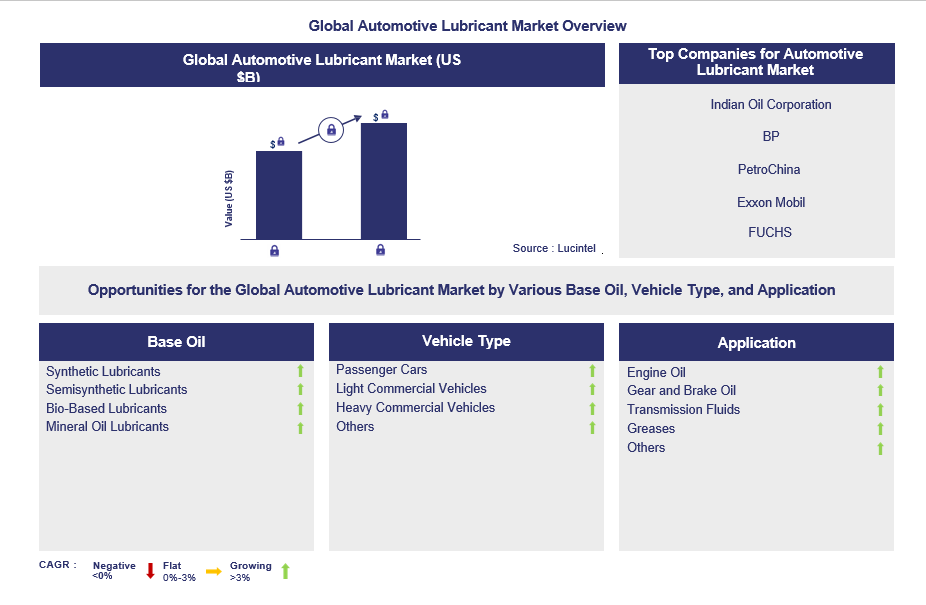
Key data points: The market size in 2031 = $89.2 billion, growth forecast = 3.8% annually for the next 7 years. Scroll below to get more insights. This market report covers trends, opportunities, and forecasts in the global automotive lubricant market to 2031 by base oil (synthetic lubricants, semisynthetic lubricants, bio-based lubricants, and mineral oil lubricants), vehicle type (passenger cars, light commercial vehicles, heavy commercial vehicles, and others), application (engine oil, gear and brake oil, transmission fluids, greases, and others), and region (North America, Europe, Asia Pacific, and the Rest of the World)
We'll send your sample report shortly.
• Lucintel forecasts that, within the base oil category, mineral oil will remain the largest segment over the forecast period due to its multiple usage in mechanical components of vehicles, such as engine, transmission assembly, and brake assembly.
• Within the application category, engine oil is expected to witness the highest growth over the forecast period.
• In terms of regions, APAC is expected to witness the highest growth over the forecast period due to growth in urbanization and industrialization, rising demand for passenger cars, and augmenting consumer’s disposable income in the region. Gain valuable insights for your business decisions with our comprehensive 150+ page report.
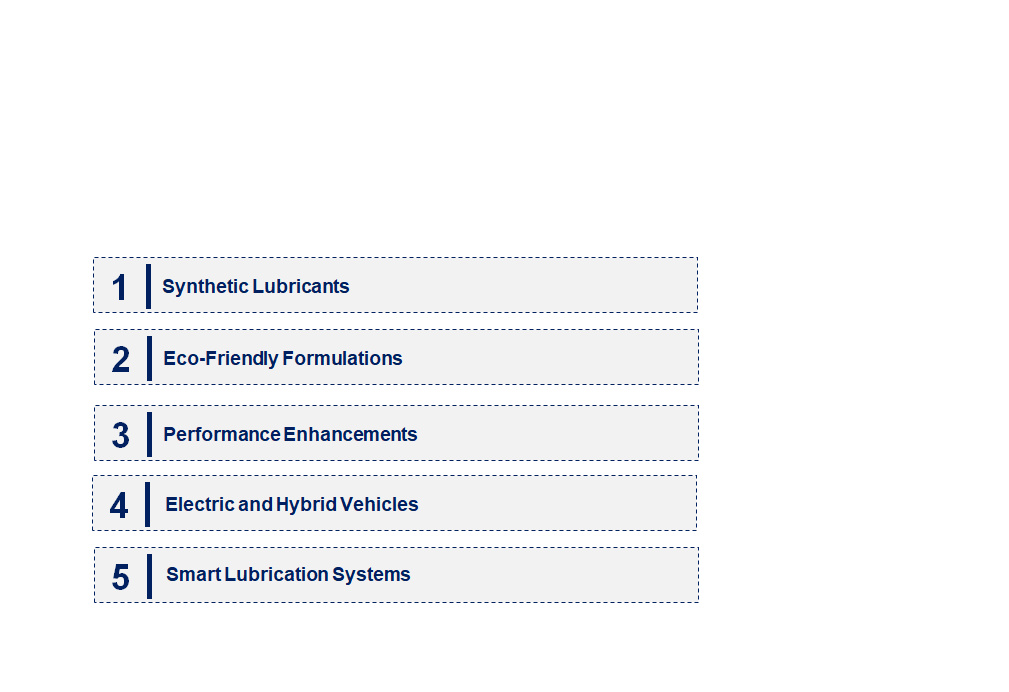
• Synthetic Lubricants: Increasingly, due to their superior performance, higher service life, and better environmental footprint compared to traditional oils, these products are considered safer.
• Eco-Friendly Formulations: This is causing changes that will result in biodegradable and low-emission lubricants, thereby reducing the ecological footprint of automotive fluids in response to increased environmental standards.
• Performance Enhancements: Advancements in lubricating technologies developed to increase engine efficiency, improve fuel economy, and protect components have raised the bar on quality standards expected of automotive lubricants.
• Electric and Hybrid Vehicles: The rise of electric vehicles (EVs) and hybrids has resulted in a demand for tailored lubricants meant for such powertrains, including those with lower friction or high thermal stability.
• Smart Lubrication Systems: Modern vehicles’ precision and efficiency regarding lubricant use are improved through the implementation of sensors and automated systems that comprise smart lubrication technologies. The evolution of the automotive lubricant market has been influenced by these trends, which focus on performance, environmental sustainability, and technology. This reflects a broader trend in the automotive industry and consumer preferences shifting toward synthetic and environmentally friendly lubricants as well as products suited for electric or hybrid vehicles.
• Advanced Synthetic Formulations: Better engine response, improved fuel efficiency, and extended engine life have been achieved through the development of advanced synthetic lubricants. These lubricants provide a higher level of protection under extreme operating conditions, reducing emissions.
• Eco-Friendly Lubricants: There is increased focus on eco-friendly lubricants such as biodegradable products with low emission levels. This trend arises due to stricter environmental regulations along with increased consumer awareness of sustainability.
• Specialized Products for Electric Vehicles: New forms of lubricants that take into account their specific needs, such as reduced friction and enhanced thermal stability, are being developed specifically for use in electric or hybrid cars.
• Improved Lubricant Technology: Advances in engine oil composition, such as additives or viscosity modifiers, contribute to better performance parameters such as fuel economy, engine protection, and component wear resistance. These trends are reshaping the automotive lubricant market by emphasizing performance, environmental sustainability, and technological innovation. The shift toward synthetic lubricants and environmentally friendly greases, which can be used with electric motors, underscores changes in the automotive sector and consumer preferences.
• Expansion in the Electric Vehicle Segment: Specialized lubricants that cater to electric drivetrains, such as those with low friction and improved thermal management, have the potential to grow with the increasing use of electric vehicles.
• Development of Eco-Friendly Products: Developing and marketing eco-friendly lubricants that conform to stricter environmental regulations will be important as more people become environmentally conscious.
• Innovations in Synthetic Lubricants: Investment in advanced synthetic lubricants could provide performance advantages and meet the growing demand for high-quality, high-performance automotive fluids.
• Emerging Markets: Venturing into emerging markets such as India or Southeast Asia will offer opportunities for growth as car ownership rises, resulting in increased demand for better-quality oils. These developments are impacting the automotive lubricant market by driving improvements in product performance, sustainability, and regulatory compliance. The emphasis on high-grade synthetic formulations, green products, and specialized motor oils for electric engines means manufacturers are realigning themselves to meet new technological demands within this space.
• Technological Advancements: Innovations in the composition and types of oils used have driven market growth by increasing performance, fuel economy, and engine protection.
• Increased Vehicle Production: Increasing global vehicle production and ownership have led to a demand for automotive lubricants due to the increased need for regular maintenance and lubrication services by more vehicles.
• Environmental Regulations: Stricter environmental regulations encourage the development of eco-friendly and low-emission lubricants, driving innovation in the market.
• Consumer Preferences: Influencing factors such as growing consumer awareness and rising demand for high-performing or sustainable products also affect advanced lubricant development and adoption. Challenges in the automotive lubricant market are:
• High Development Costs: The cost of developing advanced, eco-friendly lubricants might be high, making it challenging for manufacturers, especially within competitive markets.
• Regulatory Compliance: A manufacturer of a lubricant must meet various regulatory standards that differ across regions, which may incur significant costs.
• Market Competition: Intense competition among manufacturers can prompt price wars that squeeze profit margins, thus altering market dynamics considerably.
• Fluctuating Raw Material Prices: Variability in the prices of raw materials used in formulating lubricants can influence profitability, hence impacting production costs as well. The drivers and challenges comprising the automotive lubricant market indicate a dynamically moving industry. Key drivers include technological advancements, environmental regulations, and growing vehicle production, while high development costs, regulatory compliance, and market competition present major challenges. These factors must be taken into account by any firm wishing to thrive in the automotive lubricant industry.
• Indian Oil Corporation
• BP
• PetroChina
• Exxon Mobil
• FUCHS
• Chevron
• Valvoline
• Synthetic Lubricants
• Semisynthetic Lubricants
• Bio-Based Lubricants
• Mineral Oil Lubricants
• Passenger Cars
• Light Commercial Vehicles
• Heavy Commercial Vehicles
• Others
• Engine Oil
• Gear and Brake Oil
• Transmission Fluids
• Greases
• Others
• North America
• Europe
• Asia Pacific
• The Rest of the World
• United States: The US has witnessed a shift towards advanced synthetic lubricants designed to increase fuel economy and extend engine life. The introduction of lower viscosity high-performance lubricants is one means through which manufacturers are reacting to stricter emissions standards. Additionally, new formulations for electric and hybrid vehicles have been developed for these cars.
• China: Due to an increase in vehicle ownership and industrial growth, China’s automotive lubricant market is expanding rapidly. Key developments focus on high-performance and eco-friendly lubricants required by stringent environmental regulations. In addition to meeting local demand for electric vehicles and hybrids, domestic manufacturers are investing in research and development projects aimed at producing advanced lubricants that meet international standards.
• Germany: The German industry focuses on innovation with high-quality standards strictly adhered to. Recent advancements include developing lubricants that lead to increased engine efficiency while reducing carbon dioxide emissions in alignment with Germany’s strict environmental rules. This also involves refining lubricants meant for electric vehicles and high-performance motors, underscoring Germany’s leadership position in eco-sustainable automotive technology.
• India: The Indian automotive lubricant market is growing due to increasing car sales and infrastructure development efforts across the country. Key advancements include cost-effective, high-quality lubricants that meet both conventional and emerging vehicle categories. As the market matures and regulatory measures tighten, it becomes increasingly important for consumers to reduce their ecological impact via more environmentally sound and efficient lubricants.
• Japan: In Japan, the country’s focus on technological innovation and environmental sustainability has resulted in advancements in synthetic and high-performance lubricants among other areas of development. Additionally, Japanese manufacturers are investing in research to develop lubricants that improve fuel efficiency and reduce environmental impact.

• Indian Oil Corporation
• BP
• PetroChina
• Exxon Mobil
• FUCHS
• Chevron
• Valvoline Q6. Which automotive lubricant market segment will be the largest in future? Answer: Lucintel forecasts that mineral oil will remain the largest segment over the forecast period due to its multiple usage in mechanical components of vehicles, such as engine, transmission assembly, and brake assembly. Q7. In automotive lubricant market, which region is expected to be the largest in next 5 years? Answer: APAC is expected to witness highest growth over the forecast period due to growth in urbanization and industrialization, rising demand for passenger cars, and augmenting consumer’s disposable income in the region. Q.8 Do we receive customization in this report? Answer: Yes, Lucintel provides 10% customization without any additional cost.


Choose a license that fits your team. Instant PDF delivery.
Prices exclude taxes. Instant delivery. Custom licensing available on request.
Market Report · July 15, 2026
Market Report · June 24, 2026
Market Report · May 18, 2026
Trusted partner for strategic intelligence and business growth


Receive a complimentary market analysis tailored to your industry. Our analysts will identify key growth opportunities and competitive dynamics specific to your business.

Market size, growth rate, and key trend analysis for your specific sector.

Top competitor positioning and market share analysis.

Strategic recommendations backed by data-driven insights.
Get curated market intelligence and competitive moves straight to your inbox.
By subscribing, you agree to receive our monthly insights. Unsubscribe anytime.
Receive a complimentary market analysis tailored to your industry. Our analysts will identify key growth opportunities and competitive dynamics specific to your business.
Market size, growth rate, and key trend analysis for your specific sector.
Top competitor positioning and market share analysis.
Strategic recommendations backed by data-driven insights.
Get curated market intelligence, emerging trends, and competitive moves straight to your inbox each month.
By subscribing, you agree to receive our monthly insights. Unsubscribe anytime.
We'll send your sample report shortly.