
Automotive HMI Market Trends and Forecast
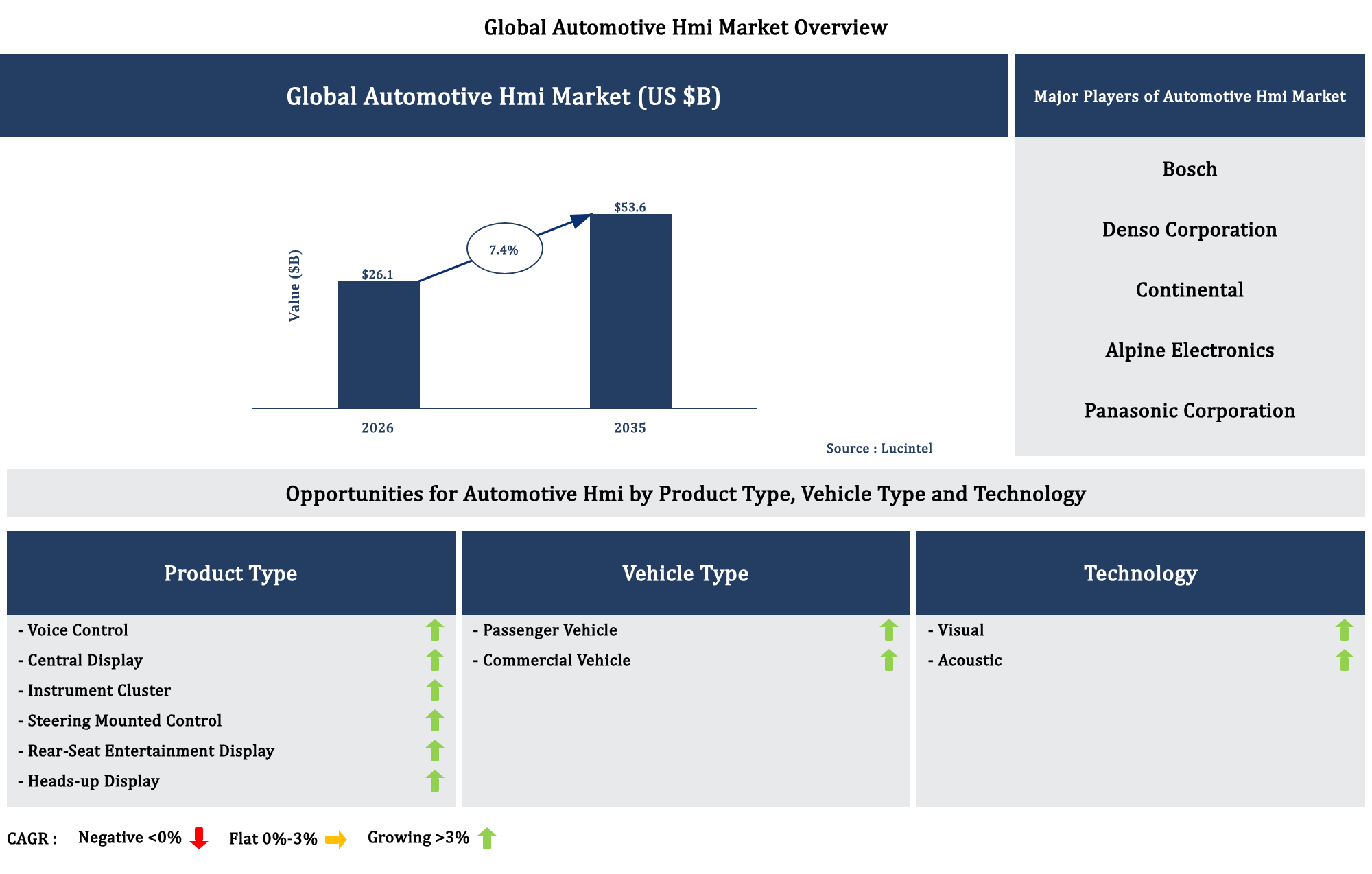
The future of the global automotive HMI market looks promising with opportunities in the passenger vehicle and commercial vehicle markets. The global automotive HMI market is expected to reach an estimated $53,667 million by 2035 with a CAGR of 7.4% from 2026 to 2035. The major drivers for this market are the growing use of artificial intelligence in vehicles, the increasing consumer preference for smart car interfaces, and the rising integration of voice control technology.
• Lucintel forecasts that, within the product type category, central display is expected to witness the highest growth over the forecast period.
• Within the vehicle type category, passenger vehicle is expected to witness the highest growth.
• In terms of region, APAC is expected to witness the highest growth over the forecast period.
Gain valuable insights for your business decisions with our comprehensive 150+ page report. Sample figures with some insights are shown below.
Emerging Trends in the Automotive HMI Market
The automotive HMI market is experiencing rapid evolution driven by technological advancements, changing consumer preferences, and the push toward autonomous and connected vehicles. As vehicles become more integrated with digital systems, the demand for intuitive, responsive, and innovative HMI solutions is increasing. These developments are transforming how drivers interact with their vehicles, enhancing safety, comfort, and overall user experience. The market is also influenced by regulatory standards, sustainability goals, and the integration of artificial intelligence. Understanding these emerging trends is crucial for stakeholders aiming to stay competitive and meet future consumer expectations in the automotive industry.
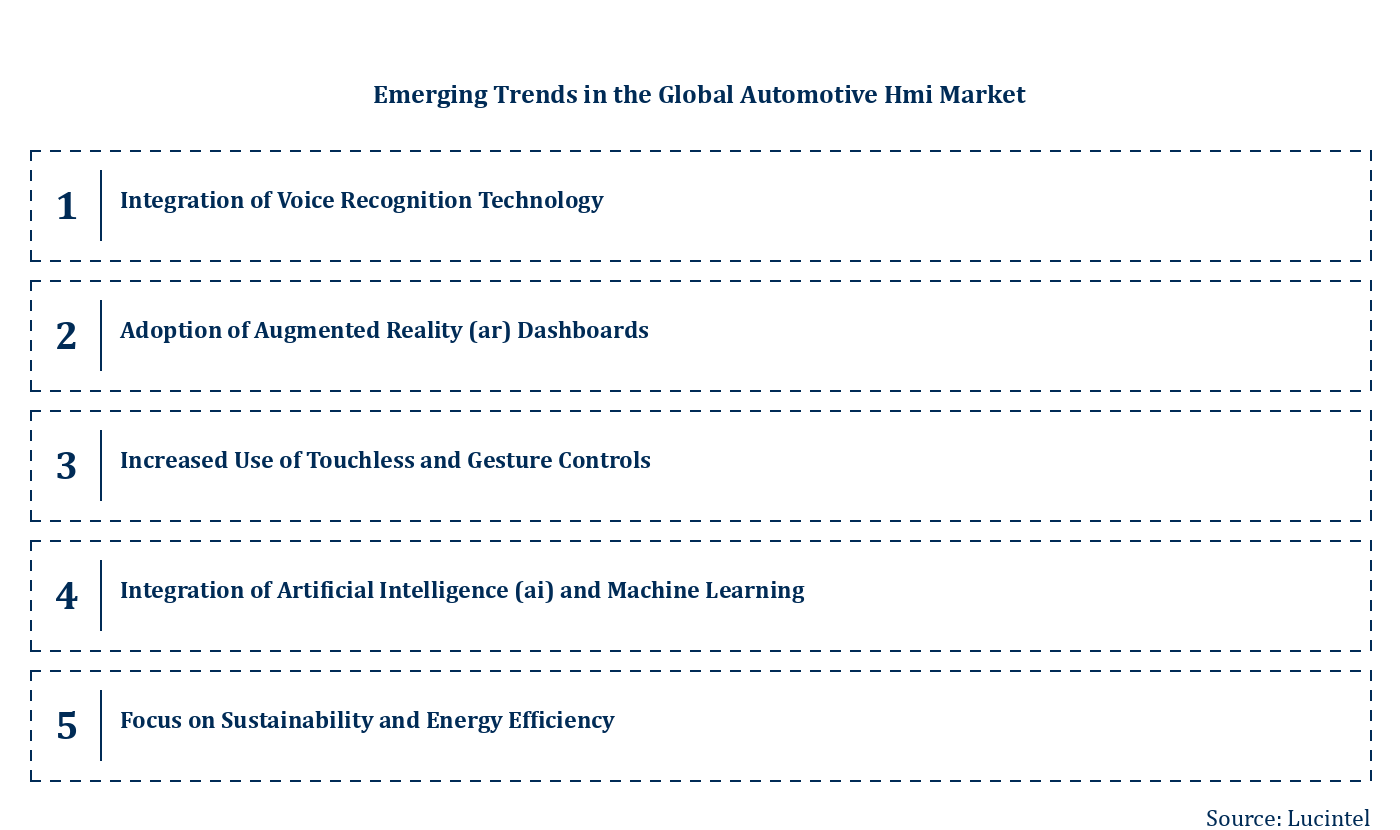
• Integration of Voice Recognition Technology: Voice recognition is becoming a core feature in automotive HMI, enabling hands-free control of various vehicle functions. This trend enhances safety by reducing driver distraction and offers a more natural interaction method. Advanced voice assistants can understand complex commands, support multiple languages, and adapt to individual user preferences. As voice technology improves, it is expected to become more accurate and context-aware, leading to widespread adoption across different vehicle segments. This shift significantly impacts user experience, making vehicle operation more intuitive and accessible.
• Adoption of Augmented Reality (AR) Dashboards: AR dashboards overlay digital information onto the real-world view through windshields, providing drivers with real-time data such as navigation, speed, and hazard alerts. This trend improves situational awareness and reduces the need for drivers to glance away from the road, thereby enhancing safety. AR interfaces are customizable and can display contextual information based on driving conditions. The integration of AR in HMI systems is expected to grow, especially in premium and autonomous vehicles, transforming traditional dashboards into immersive, interactive displays that improve driver engagement and safety.
• Increased Use of Touchless and Gesture Controls: Touchless interfaces and gesture controls are gaining popularity as they offer hygienic, intuitive, and contactless ways to operate vehicle systems. These technologies use sensors to detect hand movements or gestures, allowing drivers to control infotainment, climate, and other functions without physical contact. This trend is driven by advancements in sensor technology and the desire for more futuristic, seamless interactions. Gesture controls reduce driver distraction and can be particularly useful in scenarios where touchscreens are inconvenient or unsafe. Their adoption is expected to expand across various vehicle types, influencing interior design and user interaction paradigms.
• Integration of Artificial Intelligence (AI) and Machine Learning: AI-powered HMI systems are becoming more sophisticated, offering personalized experiences by learning driver preferences and behaviors. These systems can predict user needs, optimize vehicle settings, and provide proactive assistance, thereby enhancing convenience and safety. AI also enables natural language processing, making voice commands more effective. As AI integration deepens, HMI systems will become more adaptive, context-aware, and capable of managing complex interactions. This trend is reshaping the market by enabling smarter, more intuitive interfaces that significantly improve the overall driving experience.
• Focus on Sustainability and Energy Efficiency: As the automotive industry shifts toward electric vehicles (EVs) and sustainable practices, HMI systems are also evolving to support energy efficiency. This includes optimizing display technologies, reducing power consumption, and integrating eco-friendly materials. HMI designs are becoming more minimalist and energy-conscious, aligning with the broader sustainability goals of automakers. Additionally, HMI systems are being used to educate and encourage eco-friendly driving behaviors. This trend influences market offerings by emphasizing environmentally responsible solutions that appeal to eco-conscious consumers and regulatory standards.
These emerging trends are fundamentally reshaping the automotive HMI market by making vehicle interactions more intuitive, safe, personalized, and sustainable. They are driving innovation, enhancing user experience, and supporting the shift toward autonomous and electric vehicles, ultimately transforming the future of automotive design and functionality.
Recent Developments in the Automotive HMI Market
The automotive HMI market is experiencing rapid innovation driven by advancements in technology, increasing consumer demand for enhanced driving experiences, and the integration of smart systems. These developments are transforming vehicle interfaces, making them more intuitive, connected, and safer. As automakers focus on user-centric designs and digital integration, the market is poised for significant growth. The following key developments highlight the current trajectory and future potential of the Automotive HMI sector.
• Voice Recognition Technology: Voice recognition systems are becoming more sophisticated, enabling drivers to control various vehicle functions hands-free. This enhances safety by reducing distractions and improves user convenience. Advanced AI-driven voice assistants can understand natural language, support multiple languages, and integrate with smartphones and smart home devices. As a result, automakers are investing heavily in voice tech, leading to increased adoption across vehicle segments. This trend is expected to boost market growth and customer satisfaction.
• Augmented Reality Dashboards: Augmented reality (AR) dashboards overlay critical information directly onto the windshield, providing real-time data such as navigation, speed, and hazard alerts. This innovation improves driver awareness and reduces cognitive load, enhancing safety and driving experience. AR dashboards also support advanced driver-assistance systems (ADAS), making complex information more accessible. Automakers are integrating AR into premium and mid-range vehicles, which is expected to expand market penetration and set new standards for vehicle interfaces.
• Touchscreen and Gesture Controls: The shift towards touchscreen interfaces and gesture controls offers a more modern, sleek, and intuitive user experience. Touchscreens replace traditional buttons, providing customizable controls and multimedia access, while gesture controls enable contactless operation. These technologies reduce physical clutter and improve ergonomics. As consumer preferences lean towards digital interfaces, automakers are adopting these features widely, driving market expansion. The integration of haptic feedback further enhances usability, making these controls more precise and user-friendly.
• Integration of AI and Machine Learning: AI and machine learning are transforming HMI systems by enabling personalized experiences and predictive functionalities. These systems learn driver preferences, optimize climate control, and suggest navigation routes, enhancing comfort and convenience. AI-driven HMIs also improve safety by detecting driver fatigue or distraction and issuing alerts. The continuous evolution of AI capabilities is expected to make HMIs more adaptive and intelligent, fostering greater consumer engagement and automaker innovation, thus significantly impacting market growth.
• Connectivity and IoT Integration: Connectivity and IoT integration allow vehicles to communicate with external devices and infrastructure, enabling features like remote diagnostics, over-the-air updates, and vehicle-to-everything (V2X) communication. This connectivity enhances user experience, safety, and vehicle management. Automakers are investing in cloud-based platforms and secure communication protocols to support these features. As connected vehicles become mainstream, the market will see increased demand for advanced HMI systems that facilitate seamless digital ecosystems, driving growth and innovation.
These developments are revolutionizing the automotive HMI market by making vehicle interfaces more intuitive, connected, and safe. Enhanced safety features, personalized experiences, and seamless connectivity are driving consumer interest and automaker investments. As these technologies mature, they will significantly influence vehicle design, user engagement, and overall market dynamics, fostering a more integrated and intelligent driving environment. The market is poised for sustained growth, driven by innovation and evolving consumer expectations.
Strategic Growth Opportunities in the Automotive HMI Market
The automotive HMI market is experiencing rapid growth driven by technological advancements, increasing vehicle automation, and consumer demand for enhanced driving experiences. As automakers integrate sophisticated interfaces, opportunities arise for innovative solutions that improve safety, usability, and connectivity. The market‘s expansion is also fueled by the rise of electric vehicles and connected car technologies, creating a competitive landscape for manufacturers and technology providers to develop cutting-edge HMI systems that meet evolving consumer expectations and regulatory standards.
• Integration of Voice Recognition and AI for Enhanced User Experience: The adoption of voice recognition and artificial intelligence in automotive HMI systems offers drivers hands-free control, reducing distractions and improving safety. These technologies enable natural language processing, personalized interactions, and real-time assistance, making driving more intuitive. As consumer demand for seamless connectivity grows, automakers are investing in advanced voice-enabled interfaces, creating opportunities for AI-driven HMI solutions that adapt to individual preferences and driving contexts.
• Development of Augmented Reality Dashboards for Improved Safety: Augmented reality (AR) dashboards overlay critical information directly onto the windshield, providing real-time navigation, hazard alerts, and vehicle status updates without diverting driver attention. This innovation enhances situational awareness and reduces cognitive load, especially in complex driving environments. The increasing integration of AR in HMI systems presents opportunities for automakers to differentiate their offerings, improve safety standards, and meet regulatory requirements for driver assistance and accident prevention.
• Expansion of Touchscreen and Gesture-Based Interfaces for Intuitive Control: Touchscreens and gesture controls are replacing traditional buttons, offering sleek, user-friendly interfaces that facilitate quick access to vehicle functions. These systems support multi-touch gestures, haptic feedback, and customizable layouts, enhancing driver engagement and convenience. The growing demand for modern, minimalist interiors drives automakers to adopt these interfaces, creating opportunities for innovative HMI designs that combine aesthetics with functionality, especially in premium and electric vehicles.
• Adoption of Connected Car Technologies for Enhanced Functionality: Connected car systems enable real-time data exchange between vehicles and external networks, supporting features like remote diagnostics, over-the-air updates, and integrated navigation. These technologies improve vehicle performance, safety, and user engagement. The expansion of 5G connectivity and IoT integration opens new avenues for HMI systems to deliver personalized content, remote control, and seamless connectivity, positioning automakers to capitalize on the growing demand for smart, connected mobility solutions.
• Focus on Personalization and Customization for Consumer Satisfaction: Personalization features allow drivers to tailor HMI interfaces to their preferences, including display layouts, language settings, and driver profiles. Advanced analytics and machine learning enable systems to adapt over time, enhancing usability and driver satisfaction. As consumers seek more individualized experiences, automakers have opportunities to develop customizable HMI solutions that foster brand loyalty, improve user engagement, and differentiate their vehicles in a competitive market.
The overall growth of the automotive HMI market is driven by technological innovation and consumer preferences for safer, more connected, and personalized driving experiences. These opportunities will shape the future landscape, encouraging automakers and technology providers to develop advanced, intuitive, and integrated HMI systems that meet evolving industry standards and customer expectations.
Automotive HMI Market Driver and Challenges
The automotive HMI market is influenced by a variety of technological, economic, and regulatory factors. Rapid advancements in vehicle automation, increasing consumer demand for enhanced driving experiences, and stringent safety standards are shaping the market landscape. Additionally, the integration of smart technologies and the push toward connected vehicles are driving growth, while economic fluctuations and regulatory compliance pose challenges. These factors collectively impact the development, adoption, and innovation within the Automotive HMI sector, making it a dynamic and competitive industry. Understanding these drivers and challenges is essential for stakeholders aiming to capitalize on emerging opportunities and navigate potential risks effectively.
The factors responsible for driving the automotive HMI market include:
• Technological Innovation: The continuous evolution of display technologies, voice recognition, and AI-driven interfaces is transforming vehicle interactions. Consumers increasingly expect intuitive, seamless, and personalized experiences, prompting automakers to adopt advanced HMI solutions. These innovations improve safety by reducing driver distraction and enhance user engagement, thereby accelerating market growth. The integration of augmented reality (AR) and gesture controls further elevates the driving experience, making vehicles smarter and more responsive to user needs.
• Rising Adoption of Connected Vehicles: The proliferation of IoT and 5G connectivity has enabled vehicles to communicate with each other and infrastructure, creating a more integrated driving environment. Connected HMI systems facilitate real-time data sharing, navigation, and remote diagnostics, which improve safety, efficiency, and convenience. This connectivity fosters the development of smart cities and autonomous vehicles, fueling demand for sophisticated HMI solutions that can handle complex data and user interactions seamlessly.
• Increasing Focus on Safety and Regulations: Governments worldwide are implementing strict safety standards and regulations to reduce road accidents and improve vehicle safety features. HMI systems that support driver assistance, alertness monitoring, and emergency communication are becoming mandatory in many regions. Compliance with these regulations drives automakers to incorporate advanced HMI technologies, which not only meet legal requirements but also enhance consumer trust and vehicle safety ratings.
• Growing Consumer Preference for Advanced Infotainment: Modern consumers prioritize entertainment, connectivity, and personalized experiences in their vehicles. The demand for high-resolution displays, voice-controlled systems, and multimedia integration is rising rapidly. Automakers are investing heavily in developing intuitive HMI interfaces that cater to these preferences, thereby boosting market growth. This trend is particularly prominent among younger demographics seeking a connected and engaging driving environment.
• Expansion of Electric Vehicles (EVs): The shift toward electric mobility is significantly impacting the HMI market. EVs often feature more sophisticated interfaces to manage battery status, charging, and energy consumption, alongside traditional infotainment functions. The integration of HMI systems in EVs enhances user experience and provides vital vehicle information, encouraging adoption. As EV sales increase globally, the demand for innovative HMI solutions tailored to electric vehicles is expected to grow substantially.
The challenges in the automotive HMI market are:
• High Development and Implementation Costs: Developing advanced HMI systems involves significant investment in research, design, and testing. Automakers face high costs associated with integrating cutting-edge technologies like AR, AI, and voice recognition into vehicles. These expenses can hinder the adoption of new HMI solutions, especially among smaller manufacturers or in cost-sensitive markets. Additionally, ongoing maintenance and updates add to the financial burden, potentially limiting market expansion and innovation.
• Regulatory and Standardization Issues: The lack of uniform standards across different regions complicates the deployment of HMI systems. Variations in safety regulations, data privacy laws, and vehicle communication protocols create challenges for automakers aiming for global compatibility. Navigating these regulatory landscapes requires substantial compliance efforts, which can delay product launches and increase costs. Moreover, evolving regulations demand continuous adaptation of HMI designs to meet new legal requirements.
• Cybersecurity Concerns: As vehicles become more connected and reliant on digital interfaces, they become vulnerable to cyber threats. HMI systems that handle sensitive data or enable remote access pose significant security risks. Cyberattacks can compromise vehicle safety, lead to data breaches, and erode consumer trust. Ensuring robust cybersecurity measures is complex and costly, yet essential for market acceptance. Failure to address these concerns could hinder the growth of connected and intelligent HMI solutions.
The automotive HMI market is driven by rapid technological advancements, increasing connectivity, safety regulations, consumer preferences, and the rise of electric vehicles. However, high development costs, regulatory complexities, and cybersecurity threats present notable challenges. These factors collectively shape the market‘s trajectory, requiring stakeholders to innovate strategically while managing risks. The interplay of drivers and challenges will determine the pace of growth and the evolution of HMI solutions in the automotive industry, influencing future vehicle design and user experience standards.
List of Automotive HMI Companies
Companies in the market compete on the basis of product quality offered. Major players in this market focus on expanding their manufacturing facilities, R&D investments, infrastructural development, and leverage integration opportunities across the value chain. With these strategies automotive HMI companies cater increasing demand, ensure competitive effectiveness, develop innovative products & technologies, reduce production costs, and expand their customer base. Some of the automotive HMI companies profiled in this report include-
• Bosch
• Denso Corporation
• Continental
• Alpine Electronics
• Panasonic Corporation
• Visteon Corporation
• Nuance Communications
• Clarion
• Harman
• Samsung Electronics
Automotive HMI Market by Segment
The study includes a forecast for the global automotive HMI market by product type, vehicle type, technology, and region.
Automotive HMI Market by Product Type [Value from 2019 to 2035]:
• Voice Control
• Central Display
• Instrument Cluster
• Steering Mounted Control
• Rear-Seat Entertainment Display
• Heads-up Display
Automotive HMI Market by Vehicle Type [Value from 2019 to 2035]:
• Passenger Vehicle
• Commercial Vehicle
Automotive HMI Market by Technology [Value from 2019 to 2035]:
• Visual
• Acoustic
Automotive HMI Market by Region [Value from 2019 to 2035]:
• North America
• Europe
• Asia Pacific
• The Rest of the World
Country Wise Outlook for the Automotive HMI Market
The automotive HMI market has experienced rapid growth driven by technological advancements, increasing consumer demand for enhanced driving experiences, and the integration of smart features in vehicles. As automakers focus on safety, connectivity, and user engagement, the market landscape is evolving with innovative solutions such as voice recognition, touchscreens, and augmented reality displays. The adoption of electric and autonomous vehicles further accelerates the development of sophisticated HMI systems. Countries are competing to lead in this sector, with significant investments and strategic initiatives shaping the future of automotive interfaces worldwide.
• United States: The US automotive HMI market has seen significant innovation, with major automakers investing heavily in voice-activated systems and augmented reality displays. The focus is on enhancing driver safety and convenience through advanced touchscreens and gesture controls. Companies like Tesla and Ford are pioneering AI-driven interfaces, integrating seamless connectivity with smart devices. The rise of autonomous vehicle testing has also spurred the development of sophisticated HMI solutions that improve user interaction and safety features. Additionally, startups are emerging with novel HMI technologies, contributing to a competitive and dynamic market environment.
• China: China remains a leader in automotive HMI development, driven by government policies promoting smart and electric vehicles. The market is characterized by rapid adoption of AI-powered voice assistants and large touchscreen interfaces. Local companies such as Baidu and Huawei are developing integrated HMI systems that emphasize connectivity and user personalization. The growth of connected car services and the push for autonomous driving capabilities are fueling innovation. Moreover, collaborations between automakers and tech giants are accelerating the deployment of advanced HMI features tailored to Chinese consumers‘ preferences, making China a key hub for automotive interface advancements.
• Germany: Germany‘s automotive HMI market is marked by a focus on luxury and high-performance vehicles, with automakers like BMW, Mercedes-Benz, and Audi leading the way. The emphasis is on premium user experiences, integrating sophisticated voice control, haptic feedback, and augmented reality displays. The country is also investing in research for sustainable and intelligent HMI solutions that support electric and hybrid vehicles. German automakers are collaborating with technology firms to develop next-generation interfaces that prioritize safety, ergonomics, and seamless connectivity. The market is characterized by a blend of innovation and tradition, maintaining Germany‘s reputation for engineering excellence.
• India: The Indian automotive HMI market is rapidly expanding, driven by increasing vehicle sales and consumer demand for modern features. Automakers are incorporating basic touchscreens, voice recognition, and smartphone connectivity to cater to a growing middle class. Local companies are focusing on affordable and user-friendly HMI solutions, often integrating regional language support to enhance accessibility. The rise of electric vehicles and connected cars is prompting investments in smarter interfaces. Additionally, government initiatives promoting digital infrastructure and smart mobility are fostering a conducive environment for HMI innovation, positioning India as a significant emerging market in this sector.
• Japan: Japan‘s automotive HMI market is characterized by a focus on safety, reliability, and advanced technology integration. Leading automakers like Toyota and Honda are developing intuitive interfaces with voice commands, heads-up displays, and gesture controls. The country emphasizes the integration of HMI with autonomous driving systems and vehicle connectivity to improve user experience and safety. Japanese firms are also investing in research for eco-friendly and energy-efficient HMI solutions, aligning with national sustainability goals. The market benefits from a strong technological ecosystem, with collaborations between automakers and tech companies driving continuous innovation in automotive interfaces.
Features of the Global Automotive HMI Market
Market Size Estimates: Automotive HMI market size estimation in terms of value ($M).
Trend and Forecast Analysis: Market trends (2019 to 2025) and forecast (2026 to 2035) by various segments and regions.
Segmentation Analysis: Automotive HMI market size by product type, vehicle type, technology, and region in terms of value ($M).
Regional Analysis: Automotive HMI market breakdown by North America, Europe, Asia Pacific, and Rest of the World.
Growth Opportunities: Analysis of growth opportunities in different product type, vehicle type, technology, and regions for the automotive HMI market.
Strategic Analysis: This includes M&A, new product development, and competitive landscape of the automotive HMI market.
Analysis of competitive intensity of the industry based on Porter’s Five Forces model.
FAQ
Q1. What is the automotive HMI market size?
Answer: The global automotive HMI market is expected to reach an estimated $53,667 million by 2035.
Q2. What is the growth forecast for automotive HMI market?
Answer: The global automotive HMI market is expected to grow with a CAGR of 7.4% from 2026 to 2035.
Q3. What are the major drivers influencing the growth of the automotive HMI market?
Answer: The major drivers for this market are the growing use of artificial intelligence in vehicles, the increasing consumer preference for smart car interfaces, and the rising integration of voice control technology.
Q4. What are the major segments for automotive HMI market?
Answer: The future of the automotive HMI market looks promising with opportunities in the passenger vehicle and commercial vehicle markets.
Q5. Who are the key automotive HMI market companies?
Answer: Some of the key automotive HMI companies are as follows:
• Bosch
• Denso Corporation
• Continental
• Alpine Electronics
• Panasonic Corporation
• Visteon Corporation
• Nuance Communications
• Clarion
• Harman
• Samsung Electronics
Q6. Which automotive HMI market segment will be the largest in future?
Answer: Lucintel forecasts that, within the product type category, central display is expected to witness the highest growth over the forecast period.
Q7. In automotive HMI market, which region is expected to be the largest in next 8 years?
Answer: In terms of region, APAC is expected to witness the highest growth over the forecast period.
Q8. Do we receive customization in this report?
Answer: Yes, Lucintel provides 10% customization without any additional cost.
This report answers following 11 key questions:
Q.1. What are some of the most promising, high-growth opportunities for the automotive HMI market by product type (voice control, central display, instrument cluster, steering mounted control, rear-seat entertainment display, and heads-up display), vehicle type (passenger vehicle and commercial vehicle), technology (visual and acoustic), and region (North America, Europe, Asia Pacific, and the Rest of the World)?
Q.2. Which segments will grow at a faster pace and why?
Q.3. Which region will grow at a faster pace and why?
Q.4. What are the key factors affecting market dynamics? What are the key challenges and business risks in this market?
Q.5. What are the business risks and competitive threats in this market?
Q.6. What are the emerging trends in this market and the reasons behind them?
Q.7. What are some of the changing demands of customers in the market?
Q.8. What are the new developments in the market? Which companies are leading these developments?
Q.9. Who are the major players in this market? What strategic initiatives are key players pursuing for business growth?
Q.10. What are some of the competing products in this market and how big of a threat do they pose for loss of market share by material or product substitution?
Q.11. What M&A activity has occurred in the last 5 years and what has its impact been on the industry?
For any questions related to Automotive HMI Market, Automotive HMI Market Size, Automotive HMI Market Growth, Automotive HMI Market Analysis, Automotive HMI Market Report, Automotive HMI Market Share, Automotive HMI Market Trends, Automotive HMI Market Forecast, Automotive HMI Companies, write Lucintel analyst at email: helpdesk@lucintel.com. We will be glad to get back to you soon.