
Market Report · July 31, 2026

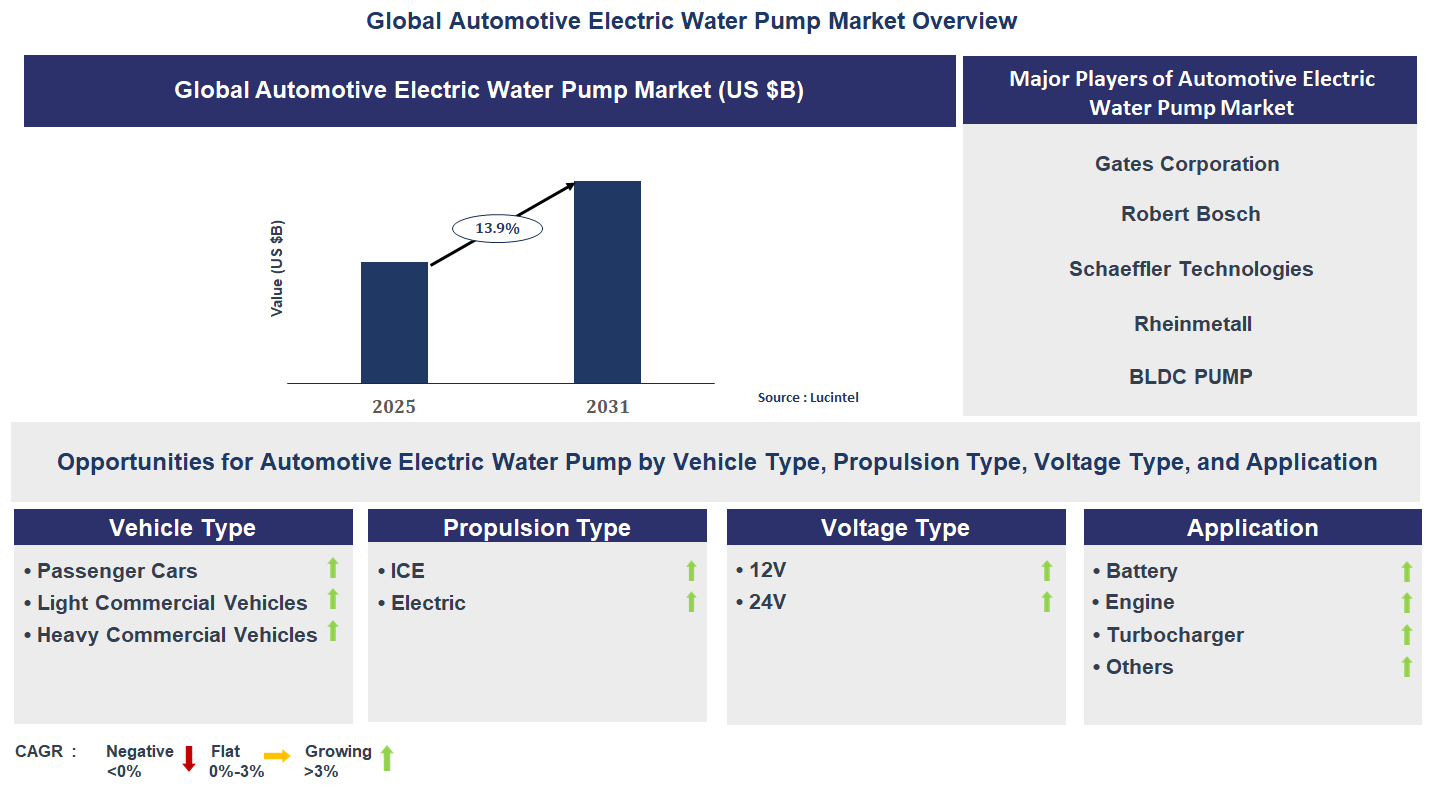
Key data points: The growth forecast = 13.9% annually for the next 7 years. Scroll below to get more insights. This market report covers trends, opportunities and forecasts in automotive electric water pump market to 2031 by vehicle type (passenger cars, light commercial vehicles, and heavy commercial vehicles), propulsion type (ICE and electric), voltage type (12V and 24V), application (battery, engine, turbocharger, and others), and region (North America, Europe, Asia Pacific, and the Rest of the World)
We'll send your sample report shortly.
• Lucintel forecasts that, within the vehicle type category, passenger car will remain the largest segment over the forecast period.
• Within the application category, battery will remain the largest segment.
• In terms of region, North America will remain the largest region over the forecast period. Gain valuable insights for your business decisions with our comprehensive 150+ page report. Sample figures with some insights are shown below.
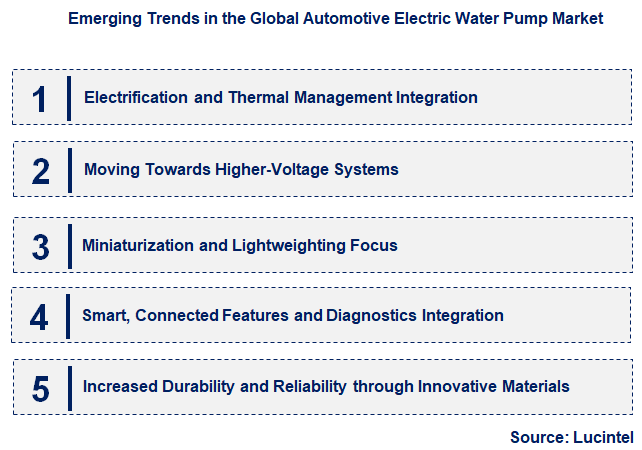
• Electrification and Thermal Management Integration: The global proliferation of Battery Electric Vehicles (BEVs) and Plug-in Hybrid Electric Vehicles (PHEVs) is the prime driver. EWPs are crucial to manage the intricate thermal demands of high-voltage elements—namely the battery pack, inverter, and electric motor. This development shifts EWPs from an elementary fluid mover to a fully integrated, smart element within a comprehensive thermal management system, typically controlled by a central Vehicle Control Unit (VCU). This integration guarantees optimum operating temperatures, a must for achieving maximum battery range, charging velocity, and system longevity.
• Moving Towards Higher-Voltage Systems: With rising performance demands on high-power electric and hybrid powertrains, there is an increasing need for 48V, 400V, and 800V EWP solutions. Conventional 12V systems are not capable of carrying the rising thermal loads of high-performance batteries and fast charging. This trend propels the creation of more powerful, higher-voltage pumps for increased flow and efficiency. The transition influences component design, with a need for greater electrical insulation and safety features, and prompts a distinct market division between auxiliary (12V) and primary cooling (high-voltage) pump use.
• Miniaturization and Lightweighting Focus: Minimizing the weight and size of all vehicle parts is an ongoing goal to enhance fuel efficiency in ICE vehicles and increase driving range in EVs. The trend includes employing higher-performance materials such as high-performance polymers, ceramics, and composite materials in making EWP parts, including housings and impellers. The effect is lighter, more compact pumps with increased installation flexibility and overall vehicle weight reduction, without sacrificing flow capacity or durability.
• Smart, Connected Features and Diagnostics Integration: Todays EWPs are integrating with built-in sensors, microcontrollers, and sophisticated control algorithms to make them intelligent, networked appliances. With real-time monitoring of the health of the pump, flow rate, and temperature, predictive maintenance and improved diagnostics become possible. The result is a drastic boost in the reliability and lifespan of the overall cooling system, shifting from reactive to proactive maintenance.
• Increased Durability and Reliability through Innovative Materials: The harsh operating conditions, specifically with corrosive coolants and heat in electrified powertrains, call for dramatic improvements in the durability of EWP. This trend consists of the expanded use of strong, corrosion-resistant materials for internal parts, enhanced sealing technologies, and sophisticated motor designs (e.g., Brushless DC motors). The result is increased service life, a vital factor in underpinning extended vehicle warranties and minimizing maintenance cost, hence confronting past reliability issues with first-generation electric pumps and instilling confidence on the part of OEMs and buyers alike. These trends are radically transforming the automotive electric water pump market into a high-technology, mission-critical segment from a peripheral component business. The market is polarizing: 12V EWPs are cost-optimized and auxiliary function-intensive, whereas high-voltage pumps are becoming integral, advanced thermal regulators in high-end EV applications. The shared emphasis on electrification, smart integration, and smart materials guarantees that the EWP will be a continued high-growth industry, essential to meet global efficiency and emissions goals.
• Dominance of Battery Thermal Management Application: The single most significant development is the predominance of EWPs in Battery Thermal Management Systems (BTMS). EVs and HEVs have highly demanding temperature management requirements for their high-voltage battery packs, frequently necessitating multiple, specialized EWPs to move coolant or refrigerant. The effect is a hike in demand for continuous operation and highly reliable high-voltage (e.g., 400V, 800V) pumps.
• Transition to Brushless DC Motor Technology: There is a nearly universal transition away from conventional brushed DC motors to Brushless DC (BLDC) motor technology for automotive EWPs. BLDC motors avoid the use of brushes, considerably lessening mechanical wear, maintenance needs, and electrical noise. The effect is a dramatic increase in the EWPs working life, efficiency, and reliability, all of which are critical in mission-critical uses such as cooling battery packs and power electronics. The technology change is raising the average cost and complexity of EWPs but providing long-term performance value at a higher level.
• Integration of E-Pumps with Advanced Thermal Modules: EWPs are increasingly being marketed as part of integrated, multi-function thermal modules instead of individual components. These modules integrate the pump, valve systems, heat exchangers, and related sensors and controllers in one pre-assembled package. The consequence is streamlined vehicle assembly for OEMs, lower complexity in vehicle architecture, and better coordination of cooling and heating capabilities (e.g., by applying a heat pump to cabin and battery conditioning). The technology promotes the suppliers role to the level of a thermal system integrator with full, optimized solutions.
• Use of High-Performance Plastic and Composite Materials: Manufacturers are making increasing use of high-performance engineering plastics and composite materials for EWP housings, impellers, and internal parts. The plastics and composites provide greater resistance to corrosion by latest generation coolants and to high temperature, and considerably lower component weight than metal pumps. The effect is two-fold: enhanced durability and life, and direct support for overall vehicle lightweighting. This material science advancement helps to enhance the efficiency of the vehicle and lower the cost of manufacturing in large volume production.
• Spread of Auxiliary EWPs in ICE and Hybrid Vehicles: Aside from primary cooling of electric components, auxiliary EWPs are finding widespread application in advanced ICE and HEV designs for dedicated applications such as turbocharger cooling (after-run cooling), charge air cooling, and Exhaust Gas Recirculation (EGR) cooling. The effect is a quantifiable reduction in engine efficiency and pollution. These small, usually 12V pumps run on-demand to provide the best temperatures for these ancillary systems, enabling more stringent compliance with worldwide emissions regulations such as Euro 7 and CAFE. These five advances are a deep transformation of the automotive electric water pump market. They are taking the EWP from a mere cooling accessory to a critical, high-tech driver of vehicle electrification and efficiency. The industry is shaped by a need for higher voltage, higher integration, better materials, and higher reliability, all of which are a direct function of the quality and feasibility of the next wave of electric and high-efficiency vehicles. The function of the EWP is now central to the fundamental thermal architecture of any contemporary vehicle.
• High-Voltage Battery Cooling in Electric Vehicles: The biggest and only one, this is the largest strategic growth opportunity. The high-voltage battery is the most temperature-sensitive and critical component in an EV, with dedicated and precise thermal management needed to provide optimal range, charging rate, and longevity. The potential is in creating very reliable, high-voltage (400V/800V) EWPs with sophisticated control logic for battery packs.
• Inverter and Power Electronics Cooling: Power electronics such as inverters, converters, and onboard chargers (OBCs) produce tremendous heat and need to be contained within strict temperature ranges for safe operation of the electric powertrain. The strategic growth opportunity here lies in creating small, high-efficiency auxiliary EWPs (usually 12V or 24V) that are tailored for the exact cooling loops of such components. The effect is to provide the functional dependability of the overall electric drive system, as well as to facilitate accelerated DC charging.
• Engine Downsizing and Turbocharger Cooling in ICE/HEVs: New Internal Combustion Engines (ICE) and Hybrid Electric Vehicles (HEVs) employ engine downsizing and turbocharging to achieve strict fuel economy and emission regulations. These designs produce more localized heat, requiring sophisticated cooling systems. The potential is in the mass market use of auxiliary 12V EWPs for "after-run cooling" (turbocharger cooling after the engine has been turned off) and for dedicated charge air cooling. The benefit is improved durability of the engine, avoiding thermal harm, and optimized combustion, and this makes the EWP a necessary component for high efficiency ICE and HEV models.
• Cabin Heating and HVAC Systems: Cabin heating and cooling in EVs is frequently based on a high-efficiency heat pump system, which involves advanced coolant circulation to locate thermal energy between the cabin, battery, and ambient air. The opportunity for growth is to design EWPs optimized for circulation through these advanced heat pump circuits, and for variable flow rates and temperatures, to provide both cabin comfort and battery conditioning simultaneously.
• Cooling of Automatic Transmissions and Gearboxes: Latest high-performance transmissions and electric vehicle reduction gearboxes (e-axles) are operating at higher load and power density, producing more heat that has to be controlled. The strategic potential is in EWPs intended for purpose-built transmission oil cooling loops, especially for high-torque HEVs and high-performance EVs. The effect is enhanced transmission efficiency and durability through maintaining ideal fluid temperature, avoiding premature wear, and providing smooth shifting under all driving modes. Such strategic growth opportunities validate the EWPs evolution from a commoditized component to a high-value technology enabler. The future growth of the market is focused on applications where accurate thermal management directly corresponds to enhanced EV range, powertrain performance, and vehicle efficiency. If the suppliers focus on these five strategic applications—particularly high-voltage battery and power electronics cooling—industry suppliers can leverage the industrys electrification megatrend, significantly influencing and propelling the total value of the automotive electric water pump market.
• Gates Corporation
• Robert Bosch
• Schaeffler Technologies
• Rheinmetall
• BLDC PUMP
• Valeo
• Carter Fuel Systems
• Continental
• Hitachi Astemo Americas
• VOVYO TECHNOLOGY
• Passenger Cars
• Light Commercial Vehicles
• Heavy Commercial Vehicles
• ICE
• Electric
• 12V
• 24V
• Battery
• Engine
• Turbocharger
• Others
• North America
• Europe
• Asia Pacific
• The Rest of the World
• United States: The United States market is defined by the growing use of EWPs in hybrid and more advanced ICE vehicles due to more stringent corporate average fuel economy (CAFE) regulations and customer demand for high-performance vehicles. An area of particular interest is the burgeoning growth expected for the EWP aftermarket, since the vehicle fleet originally fitted with these pumps grows and needs replacement components. Key developments include significant investments by manufacturers in domestic production capacity and the development of higher-efficiency pumps that support sophisticated thermal management systems for large electric SUVs and trucks, a growing segment in the US.
• China: China is the worlds largest market for electric vehicles, making it the most dominant and fastest-growing region for the EWP market. Strong government regulatory push and fiscal incentives for New Energy Vehicles (NEVs) are the key drivers. Activity revolves around the enormous scale-up of 12V and 24V EWP production, with emphasis on cooling of battery and power electronics for its huge local EV factory base. Domestic players are highly competitive, emphasizing cost-efficient, high-volume production and fast technology integration into new EV models to stay competitive.
• Germany: With its leadership in top-end auto engineering, the German EWP business addresses high-precision, high-quality products for luxury ICE cars (with engine downsizing and turbocharging) and high-performance electric vehicles/hybrid electric vehicles. Emerging trends involve R&D of combined EWP and thermal management modules and commercialization of highly robust, smart pumps with advanced control algorithms. German manufacturers such as Continental (Vitesco) and Rheinmetall are procuring big, long-term deals for high-voltage pumps, substantiating the transition towards next-generation thermal solutions for European vehicle platforms.
• India: Indias EWP market is in an emerging stage, led by incremental growth in acceptance of HEVs and the phased rollout of EVs, combined with the transition towards higher emission norms (such as Bharat Stage VI). Activities are targeted towards local production and sourcing of simple 12V EWPs for auxiliary cooling uses in ICE vehicles, and the early establishment of supply chains for the more sophisticated pumps demanded by HEVs and the new EV market. Targeted are reliable, economical solutions capable of tolerating harsh driving and environmental conditions as large domestic carmakers embark on their electrification paths.
• Japan: Japans EWP market is characterized by the strong penetration of hybrid electric vehicles, which were among the first to use electric pumps for effective engine and ancillary cooling. New developments focus on miniaturization, light weight, and high reliability in pump design, consistent with Japans preoccupation with compact and fuel-efficient cars. Japanese manufacturers such as Denso and Aisin are at the forefront of innovation, designing pumps with next-generation plastic bearing technology and built-in motor controls to minimize friction and energy loss, which further boosts the fuel efficiency of their world-class HEV and EV platforms.


• Gates Corporation
• Robert Bosch
• Schaeffler Technologies
• Rheinmetall
• BLDC PUMP
• Valeo
• Carter Fuel Systems
• Continental
• Hitachi Astemo Americas
• VOVYO TECHNOLOGY Q5. Which automotive electric water pump market segment will be the largest in future? Answer: Lucintel forecasts that, within the vehicle type category, passenger car will remain the largest segment over the forecast period. Q6. In automotive electric water pump market, which region is expected to be the largest in next 5 years? Answer: In terms of region, North America will remain the largest region over the forecast period. Q7. Do we receive customization in this report? Answer: Yes, Lucintel provides 10% customization without any additional cost.


Choose a license that fits your team. Instant PDF delivery.
Prices exclude taxes. Instant delivery. Custom licensing available on request.
Market Report · July 31, 2026
Market Report · July 22, 2026
Market Report · July 17, 2026
Trusted partner for strategic intelligence and business growth


Receive a complimentary market analysis tailored to your industry. Our analysts will identify key growth opportunities and competitive dynamics specific to your business.

Market size, growth rate, and key trend analysis for your specific sector.

Top competitor positioning and market share analysis.

Strategic recommendations backed by data-driven insights.
Get curated market intelligence and competitive moves straight to your inbox.
By subscribing, you agree to receive our monthly insights. Unsubscribe anytime.
Receive a complimentary market analysis tailored to your industry. Our analysts will identify key growth opportunities and competitive dynamics specific to your business.
Market size, growth rate, and key trend analysis for your specific sector.
Top competitor positioning and market share analysis.
Strategic recommendations backed by data-driven insights.
Get curated market intelligence, emerging trends, and competitive moves straight to your inbox each month.
By subscribing, you agree to receive our monthly insights. Unsubscribe anytime.
We'll send your sample report shortly.