
Market Report · July 24, 2026

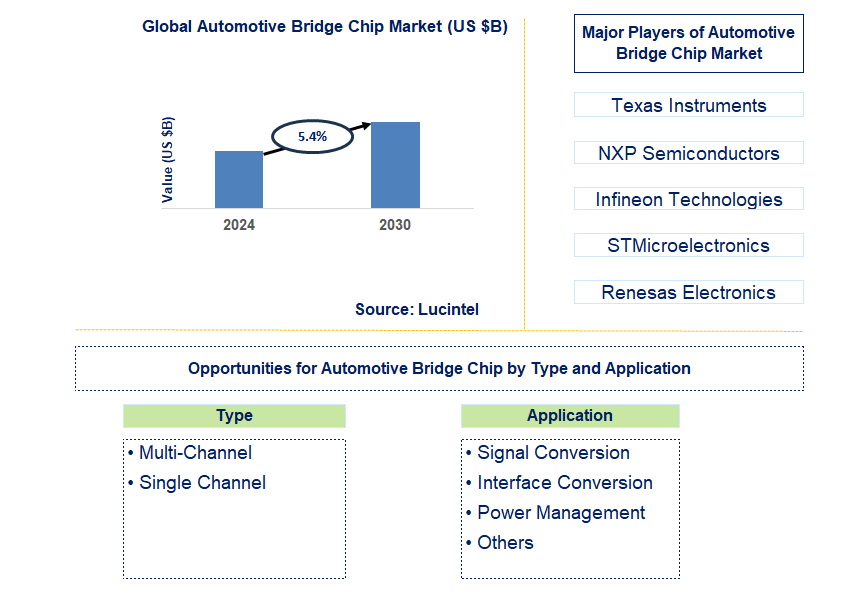
Key data points: The growth forecast = 5.4% annually for the next 6 years. Scroll below to get more insights. This market report covers trends, opportunities, and forecasts in the global automotive bridge chip market to 2030 by type (multi-channel and single channel), application (signal conversion, interface conversion, power management, and others), and region (North America, Europe, Asia Pacific, and the Rest of the World)
We'll send your sample report shortly.
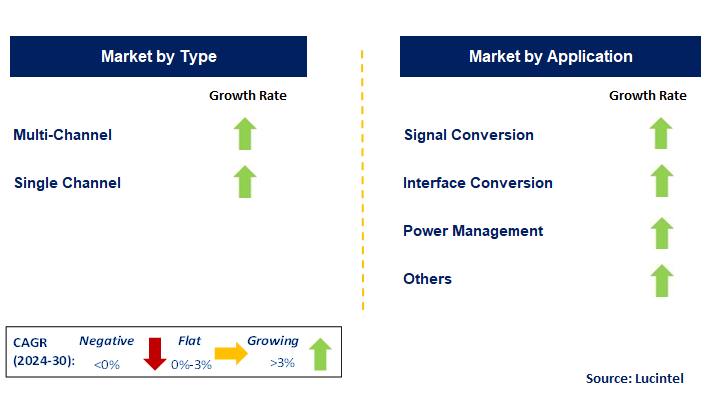
• Lucintel forecasts that, within the type category, multi-channel is expected to witness higher growth over the forecast period.
• Within the application category, signal conversion is expected to witness the highest growth.
• In terms of regions, APAC is expected to witness the highest growth over the forecast period. A more than 150-page report is developed to help in your business decisions.
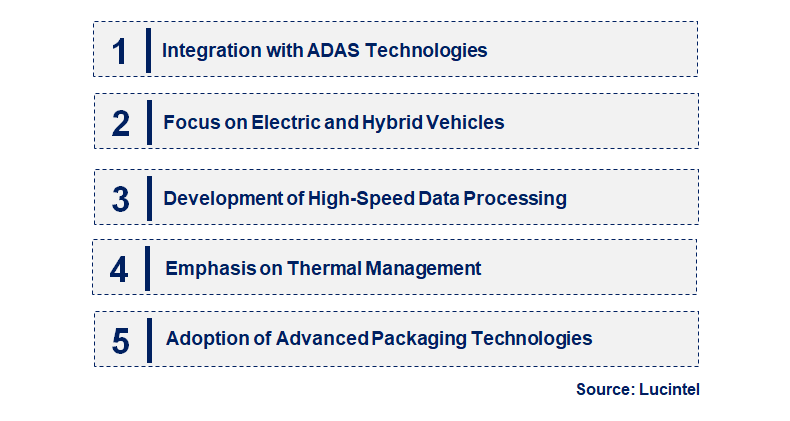
• Integration with ADAS Technologies: The integration of automotive bridge chips into advanced driver assistance systems (ADAS) has become more common. This helps improve vehicle safety and automate features such as adaptive cruise control and lane-keeping assist by providing data processing at high speeds, thus enabling reliable communication.
• Focus on Electric and Hybrid Vehicles: Bridge chips specifically designed for electric and hybrid vehicles are increasingly in demand. They allow battery management systems, power conversion, and thermal management that are essential for better EV performance over time and extended lifecycles of EV batteries and powertrains.
• Development of High-Speed Data Processing: Automotive bridge chips must handle high-speed data processing. This trend supports advanced infotainment systems, real-time navigation, and V2X communications in cars, thereby facilitating a better driving experience with greater connectedness between vehicles while on road trips.
• Emphasis on Thermal Management: Automotive bridge chips are becoming more important with the increasing power densities and operating temperatures of modern vehicles. Chip design innovations and materials aim at improving heat dissipation and ensuring that they function well under demanding conditions.
• Adoption of Advanced Packaging Technologies: Automotive bridge chips feature advanced packaging technologies, such as SiP (System-in-Package) and 3D stacking, to enhance functionality and miniaturization. The integration density increases while better performance is realized, supporting the compactness of automotive systems. These trends are redefining the automotive bridge chip market by driving safety innovation, improved performance, and efficiency in cars. It is imperative for companies to focus on both tight integration with advanced technologies and improved thermal management, which is essential in addressing the growing demand for highly-integrated electronic products for automotive applications.
• Enhanced Integration with ADAS: This trend involves the increased integration of automotive bridge chips with ADAS, offering additional features such as collision avoidance and automatic emergency braking. This development enhances vehicle safety by supporting the growth of autonomous driving systems.
• Advancements in EV-Specific Chips: Automotive bridge chip developments for electric vehicles center around improving battery management and power conversion efficiency, among others. These new chip designs can handle higher power density, thus optimizing battery life enhancement needed to grow the electric vehicle market.
• High-Speed Data Communication Improvements: To achieve real-time infotainment and navigation services, high-speed data communication capabilities are embedded in automotive bridge chips. As a result, it improves user experience, enables vehicle connectivity, and facilitates data processing.
• Innovations in Thermal Management: Improvements in thermal management technology have led to its integration into automotive bridge chips designed to cater to high operating temperatures and power densities. This ensures that the performance of these chips remains reliable over time in aggressive automotive environments.
• Adoption of Advanced Packaging Techniques: These techniques enable higher functional density and miniaturization of automotive bridge chips through 3D integration and SiP (System-in-Package). The resulting reduction in overall size improves the performance of automobile electronics. These developments contribute to making automotive bridge chips safer, more efficient, and better-performing. Therefore, advanced technologies such as integration, data communication, and thermal management must be improved to meet the changing requirements of the automotive industry.
• Advanced Driver-Assistance Systems (ADAS): Automotive bridge chips are becoming a significant part of vehicles that have increasingly adopted ADAS. They increase vehicle safety by enabling adaptive cruise control and lane-keeping assistance capabilities, adding to the automation of vehicle feature sets at large.
• Electric and Hybrid Vehicles: The demand for electric vehicles has led to an increased need for bridge chips that manage battery systems, including power conversion. Opportunities are available to develop chips that enhance battery efficiency, thereby increasing overall vehicle performance.
• Infotainment Systems: There is growing demand for bridge chips with high-speed data processing and connectivity features due to the sophistication of automotive infotainment systems integrated into cars today. These chips support advanced multimedia, navigation, and communication functions, among others.
• Vehicle-to-Everything (V2X) Communication: To expand V2X communication technologies, bridge chips are needed to facilitate real-time information exchange between vehicles and infrastructure. This will enhance traffic management, safety, and overall vehicle connectivity.
• Autonomous Vehicles: The rise in autonomous vehicles has necessitated the development of bridge chips that support high-performance sensors and computing systems. They are critical in processing data from cameras, radar, and lidar for self-driving functionality. These strategic growth opportunities highlight key areas where automotive bridge chips can drive market expansion. Corporations can exploit emerging trends and technological advancements by focusing on ADAS, EVs, infotainment systems, V2X communications, and autonomous driving.
• Growing Adoption of ADAS: ADAS technologies have been incorporated into many cars, driving a demand for automotive bridge chips. These chips enable advanced safety features and automation, contributing to the sophistication of automotive systems.
• Expansion of Electric Vehicles (EVs): Automotive bridge chips supporting battery management systems and power conversion stages are becoming increasingly relevant due to the rise of electric and hybrid vehicles. This trend supports the growth of the EV market while boosting chip technology innovations.
• Advancements in Vehicle Connectivity: High-performance automotive bridge chips are required due to the increased need for better vehicle connections, such as infotainment systems and V2X communication systems. These chips enable seamless data exchange, ultimately improving the driving experience.
• Technological Advancements in Semiconductors: The improvement of automotive bridge chip performance through semiconductor innovations, such as advanced packaging materials, presents opportunities. This innovation also aids higher integration, better thermal management, and improved functionality.
• Increasing Focus on Vehicle Safety: The demand for reliable and high-performance automotive bridge chips is rising as vehicle safety is enhanced by ADAS and autonomous driving. This focus promotes chip technology advancement. Challenges in the automotive bridge chip market include:
• High Material and Manufacturing Costs: The costs of materials and manufacturing processes for automotive bridge chips can be significant. Manufacturers face the challenge of managing these costs while maintaining acceptable performance and reliability levels.
• Rapid Technological Changes: Technological developments in automotive electronics occur rapidly, and companies must keep pace with them through continuous innovation, targeting new trends or ensuring their products are compatible with newer technologies.
• Regulatory Compliance: Complying with safety, environmental, and performance requirements can be challenging. Certification and quality assurance processes need to pass international standard tests, which require substantial financial outlays. These drivers and challenges shape product development, market demand, and regulatory compliance within the automotive bridge chip market. It is crucial to address these issues when navigating the market to take advantage of the available growth opportunities.
• Texas Instruments
• NXP Semiconductors
• Infineon Technologies
• STMicroelectronics
• Renesas Electronics
• Chipone Technology
• Analog Devices
• Multi-Channel
• Single Channel
• Signal Conversion
• Interface Conversion
• Power Management
• Others
• North America
• Europe
• Asia Pacific
• The Rest of the World
• United States: Automotive bridge chip development within America focuses on increasing performance for advanced driver assistance systems (ADAS) and electric vehicles (EVs). Companies making these chips are designing them with high-speed data processing capabilities that can support complex algorithms used in autonomous driving technologies while enhancing safety features for robustness purposes. It has also increased investments in research aimed at improving efficiency of chips in environments that contain harsh automotive conditions.
• China: At present there is an intense drive by China to build up its own capacities in semiconductors for automobiles by investing massively on local chip development and production. Chinese firms seek inexpensive bridge chips which will back a growing EV market. Technological self-sufficiency promoted by Beijing encourages innovation here thus reducing the dependence of the country on foreign suppliers.
• Germany: High-performance automotive bridge chips for both EVs and internal combustion cars are being developed mainly by German manufacturers. Thermal management innovations such as multiple functions consolidation into one single chip characterizes. Some German companies’ approach towards this technology space while at the same time minimizing energy consumption as well as reliability of vehicle systems needed to enhance advanced applications within the automotive industry.
• India: India is increasingly becoming a key player in automotive chip manufacturing and is working towards improving its local manufacturing capabilities. Indian companies are engaged in developing low-cost automotive bridge chips to support the growth of the auto sector. Besides, there is emphasis on partnering with international entities to boost technology transfer and innovation.
• Japan: Japanese firms have continued to dominate in automobile semiconductor technology evidenced by their advancements in high-precision bridge chips for electric and hybrid vehicles. Moreover, chip performance improvements through research investments as well as introduction of 5G connectivity enable V2X communications which are important for extending vehicle functionality.


• Texas Instruments
• NXP Semiconductors
• Infineon Technologies
• STMicroelectronics
• Renesas Electronics
• Chipone Technology
• Analog Devices Q5. Which automotive bridge chip market segment will be the largest in future? Answer: Lucintel forecasts that multi-channel is expected to witness higher growth over the forecast period. Q6. In automotive bridge chip market, which region is expected to be the largest in next 5 years? Answer: APAC is expected to witness the highest growth over the forecast period. Q.7 Do we receive customization in this report? Answer: Yes, Lucintel provides 10% customization without any additional cost.


Choose a license that fits your team. Instant PDF delivery.
Prices exclude taxes. Instant delivery. Custom licensing available on request.
Market Report · July 24, 2026
Market Report · July 20, 2026
Market Report · July 20, 2026
Trusted partner for strategic intelligence and business growth


Receive a complimentary market analysis tailored to your industry. Our analysts will identify key growth opportunities and competitive dynamics specific to your business.

Market size, growth rate, and key trend analysis for your specific sector.

Top competitor positioning and market share analysis.

Strategic recommendations backed by data-driven insights.
Get curated market intelligence and competitive moves straight to your inbox.
By subscribing, you agree to receive our monthly insights. Unsubscribe anytime.
Receive a complimentary market analysis tailored to your industry. Our analysts will identify key growth opportunities and competitive dynamics specific to your business.
Market size, growth rate, and key trend analysis for your specific sector.
Top competitor positioning and market share analysis.
Strategic recommendations backed by data-driven insights.
Get curated market intelligence, emerging trends, and competitive moves straight to your inbox each month.
By subscribing, you agree to receive our monthly insights. Unsubscribe anytime.
We'll send your sample report shortly.