
Report Feature
Automotive BJT Market Trends and Forecast
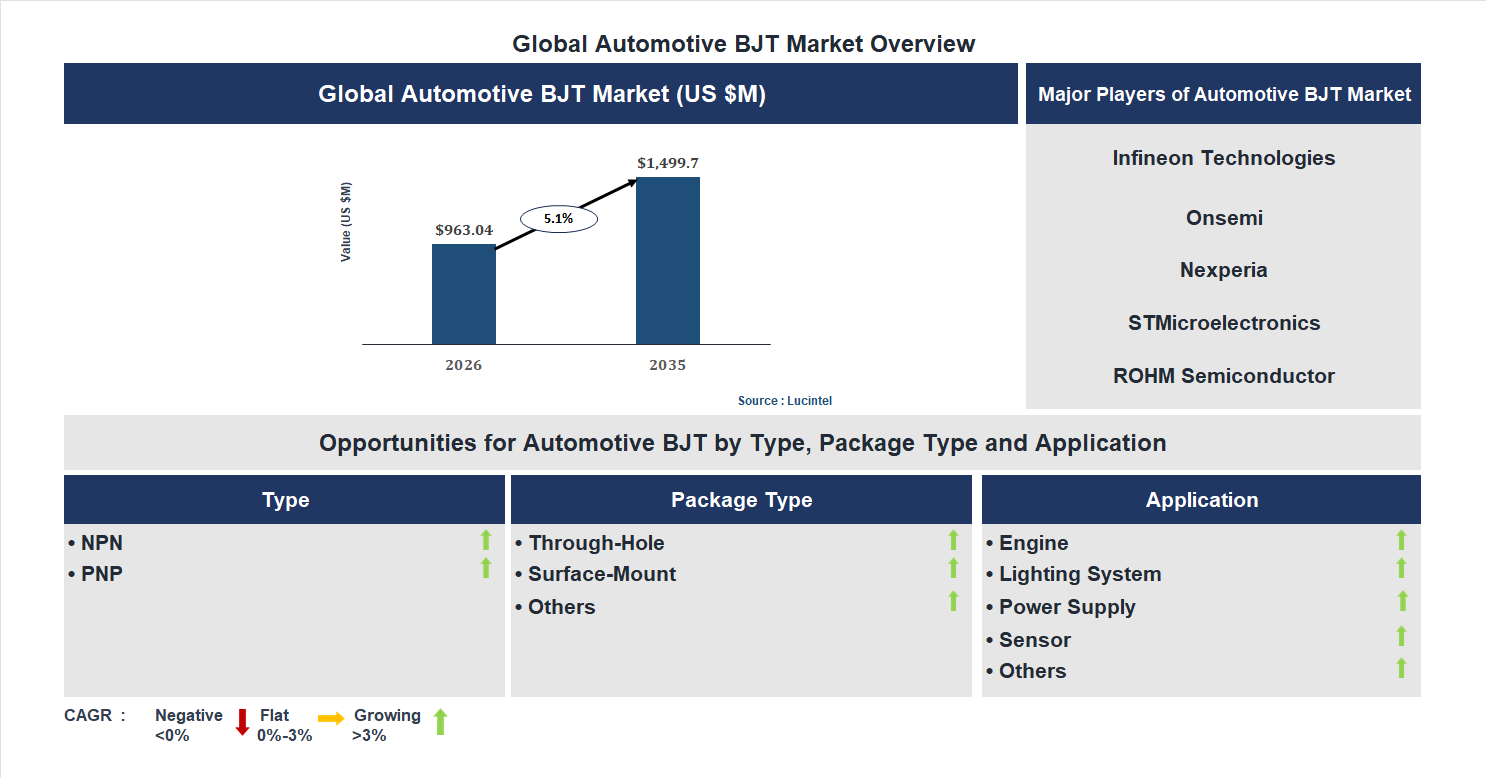
The future of the global automotive BJT market looks promising with opportunities in the engine, lighting system, power supply, and sensor markets. The global automotive BJT market is expected to reach an estimated $1499.7 million by 2035 with a CAGR of 5.1% from 2026 to 2035. The major drivers for this market are the increasing adoption of electric vehicles, the rising demand for fuel-efficient vehicles, and the growing use of advanced driver assistance systems.• Lucintel forecasts that, within the type category, NPN is expected to witness higher growth over the forecast period.
• Within the application category, sensor is expected to witness the highest growth.
• In terms of region, APAC is expected to witness the highest growth over the forecast period. Gain valuable insights for your business decisions with our comprehensive 150+ page report. Sample figures with some insights are shown below.
Emerging Trends in the Automotive BJT Market
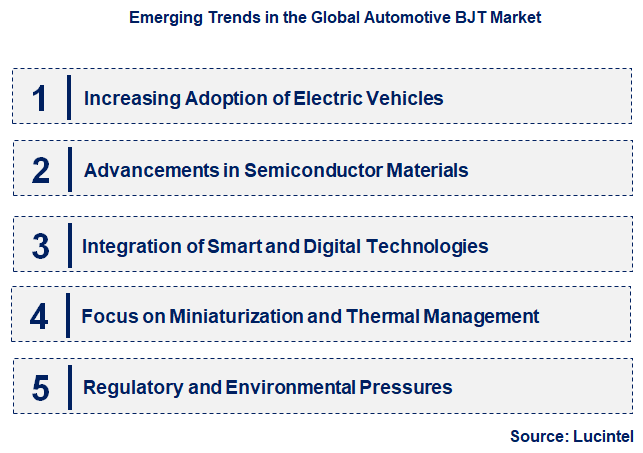
The automotive BJT market is experiencing a significant transformation driven by technological advancements, evolving consumer preferences, and regulatory changes. As vehicles become more sophisticated and electrified, the demand for reliable, high-performance BJTs increases. Innovations in manufacturing processes and materials are also shaping the market landscape. Additionally, the shift towards electric vehicles (EVs) and hybrid systems is creating new opportunities and challenges for component suppliers. These developments are not only influencing product design and performance but also impacting supply chains and market strategies. Understanding these emerging trends is crucial for stakeholders aiming to stay competitive in this dynamic environment.• Increasing Adoption of Electric Vehicles: The rise of EVs is boosting demand for power electronic components, including BJTs, which are essential for motor control and power management. As governments enforce stricter emission standards, automakers are investing heavily in EV technology, leading to a surge in BJT requirements for efficient power conversion and management systems. This trend is expected to continue, significantly expanding the market size and encouraging innovation in BJT design to meet the high-performance demands of EV applications.
• Advancements in Semiconductor Materials: The development of wide-bandgap semiconductors, like silicon carbide (SiC) and gallium nitride (GaN) is revolutionizing power electronics. These materials offer higher efficiency, faster switching speeds, and better thermal performance compared to traditional silicon BJTs. As a result, manufacturers are integrating these materials into BJT designs to improve vehicle performance and energy efficiency. This trend is driving a shift towards more durable, compact, and energy-efficient BJTs, which are critical for next-generation automotive electronics.
• Integration of Smart and Digital Technologies: The incorporation of IoT, sensors, and digital control systems in vehicles is increasing the complexity and functionality of BJTs. Smart BJTs with integrated diagnostics and communication capabilities enable real-time monitoring and predictive maintenance, reducing downtime and enhancing reliability. This trend is transforming BJTs from simple passive components into intelligent devices that support advanced vehicle features, including autonomous driving and connected car systems, thereby elevating overall vehicle performance and safety.
• Focus on Miniaturization and Thermal Management: As automotive electronics become more compact, there is a growing demand for smaller, more efficient BJTs with superior thermal management. Innovations in packaging and materials are enabling the production of miniature BJTs that can operate at higher temperatures without performance degradation. This miniaturization supports the trend toward lightweight, space-saving vehicle designs and improves overall system efficiency. Effective thermal management also extends component lifespan and reduces cooling requirements, contributing to more sustainable and reliable automotive electronics.
• Regulatory and Environmental Pressures: Stricter emissions standards and environmental regulations are compelling automakers to adopt cleaner, more efficient power electronic components. BJTs that offer high efficiency and low power loss are increasingly in demand to meet these standards. Additionally, the push for sustainable manufacturing practices is encouraging the development of eco-friendly BJT production processes. These regulatory pressures are accelerating innovation in BJT technology, fostering the development of greener, more efficient automotive electronics that align with global sustainability goals. In summary, these emerging trends are reshaping the automotive BJT market by driving innovation, enhancing performance, and supporting the shift towards electric and smart vehicles. The market is becoming more competitive and technologically advanced, with a focus on efficiency, miniaturization, and sustainability. Stakeholders who adapt to these trends will be better positioned to capitalize on new opportunities and meet the evolving demands of the automotive industry.
Recent Development in the Automotive BJT Market
The automotive BJT market is experiencing rapid growth driven by advancements in electric vehicles, autonomous driving technology, and increased demand for efficient power management systems. As automakers focus on sustainability and innovation, the integration of BJTs in various automotive applications is becoming more prevalent. These developments are transforming the industry landscape, creating new opportunities for manufacturers and suppliers. The following key developments highlight the current trajectory and future potential of the automotive BJT market.• Growing Adoption of Electric Vehicles: Increasing demand for electric vehicles (EVs) is fueling the need for high-performance power transistors like BJTs. Automakers are integrating BJTs into power modules to improve efficiency, reduce heat generation, and enhance overall vehicle performance. This trend is supported by government incentives and stricter emission regulations, which are accelerating EV adoption worldwide. As a result, the automotive BJT market is expanding rapidly, with significant opportunities for innovation and growth.
• Advancements in Power Management Systems: Enhanced power management systems are critical for modern vehicles, especially EVs and hybrid models. BJTs play a vital role in voltage regulation, motor control, and battery management. Recent developments focus on creating more durable, efficient, and compact BJTs to meet the increasing power demands. These innovations improve vehicle reliability, reduce energy consumption, and extend battery life, thereby boosting the market for automotive BJTs and supporting the shift toward smarter, more efficient vehicles.
• Integration of BJTs in Autonomous Vehicles: Autonomous driving systems require sophisticated electronic components for sensor operation, data processing, and control systems. BJTs are essential in amplifiers and signal processing units within these systems. Recent developments include high-speed, low-noise BJTs that enhance sensor accuracy and system responsiveness. This integration is crucial for the safe and reliable operation of autonomous vehicles, driving demand for advanced BJTs and fostering innovation in automotive electronics.
• Focus on Thermal Management and Reliability: As BJTs are subjected to high currents and voltages in automotive applications, thermal management and reliability are paramount. Recent innovations involve developing BJTs with improved heat dissipation capabilities and longer lifespans. These advancements ensure consistent performance under harsh conditions, such as extreme temperatures and vibrations. Enhanced reliability reduces maintenance costs and increases vehicle safety, making these BJTs highly desirable in the automotive industry and expanding their market presence.
• Expansion of Semiconductor Manufacturing Capabilities: To meet rising demand, manufacturers are investing in advanced fabrication facilities and adopting new production technologies. This expansion enables the production of higher-quality, more efficient BJTs at scale. Additionally, collaborations between automotive OEMs and semiconductor companies are fostering innovation and customization. These developments ensure a steady supply of cutting-edge BJTs, support industry growth, and enable automakers to incorporate more sophisticated electronic systems into vehicles. These developments are significantly impacting the automotive BJT market by driving innovation, improving performance, and supporting the shift toward electric and autonomous vehicles. The market is becoming more competitive, with increased investment in research and manufacturing capabilities. Overall, these trends are fostering a more efficient, reliable, and sustainable automotive industry, opening new avenues for growth and technological advancement.
Strategic Growth Opportunities in the Automotive BJT Market
The automotive BJT market is experiencing rapid growth driven by advancements in vehicle electronics, increasing demand for electric vehicles, and the need for efficient power management solutions. As automakers focus on enhancing vehicle performance, safety, and energy efficiency, the integration of BJTs becomes crucial. Market players are investing in innovation and expanding production capacities to meet rising demand. This evolving landscape presents significant opportunities for growth, collaboration, and technological development across various automotive applications.• Growing Demand for Electric Vehicles Drives Automotive BJT Adoption: The surge in electric vehicle production necessitates high-performance power transistors like BJTs for efficient energy conversion and management. As automakers aim to improve battery life and vehicle range, BJTs are increasingly used in power inverters, motor controllers, and charging systems. This trend offers substantial growth opportunities for BJT manufacturers to supply components that meet the stringent efficiency and durability standards of electric vehicles.
• Advancements in Power Electronics Enhance BJT Market Potential: Innovations in power electronic systems, including improved thermal management and miniaturization, are expanding the application scope of BJTs in automotive systems. These advancements enable better control of high-current loads, contributing to vehicle safety and performance. As automakers adopt more sophisticated electronic architectures, the demand for reliable, high-speed BJTs is expected to rise, creating new avenues for market expansion and technological development.
• Increasing Focus on Vehicle Safety and Autonomous Technologies: The integration of BJTs in advanced driver-assistance systems (ADAS) and autonomous vehicle components is growing. These systems require robust power switching and amplification devices to ensure real-time responsiveness and safety. The need for high-quality, durable BJTs that can operate under harsh conditions presents opportunities for manufacturers to innovate and supply specialized components tailored for next-generation automotive safety and automation solutions.
• Expansion of Hybrid Vehicle Market Presents New Opportunities: Hybrid vehicles combine internal combustion engines with electric propulsion, requiring efficient power management systems. BJTs play a vital role in controlling power flow, regenerative braking, and energy distribution within these systems. As hybrid vehicle sales increase globally, the demand for high-performance BJTs that can withstand frequent switching and thermal stresses is expected to grow, encouraging manufacturers to develop specialized products for this segment.
• Increasing Emphasis on Energy Efficiency and Regulatory Compliance: Stringent emissions and fuel efficiency standards are pushing automakers to adopt advanced electronic components like BJTs to optimize engine and powertrain performance. These components help reduce energy losses and improve overall vehicle efficiency. The market for energy-efficient BJTs is expanding as manufacturers seek to meet regulatory requirements, driving innovation in low-loss, high-speed devices suitable for modern automotive applications. The overall impact of these opportunities is set to significantly accelerate growth in the automotive BJT market, fostering innovation, expanding application areas, and enabling automakers to meet evolving technological and regulatory demands. This dynamic environment promises sustained market expansion and increased competitiveness for industry players.
Automotive BJT Market Driver and Challenges
The automotive BJT market is influenced by a variety of technological, economic, and regulatory factors. Rapid advancements in automotive electronics, increasing demand for electric vehicles, and stringent emission standards are shaping the market landscape. Additionally, economic growth in emerging markets and the need for energy-efficient components further drive market dynamics. However, challenges such as supply chain disruptions, technological complexities, and regulatory compliance issues pose significant hurdles. Understanding these drivers and challenges is essential for stakeholders to navigate the evolving market effectively and capitalize on emerging opportunities. The factors responsible for driving the automotive BJT market include:-• Technological Advancements: The continuous development of automotive electronics, including power management and control systems, necessitates high-performance BJTs. Innovations in semiconductor materials and manufacturing processes enhance BJT efficiency, reliability, and thermal stability, making them indispensable for modern vehicles. As vehicles become more sophisticated, the demand for advanced BJTs increases, supporting the growth of the market. These technological improvements also enable automakers to meet stricter safety and emission standards, further fueling market expansion.
• Rising Adoption of Electric Vehicles (EVs): The global shift towards electric mobility significantly boosts the demand for BJTs, which are critical in power electronics for EVs. High-efficiency BJTs help improve battery management, motor control, and charging systems, contributing to better vehicle performance and energy efficiency. As governments implement policies promoting EV adoption, automakers are investing heavily in electric powertrains, directly impacting BJT demand. This trend is expected to continue, driving sustained growth in the market.
• Increasing Focus on Energy Efficiency: Automakers are prioritizing energy-efficient components to meet environmental regulations and consumer expectations. BJTs, known for their high switching speeds and low power losses, are vital in power management systems. The integration of BJTs in hybrid and electric vehicles enhances overall energy efficiency, reducing emissions and operational costs. This focus on sustainability and efficiency is a key driver propelling the market forward, especially as regulatory pressures intensify globally.
• Growing Automotive Electronics Market: The expanding automotive electronics sector, including infotainment, ADAS (Advanced Driver Assistance Systems), and autonomous driving technologies, relies heavily on BJTs for signal amplification and switching. As vehicles become more connected and automated, the demand for reliable, high-performance electronic components increases. This growth in automotive electronics directly correlates with higher BJT consumption, supporting market expansion and technological innovation. The challenges in the automotive BJT market are:
• Supply Chain Disruptions: The global supply chain has faced significant disruptions due to geopolitical tensions, pandemics, and logistical issues. These disruptions affect the availability of raw materials and semiconductor manufacturing capacity, leading to delays and increased costs. For the BJT market, such disruptions hinder production schedules and limit the ability to meet rising demand, impacting revenue and market growth. Overcoming these challenges requires strategic sourcing and supply chain resilience initiatives.
• Technological Complexities and Integration Issues: Developing BJTs that meet the stringent requirements of modern automotive applications involves complex design and manufacturing processes. Integrating BJTs into advanced electronic systems demands high precision and compatibility, which can be challenging. These technological complexities can lead to increased R&D costs and longer development cycles, potentially delaying product launches and affecting competitiveness in the market.
• Regulatory and Compliance Challenges: The automotive industry faces strict regulations related to safety, emissions, and electronic component standards. Ensuring BJTs meet these evolving regulatory requirements involves rigorous testing and certification processes, which can be time-consuming and costly. Non-compliance risks include legal penalties and market restrictions, making regulatory adherence a critical challenge for manufacturers aiming to expand their market presence. In summary, the automotive BJT market is driven by technological innovations, the rise of electric vehicles, a focus on energy efficiency, and growth in automotive electronics. However, supply chain issues, technological complexities, and regulatory hurdles pose significant challenges. These factors collectively influence market dynamics, requiring stakeholders to adapt strategically. While growth opportunities are substantial, addressing these challenges is crucial for sustained success. Overall, the markets future will depend on how effectively companies innovate and navigate regulatory and supply chain landscapes to meet evolving automotive industry demands.
List of Automotive BJT Companies
Companies in the market compete on the basis of product quality offered. Major players in this market focus on expanding their manufacturing facilities, R&D investments, infrastructural development, and leverage integration opportunities across the value chain. With these strategies automotive BJT companies cater increasing demand, ensure competitive effectiveness, develop innovative products & technologies, reduce production costs, and expand their customer base. Some of the automotive BJT companies profiled in this report include-• Infineon Technologies
• Onsemi
• Nexperia
• STMicroelectronics
• ROHM Semiconductor
• Toshiba Electronic Devices
• Panasonic Industry
• Renesas Electronics
• Diodes Incorporated
• Vishay Intertechnology
Automotive BJT Market by Segment
The study includes a forecast for the global automotive BJT market by type, package type, application, and region.Automotive BJT Market by Type [Value from 2019 to 2035]:
• NPN
• PNP
Automotive BJT Market by Package Type [Value from 2019 to 2035]:
• Through-Hole
• Surface-Mount
• Others
Automotive BJT Market by Application [Value from 2019 to 2035]:
• Engine
• Lighting System
• Power Supply
• Sensor
• Others
Automotive BJT Market by Region [Value from 2019 to 2035]:
• North America
• Europe
• Asia Pacific
• The Rest of the World
Country Wise Outlook for the Automotive BJT Market
The automotive BJT market has experienced significant shifts driven by technological advancements, evolving regulatory standards, and increasing demand for electric vehicles worldwide. As automakers focus on improving vehicle efficiency, safety, and electronic systems, the role of BJTs in power management and control systems has become more critical. Recent developments reflect a global push towards innovation, with countries investing heavily in research and development to enhance BJT performance, reduce costs, and support the transition to electric mobility. These trends are shaping the future landscape of automotive electronics, influencing supply chains, manufacturing processes, and market dynamics across key regions.• United States: The US market has seen increased adoption of BJTs in electric vehicle (EV) power modules, driven by major automakers investments in EV technology. Innovations in high-performance BJTs for efficient power management are gaining traction, supported by government incentives for clean energy. Companies are also focusing on integrating BJTs with advanced semiconductor materials to improve thermal stability and longevity. The US government’s push for sustainable transportation has accelerated research initiatives, fostering collaborations between industry and academia to develop next-generation BJTs suitable for autonomous and electric vehicles.
• China: China remains the largest market for automotive BJTs, with rapid growth fueled by government policies promoting EV adoption and local manufacturing. Chinese companies are investing heavily in developing high-efficiency BJTs tailored for electric drivetrains and charging infrastructure. The market is characterized by a focus on cost-effective solutions, with domestic firms expanding their production capacities to meet rising demand. Additionally, China is advancing in integrating BJTs with smart electronic systems, enhancing vehicle connectivity and automation. The countrys strategic emphasis on self-sufficiency in semiconductor components continues to drive innovation and competitiveness in this sector.
• Germany: Germanys automotive industry is emphasizing the integration of BJTs in electric and hybrid vehicles, with a focus on high-performance and reliability. Leading automakers and suppliers are investing in research to develop BJTs capable of handling higher voltages and currents, essential for next-generation EVs. The country’s strong emphasis on quality and safety standards is fostering innovations in BJT design to improve durability under harsh operating conditions. Germany is also exploring collaborations with semiconductor firms to develop more efficient and environmentally friendly BJT manufacturing processes, aligning with its broader sustainability goals.
• India: The Indian automotive BJT market is witnessing growth driven by increasing demand for electric vehicles and government initiatives promoting clean transportation. Local manufacturers are expanding their capabilities to produce cost-effective BJTs suitable for entry-level and mid-range EVs. The focus is on developing components that can operate efficiently in diverse climatic conditions prevalent in India. Additionally, the government’s push for manufacturing self-reliance under schemes like Make in India is encouraging domestic R&D efforts. The market is also seeing a rise in collaborations between Indian firms and international semiconductor companies to enhance technological capabilities.
• Japan: Japans market is characterized by a focus on high-quality, high-efficiency BJTs for electric and hybrid vehicles, with a strong emphasis on innovation and reliability. Japanese automakers and semiconductor companies are investing in advanced materials and fabrication techniques to improve BJT performance, especially in high-temperature and high-voltage applications. The country is also exploring the integration of BJTs with emerging technologies such as autonomous driving and smart vehicle systems. Japan’s commitment to sustainability and technological leadership continues to drive R&D efforts, positioning it as a key player in the global automotive BJT market.

Features of the Global Automotive BJT Market
Market Size Estimates: Automotive BJT market size estimation in terms of value ($M). Trend and Forecast Analysis: Market trends (2019 to 2025) and forecast (2026 to 2035) by various segments and regions. Segmentation Analysis: Automotive BJT market size by type, package type, application, and region in terms of value ($M). Regional Analysis: Automotive BJT market breakdown by North America, Europe, Asia Pacific, and Rest of the World. Growth Opportunities: Analysis of growth opportunities in different type, package type, application, and regions for the automotive BJT market. Strategic Analysis: This includes M&A, new product development, and competitive landscape of the automotive BJT market. Analysis of competitive intensity of the industry based on Porter’s Five Forces model.
FAQ
Q1. What is the market size and growth forecast for automotive BJT market? Answer: The global automotive BJT market is expected to reach an estimated $1499.7 million by 2035 and grow with a CAGR of 5.1% from 2026 to 2035. Q2. What are the major drivers influencing the growth of the automotive BJT market? Answer: The major drivers for this market are the increasing adoption of electric vehicles, the rising demand for fuel-efficient vehicles, and the growing use of advanced driver assistance systems. Q3. What are the major segments for automotive BJT market? Answer: The future of the automotive BJT market looks promising with opportunities in the engine, lighting system, power supply, and sensor markets. Q4. Who are the key automotive BJT market companies? Answer: Some of the key automotive BJT companies are as follows:• Infineon Technologies
• Onsemi
• Nexperia
• STMicroelectronics
• ROHM Semiconductor
• Toshiba Electronic Devices
• Panasonic Industry
• Renesas Electronics
• Diodes Incorporated
• Vishay Intertechnology Q5. Which automotive BJT market segment will be the largest in future? Answer: Lucintel forecasts that, within the type category, NPN is expected to witness higher growth over the forecast period. Q6. In automotive BJT market, which region is expected to be the largest in next 5 years? Answer: In terms of region, APAC is expected to witness the highest growth over the forecast period. Q7. Do we receive customization in this report? Answer: Yes, Lucintel provides 10% customization without any additional cost.
Table of Contents
List of Figures
List of Tables
Methodology
- In-depth interviews of the major players in this market
- Detailed secondary research from competitors’ financial statements and published data
- Extensive searches of published works, market, and database information pertaining to industry news, company press releases, and customer intentions
- A compilation of the experiences, judgments, and insights of Lucintel’s professionals, who have analyzed and tracked this market over the years.


Buy Now
Choose a license that fits your team. Instant PDF delivery.
Prices exclude taxes. Instant delivery. Custom licensing available on request.
Key Questions
- • What are some of the most promising, high-growth opportunities for the automotive BJT market by type (NPN and PNP), package type (through-hole, surface-mount, and others), application (engine, lighting system, power supply, sensor, and others), and region (North America, Europe, Asia Pacific, and the Rest of the World)?
- • Which segments will grow at a faster pace and why?
- • Which region will grow at a faster pace and why?
- • What are the key factors affecting market dynamics? What are the key challenges and business risks in this market?
- • What are the business risks and competitive threats in this market?
- • What are the emerging trends in this market and the reasons behind them?
- • What are some of the changing demands of customers in the market?
- • What are the new developments in the market? Which companies are leading these developments?
- • Who are the major players in this market? What strategic initiatives are key players pursuing for business growth?
- • What are some of the competing products in this market and how big of a threat do they pose for loss of market share by material or product substitution?
- • What M&A activity has occurred in the last 7 years and what has its impact been on the industry? For any questions related to Automotive BJT Market, Automotive BJT Market Size, Automotive BJT Market Growth, Automotive BJT Market Analysis, Automotive BJT Market Report, Automotive BJT Market Share, Automotive BJT Market Trends, Automotive BJT Market Forecast, Automotive BJT Companies, write Lucintel analyst at email: helpdesk@lucintel.com. We will be glad to get back to you soon.


