
Automotive and Transportation Connector Market Trends and Forecast
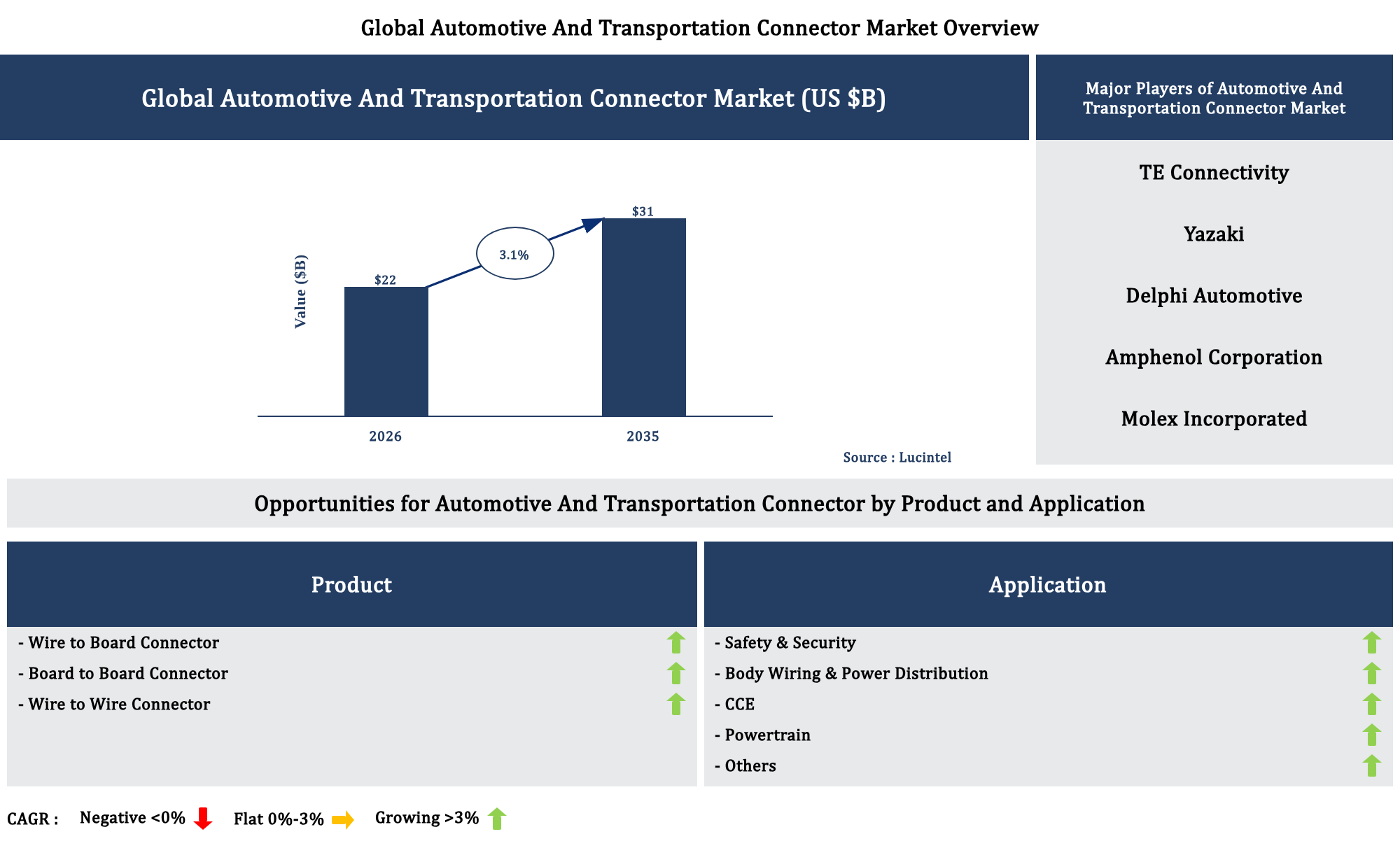
The future of the global automotive and transportation connector market looks promising with opportunities in the safety & security, body wiring & power distribution, CCE, and powertrain markets. The global automotive and transportation connector market is expected to reach an estimated $31,012 million by 2035 with a CAGR of 3.1% from 2026 to 2035. The major drivers for this market are the rising use of safety & adas systems, the increasing demand for infotainment & connectivity features, and the growing need for lightweight & compact connectors.
• Lucintel forecasts that, within the product category, wire to board connector is expected to witness the highest growth over the forecast period.
• Within the application category, body wiring & power distribution is expected to witness the highest growth.
• In terms of region, APAC is expected to witness the highest growth over the forecast period.
Gain valuable insights for your business decisions with our comprehensive 150+ page report. Sample figures with some insights are shown below.
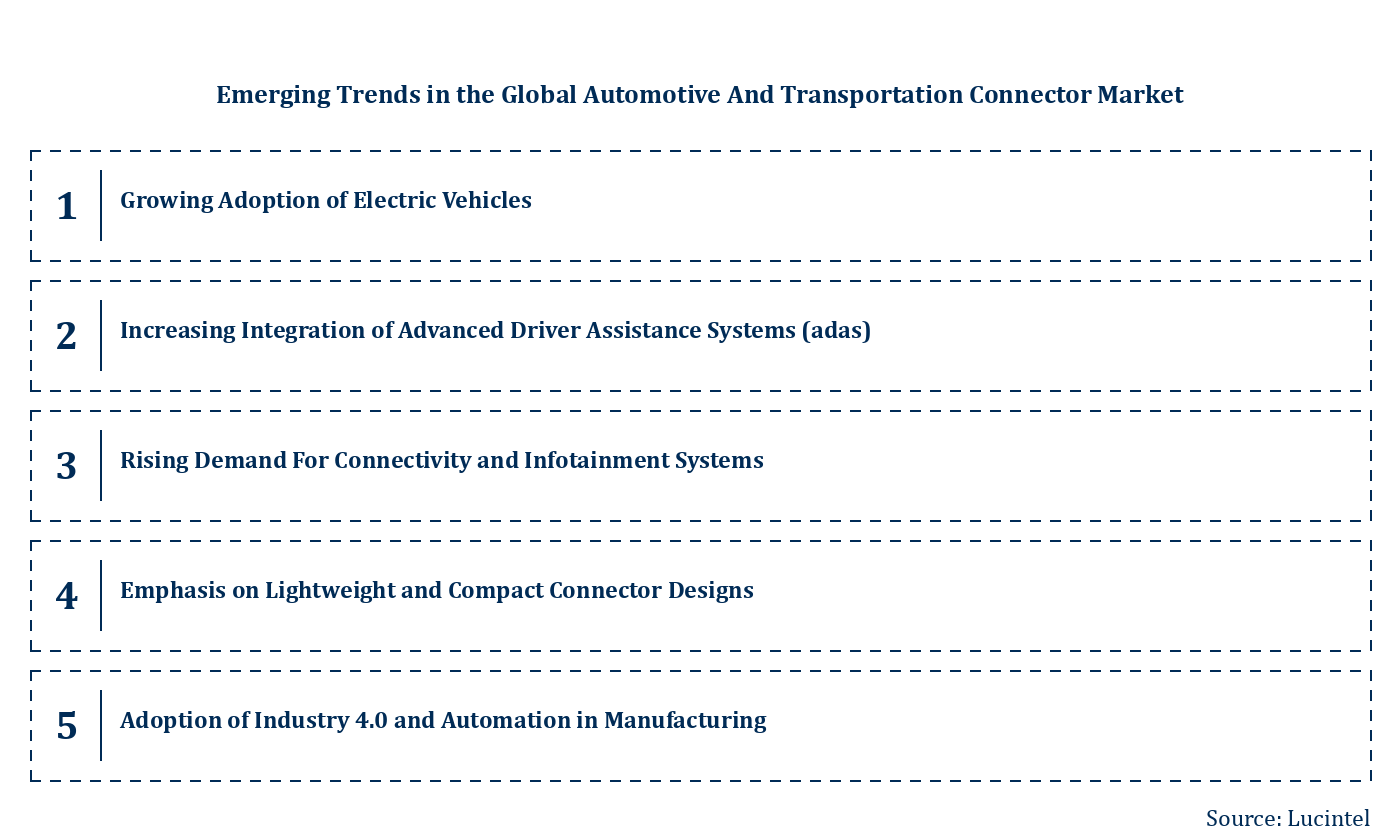
Emerging Trends in the Automotive and Transportation Connector Market
The automotive and transportation connector market is experiencing rapid evolution driven by technological advancements, increasing demand for electric vehicles, and the need for more reliable and efficient connectivity solutions. As vehicles become smarter and more connected, the market is adapting to new standards, materials, and manufacturing processes. Innovations in automation, safety features, and data transmission are also influencing market dynamics. These developments are not only enhancing vehicle performance and safety but also shaping consumer preferences and regulatory frameworks. Understanding these emerging trends is crucial for stakeholders aiming to stay competitive and capitalize on new opportunities in this fast-changing industry.
• Growing Adoption of Electric Vehicles: The shift towards electric vehicles (EVs) is significantly impacting the connector market. EVs require specialized high-voltage connectors that ensure safety, durability, and efficient power transfer. As governments implement stricter emission regulations and consumers demand sustainable transportation options, automakers are investing heavily in EV technology. This trend is driving the development of innovative connector designs that can withstand high voltages and harsh environmental conditions, thereby expanding the market for specialized connectors and creating new opportunities for manufacturers.
• Increasing Integration of Advanced Driver Assistance Systems (ADAS): The integration of ADAS features such as lane departure warnings, adaptive cruise control, and collision avoidance systems is fueling demand for sophisticated connectors. These systems require high-speed data transmission and reliable connections to ensure safety and performance. As ADAS becomes standard in more vehicles, connectors must support increased data loads and withstand vibrations, temperature fluctuations, and moisture. This trend is pushing the market toward more robust, miniaturized, and high-performance connector solutions, enhancing vehicle safety and driving innovation.
• Rising Demand for Connectivity and Infotainment Systems: Modern vehicles are becoming increasingly connected, with features like internet access, multimedia streaming, and vehicle-to-everything (V2X) communication. This surge in connectivity demands high-bandwidth, reliable connectors capable of supporting complex electronic architectures. The proliferation of infotainment and telematics systems is prompting manufacturers to develop connectors that facilitate seamless data transfer while maintaining durability and safety standards. This trend is transforming the connector market by emphasizing high-speed, multi-pin, and compact solutions that cater to the growing digital ecosystem within vehicles.
• Emphasis on Lightweight and Compact Connector Designs: As vehicle weight reduction remains a priority for improving fuel efficiency and reducing emissions, the connector market is shifting toward lightweight and space-saving designs. Miniaturization of connectors allows for more efficient use of space within vehicle architectures, enabling more flexible and innovative layouts. Materials such as plastics and composites are increasingly used to reduce weight without compromising performance. This trend is crucial for electric and hybrid vehicles, where weight savings directly impact range and efficiency, thereby influencing design strategies and manufacturing processes.
• Adoption of Industry 4.0 and Automation in Manufacturing: The integration of Industry 4.0 principles, including automation, IoT, and smart manufacturing, is transforming how connectors are produced. Automated assembly lines, real-time quality monitoring, and digital twin technologies enhance precision, reduce costs, and accelerate time-to-market. This trend enables manufacturers to meet the growing demand for customized and high-quality connectors while maintaining flexibility in production. The shift toward smart manufacturing is also fostering innovation in connector design and materials, ensuring the market remains responsive to evolving automotive industry needs.
These emerging trends are collectively reshaping the automotive and transportation connector market by fostering innovation, improving safety and performance, and supporting the shift toward sustainable, connected, and autonomous vehicles. They are driving market growth, encouraging technological advancements, and redefining industry standards, ultimately leading to more efficient, safer, and smarter transportation solutions.
Recent Developments in the Automotive and Transportation Connector Market
The automotive and transportation connector market is experiencing rapid growth driven by technological advancements, increased vehicle production, and the shift towards electric and autonomous vehicles. Innovations in connector design, materials, and manufacturing processes are enhancing vehicle safety, performance, and connectivity. Market players are investing heavily in R&D to develop more reliable, lightweight, and cost-effective connectors. These developments are shaping the future landscape of automotive connectivity, creating new opportunities for manufacturers and suppliers worldwide.
• Growing Demand for Electric Vehicles: The shift to electric vehicles (EVs) is fueling the need for specialized connectors that support high-voltage systems, improving safety and efficiency. This trend is expanding the market as automakers seek reliable, durable connectors capable of handling increased power loads. The development of innovative connectors tailored for EVs is expected to boost market growth significantly, attracting investments and fostering technological advancements.
• Advancements in Connector Materials: New materials such as high-performance plastics and composites are being adopted to enhance durability, heat resistance, and environmental stability of connectors. These innovations reduce weight and improve performance, especially in harsh conditions. The use of advanced materials is enabling manufacturers to produce more reliable and long-lasting connectors, which are crucial for safety and efficiency in modern vehicles, thereby expanding market opportunities.
• Integration of Smart and Wireless Connectors: The rise of connected and autonomous vehicles is driving the adoption of smart, wireless, and contactless connectors. These connectors facilitate seamless data transfer and power management, reducing wiring complexity and weight. Their integration enhances vehicle connectivity, safety, and user experience, making them a vital component in next-generation automotive systems and opening new avenues for market expansion.
• Increasing Focus on Miniaturization and Space-Saving Designs: As vehicle interiors become more sophisticated, there is a growing demand for compact, lightweight connectors that save space without compromising performance. Innovations in miniaturization are enabling manufacturers to design more efficient and aesthetically pleasing vehicles. This trend supports the development of advanced driver-assistance systems (ADAS) and infotainment modules, further driving market growth and diversification.
• Rising Adoption of High-Speed Data Transmission Connectors: The increasing integration of advanced infotainment, telematics, and sensor systems requires high-speed data connectors. These connectors ensure fast, reliable data transfer essential for vehicle safety and entertainment features. The demand for high-performance connectors is prompting technological innovations, which are critical for supporting the evolving needs of connected vehicles and autonomous driving systems, thereby expanding the market.
These recent developments are significantly transforming the automotive and transportation connector market by enhancing vehicle safety, performance, and connectivity. Innovations in materials, miniaturization, and high-speed data transmission are enabling automakers to meet the demands of electric, autonomous, and connected vehicles. As a result, the market is poised for substantial growth, attracting investments and fostering technological advancements that will shape the future of automotive connectivity and transportation infrastructure worldwide.
Strategic Growth Opportunities in the Automotive and Transportation Connector Market
The automotive and transportation connector market is experiencing rapid expansion driven by increasing vehicle production, technological advancements, and the integration of electronic systems. Growing demand for electric vehicles and connected car technologies further fuels this growth. Market players are focusing on innovation, strategic partnerships, and expanding manufacturing capabilities to capitalize on emerging opportunities. The evolving landscape presents significant potential for revenue growth and market dominance, making it crucial for stakeholders to identify and leverage key opportunities effectively.
• Expansion into Electric Vehicle (EV) Market: The rising adoption of electric vehicles is creating substantial demand for specialized connectors that support high-voltage systems, battery management, and charging infrastructure. Manufacturers are developing innovative, durable, and efficient connectors tailored for EV applications, which offer higher safety standards and performance. This growth is driven by government incentives, environmental concerns, and technological advancements, making EV connector development a critical opportunity for market players to capture new revenue streams and strengthen their market position.
• Integration of Smart and Data-Driven Connectivity Solutions: As vehicles become more connected, there is a growing need for smart connectors capable of supporting data transfer, telematics, and autonomous driving systems. Companies are investing in advanced connector designs that facilitate high-speed data transmission, enhanced security, and reliability. This trend aligns with the increasing deployment of IoT-enabled automotive systems, offering opportunities for innovation, differentiation, and expansion into new segments such as connected car services and autonomous vehicle infrastructure.
• Focus on Lightweight and Compact Connector Designs: The demand for lightweight, space-efficient connectors is rising to improve vehicle efficiency and reduce overall weight. Manufacturers are developing miniaturized, high-performance connectors using advanced materials and design techniques. These innovations enable better integration into modern vehicle architectures, especially in electric and hybrid vehicles where space and weight are critical. This opportunity allows companies to meet stringent industry standards while offering enhanced performance and ease of assembly.
• Strategic Collaborations and Partnerships for Innovation: Collaborations between connector manufacturers, automotive OEMs, and technology providers are accelerating product development and innovation. Such partnerships facilitate access to new markets, shared expertise, and co-development of cutting-edge solutions tailored for emerging automotive trends. This strategic approach helps companies stay competitive, reduce time-to-market, and leverage synergies to address complex technical challenges, ultimately driving growth and market leadership.
• Expansion into Emerging Markets and Regional Growth: Rapid vehicle adoption in emerging economies presents significant opportunities for connector market expansion. Local manufacturing, tailored product offerings, and strategic distribution channels are essential to capture these markets. Additionally, regional regulations and infrastructure development influence demand. Companies focusing on regional customization, cost-effective solutions, and establishing local presence can capitalize on these growth opportunities, ensuring long-term market penetration and revenue diversification.
The overall impact of these opportunities is poised to significantly accelerate growth, innovation, and competitiveness within the automotive and transportation connector market. By strategically leveraging these key areas, industry stakeholders can enhance their product portfolios, expand market reach, and meet evolving technological and regional demands, ensuring sustained success in a dynamic landscape.
Automotive and Transportation Connector Market Driver and Challenges
The automotive and transportation connector market is influenced by a variety of technological, economic, and regulatory factors that shape its growth and development. Rapid advancements in vehicle electronics, increasing demand for electric vehicles, and stringent safety standards are key drivers. Conversely, challenges such as supply chain disruptions, regulatory complexities, and technological obsolescence pose significant hurdles. Understanding these drivers and challenges is essential for stakeholders to navigate the evolving landscape effectively. The interplay of innovation, market demand, and regulatory compliance determines the trajectory of this market, impacting manufacturers, suppliers, and consumers alike.
The factors responsible for driving the automotive and transportation connector market include:-
• Technological Innovation: The rapid evolution of vehicle electronics and connectivity features necessitates advanced connectors. As vehicles become more integrated with IoT, autonomous driving systems, and infotainment, the demand for reliable, high-performance connectors increases. This technological shift encourages manufacturers to develop innovative solutions that enhance safety, durability, and data transmission capabilities, thereby fueling market growth.
• Growing Electric Vehicle Adoption: The global shift towards electric vehicles (EVs) significantly impacts connector demand. EVs require specialized connectors for battery management systems, charging stations, and power distribution. As governments implement policies promoting clean transportation, automakers are investing heavily in EV production, which directly boosts the need for advanced connectors tailored for high-voltage applications.
• Stringent Regulatory Standards: Increasing safety and quality regulations across regions compel manufacturers to adopt higher standards for connectors. Compliance with standards such as ISO, SAE, and regional safety norms ensures product reliability and safety, driving innovation and higher-quality manufacturing processes. These regulations also influence design, testing, and certification procedures, shaping market dynamics.
• Expansion of Autonomous Vehicles: The development of autonomous vehicles demands sophisticated sensor and communication systems, which rely heavily on specialized connectors. These connectors must support high data rates, withstand harsh environments, and ensure fail-safe operation. The push towards autonomous driving accelerates the need for innovative connector solutions, opening new avenues for market expansion.
• Increasing Focus on Lightweight and Compact Designs: The automotive industry’s emphasis on reducing vehicle weight and improving aerodynamics drives demand for smaller, lightweight connectors. These connectors contribute to overall vehicle efficiency and performance. Manufacturers are investing in miniaturization and material innovations to meet these demands, further propelling market growth.
The challenges facing this Market include:-
• Supply Chain Disruptions: The global supply chain has faced significant disruptions due to geopolitical tensions, pandemics, and logistical issues. These disruptions affect the availability of raw materials and components necessary for connector manufacturing, leading to delays, increased costs, and production halts, which hinder market growth and innovation.
• Rapid Technological Obsolescence: The fast pace of technological change results in frequent product obsolescence. Manufacturers must continuously innovate to keep up with evolving standards and customer expectations, which increases R&D costs and risks of inventory obsolescence. This dynamic environment challenges companies to balance innovation with cost management.
• Regulatory and Certification Complexities: Navigating diverse regional regulations and certification processes can be complex and costly. Variations in standards across markets require extensive testing and adaptation, delaying product launches and increasing compliance costs. This complexity can restrict market entry and slow down the adoption of new connector technologies.
In summary, the automotive and transportation connector market is shaped by a combination of technological advancements, regulatory pressures, and evolving consumer demands. While innovation and the shift towards electric and autonomous vehicles present substantial growth opportunities, challenges such as supply chain issues and regulatory complexities pose risks. Overall, the market‘s future depends on how effectively stakeholders can leverage technological progress while managing these hurdles, ensuring sustainable growth and competitiveness in a rapidly changing landscape.
List of Automotive and Transportation Connector Companies
Companies in the market compete on the basis of product quality offered. Major players in this market focus on expanding their manufacturing facilities, R&D investments, infrastructural development, and leverage integration opportunities across the value chain. With these strategies automotive and transportation connector companies cater increasing demand, ensure competitive effectiveness, develop innovative products & technologies, reduce production costs, and expand their customer base. Some of the automotive and transportation connector companies profiled in this report include-
• TE Connectivity
• Yazaki
• Delphi Automotive
• Amphenol Corporation
• Molex Incorporated
• Sumitomo Corporation,
• Korea Electric Terminal
• Rosenberger Hochfrequenztechnik
• Luxshare Precision Industry
• JST
Automotive and Transportation Connector Market by Segment
The study includes a forecast for the global automotive and transportation connector market by product, application, and region.
Automotive and Transportation Connector Market by Product [Value from 2019 to 2035]:
• Wire to Board Connector
• Board to Board Connector
• Wire to Wire Connector
Automotive and Transportation Connector Market by Application [Value from 2019 to 2035]:
• Safety & Security
• Body Wiring & Power Distribution
• CCE
• Powertrain
• Others
Automotive and Transportation Connector Market by Region [Value from 2019 to 2035]:
• North America
• Europe
• Asia Pacific
• The Rest of the World
Country Wise Outlook for the Automotive and Transportation Connector Market
The automotive and transportation connector market is experiencing rapid growth driven by technological advancements, increased vehicle electrification, and the integration of smart systems. As vehicles become more connected and autonomous, the demand for reliable, high-performance connectors has surged globally. Countries are investing heavily in innovation, infrastructure, and manufacturing capabilities to stay competitive. Regulatory standards and sustainability initiatives are also shaping market trends, prompting companies to develop eco-friendly and durable connector solutions. This dynamic environment reflects the evolving landscape of automotive technology, with each country contributing uniquely to global developments.
• United States: The U.S. market is witnessing significant innovation in electric vehicle (EV) connectors, driven by major automakers and tech companies. Advances in high-speed data transmission and durability are prominent, with increased adoption of smart, wireless, and modular connectors. Regulatory support for EV infrastructure and sustainability initiatives are fueling growth. Companies are investing in R&D to develop lightweight, eco-friendly connectors that meet safety standards, boosting the overall market size and technological sophistication.
• China: China remains the largest market for automotive connectors, propelled by rapid EV adoption and government policies promoting green transportation. Local manufacturers are expanding their product portfolios with advanced, cost-effective connectors tailored for electric and hybrid vehicles. The focus is on miniaturization, high performance, and integration with vehicle electronics. Strategic collaborations and investments in manufacturing capacity are strengthening China’s position as a global hub for connector innovation and production.
• Germany: Germany’s automotive connector market is characterized by high-quality, precision-engineered solutions driven by its strong automotive industry. Emphasis is placed on developing connectors that support autonomous driving, connectivity, and electric mobility. German firms are pioneering in the integration of intelligent, secure, and environmentally sustainable connectors. The focus on innovation, safety, and compliance with stringent European standards is shaping the market’s evolution.
• India: The Indian market is rapidly expanding due to increasing vehicle production, electrification, and infrastructure development. Local manufacturers are focusing on affordable, durable connectors suitable for mass-market vehicles and commercial applications. There is a growing emphasis on developing connectors that withstand harsh environmental conditions and offer reliable performance. Government initiatives promoting electric mobility and manufacturing are further boosting market growth and technological adoption.
• Japan: Japan’s automotive connector market is driven by its strong automotive manufacturing sector and focus on advanced technology integration. Innovations include high-speed data connectors for autonomous vehicles and smart systems. Japanese companies are investing in miniaturization, high durability, and eco-friendly materials. The market is also influenced by strict safety and environmental standards, leading to the development of innovative, sustainable connector solutions that enhance vehicle performance and reliability.
Features of the Global Automotive and Transportation Connector Market
Market Size Estimates: Automotive and transportation connector market size estimation in terms of value ($M).
Trend and Forecast Analysis: Market trends (2019 to 2025) and forecast (2026 to 2035) by various segments and regions.
Segmentation Analysis: Automotive and transportation connector market size by product, application, and region in terms of value ($M).
Regional Analysis: Automotive and transportation connector market breakdown by North America, Europe, Asia Pacific, and Rest of the World.
Growth Opportunities: Analysis of growth opportunities in different product, application, and regions for the automotive and transportation connector market.
Strategic Analysis: This includes M&A, new product development, and competitive landscape of the automotive and transportation connector market.
Analysis of competitive intensity of the industry based on Porter’s Five Forces model.
FAQ
Q1. What is the automotive and transportation connector market size?
Answer: The global automotive and transportation connector market is expected to reach an estimated $31,012 million by 2035.
Q2. What is the growth forecast for automotive and transportation connector market?
Answer: The global automotive and transportation connector market is expected to grow with a CAGR of 3.1% from 2026 to 2035.
Q3. What are the major drivers influencing the growth of the automotive and transportation connector market?
Answer: The major drivers for this market are the rising use of safety & adas systems, the increasing demand for infotainment & connectivity features, and the growing need for lightweight & compact connectors.
Q4. What are the major segments for automotive and transportation connector market?
Answer: The future of the automotive and transportation connector market looks promising with opportunities in the safety & security, body wiring & power distribution, CCE, and powertrain markets.
Q5. Who are the key automotive and transportation connector market companies?
Answer: Some of the key automotive and transportation connector companies are as follows:
• TE Connectivity
• Yazaki
• Delphi Automotive
• Amphenol Corporation
• Molex Incorporated
• Sumitomo Corporation,
• Korea Electric Terminal
• Rosenberger Hochfrequenztechnik
• Luxshare Precision Industry
• JST
Q6. Which automotive and transportation connector market segment will be the largest in future?
Answer: Lucintel forecasts that, within the product category, wire to board connector is expected to witness the highest growth over the forecast period.
Q7. In automotive and transportation connector market, which region is expected to be the largest in next 8 years?
Answer: In terms of region, APAC is expected to witness the highest growth over the forecast period.
Q8. Do we receive customization in this report?
Answer: Yes, Lucintel provides 10% customization without any additional cost.
This report answers following 11 key questions:
Q.1. What are some of the most promising, high-growth opportunities for the automotive and transportation connector market by product (wire to board connector, board to board connector, and wire to wire connector), application (safety & security, body wiring & power distribution, CCE, powertrain, and others), and region (North America, Europe, Asia Pacific, and the Rest of the World)?
Q.2. Which segments will grow at a faster pace and why?
Q.3. Which region will grow at a faster pace and why?
Q.4. What are the key factors affecting market dynamics? What are the key challenges and business risks in this market?
Q.5. What are the business risks and competitive threats in this market?
Q.6. What are the emerging trends in this market and the reasons behind them?
Q.7. What are some of the changing demands of customers in the market?
Q.8. What are the new developments in the market? Which companies are leading these developments?
Q.9. Who are the major players in this market? What strategic initiatives are key players pursuing for business growth?
Q.10. What are some of the competing products in this market and how big of a threat do they pose for loss of market share by material or product substitution?
Q.11. What M&A activity has occurred in the last 5 years and what has its impact been on the industry?
For any questions related to Automotive and Transportation Connector Market, Automotive and Transportation Connector Market Size, Automotive and Transportation Connector Market Growth, Automotive and Transportation Connector Market Analysis, Automotive and Transportation Connector Market Report, Automotive and Transportation Connector Market Share, Automotive and Transportation Connector Market Trends, Automotive and Transportation Connector Market Forecast, Automotive and Transportation Connector Companies, write Lucintel analyst at email: helpdesk@lucintel.com. We will be glad to get back to you soon.