
Market Report · July 29, 2026

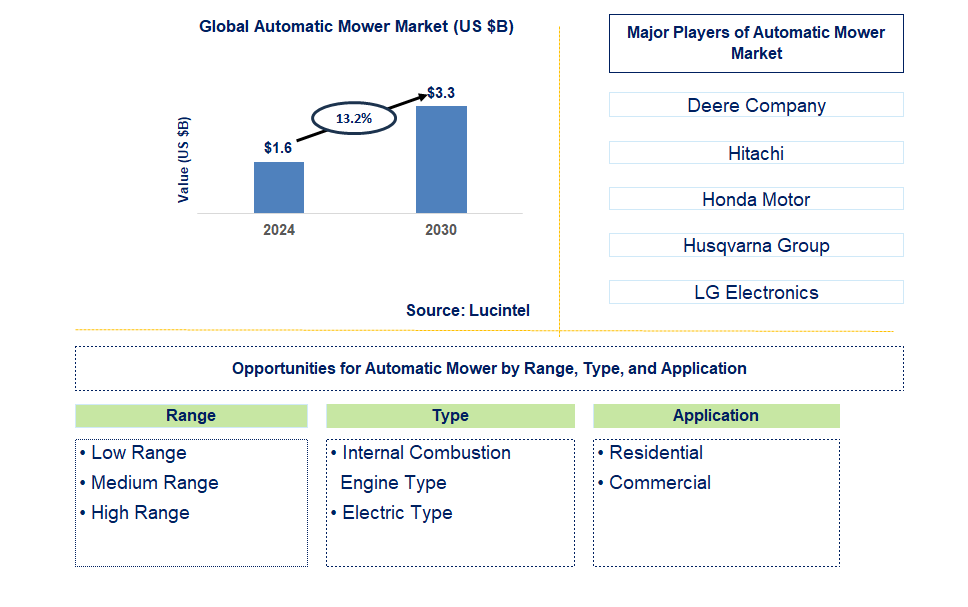
Key data points: The market size in 2030 = $3.3 billion, growth forecast = 13.2% annually for the next 6 years. Scroll below to get more insights. This market report covers trends, opportunities, and forecasts in the global automatic mower market to 2030 by range (low range, medium range, and high range), type (internal combustion engine type and electric type), application (residential and commercial), and region (North America, Europe, Asia Pacific, and the Rest of the World)
We'll send your sample report shortly.
• Lucintel forecasts that, within the type category, electric type will remain a larger segment over the forecast period due to increasing demand for zero emission products and electric mowers are more affordable, low operating costs, and a longer lifespan.
• In terms of regions, Europe will remain the largest region over the forecast period because of high prevalence of lawns and favorable weather conditions. Gain valuable insights for your business decisions with our comprehensive 150+ page report.
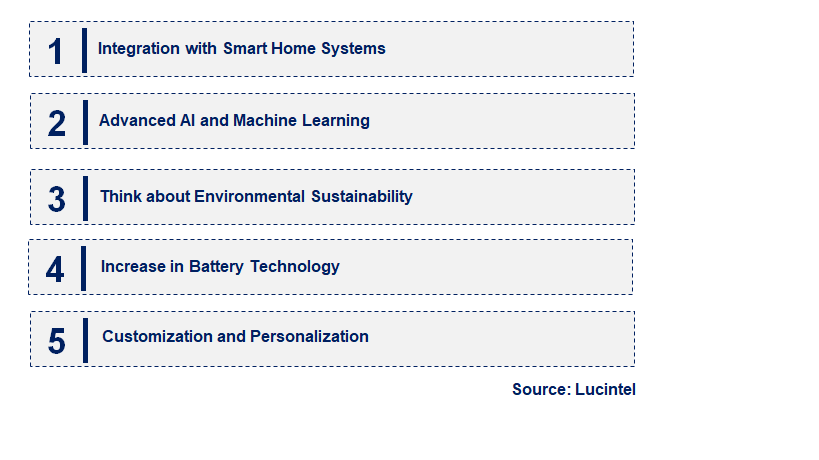
• Integration with Smart Home Systems: The spread of automatic mowers incorporates integration with smart home systems. The development of automatic mowers is adapting to the growing popularity of smart home environments with remote control and operation of devices through applications or voice commands. This trend adds comfort and customization of attention towards users making robotic mowers attractive to consumers with advanced technology. Connecting with smart homes helps these features enabling scheduling and updates remotely which can enhance user experience and improve market growth.
• Advanced AI and Machine Learning: The use of AI and machine learning for robotic mowers. The application of AI and machine learning improves the navigation and efficiency of operation of the automatic mowers. In addition, the integrated mowers have the ability to analyze their surroundings, identify areas that need to be cut more frequently and adapt the pattern of mowing to be performed in relation to the surrounding environmental factors. Improvement in the abilities of AI technology means that the output and efficient use of the automatic mowers will be enhanced, this would result in high customer satisfaction leading to more acceptance of the mower in both home and commercial settings.
• Think about Environmental Sustainability: Increasing input towards automatic mower design guiding principles incorporating environmental situations. In the design of various equipment, manufacturers give preference to the greenest options possible such as energy saving batteries, less noise and materials which can be recycled. There is increased this trend in order to meet higher standards of environmental targets and satisfy consumers who are conscious of green issues. Builders of robot mowers also consider engagement in sustainable designs to minimize carbon footprint of the mowers which strengthened the market’s shift directions towards global sustainability.
• Increase in Battery Technology: Growth in battery power to make it possible for mowers to operate longer and more efficiently. The developments in battery technologies includes improvements in time before operational hibernation, longer run time before derailing from the action and quicker recharging capacity. This has made it possible to use automatic mowers over larger areas that require a single charge thus averting problems of using gross amounts of elementary cycles of charging the units. In addressing one of the leading difficulties combined with automatic lawnmowers the trend aids the expansion of the market.
• Customization and Personalization: More emphasis is put on the customization and personalization of automatic mowers. Manufacturers are incorporating features and settings in their products whereby the user adjusts the performance of the mower. These feature and settings include zmowing to set parameters as to when and how low to cut and the shapes to cut in. Personalization solutions also increase end-user satisfaction and makes robotic mowers flexible towards the different gardens and how individual users prefer to use them resulting in growth in the market and engagement by consumers. Geared with changing automatic mower market trends such as introduction of smart home integration, artificial intelligence and machine learning, environmental considerations, battery technology scaling, and incorporating features are changing the game. These trends epitomizes the maturation process of robotic mowers towards the march of technical and marketing trends.
• Improved Navigation and Sensor Technology: Technological development has additionally increased the efficiency of automatic mowers, in particular, navigation and sensor systems. As new sensors and algorithms allow, the mowers are now capable of operating in complex garden structures, avoiding other heating objects, and finding optimal fair mowing patterns for each area. These developments increase both the effectiveness and the dependability of robotic mowers in various conditions.
• Connectivity to IoT and Home Automation systems and Operations: This integration of automatic mowers with Internet of Things (IoT) and Home Automation systems is another high point. Mowers have now become smartphone operated or monitored through Voice assistants, offering ease and customization to users. This communication facilitates the editing of mowers’ schedules, and real-time communication and maintenance of the mowers as well.
• Return of Improvements to Battery Technology: Heralded improvements in battery technology have also contributed to better performance and efficiency gadgets, in particular automatic mowers. The next generation type of batteries will provide longer run time operations, allow for fast charging, and general energy efficiency. These breakthroughs tack led to operational shortcomings that arose from the longer battery life, and frequent battery charging cycles making robotic mowers feasible.
• Understanding sustainability focus in development: The emphasis on environmental sustainability has contributed to the new innovations in automatic mowers. The manufacturers have been adding greener options such as battery storage, quiet operation, and use of recyclable materials. This sustainable design practice is consistent with the environmental goals of the world and also addresses the needs of consumers who like green products.
• Diversification of Product Offerings: Further, the diversification of product offerings has brought to the market more automatic mowers that come with different specifications and prices. This includes products such as those made for different types of gardens and terrains as well as for consumer demographic. With increased variety, consumers are able to select mowers that will meet their specific needs and also those within their budgets, hence leading to the positive growth in this market. Additional factors accounted for developments in the automatic mower market include improved navigational capabilities, IoT integration, batteries, sustainability mandates, and product mix extension. All these improvements provide enhanced performance, ease of use and consumer appeal hence supporting the growth of the market.
• Expansion into Commercial Applications Description: Increasing use of these automatic mowers in commercial applications such as parks, golf courses, or even large estates. Impact: There is an ample opportunity in terms of growth with use of the automatic mowers in the commercial applications. Automatic mowers are able to take care of large and intricate settings in the best value, less labor and resources needed. Venturing in to this segment helps in sustaining the market growth thereby increasing the sales of high performance models.
• Integration with Smart Home Ecosystems Description: Advancement in automatic mowers to fit into smart home systems and IoT platforms. Impact: Easy to use and operate automatic mowers that are compatible with smart home systems are likely to improve the experience of users. Features such as the ability of operation, scheduling and monitoring through smartphones, apps and voice assistance are very attractive to technology consumers. All these developments are beneficial to the market increasing revenues growth as satisfied consumers spend more on integrated smart homes.
• Development of Cost-Effective Models Description: Creating cheaper versions of automatic mowers to capture more consumers than ever. With the models being affordable, cost efficient agricultural robotic mowers can be availed to more customers. Manufacturers tend to increase their coverage and acceptance by price-sensitive customers by reducing the price while still offering some of the… Today, this opportunity leads to market development as it helps to resolve the price issues and brings new customers to the market.
• Concentrated on Eco-Friendly and Sustainable Designs: Higher demand for the automatic mowers that are less harmful to the environment. The trend in developing products with eco-efficient battery and low noise automowers is increasingly becoming relevant. There is growing recognition and appreciation of the fact that marketing for eco-sensitivity goes beyond simply twinning eco with business. This opportunity focuses on the development of the market of automatic mowers increasing their attractiveness to consumers and further contributing to the solution of wider ecological problems.
• Innovation in Battery and Charging Technologies: Introduction of new products aimed at improving mower performance through battery and charging technologies. Battery innovations such as long run-time and quick recharge innovations optimize the work of automatic mowers. Further improvements along this line allow for larger and fewer rechargeable batteries for mowers to expand the range of possible work. As a result, this opportunity fuels market growth by overcoming the previous drawbacks and enhancing the attractiveness of robotic mowers. The automatic mower market has several strategic growth opportunities including entering into the commercial sectors, providing smart passive mowers, making models with lower price tag, going green, and battery innovations. This is growth opportunity arises due to the consumer needs being addressed, commoditizing and enhancing product attributes, and implanting in new markets.
• Technological Advancements: Automated mowers market opportunities are influenced by varying technologies in robotics, artificial intelligence, and sensors. Advancements in technology have led to better navigation systems and more intelligent robotics with advanced sensors in robotic mowers. These improvements offer a reliable and accurate, hence more adopter friendly mechanical mower.
• Increase in Consumer Demand for Automation: There is an increase in the demand for automatic mowers due to the growing consumer interest in automation and smart home technologies. There is a demand for quick and easy solutions for lawn maintenance, and robotic mowers fill this gap. There is an increasing tendency towards smart homes which is one of the reasons why automatic mowers would be utilized as they are part of automation systems.
• Environmental Awareness: Emphasis on environmental sustainability has a positive impact on the automatic mower market. To match the ever-increasing consumer demand for sustainable products, producers are now producing low noise level or even low energy consuming batteries and other features. Mower Robots benefits from this development as it is in line with global climate strategies and boosts the market growth.
• Technological Development: Technological development in the field of battery echnology such as runtime and shorter charge time is also helping in the growth of the automatic mower market. Better battery technologies have overcome battery time and charging time problems which were previously a burden towards the wider use of robotic mowers in larger areas and commercial use. This enhancement in product performance helps in complementing market expansion.
• Further Development Of Market Offerings: The expansion of market offerings, including a wider model & features assortment, has a positive effect on the market’s growth. Manufacturers are recognizing the need and are producing different models depending on the size and type of the garden and its owners. Such enhancements offer more choices to consumers, facilitating the acceptance of the automatic mowers. Challenges in the automatic mower market are:
• High Initial Costs: The cost barriers caused due to high initial costs of automatic mowers can obstruct the adoption of this device by some consumers. Since robotic mowers are in fact high end products, it is expected that they will be marketed at a premium as opposed to the conventional lawn mowers. Cost is an issue that needs attention if a wider nest of the market is to be captured.
• Maintenance and Repair Costs: Big amounts of money spent on maintenance and repair of automatic mowers can be a drawback for the users. Commercialization, on the other hand, is laden with responsibility; while robotic mowers are efficient in their intended use, they may require maintenance and repair costs, which are eventually transferred to the owner. Providing dependable services, as well as ensuring easy access to maintenance and servicing, will aid in overcoming this challenge.
• Education and Awareness of Consumers: Inadequate details, information and education of consumers regarding the advantages and usefulness of automatic mowers can cripple market expansion. Pretty many would-be users may not be clear on the benefits offered by robotic mowers or their functionality. It is necessary to raise awareness and articulate the arguments in favor of automatic mowers to ensure their adoption. Key growth factors for the automatic mower market include market-oriented advanced technologies, rising customer inclination towards automation, attention to the environment, improvements made in the batteries, or enhancement of the market scope. Barriers such as cash outlays associated with high initial investment, costs of maintenance and repairs as well as consumer literacy affect the growth and development of the market. These drivers and challenges have to be addressed in order to understand the markets and take the chances for their growth.
• Deere Company
• Hitachi
• Honda Motor
• Husqvarna Group
• LG Electronics
• Mamibot Manufacturing
• Robert Bosch
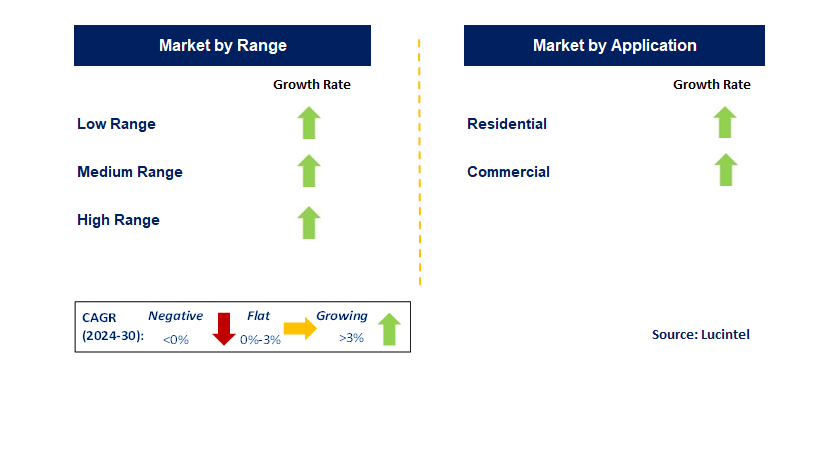
• Low Range
• Medium Range
• High Range
• Internal Combustion Engine Type
• Electric Type
• Residential
• Commercial
• North America
• Europe
• Asia Pacific
• The Rest of the World
• United States: Over the years, the automatic mower market in the United States has grown remarkably owing to remodels and increasing interest among customers on the smart home devices. Operative changes include new modifications that include advanced sensors and AI navigation systems that make robotic mowers more effective. Well recognized brands are working on improving the overall lifespan of the battery and extending capabilities such as water protection and connection to a smart home. At the same time, more and more companies are offering the possibility of subscribing to maintenance and software updates, which suggests a shift towards maintaining the customers for a more extended period.
• China: Automatic mower industry within China has developed rapidly due to the increasing efficiency of the economy and urbanization. Nevertheless, recent trends include the extension of local production which has also resulted in cheaper robotic high head mowers. Companies from China are focusing a lot on R&D to enhance the tech features of their products including navigation systems and artificial intelligence. Now, there is also a noticeable urge towards the integration of automatic mowers with smart home systems which is consistent with the trend of household automation in China.
• Germany: In Germany, the target customers of automatic mowers more or less are professional landscaping companies that undertake more demanding engineering works. However, recent developments include advanced robotic mowers which are now available with better reliability and operational functionality in advanced intricate gardening designs. German companies have further developed their mowers by includes advanced sensor systems and attached machine-learning systems. In addition to that, consumers are more inclined to be more eco-friendly by coming up with new technologies for noise abatement and energy efficiency, which is consistent with the green economy of Germany.
• India: As regards the situation in the automatic mower market in India, it is at its nascent stage. Focus is shifting on how to make robotic mowers easy to use and affordable. The development of local manufacturing and technology modification has resulted to rolling out low costing versions that caters for varied garden types and different climatic conditions. Indian manufacturers are also working around enhancing the use of robotic mowers to the local smart home and solar power systems. This reflects the rising interest in the use of robots for various applications and also adopting green technology. This sector is still at the infancy stage with a lot of opportunity for growth owing to increasing awareness and high adoption rates.
• Japan: The automatic mower market in Japan is highly sophisticated with advanced technology and high level of consumer expectation. Advanced robotics and AI are employed in recent developments toward improving the performance and functionality of robotic mowers. Compact and efficient models suitable for small urban or intricate gardens are being developed by the Japanese manufacturers. Other advancements such as waterproof designs and smart adequate engagement avoidance are also becoming popular. There are also efforts in Japan to incorporate robotic mowers into appropriate smart homes which also is indicative of the level of technological integration in Japan.


• Deere Company
• Hitachi
• Honda Motor
• Husqvarna Group
• LG Electronics
• Mamibot Manufacturing
• Robert Bosch Q6. Which automatic mower market segment will be the largest in future? Answer: Lucintel forecasts that electric type will remain a larger segment over the forecast period due to increasing demand for zero emission products and electric mowers are more affordable, low operating costs, and a longer lifespan. Q7. In automatic mower market, which region is expected to be the largest in next 5 years? Answer: Europe will remain the largest region over the forecast period because of high prevalence of lawns and favorable weather conditions. Q.8 Do we receive customization in this report? Answer: Yes, Lucintel provides 10% customization without any additional cost.


Choose a license that fits your team. Instant PDF delivery.
Prices exclude taxes. Instant delivery. Custom licensing available on request.
Market Report · July 29, 2026
Market Report · July 15, 2026
Market Report · July 13, 2026
Trusted partner for strategic intelligence and business growth


Receive a complimentary market analysis tailored to your industry. Our analysts will identify key growth opportunities and competitive dynamics specific to your business.

Market size, growth rate, and key trend analysis for your specific sector.

Top competitor positioning and market share analysis.

Strategic recommendations backed by data-driven insights.
Get curated market intelligence and competitive moves straight to your inbox.
By subscribing, you agree to receive our monthly insights. Unsubscribe anytime.
Receive a complimentary market analysis tailored to your industry. Our analysts will identify key growth opportunities and competitive dynamics specific to your business.
Market size, growth rate, and key trend analysis for your specific sector.
Top competitor positioning and market share analysis.
Strategic recommendations backed by data-driven insights.
Get curated market intelligence, emerging trends, and competitive moves straight to your inbox each month.
By subscribing, you agree to receive our monthly insights. Unsubscribe anytime.
We'll send your sample report shortly.