
Report Feature
Automated Valet Parking System Market Trends and Forecast
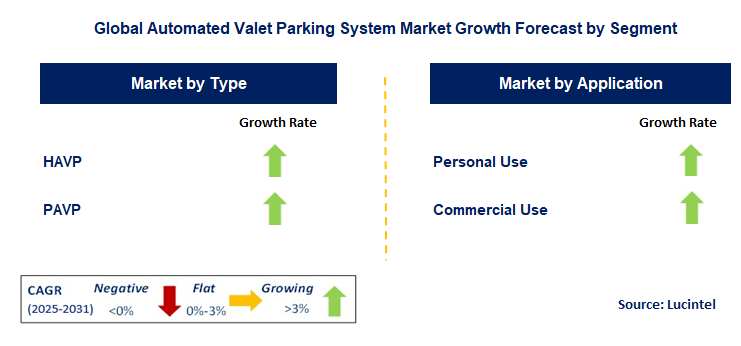
The future of the global automated valet parking system market looks promising with opportunities in the personal use and commercial use markets. The global automated valet parking system market is expected to grow with a CAGR of 19.2% from 2025 to 2031. The major drivers for this market are rising need for more efficient, convenient, and easy-to-use parking systems, the escalation of traffic congestion combined with growing investments in smart city initiatives, and the increasing number of vehicles alongside limited parking space availability. Lucintel forecasts that, within the type category, PAVP is expected to witness higher growth over the forecast period due to its larger consumer base, growing urbanization, and alignment with the increasing adoption of autonomous. Within the application category, commercial use is expected to witness the higher growth due to the greater demand for space optimization, higher return on investment for businesses, and alignment with urbanization and smart city initiatives. In terms of region, APAC is expected to witness the highest growth over the forecast period due to its rapid urbanization, large automotive markets, and strong government support for smart cities. Gain valuable insights for your business decisions with our comprehensive 150+ page report. Sample figures with some insights are shown below.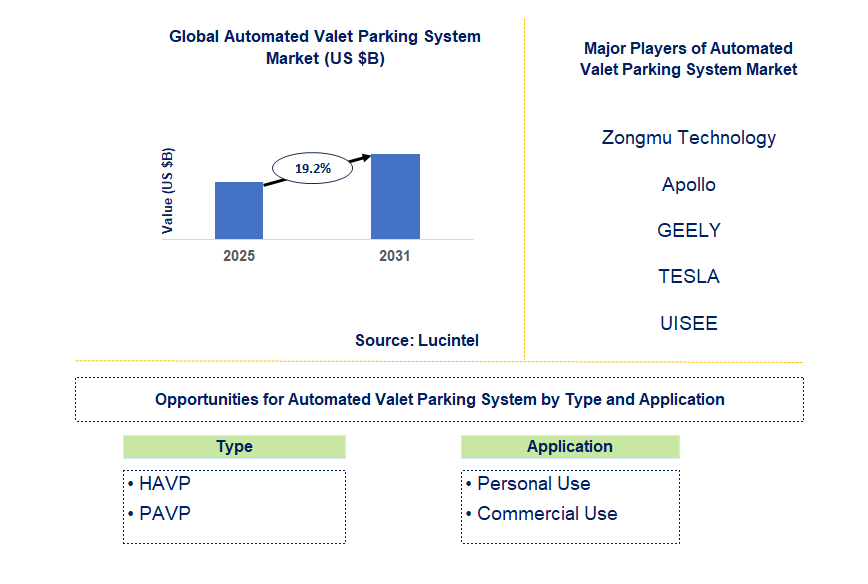
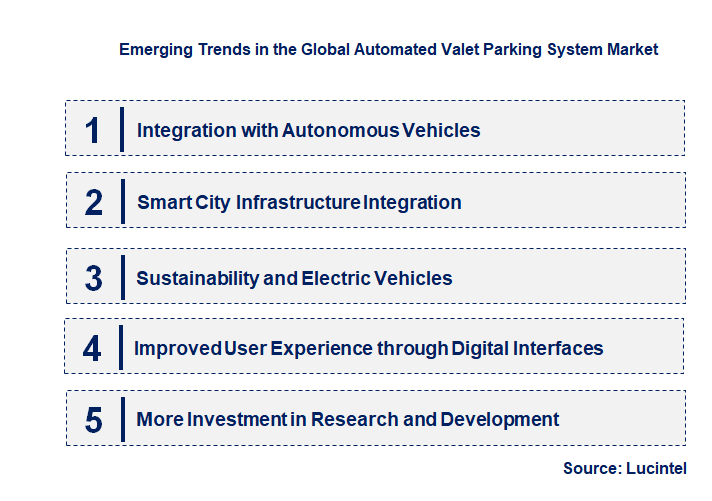
Emerging Trends in the Automated Valet Parking System Market
The automated valet parking system market is evolving rapidly, influenced by technological developments, consumer demands for convenience, and the integration of smart city infrastructure. A number of emerging trends are shaping the landscape of AVP systems. The trends include advancements in autonomous driving technology, growth in electric and connected vehicles, increased urbanization, regulatory changes, and the push for sustainability in parking management. As AVP systems become more sophisticated, these trends are influencing how parking is managed in urban centers worldwide, presenting new opportunities for growth and innovation in the market.• Integration with Autonomous Vehicles: The most significant trend in the market is the integration of automated valet parking systems with autonomous vehicles. As AVs become more mainstream, AVP systems are evolving to work seamlessly with these vehicles, allowing them to park autonomously without human intervention. This trend is particularly important for urban environments, where parking space is limited. Communication with AVP Infrastructure ensures that more parking spaces are utilized efficiently in a manner that reduces congestion and optimizes the flow of traffic in crowded cities.
• Smart City Infrastructure Integration: AVP systems are becoming integrated with the smart city infrastructure to enhance the mobility of people in urban environments. This includes the integration of AVP systems with existing platforms for traffic management, security, and data analytics. This way, cities can track and manage parking spots, manage traffic flow, and minimize congestion. In addition, the incorporation of AVP systems into public transport networks will be able to ensure seamless and sustainable urban mobility, thus improving the overall efficiency of city infrastructure while reducing the negative environmental impacts associated with traditional parking solutions.
• Sustainability and Electric Vehicles: With the growing concerns over climate change, the focus is more on making parking solutions sustainable. The development of AVP systems compatible with electric vehicles is on the rise because electric vehicles are expected to dominate the future automotive landscape. AVP systems are designed to optimize space and energy usage, thus reducing the carbon footprint of parking operations. Further, AVP infrastructure is being integrated with charging stations for EVs, which enables vehicles to automatically park and recharge without human intervention, thus enhancing sustainability in urban environments.
• Improved User Experience through Digital Interfaces: The user experience is an important consideration in the development of automated valet parking systems. With the help of digital interfaces, such as smartphone apps, users can seamlessly interact with AVP systems. Ease of booking, tracking of vehicles, and notifications in real time make the parking processes smooth and comfortable. Consumer demand is on the increase as such digital platforms are taken in while adopting AVP systems because users expect an efficient hassle-free parking experience. Thus, the propensity to increase will be enhanced by an increasing number of consumers embracing connected technologies in their daily lives.
• More Investment in Research and Development: There is a tremendous investment from both the public and private sectors in the automated valet parking market. Companies are putting a lot of resources into research and development (R&D) to enhance the efficiency, safety, and scalability of AVP systems. In an increasingly competitive automotive and tech sector, R&D is necessary to enhance the capabilities of AVP technology. This trend is accelerating the commercialization of AVP systems, with more pilot programs and real-world applications being developed globally. These emerging trends are transforming the AVP system market through the drive for innovation, betterment of user experience, and advancement in more sustainable and efficient parking solutions. This trend is to grow rapidly over the next decade with new technologies and business models that will define the management of parking in cities.
Recent Development in the Automated Valet Parking System Market
The automated valet parking system market has gained significant developments recently, due to the growth in autonomous vehicle technology, demand for urban mobility solutions, and integration of smart infrastructure. The players in the automobile, technology, and real estate sectors are heavily investing in making AVP systems available in the market. These developments focus on improving efficiency, safety, and user experience, with a growing emphasis on sustainability and the seamless integration of AVP systems into the existing urban mobility ecosystem.• Partnerships Between Automotive and Tech Companies: Many automotive companies are teaming up with tech firms to speed up the development and deployment of AVP systems. Such collaborations blend the strengths of car manufacturers in vehicle design with the technological muscle of companies specialized in AI, machine learning, and sensor technologies. By capitalizing on these strengths, the collaborations are paving the way for the rapid development of AVP solutions that are safe, reliable, and scalable.
• Pilot Programs and Real-World Testing: Currently, pilot programs for AVP systems have been undertaken in cities all over the globe. These help companies test whether AVP technology is viable within urban environments while working on addressing challenges such as optimizing parking spaces, reducing congestion, and even system integration. The success of pilot programs for AVP technology has opened its deployment in a wide range, from commercial regions to airports, residential complexes, and more.
• Government Regulations and Standardization: A very important aspect is the clear development of government regulations and industry standards for AVP systems in ensuring safe and efficient deployment of these technologies. In several countries, regulatory bodies are working to create frameworks addressing safety, data privacy, and integration with other transportation systems. Standardization is building consumer trust and facilitating widespread adoption of AVP systems while ensuring that such solutions are deployed consistently and reliably.
• Advancements in Sensor and Communication Technologies: The advancement of sensor and communication technologies is enabling AVP systems to become more accurate and reliable. Lidar, radar, and camera systems are now being used to provide high-resolution, real-time data for vehicle navigation in parking environments. Furthermore, vehicle-to-infrastructure (V2I) communication protocols are improving the interaction between AVP systems and the surrounding infrastructure, allowing for better coordination and smoother operation in complex urban environments.
• Compatibility with Electric Vehicle Charging Stations: As the uptake of electric vehicles (EVs) increases, AVP systems are being installed at EV charging stations to give a seamless experience to users. It allows for vehicles to be parked and charged automatically without the intervention of a human, hence increasing the convenience and efficiency of the overall parking experience. This development is critical in cities seeking to expand the infrastructure of EVs and to promote clean energy solutions. These strategic developments are transforming the automated valet parking system market by optimizing the functionality, scalability, and accessibility of the AVP offerings. As this continues to emerge, the marketplace is expected to witness higher adaptation and wider coverage of AVP systems in metropolitan cities, effectively enhancing the ease and efficiency with which parking will be managed.
Strategic Growth Opportunites in the Automated Valet Parking System Market
The automated valet parking system market offers a plethora of growth opportunities as urbanization continues to gain momentum and demand for smart city solutions increases. AVP systems are expected to revolutionize parking management, especially in crowded urban environments, with enhanced efficiency, reduced congestion, and better space utilization. There are significant growth opportunities emerging in various application areas, ranging from residential complexes to commercial and retail spaces, with huge investment from both public and private sectors. The following outlines five key growth opportunities in the AVP system market that will further spur innovation and expansion in the market.• Commercial Parking Facilities: One of the significant growth opportunities for commercial parking facilities such as shopping malls, office buildings, and airports is through automated valet parking systems. Most of these facilities have high demand for parking and can make full use of the available space by using AVP systems, which can reduce traffic congestion and enhance the user experience. With growing reliability and lower costs, more commercial parking operators are adopting AVP systems to stay competitive and meet the evolving needs of urban consumers.
• Smart Residential Complexes: With density in cities constantly on the rise, residential areas are one of the burgeoning demands for automated valet parking. AVP systems help residents have a convenient and space-saving parking facility by automating the process of parking as well as retrieving vehicles. They are particularly useful for multi-story buildings or gated communities where parking space is scarce. Developers realize now that AVP systems increase property value and help attract environmentally conscious residents, thus developing into a growing market segment for AVP solutions.
• Integration of Maas Platforms: With Mobility-as-a-Service (Maas) platforms that provide consumers with streamlined access to multiple modes of transportation, there is a great opportunity for AVP systems. With the integration of AVP solutions with Maas platforms, users can park their vehicles at designated locations and access other modes of transport, such as ride-sharing or public transit, without having to search for parking. This integration offers a holistic transportation experience, aligning with the growing demand for smart, connected mobility solutions in urban areas.
• Airport Parking Solutions: The most popular use of AVP systems is in the airport parking lots, where optimization of space and customer experience is highly critical. As the number of passengers continues to increase annually, airports have found it best to invest in AVP technology for an efficient and hassle-free parking experience. In an AVP system, passengers are allowed to drop off their vehicles at designated areas where the system automatically parks the vehicle, saving time and reducing congestion in parking areas. Airports are investing in AVP solutions for better operational efficiency and improved customer satisfaction.
• Electric Vehicle Infrastructure Integration: As the need for electric vehicles continues to rise, so does the requirement for AVP systems that can be seamlessly integrated into electric vehicle charging stations. Users can comfortably park and charge their vehicles with zero manual effort using this seamless integration that transcends both parking and charging conveniences. AVP providers can create a much more comprehensive and sustainable parking solution by partnering with EV manufacturers and charging infrastructure companies based on the increasing adoption of electric vehicles. These strategic growth prospects are accelerating the expansion of the automated valet parking system market by accommodating the changing needs of urban mobility. As a rising demand for smart, efficient, and sustainable parking solutions takes place, AVP systems have an important role to play in reshaping how cities worldwide will be car-parked in the future.
Automated Valet Parking System Market Driver and Challenges
Several technological, economic, and regulatory drivers and challenges govern the automated valet parking system market. Technological drivers range from advancements in autonomous driving to increasing urbanization and changing preferences of consumers with regard to convenience and sustainability. However, other challenges include a high cost for development, difficulties in regulation, and infrastructure that needs to be addressed for massive adoption. Understanding these drivers and challenges will enable stakeholders to make their way through the complex AVP system market landscape and capitalize on emerging opportunities. The factors responsible for driving the automated valet parking system market include: 1. Advancements in Autonomous Driving Technology: Continuous development in autonomous driving technologies is the most significant growth factor for the AVP market. As the capabilities of the vehicles increase, the interaction with the automated valet parking system is seamless. The advancements in sensor technologies, AI algorithms, and machine learning make the AVP systems more reliable and efficient, which are promoting their use in urban areas. 2. Urbanization: With the expansion of cities and the increase in their congestion levels, the requirement for efficient parking solutions is at an all-time high. Optimizing parking space utilization and easing traffic congestion through automated valet parking systems are very attractive to urban areas where parking space is limited. As the urban population increases, there is a resultant demand for AVP systems to enhance the general efficiency of the transportation infrastructure. 3. Consumer Demand for Convenience: The demands of consumers increase daily for hassle-free and convenient parking options. AVP, automated valet parking systems, offers efficient parking without the stress of looking for parking spots and saving time at such a place. As the consumers become more accustomed to various fully connected and automated technologies in other areas of their lives, their expectations will require greater convenience in parking, thus increasing their demand for AVP solutions. 4. Government Support and Regulatory Development: Around the world, governments are providing incentives and regulatory support to encourage the development and deployment of automated vehicle technologies, such as AVP systems. Authorities in many regions are updating their infrastructure and regulations to allow the safe integration of AVP solutions into urban environments. This is helping to hasten the commercialization of AVP systems. 5. Sustainability and Environmental Impact: AVP systems have seen a recent rise in usage because of their adoption due to growing emphasis on sustainability and environmental responsibility. Through optimization of the use of parking spaces and lowering traffic congestion, AVP solutions will help to minimize carbon emissions and energy usage. The association of EV charging stations with the AVP systems also increases environmental advantages of the two technologies. Challenges in the automated valet parking system market are: 1. High Development and Deployment Costs: Developing and deploying AVP systems requires large-scale investment in infrastructure, research, and technology. High development costs, particularly for autonomous vehicle systems and smart city integration, will be a barrier to its adoption. It is challenging for companies to find funds for mass deployment in urban areas, as initial investments are significant. 2. Regulatory and Safety Challenges: The regulatory landscape of AVP systems is still emerging, with several countries and regions working to provide clear frameworks for testing and deployment. Safety standards also need to be developed for ensuring the safe use of AVP systems for the public. Regulatory uncertainty and safety concerns can delay the AVP adoption rate, as developers and policymakers are working to find solutions to such challenges. 3. Infrastructure and Integration Requirements: AVP systems require a much larger amount of investment in terms of infrastructural change, including sensors, communication systems, and charging stations for vehicles. Integrating AVP systems into existing urban infrastructure is a complex and costly proposition, as old cities have much lesser amounts of smart infrastructure. Therefore, overcoming these integration challenges may be crucial for successfully deploying AVP solutions. The major drivers and challenges that are shaping the future of urban mobility in the automated valet parking system market are technological advancements, growing urbanization, and increasing demand for convenience. However, high development costs, regulatory hurdles, and infrastructure integration are some of the challenges that need to be addressed for widespread adoption. As stakeholders navigate these factors, the AVP market is poised to experience significant growth, with innovative solutions that will transform parking management in cities worldwide.List of Automated Valet Parking System Companies
Companies in the market compete on the basis of product quality offered. Major players in this market focus on expanding their manufacturing facilities, R&D investments, infrastructural development, and leverage integration opportunities across the value chain. With these strategies automated valet parking system companies cater increasing demand, ensure competitive effectiveness, develop innovative products & technologies, reduce production costs, and expand their customer base. Some of the automated valet parking system companies profiled in this report include-• Zongmu Technology
• Apollo
• GEELY
• TESLA
• UISEE
• Momenta
• MOTOVIS
Automated Valet Parking System Market by Segment
The study includes a forecast for the global automated valet parking system market by type, application, and region.Automated Valet Parking System Market by Type [Value from 2019 to 2031]:
• HAVP
• PAVP
Automated Valet Parking System Market by Application [Value from 2019 to 2031]:
• Personal Use
• Commercial Use
Automated Valet Parking System Market by Region [Value from 2019 to 2031]:
• North America
• Europe
• Asia Pacific
• The Rest of the World
Country Wise Outlook for the Automated Valet Parking System Market
The market for the automated valet parking system has gained significant ground lately, primarily due to the advancements in autonomous driving technologies, strong demand for smart city infrastructure, and increasing urbanization. The key focus has shifted to providing solutions that offer greater convenience, reduce parking congestion, and improve traffic flow in urban areas. Major developments have occurred in the United States, China, Germany, India, and Japan, through which top manufacturers, companies such as those offering technological capabilities, and regulators advance the commercialization of automated valet parking systems. Many investment and cooperation packages have been signed and have played a vital role in driving development.• United States: The U.S. has taken considerable steps in the development of automated valet parking systems, which are being experimented through various pilot projects and collaboration between tech companies and automotive manufacturers. Companies such as Tesla, Waymo, and General Motors are testing and refining their AVP solutions. In addition, cities like San Francisco and Los Angeles are implementing AVP technology in their smart city initiatives. Accelerated development is driven by government support for infrastructure like dedicated testing lanes and regulatory updates. In addition, U.S. companies are also working towards integrating AVP with electric vehicle (EV) infrastructure, which is likely to propel the growth of AVP solutions in cities.
• China: China is on the forefront in the development of AVP technology, which has been backed with massive investments by the government as well as private enterprises. Companies like Baidu, NIO, and Greely are successful in advancing autonomous vehicle technologies with special attention to parking automation. Shanghai and Beijing‘s pilot projects have been initiated for testing automated valet parking in commercial centers and airports. The secondly, China‘s regulations also embrace the testing and deployment of the AVP system, hence is making it easy for the country to lead at the international levels in autonomous vehicle and smart parking industries.
• Germany: Some of the largest vehicle manufacturers are situated in Germany like BMW, Audi, and Daimler are making some immense progress with respect to the implementation of the technology of AVP. Pilot projects in cities such as Stuttgart and Munich are being initiated to integrate the AVP systems with the already existing smart city infrastructure. The regulatory environment for autonomous vehicles in Germany is good, and research and development expenditure in this sector is high. German manufacturers also focus on making their AVP solutions safe to the highest levels, which would be a decisive factor for the public to accept and deploy on a large scale.
• India: In India, the adoption of automated valet parking systems is still in the development stage. Still, rapid urbanization in the country is creating a gradual demand for solutions that reduce parking congestions in major cities like Mumbai, Delhi, and Bangalore. Start-ups and manufacturers are slowly exploring AVP technologies, with some partnerships forming to test automated parking systems in select commercial and residential complexes. While regulatory frameworks are still evolving, there is a strong impetus from the public and private sectors alike to create smart cities, which can be a huge growth opportunity for AVP solutions in the future.
• Japan: Japan has already been leading innovation in robotics and autonomous vehicle technologies. It is not surprising that its focus on automated valet parking is also not behind. Companies such as Toyota, Nissan, and Honda are actively working on integrating AVP systems into their future vehicle lineups. The dense urban environment of Japan, especially in cities like Tokyo, makes AVP an attractive solution to ease parking congestion. Japan is also a leader in developing smart city infrastructure, and the government is supportive of efforts to integrate AVP technology into urban mobility solutions. Japan‘s very efficient public transport system also provides scope for a smooth integration with AVP systems.

Features of the Global Automated Valet Parking System Market
Market Size Estimates: Automated valet parking system market size estimation in terms of value ($B). Trend and Forecast Analysis: Market trends (2019 to 2024) and forecast (2025 to 2031) by various segments and regions. Segmentation Analysis: Automated valet parking system market size by type, application, and region in terms of value ($B). Regional Analysis: Automated valet parking system market breakdown by North America, Europe, Asia Pacific, and Rest of the World. Growth Opportunities: Analysis of growth opportunities in different type, application, and regions for the automated valet parking system market. Strategic Analysis: This includes M&A, new product development, and competitive landscape of the automated valet parking system market. Analysis of competitive intensity of the industry based on Porter’s Five Forces model.
FAQ
Q1. What is the growth forecast for automated valet parking system market? Answer: The global automated valet parking system market is expected to grow with a CAGR of 19.2% from 2025 to 2031. Q2. What are the major drivers influencing the growth of the automated valet parking system market? Answer: The major drivers for this market are rising need for more efficient, convenient, and easy-to-use parking systems, the escalation of traffic congestion combined with growing investments in smart city initiatives, and the increasing number of vehicles alongside limited parking space availability. Q3. What are the major segments for automated valet parking system market? Answer: The future of the automated valet parking system market looks promising with opportunities in the personal use and commercial use markets. Q4. Who are the key automated valet parking system market companies? Answer: Some of the key automated valet parking system companies are as follows:• Zongmu Technology
• Apollo
• GEELY
• TESLA
• UISEE
• Momenta
• MOTOVIS Q5. Which automated valet parking system market segment will be the largest in future? Answer: Lucintel forecasts that PAVP is expected to witness higher growth over the forecast period due to its larger consumer base, growing urbanization, and alignment with the increasing adoption of autonomous. Q6. In automated valet parking system market, which region is expected to be the largest in next 5 years? Answer: APAC is expected to witness the highest growth over the forecast period due to its rapid urbanization, large automotive markets, and strong government support for smart cities. Q7. Do we receive customization in this report? Answer: Yes, Lucintel provides 10% customization without any additional cost.
Table of Contents
Methodology
- In-depth interviews of the major players in this market
- Detailed secondary research from competitors’ financial statements and published data
- Extensive searches of published works, market, and database information pertaining to industry news, company press releases, and customer intentions
- A compilation of the experiences, judgments, and insights of Lucintel’s professionals, who have analyzed and tracked this market over the years.


Buy Now
Choose a license that fits your team. Instant PDF delivery.
Prices exclude taxes. Instant delivery. Custom licensing available on request.
Key Questions
- • What are some of the most promising, high-growth opportunities for the automated valet parking system market by type (HAVP and PAVP), application (personal use and commercial use), and region (North America, Europe, Asia Pacific, and the Rest of the World)?
- • Which segments will grow at a faster pace and why?
- • Which region will grow at a faster pace and why?
- • What are the key factors affecting market dynamics? What are the key challenges and business risks in this market?
- • What are the business risks and competitive threats in this market?
- • What are the emerging trends in this market and the reasons behind them?
- • What are some of the changing demands of customers in the market?
- • What are the new developments in the market? Which companies are leading these developments?
- • Who are the major players in this market? What strategic initiatives are key players pursuing for business growth?
- • What are some of the competing products in this market and how big of a threat do they pose for loss of market share by material or product substitution?
- • What M&A activity has occurred in the last 5 years and what has its impact been on the industry? For any questions related to Automated Valet Parking System Market, Automated Valet Parking System Market Size, Automated Valet Parking System Market Growth, Automated Valet Parking System Market Analysis, Automated Valet Parking System Market Report, Automated Valet Parking System Market Share, Automated Valet Parking System Market Trends, Automated Valet Parking System Market Forecast, Automated Valet Parking System Companies, write Lucintel analyst at email: helpdesk@lucintel.com. We will be glad to get back to you soon.


