
Report Feature
Autoencoder Market Trends and Forecast
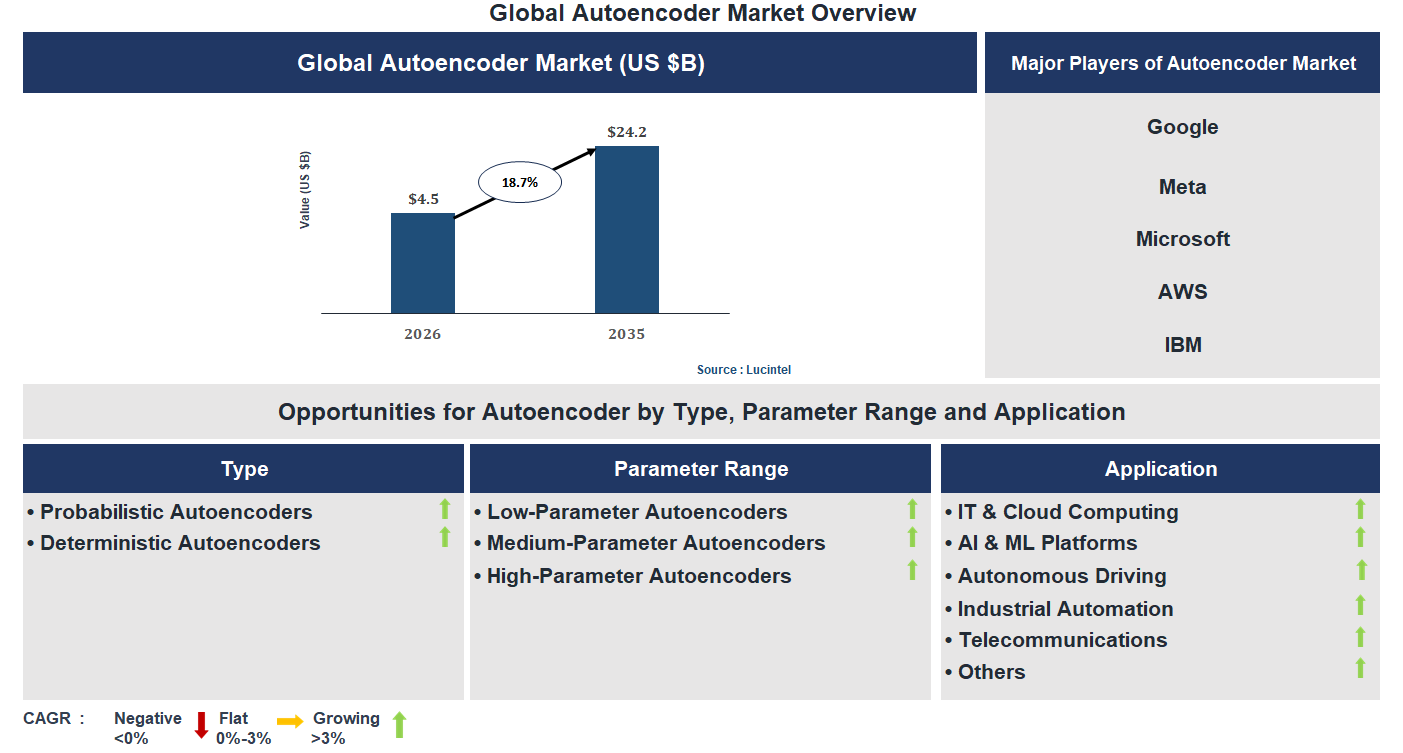
The future of the global autoencoder market looks promising with opportunities in the IT & cloud computing, AI & ML platform, autonomous driving, industrial automation, and telecommunication markets. The global autoencoder market is expected to reach an estimated $24.2 billion by 2035 with a CAGR of 18.7% from 2026 to 2035. The major drivers for this market are the rising demand for data compression & dimensionality reduction techniques, the growing need for anomaly detection in cybersecurity & fraud prevention, and the increasing adoption of AI & machine learning across industries.• Lucintel forecasts that, within the type category, probabilistic autoencoder is expected to witness higher growth over the forecast period.
• Within the application category, AI & ML platform is expected to witness the highest growth.
• In terms of region, APAC is expected to witness the highest growth over the forecast period. Gain valuable insights for your business decisions with our comprehensive 150+ page report. Sample figures with some insights are shown below.
Emerging Trends in the Autoencoder Market
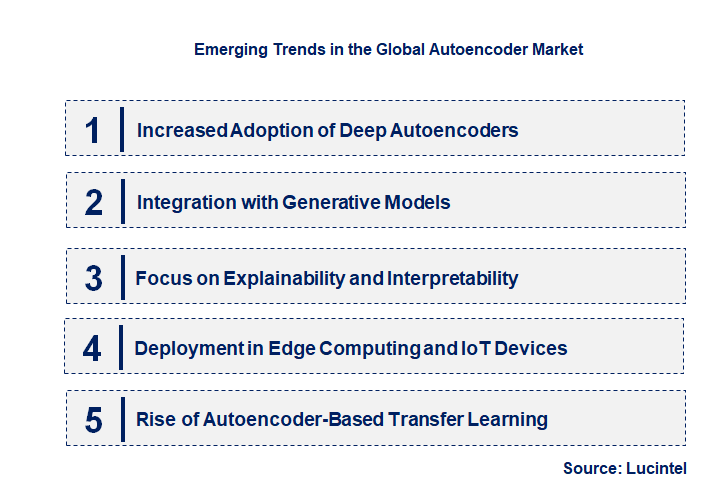
The autoencoder market is experiencing rapid growth driven by advancements in machine learning, increased demand for data compression, and the need for efficient feature extraction in various applications. As industries adopt more sophisticated AI solutions, the role of autoencoders becomes increasingly vital in enhancing data processing, reducing noise, and improving model accuracy. Emerging trends are shaping the future landscape of this market, influencing product development, deployment strategies, and competitive dynamics. These developments are not only expanding the scope of autoencoder applications but also driving innovation and investment, ultimately transforming how data is processed and utilized across sectors.• Increased Adoption of Deep Autoencoders: Deep autoencoders, with multiple layers, are gaining popularity due to their ability to learn complex data representations. They improve performance in tasks like image denoising, anomaly detection, and feature extraction. This trend is driven by the need for more accurate and efficient models capable of handling high-dimensional data. As a result, industries such as healthcare, finance, and autonomous vehicles are increasingly integrating deep autoencoders into their workflows, leading to enhanced data analysis capabilities and more robust AI systems.
• Integration with Generative Models: Autoencoders are increasingly being combined with generative models like GANs (Generative Adversarial Networks) to create hybrid systems that excel in data generation and reconstruction. This integration enhances the ability to generate realistic synthetic data, which is crucial for training robust models when data scarcity is an issue. The impact is significant in fields such as image synthesis, drug discovery, and virtual reality, where high-quality data generation is essential. This trend is expanding the functional scope of autoencoders beyond traditional compression and feature learning.
• Focus on Explainability and Interpretability: As AI applications become more embedded in critical decision-making processes, there is a growing emphasis on making autoencoders more interpretable. Researchers are developing techniques to visualize and understand the features learned by autoencoders, which helps in debugging models and ensuring compliance with regulatory standards. This trend improves trust and transparency in AI systems, especially in sensitive sectors like healthcare and finance, where understanding model decisions is crucial for adoption and ethical considerations.
• Deployment in Edge Computing and IoT Devices: The miniaturization and optimization of autoencoders are enabling their deployment on edge devices and IoT sensors. This trend allows real-time data processing and anomaly detection directly at the source, reducing latency and bandwidth requirements. Industries such as manufacturing, smart cities, and agriculture benefit from this development by enabling faster decision-making and reducing reliance on cloud infrastructure. The shift towards edge deployment is expanding the reach of autoencoders into new, resource-constrained environments.
• Rise of Autoencoder-Based Transfer Learning: Transfer learning with autoencoders is gaining traction as it allows models trained on large datasets to be adapted for specific tasks with limited data. This approach accelerates development cycles and reduces the need for extensive labeled datasets. It is particularly impactful in domains like medical imaging and speech recognition, where data collection is costly or time-consuming. This trend is fostering more flexible and scalable AI solutions, making autoencoders a key component in rapid deployment strategies across various sectors. These emerging trends are fundamentally reshaping the autoencoder market by enhancing model capabilities, expanding application areas, and improving deployment flexibility. The integration with generative models and focus on interpretability are driving innovation, while the shift towards edge computing and transfer learning is making autoencoders more accessible and practical for real-world use. As these trends continue to evolve, they will significantly influence the development of smarter, more efficient, and more transparent AI systems, ultimately transforming data processing and analysis across multiple industries.
Recent Development in the Autoencoder Market
The autoencoder market is experiencing rapid growth driven by advancements in machine learning, increased demand for data compression, and enhanced capabilities in anomaly detection. As industries adopt AI solutions, the development of more sophisticated autoencoders is transforming data processing and feature extraction. These innovations are opening new avenues for applications across healthcare, finance, and technology sectors, fostering competitive advantages and operational efficiencies. The evolving landscape presents significant opportunities for market expansion and technological breakthroughs.• Growing Demand for Data Compression: The need to efficiently store and transmit large volumes of data is fueling autoencoder adoption. These models excel at reducing data size while preserving essential information, making them vital for cloud storage, streaming services, and IoT devices. As data generation accelerates, autoencoders are becoming indispensable for optimizing bandwidth and storage costs, thereby expanding their market reach and application scope.
• Advancements in Deep Learning Architectures: Recent innovations in neural network design, such as convolutional and variational autoencoders, have enhanced model performance and versatility. These developments enable more accurate feature extraction, image reconstruction, and anomaly detection. Improved architectures are attracting industries seeking robust solutions for complex data analysis, thus driving market growth and encouraging further research and investment in autoencoder technologies.
• Increased Adoption in Healthcare Diagnostics: Autoencoders are increasingly used for medical image analysis, disease detection, and patient data anonymization. Their ability to identify subtle patterns and anomalies improves diagnostic accuracy and reduces manual effort. This adoption is transforming healthcare workflows, enabling early diagnosis, personalized treatment plans, and data privacy, which collectively boost the market by opening new revenue streams and fostering innovation in medical AI applications.
• Rising Use in Financial Fraud Detection: Financial institutions leverage autoencoders to detect fraudulent transactions and unusual account activities. Their capacity to learn normal behavior patterns and flag deviations enhances security measures. As cyber threats grow more sophisticated, autoencoders provide a scalable, efficient solution for real-time fraud detection, strengthening market demand. This trend is prompting financial firms to invest heavily in AI-driven security systems, further expanding the autoencoder market.
• Expansion into Industrial and Manufacturing Sectors: Autoencoders are increasingly employed for predictive maintenance, quality control, and process optimization. Their ability to analyze sensor data and detect anomalies reduces downtime and operational costs. As industries seek smarter manufacturing solutions, autoencoders are becoming integral to Industry 4.0 initiatives. This expansion is creating new market opportunities, encouraging cross-sector collaborations, and accelerating technological innovation in industrial AI applications. These developments are significantly impacting the autoencoder market by broadening application areas, improving model capabilities, and driving industry adoption. The integration of advanced architectures and sector-specific solutions is fostering market growth, attracting investments, and encouraging innovation. As these opportunities continue to evolve, the market is poised for sustained expansion, transforming data processing and AI-driven solutions across multiple industries.
Strategic Growth Opportunities in the Autoencoder Market
The autoencoder market is experiencing rapid growth driven by advancements in machine learning, data compression, and anomaly detection. As industries seek efficient ways to process and analyze large datasets, autoencoders are increasingly adopted for their ability to reduce dimensionality and enhance data quality. Emerging applications in healthcare, finance, and autonomous systems further expand market potential. Strategic investments and technological innovations are expected to accelerate growth, creating new opportunities for businesses to leverage autoencoder capabilities across diverse sectors.• Expanding Use in Healthcare Data Analysis: Autoencoders are increasingly used in healthcare for medical image denoising, anomaly detection, and patient data compression. They enable efficient processing of large, complex datasets, improving diagnostic accuracy and reducing computational costs. As healthcare data volume grows exponentially, autoencoders facilitate real-time analysis and personalized treatment plans, driving adoption in hospitals and research institutions. This expansion enhances diagnostic tools and supports predictive analytics, making healthcare delivery more efficient and precise.
• Growing Adoption in Anomaly Detection and Fraud Prevention: Autoencoders are vital for detecting anomalies in financial transactions, network security, and industrial systems. Their ability to learn normal data patterns and identify deviations makes them ideal for fraud detection and cybersecurity. As cyber threats and financial fraud become more sophisticated, autoencoders offer scalable, real-time solutions. Increased investment in security infrastructure and regulatory compliance further propels their use, helping organizations mitigate risks and maintain operational integrity.
• Integration into Autonomous and IoT Systems: Autoencoders play a crucial role in autonomous vehicles and Internet of Things (IoT) devices by enabling efficient sensor data compression and feature extraction. They improve real-time decision-making and reduce bandwidth requirements for transmitting large sensor datasets. As autonomous systems and IoT networks expand, autoencoders facilitate faster processing and enhanced system reliability. This integration supports smarter, more responsive devices, fostering innovation in transportation, smart cities, and industrial automation.
• Advancements in Deep Learning and Model Optimization: Continuous improvements in neural network architectures and training algorithms enhance autoencoder performance. Techniques like variational autoencoders and denoising autoencoders expand application scope, enabling more accurate data reconstruction and generative modeling. Optimization for edge computing and low-power devices broadens usability in resource-constrained environments. These advancements drive innovation, reduce costs, and improve scalability, making autoencoders more accessible for diverse applications across industries.
• Rising Demand for Data Compression and Dimensionality Reduction: As data volumes grow exponentially, autoencoders are increasingly used for efficient data compression and feature extraction. They enable storage and transmission of large datasets with minimal loss of information, essential for cloud computing and big data analytics. Their ability to reduce dimensionality while preserving critical features accelerates machine learning workflows. This demand supports faster data processing, lowers infrastructure costs, and enhances analytical capabilities across sectors like finance, retail, and telecommunications. These growth opportunities significantly impact the autoencoder market by expanding its application scope and enhancing technological capabilities. Increased adoption across healthcare, security, autonomous systems, and data management will drive market expansion, foster innovation, and create competitive advantages. As industries recognize the value of autoencoders in optimizing data processing and analysis, the market is poised for sustained growth, attracting investments and accelerating technological breakthroughs.
Autoencoder Market Driver and Challenges
The autoencoder market is influenced by a variety of technological, economic, and regulatory factors that shape its growth and development. Advances in machine learning and deep learning technologies have significantly increased the adoption of autoencoders across industries. Economic factors such as increasing investments in AI research and the rising demand for data compression and anomaly detection further propel market expansion. Regulatory frameworks around data privacy and security also impact how autoencoders are developed and deployed. These drivers and challenges collectively determine the pace and direction of market growth, requiring stakeholders to adapt to rapid technological changes and evolving regulatory landscapes. The factors responsible for driving the autoencoder market include:-• Technological Advancements: The continuous evolution of deep learning architectures has enhanced autoencoder capabilities, enabling more efficient data compression, feature extraction, and anomaly detection. These improvements facilitate broader application across sectors like healthcare, finance, and automotive. As hardware accelerates processing speeds, autoencoders can handle larger datasets with greater accuracy, fostering innovation and adoption. The integration of autoencoders with other AI models further expands their utility, making them indispensable tools in modern AI ecosystems.
• Increasing Data Volumes: The exponential growth of data generated by IoT devices, social media, and enterprise systems necessitates effective data management solutions. Autoencoders excel at reducing data dimensionality while preserving essential information, making them ideal for handling big data. This capability supports real-time analytics, predictive modeling, and efficient storage, which are critical for industries aiming to leverage data-driven insights. As data volumes continue to surge, the demand for autoencoders is expected to rise correspondingly.
• Rising Adoption in Healthcare: The healthcare sector increasingly relies on autoencoders for medical image denoising, anomaly detection, and patient data analysis. These applications improve diagnostic accuracy and streamline workflows. Autoencoders facilitate the extraction of meaningful features from complex medical data, enabling early disease detection and personalized treatment plans. The growing emphasis on AI-driven healthcare solutions and the need for secure, efficient data processing are significant drivers fueling market growth.
• Growing Use in Anomaly Detection and Security: Autoencoders are widely used for detecting anomalies in network security, fraud detection, and industrial monitoring. Their ability to learn normal patterns and identify deviations makes them valuable for safeguarding digital assets. As cyber threats become more sophisticated, the demand for advanced anomaly detection tools like autoencoders increases. This trend is particularly prominent in finance, cybersecurity, and manufacturing sectors, where early detection of irregularities is crucial. The challenges in the autoencoder market are:
• Data Privacy and Regulatory Concerns: The deployment of autoencoders often involves processing sensitive data, raising privacy issues and compliance challenges. Regulations such as GDPR and HIPAA impose strict guidelines on data handling, which can limit the scope of autoencoder applications. Ensuring data security while maintaining model performance requires sophisticated techniques, increasing complexity and cost. Navigating these regulatory landscapes is a significant hurdle for market players aiming to expand their autoencoder solutions globally.
• Model Interpretability and Trust: Despite their effectiveness, autoencoders are often viewed as "black box" models, making it difficult to interpret their outputs. This lack of transparency hampers trust among users, especially in critical sectors like healthcare and finance. Developing explainable autoencoders is essential to facilitate wider acceptance and regulatory approval. The challenge lies in balancing model complexity with interpretability without compromising performance
• High Computational Costs: Training deep autoencoders demands substantial computational resources, including high-performance GPUs and extensive energy consumption. This requirement can be prohibitive for small and medium-sized enterprises, limiting market accessibility. Additionally, the need for large labeled datasets for supervised fine-tuning increases costs and development time. Overcoming these computational barriers is vital for democratizing autoencoder technology and fostering widespread adoption. In summary, the autoencoder market is driven by rapid technological innovations, increasing data demands, and expanding applications in healthcare and security. However, challenges such as data privacy, model interpretability, and high computational costs pose significant hurdles. These factors collectively influence the markets growth trajectory, requiring stakeholders to innovate and adapt to ensure sustainable expansion. Addressing regulatory concerns and improving model transparency will be crucial for unlocking the full potential of autoencoders across diverse industries.
List of Autoencoder Companies
Companies in the market compete on the basis of product quality offered. Major players in this market focus on expanding their manufacturing facilities, R&D investments, infrastructural development, and leverage integration opportunities across the value chain. With these strategies autoencoder companies cater increasing demand, ensure competitive effectiveness, develop innovative products & technologies, reduce production costs, and expand their customer base. Some of the autoencoder companies profiled in this report include-• Meta
• Microsoft
• AWS
• IBM
• Oracle
• Skymind
• Infosys
• H2O.ai
• Maruti Techlabs
Autoencoder Market by Segment
The study includes a forecast for the global autoencoder market by type, parameter range, application, and region.Autoencoder Market by Type [Value from 2019 to 2035]:
• Probabilistic Autoencoders
• Deterministic Autoencoders
Autoencoder Market by Parameter Range [Value from 2019 to 2035]:
• Low-Parameter Autoencoders
• Medium-Parameter Autoencoders
• High-Parameter Autoencoders
Autoencoder Market by Application [Value from 2019 to 2035]:
• IT & Cloud Computing
• AI & ML Platforms
• Autonomous Driving
• Industrial Automation
• Telecommunications
• Others
Autoencoder Market by Region [Value from 2019 to 2035]:
• North America
• Europe
• Asia Pacific
• The Rest of the World
Country Wise Outlook for the Autoencoder Market
The autoencoder market has experienced significant growth driven by advancements in artificial intelligence, machine learning, and data processing technologies. As industries increasingly rely on efficient data compression, anomaly detection, and feature extraction, key players and emerging startups are innovating rapidly. The United States, China, Germany, India, and Japan are at the forefront of these developments, each contributing unique technological advancements and strategic initiatives. These countries are leveraging their technological ecosystems, research capabilities, and industrial needs to shape the future of autoencoder applications across sectors such as healthcare, automotive, finance, and manufacturing.• United States: The US market has seen substantial investments in AI startups focusing on autoencoder applications for healthcare diagnostics, autonomous vehicles, and cybersecurity. Major tech giants like Google and Microsoft are integrating autoencoders into their cloud services, enhancing data security and predictive analytics. Research institutions are pioneering novel architectures that improve model efficiency and interpretability, fostering innovation in real-time data processing and anomaly detection.
• China: China is rapidly expanding its autoencoder research, particularly in smart manufacturing, facial recognition, and financial fraud detection. Government initiatives support AI development, leading to increased deployment of autoencoders in industrial automation and surveillance systems. Chinese tech firms are also developing lightweight autoencoders suitable for mobile and edge devices, boosting applications in IoT and smart city projects.
• Germany: Germany’s focus on industrial automation and automotive manufacturing has driven advancements in autoencoder-based fault detection and predictive maintenance. Leading automotive and engineering companies are adopting autoencoders for quality control and process optimization. Additionally, research institutions are exploring eco-friendly AI solutions, integrating autoencoders with other machine learning models to enhance sustainability efforts.
• India: The Indian market is witnessing a surge in autoencoder applications within the fintech and healthcare sectors. Startups are utilizing autoencoders for fraud detection, credit scoring, and medical image analysis. Government initiatives promoting digital transformation and AI research are fostering local innovation, with a focus on developing cost-effective and scalable autoencoder solutions suitable for diverse socio-economic contexts.
• Japan: Japan’s autoencoder market is characterized by advancements in robotics, manufacturing, and healthcare. Leading corporations are integrating autoencoders into robotic vision systems and quality inspection processes. Japan’s emphasis on precision and reliability is driving research into robust autoencoder architectures capable of functioning in challenging environments, supporting the country’s aging population and industrial automation needs.

Features of the Global Autoencoder Market
Market Size Estimates: Autoencoder market size estimation in terms of value ($B). Trend and Forecast Analysis: Market trends (2019 to 2025) and forecast (2026 to 2035) by various segments and regions. Segmentation Analysis: Autoencoder market size by type, parameter range, application, and region in terms of value ($B). Regional Analysis: Autoencoder market breakdown by North America, Europe, Asia Pacific, and Rest of the World. Growth Opportunities: Analysis of growth opportunities in different types, parameter range, applications, and regions for the autoencoder market. Strategic Analysis: This includes M&A, new product development, and competitive landscape of the autoencoder market. Analysis of competitive intensity of the industry based on Porter’s Five Forces model.
FAQ
Q1. What is the market size and growth forecast for autoencoder market? Answer: The global autoencoder market is expected to reach an estimated $24.2 billion by 2035 and grow with a CAGR of 18.7% from 2026 to 2035. Q2. What are the major drivers influencing the growth of the autoencoder market? Answer: The major drivers for this market are the rising demand for data compression & dimensionality reduction techniques, the growing need for anomaly detection in cybersecurity & fraud prevention, and the increasing adoption of AI & machine learning across industries. Q3. What are the major segments for autoencoder market? Answer: The future of the autoencoder market looks promising with opportunities in the IT & cloud computing, AI & ML platform, autonomous driving, industrial automation, and telecommunication markets. Q4. Who are the key autoencoder market companies? Answer: Some of the key autoencoder companies are as follows:• Meta
• Microsoft
• AWS
• IBM
• Oracle
• Skymind
• Infosys
• H2O.ai
• Maruti Techlabs Q5. Which autoencoder market segment will be the largest in future? Answer: Lucintel forecasts that, within the type category, probabilistic autoencoder is expected to witness higher growth over the forecast period. Q6. In autoencoder market, which region is expected to be the largest in next 5 years? Answer: In terms of region, APAC is expected to witness the highest growth over the forecast period. Q7. Do we receive customization in this report? Answer: Yes, Lucintel provides 10% customization without any additional cost.
Table of Contents
List of Figures
List of Tables
Methodology
- In-depth interviews of the major players in this market
- Detailed secondary research from competitors’ financial statements and published data
- Extensive searches of published works, market, and database information pertaining to industry news, company press releases, and customer intentions
- A compilation of the experiences, judgments, and insights of Lucintel’s professionals, who have analyzed and tracked this market over the years.


Buy Now
Choose a license that fits your team. Instant PDF delivery.
Prices exclude taxes. Instant delivery. Custom licensing available on request.
Key Questions
- • What are some of the most promising, high-growth opportunities for the autoencoder market by type (probabilistic autoencoders and deterministic autoencoders), parameter range (low-parameter autoencoders, medium-parameter autoencoders, and high-parameter autoencoders), application (IT & cloud computing, AI & ML platforms, autonomous driving, industrial automation, telecommunications, and others), and region (North America, Europe, Asia Pacific, and the Rest of the World)?
- • Which segments will grow at a faster pace and why?
- • Which region will grow at a faster pace and why?
- • What are the key factors affecting market dynamics? What are the key challenges and business risks in this market?
- • What are the business risks and competitive threats in this market?
- • What are the emerging trends in this market and the reasons behind them?
- • What are some of the changing demands of customers in the market?
- • What are the new developments in the market? Which companies are leading these developments?
- • Who are the major players in this market? What strategic initiatives are key players pursuing for business growth?
- • What are some of the competing products in this market and how big of a threat do they pose for loss of market share by material or product substitution?
- • What M&A activity has occurred in the last 7 years and what has its impact been on the industry? For any questions related to Autoencoder Market, Autoencoder Market Size, Autoencoder Market Growth, Autoencoder Market Analysis, Autoencoder Market Report, Autoencoder Market Share, Autoencoder Market Trends, Autoencoder Market Forecast, Autoencoder Companies, write Lucintel analyst at email: helpdesk@lucintel.com. We will be glad to get back to you soon.


