
Report Feature
Autoclaved Aerated Concrete Market Trends and Forecast
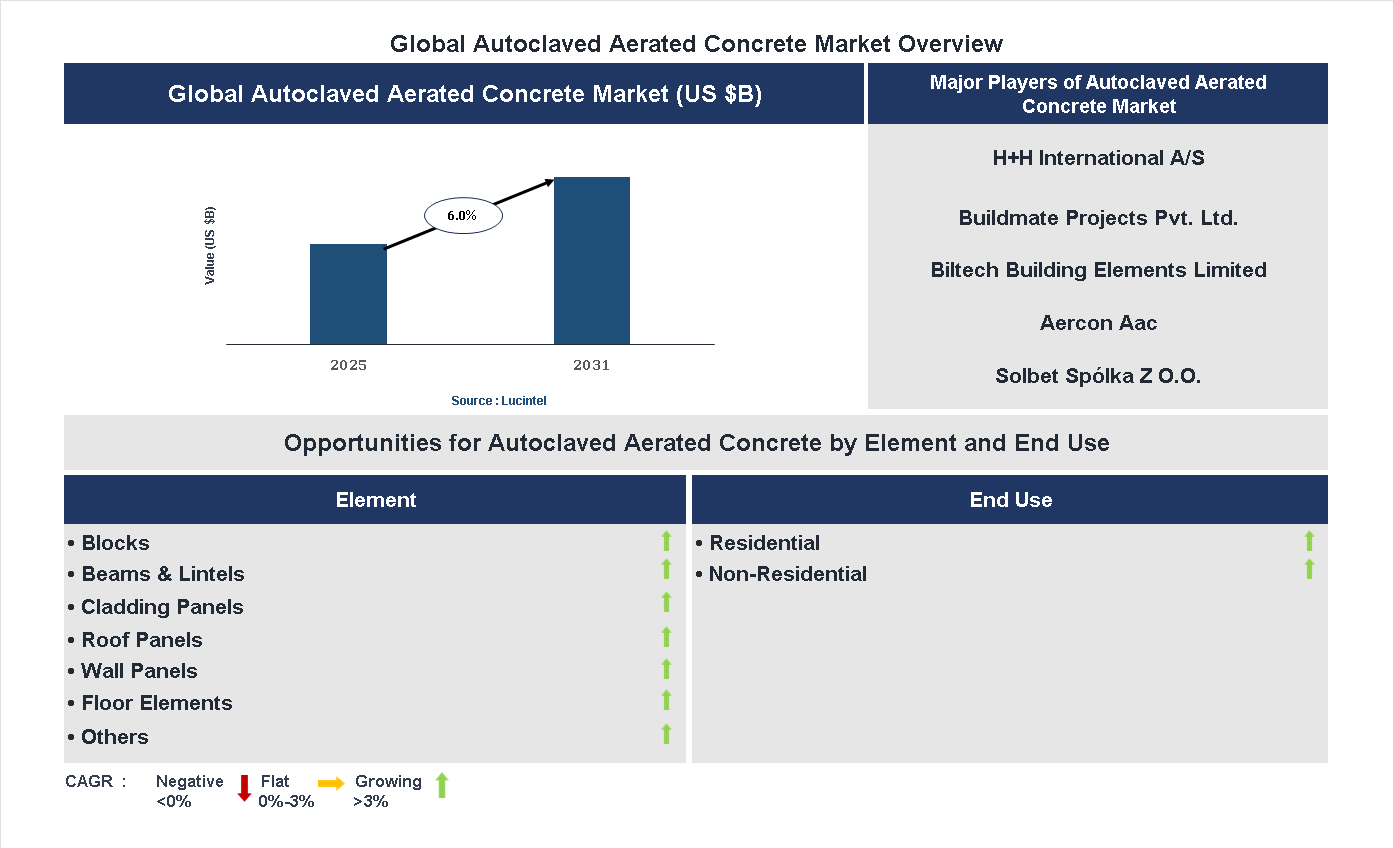
The future of the global autoclaved aerated concrete market looks promising with opportunities in the residential and non-residential markets. The global autoclaved aerated concrete market is expected to grow with a CAGR of 6% from 2025 to 2031. The major drivers for this market are the increasing demand for energy efficient building materials, the rising adoption in residential construction projects, and the growing focus on sustainable lightweight construction solutions.• Lucintel forecasts that, within the element category, wall panel is expected to witness the highest growth over the forecast period.
• Within the end use category, residential is expected to witness higher growth.
• In terms of region, APAC is expected to witness the highest growth over the forecast period. Gain valuable insights for your business decisions with our comprehensive 150+ page report. Sample figures with some insights are shown below.
Emerging Trends in the Autoclaved Aerated Concrete Market
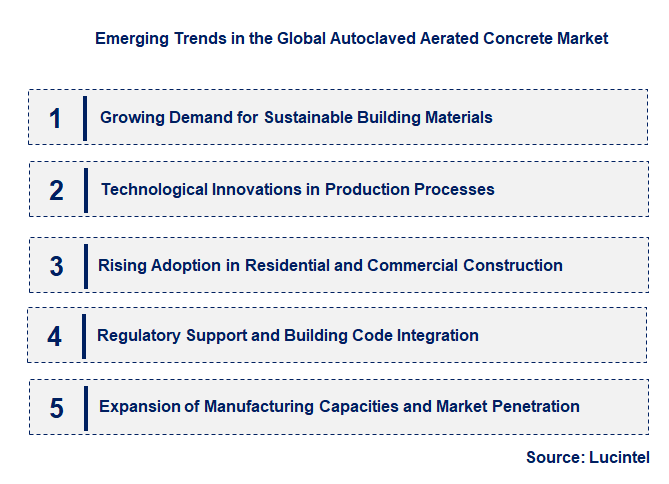
The autoclaved aerated concrete market is experiencing rapid growth driven by increasing demand for sustainable, energy-efficient, and cost-effective building materials. As the construction industry shifts towards greener solutions, AACs lightweight, insulating, and fire-resistant properties make it a preferred choice worldwide. Technological advancements and regulatory changes are further propelling market expansion. These developments are not only transforming manufacturing and application practices but also influencing global construction trends. Understanding these emerging trends is crucial for stakeholders aiming to capitalize on the markets potential and adapt to the evolving landscape of sustainable construction materials.• Growing Demand for Sustainable Building Materials: The push for eco-friendly construction is significantly boosting AAC adoption. Governments and industry players are emphasizing green building certifications, which favor materials like AAC that reduce carbon footprints. Its energy-efficient properties contribute to lower operational costs and environmental impact, making it a preferred choice for sustainable development projects. This trend is encouraging manufacturers to innovate and expand production capacities, ultimately leading to increased market penetration and a shift towards greener construction practices globally.
• Technological Innovations in Production Processes: Advances in manufacturing technology are enhancing AAC quality and reducing production costs. Innovations such as automation, improved autoclaving techniques, and raw material optimization are making AAC more competitive against traditional materials like concrete and brick. These technological improvements enable higher precision, better insulation properties, and faster production cycles, which benefit builders and developers. As a result, the market is witnessing increased adoption of AAC in diverse construction applications, fostering industry growth and encouraging new entrants to innovate further.
• Rising Adoption in Residential and Commercial Construction: The versatility of AAC makes it suitable for various building types, leading to increased adoption in residential, commercial, and institutional projects. Its lightweight nature simplifies transportation and installation, reducing labor costs and construction time. Additionally, its fire resistance, sound insulation, and thermal efficiency appeal to developers aiming for high-performance buildings. This trend is expanding the market beyond traditional regions, with emerging economies recognizing AACs benefits, thereby fueling global demand and encouraging infrastructure development.
• Regulatory Support and Building Code Integration: Governments worldwide are incorporating AAC into building codes and standards to promote sustainable construction. Incentives, subsidies, and regulations favoring energy-efficient materials are encouraging architects and builders to choose AAC. This regulatory backing enhances market credibility and accelerates adoption across various regions. As building codes evolve to prioritize safety, energy efficiency, and environmental impact, AACs compliance advantages position it as a strategic material choice, further driving market growth and innovation.
• Expansion of Manufacturing Capacities and Market Penetration: To meet rising demand, manufacturers are expanding production facilities and investing in research and development. This expansion improves supply chain efficiency and reduces costs, making AAC more accessible and affordable. Market penetration is also facilitated by strategic partnerships and collaborations with construction firms. As manufacturing capacities grow, especially in emerging markets, AAC is becoming a mainstream construction material, leading to increased competition, innovation, and a broader global footprint for the industry. In summary, these emerging trends are collectively reshaping the AAC market by promoting sustainability, technological advancement, regulatory support, and expanded application. They are driving increased adoption, reducing costs, and fostering innovation, which positions AAC as a key material in the future of sustainable construction worldwide.
Recent Development in the Autoclaved Aerated Concrete Market
The autoclaved aerated concrete market has experienced significant growth driven by increasing demand for sustainable and energy-efficient building materials. Innovations in manufacturing processes, rising construction activities worldwide, and a shift towards eco-friendly construction practices are shaping the market landscape. Technological advancements and regulatory support further bolster market expansion. As urbanization accelerates, the AAC market is poised for continued growth, offering cost-effective and environmentally friendly solutions for modern construction needs. These developments reflect a broader trend towards sustainable infrastructure, influencing market dynamics and competitive strategies across the industry.• Technological Innovations in Production: Advances in manufacturing technology have improved AAC quality and reduced production costs. New methods enhance material strength and insulation properties, making AAC more attractive to builders. These innovations enable manufacturers to meet stricter building codes and sustainability standards, expanding market reach. The improved efficiency also shortens production cycles, increasing supply capacity and reducing prices, which benefits consumers and developers alike.
• Rising Adoption in Residential and Commercial Construction: Increasing urbanization and infrastructure development have driven higher demand for AAC in residential and commercial projects. Its lightweight, fire-resistant, and insulating properties make it ideal for diverse construction applications. Governments and private sectors are promoting eco-friendly building materials, further boosting adoption. This trend results in a broader market base, with more projects opting for AAC over traditional materials, thereby accelerating market growth.
• Regulatory Support and Green Building Certifications: Governments worldwide are implementing policies favoring sustainable construction materials, including AAC. Incentives, tax benefits, and green building certifications like LEED encourage developers to choose AAC. These regulatory frameworks create a favorable environment for market expansion, ensuring compliance with environmental standards. As a result, manufacturers are investing more in eco-friendly production methods, aligning with global sustainability goals.
• Expansion in Emerging Markets: Rapid urbanization in Asia-Pacific, Latin America, and Africa is opening new opportunities for AAC manufacturers. These regions are experiencing increased infrastructure investments and a shift towards sustainable building practices. Local manufacturers are adopting innovative production techniques to meet regional demand. This expansion diversifies the market, reduces dependency on traditional construction materials, and fosters competitive growth in emerging economies.
• Strategic Mergers and Acquisitions: Major players in the AAC market are engaging in mergers and acquisitions to strengthen their market position. These strategic moves facilitate technology sharing, expand product portfolios, and increase global footprint. Such consolidation enhances competitiveness and accelerates innovation. It also helps companies better meet regional demands and comply with evolving regulations, ultimately driving market stability and growth. In summary, technological advancements, increased adoption, supportive regulations, emerging market expansion, and strategic corporate activities are collectively propelling the AAC market forward. These developments are fostering a more sustainable, efficient, and competitive industry landscape, aligning with global trends toward eco-friendly construction practices.
Strategic Growth Opportunities in the Autoclaved Aerated Concrete Market
The autoclaved aerated concrete market is experiencing rapid growth driven by increasing demand for sustainable, energy-efficient building materials. As construction standards evolve and environmental concerns rise, AAC offers a lightweight, durable, and eco-friendly alternative to traditional materials. Key applications such as residential, commercial, infrastructure, industrial, and renovation projects are fueling this expansion. Companies are exploring innovative solutions to meet diverse needs, creating significant opportunities for market players. These developments are shaping the future landscape of construction, emphasizing sustainability, cost-efficiency, and technological advancements. The following are five key growth opportunities across different applications in the AAC market.• Residential Construction: Growing demand for energy-efficient homes : Increasing consumer awareness and government incentives for green buildings are driving the adoption of AAC in residential projects. Its thermal insulation properties reduce energy costs, making it attractive for eco-conscious homeowners. The lightweight nature of AAC also simplifies construction, reducing labor and time. As urbanization accelerates, the need for sustainable housing solutions boosts AACs market share in residential construction, supporting long-term growth.
• Commercial Buildings: Emphasis on sustainable commercial infrastructure : The commercial sector is prioritizing eco-friendly and energy-efficient buildings to meet regulatory standards and corporate sustainability goals. AACs fire resistance, soundproofing, and thermal insulation make it ideal for offices, malls, and hotels. Its ease of installation and low maintenance costs further enhance its appeal. This focus on green building certifications and LEED standards is expanding AACs role in commercial construction, fostering significant market growth.
• Infrastructure Projects: Adoption in public infrastructure development : Governments and private entities are increasingly incorporating AAC in infrastructure projects such as bridges, tunnels, and public facilities. Its lightweight and durability reduce transportation and construction costs. Additionally, AACs fire and pest resistance improve safety and longevity. As infrastructure investments rise globally, AACs application in this sector is expected to grow, offering sustainable and cost-effective solutions for large-scale projects.
• Industrial Applications: Use in industrial facilities and warehouses : The industrial sector is adopting AAC for constructing warehouses, factories, and storage units due to its fire resistance and thermal insulation. Its ability to withstand harsh environments and reduce energy consumption makes it suitable for industrial use. The lightweight nature facilitates faster construction, minimizing downtime. As industries seek sustainable and resilient building materials, AACs industrial application is poised for expansion, supporting market diversification.
• Renovation and Retrofitting: Growing trend of building upgrades : The renovation sector is increasingly utilizing AAC for retrofitting existing structures to improve energy efficiency and structural integrity. Its compatibility with various construction techniques and minimal disruption during installation make it ideal for upgrades. Governments focus on sustainable urban renewal projects further accelerates this trend. The rising need for building modernization presents a substantial opportunity for AAC to penetrate the renovation market, promoting sustainable development. In summary, these growth opportunities across key applications are significantly impacting the AAC market by expanding its adoption, fostering innovation, and emphasizing sustainability. As demand for eco-friendly and cost-effective construction materials increases globally, AACs versatility and performance are positioning it as a preferred choice across diverse sectors, ensuring sustained market growth and development.
Autoclaved Aerated Concrete Market Driver and Challenges
The autoclaved aerated concrete market is influenced by a variety of technological, economic, and regulatory factors that shape its growth trajectory. Technological advancements in manufacturing processes and product innovation drive market expansion, while economic conditions such as construction activity levels and infrastructure development influence demand. Regulatory frameworks concerning building codes and environmental standards also play a crucial role in shaping market dynamics. Additionally, factors like urbanization, sustainability initiatives, and cost-efficiency considerations impact the adoption of AAC. Navigating these drivers and overcoming associated challenges is essential for stakeholders aiming to capitalize on the markets potential and ensure sustainable growth in the construction industry. The factors responsible for driving the autoclaved aerated concrete market include:• Technological Innovation: The development of advanced manufacturing techniques has significantly improved the quality, strength, and insulation properties of AAC. Innovations such as automation and improved curing processes have enhanced production efficiency, reduced costs, and enabled the creation of more versatile products. These technological improvements make AAC more attractive to builders and architects, fostering increased adoption in residential, commercial, and industrial construction projects. As a result, the market experiences steady growth driven by continuous innovation aimed at meeting evolving construction standards and sustainability goals.
• Growing Construction and Infrastructure Development: Rapid urbanization and infrastructure expansion in emerging economies are major drivers for the AAC market. Governments and private sector investments in affordable housing, commercial complexes, and public infrastructure projects increase demand for lightweight, energy-efficient building materials like AAC. Its ease of installation and superior thermal insulation properties make it a preferred choice for large-scale construction projects. The ongoing focus on sustainable development further amplifies the demand for eco-friendly building materials, positioning AAC as a key component in modern construction practices.
• Environmental Regulations and Sustainability Trends: Increasing environmental awareness and stricter regulations regarding carbon emissions and energy efficiency are propelling the adoption of AAC. Its eco-friendly manufacturing process, which involves less energy consumption and produces minimal waste, aligns with global sustainability goals. Additionally, AACs excellent thermal insulation reduces energy consumption in buildings, contributing to lower greenhouse gas emissions. These factors encourage builders and developers to opt for AAC to meet regulatory standards and achieve green building certifications, thereby expanding its market share.
• Cost-Effectiveness and Energy Efficiency: AAC offers significant cost advantages over traditional construction materials due to its lightweight nature, ease of handling, and reduced labor requirements. Its superior thermal insulation properties lead to lower energy costs for heating and cooling, making it an economically attractive option for end-users. The overall reduction in construction time and material costs further enhances its appeal, especially in cost-sensitive markets. As energy efficiency becomes a priority globally, the economic benefits of AAC are expected to drive increased adoption across various regions.
• Market Expansion and Product Diversification: The expanding product portfolio and increasing geographic reach of AAC manufacturers are fueling market growth. Companies are diversifying their offerings by developing different sizes, shapes, and composite materials to cater to specific construction needs. Strategic partnerships, acquisitions, and regional expansion initiatives enable manufacturers to penetrate new markets, including developing countries with rising construction activities. This diversification and expansion facilitate broader adoption of AAC, supporting the overall growth of the market by addressing diverse customer requirements and regional standards. The challenges facing this autoclaved aerated concrete market include:
• High Initial Investment and Cost Barriers: Despite its long-term savings, the initial costs associated with AAC production facilities and equipment are substantial. This high capital expenditure can deter new entrants and limit adoption in price-sensitive markets. Additionally, the relatively higher cost of raw materials and specialized manufacturing processes can impact profit margins. These financial barriers pose challenges for small and medium-sized enterprises seeking to enter or expand within the AAC market, potentially slowing overall market growth.
• Lack of Skilled Workforce and Technical Expertise: The specialized nature of AAC manufacturing and installation requires skilled labor and technical expertise. A shortage of trained personnel can lead to quality inconsistencies, increased project delays, and higher costs. This skills gap hampers the widespread adoption of AAC, especially in regions where construction practices are still evolving. Addressing this challenge necessitates investment in training programs and knowledge transfer, which can be time-consuming and resource-intensive.
• Regulatory and Standardization Challenges: Variability in building codes, standards, and certification processes across different regions can hinder the uniform adoption of AAC. Lack of clear regulations or recognition of AAC as a standard construction material limits its acceptance in certain markets. Additionally, compliance with evolving environmental and safety standards requires continuous product innovation and certification efforts. These regulatory hurdles can slow market penetration and create uncertainties for manufacturers and consumers alike. In summary, the AAC market is driven by technological advancements, urbanization, sustainability trends, economic benefits, and product diversification. However, high initial costs, skill shortages, and regulatory complexities pose significant challenges. The overall impact of these drivers and challenges is a dynamic market landscape that requires strategic innovation, regulatory alignment, and workforce development to sustain growth. Embracing these factors will be crucial for stakeholders aiming to leverage AACs benefits and expand its footprint in the global construction industry.
List of Autoclaved Aerated Concrete Companies
Companies in the market compete on the basis of product quality offered. Major players in this market focus on expanding their manufacturing facilities, R&D investments, infrastructural development, and leverage integration opportunities across the value chain. With these strategies autoclaved aerated concrete companies cater increasing demand, ensure competitive effectiveness, develop innovative products & technologies, reduce production costs, and expand their customer base. Some of the autoclaved aerated concrete companies profiled in this report include-• H+H International A/S
• Buildmate Projects Pvt. Ltd.
• Biltech Building Elements Limited
• Aercon Aac
• Solbet Spólka Z O.O.
• Akg Gazbeton
• UAL Industries Ltd.
• JK Lakshmi Cement Ltd.
• Quinn Building Products
• CSR Limited
Autoclaved Aerated Concrete Market by Segment
The study includes a forecast for the global autoclaved aerated concrete market by element, end use, and region.Autoclaved Aerated Concrete Market by Element [Value from 2019 to 2031]:
• Blocks
• Beams & Lintels
• Cladding Panels
• Roof Panels
• Wall Panels
• Floor Elements
• Others
Autoclaved Aerated Concrete Market by End Use [Value from 2019 to 2031]:
• Residential
• Non-Residential
Autoclaved Aerated Concrete Market by Region [Value from 2019 to 2031]:
• North America
• Europe
• Asia Pacific
• The Rest of the World
Country Wise Outlook for the Autoclaved Aerated Concrete Market
The autoclaved aerated concrete market has experienced significant growth globally, driven by increasing demand for sustainable, energy-efficient building materials. Innovations in manufacturing processes, rising construction activities, and government policies promoting eco-friendly construction have contributed to market expansion. Countries are focusing on developing advanced AAC products to meet modern architectural needs and environmental standards. The markets evolution reflects a shift towards greener construction practices, with technological advancements enhancing product quality and performance. As urbanization accelerates, especially in emerging economies, the AAC market is poised for continued growth, with key players investing in research and development to capture new opportunities.• United States: The U.S. market has seen increased adoption of AAC due to rising green building initiatives and energy efficiency standards. Manufacturers are focusing on producing lightweight, high-strength AAC blocks suitable for commercial and residential projects. Regulatory incentives for sustainable construction have further boosted demand, alongside innovations in fire resistance and insulation properties. The market is also witnessing a surge in prefab construction, where AAC plays a vital role.
• China: China remains the largest market for AAC, driven by rapid urbanization and government policies promoting eco-friendly construction. The country has seen technological advancements in manufacturing processes, leading to higher-quality products. The government’s focus on reducing carbon emissions and energy consumption in buildings has increased AAC adoption. Additionally, local manufacturers are expanding their product portfolios to include customized solutions for diverse construction needs.
• Germany: The German market is characterized by a strong emphasis on sustainable building practices and energy-efficient construction. Innovations in AAC production, such as improved thermal insulation and soundproofing, are gaining popularity. Strict building codes and environmental regulations are encouraging the use of AAC in both new constructions and renovations. German companies are also investing in research to develop more durable and eco-friendly AAC variants.
• India: India’s AAC market is experiencing rapid growth due to increasing urbanization, government initiatives for affordable housing, and a focus on sustainable construction. Local manufacturers are adopting advanced manufacturing techniques to produce cost-effective AAC blocks. The demand is driven by the need for lightweight, durable, and energy-efficient building materials in residential and commercial sectors. The government’s push for green buildings is further propelling market expansion.
• Japan: Japan’s AAC market is characterized by technological innovation and high standards for earthquake-resistant construction. Manufacturers are developing AAC products with enhanced strength and seismic resilience. The country’s focus on energy conservation and disaster preparedness has led to increased use of AAC in both new and retrofitting projects. Japanese companies are also exploring eco-friendly production methods to meet stringent environmental regulations.

Features of the Global Autoclaved Aerated Concrete Market
Market Size Estimates: Autoclaved aerated concrete market size estimation in terms of value ($B). Trend and Forecast Analysis: Market trends (2019 to 2024) and forecast (2025 to 2031) by various segments and regions. Segmentation Analysis: Autoclaved aerated concrete market size by element, end use, and region in terms of value ($B). Regional Analysis: Autoclaved aerated concrete market breakdown by North America, Europe, Asia Pacific, and Rest of the World. Growth Opportunities: Analysis of growth opportunities in different elements, end uses, and regions for the autoclaved aerated concrete market. Strategic Analysis: This includes M&A, new product development, and competitive landscape of the autoclaved aerated concrete market. Analysis of competitive intensity of the industry based on Porter’s Five Forces model.
FAQ
Q1. What is the growth forecast for autoclaved aerated concrete market? Answer: The global autoclaved aerated concrete market is expected to grow with a CAGR of 6% from 2025 to 2031. Q2. What are the major drivers influencing the growth of the autoclaved aerated concrete market? Answer: The major drivers for this market are the increasing demand for energy efficient building materials, the rising adoption in residential construction projects, and the growing focus on sustainable lightweight construction solutions. Q3. What are the major segments for autoclaved aerated concrete market? Answer: The future of the autoclaved aerated concrete market looks promising with opportunities in the residential and non-residential markets. Q4. Who are the key autoclaved aerated concrete market companies? Answer: Some of the key autoclaved aerated concrete companies are as follows:• H+H International A/S
• Buildmate Projects Pvt. Ltd.
• Biltech Building Elements Limited
• Aercon Aac
• Solbet Spólka Z O.O.
• Akg Gazbeton
• UAL Industries Ltd.
• JK Lakshmi Cement Ltd.
• Quinn Building Products
• CSR Limited Q5. Which autoclaved aerated concrete market segment will be the largest in future? Answer: Lucintel forecasts that, within the element category, wall panel is expected to witness the highest growth over the forecast period. Q6. In autoclaved aerated concrete market, which region is expected to be the largest in next 5 years? Answer: In terms of region, APAC is expected to witness the highest growth over the forecast period. Q7. Do we receive customization in this report? Answer: Yes, Lucintel provides 10% customization without any additional cost.
Table of Contents
List of Figures
List of Tables
Methodology
- In-depth interviews of the major players in this market
- Detailed secondary research from competitors’ financial statements and published data
- Extensive searches of published works, market, and database information pertaining to industry news, company press releases, and customer intentions
- A compilation of the experiences, judgments, and insights of Lucintel’s professionals, who have analyzed and tracked this market over the years.


Buy Now
Choose a license that fits your team. Instant PDF delivery.
Prices exclude taxes. Instant delivery. Custom licensing available on request.
Key Questions
- • What are some of the most promising, high-growth opportunities for the autoclaved aerated concrete market by element (blocks, beams & lintels, cladding panels, roof panels, wall panels, floor elements, and others), end use (residential and non-residential), and region (North America, Europe, Asia Pacific, and the Rest of the World)?
- • Which segments will grow at a faster pace and why?
- • Which region will grow at a faster pace and why?
- • What are the key factors affecting market dynamics? What are the key challenges and business risks in this market?
- • What are the business risks and competitive threats in this market?
- • What are the emerging trends in this market and the reasons behind them?
- • What are some of the changing demands of customers in the market?
- • What are the new developments in the market? Which companies are leading these developments?
- • Who are the major players in this market? What strategic initiatives are key players pursuing for business growth?
- • What are some of the competing products in this market and how big of a threat do they pose for loss of market share by material or product substitution?
- • What M&A activity has occurred in the last 5 years and what has its impact been on the industry? For any questions related to Autoclaved Aerated Concrete Market, Autoclaved Aerated Concrete Market Size, Autoclaved Aerated Concrete Market Growth, Autoclaved Aerated Concrete Market Analysis, Autoclaved Aerated Concrete Market Report, Autoclaved Aerated Concrete Market Share, Autoclaved Aerated Concrete Market Trends, Autoclaved Aerated Concrete Market Forecast, Autoclaved Aerated Concrete Companies, write Lucintel analyst at email: helpdesk@lucintel.com. We will be glad to get back to you soon.


