
Market Report · July 31, 2026

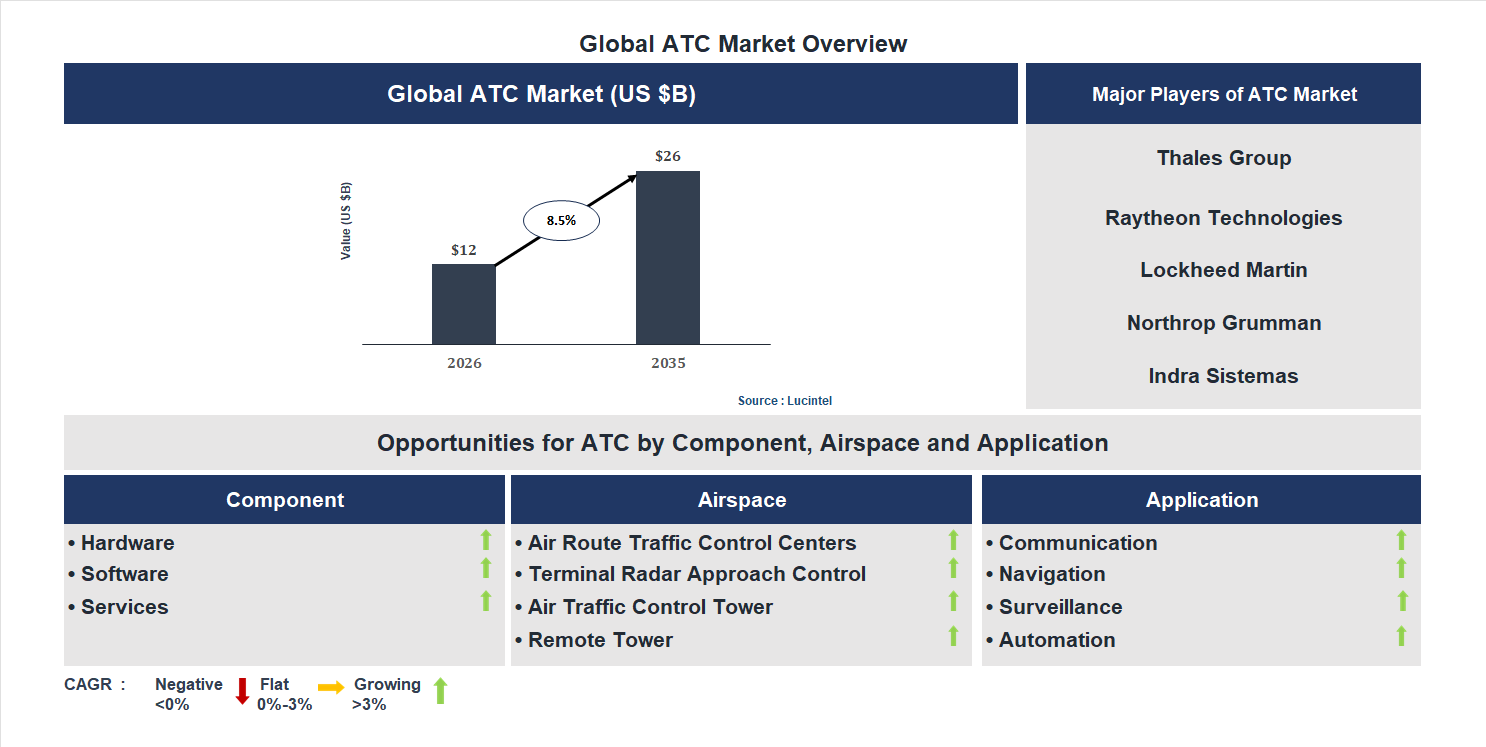
Key data points: The market size in 2035 = $26 billion, growth forecast = 8.5% annually for the next 8 years. Scroll below to get more insights. This market report covers trends, opportunities and forecasts in ATC market to 2035 by component (hardware, software, and services), airspace (air route traffic control centers, terminal radar approach control, air traffic control tower, and remote tower), application (communication, navigation, surveillance, and automation), and region (North America, Europe, Asia Pacific, and the Rest of the World)
We'll send your sample report shortly.
• Lucintel forecasts that, within the component category, software is expected to witness the highest growth over the forecast period.
• Within the application category, communication is expected to witness the highest growth.
• In terms of region, APAC is expected to witness the highest growth over the forecast period. Gain valuable insights for your business decisions with our comprehensive 150+ page report. Sample figures with some insights are shown below.
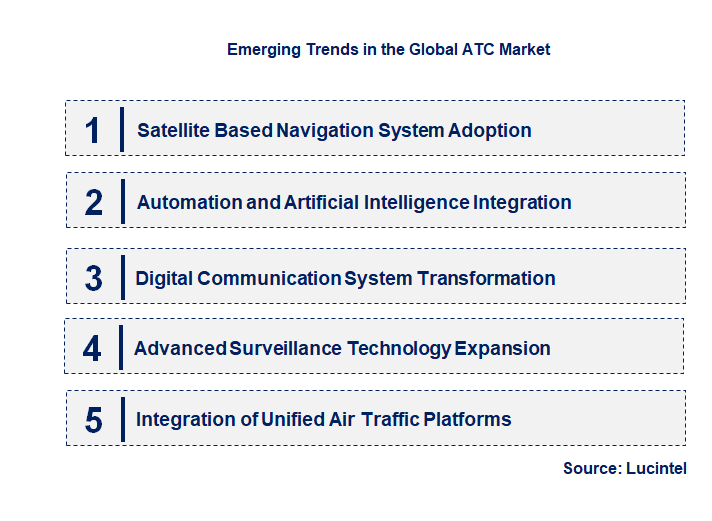
• Satellite Based Navigation System Adoption: Increasing use of satellite navigation is improving accuracy, coverage, and efficiency in air traffic management.
• Automation and Artificial Intelligence Integration: Advanced automation tools are enhancing decision-making, reducing controller workload, and improving safety.
• Digital Communication System Transformation: Transition from analog to digital communication is improving clarity, reliability, and coordination.
• Advanced Surveillance Technology Expansion: Adoption of modern surveillance systems is enhancing real-time tracking and airspace visibility.
• Integration of Unified Air Traffic Platforms: Development of integrated platforms is improving coordination across multiple airspace users and systems. These emerging trends are transforming the air traffic control market by improving efficiency, safety, and scalability. Continuous technological advancement is enabling more effective airspace management and supporting the growing complexity of global aviation operations.
• Advancement in Next Generation ATC Systems: Development of modern systems is improving efficiency, capacity, and safety in air traffic management.
• Integration of Digital Communication Technologies: Enhanced communication systems are improving coordination and operational reliability.
• Expansion of Airspace Surveillance Capabilities: Advanced tracking technologies are improving situational awareness and control.
• Adoption of Automated Traffic Management Tools: Automation is reducing workload and enhancing decision-making capabilities.
• Growth in Airport Infrastructure Modernization: Expansion and upgrading of airports are driving demand for advanced ATC systems. These developments are strengthening the air traffic control market by enhancing system efficiency, improving safety standards, and supporting increasing air traffic volumes globally.
• Commercial Aviation Traffic Management Opportunity: Rising passenger traffic is driving demand for efficient air traffic control solutions.
• Military Airspace Management Application Opportunity: Defense requirements are creating demand for advanced ATC systems.
• Airport Infrastructure Development Opportunity: Expansion of airports is increasing need for modern ATC systems.
• Unmanned Aerial System Integration Opportunity: Growth in drone usage is creating demand for integrated traffic management solutions.
• Regional Airspace Modernization Opportunity: Development of regional aviation networks is driving demand for advanced ATC technologies. Strategic growth opportunities are expanding across multiple applications. Focus on efficiency, safety, and integration is supporting continued innovation and development in the air traffic control market.
• Increasing Global Air Traffic Demand: Growing aviation activity is driving need for efficient airspace management systems.
• Advancements in ATC Technology Systems: Innovation in automation and communication is improving operational performance.
• Government Investment in Aviation Infrastructure: Public sector funding is supporting modernization of ATC systems.
• Rising Focus on Aviation Safety Standards: Emphasis on safety is driving adoption of advanced control technologies.
• Integration of Digital Air Traffic Solutions: Digital transformation is enhancing coordination and efficiency. The challenges facing the air traffic control market include:
• High Cost of System Implementation: Advanced ATC systems require significant investment and infrastructure upgrades.
• Complexity in System Integration Processes: Integrating new technologies with existing systems presents challenges.
• Regulatory and Compliance Constraints: Strict regulations can delay deployment and increase operational complexity. The air traffic control market is shaped by strong demand for efficient and safe airspace management alongside notable challenges. While technological advancements and increasing air traffic drive growth, addressing high costs, integration complexity, and regulatory constraints remains essential for ensuring effective and sustainable development of ATC systems globally.
• Thales Group
• Raytheon Technologies
• Lockheed Martin
• Northrop Grumman
• Indra Sistemas
• Leonardo
• Harris Corporation
• Saab
• Frequentis
• Aireon
• Hardware
• Software
• Services
• Air Route Traffic Control Centers
• Terminal Radar Approach Control
• Air Traffic Control Tower
• Remote Tower
• Communication
• Navigation
• Surveillance
• Automation
• North America
• Europe
• Asia Pacific
• The Rest of the World
• United States: The market is driven by modernization of legacy air traffic control systems and integration of next-generation technologies. Developments focus on satellite-based navigation, automation, and digital communication systems. Emphasis on improving airspace efficiency and safety is encouraging adoption of advanced surveillance and traffic management solutions, supporting increasing air traffic demand across commercial and defense aviation sectors.
• China: Rapid growth in air traffic is driving significant investment in air traffic control infrastructure. Developments emphasize expansion of radar networks, digital communication systems, and automation capabilities. Focus on enhancing airspace capacity and efficiency is supporting adoption of modern ATC technologies, while government initiatives are strengthening domestic capabilities and improving overall air traffic management systems.
• Germany: Strong focus on precision engineering and efficiency is driving ATC advancements. Developments include integration of digital air traffic management systems, advanced surveillance technologies, and automation tools. Collaboration within European aviation frameworks is enhancing interoperability and system efficiency, while sustainability and optimized airspace utilization remain key priorities in market development.
• India: Increasing air traffic and airport expansion are driving demand for advanced ATC systems. Developments focus on modernization of infrastructure, adoption of satellite-based navigation, and digital communication technologies. Government initiatives are supporting capacity enhancement and operational efficiency, while emphasis on cost-effective solutions is encouraging broader deployment of modern air traffic management systems.
• Japan: Advanced technological capabilities are driving innovation in ATC systems. Developments include automation, real-time data integration, and advanced surveillance solutions. Focus on safety, efficiency, and reliability is encouraging adoption of next-generation air traffic management technologies, while strong infrastructure supports continuous system upgrades and operational improvements.


• Thales Group
• Raytheon Technologies
• Lockheed Martin
• Northrop Grumman
• Indra Sistemas
• Leonardo
• Harris Corporation
• Saab
• Frequentis
• Aireon Q6. Which ATC market segment will be the largest in future? Answer: Lucintel forecasts that, within the component category, software is expected to witness the highest growth over the forecast period. Q7. In ATC market, which region is expected to be the largest in next 8 years? Answer: In terms of region, APAC is expected to witness the highest growth over the forecast period. Q8. Do we receive customization in this report? Answer: Yes, Lucintel provides 10% customization without any additional cost.


Choose a license that fits your team. Instant PDF delivery.
Prices exclude taxes. Instant delivery. Custom licensing available on request.
Market Report · July 31, 2026
Market Report · July 31, 2026
Market Report · July 31, 2026
Trusted partner for strategic intelligence and business growth


Receive a complimentary market analysis tailored to your industry. Our analysts will identify key growth opportunities and competitive dynamics specific to your business.

Market size, growth rate, and key trend analysis for your specific sector.

Top competitor positioning and market share analysis.

Strategic recommendations backed by data-driven insights.
Get curated market intelligence and competitive moves straight to your inbox.
By subscribing, you agree to receive our monthly insights. Unsubscribe anytime.
Receive a complimentary market analysis tailored to your industry. Our analysts will identify key growth opportunities and competitive dynamics specific to your business.
Market size, growth rate, and key trend analysis for your specific sector.
Top competitor positioning and market share analysis.
Strategic recommendations backed by data-driven insights.
Get curated market intelligence, emerging trends, and competitive moves straight to your inbox each month.
By subscribing, you agree to receive our monthly insights. Unsubscribe anytime.
We'll send your sample report shortly.