
Market Report · July 31, 2026

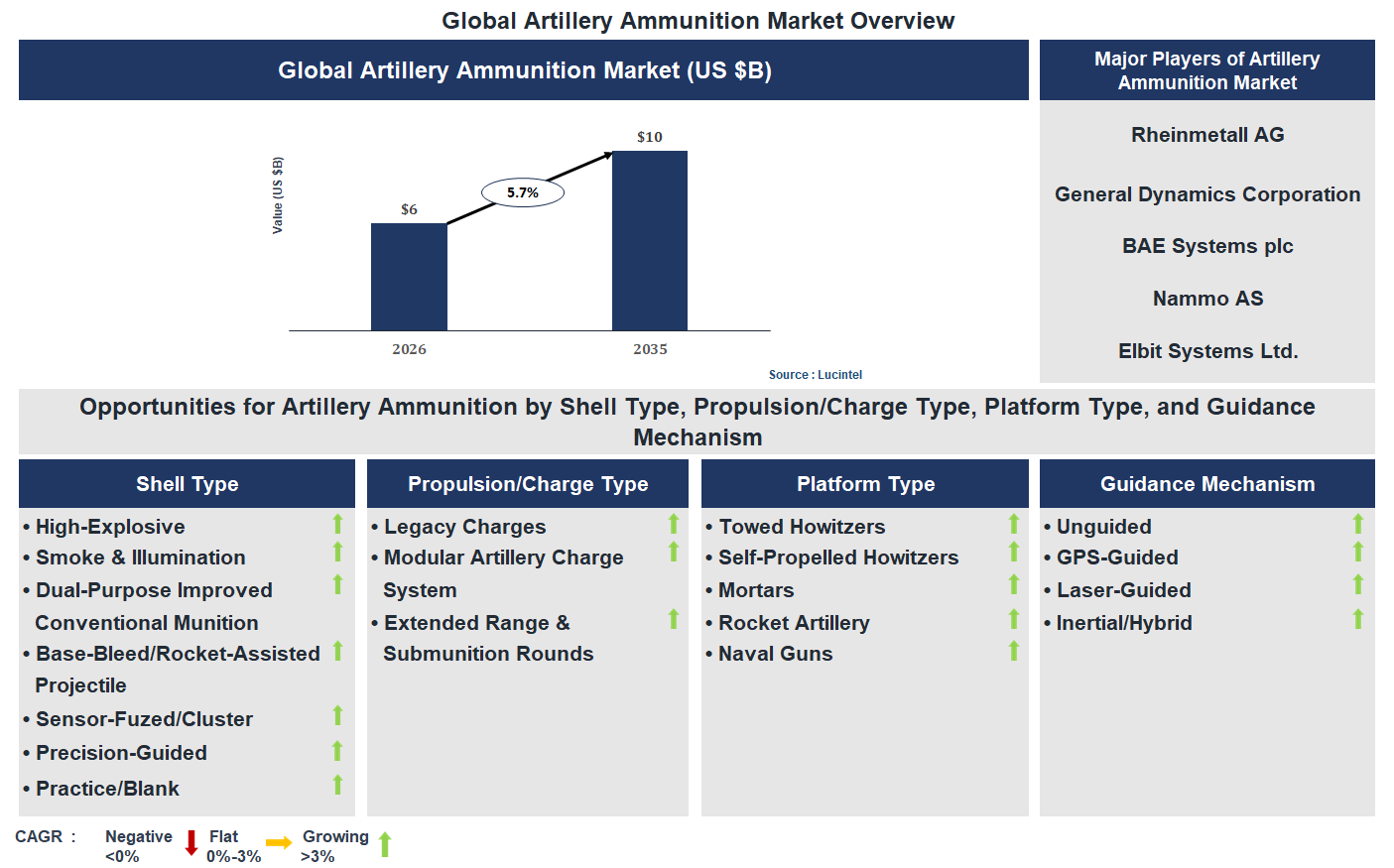
Key data points: The market size in 2035 = $10 billion, growth forecast = 5.7% annually for the next 8 years. Scroll below to get more insights. This market report covers trends, opportunities and forecasts in artillery ammunition market to 2035 by shell type (high-explosive, smoke & illumination, dual-purpose improved conventional munition, base-bleed/rocket-assisted projectile, sensor-fuzed/cluster, precision-guided, and practice/blank), propulsion/charge type (legacy charges, modular artillery charge system, and extended range & submunition rounds), platform type (towed howitzers, self-propelled howitzers, mortars, rocket artillery, and naval guns), guidance mechanism (unguided, GPS-guided, laser-guided, and inertial/hybrid), and region (North America, Europe, Asia Pacific, and the Rest of the World)
We'll send your sample report shortly.
• Lucintel forecasts that, within the shell type category, high-explosive is expected to witness the highest growth over the forecast period.
• Within the platform type category, self-propelled howitzer is expected to witness the highest growth.
• In terms of region, North America is expected to witness the highest growth over the forecast period. Gain valuable insights for your business decisions with our comprehensive 150+ page report. Sample figures with some insights are shown below.
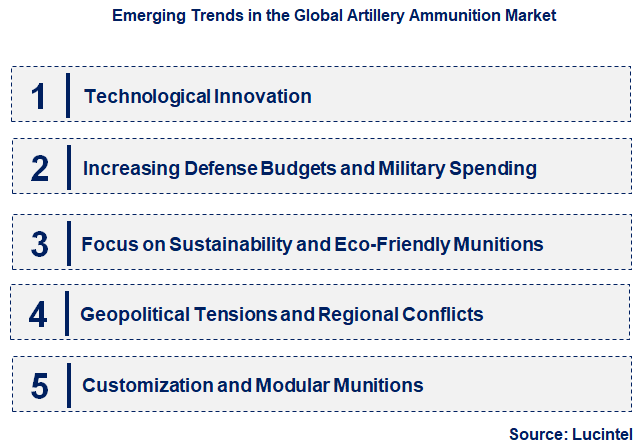
• Technological Innovation: The integration of advanced technologies such as precision-guided munitions and automation is revolutionizing artillery ammunition. These innovations improve accuracy, reduce collateral damage, and enhance operational efficiency. The development of smart shells with GPS and laser guidance allows for precise targeting, which is critical in modern combat scenarios. Automation in manufacturing processes also ensures higher quality and faster production cycles. As technology continues to evolve, the market is expected to see increased adoption of intelligent, adaptable munitions that meet complex battlefield requirements, thereby transforming traditional artillery capabilities.
• Increasing Defense Budgets and Military Spending: Many countries are boosting their defense budgets to modernize their armed forces, directly impacting the artillery ammunition market. Higher spending enables procurement of advanced munitions and supports ongoing research and development efforts. Governments are prioritizing artillery systems to strengthen their defense posture amid rising geopolitical tensions. This increased financial commitment leads to expanded market opportunities for manufacturers and encourages innovation. As defense budgets grow, the market is poised for sustained growth, with a focus on developing more effective, longer-range, and versatile artillery ammunition to meet evolving security needs.
• Focus on Sustainability and Eco-Friendly Munitions: Environmental concerns and regulations are prompting the industry to develop sustainable artillery ammunition options. Manufacturers are exploring eco-friendly propellants, biodegradable casings, and reduced hazardous materials to minimize environmental impact. This trend aligns with global efforts to promote sustainability in defense procurement. Eco-friendly munitions not only reduce ecological footprints but also enhance operational safety and compliance with international standards. As environmental considerations become more prominent, the market will see increased innovation in green artillery solutions, influencing product development and procurement policies worldwide.
• Geopolitical Tensions and Regional Conflicts: Ongoing regional conflicts and geopolitical rivalries are fueling demand for artillery ammunition. Countries seek to bolster their military arsenals to ensure strategic superiority, leading to increased procurement and stockpiling. This heightened demand drives innovation in munitions that can operate effectively in diverse terrains and combat scenarios. Additionally, regional conflicts often prompt rapid modernization efforts, fostering competition among manufacturers. The markets growth is thus closely linked to geopolitical stability, with heightened tensions accelerating the development and deployment of advanced artillery systems to address emerging threats.
• Customization and Modular Munitions: The trend toward customizable and modular artillery ammunition is gaining momentum. This approach allows military forces to adapt munitions for specific operational needs, such as different ranges, explosive yields, or targeting mechanisms. Modular designs facilitate easier upgrades and maintenance, extending the lifespan of artillery systems. Customization enhances tactical flexibility and operational effectiveness, especially in complex combat environments. As militaries seek versatile solutions, manufacturers are investing in adaptable munitions that can be tailored to various scenarios, thereby expanding the markets scope and offering strategic advantages in modern warfare. These trends are collectively reshaping the artillery ammunition market by fostering innovation, increasing demand driven by geopolitical factors, emphasizing sustainability, and promoting flexibility in military capabilities. The market is evolving toward smarter, more sustainable, and adaptable solutions, reflecting the changing nature of modern defense strategies and technological progress.
• Technological Innovations in Ammunition: Advancements in precision-guided munitions and smart technology are transforming artillery capabilities. These innovations enhance accuracy, reduce collateral damage, and improve operational efficiency. The integration of GPS and laser guidance systems allows for more effective targeting, expanding the scope of artillery applications. As militaries prioritize modernization, the demand for technologically advanced ammunition is expected to surge, driving market growth and encouraging R&D investments.
• Increasing Defense Budgets and Military Modernization: Governments worldwide are boosting defense spending to modernize their armed forces amid geopolitical tensions. This increased funding supports procurement of advanced artillery systems and ammunition. Countries are focusing on enhancing their strategic deterrence and battlefield effectiveness, leading to higher demand for a variety of artillery munitions. The trend is particularly prominent in Asia-Pacific and Middle Eastern regions, fueling market expansion and fostering competitive innovation.
• Rising Demand for Lightweight and Portable Ammunition: The need for mobility and rapid deployment in modern warfare is driving the development of lightweight artillery ammunition. These products facilitate easier handling, faster deployment, and improved logistical efficiency. Manufacturers are investing in materials and design innovations to reduce weight without compromising performance. This trend is expected to open new market segments, especially for mobile and expeditionary forces, contributing to overall market growth.
• Focus on Sustainable and Environmentally Friendly Ammunition: Environmental concerns and regulations are prompting the industry to develop eco-friendly artillery munitions. These include biodegradable casings and reduced toxic propellants, minimizing environmental impact. Such innovations are gaining traction among military forces committed to sustainability goals. The shift towards greener solutions is expected to create new market opportunities, influence procurement policies, and foster innovation in ammunition manufacturing.
• Geopolitical Tensions and Regional Conflicts: Ongoing regional conflicts and geopolitical tensions are escalating the demand for artillery ammunition globally. Countries seek to bolster their defense capabilities through increased procurement and stockpiling. This heightened demand is driving market growth, encouraging manufacturers to expand production capacities and diversify product offerings. The trend underscores the importance of reliable supply chains and strategic partnerships, shaping the competitive landscape of the artillery ammunition market. The overall impact of these developments is a robust, innovative, and expanding artillery ammunition market. Increased investments, technological progress, and geopolitical factors are collectively driving growth, fostering competition, and encouraging sustainable practices. These trends are shaping a future where advanced, efficient, and environmentally conscious artillery solutions become central to modern defense strategies.
• Growing Defense Budgets and Military Modernization Drive Market Expansion: Increased defense spending by governments worldwide, especially in Asia-Pacific and the Middle East, is fueling demand for advanced artillery ammunition. Countries are modernizing their military forces with upgraded artillery systems, requiring a steady supply of innovative munitions. This trend is supported by geopolitical tensions and the need for enhanced national security, prompting investments in both conventional and precision-guided artillery ammunition, thereby expanding market opportunities.
• Rising Adoption of Precision-Guided Munitions Enhances Market Growth: The shift towards precision-guided artillery shells offers higher accuracy, reduced collateral damage, and increased operational efficiency. Military forces are increasingly adopting smart munitions equipped with GPS and laser guidance systems. This technological evolution is creating a demand for sophisticated artillery ammunition capable of precise targeting, which is expected to significantly boost market growth as militaries seek more effective and reliable weaponry.
• Technological Innovations in Artillery Ammunition Create New Opportunities: Advances in materials, propulsion systems, and guidance technologies are enabling the development of more effective and versatile artillery shells. Innovations such as extended range, multi-purpose capabilities, and improved safety features are attracting military procurement. These technological improvements are driving market growth by offering enhanced performance, operational flexibility, and cost-effectiveness, encouraging defense agencies to upgrade existing arsenals with next-generation ammunition.
• Increasing Focus on Automated and Smart Artillery Systems Promotes Market Expansion: The integration of automation and smart technology in artillery systems is transforming battlefield operations. Automated loading, fire control, and real-time targeting systems require compatible ammunition with advanced features. This trend is fostering demand for intelligent artillery shells that can adapt to various combat scenarios, thereby expanding the market as militaries seek to improve efficiency, reduce crew workload, and enhance combat effectiveness.
• Geopolitical Tensions and Conflicts Accelerate Demand for Artillery Ammunition: Ongoing regional conflicts and rising geopolitical tensions are prompting countries to bolster their artillery capabilities. The need for rapid, reliable, and effective ammunition in conflict zones is increasing procurement activities. This heightened demand is expected to sustain market growth, especially in regions experiencing instability, as nations prioritize strengthening their artillery forces to ensure strategic dominance and security. The overall outlook indicates that technological advancements, modernization initiatives, and geopolitical factors will continue to propel the artillery ammunition market, offering lucrative opportunities for manufacturers and suppliers to innovate and expand their global footprint.
• Technological Innovation: The continuous development of advanced artillery shells, precision-guided munitions, and improved manufacturing processes enhances effectiveness and safety, fueling market growth. Governments and defense contractors invest heavily in R&D to stay ahead in military capabilities, which propels demand for cutting-edge ammunition. This technological evolution not only improves battlefield performance but also opens new avenues for export and international cooperation, further expanding the market.
• Increasing Defense Budgets: Many countries are increasing their defense spending to modernize armed forces and enhance national security. Elevated budgets enable procurement of advanced artillery systems and ammunition, supporting sustained market growth. Governments prioritize modernization programs, which include upgrading existing arsenals and acquiring new weaponry, directly impacting the demand for artillery ammunition. This trend is particularly prominent in regions facing geopolitical tensions, driving consistent market expansion.
• Geopolitical Tensions and Conflicts: Ongoing regional conflicts and geopolitical tensions prompt nations to bolster their military capabilities, including artillery systems. The need for reliable, high-performance ammunition becomes critical in such scenarios, leading to increased procurement. These tensions often accelerate procurement cycles and encourage the development of specialized ammunition types, thereby boosting market demand and encouraging innovation within the industry.
• Regulatory and Export Policies: Stringent export controls, arms treaties, and safety regulations influence the production and distribution of artillery ammunition. While these policies can restrict market access in some regions, they also promote compliance and safety standards, fostering trust and stability in international trade. Countries with favorable regulatory environments attract more exports, expanding market opportunities and encouraging manufacturers to meet global standards.
• Technological Collaboration and Partnerships: Strategic alliances between defense firms and governments facilitate the sharing of technology and expertise, accelerating innovation. Collaborative efforts often lead to the development of next-generation artillery ammunition, which can be tailored to specific operational needs. These partnerships also help in navigating regulatory landscapes and expanding market reach, ultimately driving growth through shared resources and knowledge. The challenges facing the artillery ammunition market include:-
• Regulatory Restrictions and Export Controls: Strict international arms regulations and export restrictions limit market access and complicate cross-border trade. These policies often require extensive compliance procedures, delaying procurement and increasing costs for manufacturers and buyers. Additionally, geopolitical tensions can lead to embargoes or sanctions, further constraining market growth and reducing opportunities for expansion in certain regions.
• High Development and Manufacturing Costs: The development of advanced artillery ammunition involves significant R&D investment, sophisticated manufacturing processes, and stringent quality controls. These high costs can act as barriers for new entrants and limit innovation to well-established players. Moreover, fluctuating raw material prices and supply chain disruptions can increase production expenses, impacting profitability and pricing strategies.
• Rapid Technological Obsolescence: The fast pace of technological innovation in defense systems can render existing ammunition obsolete quickly. Manufacturers face pressure to continuously upgrade products, which increases R&D costs and shortens product life cycles. This rapid obsolescence challenges companies to balance innovation with cost-effectiveness, risking overinvestment or market saturation if new developments do not meet expectations. The artillery ammunition market is shaped by significant technological advancements, increasing defense budgets, geopolitical tensions, and regulatory frameworks. While these drivers promote growth and innovation, challenges such as regulatory restrictions, high costs, and rapid technological obsolescence pose risks to market stability. The overall impact is a dynamic environment requiring strategic adaptation by industry players. Success depends on balancing innovation with compliance, managing costs, and navigating geopolitical landscapes, ultimately influencing the market’s future trajectory and global competitiveness.
• Rheinmetall AG
• General Dynamics Corporation
• BAE Systems plc
• Nammo AS
• Elbit Systems Ltd.
• KNDS N.V.
• Saab AB
• Thales Group
• MESKO S.A.
• Hanwha Corporation
• High-Explosive
• Smoke & Illumination
• Dual-Purpose Improved Conventional Munition
• Base-Bleed/Rocket-Assisted Projectile
• Sensor-Fuzed/Cluster
• Precision-Guided
• Practice/Blank
• Legacy Charges
• Modular Artillery Charge System
• Extended Range & Submunition Rounds
• Towed Howitzers
• Self-Propelled Howitzers
• Mortars
• Rocket Artillery
• Naval Guns
• Unguided
• GPS-Guided
• Laser-Guided
• Inertial/Hybrid
• North America
• Europe
• Asia Pacific
• The Rest of the World
• United States: The US artillery ammunition market has seen substantial growth due to increased defense budgets and modernization initiatives. The focus is on developing precision-guided munitions, longer-range shells, and automated systems. Recent advancements include the integration of smart technology and improved safety features, with significant investments in research and development to maintain technological superiority. The US military is also emphasizing interoperability with allied forces, leading to increased procurement of standardized munitions.
• China: China is rapidly expanding its artillery capabilities, driven by modernization efforts and regional security concerns. The country has invested heavily in developing advanced guided shells, extended-range artillery systems, and automated ammunition handling. Recent developments include indigenous production of precision munitions and increased export of artillery systems to allied nations. The Chinese government’s focus on self-reliance and technological innovation is fueling rapid advancements in this sector.
• Germany: Germany’s artillery ammunition market is characterized by high-quality, technologically advanced products aimed at both domestic and NATO markets. Recent developments include the adoption of new guidance systems, increased use of composite materials for lighter shells, and enhanced safety features. Germany is also investing in environmentally friendly munitions and sustainable manufacturing processes, aligning with broader European defense and environmental policies.
• India: India is actively modernizing its artillery forces to address regional security challenges. The country has focused on indigenously developing guided and extended-range munitions, reducing reliance on imports. Recent developments include the successful testing of new artillery systems and the integration of advanced targeting technologies. India’s emphasis on self-reliance and domestic manufacturing is driving innovation and expanding its artillery ammunition capabilities.
• Japan: Japan’s artillery ammunition market is evolving with a focus on precision, safety, and environmental sustainability. Recent advancements include the development of advanced guidance systems, longer-range shells, and environmentally friendly propellants. Japan is also investing in upgrading existing artillery systems and increasing domestic production to ensure supply security amid regional tensions. The country’s efforts are aligned with its broader defense modernization and technological innovation strategies.


• Rheinmetall AG
• General Dynamics Corporation
• BAE Systems plc
• Nammo AS
• Elbit Systems Ltd.
• KNDS N.V.
• Saab AB
• Thales Group
• MESKO S.A.
• Hanwha Corporation Q6. Which artillery ammunition market segment will be the largest in future? Answer: Lucintel forecasts that, within the shell type category, high-explosive is expected to witness the highest growth over the forecast period. Q7. In artillery ammunition market, which region is expected to be the largest in next 8 years? Answer: In terms of region, North America is expected to witness the highest growth over the forecast period. Q8. Do we receive customization in this report? Answer: Yes, Lucintel provides 10% customization without any additional cost.


Choose a license that fits your team. Instant PDF delivery.
Prices exclude taxes. Instant delivery. Custom licensing available on request.
Market Report · July 31, 2026
Market Report · July 31, 2026
Market Report · July 31, 2026
Trusted partner for strategic intelligence and business growth


Receive a complimentary market analysis tailored to your industry. Our analysts will identify key growth opportunities and competitive dynamics specific to your business.

Market size, growth rate, and key trend analysis for your specific sector.

Top competitor positioning and market share analysis.

Strategic recommendations backed by data-driven insights.
Get curated market intelligence and competitive moves straight to your inbox.
By subscribing, you agree to receive our monthly insights. Unsubscribe anytime.
Receive a complimentary market analysis tailored to your industry. Our analysts will identify key growth opportunities and competitive dynamics specific to your business.
Market size, growth rate, and key trend analysis for your specific sector.
Top competitor positioning and market share analysis.
Strategic recommendations backed by data-driven insights.
Get curated market intelligence, emerging trends, and competitive moves straight to your inbox each month.
By subscribing, you agree to receive our monthly insights. Unsubscribe anytime.
We'll send your sample report shortly.