
'
...

The Impact of COVID-19 is included in Artificial Sweetener Market Report. Buy it today to get an advantage.

Request the impact of COVID-19 on your product or industry


Artificial Sweetener Market Trends and Forecast

The future of the global artificial sweetener market looks promising with opportunities in the bakery item, confectionery, dairy product, and beverage markets. The global artificial sweetener market is expected to reach an estimated $7 billion by 2035 with a CAGR of 4.8% from 2026 to 2035. The major drivers for this market are the increasing demand for sugar alternatives, the rising health consciousness among consumers, and the growing preference for low-calorie products.

• Lucintel forecasts that, within the type category, aspartame is expected to witness the highest growth over the forecast period.
• Within the application category, beverage is expected to witness the highest growth.
• In terms of region, APAC is expected to witness the highest growth over the forecast period.
Gain valuable insights for your business decisions with our comprehensive 150+ page report. Sample figures with some insights are shown below.
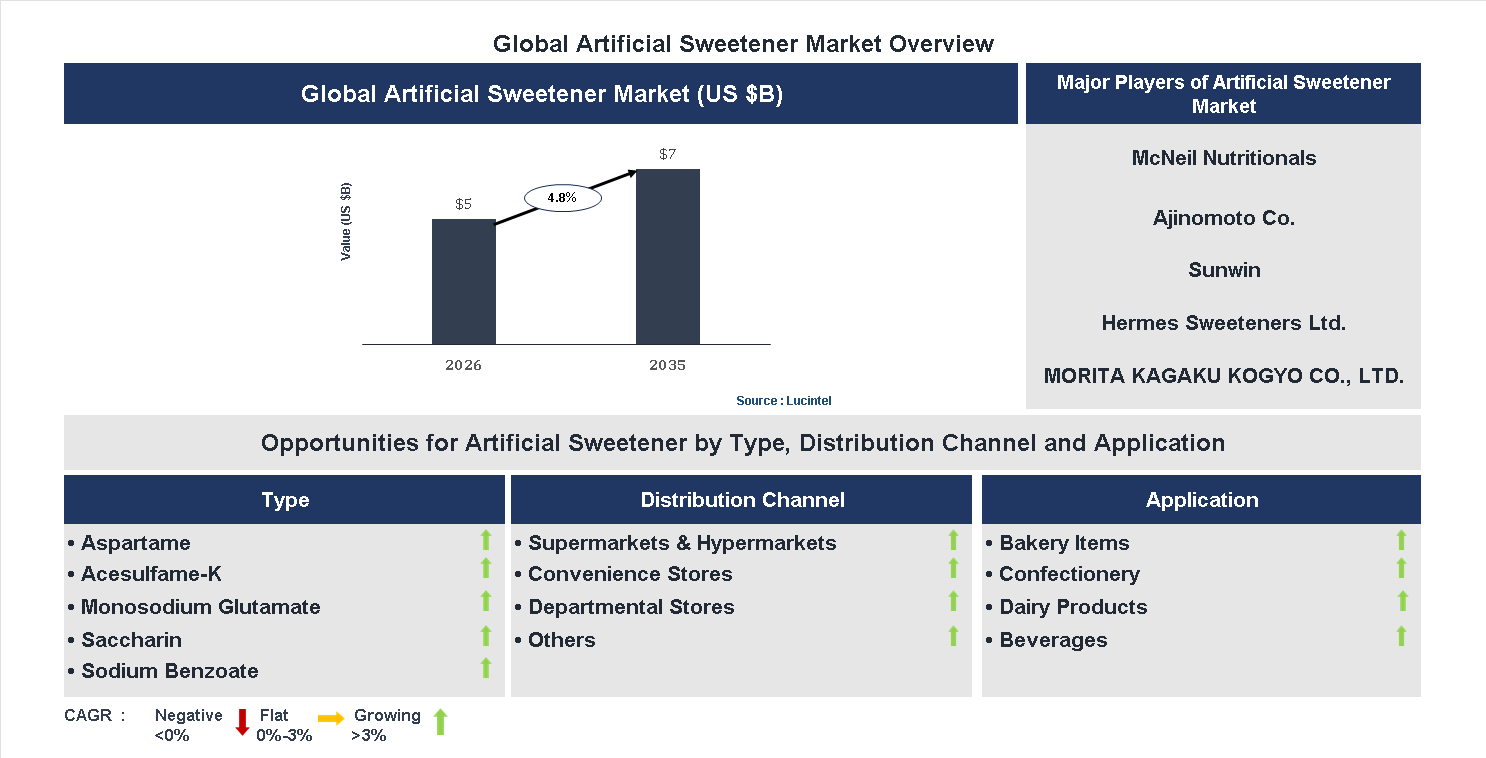
Artificial Sweetener Market Trends and Forecast

Emerging Trends in the Artificial Sweetener Market

The artificial sweetener market is experiencing rapid evolution driven by changing consumer preferences, health consciousness, and technological advancements. As consumers seek healthier alternatives to sugar, the industry is innovating with new formulations and sustainable practices. Regulatory landscapes are also shifting, influencing product development and marketing strategies. Additionally, the rise of plant-based and natural ingredients is shaping product portfolios. These developments are collectively transforming the market landscape, creating new opportunities and challenges for manufacturers, suppliers, and retailers. Understanding these emerging trends is crucial for stakeholders aiming to stay competitive and meet evolving consumer demands in this dynamic industry.

• Growing Demand for Natural and Plant-based Sweeteners: Consumers are increasingly seeking natural, organic, and plant-derived sweeteners such as stevia and monk fruit. This trend is driven by health concerns over artificial ingredients and a desire for cleaner labels. As a result, companies are investing in research to develop more effective natural sweeteners, which are perceived as healthier and more sustainable. This shift is expanding the product portfolio and encouraging innovation, ultimately leading to increased market share for natural sweetener brands and a broader consumer base.
• Rising Health Consciousness and Sugar Reduction Initiatives: Consumers are becoming more aware of the health risks associated with excessive sugar intake, such as obesity and diabetes. Governments and health organizations are promoting sugar reduction through policies and campaigns. This has led to increased demand for low-calorie and zero-calorie sweeteners. Manufacturers are responding by reformulating products and developing new sweetener blends that cater to health-conscious consumers. This trend is significantly impacting product development, marketing strategies, and regulatory compliance within the market.
• Technological Advancements in Sweetener Production: Innovations in biotechnology and extraction processes are enabling the development of more efficient, stable, and taste-closer artificial and natural sweeteners. These advancements improve product quality, reduce production costs, and enhance shelf life. Enhanced flavor profiles and reduced aftertastes are making artificial sweeteners more appealing to consumers. This technological progress is fostering product diversification and enabling companies to meet diverse consumer preferences, thereby expanding market opportunities and competitive advantage.
• Increasing Regulatory Scrutiny and Labeling Requirements: Governments worldwide are implementing stricter regulations concerning the safety, labeling, and marketing of artificial sweeteners. This includes transparent labeling and restrictions on certain ingredients. Companies must adapt to these regulations by reformulating products and ensuring compliance, which can increase costs but also build consumer trust. Regulatory developments are shaping market dynamics by influencing product innovation, marketing strategies, and consumer perceptions, ultimately impacting market growth and competitiveness.
• Expansion of Plant-based and Clean-label Products: The trend toward clean-label products emphasizes transparency, minimal processing, and natural ingredients. Plant-based sweeteners are gaining popularity due to their perceived health benefits and sustainability credentials. Manufacturers are focusing on developing products that meet these criteria to attract health-conscious and environmentally aware consumers. This shift is driving innovation in product formulations and packaging, leading to a broader acceptance of plant-based sweeteners and a move away from artificial options, thereby reshaping the competitive landscape.

These emerging trends are collectively reshaping the artificial sweetener market by emphasizing health, natural ingredients, technological innovation, regulatory compliance, and sustainability. They are driving product innovation, influencing consumer preferences, and creating new market opportunities, ultimately leading to a more diverse, transparent, and health-oriented industry landscape.
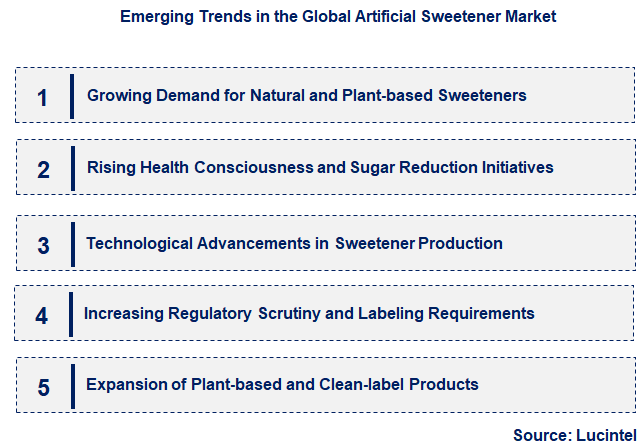
Emerging Trends in the Artificial Sweetener Market

Recent Development in the Artificial Sweetener Market

The artificial sweetener market is experiencing rapid growth driven by increasing health consciousness, rising diabetes prevalence, and demand for low-calorie alternatives. Innovations in product formulations and expanding applications across food, beverages, and pharmaceuticals are further fueling this expansion. Market players are investing in research to develop natural and zero-calorie sweeteners, while regulatory approvals are shaping product offerings. These developments are transforming the industry landscape, creating new opportunities for manufacturers and offering consumers healthier options.

• Growing Demand for Low-Calorie Alternatives: The rising awareness of health issues like obesity and diabetes is boosting demand for low-calorie sweeteners. Consumers seek healthier food and beverage options, prompting manufacturers to innovate with zero-calorie and natural sweeteners. This shift is expanding market reach and encouraging product diversification, ultimately leading to increased sales and market share for companies offering healthier alternatives.
• Innovation in Natural Sweeteners: Advances in extraction and synthesis techniques are enabling the development of natural sweeteners like stevia and monk fruit. These products are gaining popularity due to their perceived health benefits and natural origin. The innovation is driving market growth by attracting health-conscious consumers and meeting regulatory preferences for natural ingredients, thus opening new avenues for product development and expanding the consumer base.
• Expansion into Food and Beverage Sectors: The application of artificial sweeteners is broadening beyond traditional beverages into snacks, dairy, and baked goods. This diversification is driven by consumer demand for healthier options and manufacturers efforts to reduce sugar content. The expansion enhances market opportunities, increases product portfolio diversity, and boosts overall industry revenue, making artificial sweeteners a staple across multiple food categories.
• Regulatory Approvals and Standards: Evolving regulations and safety assessments are shaping the market landscape. Positive approvals for new sweeteners and stricter standards for existing ones influence product development and marketing strategies. Regulatory clarity boosts consumer confidence and facilitates international trade, while compliance costs may challenge smaller players. Overall, regulatory developments are pivotal in ensuring market stability and fostering innovation.
• Technological Advancements in Production: Cutting-edge manufacturing technologies are improving the efficiency, purity, and cost-effectiveness of sweetener production. Innovations such as enzymatic synthesis and fermentation processes are reducing environmental impact and enhancing product quality. These technological advancements enable companies to meet growing demand more sustainably and competitively, thereby strengthening their market position and supporting industry growth.

The overall impact of these developments is a dynamic, expanding market characterized by innovation, diversification, and increased consumer acceptance. Enhanced product offerings and regulatory support are driving growth, while technological progress ensures sustainable production. These factors collectively position the artificial sweetener market for continued expansion, offering significant opportunities for industry stakeholders and contributing to healthier consumer choices worldwide.

Strategic Growth Opportunities in the Artificial Sweetener Market

The artificial sweetener market is experiencing rapid expansion driven by increasing health consciousness, demand for low-calorie products, and rising awareness of sugar-related health issues. Innovations in formulation and the growing adoption across various food and beverage sectors are creating new growth avenues. Market players are focusing on product diversification, regulatory compliance, and strategic partnerships to capitalize on emerging opportunities. This dynamic landscape offers significant potential for market expansion, driven by consumer preferences for healthier alternatives and technological advancements.

• Expanding Use in Food and Beverage Industry: Artificial sweeteners are increasingly integrated into a wide range of food and beverage products, including soft drinks, baked goods, dairy, and confectionery, to cater to health-conscious consumers. The demand for low-calorie, sugar-free options is fueling product innovation and market penetration. Manufacturers are developing tailored formulations to meet specific dietary needs, which enhances product appeal and broadens market reach. This expansion is expected to sustain growth and diversify application areas.
• Rising Adoption in Pharmaceuticals and Personal Care Products: The use of artificial sweeteners in pharmaceuticals, such as cough syrups and chewable vitamins, is growing due to their ability to improve taste and compliance. Additionally, personal care products like toothpaste and mouthwash incorporate sweeteners to enhance flavor and consumer experience. This diversification into non-food sectors presents new revenue streams and market opportunities, driven by consumer demand for healthier, more palatable products across multiple industries.
• Innovation in Natural and Zero-Calorie Sweeteners: The development of natural, zero-calorie sweeteners like stevia and monk fruit is gaining momentum, driven by consumer preference for clean-label products. Companies are investing in research to improve taste profiles and stability, making these alternatives more appealing. The shift towards natural ingredients aligns with regulatory trends and health concerns, positioning these sweeteners as key growth drivers. This innovation is expected to expand market share and meet evolving consumer expectations.
• Strategic Collaborations and Product Launches: Market players are forming strategic alliances, joint ventures, and partnerships to accelerate product development and expand distribution channels. Launching new, innovative sweetener products tailored to specific applications helps capture niche markets and enhance competitiveness. These collaborations facilitate technology transfer, regulatory compliance, and market penetration, ultimately driving growth. Continuous innovation and strategic positioning are crucial for maintaining market leadership in a competitive landscape.
• Increasing Regulatory Support and Market Acceptance: Governments and regulatory bodies are establishing clearer guidelines and standards for artificial sweeteners, boosting consumer confidence and industry credibility. Favorable policies and approvals facilitate market entry and expansion, especially in emerging markets. As regulatory frameworks become more supportive, manufacturers can scale production and marketing efforts, leading to increased adoption. This regulatory environment fosters market stability and growth, encouraging investment and innovation in artificial sweetener products.

The overall impact of these opportunities is a robust, expanding market characterized by innovation, diversification, and increased consumer acceptance. Companies that leverage these growth avenues through strategic initiatives and product development are poised to capitalize on the rising demand for healthier, low-calorie alternatives. This evolution will likely lead to sustained market growth, increased competition, and broader application across industries, shaping the future landscape of the artificial sweetener market.

Artificial Sweetener Market Driver and Challenges

The artificial sweetener market is influenced by a complex interplay of technological advancements, economic shifts, and regulatory frameworks. Innovations in food technology have led to the development of new, healthier sweetening options, while changing consumer preferences for low-calorie and sugar-free products drive demand. Economic factors such as rising health consciousness and disposable incomes further propel market growth. However, regulatory challenges related to safety standards and labeling requirements pose significant hurdles. Additionally, concerns over the long-term health effects of artificial sweeteners influence consumer trust and industry practices. Understanding these drivers and challenges is essential for stakeholders aiming to capitalize on market opportunities and navigate potential risks effectively.

The factors responsible for driving the artificial sweetener market include:
• Technological Innovations: The development of new, more natural, and safer artificial sweeteners has expanded product offerings. Advances in food processing and formulation techniques enable manufacturers to create high-quality, stable, and cost-effective sweeteners. These innovations meet consumer demand for healthier alternatives and improve product shelf life, thus boosting market growth. Continuous R&D efforts are also leading to the discovery of novel sweetening agents with minimal aftertaste and better solubility, further enhancing consumer acceptance and expanding application areas across food and beverage sectors.
• Rising Health Consciousness: Increasing awareness about obesity, diabetes, and other health issues has shifted consumer preferences toward low-calorie and sugar-free products. Artificial sweeteners provide a viable alternative to sugar, enabling food and beverage companies to develop healthier options. This trend is supported by a growing number of health-conscious consumers seeking to reduce calorie intake without sacrificing taste. As a result, demand for artificial sweeteners is surging across various regions, especially in developed markets where health and wellness trends are more prominent, thereby fueling market expansion.
• Regulatory Environment: Stringent safety standards and labeling regulations imposed by authorities such as the FDA and EFSA influence market dynamics. While these regulations ensure consumer safety, they also pose challenges for manufacturers in terms of compliance costs and product approvals. Regulatory scrutiny can delay product launches and restrict certain ingredients, impacting innovation and market growth. Conversely, clear and supportive regulatory frameworks can boost consumer confidence and facilitate market expansion by establishing trust in artificial sweeteners as safe alternatives.
• Growing Application in Food & Beverage Industry: The increasing adoption of artificial sweeteners across diverse food and beverage categories, including beverages, dairy products, baked goods, and confectionery, is a key driver. Manufacturers leverage these sweeteners to meet consumer demand for healthier, low-calorie options while maintaining taste and texture. The expansion of product portfolios and innovations in formulation are further propelling market growth. Additionally, the rise of functional foods and beverages incorporating artificial sweeteners offers new revenue streams, reinforcing the market’s upward trajectory.
• Market Expansion in Emerging Economies: Rapid urbanization, changing lifestyles, and rising disposable incomes in emerging economies such as China, India, and Brazil are driving demand for healthier food options. These regions present significant growth opportunities due to increasing awareness of health issues and a growing middle class seeking affordable, low-calorie alternatives. Local manufacturers are also investing in R&D to develop region-specific products, further expanding the market. This geographic diversification helps mitigate risks associated with mature markets and sustains long-term growth prospects.

The challenges facing the artificial sweetener market include:
• Health and Safety Concerns: Despite regulatory approvals, ongoing debates about the long-term health effects of artificial sweeteners create consumer skepticism. Reports linking certain sweeteners to health issues such as cancer, metabolic disorders, and gut health problems influence consumer perception negatively. This skepticism hampers market growth as consumers may prefer natural alternatives or reduce artificial sweetener consumption altogether. Manufacturers must invest in transparent communication and scientific research to address these concerns and build trust.
• Regulatory Restrictions and Labeling Requirements: Variations in regulations across countries complicate market operations. Some regions impose strict limits or bans on specific artificial sweeteners, restricting market access and product formulation options. Labeling requirements demanding detailed disclosure can also deter consumers wary of artificial ingredients. Navigating these regulatory landscapes requires significant compliance costs and strategic planning, which can slow down innovation and market penetration, especially for smaller players.
• Consumer Preference for Natural Alternatives: Growing demand for natural sweeteners like stevia and monk fruit challenges the artificial sweetener market. Consumers increasingly associate natural ingredients with health and purity, leading to a preference for plant-based, minimally processed options. This shift pressures manufacturers to innovate and reformulate products, potentially increasing costs and complicating supply chains. Failure to adapt to this trend could result in loss of market share to natural sweetener providers, impacting overall growth prospects.

The artificial sweetener market is shaped by technological progress, health trends, and regulatory frameworks, which collectively drive growth. However, health concerns, regulatory complexities, and shifting consumer preferences pose significant challenges. The interplay of these factors determines the market’s future trajectory, requiring stakeholders to innovate, adapt, and communicate effectively. While opportunities abound in emerging markets and product diversification, addressing safety concerns and aligning with consumer preferences will be crucial for sustained success. Overall, the market’s evolution hinges on balancing innovation with safety and transparency to meet the dynamic demands of global consumers.

List of Artificial Sweetener Companies

Companies in the market compete on the basis of product quality offered. Major players in this market focus on expanding their manufacturing facilities, R&D investments, infrastructural development, and leverage integration opportunities across the value chain. With these strategies artificial sweetener companies cater increasing demand, ensure competitive effectiveness, develop innovative products & technologies, reduce production costs, and expand their customer base. Some of the artificial sweetener companies profiled in this report include-
• McNeil Nutritionals
• Ajinomoto Co.
• Sunwin
• Hermes Sweeteners Ltd.
• MORITA KAGAKU KOGYO CO., LTD.
• NutraSweet Property Holdings
• Roquette
• Zydus Wellness Ltd.
• PureCircle
• JK Sucralose

Artificial Sweetener Market by Segment

The study includes a forecast for the global artificial sweetener market by type, distribution channel, application, and region.

Artificial Sweetener Market by Type [Value from 2019 to 2035]:


• Aspartame
• Acesulfame-K
• Monosodium Glutamate
• Saccharin
• Sodium Benzoate

Artificial Sweetener Market by Distribution Channel [Value from 2019 to 2035]:


• Supermarkets & Hypermarkets
• Convenience Stores
• Departmental Stores
• Others

Artificial Sweetener Market by Application [Value from 2019 to 2035]:


• Bakery Items
• Confectionery
• Dairy Products
• Beverages

Artificial Sweetener Market by Region [Value from 2019 to 2035]:


• North America
• Europe
• Asia Pacific
• The Rest of the World

Country Wise Outlook for the Artificial Sweetener Market

The artificial sweetener market has experienced significant shifts driven by health trends, regulatory changes, and technological innovations. As consumers become more health-conscious, demand for low-calorie alternatives has surged, prompting companies to develop new formulations and improve existing products. Governments are implementing stricter regulations on artificial sweeteners, influencing market dynamics. Additionally, advancements in food technology have enabled the creation of more natural and sustainable sweetener options. These developments vary across regions, shaped by local consumer preferences, regulatory environments, and technological capabilities, creating a complex and rapidly evolving global landscape.

• United States: The U.S. market has seen increased demand for natural and plant-based sweeteners, driven by health-conscious consumers. Major companies are investing in R&D to develop innovative products like stevia-based and monk fruit sweeteners. Regulatory agencies are scrutinizing artificial sweeteners such as aspartame, leading to stricter labeling requirements. The rise of clean-label trends has also pushed manufacturers to reformulate products with fewer artificial ingredients. E-commerce sales of sweeteners have grown substantially, expanding market reach. Overall, the U.S. market is shifting towards more natural, transparent, and health-oriented products, with significant innovation in product offerings.
• China: China’s artificial sweetener market is expanding rapidly due to increasing urbanization and rising disposable incomes. The government promotes the use of low-calorie sweeteners to combat obesity and diabetes. Local companies are investing in the development of stevia and other natural sweeteners, gaining market share. Regulatory frameworks are becoming more stringent, ensuring product safety and quality. The popularity of functional foods and beverages incorporating artificial sweeteners is rising, especially among young consumers. E-commerce platforms are playing a crucial role in distribution. Overall, China’s market is characterized by rapid growth, innovation, and a shift towards natural and health-oriented sweeteners.
• Germany: Germany’s market is characterized by a strong preference for natural and organic products, influencing the demand for natural sweeteners like stevia and erythritol. Regulatory standards are strict, ensuring high safety and quality levels, which benefits premium products. The food and beverage industry is increasingly incorporating artificial sweeteners to meet consumer demand for low-calorie options. Sustainability and eco-friendliness are also important factors, prompting companies to develop environmentally friendly production methods. The market is witnessing technological advancements in extraction and purification processes, improving product quality. Overall, Germany’s market emphasizes natural, safe, and sustainable sweetener options aligned with health and environmental concerns.
• India: India’s artificial sweetener market is growing rapidly, driven by increasing health awareness and a rising prevalence of lifestyle diseases like diabetes. The government’s initiatives to promote sugar reduction are boosting demand for low-calorie alternatives. Local manufacturers are expanding their product portfolios with stevia and other natural sweeteners. The market is also influenced by changing consumer preferences towards healthier food options. Regulatory frameworks are evolving to ensure safety and quality standards. E-commerce and retail channels are expanding access to these products. Overall, India’s market is characterized by rapid growth, innovation, and a shift towards natural, health-focused sweetener options.
• Japan: Japan’s market for artificial sweeteners is mature, with a high level of consumer awareness and preference for health-conscious products. The demand for low-calorie and sugar-free foods remains strong, especially among aging populations. Companies are innovating with natural sweeteners like stevia and monk fruit to meet consumer preferences. Regulatory standards are stringent, ensuring product safety and efficacy. The trend towards functional foods incorporating sweeteners for health benefits is growing. Technological advancements in extraction and formulation are enhancing product quality. Overall, Japan’s market is focused on natural, safe, and functional sweetener solutions, aligned with health and wellness trends.

Lucintel Analytics Dashboard

Features of the Global Artificial Sweetener Market

Market Size Estimates: Artificial sweetener market size estimation in terms of value ($B).
Trend and Forecast Analysis: Market trends (2019 to 2025) and forecast (2026 to 2035) by various segments and regions.
Segmentation Analysis: Artificial sweetener market size by type, distribution channel, application, and region in terms of value ($B).
Regional Analysis: Artificial sweetener market breakdown by North America, Europe, Asia Pacific, and Rest of the World.
Growth Opportunities: Analysis of growth opportunities in different types, distribution channels, applications, and regions for the artificial sweetener market.
Strategic Analysis: This includes M&A, new product development, and competitive landscape of the artificial sweetener market.
Analysis of competitive intensity of the industry based on Porter’s Five Forces model.

Lucintel Consulting Services

FAQ

Q1. What is the artificial sweetener market size?
Answer: The global artificial sweetener market is expected to reach an estimated $7 billion by 2035.
Q2. What is the growth forecast for artificial sweetener market?
Answer: The global artificial sweetener market is expected to grow with a CAGR of 4.8% from 2026 to 2035.
Q3. What are the major drivers influencing the growth of the artificial sweetener market?
Answer: The major drivers for this market are the increasing demand for sugar alternatives, the rising health consciousness among consumers, and the growing preference for low-calorie products.
Q4. What are the major segments for artificial sweetener market?
Answer: The future of the artificial sweetener market looks promising with opportunities in the bakery item, confectionery, dairy product, and beverage markets.
Q5. Who are the key artificial sweetener market companies?
Answer: Some of the key artificial sweetener companies are as follows:
• McNeil Nutritionals
• Ajinomoto Co.
• Sunwin
• Hermes Sweeteners Ltd.
• MORITA KAGAKU KOGYO CO., LTD.
• NutraSweet Property Holdings
• Roquette
• Zydus Wellness Ltd.
• PureCircle
• JK Sucralose
Q6. Which artificial sweetener market segment will be the largest in future?
Answer: Lucintel forecasts that, within the type category, aspartame is expected to witness the highest growth over the forecast period.
Q7. In artificial sweetener market, which region is expected to be the largest in next 8 years?
Answer: In terms of region, APAC is expected to witness the highest growth over the forecast period.
Q8. Do we receive customization in this report?
Answer: Yes, Lucintel provides 10% customization without any additional cost.

This report answers following 11 key questions:

Q.1. What are some of the most promising, high-growth opportunities for the artificial sweetener market by type (aspartame, acesulfame-K, monosodium glutamate, saccharin, and sodium benzoate), distribution channel (supermarkets & hypermarkets, convenience stores, departmental stores, and others), application (bakery items, confectionery, dairy products, and beverages), and region (North America, Europe, Asia Pacific, and the Rest of the World)?
Q.2. Which segments will grow at a faster pace and why?
Q.3. Which region will grow at a faster pace and why?
Q.4. What are the key factors affecting market dynamics? What are the key challenges and business risks in this market?
Q.5. What are the business risks and competitive threats in this market?
Q.6. What are the emerging trends in this market and the reasons behind them?
Q.7. What are some of the changing demands of customers in the market?
Q.8. What are the new developments in the market? Which companies are leading these developments?
Q.9. Who are the major players in this market? What strategic initiatives are key players pursuing for business growth?
Q.10. What are some of the competing products in this market and how big of a threat do they pose for loss of market share by material or product substitution?
Q.11. What M&A activity has occurred in the last 7 years and what has its impact been on the industry?

For any questions related to Artificial Sweetener Market, Artificial Sweetener Market Size, Artificial Sweetener Market Growth, Artificial Sweetener Market Analysis, Artificial Sweetener Market Report, Artificial Sweetener Market Share, Artificial Sweetener Market Trends, Artificial Sweetener Market Forecast, Artificial Sweetener Companies, write Lucintel analyst at email: helpdesk@lucintel.com. We will be glad to get back to you soon.
                                           Table of Contents

            1. Executive Summary

            2. Market Overview

                        2.1 Background and Classifications
                        2.2 Supply Chain

            3. Market Trends & Forecast Analysis

                        3.1 Macroeconomic Trends and Forecasts
                        3.2 Industry Drivers and Challenges
                        3.3 PESTLE Analysis
                        3.4 Patent Analysis
                        3.5 Regulatory Environment
                        3.6 Global Artificial Sweetener Market Trends and Forecast

            4. Global Artificial Sweetener Market by Type

                        4.1 Overview
                        4.2 Attractiveness Analysis by Type
                        4.3 Aspartame : Trends and Forecast (2019 to 2035)
                        4.4 Acesulfame-K : Trends and Forecast (2019 to 2035)
                        4.5 Monosodium Glutamate : Trends and Forecast (2019 to 2035)
                        4.6 Saccharin : Trends and Forecast (2019 to 2035)
                        4.7 Sodium Benzoate : Trends and Forecast (2019 to 2035)

            5. Global Artificial Sweetener Market by Distribution Channel

                        5.1 Overview
                        5.2 Attractiveness Analysis by Distribution Channel
                        5.3 Supermarkets & Hypermarkets : Trends and Forecast (2019 to 2035)
                        5.4 Convenience Stores : Trends and Forecast (2019 to 2035)
                        5.5 Departmental Stores : Trends and Forecast (2019 to 2035)
                        5.6 Others : Trends and Forecast (2019 to 2035)

            6. Global Artificial Sweetener Market by Application

                        6.1 Overview
                        6.2 Attractiveness Analysis by Application
                        6.3 Bakery Items : Trends and Forecast (2019 to 2035)
                        6.4 Confectionery : Trends and Forecast (2019 to 2035)
                        6.5 Dairy Products : Trends and Forecast (2019 to 2035)
                        6.6 Beverages : Trends and Forecast (2019 to 2035)

            7. Regional Analysis

                        7.1 Overview
                        7.2 Global Artificial Sweetener Market by Region

            8. North American Artificial Sweetener Market

                        8.1 Overview
                        8.2 North American Artificial Sweetener Market by Type
                        8.3 North American Artificial Sweetener Market by Application
                        8.4 The United States Artificial Sweetener Market
                        8.5 Canadian Artificial Sweetener Market
                        8.6 Mexican Artificial Sweetener Market

            9. European Artificial Sweetener Market

                        9.1 Overview
                        9.2 European Artificial Sweetener Market by Type
                        9.3 European Artificial Sweetener Market by Application
                        9.4 German Artificial Sweetener Market
                        9.5 French Artificial Sweetener Market
                        9.6 Italian Artificial Sweetener Market
                        9.7 Spanish Artificial Sweetener Market
                        9.8 The United Kingdom Artificial Sweetener Market

            10. APAC Artificial Sweetener Market

                        10.1 Overview
                        10.2 APAC Artificial Sweetener Market by Type
                        10.3 APAC Artificial Sweetener Market by Application
                        10.4 Chinese Artificial Sweetener Market
                        10.5 Indian Artificial Sweetener Market
                        10.6 Japanese Artificial Sweetener Market
                        10.7 South Korean Artificial Sweetener Market
                        10.8 Indonesian Artificial Sweetener Market

            11. ROW Artificial Sweetener Market

                        11.1 Overview
                        11.2 ROW Artificial Sweetener Market by Type
                        11.3 ROW Artificial Sweetener Market by Application
                        11.4 Middle Eastern Artificial Sweetener Market
                        11.5 South American Artificial Sweetener Market
                        11.6 African Artificial Sweetener Market

            12. Competitor Analysis

                        12.1 Product Portfolio Analysis
                        12.2 Operational Integration
                        12.3 Porter’s Five Forces Analysis
                                    • Competitive Rivalry
                                    • Bargaining Power of Buyers
                                    • Bargaining Power of Suppliers
                                    • Threat of Substitutes
                                    • Threat of New Entrants
                        12.4 Market Share Analysis

            13. Opportunities & Strategic Analysis

                        13.1 Value Chain Analysis
                        13.2 Growth Opportunity Analysis
                                    13.2.1 Growth Opportunity by Type
                                    13.2.2 Growth Opportunity by Distribution Channel
                                    13.2.3 Growth Opportunity by Application
                                    13.2.4 Growth Opportunity by Region
                        13.3 Emerging Trends in the Global Artificial Sweetener Market
                        13.4 Strategic Analysis
                                    13.4.1 New Product Development
                                    13.4.2 Certification and Licensing
                                    13.4.3 Mergers, Acquisitions, Agreements, Collaborations, and Joint Ventures

            14. Company Profiles of the Leading Players Across the Value Chain

                        14.1 Competitive Analysis Overview
                        14.2 McNeil Nutritionals
                                    • Company Overview
                                    • Artificial Sweetener Market Business Overview
                                    • New Product Development
                                    • Merger, Acquisition, and Collaboration
                                    • Certification and Licensing
                        14.3 Ajinomoto Co.
                                    • Company Overview
                                    • Artificial Sweetener Market Business Overview
                                    • New Product Development
                                    • Merger, Acquisition, and Collaboration
                                    • Certification and Licensing
                        14.4 Sunwin
                                    • Company Overview
                                    • Artificial Sweetener Market Business Overview
                                    • New Product Development
                                    • Merger, Acquisition, and Collaboration
                                    • Certification and Licensing
                        14.5 Hermes Sweeteners Ltd.
                                    • Company Overview
                                    • Artificial Sweetener Market Business Overview
                                    • New Product Development
                                    • Merger, Acquisition, and Collaboration
                                    • Certification and Licensing
                        14.6 MORITA KAGAKU KOGYO CO., LTD.
                                    • Company Overview
                                    • Artificial Sweetener Market Business Overview
                                    • New Product Development
                                    • Merger, Acquisition, and Collaboration
                                    • Certification and Licensing
                        14.7 NutraSweet Property Holdings
                                    • Company Overview
                                    • Artificial Sweetener Market Business Overview
                                    • New Product Development
                                    • Merger, Acquisition, and Collaboration
                                    • Certification and Licensing
                        14.8 Roquette
                                    • Company Overview
                                    • Artificial Sweetener Market Business Overview
                                    • New Product Development
                                    • Merger, Acquisition, and Collaboration
                                    • Certification and Licensing
                        14.9 Zydus Wellness Ltd.
                                    • Company Overview
                                    • Artificial Sweetener Market Business Overview
                                    • New Product Development
                                    • Merger, Acquisition, and Collaboration
                                    • Certification and Licensing
                        14.10 PureCircle
                                    • Company Overview
                                    • Artificial Sweetener Market Business Overview
                                    • New Product Development
                                    • Merger, Acquisition, and Collaboration
                                    • Certification and Licensing
                        14.11 JK Sucralose
                                    • Company Overview
                                    • Artificial Sweetener Market Business Overview
                                    • New Product Development
                                    • Merger, Acquisition, and Collaboration
                                    • Certification and Licensing

            15. Appendix

                        15.1 List of Figures
                        15.2 List of Tables
                        15.3 Research Methodology
                        15.4 Disclaimer
                        15.5 Copyright
                        15.6 Abbreviations and Technical Units
                        15.7 About Us
                        15.8 Contact Us

                                               List of Figures


            Chapter 1

                        Figure 1.1: Trends and Forecast for the Global Artificial Sweetener Market

            Chapter 2

                        Figure 2.1: Usage of Artificial Sweetener Market
                        Figure 2.2: Classification of the Global Artificial Sweetener Market
                        Figure 2.3: Supply Chain of the Global Artificial Sweetener Market

            Chapter 3

                        Figure 3.1: Trends of the Global GDP Growth Rate
                        Figure 3.2: Trends of the Global Population Growth Rate
                        Figure 3.3: Trends of the Global Inflation Rate
                        Figure 3.4: Trends of the Global Unemployment Rate
                        Figure 3.5: Trends of the Regional GDP Growth Rate
                        Figure 3.6: Trends of the Regional Population Growth Rate
                        Figure 3.7: Trends of the Regional Inflation Rate
                        Figure 3.8: Trends of the Regional Unemployment Rate
                        Figure 3.9: Trends of Regional Per Capita Income
                        Figure 3.10: Forecast for the Global GDP Growth Rate
                        Figure 3.11: Forecast for the Global Population Growth Rate
                        Figure 3.12: Forecast for the Global Inflation Rate
                        Figure 3.13: Forecast for the Global Unemployment Rate
                        Figure 3.14: Forecast for the Regional GDP Growth Rate
                        Figure 3.15: Forecast for the Regional Population Growth Rate
                        Figure 3.16: Forecast for the Regional Inflation Rate
                        Figure 3.17: Forecast for the Regional Unemployment Rate
                        Figure 3.18: Forecast for Regional Per Capita Income
                        Figure 3.19: Driver and Challenges of the Artificial Sweetener Market

            Chapter 4

                        Figure 4.1: Global Artificial Sweetener Market by Type in 2019, 2025, and 2035
                        Figure 4.2: Trends of the Global Artificial Sweetener Market ($B) by Type
                        Figure 4.3: Forecast for the Global Artificial Sweetener Market ($B) by Type
                        Figure 4.4: Trends and Forecast for Aspartame in the Global Artificial Sweetener Market (2019-2035)
                        Figure 4.5: Trends and Forecast for Acesulfame-K in the Global Artificial Sweetener Market (2019-2035)
                        Figure 4.6: Trends and Forecast for Monosodium Glutamate in the Global Artificial Sweetener Market (2019-2035)
                        Figure 4.7: Trends and Forecast for Saccharin in the Global Artificial Sweetener Market (2019-2035)
                        Figure 4.8: Trends and Forecast for Sodium Benzoate in the Global Artificial Sweetener Market (2019-2035)

            Chapter 5

                        Figure 5.1: Global Artificial Sweetener Market by Distribution Channel in 2019, 2025, and 2035
                        Figure 5.2: Trends of the Global Artificial Sweetener Market ($B) by Distribution Channel
                        Figure 5.3: Forecast for the Global Artificial Sweetener Market ($B) by Distribution Channel
                        Figure 5.4: Trends and Forecast for Supermarkets & Hypermarkets in the Global Artificial Sweetener Market (2019-2035)
                        Figure 5.5: Trends and Forecast for Convenience Stores in the Global Artificial Sweetener Market (2019-2035)
                        Figure 5.6: Trends and Forecast for Departmental Stores in the Global Artificial Sweetener Market (2019-2035)
                        Figure 5.7: Trends and Forecast for Others in the Global Artificial Sweetener Market (2019-2035)

            Chapter 6

                        Figure 6.1: Global Artificial Sweetener Market by Application in 2019, 2025, and 2035
                        Figure 6.2: Trends of the Global Artificial Sweetener Market ($B) by Application
                        Figure 6.3: Forecast for the Global Artificial Sweetener Market ($B) by Application
                        Figure 6.4: Trends and Forecast for Bakery Items in the Global Artificial Sweetener Market (2019-2035)
                        Figure 6.5: Trends and Forecast for Confectionery in the Global Artificial Sweetener Market (2019-2035)
                        Figure 6.6: Trends and Forecast for Dairy Products in the Global Artificial Sweetener Market (2019-2035)
                        Figure 6.7: Trends and Forecast for Beverages in the Global Artificial Sweetener Market (2019-2035)

            Chapter 7

                        Figure 7.1: Trends of the Global Artificial Sweetener Market ($B) by Region (2019-2025)
                        Figure 7.2: Forecast for the Global Artificial Sweetener Market ($B) by Region (2026-2035)

            Chapter 8

                        Figure 8.1: Trends and Forecast for the North American Artificial Sweetener Market (2019-2035)
                        Figure 8.2: North American Artificial Sweetener Market by Type in 2019, 2025, and 2035
                        Figure 8.3: Trends of the North American Artificial Sweetener Market ($B) by Type (2019-2025)
                        Figure 8.4: Forecast for the North American Artificial Sweetener Market ($B) by Type (2026-2035)
                        Figure 8.5: North American Artificial Sweetener Market by Distribution Channel in 2019, 2025, and 2035
                        Figure 8.6: Trends of the North American Artificial Sweetener Market ($B) by Distribution Channel (2019-2025)
                        Figure 8.7: Forecast for the North American Artificial Sweetener Market ($B) by Distribution Channel (2026-2035)
                        Figure 8.8: Trends and Forecast for the United States Artificial Sweetener Market ($B) (2019-2035)
                        Figure 8.9: Trends and Forecast for the Mexican Artificial Sweetener Market ($B) (2019-2035)
                        Figure 8.10: Trends and Forecast for the Canadian Artificial Sweetener Market ($B) (2019-2035)

            Chapter 9

                        Figure 9.1: Trends and Forecast for the European Artificial Sweetener Market (2019-2035)
                        Figure 9.2: European Artificial Sweetener Market by Type in 2019, 2025, and 2035
                        Figure 9.3: Trends of the European Artificial Sweetener Market ($B) by Type (2019-2025)
                        Figure 9.4: Forecast for the European Artificial Sweetener Market ($B) by Type (2026-2035)
                        Figure 9.5: European Artificial Sweetener Market by Distribution Channel in 2019, 2025, and 2035
                        Figure 9.6: Trends of the European Artificial Sweetener Market ($B) by Distribution Channel (2019-2025)
                        Figure 9.7: Forecast for the European Artificial Sweetener Market ($B) by Distribution Channel (2026-2035)
                        Figure 9.8: Trends and Forecast for the German Artificial Sweetener Market ($B) (2019-2035)
                        Figure 9.9: Trends and Forecast for the French Artificial Sweetener Market ($B) (2019-2035)
                        Figure 9.10: Trends and Forecast for the Spanish Artificial Sweetener Market ($B) (2019-2035)
                        Figure 9.11: Trends and Forecast for the Italian Artificial Sweetener Market ($B) (2019-2035)
                        Figure 9.12: Trends and Forecast for the United Kingdom Artificial Sweetener Market ($B) (2019-2035)

            Chapter 10

                        Figure 10.1: Trends and Forecast for the APAC Artificial Sweetener Market (2019-2035)
                        Figure 10.2: APAC Artificial Sweetener Market by Type in 2019, 2025, and 2035
                        Figure 10.3: Trends of the APAC Artificial Sweetener Market ($B) by Type (2019-2025)
                        Figure 10.4: Forecast for the APAC Artificial Sweetener Market ($B) by Type (2026-2035)
                        Figure 10.5: APAC Artificial Sweetener Market by Distribution Channel in 2019, 2025, and 2035
                        Figure 10.6: Trends of the APAC Artificial Sweetener Market ($B) by Distribution Channel (2019-2025)
                        Figure 10.7: Forecast for the APAC Artificial Sweetener Market ($B) by Distribution Channel (2026-2035)
                        Figure 10.8: Trends and Forecast for the Japanese Artificial Sweetener Market ($B) (2019-2035)
                        Figure 10.9: Trends and Forecast for the Indian Artificial Sweetener Market ($B) (2019-2035)
                        Figure 10.10: Trends and Forecast for the Chinese Artificial Sweetener Market ($B) (2019-2035)
                        Figure 10.11: Trends and Forecast for the South Korean Artificial Sweetener Market ($B) (2019-2035)
                        Figure 10.12: Trends and Forecast for the Indonesian Artificial Sweetener Market ($B) (2019-2035)

            Chapter 11

                        Figure 11.1: Trends and Forecast for the ROW Artificial Sweetener Market (2019-2035)
                        Figure 11.2: ROW Artificial Sweetener Market by Type in 2019, 2025, and 2035
                        Figure 11.3: Trends of the ROW Artificial Sweetener Market ($B) by Type (2019-2025)
                        Figure 11.4: Forecast for the ROW Artificial Sweetener Market ($B) by Type (2026-2035)
                        Figure 11.5: ROW Artificial Sweetener Market by Distribution Channel in 2019, 2025, and 2035
                        Figure 11.6: Trends of the ROW Artificial Sweetener Market ($B) by Distribution Channel (2019-2025)
                        Figure 11.7: Forecast for the ROW Artificial Sweetener Market ($B) by Distribution Channel (2026-2035)
                        Figure 11.8: Trends and Forecast for the Middle Eastern Artificial Sweetener Market ($B) (2019-2035)
                        Figure 11.9: Trends and Forecast for the South American Artificial Sweetener Market ($B) (2019-2035)
                        Figure 11.10: Trends and Forecast for the African Artificial Sweetener Market ($B) (2019-2035)

            Chapter 12

                        Figure 12.1: Porter’s Five Forces Analysis of the Global Artificial Sweetener Market
                        Figure 12.2: Market Share (%) of Top Players in the Global Artificial Sweetener Market (2025)

            Chapter 13

                        Figure 13.1: Growth Opportunities for the Global Artificial Sweetener Market by Type
                        Figure 13.2: Growth Opportunities for the Global Artificial Sweetener Market by Distribution Channel
                        Figure 13.3: Growth Opportunities for the Global Artificial Sweetener Market by Application
                        Figure 13.4: Growth Opportunities for the Global Artificial Sweetener Market by Region
                        Figure 13.5: Emerging Trends in the Global Artificial Sweetener Market

                                               List of Tables


            Chapter 1

                        Table 1.1: Growth Rate (%, 2024-2025) and CAGR (%, 2026-2035) of the Artificial Sweetener Market by Type, Distribution Channel, and Application
                        Table 1.2: Attractiveness Analysis for the Artificial Sweetener Market by Region
                        Table 1.3: Global Artificial Sweetener Market Parameters and Attributes

            Chapter 3

                        Table 3.1: Trends of the Global Artificial Sweetener Market (2019-2025)
                        Table 3.2: Forecast for the Global Artificial Sweetener Market (2026-2035)

            Chapter 4

                        Table 4.1: Attractiveness Analysis for the Global Artificial Sweetener Market by Type
                        Table 4.2: Market Size and CAGR of Various Type in the Global Artificial Sweetener Market (2019-2025)
                        Table 4.3: Market Size and CAGR of Various Type in the Global Artificial Sweetener Market (2026-2035)
                        Table 4.4: Trends of Aspartame in the Global Artificial Sweetener Market (2019-2025)
                        Table 4.5: Forecast for Aspartame in the Global Artificial Sweetener Market (2026-2035)
                        Table 4.6: Trends of Acesulfame-K in the Global Artificial Sweetener Market (2019-2025)
                        Table 4.7: Forecast for Acesulfame-K in the Global Artificial Sweetener Market (2026-2035)
                        Table 4.8: Trends of Monosodium Glutamate in the Global Artificial Sweetener Market (2019-2025)
                        Table 4.9: Forecast for Monosodium Glutamate in the Global Artificial Sweetener Market (2026-2035)
                        Table 4.10: Trends of Saccharin in the Global Artificial Sweetener Market (2019-2025)
                        Table 4.11: Forecast for Saccharin in the Global Artificial Sweetener Market (2026-2035)
                        Table 4.12: Trends of Sodium Benzoate in the Global Artificial Sweetener Market (2019-2025)
                        Table 4.13: Forecast for Sodium Benzoate in the Global Artificial Sweetener Market (2026-2035)

            Chapter 5

                        Table 5.1: Attractiveness Analysis for the Global Artificial Sweetener Market by Distribution Channel
                        Table 5.2: Market Size and CAGR of Various Distribution Channel in the Global Artificial Sweetener Market (2019-2025)
                        Table 5.3: Market Size and CAGR of Various Distribution Channel in the Global Artificial Sweetener Market (2026-2035)
                        Table 5.4: Trends of Supermarkets & Hypermarkets in the Global Artificial Sweetener Market (2019-2025)
                        Table 5.5: Forecast for Supermarkets & Hypermarkets in the Global Artificial Sweetener Market (2026-2035)
                        Table 5.6: Trends of Convenience Stores in the Global Artificial Sweetener Market (2019-2025)
                        Table 5.7: Forecast for Convenience Stores in the Global Artificial Sweetener Market (2026-2035)
                        Table 5.8: Trends of Departmental Stores in the Global Artificial Sweetener Market (2019-2025)
                        Table 5.9: Forecast for Departmental Stores in the Global Artificial Sweetener Market (2026-2035)
                        Table 5.10: Trends of Others in the Global Artificial Sweetener Market (2019-2025)
                        Table 5.11: Forecast for Others in the Global Artificial Sweetener Market (2026-2035)

            Chapter 6

                        Table 6.1: Attractiveness Analysis for the Global Artificial Sweetener Market by Application
                        Table 6.2: Market Size and CAGR of Various Application in the Global Artificial Sweetener Market (2019-2025)
                        Table 6.3: Market Size and CAGR of Various Application in the Global Artificial Sweetener Market (2026-2035)
                        Table 6.4: Trends of Bakery Items in the Global Artificial Sweetener Market (2019-2025)
                        Table 6.5: Forecast for Bakery Items in the Global Artificial Sweetener Market (2026-2035)
                        Table 6.6: Trends of Confectionery in the Global Artificial Sweetener Market (2019-2025)
                        Table 6.7: Forecast for Confectionery in the Global Artificial Sweetener Market (2026-2035)
                        Table 6.8: Trends of Dairy Products in the Global Artificial Sweetener Market (2019-2025)
                        Table 6.9: Forecast for Dairy Products in the Global Artificial Sweetener Market (2026-2035)
                        Table 6.10: Trends of Beverages in the Global Artificial Sweetener Market (2019-2025)
                        Table 6.11: Forecast for Beverages in the Global Artificial Sweetener Market (2026-2035)

            Chapter 7

                        Table 7.1: Market Size and CAGR of Various Regions in the Global Artificial Sweetener Market (2019-2025)
                        Table 7.2: Market Size and CAGR of Various Regions in the Global Artificial Sweetener Market (2026-2035)

            Chapter 8

                        Table 8.1: Trends of the North American Artificial Sweetener Market (2019-2025)
                        Table 8.2: Forecast for the North American Artificial Sweetener Market (2026-2035)
                        Table 8.3: Market Size and CAGR of Various Type in the North American Artificial Sweetener Market (2019-2025)
                        Table 8.4: Market Size and CAGR of Various Type in the North American Artificial Sweetener Market (2026-2035)
                        Table 8.5: Market Size and CAGR of Various Distribution Channel in the North American Artificial Sweetener Market (2019-2025)
                        Table 8.6: Market Size and CAGR of Various Distribution Channel in the North American Artificial Sweetener Market (2026-2035)
                        Table 8.7: Trends and Forecast for the United States Artificial Sweetener Market (2019-2035)
                        Table 8.8: Trends and Forecast for the Mexican Artificial Sweetener Market (2019-2035)
                        Table 8.9: Trends and Forecast for the Canadian Artificial Sweetener Market (2019-2035)

            Chapter 9

                        Table 9.1: Trends of the European Artificial Sweetener Market (2019-2025)
                        Table 9.2: Forecast for the European Artificial Sweetener Market (2026-2035)
                        Table 9.3: Market Size and CAGR of Various Type in the European Artificial Sweetener Market (2019-2025)
                        Table 9.4: Market Size and CAGR of Various Type in the European Artificial Sweetener Market (2026-2035)
                        Table 9.5: Market Size and CAGR of Various Distribution Channel in the European Artificial Sweetener Market (2019-2025)
                        Table 9.6: Market Size and CAGR of Various Distribution Channel in the European Artificial Sweetener Market (2026-2035)
                        Table 9.7: Trends and Forecast for the German Artificial Sweetener Market (2019-2035)
                        Table 9.8: Trends and Forecast for the French Artificial Sweetener Market (2019-2035)
                        Table 9.9: Trends and Forecast for the Spanish Artificial Sweetener Market (2019-2035)
                        Table 9.10: Trends and Forecast for the Italian Artificial Sweetener Market (2019-2035)
                        Table 9.11: Trends and Forecast for the United Kingdom Artificial Sweetener Market (2019-2035)

            Chapter 10

                        Table 10.1: Trends of the APAC Artificial Sweetener Market (2019-2025)
                        Table 10.2: Forecast for the APAC Artificial Sweetener Market (2026-2035)
                        Table 10.3: Market Size and CAGR of Various Type in the APAC Artificial Sweetener Market (2019-2025)
                        Table 10.4: Market Size and CAGR of Various Type in the APAC Artificial Sweetener Market (2026-2035)
                        Table 10.5: Market Size and CAGR of Various Distribution Channel in the APAC Artificial Sweetener Market (2019-2025)
                        Table 10.6: Market Size and CAGR of Various Distribution Channel in the APAC Artificial Sweetener Market (2026-2035)
                        Table 10.7: Trends and Forecast for the Japanese Artificial Sweetener Market (2019-2035)
                        Table 10.8: Trends and Forecast for the Indian Artificial Sweetener Market (2019-2035)
                        Table 10.9: Trends and Forecast for the Chinese Artificial Sweetener Market (2019-2035)
                        Table 10.10: Trends and Forecast for the South Korean Artificial Sweetener Market (2019-2035)
                        Table 10.11: Trends and Forecast for the Indonesian Artificial Sweetener Market (2019-2035)

            Chapter 11

                        Table 11.1: Trends of the ROW Artificial Sweetener Market (2019-2025)
                        Table 11.2: Forecast for the ROW Artificial Sweetener Market (2026-2035)
                        Table 11.3: Market Size and CAGR of Various Type in the ROW Artificial Sweetener Market (2019-2025)
                        Table 11.4: Market Size and CAGR of Various Type in the ROW Artificial Sweetener Market (2026-2035)
                        Table 11.5: Market Size and CAGR of Various Distribution Channel in the ROW Artificial Sweetener Market (2019-2025)
                        Table 11.6: Market Size and CAGR of Various Distribution Channel in the ROW Artificial Sweetener Market (2026-2035)
                        Table 11.7: Trends and Forecast for the Middle Eastern Artificial Sweetener Market (2019-2035)
                        Table 11.8: Trends and Forecast for the South American Artificial Sweetener Market (2019-2035)
                        Table 11.9: Trends and Forecast for the African Artificial Sweetener Market (2019-2035)

            Chapter 12

                        Table 12.1: Product Mapping of Artificial Sweetener Suppliers Based on Segments
                        Table 12.2: Operational Integration of Artificial Sweetener Manufacturers
                        Table 12.3: Rankings of Suppliers Based on Artificial Sweetener Revenue

            Chapter 13

                        Table 13.1: New Product Launches by Major Artificial Sweetener Producers (2019-2025)
                        Table 13.2: Certification Acquired by Major Competitor in the Global Artificial Sweetener Market

.

Buy full report or by chapter as follows

Price by License Type:
[-] Hide Chapter Details
[Chapter Number] [Chapter Name] [Chapter Number Of Pages] [Chapter Price]
Title/Chapter Name Pages Price
Full Report: Artificial Sweetener Market Report: Trends, Forecast and Competitive Analysis to 2035 Full Report $ 4,850
A 150 Page Report
Lucintel has been in the business of market research and management consulting since 2000 and has published over 1000 market intelligence reports in various markets / applications and served over 1,000 clients worldwide. This study is a culmination of four months of full-time effort performed by Lucintel's analyst team. The analysts used the following sources for the creation and completion of this valuable report:
  • In-depth interviews of the major players in this market
  • Detailed secondary research from competitors’ financial statements and published data 
  • Extensive searches of published works, market, and database information pertaining to industry news, company press releases, and customer intentions
  • A compilation of the experiences, judgments, and insights of Lucintel’s professionals, who have analyzed and tracked this market over the years.
Extensive research and interviews are conducted across the supply chain of this market to estimate market share, market size, trends, drivers, challenges, and forecasts. Below is a brief summary of the primary interviews that were conducted by job function for this report.
 
Thus, Lucintel compiles vast amounts of data from numerous sources, validates the integrity of that data, and performs a comprehensive analysis. Lucintel then organizes the data, its findings, and insights into a concise report designed to support the strategic decision-making process. The figure below is a graphical representation of Lucintel’s research process. 
 

Please sign in below to get report brochure - Artificial Sweetener Market Report.

At Lucintel, we respect your privacy and maintain the confidentiality of information / data provided by you
(Please enter your corporate email. * These fields are mandatory )

Follow us on

