
Report Feature
Artificial Intelligence-Driven Smart Grid Intrusion Detection Market Trends and Forecast
The future of the global artificial intelligence-driven smart grid intrusion detection market looks promising with opportunities in the utility, industrial, commercial, and residential markets. The global artificial intelligence-driven smart grid intrusion detection market is expected to grow with a CAGR of 19.9% from 2025 to 2031. The major drivers for this market are the increasing vulnerability of interconnected power networks, the rising demand for automated grid protection, and the growing deployment of AI-based intrusion systems.• Lucintel forecasts that, within the deployment mode category, cloud is expected to witness higher growth over the forecast period.
• Within the end use category, utility is expected to witness the highest growth.
• In terms of region, APAC is expected to witness the highest growth over the forecast period. Gain valuable insights for your business decisions with our comprehensive 150+ page report. Sample figures with some insights are shown below.
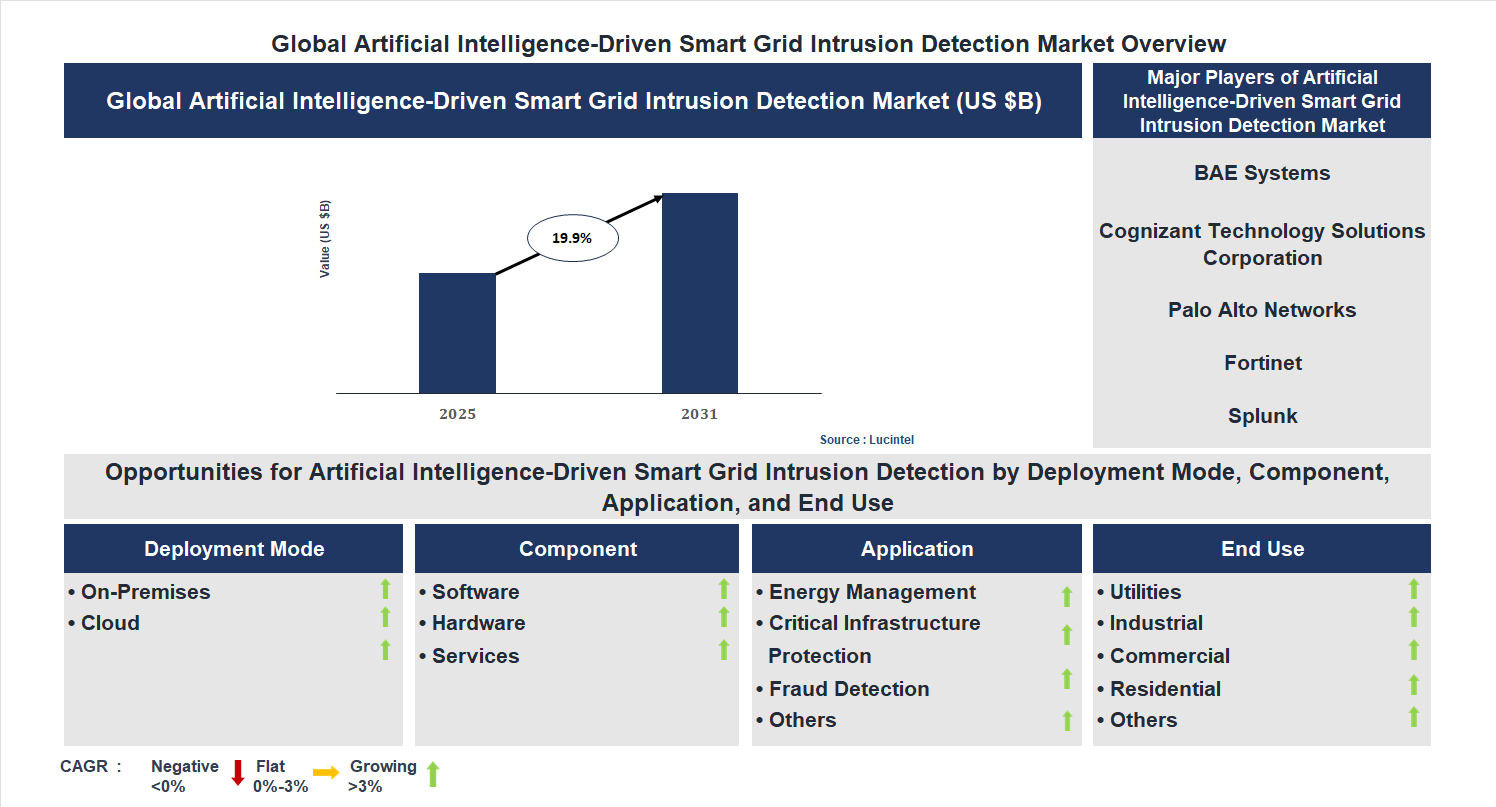
Emerging Trends in the Artificial Intelligence-Driven Smart Grid Intrusion Detection Market
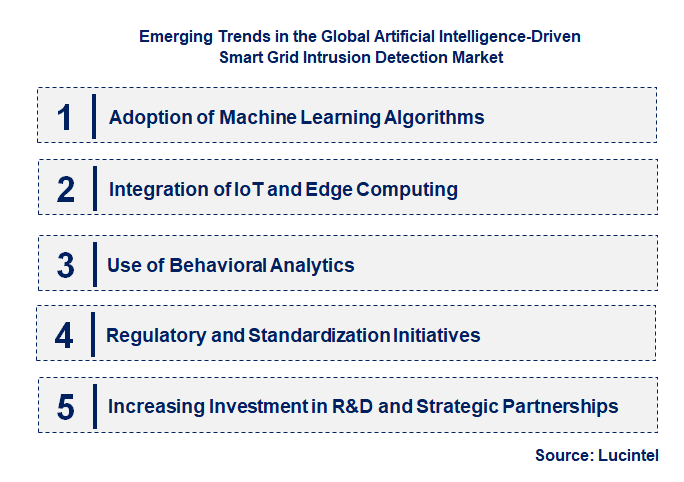
The artificial intelligence-driven smart grid intrusion detection market is experiencing rapid growth driven by the increasing need for cybersecurity in energy infrastructure. As smart grids become more complex and interconnected, the risk of cyber threats escalates, prompting the adoption of advanced AI solutions for real-time threat detection and prevention. This market is shaped by technological advancements, regulatory pressures, and the rising importance of reliable energy supply. The integration of AI into smart grid security systems is transforming how utilities protect critical infrastructure, ensuring resilience against cyberattacks. Here are five key emerging trends shaping this market's future.• Adoption of Machine Learning Algorithms: The market is witnessing a surge in machine learning-based intrusion detection systems that can analyze vast amounts of data to identify anomalies. These algorithms improve over time, enhancing detection accuracy and reducing false positives. This trend enables utilities to respond swiftly to threats, minimizing potential damage and ensuring grid stability. The continuous evolution of machine learning models is making intrusion detection more adaptive and intelligent, which is crucial for safeguarding complex smart grid networks.
• Integration of IoT and Edge Computing: The proliferation of IoT devices in smart grids necessitates localized security solutions. Edge computing allows data processing closer to the source, reducing latency and enabling real-time threat detection. This integration enhances the responsiveness of intrusion detection systems, especially in remote or distributed grid segments. It also alleviates bandwidth issues by processing data locally, making security measures more efficient and scalable across extensive smart grid infrastructures.
• Use of Behavioral Analytics: Behavioral analytics is increasingly employed to monitor user and device activities within smart grids. By establishing baseline behaviors, AI systems can detect deviations indicative of cyber threats or insider attacks. This trend improves the detection of sophisticated and zero-day attacks that traditional signature-based systems might miss. Behavioral analytics provides a proactive security approach, enabling early threat identification and reducing the risk of successful intrusions.
• Regulatory and Standardization Initiatives: Governments and industry bodies are developing regulations and standards to enhance cybersecurity in smart grids. These initiatives promote the adoption of AI-driven intrusion detection systems by establishing best practices and compliance requirements. The trend fosters increased market confidence and encourages utilities to invest in advanced security solutions. Standardization also facilitates interoperability among different systems, ensuring comprehensive protection across diverse smart grid components.
• Increasing Investment in R&D and Strategic Partnerships: Companies and governments are investing heavily in research and development to innovate AI-based security solutions. Strategic partnerships between technology providers, utility companies, and cybersecurity firms are forming to develop integrated security frameworks. This trend accelerates the deployment of cutting-edge intrusion detection technologies, enhances system robustness, and drives market growth. It also fosters knowledge sharing and the development of industry-wide best practices, ensuring the market remains at the forefront of cybersecurity innovation. In summary, these emerging trends are fundamentally reshaping the artificial intelligence-driven smart grid intrusion detection market by making security systems more intelligent, responsive, and integrated. They are driving increased adoption, improving threat detection capabilities, and fostering a more resilient energy infrastructure. As these trends continue to evolve, they will play a crucial role in safeguarding smart grids against an ever-expanding landscape of cyber threats, ensuring reliable and secure energy delivery for the future.
Recent Development in the Artificial Intelligence-Driven Smart Grid Intrusion Detection Market
The artificial intelligence-driven smart grid intrusion detection market is experiencing rapid growth driven by increasing cyber threats and the need for enhanced grid security. As energy infrastructure becomes more digitized, protecting these systems from cyberattacks is critical. AI technologies are being integrated into smart grid systems to detect and prevent intrusions in real-time, ensuring reliable and secure energy distribution. Recent developments reflect advancements in AI algorithms, increased adoption by utility providers, and regulatory support for cybersecurity measures. These trends are shaping the future landscape of energy security, making the market more robust and resilient against evolving cyber threats.• Advancements in AI Algorithms: Development of more sophisticated machine learning models has improved intrusion detection accuracy, reducing false positives and enabling faster response times, thereby strengthening grid security.
• Increased Adoption by Utility Providers: Utility companies are increasingly integrating AI-driven intrusion detection systems into their smart grids, leading to enhanced real-time monitoring and threat mitigation capabilities.
• Regulatory and Policy Support: Governments and regulatory bodies are implementing stricter cybersecurity standards and providing funding for AI-based security solutions, encouraging market growth and innovation.
• Integration with IoT and Big Data: The convergence of IoT devices and big data analytics with AI enhances the ability to monitor vast amounts of data, improving threat detection and predictive maintenance in smart grids.
• Emergence of Edge Computing: Deployment of AI at the edge allows for faster detection and response to intrusions directly within the grid infrastructure, reducing reliance on centralized systems and improving resilience. These developments are significantly impacting the market by increasing the deployment of AI-driven security solutions, improving grid resilience, and fostering innovation. The market is becoming more competitive and sophisticated, with a focus on real-time, proactive cybersecurity measures that safeguard critical energy infrastructure against cyber threats.
Strategic Growth Opportunities in the Artificial Intelligence-Driven Smart Grid Intrusion Detection Market
The artificial intelligence-driven smart grid intrusion detection market is experiencing rapid growth driven by the increasing need for cybersecurity in energy infrastructure. As smart grids become more prevalent, the demand for advanced detection systems that leverage AI to identify and mitigate threats is rising. Key applications such as utility management, renewable energy integration, industrial automation, residential smart homes, and government infrastructure are pivotal in shaping market expansion. These sectors are adopting AI-driven solutions to enhance security, improve operational efficiency, and ensure reliable energy delivery. The following opportunities highlight the most promising avenues for growth across these applications.• Utility Management: Enhanced Security and Efficiency : AI-driven intrusion detection systems enable utilities to monitor and protect critical infrastructure from cyber threats, ensuring uninterrupted service and operational resilience. This reduces downtime and maintenance costs while improving response times to security breaches.
• Renewable Energy Integration: Securing Distributed Resources : As renewable energy sources like solar and wind are integrated into smart grids, AI solutions help detect vulnerabilities in these decentralized systems, preventing cyber-attacks that could disrupt energy supply and grid stability.
• Industrial Automation: Protecting Critical Infrastructure : Industrial facilities utilizing smart grid technology benefit from AI-based intrusion detection to safeguard sensitive equipment and data. This minimizes risks of sabotage and cyber espionage, ensuring continuous industrial operations.
• Residential Smart Homes: Enhancing Consumer Security : The adoption of AI-driven intrusion detection in smart home systems offers consumers better protection against cyber threats, fostering trust and accelerating market penetration of connected home devices.
• Government Infrastructure: National Security and Resilience : Governments are deploying AI-powered intrusion detection to defend national energy infrastructure from sophisticated cyber-attacks, strengthening national security and ensuring energy independence. In summary, these growth opportunities are significantly impacting the artificial intelligence-driven smart grid intrusion detection market by expanding its application scope, enhancing security measures, and fostering innovation. As sectors increasingly adopt AI solutions, the market is poised for substantial growth, driven by the need for resilient, secure, and efficient energy systems worldwide.
Artificial Intelligence-Driven Smart Grid Intrusion Detection Market Driver and Challenges
The artificial intelligence-driven smart grid intrusion detection market is influenced by a variety of technological, economic, and regulatory factors. Rapid advancements in AI and machine learning technologies are enabling more sophisticated and real-time threat detection, which is crucial for securing smart grid infrastructures. Economic factors such as increasing investments in smart grid modernization and the rising need for reliable energy distribution are fueling market growth. Regulatory frameworks and government initiatives aimed at enhancing cybersecurity standards further propel adoption. However, the market also faces challenges like high implementation costs, data privacy concerns, and evolving cyber threats that require continuous innovation and strategic planning to overcome. The factors responsible for driving the artificial intelligence-driven smart grid intrusion detection market include:• Technological Advancements: The continuous development of AI and machine learning algorithms enhances the ability to detect and respond to cyber threats in real-time. These technologies enable predictive analytics, anomaly detection, and automated responses, significantly improving grid security. As AI models become more sophisticated, their integration into smart grid systems becomes more seamless, leading to increased adoption. The ability to process vast amounts of data quickly and accurately is vital for identifying complex intrusion patterns, making technological progress a key driver.
• Increasing Investment in Smart Grid Infrastructure: Governments and private sector players are investing heavily in modernizing energy infrastructure to improve efficiency, reliability, and security. These investments include deploying AI-powered intrusion detection systems to safeguard critical assets. The rising demand for resilient energy networks amid growing cyber threats encourages stakeholders to adopt advanced security solutions. Funding initiatives and incentives further accelerate market growth, making investment in AI-driven security a strategic priority for energy providers.
• Rising Cybersecurity Threats: The increasing frequency and sophistication of cyberattacks targeting smart grids create an urgent need for advanced intrusion detection solutions. AI-driven systems can identify and mitigate threats faster than traditional methods, reducing potential damages. As threat actors develop more complex attack vectors, the reliance on AI for proactive defense becomes essential. This escalating threat landscape compels utilities and grid operators to adopt intelligent security measures, thereby driving market expansion.
• Regulatory and Policy Frameworks: Governments worldwide are implementing regulations and standards to enhance the cybersecurity of critical infrastructure, including smart grids. These policies often mandate the deployment of advanced intrusion detection systems, encouraging market players to adopt AI-based solutions. Compliance requirements and incentives for secure energy systems foster a conducive environment for market growth. Regulatory support not only accelerates adoption but also ensures that security measures keep pace with evolving cyber threats. The challenges facing this artificial intelligence-driven smart grid intrusion detection market include:
• High Implementation and Maintenance Costs: Deploying AI-driven intrusion detection systems involves significant capital expenditure, including hardware, software, and skilled personnel. Ongoing maintenance, updates, and system upgrades add to operational costs, which can be prohibitive for smaller utilities or developing regions. These financial barriers may slow down widespread adoption, especially where budget constraints exist, limiting the market's growth potential.
• Data Privacy and Security Concerns: The deployment of AI systems requires extensive data collection and analysis, raising concerns over data privacy and security. Sensitive information related to grid operations and customer data must be protected against breaches. Ensuring compliance with data protection regulations adds complexity and can hinder implementation. Additionally, the risk of AI systems themselves being targeted or manipulated poses further security challenges.
• Evolving Cyber Threat Landscape: Cyber threats are continuously evolving, with attackers developing new techniques to bypass security measures. AI systems must be regularly updated and trained to recognize emerging threats, which demands ongoing research and development. Failure to keep pace can render intrusion detection systems ineffective, exposing smart grids to vulnerabilities. This dynamic threat environment necessitates continuous innovation and resource allocation, posing a significant challenge for market players. In summary, the artificial intelligence-driven smart grid intrusion detection market is shaped by rapid technological progress, increasing investments, rising cyber threats, and supportive regulatory frameworks. However, high costs, data privacy issues, and the constantly evolving cyber threat landscape present notable challenges. These factors collectively influence the pace and scope of market growth, requiring stakeholders to balance innovation with strategic risk management. Overall, the market's future depends on addressing these challenges effectively while leveraging technological and regulatory drivers to enhance grid security globally.
List of Artificial Intelligence-Driven Smart Grid Intrusion Detection Companies
Companies in the market compete on the basis of product quality offered. Major players in this market focus on expanding their manufacturing facilities, R&D investments, infrastructural development, and leverage integration opportunities across the value chain. With these strategies artificial intelligence-driven smart grid intrusion detection companies cater increasing demand, ensure competitive effectiveness, develop innovative products & technologies, reduce production costs, and expand their customer base. Some of the artificial intelligence-driven smart grid intrusion detection companies profiled in this report include-• BAE Systems
• Cognizant Technology Solutions Corporation
• Palo Alto Networks
• Fortinet
• Splunk
• Itron
• Trellix
• Trend Micro Incorporated
• Persistent Systems
• Tenable Holdings
Artificial Intelligence-Driven Smart Grid Intrusion Detection Market by Segment
The study includes a forecast for the global artificial intelligence-driven smart grid intrusion detection market by deployment mode, component, application, end use, and region.Artificial Intelligence-Driven Smart Grid Intrusion Detection Market by Deployment Mode [Value from 2019 to 2031]:
• On-Premises
• Cloud
Artificial Intelligence-Driven Smart Grid Intrusion Detection Market by Component [Value from 2019 to 2031]:
• Software
• Hardware
• Services
Artificial Intelligence-Driven Smart Grid Intrusion Detection Market by Application [Value from 2019 to 2031]:
• Energy Management
• Critical Infrastructure Protection
• Fraud Detection
• Others
Artificial Intelligence-Driven Smart Grid Intrusion Detection Market by End Use [Value from 2019 to 2031]:
• Utilities
• Industrial
• Commercial
• Residential
• Others
Artificial Intelligence-Driven Smart Grid Intrusion Detection Market by Region [Value from 2019 to 2031]:
• North America
• Europe
• Asia Pacific
• The Rest of the World
Country Wise Outlook for the Artificial Intelligence-Driven Smart Grid Intrusion Detection Market
The artificial intelligence-driven smart grid intrusion detection market is experiencing rapid growth driven by increasing cybersecurity threats and the need for resilient energy infrastructure. Countries worldwide are investing heavily in AI technologies to enhance grid security, improve operational efficiency, and prevent cyberattacks. The market's evolution reflects advancements in machine learning, real-time data analysis, and automation, which are transforming traditional energy systems into smarter, more secure networks. As governments and private sectors recognize the importance of protecting critical infrastructure, regional developments are shaping the future landscape of AI-driven smart grid security solutions.• United States: The U.S. market is leading in AI-driven smart grid intrusion detection, with significant investments from government agencies and private firms. Recent developments include the deployment of advanced machine learning algorithms for real-time threat detection and the integration of IoT devices for enhanced monitoring. Federal initiatives aim to modernize aging infrastructure and bolster cybersecurity resilience, fostering innovation in AI applications. Collaborations between tech companies and utilities are accelerating the adoption of intelligent security systems, making the U.S. a pioneer in this domain.
• China: China is rapidly expanding its AI capabilities within the smart grid sector, focusing on large-scale deployment of AI-powered intrusion detection systems. The government’s strategic plans emphasize energy security and digital transformation, leading to significant investments in AI research and infrastructure. Recent advancements include the development of autonomous threat response mechanisms and the integration of big data analytics to predict and prevent cyberattacks. Domestic companies are increasingly involved in deploying these solutions across urban and rural grids, positioning China as a key player in AI-driven energy security.
• Germany: Germany’s focus on energy transition and digitalization has propelled advancements in AI-driven smart grid security. The country emphasizes integrating renewable energy sources with intelligent cybersecurity measures. Recent developments include the deployment of AI-based anomaly detection systems and enhanced encryption protocols to safeguard critical infrastructure. Public-private partnerships are fostering innovation, and regulatory frameworks are evolving to support secure digital energy networks. Germany’s commitment to sustainability and security is driving the adoption of cutting-edge AI solutions in its smart grid systems.
• India: India is witnessing rapid growth in AI applications for smart grid security, driven by increasing energy demand and cyber threats. Recent developments include the deployment of AI-enabled intrusion detection systems in major urban centers and rural areas to improve grid reliability. The government’s initiatives aim to modernize the power sector through digital transformation, with investments in AI research and infrastructure. Innovations such as predictive analytics and automated threat mitigation are being integrated into existing grids, enhancing resilience and operational efficiency across the country.
• Japan: Japan is advancing its smart grid security through AI-driven intrusion detection, focusing on disaster resilience and energy efficiency. Recent developments include deploying AI algorithms for early threat detection and integrating sensor networks for real-time monitoring. The country’s emphasis on cybersecurity in critical infrastructure has led to the adoption of sophisticated AI solutions. Collaborations between government agencies, academia, and industry are fostering innovation, with a particular focus on protecting against cyberattacks amid increasing digitalization and natural disaster risks.

Features of the Global Artificial Intelligence-Driven Smart Grid Intrusion Detection Market
Market Size Estimates: Artificial intelligence-driven smart grid intrusion detection market size estimation in terms of value ($B). Trend and Forecast Analysis: Market trends (2019 to 2024) and forecast (2025 to 2031) by various segments and regions. Segmentation Analysis: Artificial intelligence-driven smart grid intrusion detection market size by various segments, such as by deployment mode, component, application, end use, and region in terms of value ($B). Regional Analysis: Artificial intelligence-driven smart grid intrusion detection market breakdown by North America, Europe, Asia Pacific, and Rest of the World. Growth Opportunities: Analysis of growth opportunities in different deployment mode, components, applications, end uses, and regions for the artificial intelligence-driven smart grid intrusion detection market. Strategic Analysis: This includes M&A, new product development, and competitive landscape of the artificial intelligence-driven smart grid intrusion detection market. Analysis of competitive intensity of the industry based on Porter’s Five Forces model.
FAQ
Q1. What is the growth forecast for artificial intelligence-driven smart grid intrusion detection market? Answer: The global artificial intelligence-driven smart grid intrusion detection market is expected to grow with a CAGR of 19.9% from 2025 to 2031. Q2. What are the major drivers influencing the growth of the artificial intelligence-driven smart grid intrusion detection market? Answer: The major drivers for this market are the increasing vulnerability of interconnected power networks, the rising demand for automated grid protection, and the growing deployment of AI-based intrusion systems. Q3. What are the major segments for artificial intelligence-driven smart grid intrusion detection market? Answer: The future of the artificial intelligence-driven smart grid intrusion detection market looks promising with opportunities in the utility, industrial, commercial, and residential markets. Q4. Who are the key artificial intelligence-driven smart grid intrusion detection market companies? Answer: Some of the key artificial intelligence-driven smart grid intrusion detection companies are as follows:• BAE Systems
• Cognizant Technology Solutions Corporation
• Palo Alto Networks
• Fortinet
• Splunk
• Itron
• Trellix
• Trend Micro Incorporated
• Persistent Systems
• Tenable Holdings Q5. Which artificial intelligence-driven smart grid intrusion detection market segment will be the largest in future? Answer: Lucintel forecasts that, within the deployment mode category, cloud is expected to witness higher growth over the forecast period. Q6. In artificial intelligence-driven smart grid intrusion detection market, which region is expected to be the largest in next 5 years? Answer: In terms of region, APAC is expected to witness the highest growth over the forecast period. Q7. Do we receive customization in this report? Answer: Yes, Lucintel provides 10% customization without any additional cost.
Table of Contents
List of Figures
List of Tables
Methodology
- In-depth interviews of the major players in this market
- Detailed secondary research from competitors’ financial statements and published data
- Extensive searches of published works, market, and database information pertaining to industry news, company press releases, and customer intentions
- A compilation of the experiences, judgments, and insights of Lucintel’s professionals, who have analyzed and tracked this market over the years.


Buy Now
Choose a license that fits your team. Instant PDF delivery.
Prices exclude taxes. Instant delivery. Custom licensing available on request.
Key Questions
- • What are some of the most promising, high-growth opportunities for the artificial intelligence-driven smart grid intrusion detection market by deployment mode (on-premises and cloud), component (software, hardware, and services), application (energy management, critical infrastructure protection, fraud detection, and others), end use (utilities, industrial, commercial, residential, and others), and region (North America, Europe, Asia Pacific, and the Rest of the World)?
- • Which segments will grow at a faster pace and why?
- • Which region will grow at a faster pace and why?
- • What are the key factors affecting market dynamics? What are the key challenges and business risks in this market?
- • What are the business risks and competitive threats in this market?
- • What are the emerging trends in this market and the reasons behind them?
- • What are some of the changing demands of customers in the market?
- • What are the new developments in the market? Which companies are leading these developments?
- • Who are the major players in this market? What strategic initiatives are key players pursuing for business growth?
- • What are some of the competing products in this market and how big of a threat do they pose for loss of market share by material or product substitution?
- • What M&A activity has occurred in the last 5 years and what has its impact been on the industry? For any questions related to Artificial Intelligence-Driven Smart Grid Intrusion Detection Market, Artificial Intelligence-Driven Smart Grid Intrusion Detection Market Size, Artificial Intelligence-Driven Smart Grid Intrusion Detection Market Growth, Artificial Intelligence-Driven Smart Grid Intrusion Detection Market Analysis, Artificial Intelligence-Driven Smart Grid Intrusion Detection Market Report, Artificial Intelligence-Driven Smart Grid Intrusion Detection Market Share, Artificial Intelligence-Driven Smart Grid Intrusion Detection Market Trends, Artificial Intelligence-Driven Smart Grid Intrusion Detection Market Forecast, Artificial Intelligence-Driven Smart Grid Intrusion Detection Companies, write Lucintel analyst at email: helpdesk@lucintel.com. We will be glad to get back to you soon.


