
Market Report · July 31, 2026

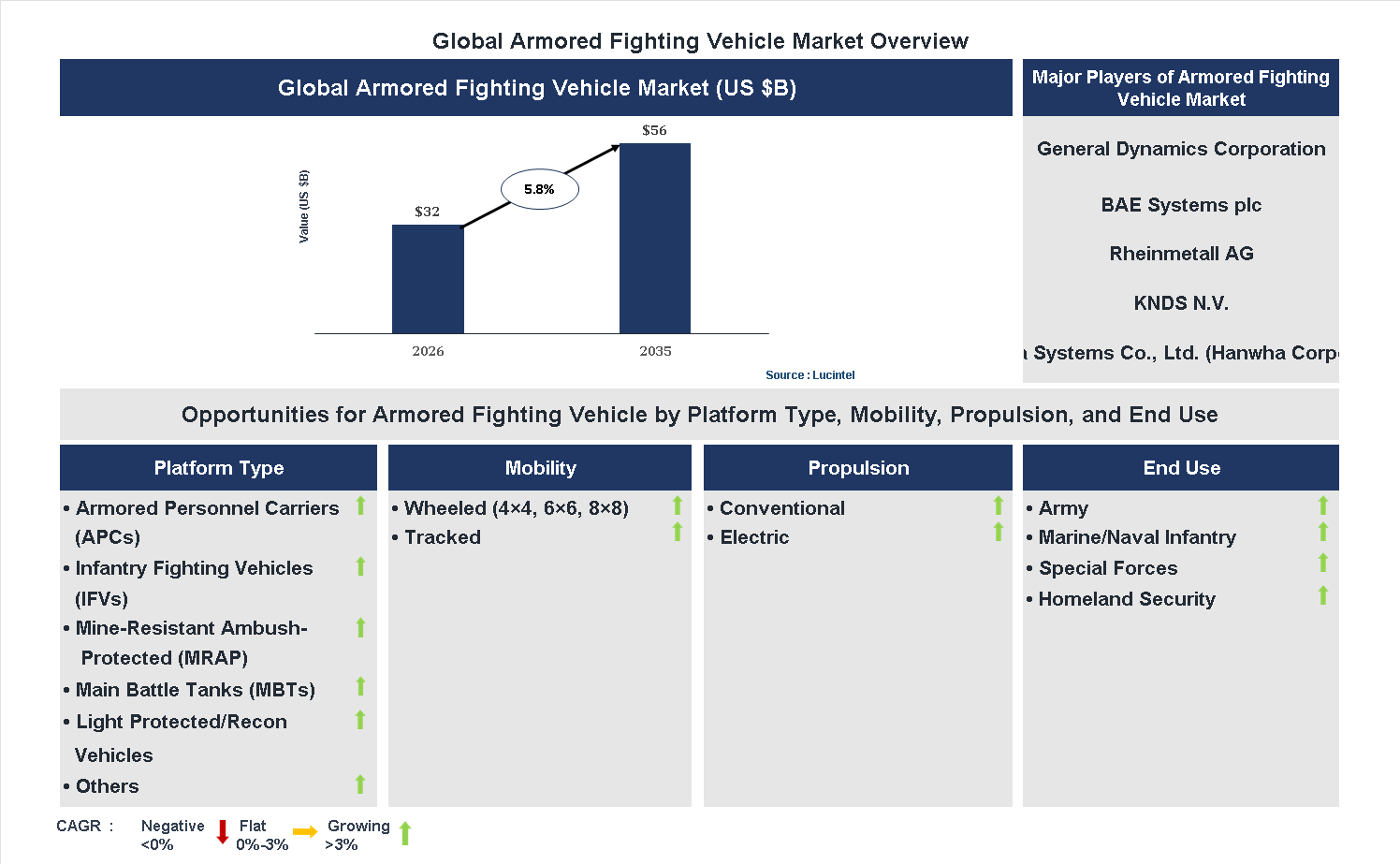
Key data points: The market size in 2035 = $56 billion, growth forecast = 5.8% annually for the next 8 years. Scroll below to get more insights. This market report covers trends, opportunities and forecasts in armored fighting vehicle market to 2035 by platform type (armored personnel carriers, infantry fighting vehicles, mine-resistant ambush-protected, main battle tanks, light protected/recon vehicles, and others), mobility (wheeled (4×4, 6×6, 8×8) and tracked), propulsion (conventional and electric), end use (army, marine/naval infantry, special forces, and homeland security), and region (North America, Europe, Asia Pacific, and the Rest of the World)
We'll send your sample report shortly.
• Lucintel forecasts that, within the platform type category, infantry fighting vehicle (IFVs) is expected to witness higher growth over the forecast period.
• Within the end use category, army is expected to witness the highest growth.
• In terms of region, APAC is expected to witness the highest growth over the forecast period. Gain valuable insights for your business decisions with our comprehensive 150+ page report. Sample figures with some insights are shown below.
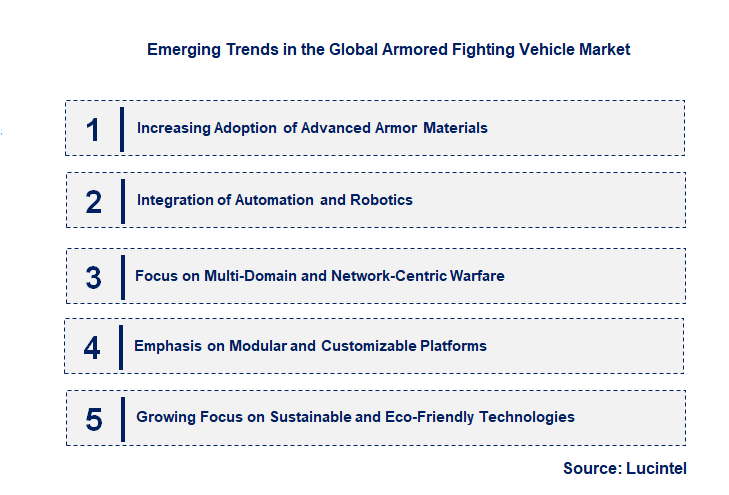
• Increasing Adoption of Advanced Armor Materials: The market is witnessing a shift towards lightweight, high-strength materials such as composite armor and ceramics. These materials provide enhanced protection while reducing vehicle weight, improving mobility and fuel efficiency. This trend allows for better survivability against modern threats like IEDs and anti-tank missiles, thereby increasing the operational lifespan of AFVs and reducing maintenance costs.
• Integration of Automation and Robotics: Modern AFVs are incorporating autonomous systems, remote weapon stations, and robotic technologies. These advancements reduce crew exposure to danger, improve precision, and enhance battlefield situational awareness. Automation also enables faster decision-making and operational efficiency, which are critical in complex combat scenarios. This trend is expected to revolutionize vehicle design and combat tactics, making AFVs more versatile and lethal.
• Focus on Multi-Domain and Network-Centric Warfare: The market is shifting towards vehicles equipped with advanced communication and sensor systems that enable seamless integration across land, air, sea, and cyber domains. Network-centric capabilities facilitate real-time data sharing, coordinated operations, and enhanced command and control. This interconnected approach improves battlefield responsiveness and strategic flexibility, making AFVs more effective in joint and coalition operations.
• Emphasis on Modular and Customizable Platforms: Manufacturers are designing AFVs with modular architectures that allow easy upgrades and customization based on mission requirements. This flexibility reduces lifecycle costs and extends the operational relevance of vehicles. Modular systems enable rapid adaptation to emerging threats, new weapon systems, and evolving tactical needs, thus providing a competitive edge in a dynamic security environment.
• Growing Focus on Sustainable and Eco-Friendly Technologies: The market is increasingly adopting hybrid and electric propulsion systems to reduce carbon footprints and operational costs. Incorporating renewable energy sources and energy-efficient components aligns with global sustainability goals. This trend not only enhances the environmental profile of AFVs but also offers strategic advantages such as reduced logistical dependencies on fuel supplies, thereby increasing operational resilience. These emerging trends are fundamentally reshaping the Armored Fighting Vehicle market by enhancing vehicle protection, operational efficiency, and adaptability. The integration of advanced materials, automation, network capabilities, modular designs, and sustainable technologies is driving innovation and competitiveness. As a result, modern AFVs are becoming more sophisticated, versatile, and capable of meeting the complex demands of contemporary and future warfare environments.
• Growing Defense Budgets: Increased military spending worldwide is fueling AFV demand. Countries are prioritizing modernization programs to enhance their defense capabilities, leading to higher procurement of advanced armored vehicles. This trend is driven by geopolitical tensions, regional conflicts, and the need for strategic superiority. As a result, manufacturers are expanding production capacities and investing in R&D to meet rising orders, which boosts market growth and innovation.
• Technological Advancements in Armor and Weaponry: Innovations in composite armor, active protection systems, and weapon integration are transforming AFVs. These advancements improve vehicle survivability, firepower, and operational efficiency. The integration of AI and automation is further enhancing battlefield capabilities. Such technological progress attracts military contracts and encourages modernization of existing fleets, thereby expanding the market and encouraging competition among defense contractors.
• Increased Focus on Modernization and Upgrades: Many countries are upgrading their existing AFV fleets to extend service life and incorporate new technologies. Modernization programs include installing advanced sensors, communication systems, and weaponry. This trend reduces the need for complete replacements, offering cost-effective solutions. It also creates a steady demand for upgrade kits and retrofit services, stimulating growth in the aftermarket segment and fostering long-term industry stability.
• Rising Demand in Emerging Markets: Developing nations are increasingly investing in AFVs to bolster their defense systems amid regional conflicts and security concerns. These markets offer significant growth opportunities due to lower existing penetration and rising military budgets. Local manufacturing partnerships and technology transfers are common strategies to meet demand. This expansion diversifies the market, increases competition, and accelerates innovation, ultimately broadening the global footprint of AFV manufacturers.
• Impact of Geopolitical Tensions and Conflicts: Ongoing regional conflicts and geopolitical rivalries are driving countries to prioritize AFV procurement. The need for secure, mobile, and heavily armored vehicles is critical in conflict zones. This environment accelerates procurement cycles and encourages rapid deployment of new technologies. Consequently, the market experiences heightened demand, increased competition among defense contractors, and a focus on rapid innovation to meet urgent military needs, shaping the future landscape of armored vehicle development. The overall impact of these developments is a robust, dynamic AFV market characterized by technological innovation, increased competition, and expanding global demand. Countries are modernizing their military assets, which drives growth and diversification in the industry. This evolution enhances defense capabilities worldwide, fostering strategic advantages and contributing to global security stability.
• Increasing Defense Budgets and Geopolitical Tensions Drive Demand for Armored Fighting Vehicles: Countries worldwide are prioritizing military modernization to enhance national security, leading to increased procurement of armored vehicles. Governments are allocating substantial funds to upgrade existing fleets and develop new platforms capable of countering emerging threats. This trend is particularly prominent in regions experiencing regional conflicts or border disputes, fueling sustained growth in the market.
• Technological Advancements in Automation and Weapon Systems Expand Vehicle Capabilities: Innovations such as autonomous driving, advanced targeting, and integrated weapon systems are transforming armored fighting vehicles. These technologies improve operational efficiency, reduce crew risk, and enhance combat effectiveness. Manufacturers are investing in R&D to incorporate AI, sensor fusion, and modular designs, enabling vehicles to adapt to evolving battlefield requirements and increasing their appeal to modern armed forces.
• Growing Demand for Multi-Role and Versatile Vehicles for Diverse Combat Scenarios: Modern militaries seek adaptable vehicles capable of performing multiple functions, including reconnaissance, troop transport, and direct engagement. The development of modular platforms allows customization for specific missions, increasing operational flexibility. This trend supports the deployment of fewer specialized vehicles, reducing costs and logistical complexity, and broadening the market for multi-purpose armored fighting vehicles.
• Rising Focus on Lightweight, Protected, and Sustainable Vehicles: Advances in materials such as composites and lightweight alloys enable the production of more mobile and fuel-efficient armored vehicles. Emphasis on sustainability and reduced environmental impact is prompting innovations in hybrid and electric powertrains. These developments improve operational range and reduce logistical burdens, making vehicles suitable for varied terrains and prolonged missions, thus expanding market opportunities.
• Strategic Collaborations and Government Contracts Boost Market Growth: Partnerships between defense contractors, technology firms, and governments facilitate the development of cutting-edge armored vehicles. Large-scale procurement programs and international collaborations provide stable revenue streams for manufacturers. These alliances accelerate innovation, reduce costs, and enable the deployment of advanced vehicles, further fueling market expansion and ensuring the sectors resilience amid geopolitical uncertainties. The armored fighting vehicle market is poised for substantial growth driven by technological innovation, evolving military needs, and strategic collaborations. Increasing defense investments and the demand for versatile, lightweight, and advanced vehicles will shape future developments. These opportunities will enhance military capabilities worldwide, fostering a competitive and innovative industry landscape that responds effectively to emerging security challenges.
• Technological Innovation: The continuous evolution of AFV technology, such as improved armor, weapon systems, and automation, enhances battlefield effectiveness. Countries prioritize modern, technologically advanced vehicles to maintain strategic superiority, fueling market growth. Innovations like unmanned systems and hybrid propulsion are expanding capabilities, attracting military investments worldwide.
• Increasing Defense Budgets: Many nations are increasing their defense spending to modernize their armed forces amid rising geopolitical tensions. This surge in budgets enables procurement of advanced AFVs, supporting market expansion. Governments recognize the importance of armored vehicles in modern warfare, leading to sustained demand.
• Geopolitical Tensions and Conflicts: Ongoing regional conflicts and geopolitical instability drive countries to bolster their military capabilities. The need for reliable, heavily armed vehicles to ensure national security results in increased orders for AFVs, stimulating market growth.
• Strategic Alliances and Defense Collaborations: International partnerships and defense alliances facilitate technology transfer and joint procurement programs. These collaborations expand market opportunities for AFV manufacturers and promote standardization, thereby boosting sales and innovation. The challenges in the Armored Fighting Vehicle Market are:-
• High Production and Maintenance Costs: Developing and maintaining advanced AFVs require significant financial investment. The high costs associated with research, development, and lifecycle maintenance can limit procurement, especially for smaller defense budgets, constraining market growth.
• Regulatory and Compliance Barriers: Stringent defense procurement regulations, export controls, and compliance standards can delay or restrict the deployment of new AFVs. Navigating complex regulatory environments hampers timely market entry and expansion.
• Procurement Delays and Budget Constraints: Political changes, budget reallocations, and lengthy procurement processes often cause delays in vehicle acquisition. These delays impact manufacturers revenue streams and can hinder the overall growth trajectory of the market. The Armored Fighting Vehicle Market is shaped by rapid technological advancements, increased defense spending, and geopolitical tensions, which collectively drive growth. However, high costs, regulatory hurdles, and procurement delays pose significant challenges. These factors create a dynamic environment where innovation and strategic planning are crucial. While opportunities for expansion are substantial, stakeholders must navigate financial and regulatory complexities to capitalize on market potential. Overall, the markets future depends on balancing technological progress with effective management of economic and regulatory challenges.
• General Dynamics Corporation
• BAE Systems plc
• Rheinmetall AG
• KNDS N.V.
• Hanwha Systems Co., Ltd. (Hanwha Corporation)
• Oshkosh Corporation
• Textron Systems Corporation (Textron Inc.)
• Elbit Systems Ltd.
• Patria Group
• FNSS Savunma Sistemleri A.Ş.
• Armored Personnel Carriers
• Infantry Fighting Vehicles
• Mine-Resistant Ambush-Protected
• Main Battle Tanks
• Light Protected/Recon Vehicles
• Others
• Wheeled (4×4, 6×6, 8×8)
• Tracked
• Conventional
• Electric
• Army
• Marine/Naval Infantry
• Special Forces
• Homeland Security
• North America
• Europe
• Asia Pacific
• The Rest of the World
• United States: The US has focused on upgrading its fleet with next-generation armored vehicles, including the Bradley Fighting Vehicle and Stryker series, integrating advanced armor and weapon systems. Recent developments include the deployment of autonomous and remotely operated systems, enhancing battlefield versatility. The US government is also investing in next-gen technologies like AI and hybrid powertrains to improve vehicle performance and survivability. Additionally, procurement of new vehicles such as the Armored Multi-Purpose Vehicle (AMPV) demonstrates ongoing modernization efforts to replace aging platforms.
• China: China has rapidly expanded its armored vehicle capabilities, emphasizing indigenous development and modernization. Recent advancements include the production of new infantry fighting vehicles like the ZBD-08 and ZBD-09, featuring improved armor, firepower, and mobility. China is also investing in unmanned and remotely operated AFVs, integrating AI and sensor technologies. The military modernization program aims to enhance strategic reach and operational flexibility, with increased procurement of armored vehicles for both domestic use and export markets. The development of heavy tanks and amphibious armored vehicles underscores Chinas focus on versatile battlefield assets.
• Germany: Germany continues to innovate within its armored vehicle sector, focusing on upgrading existing platforms such as the Leopard 2 tank and Boxer armored personnel carrier. Recent developments include the integration of active protection systems and enhanced armor to counter evolving threats. Germany is also investing in digitization and network-centric warfare capabilities, enabling better battlefield coordination. The country is exploring hybrid propulsion systems to improve fuel efficiency and reduce environmental impact. Collaborative projects with NATO allies aim to standardize and modernize armored vehicle fleets, ensuring interoperability and technological superiority.
• India: India has accelerated its armored vehicle modernization, emphasizing indigenous development through programs like the Arjun tank and the production of the BMP-2 upgrade. Recent advancements include the development of the Future Infantry Combat Vehicle (FICV) and the K-9 Vajra artillery gun, integrating modern armor, firepower, and electronics. India is also focusing on enhancing mobility and survivability with new armor materials and weapon systems. The government’s "Make in India" initiative promotes domestic manufacturing, reducing reliance on imports. Increased procurement and joint ventures with foreign firms are driving the expansion and modernization of India’s armored fleet.
• Japan: Japan is advancing its armored vehicle capabilities to address regional security challenges, focusing on modernization and technological innovation. Recent developments include upgrades to the Type 90 and Type 10 tanks, incorporating improved armor, fire control systems, and network connectivity. Japan is investing in autonomous and unmanned systems to augment its armored forces. The country emphasizes lightweight, highly mobile vehicles suitable for its terrain and strategic needs. Collaborations with international partners aim to incorporate cutting-edge technologies, ensuring Japan’s armored fleet remains modern and capable of countering regional threats effectively.


• General Dynamics Corporation
• BAE Systems plc
• Rheinmetall AG
• KNDS N.V.
• Hanwha Systems Co., Ltd. (Hanwha Corporation)
• Oshkosh Corporation
• Textron Systems Corporation (Textron Inc.)
• Elbit Systems Ltd.
• Patria Group
• FNSS Savunma Sistemleri A.Ş. Q6. Which armored fighting vehicle market segment will be the largest in future? Answer: Lucintel forecasts that, within the platform type category, infantry fighting vehicle (IFVs) is expected to witness higher growth over the forecast period. Q7. In armored fighting vehicle market, which region is expected to be the largest in next 8 years? Answer: In terms of region, APAC is expected to witness the highest growth over the forecast period. Q8. Do we receive customization in this report? Answer: Yes, Lucintel provides 10% customization without any additional cost.


Choose a license that fits your team. Instant PDF delivery.
Prices exclude taxes. Instant delivery. Custom licensing available on request.
Market Report · July 31, 2026
Market Report · July 31, 2026
Market Report · July 22, 2026
Trusted partner for strategic intelligence and business growth


Receive a complimentary market analysis tailored to your industry. Our analysts will identify key growth opportunities and competitive dynamics specific to your business.

Market size, growth rate, and key trend analysis for your specific sector.

Top competitor positioning and market share analysis.

Strategic recommendations backed by data-driven insights.
Get curated market intelligence and competitive moves straight to your inbox.
By subscribing, you agree to receive our monthly insights. Unsubscribe anytime.
Receive a complimentary market analysis tailored to your industry. Our analysts will identify key growth opportunities and competitive dynamics specific to your business.
Market size, growth rate, and key trend analysis for your specific sector.
Top competitor positioning and market share analysis.
Strategic recommendations backed by data-driven insights.
Get curated market intelligence, emerging trends, and competitive moves straight to your inbox each month.
By subscribing, you agree to receive our monthly insights. Unsubscribe anytime.
We'll send your sample report shortly.