
Report Feature
AR Optical Waveguide Module Market Trends and Forecast
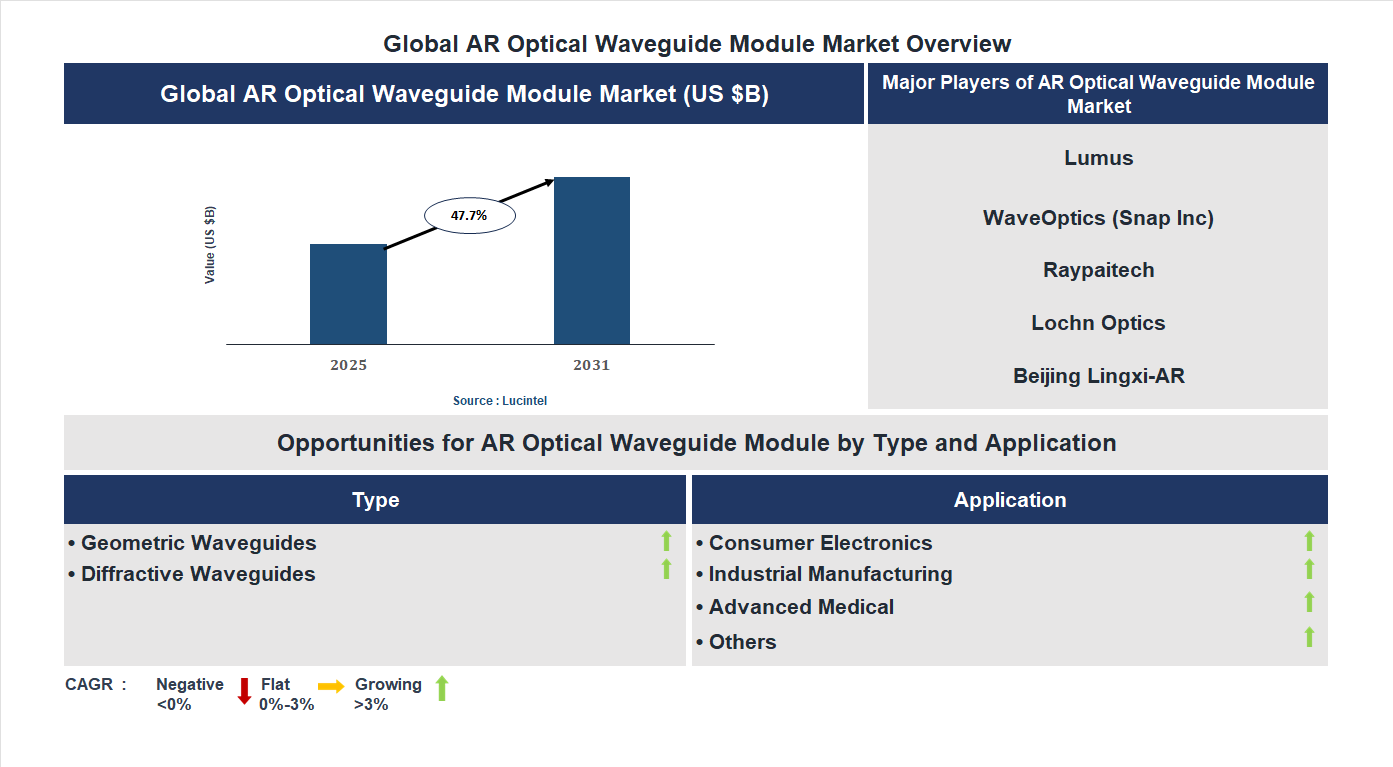
The future of the global AR optical waveguide module market looks promising with opportunities in the consumer electronics, industrial manufacturing, and advanced medical markets. The global AR optical waveguide module market is expected to grow with a CAGR of 47.7% from 2025 to 2031. The major drivers for this market are the increasing adoption of augmented reality devices, the rising demand for lightweight wearable displays, and the growing investment in immersive visual technologies.• Lucintel forecasts that, within the type category, geometric waveguide is expected to witness higher growth over the forecast period.
• Within the application category, consumer electronics is expected to witness the highest growth.
• In terms of region, APAC is expected to witness the highest growth over the forecast period. Gain valuable insights for your business decisions with our comprehensive 150+ page report. Sample figures with some insights are shown below.
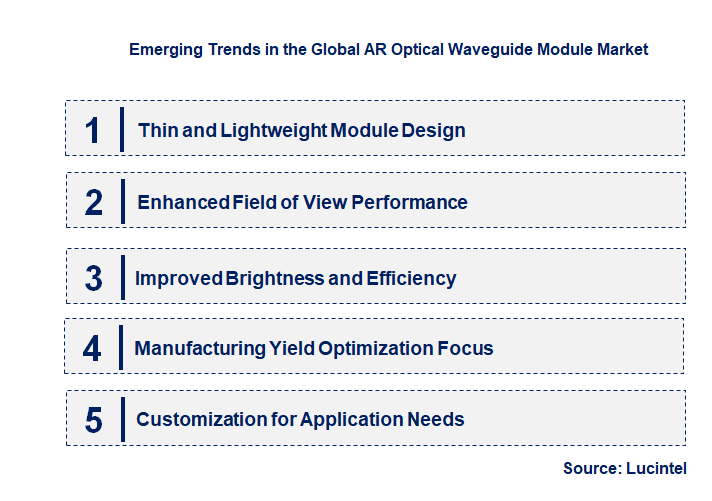
Emerging Trends in the AR Optical Waveguide Module Market
The AR optical waveguide module market is shaped by the need for immersive visual experiences, compact hardware, and user comfort. Emerging trends reflect ongoing efforts to balance optical performance, manufacturability, and user-centric design.• Thin and Lightweight Module Design: Manufacturers are prioritizing ultra-thin waveguide structures to improve wearer comfort and device aesthetics. Reduced thickness supports extended usage in consumer and enterprise environments without compromising optical performance.
• Enhanced Field Of View Performance: Expanding the field of view is a major trend, improving immersion and usability. Innovations in waveguide geometry and coupling techniques are enabling broader visual coverage while maintaining image clarity.
• Improved Brightness And Efficiency: Efforts to enhance light efficiency are gaining importance. Optimized optical paths and advanced materials help reduce power consumption while delivering brighter images suitable for varied lighting conditions.
• Manufacturing Yield Optimization Focus: Yield improvement is emerging as a key trend to support scalability. Process refinements aim to reduce defects and improve consistency, making AR waveguide modules more commercially viable.
• Customization For Application Needs: Modular and customizable waveguide designs are becoming common. Tailored optical properties allow adaptation for enterprise, industrial, and consumer AR use cases. These trends are reshaping the AR optical waveguide module market by enhancing comfort, performance, and scalability. The market is moving closer to widespread adoption across diverse AR applications.
Recent Development in the AR Optical Waveguide Module Market
Recent developments in the AR optical waveguide module market reflect continuous innovation aimed at overcoming technical and manufacturing challenges. Companies are refining designs and materials to improve performance and reliability.• Advanced Waveguide Material Development: New materials improve transparency, durability, and optical efficiency.
• Integration With Compact Display Engines: Closer integration supports reduced module size and improved system performance.
• Enhanced Optical Coupling Techniques: Improved coupling methods reduce image distortion and light loss.
• Process Automation And Quality Control: Automation enhances consistency and supports scalable manufacturing.
• Collaboration Across AR Value Chain: Partnerships accelerate innovation and system-level optimization. These developments are strengthening the AR optical waveguide module market by addressing performance limitations and supporting broader commercial deployment.
Strategic Growth Opportunities in the AR Optical Waveguide Module Market
Growth opportunities in the AR optical waveguide module market are closely tied to expanding AR applications. Different sectors are driving demand for tailored waveguide solutions that balance performance and usability.• Consumer Smart Glasses Adoption: Lightweight and stylish AR glasses create demand for compact waveguide modules.
• Industrial Training And Maintenance Use: Hands-free visual guidance drives adoption in industrial environments.
• Healthcare Visualization Applications: Medical AR tools rely on precise and clear optical waveguides.
• Defense And Tactical Systems Integration: Rugged and high-performance modules support mission-critical AR use.
• Education And Remote Learning Tools: Interactive learning solutions create opportunities for cost-effective waveguide designs. Application-driven growth opportunities are expanding the AR optical waveguide module market, supporting innovation across consumer, industrial, and professional segments.
AR Optical Waveguide Module Market Driver and Challenges
The AR optical waveguide module market is influenced by technological progress, economic considerations, and evolving regulatory environments. Strong drivers support market expansion, while technical and cost-related challenges shape adoption strategies. The factors responsible for driving the AR optical waveguide module market include: 1. Growing Demand For Immersive Displays: Increasing interest in immersive digital experiences boosts AR hardware adoption. 2. Advancements In Optical Material Science: Material innovation enhances transparency and performance reliability. 3. Expansion Of Enterprise AR Applications: Industrial and professional use cases drive demand for robust waveguide modules. 4. Miniaturization Of Wearable Devices: Compact electronics require thin and efficient optical components. 5. Integration With Smart Ecosystems: Compatibility with sensors and software platforms supports adoption. Challenges in the AR optical waveguide module market are: 1. Complex Manufacturing Processes: Precision fabrication increases production difficulty and cost. 2. High Development And Material Costs: Advanced materials and tooling raise entry barriers. 3. Limited Standardization Across Industry: Lack of uniform standards complicates integration and scaling. The AR optical waveguide module market is driven by strong demand for immersive and wearable AR solutions. Addressing manufacturing complexity, cost pressures, and standardization challenges will be critical to unlocking its full growth potential.List of AR Optical Waveguide Module Companies
Companies in the market compete on the basis of product quality offered. Major players in this market focus on expanding their manufacturing facilities, R&D investments, infrastructural development, and leverage integration opportunities across the value chain. With these strategies AR optical waveguide module companies cater increasing demand, ensure competitive effectiveness, develop innovative products & technologies, reduce production costs, and expand their customer base. Some of the AR optical waveguide module companies profiled in this report include-• Lumus
• WaveOptics (Snap Inc)
• Raypaitech
• Lochn Optics
• Beijing Lingxi-AR
• LLVISION
• Vieewer
• Goolton
• North Ocean Photonics
• SeeYA Technology Corporation
AR Optical Waveguide Module Market by Segment
The study includes a forecast for the global AR optical waveguide module market by type, application, and region.AR Optical Waveguide Module Market by Type [Value from 2019 to 2031]:
• Geometric Waveguides
• Diffractive Waveguides
AR Optical Waveguide Module Market by Application [Value from 2019 to 2031]:
• Consumer Electronics
• Industrial Manufacturing
• Advanced Medical
• Others
AR Optical Waveguide Module Market by Region [Value from 2019 to 2031]:
• North America
• Europe
• Asia Pacific
• The Rest of the World
Country Wise Outlook for the AR Optical Waveguide Module Market
The AR optical waveguide module market is evolving as augmented reality moves closer to mainstream adoption. Advancements in display clarity, lightweight form factors, and optical efficiency are driving innovation. Key regions are focusing on material improvements, manufacturing scalability, and ecosystem partnerships to support consumer, enterprise, and industrial AR applications.• United States: The United States market is progressing through strong collaboration between AR hardware developers, software platforms, and component suppliers. Developments emphasize improved optical clarity, wider field of view, and ergonomic designs. Enterprise and defense applications are influencing module performance standards, encouraging rapid prototyping and system-level integration.
• China: China is advancing the AR optical waveguide module market through scalable manufacturing and cost-focused design improvements. Developments concentrate on yield improvement, localized supply chains, and competitive pricing. Strong consumer electronics manufacturing capabilities support faster commercialization of AR devices with integrated waveguide modules.
• Germany: Germany’s developments focus on precision optics and reliability for industrial and automotive AR applications. Emphasis is placed on optical accuracy, durability, and seamless integration into industrial head-mounted displays. Strong engineering expertise supports high-quality waveguide modules for professional and industrial-grade AR systems.
• India: India is witnessing early-stage development in AR optical waveguide modules driven by startups and technology partnerships. Focus areas include affordability, lightweight designs, and adaptation for education and industrial training applications. Gradual ecosystem growth is supporting experimentation and localized innovation.
• Japan: Japan continues to lead in advanced optical materials and miniaturization techniques. Developments emphasize high-transparency waveguides, improved brightness efficiency, and compact module integration. Strong expertise in optics and electronics supports high-performance AR devices for consumer and industrial markets.

Features of the Global AR Optical Waveguide Module Market
Market Size Estimates: AR optical waveguide module market size estimation in terms of value ($B). Trend and Forecast Analysis: Market trends (2019 to 2024) and forecast (2025 to 2031) by various segments and regions. Segmentation Analysis: AR optical waveguide module market size by type, application, and region in terms of value ($B). Regional Analysis: AR optical waveguide module market breakdown by North America, Europe, Asia Pacific, and Rest of the World. Growth Opportunities: Analysis of growth opportunities in different type, application, and regions for the AR optical waveguide module market. Strategic Analysis: This includes M&A, new product development, and competitive landscape of the AR optical waveguide module market. Analysis of competitive intensity of the industry based on Porter’s Five Forces model.
FAQ
Q1. What is the growth forecast for AR optical waveguide module market? Answer: The global AR optical waveguide module market is expected to grow with a CAGR of 47.7% from 2025 to 2031. Q2. What are the major drivers influencing the growth of the AR optical waveguide module market? Answer: The major drivers for this market are the increasing adoption of augmented reality devices, the rising demand for lightweight wearable displays, and the growing investment in immersive visual technologies. Q3. What are the major segments for AR optical waveguide module market? Answer: The future of the AR optical waveguide module market looks promising with opportunities in the consumer electronics, industrial manufacturing, and advanced medical markets. Q4. Who are the key AR optical waveguide module market companies? Answer: Some of the key AR optical waveguide module companies are as follows:• Lumus
• WaveOptics (Snap Inc)
• Raypaitech
• Lochn Optics
• Beijing Lingxi-AR
• LLVISION
• Vieewer
• Goolton
• North Ocean Photonics
• SeeYA Technology Corporation Q5. Which AR optical waveguide module market segment will be the largest in future? Answer: Lucintel forecasts that, within the type category, geometric waveguide is expected to witness higher growth over the forecast period. Q6. In AR optical waveguide module market, which region is expected to be the largest in next 5 years? Answer: In terms of region, APAC is expected to witness the highest growth over the forecast period. Q7. Do we receive customization in this report? Answer: Yes, Lucintel provides 10% customization without any additional cost.
Table of Contents
List of Figures
List of Tables
Methodology
- In-depth interviews of the major players in this market
- Detailed secondary research from competitors’ financial statements and published data
- Extensive searches of published works, market, and database information pertaining to industry news, company press releases, and customer intentions
- A compilation of the experiences, judgments, and insights of Lucintel’s professionals, who have analyzed and tracked this market over the years.


Buy Now
Choose a license that fits your team. Instant PDF delivery.
Prices exclude taxes. Instant delivery. Custom licensing available on request.
Key Questions
- • What are some of the most promising, high-growth opportunities for the AR optical waveguide module market by type (geometric waveguides and diffractive waveguides), application (consumer electronics, industrial manufacturing, advanced medical, and others), and region (North America, Europe, Asia Pacific, and the Rest of the World)?
- • Which segments will grow at a faster pace and why?
- • Which region will grow at a faster pace and why?
- • What are the key factors affecting market dynamics? What are the key challenges and business risks in this market?
- • What are the business risks and competitive threats in this market?
- • What are the emerging trends in this market and the reasons behind them?
- • What are some of the changing demands of customers in the market?
- • What are the new developments in the market? Which companies are leading these developments?
- • Who are the major players in this market? What strategic initiatives are key players pursuing for business growth?
- • What are some of the competing products in this market and how big of a threat do they pose for loss of market share by material or product substitution?
- • What M&A activity has occurred in the last 5 years and what has its impact been on the industry? For any questions related to AR Optical Waveguide Module Market, AR Optical Waveguide Module Market Size, AR Optical Waveguide Module Market Growth, AR Optical Waveguide Module Market Analysis, AR Optical Waveguide Module Market Report, AR Optical Waveguide Module Market Share, AR Optical Waveguide Module Market Trends, AR Optical Waveguide Module Market Forecast, AR Optical Waveguide Module Companies, write Lucintel analyst at email: helpdesk@lucintel.com. We will be glad to get back to you soon.


