
Report Feature
AR-HUD PGU Market Trends and Forecast
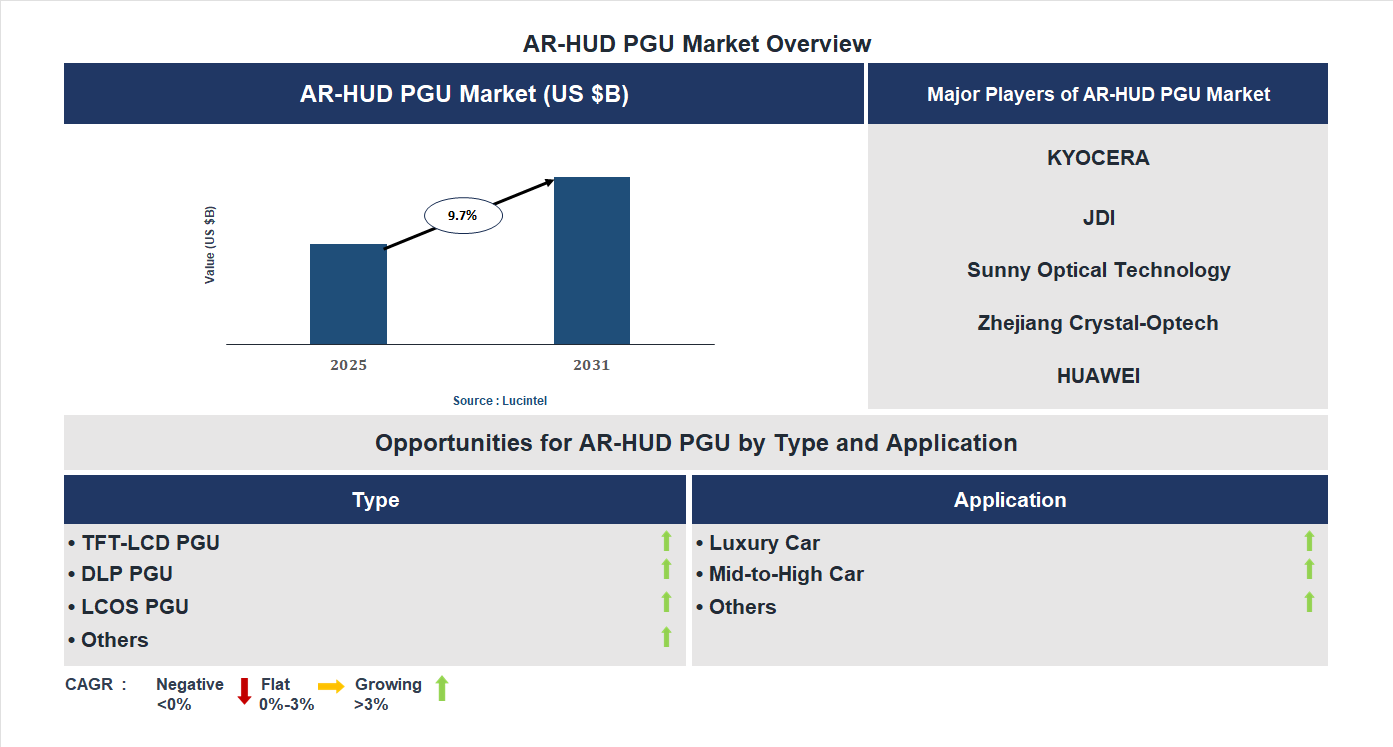
The future of the global AR-HUD PGU market looks promising with opportunities in the luxury car and mid-to-high car markets. The global AR-HUD PGU market is expected to grow with a CAGR of 9.7% from 2025 to 2031. The major drivers for this market are the increasing demand for advanced driver assistance, the rising adoption of augmented reality displays, and the growing focus on enhanced driving safety.• Lucintel forecasts that, within the type category, LCOS PGU is expected to witness the highest growth over the forecast period.
• Within the application category, mid-to-high car is expected to witness higher growth.
• In terms of region, APAC is expected to witness the highest growth over the forecast period. Gain valuable insights for your business decisions with our comprehensive 150+ page report. Sample figures with some insights are shown below.
Emerging Trends in the AR-HUD PGU Market
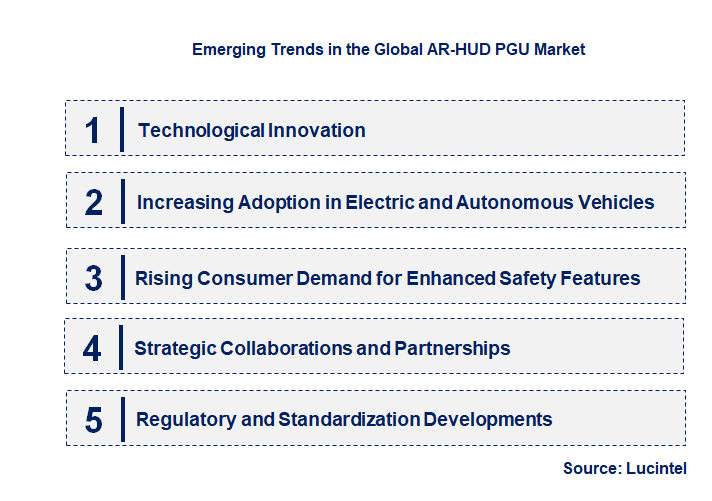
The AR-HUD PGU market is experiencing rapid growth driven by technological advancements, increasing demand for enhanced vehicle safety, and the integration of smart features in automotive systems. As automakers focus on improving driver experience and safety, AR-HUD systems are becoming more sophisticated, offering real-time data overlays and intuitive interfaces. The market is also influenced by the rise of electric vehicles and autonomous driving technologies, which require advanced display solutions. These developments are transforming the automotive landscape, making driving safer, more efficient, and more engaging for consumers worldwide.• Technological Innovation: The market is witnessing continuous advancements in AR display technology, including higher resolution, wider field of view, and improved brightness. These innovations enable clearer, more immersive visuals that enhance driver awareness and safety. Integration of AI and machine learning further personalizes the AR experience, providing real-time alerts and contextual information. As technology becomes more affordable and reliable, automakers are increasingly adopting AR-HUD systems, driving market growth and expanding application scopes across different vehicle segments.
• Increasing Adoption in Electric and Autonomous Vehicles: The shift towards electric vehicles (EVs) and autonomous driving is significantly impacting the AR-HUD PGU market. These vehicles require advanced display systems to communicate complex data such as navigation, sensor information, and system diagnostics. AR-HUDs facilitate better situational awareness, reducing driver distraction and improving safety in autonomous vehicles. The integration of AR-HUDs in EVs also supports energy efficiency by providing streamlined, intuitive interfaces that minimize driver workload, thus accelerating adoption and market penetration.
• Rising Consumer Demand for Enhanced Safety Features: Consumers are increasingly prioritizing safety features in their vehicle purchases. AR-HUD systems offer real-time hazard detection, lane departure warnings, and speed monitoring, which contribute to safer driving experiences. Automakers are responding by incorporating these systems as standard or optional features, boosting consumer appeal. The demand for such safety enhancements is driving market expansion, especially in regions with strict safety regulations and a focus on reducing road accidents, thereby shaping the future of automotive display technologies.
• Strategic Collaborations and Partnerships: Major automotive manufacturers, technology firms, and display component suppliers are forming strategic alliances to develop advanced AR-HUD PGU solutions. These collaborations facilitate the sharing of expertise, accelerate product development, and reduce time-to-market. For example, partnerships between automakers and tech companies enable the integration of cutting-edge AR software with hardware components, ensuring compatibility and performance. Such collaborations are vital for overcoming technical challenges and driving innovation, ultimately expanding the market reach and fostering competitive advantages.
• Regulatory and Standardization Developments: Governments and industry bodies are establishing safety standards and regulations for AR-HUD systems to ensure reliability and driver safety. These standards influence product design, testing protocols, and certification processes, shaping market entry strategies. Compliance with evolving regulations encourages manufacturers to invest in high-quality, compliant systems, fostering consumer trust. Additionally, standardization efforts promote interoperability and reduce costs, facilitating broader adoption across vehicle segments. As regulatory frameworks mature, they will play a crucial role in guiding technological development and market growth in the AR-HUD PGU sector. In summary, these emerging trends are collectively reshaping the AR-HUD PGU market by fostering innovation, enhancing safety, and promoting widespread adoption. The integration of advanced technologies, strategic collaborations, and regulatory support is driving the development of smarter, safer, and more efficient automotive display systems, ultimately transforming the driving experience and setting new industry standards.
Recent Development in the AR-HUD PGU Market
The AR-HUD PGU market is experiencing rapid advancements driven by technological innovation and increasing demand for enhanced driver safety and experience. As automotive manufacturers integrate augmented reality and projection technologies, the market is poised for significant growth. These developments are transforming vehicle interfaces, improving navigation, and enabling smarter, more connected driving environments. Stakeholders are investing heavily in R&D to capitalize on these opportunities, which are expected to reshape the future of automotive displays and driver assistance systems.• Growing Adoption of Augmented Reality in Vehicles: The integration of AR technology into head-up displays (HUDs) is revolutionizing driver interaction by providing real-time, contextual information directly in the driver’s line of sight. This reduces distraction and enhances safety, especially in complex driving scenarios. Automakers are increasingly adopting AR-HUDs to differentiate their offerings, leading to a surge in demand. The market benefits from improved user experience, increased safety features, and the potential for new revenue streams through advanced driver-assistance systems (ADAS). This trend is expected to accelerate as AR technology becomes more affordable and reliable.
• Advancements in Projection and Display Technologies: Innovations in micro-LED and OLED displays are significantly improving the clarity, brightness, and durability of AR-HUDs. These advancements enable clearer visuals even in bright sunlight and extend the lifespan of display components. Automakers are leveraging these technologies to create more immersive and customizable driver interfaces. The impact includes enhanced safety through better visibility, increased consumer interest, and the ability to incorporate more complex graphics and information. As display tech continues to evolve, AR-HUDs will become more integrated and user-friendly, boosting market growth.
• Increasing Focus on Safety and Driver Assistance Features: The automotive industry is prioritizing safety by integrating AR-HUDs with advanced driver assistance systems. These systems provide real-time alerts for lane departure, collision warnings, and navigation cues, reducing accidents and improving overall safety. The market sees a rising demand for both premium and mid-range vehicles, driven by regulatory pressures and consumer awareness. The impact is a safer driving environment, higher vehicle value, and a competitive edge for manufacturers adopting these features. This focus is expected to propel the market forward as safety remains a key purchasing factor.
• Rising Investment in Autonomous Vehicle Technologies: The development of autonomous vehicles relies heavily on sophisticated AR-HUD systems to communicate critical information to drivers and passengers. These systems assist in navigation, obstacle detection, and environment mapping, facilitating safer autonomous operation. Increased investments from tech giants and automakers are fueling innovation, leading to more reliable and integrated AR-HUD solutions. The impact includes accelerated autonomous vehicle deployment, enhanced safety protocols, and new market segments. This trend positions AR-HUD PGU as a vital component in the future of mobility.
• Expansion of Market Through Strategic Collaborations and Mergers: Companies are forming strategic alliances to accelerate AR-HUD PGU technology development and deployment. Collaborations between tech firms, automotive manufacturers, and component suppliers are fostering innovation, reducing costs, and expanding market reach. Mergers and acquisitions are also consolidating expertise and resources, enabling faster commercialization. The impact is a more competitive landscape, rapid technological advancements, and broader adoption across vehicle segments. These strategic moves are crucial for capturing emerging opportunities and maintaining market leadership in a rapidly evolving industry. The overall impact of these developments is a dynamic, rapidly growing market characterized by innovative technologies, enhanced safety features, and increased integration with autonomous systems. These trends are driving higher adoption rates, expanding application scopes, and fostering competitive advantages for industry players. As a result, the AR-HUD PGU market is poised for sustained growth, transforming vehicle interfaces and elevating the driving experience worldwide.
Strategic Growth Opportunities in the AR-HUD PGU Market
The AR-HUD PGU market is experiencing rapid growth driven by technological advancements and increasing demand for enhanced driver safety and experience. Automakers are integrating augmented reality head-up displays (AR-HUD) with personalized graphics and real-time data, transforming vehicle interfaces. The markets expansion is fueled by rising consumer expectations, regulatory standards, and the push toward autonomous vehicles. Companies investing in innovative display solutions and strategic partnerships are poised to capitalize on this evolving landscape, creating significant opportunities for growth across various automotive applications.• Increasing Adoption of Augmented Reality Head-Up Displays in Vehicles: The integration of AR-HUD systems enhances driver awareness by projecting critical information directly onto the windshield, reducing distraction and improving safety. Automakers are adopting these systems to meet safety regulations and consumer demand for advanced features. The growth is driven by technological improvements, cost reductions, and the desire for a futuristic driving experience, making AR-HUD a key differentiator in the competitive automotive market.
• Expansion of Advanced Driver Assistance Systems (ADAS) with AR Capabilities: AR technology is increasingly embedded within ADAS to provide real-time, intuitive visual cues for lane departure, collision warnings, and navigation. This integration improves driver response times and situational awareness, especially in complex driving environments. As safety standards tighten and autonomous driving progresses, the demand for AR-enhanced ADAS is expected to surge, creating new opportunities for component suppliers and system integrators.
• Growing Demand for Premium and Luxury Vehicle Features: Consumers in the premium segment seek innovative, high-tech features that elevate driving comfort and safety. AR-HUD systems offer a sophisticated interface with customizable displays, augmented reality overlays, and seamless connectivity. Automakers are leveraging these features to differentiate their offerings, driving market growth. The trend toward personalization and enhanced user experience is expected to further accelerate adoption in luxury vehicles.
• Technological Advancements in Display and Sensor Technologies: Innovations in display resolution, brightness, and sensor accuracy are making AR-HUD systems more reliable and visually appealing. Improvements in lightweight materials and power efficiency also contribute to broader implementation. These technological advancements reduce costs and enhance performance, enabling mass-market adoption. Continued R&D investments are expected to push the boundaries of AR-HUD capabilities, opening new avenues for market expansion.
• Strategic Collaborations and Partnerships for Market Expansion: Companies are forming alliances to develop integrated AR-HUD solutions, combining expertise in display technology, automotive engineering, and software development. These collaborations facilitate faster innovation, cost reduction, and wider deployment across vehicle segments. Strategic partnerships also help in navigating regulatory landscapes and expanding into emerging markets. Such collaborations are crucial for maintaining competitive advantage and accelerating market penetration. The overall impact of these opportunities is a dynamic, rapidly evolving AR-HUD PGU market that promises enhanced safety, user experience, and technological innovation. As automakers and suppliers capitalize on these growth avenues, the market is set to witness substantial expansion, shaping the future of automotive displays and driver assistance systems. This evolution will ultimately lead to safer, smarter, and more connected vehicles worldwide.
AR-HUD PGU Market Driver and Challenges
The AR-HUD PGU market is influenced by a variety of technological, economic, and regulatory factors that shape its growth trajectory. Rapid advancements in augmented reality technology and automotive displays are driving innovation, while increasing vehicle safety standards and consumer demand for enhanced driving experiences propel market expansion. Economic factors such as rising automotive production and consumer spending on luxury features further support growth. However, regulatory challenges related to safety standards and data privacy, along with high development costs, pose significant hurdles. Understanding these drivers and challenges is essential for stakeholders aiming to capitalize on emerging opportunities within this dynamic market. The factors responsible for driving the AR-HUD PGU market include:• Technological Innovation: The continuous evolution of augmented reality and display technologies enables more immersive and accurate head-up displays, improving driver safety and experience. Advancements in miniaturization, sensor integration, and real-time data processing make AR-HUD systems more feasible and appealing for automakers. These innovations reduce costs over time and expand application possibilities, encouraging automakers to incorporate AR-HUD PGUs into a broader range of vehicles. As technology becomes more sophisticated, consumer acceptance and demand are expected to rise, further fueling market growth.
• Increasing Vehicle Safety Regulations: Governments worldwide are implementing stricter safety standards that encourage the adoption of advanced driver assistance systems, including AR-HUD. These regulations aim to reduce accidents and improve road safety, prompting automakers to integrate AR-HUD PGUs to meet compliance. The push for safer vehicles, especially in developed markets, accelerates the deployment of these systems. Regulatory incentives and mandates are likely to sustain demand, making AR-HUD PGUs a critical component in future vehicle safety architectures.
• Rising Consumer Preference for Advanced Features: Consumers are increasingly seeking vehicles equipped with cutting-edge technology that enhances comfort, safety, and driving experience. AR-HUD PGUs offer real-time information, navigation, and alerts directly in the driver’s line of sight, reducing distraction and improving situational awareness. This demand for premium features, especially among luxury and mid-range vehicle buyers, drives automakers to incorporate AR-HUD systems. As consumer expectations evolve, the market for AR-HUD PGUs is expected to expand rapidly, influencing vehicle design and feature offerings.
• Growth in Automotive Production and Sales: The global increase in automotive manufacturing, particularly in emerging markets, provides a substantial growth opportunity for AR-HUD PGU adoption. As vehicle production volumes rise, automakers seek to differentiate their offerings through innovative features like AR-HUD. The expansion of electric and autonomous vehicles also creates a conducive environment for integrating advanced display systems. Higher vehicle sales translate into increased demand for AR-HUD PGUs, supporting market expansion and encouraging investments in research and development.
• Cost Reduction through Technological Advancements: As AR-HUD technology matures, manufacturing costs are decreasing due to improved production techniques and economies of scale. Lower costs make AR-HUD PGUs more accessible to a broader range of vehicle segments, including mid-range and economy models. Cost reductions also enable automakers to incorporate these systems without significantly impacting vehicle pricing, thereby increasing adoption rates. This trend is crucial for expanding the market beyond luxury vehicles and fostering widespread acceptance of AR-HUD technology. The challenges facing this AR-HUD PGU market include:
• High Development and Integration Costs: Developing advanced AR-HUD PGUs involves significant investment in research, hardware, software, and testing. Integration into existing vehicle architectures requires substantial engineering efforts, which can increase overall costs for automakers. These high expenses may limit adoption, especially among smaller manufacturers or in lower-priced vehicle segments. Additionally, ongoing maintenance and updates add to the total cost of ownership, potentially hindering market growth and slowing deployment rates.
• Regulatory and Safety Concerns: While regulations promote AR-HUD adoption, they also pose challenges related to safety standards, data privacy, and cybersecurity. Ensuring that AR-HUD systems meet stringent safety requirements involves rigorous testing and certification processes, which can delay product launches. Privacy concerns regarding data collection and potential hacking vulnerabilities also create apprehension among automakers and consumers. Navigating complex regulatory landscapes across different regions adds further complexity, potentially restricting market expansion.
• Technological Limitations and Reliability Issues: Despite rapid advancements, AR-HUD PGUs face technical challenges such as display calibration, glare, and visibility under various lighting conditions. Ensuring consistent performance and reliability across diverse driving environments remains difficult. Technical glitches or system failures could compromise safety, leading to consumer distrust and regulatory scrutiny. Overcoming these limitations requires ongoing innovation and rigorous testing, which can prolong development timelines and increase costs, thereby impacting market growth. In summary, the AR-HUD PGU market is driven by technological innovation, safety regulations, consumer demand, and increasing vehicle production. However, high development costs, regulatory hurdles, and technological limitations present significant challenges. These factors collectively influence the pace and scope of market expansion. While growth opportunities are substantial, addressing these challenges is crucial for sustained success. The markets future will depend on how effectively stakeholders can leverage technological advancements while navigating regulatory and technical obstacles.
List of AR-HUD PGU Companies
Companies in the market compete on the basis of product quality offered. Major players in this market focus on expanding their manufacturing facilities, R&D investments, infrastructural development, and leverage integration opportunities across the value chain. With these strategies AR-HUD PGU companies cater increasing demand, ensure competitive effectiveness, develop innovative products & technologies, reduce production costs, and expand their customer base. Some of the AR-HUD PGU companies profiled in this report include-• KYOCERA
• JDI
• Sunny Optical Technology
• Zhejiang Crystal-Optech
• HUAWEI
• BOE Technology
• Microvision
• Beijing ASU Tech
• Appotronics Corporation
• Goertek
AR-HUD PGU Market by Segment
The study includes a forecast for the global AR-HUD PGU market by type, application, and region.AR-HUD PGU Market by Type [Value from 2019 to 2031]:
• TFT-LCD PGU
• DLP PGU
• LCOS PGU
• Others
AR-HUD PGU Market by Application [Value from 2019 to 2031]:
• Luxury Car
• Mid-to-High Car
• Others
AR-HUD PGU Market by Region [Value from 2019 to 2031]:
• North America
• Europe
• Asia Pacific
• The Rest of the World
Country Wise Outlook for the AR-HUD PGU Market
The AR-HUD PGU market is experiencing rapid growth driven by technological advancements, increasing vehicle automation, and consumer demand for enhanced driving experiences. As automotive manufacturers integrate AR technology into their vehicles, the market landscape is shifting with innovations and strategic collaborations. Countries like the United States, China, Germany, India, and Japan are at the forefront, each contributing uniquely to this evolving sector. These developments reflect broader trends in automotive electrification, smart technology adoption, and regulatory support for safer, more connected vehicles.• United States: The US market has seen significant investments from major automakers and tech firms, focusing on integrating AR-HUD PGUs into electric and autonomous vehicles. Innovations in display clarity, power efficiency, and user interface are prominent, with increased R&D activities and pilot programs in California and Michigan. Regulatory support and consumer interest in advanced driver-assistance systems (ADAS) are accelerating adoption.
• China: China leads in market expansion, driven by government policies promoting smart vehicle development and EV adoption. Local companies are developing cost-effective AR-HUD PGUs with enhanced connectivity features. Collaborations between tech giants and automakers are fostering rapid deployment, with a focus on integrating AI and 5G for real-time data processing and improved user experience.
• Germany: Germanys automotive industry emphasizes high-quality, precision-engineered AR-HUD PGUs, aligning with its reputation for engineering excellence. Major manufacturers like BMW and Mercedes-Benz are incorporating these systems into luxury models, emphasizing safety and driver comfort. The focus is on seamless integration with existing vehicle systems and compliance with stringent safety standards.
• India: The Indian market is witnessing growing interest in affordable AR-HUD PGUs to enhance vehicle safety and driver awareness amid increasing road traffic. Local startups and OEMs are developing cost-efficient solutions tailored for mid-range vehicles. Government initiatives supporting EVs and smart mobility are further propelling market growth, with a focus on rural and semi-urban markets.
• Japan: Japans market is characterized by advanced technological integration and innovation in AR-HUD PGUs, driven by leading automakers like Toyota and Honda. Emphasis is placed on miniaturization, energy efficiency, and integration with other vehicle systems. Japan is also investing in research to improve AR display durability and visibility under various driving conditions, aligning with its focus on safety and reliability.

Features of the Global AR-HUD PGU Market
Market Size Estimates: AR-HUD PGU market size estimation in terms of value ($B). Trend and Forecast Analysis: Market trends (2019 to 2024) and forecast (2025 to 2031) by various segments and regions. Segmentation Analysis: AR-HUD PGU market size by type, application, and region in terms of value ($B). Regional Analysis: AR-HUD PGU market breakdown by North America, Europe, Asia Pacific, and Rest of the World. Growth Opportunities: Analysis of growth opportunities in different type, application, and regions for the AR-HUD PGU market. Strategic Analysis: This includes M&A, new product development, and competitive landscape of the AR-HUD PGU market. Analysis of competitive intensity of the industry based on Porter’s Five Forces model.
FAQ
Q1. What is the growth forecast for AR-HUD PGU market? Answer: The global AR-HUD PGU market is expected to grow with a CAGR of 9.7% from 2025 to 2031. Q2. What are the major drivers influencing the growth of the AR-HUD PGU market? Answer: The major drivers for this market are the increasing demand for advanced driver assistance, the rising adoption of augmented reality displays, and the growing focus on enhanced driving safety. Q3. What are the major segments for AR-HUD PGU market? Answer: The future of the AR-HUD PGU market looks promising with opportunities in the luxury car and mid-to-high car markets. Q4. Who are the key AR-HUD PGU market companies? Answer: Some of the key AR-HUD PGU companies are as follows:• KYOCERA
• JDI
• Sunny Optical Technology
• Zhejiang Crystal-Optech
• HUAWEI
• BOE Technology
• Microvision
• Beijing ASU Tech
• Appotronics Corporation
• Goertek Q5. Which AR-HUD PGU market segment will be the largest in future? Answer: Lucintel forecasts that, within the type category, LCOS PGU is expected to witness the highest growth over the forecast period. Q6. In AR-HUD PGU market, which region is expected to be the largest in next 5 years? Answer: In terms of region, APAC is expected to witness the highest growth over the forecast period. Q7. Do we receive customization in this report? Answer: Yes, Lucintel provides 10% customization without any additional cost.
Table of Contents
List of Figures
List of Tables
Methodology
- In-depth interviews of the major players in this market
- Detailed secondary research from competitors’ financial statements and published data
- Extensive searches of published works, market, and database information pertaining to industry news, company press releases, and customer intentions
- A compilation of the experiences, judgments, and insights of Lucintel’s professionals, who have analyzed and tracked this market over the years.


Buy Now
Choose a license that fits your team. Instant PDF delivery.
Prices exclude taxes. Instant delivery. Custom licensing available on request.
Key Questions
- • What are some of the most promising, high-growth opportunities for the AR-HUD PGU market by type (TFT-LCD PGU, DLP PGU, LCOS PGU, and others), application (luxury car, mid-to-high car, and others), and region (North America, Europe, Asia Pacific, and the Rest of the World)?
- • Which segments will grow at a faster pace and why?
- • Which region will grow at a faster pace and why?
- • What are the key factors affecting market dynamics? What are the key challenges and business risks in this market?
- • What are the business risks and competitive threats in this market?
- • What are the emerging trends in this market and the reasons behind them?
- • What are some of the changing demands of customers in the market?
- • What are the new developments in the market? Which companies are leading these developments?
- • Who are the major players in this market? What strategic initiatives are key players pursuing for business growth?
- • What are some of the competing products in this market and how big of a threat do they pose for loss of market share by material or product substitution?
- • What M&A activity has occurred in the last 6 years and what has its impact been on the industry? For any questions related to AR-HUD PGU Market, AR-HUD PGU Market Size, AR-HUD PGU Market Growth, AR-HUD PGU Market Analysis, AR-HUD PGU Market Report, AR-HUD PGU Market Share, AR-HUD PGU Market Trends, AR-HUD PGU Market Forecast, AR-HUD PGU Companies, write Lucintel analyst at email: helpdesk@lucintel.com. We will be glad to get back to you soon.


