
'
...

The Impact of COVID-19 is included in Antimony Mineral Market Report. Buy it today to get an advantage.

Request the impact of COVID-19 on your product or industry


Antimony Mineral Market Trends and Forecast

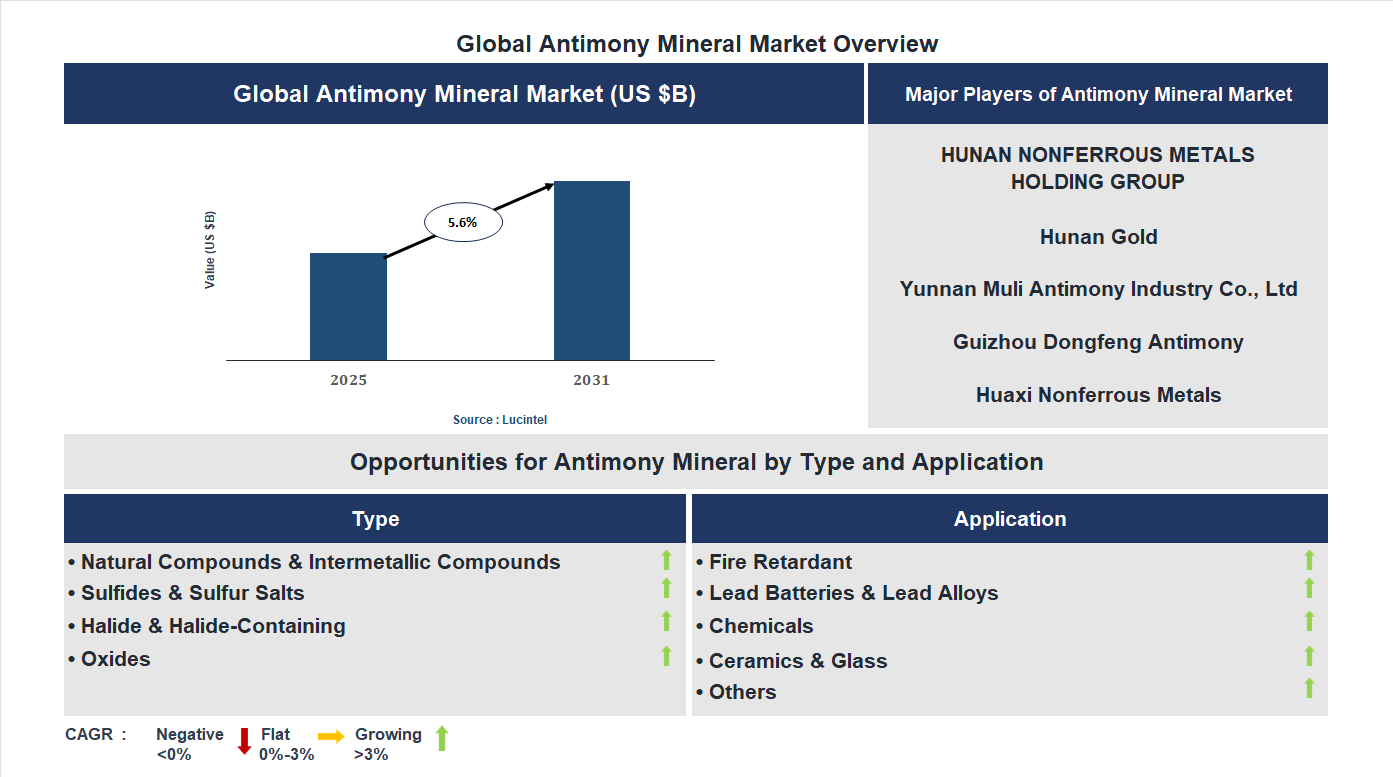
The future of the global antimony mineral market looks promising with opportunities in the fire retardant, lead battery & lead alloy, chemical, and ceramics & glass markets. The global antimony mineral market is expected to grow with a CAGR of 5.6% from 2025 to 2031. The major drivers for this market are the increasing use in flame retardant applications, the rising demand from metal finishing industries, and the growing consumption in automotive battery production.

• Lucintel forecasts that, within the type category, oxide is expected to witness the highest growth over the forecast period.
• Within the application category, lead battery & lead alloy is expected to witness the highest growth.
• In terms of region, APAC is expected to witness the highest growth over the forecast period.
Gain valuable insights for your business decisions with our comprehensive 150+ page report. Sample figures with some insights are shown below.
Antimony Mineral Market Trends and Forecast

Emerging Trends in the Antimony Mineral Market

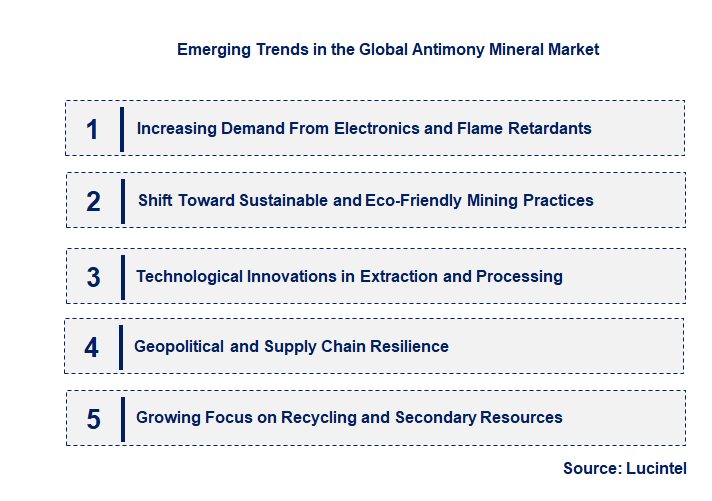
The antimony mineral market is experiencing significant transformation driven by technological advancements, environmental considerations, and shifting global demand patterns. As industries such as electronics, flame retardants, and alloys expand, the market adapts to meet new regulatory standards and sustainability goals. Emerging trends are shaping the future landscape, influencing supply chains, pricing, and innovation. Stakeholders must stay informed about these developments to capitalize on opportunities and mitigate risks. The following five key trends highlight the current and future directions of the antimony mineral market, reflecting its dynamic nature and evolving competitive environment.

• Increasing Demand from Electronics and Flame Retardants: The rapid growth of electronics manufacturing and the need for flame-retardant materials are driving higher antimony consumption. Antimony trioxide is widely used as a flame retardant in plastics, textiles, and electronics, making these sectors primary growth drivers. As consumer electronics and safety regulations expand, demand for antimony is expected to rise, prompting producers to increase output and invest in new extraction technologies to meet market needs.
• Shift Toward Sustainable and Eco-Friendly Mining Practices: Environmental concerns and stricter regulations are pushing the industry toward sustainable mining methods. Companies are adopting eco-friendly extraction techniques, reducing waste, and implementing responsible sourcing practices. This trend not only helps in complying with international standards but also enhances brand reputation and consumer trust. Sustainable practices are becoming a competitive advantage, influencing investment decisions and supply chain transparency across the market.
• Technological Innovations in Extraction and Processing: Advances in mining technology, such as automation, improved ore processing, and recycling methods, are transforming the antimony supply chain. These innovations increase efficiency, reduce costs, and minimize environmental impact. Enhanced processing techniques also enable the recovery of antimony from secondary sources, broadening the resource base. Such technological progress is crucial for meeting rising demand while addressing environmental and economic challenges.
• Geopolitical and Supply Chain Resilience: The concentration of antimony production in a few countries, notably China, raises concerns about supply stability and geopolitical risks. Recent geopolitical tensions and trade restrictions have prompted efforts to diversify sources and develop alternative supply chains. Countries and companies are investing in domestic mining projects and exploring recycling options to reduce dependency on imports, ensuring market resilience amid global uncertainties.
• Growing Focus on Recycling and Secondary Resources: Recycling of antimony from electronic waste and industrial by-products is gaining prominence as a sustainable supply alternative. This trend reduces reliance on primary mining, lowers environmental impact, and aligns with circular economy principles. Advances in recycling technology are making secondary sources more economically viable, encouraging industry stakeholders to integrate recycling into their supply strategies and meet increasing environmental standards.

In summary, these emerging trends are reshaping the antimony mineral market by fostering sustainable practices, technological innovation, diversified supply chains, and increased recycling efforts. Collectively, they are driving a more resilient, environmentally conscious, and technologically advanced industry, positioning it for future growth amid evolving global demands and regulatory landscapes.
Emerging Trends in the Antimony Mineral Market

Recent Development in the Antimony Mineral Market

The antimony mineral market has experienced significant shifts driven by technological advancements, regulatory changes, and fluctuating global demand. As industries increasingly rely on antimony for flame retardants, alloys, and electronics, market dynamics are evolving rapidly. Recent developments reflect efforts to enhance supply chain resilience, adopt sustainable practices, and meet rising environmental standards. These changes are shaping the competitive landscape and influencing pricing strategies. Stakeholders are focusing on innovation, diversification, and regulatory compliance to capitalize on emerging opportunities. Understanding these key developments is essential for navigating the current market environment and anticipating future trends.

• Technological Advancements: Improved extraction and processing techniques have increased efficiency and reduced environmental impact, leading to higher yields and cost savings for producers. This development enhances supply stability and encourages investment in antimony mining projects, positively impacting market growth.
• Regulatory Changes: Stricter environmental regulations and bans on certain hazardous substances have prompted companies to adopt greener practices. These regulations drive innovation in eco-friendly extraction methods and influence global trade policies, affecting supply chains and market accessibility.
• Supply Chain Diversification: Companies are diversifying sources of antimony to reduce dependency on traditional regions like China. This shift enhances supply security, mitigates geopolitical risks, and fosters competition, which can stabilize prices and expand market reach.
• Rising Demand in Electronics and Flame Retardants: The increasing use of antimony in electronics, batteries, and flame retardants is boosting demand. This trend supports market expansion, encourages new investments, and prompts research into alternative materials to meet industry needs.
• Sustainability Initiatives: Industry players are adopting sustainable mining practices and investing in recycling technologies. These initiatives improve environmental credentials, meet consumer expectations, and align with global sustainability goals, influencing market reputation and long-term viability.

In summary, recent developments in the antimony mineral market—spanning technological improvements, regulatory shifts, supply diversification, rising demand, and sustainability efforts—are collectively driving growth and resilience. These changes are fostering a more sustainable, competitive, and innovative market environment, positioning the industry for continued evolution and expansion.

Strategic Growth Opportunities in the Antimony Mineral Market

The antimony mineral market is experiencing significant growth driven by increasing industrial demand and technological advancements. As applications expand across various sectors, strategic growth opportunities are emerging, offering potential for market expansion and innovation. These opportunities are shaped by evolving consumer needs, regulatory changes, and technological developments, making it essential for stakeholders to identify and capitalize on key areas for sustainable growth. Focusing on specific applications allows companies to tailor their strategies, optimize resource utilization, and enhance competitiveness. The following are five key growth opportunities across different applications that are poised to shape the future of the antimony mineral market.

• Electronics and Flame Retardants: Growing demand for electronics and consumer appliances is boosting antimony use in flame retardants. This application offers substantial growth potential due to increasing safety regulations and consumer awareness. Enhanced fire safety standards are driving the need for effective flame retardants, positioning antimony as a critical component. Market players can capitalize on this trend by developing eco-friendly and efficient flame retardant products, thereby expanding their market share and supporting sustainable development.
• Lead-Acid Batteries: The rising adoption of lead-acid batteries in automotive and energy storage sectors presents a significant growth opportunity. Antimony improves battery performance and lifespan, making it essential for high-quality batteries. As electric vehicles and renewable energy storage expand, demand for durable batteries increases. Companies investing in advanced antimony-based battery technologies can benefit from this trend, ensuring better performance and longer service life, which will drive market growth and innovation.
• Glass and Ceramics: Antimony compounds are used as decolorizing agents and in the production of specialty glass and ceramics. The increasing demand for decorative and functional glass products in construction and consumer goods fuels this application. Innovations in glass manufacturing and the need for high-quality, aesthetically appealing products are expanding this market segment. Stakeholders focusing on high-purity antimony compounds can leverage this opportunity to meet industry standards and enhance product offerings.
• Alloys and Soldering Materials: Antimony is used in alloys to improve hardness and mechanical properties, especially in soldering materials. The electronics and construction industries are key drivers of this demand. As these sectors grow, so does the need for reliable, high-performance alloys. Developing new alloy formulations with optimized antimony content can lead to improved product performance, opening avenues for market expansion and technological advancement.
• Pharmaceuticals and Chemical Applications: Emerging research indicates potential uses of antimony compounds in pharmaceuticals and chemical processing. Although currently niche, this application offers long-term growth prospects driven by scientific innovation. Developing safe, effective antimony-based drugs and chemicals can open new markets and diversify revenue streams. Investment in research and development is crucial to unlock the full potential of this application.

In summary, these five growth opportunities across applications are significantly impacting the antimony mineral market by driving innovation, expanding market reach, and fostering sustainable development. Companies that strategically invest in these areas can capitalize on emerging trends, ensuring long-term growth and competitiveness in a dynamic industry landscape.

Antimony Mineral Market Driver and Challenges

The antimony mineral market is influenced by a complex interplay of technological advancements, economic conditions, and regulatory frameworks. As industries seek sustainable and efficient sources of antimony, innovations in extraction and processing technologies play a crucial role. Economic factors such as fluctuating commodity prices and global demand significantly impact market growth. Additionally, regulatory policies aimed at environmental protection and resource management shape operational practices and market accessibility. These drivers and challenges collectively determine the markets trajectory, influencing investment decisions, supply chain dynamics, and technological development. Understanding these factors is essential for stakeholders to navigate the evolving landscape effectively and capitalize on emerging opportunities.

The factors responsible for driving the antimony mineral market include:
• Increasing Demand from Flame Retardants: The rising use of antimony trioxide as a flame retardant in plastics, textiles, and electronics is a major driver. As safety standards become more stringent globally, manufacturers are adopting antimony-based flame retardants to meet fire safety regulations. This growing demand boosts mining activities and processing capacities, fostering market expansion. Moreover, the electronics industrys growth, especially in developing economies, further amplifies the need for antimony compounds, making it a key growth driver.
• Technological Advancements in Extraction and Processing: Innovations in mining and processing technologies have improved the efficiency and environmental sustainability of antimony extraction. Techniques such as flotation and hydrometallurgical processes reduce waste and energy consumption, making mining more cost-effective and eco-friendly. These advancements enable producers to access lower-grade ore deposits and increase yield, thereby expanding supply. As technology continues to evolve, it is expected to lower production costs and enhance the overall competitiveness of the market.
• Growing Use in Lead-Acid Batteries: Antimony is a critical component in lead alloys used in lead-acid batteries, which are widely employed in automotive and energy storage applications. The surge in electric vehicle adoption and renewable energy storage solutions drives the demand for reliable, high-performance batteries. Antimonys role in improving battery durability and performance makes it a vital material, fueling market growth. As the demand for clean energy solutions increases, so does the need for antimony, positioning it as a key driver in the market.
• Expansion of End-Use Industries: The growth of construction, electronics, and automotive sectors globally contributes significantly to the demand for antimony minerals. In construction, antimony compounds are used in flame-retardant materials, while in electronics, they are essential for manufacturing semiconductors and soldering materials. The automotive industry’s shift towards electric vehicles also increases the need for antimony in battery components. These expanding end-use industries create a sustained demand, encouraging exploration and development of new mining projects to meet future needs.
• Rising Investment in Mining Infrastructure: Governments and private companies are investing heavily in developing mining infrastructure to increase antimony production capacity. This includes establishing new mines, upgrading existing facilities, and improving transportation networks. Such investments aim to secure supply chains, reduce costs, and meet rising global demand. Enhanced infrastructure also facilitates the adoption of environmentally sustainable mining practices, which are increasingly mandated by regulations, thus supporting long-term market growth.

The challenges facing this antimony mineral market include:
• Environmental and Regulatory Constraints: Stringent environmental regulations aimed at reducing ecological impact pose significant challenges for antimony mining and processing. Regulations related to waste management, water usage, and emissions require substantial compliance investments, increasing operational costs. Additionally, restrictions on the use of certain chemicals in processing can limit technological options. These constraints can delay project approvals, increase costs, and restrict market expansion, especially in regions with strict environmental policies.
• Fluctuating Commodity Prices: The antimony market is highly susceptible to price volatility driven by global economic conditions, supply-demand imbalances, and geopolitical tensions. Price fluctuations can impact profitability, deter investment, and lead to market uncertainties. Producers may delay or scale back production during downturns, affecting supply stability. Conversely, sudden price surges can lead to increased exploration and mining activity but also risk market oversupply. Managing price volatility remains a critical challenge for stakeholders.
• Limited Supply and Concentrated Production: The global supply of antimony is concentrated in a few countries, primarily China, which controls a significant share of the market. This concentration creates supply risks, including geopolitical tensions, export restrictions, and resource depletion. Limited reserves and high extraction costs further constrain supply growth. Such dependencies make the market vulnerable to disruptions, impacting global availability and pricing stability, and pose challenges for diversification and sustainable development.

In summary, the antimony mineral market is driven by increasing demand from various end-use industries, technological innovations, and infrastructure investments. However, environmental regulations, price volatility, and supply concentration pose significant hurdles. These factors collectively influence market dynamics, requiring stakeholders to adopt strategic approaches to mitigate risks and capitalize on growth opportunities. The markets future will depend on balancing technological progress and regulatory compliance with sustainable resource management.

List of Antimony Mineral Companies

Companies in the market compete on the basis of product quality offered. Major players in this market focus on expanding their manufacturing facilities, R&D investments, infrastructural development, and leverage integration opportunities across the value chain. With these strategies antimony mineral companies cater increasing demand, ensure competitive effectiveness, develop innovative products & technologies, reduce production costs, and expand their customer base. Some of the antimony mineral companies profiled in this report include-
• HUNAN NONFERROUS METALS HOLDING GROUP
• Hunan Gold
• Yunnan Muli Antimony Industry Co., Ltd
• Guizhou Dongfeng Antimony
• Huaxi Nonferrous Metals
• Huayu
• Alkane Resources

Antimony Mineral Market by Segment

The study includes a forecast for the global antimony mineral market by type, application, and region.

Antimony Mineral Market by Type [Value from 2019 to 2031]:


• Natural Compounds & Intermetallic Compounds
• Sulfides & Sulfur Salts
• Halide & Halide-Containing
• Oxides

Antimony Mineral Market by Application [Value from 2019 to 2031]:


• Fire Retardant
• Lead Batteries & Lead Alloys
• Chemicals
• Ceramics & Glass
• Others

Antimony Mineral Market by Region [Value from 2019 to 2031]:


• North America
• Europe
• Asia Pacific
• The Rest of the World

Country Wise Outlook for the Antimony Mineral Market

The antimony mineral market has experienced notable shifts driven by technological advancements, regulatory changes, and fluctuating global demand. As industries such as electronics, flame retardants, and alloys expand, countries are adjusting their production and import-export strategies to meet rising needs. Environmental concerns and resource sustainability also influence market dynamics, prompting innovations in extraction and recycling processes. The following summaries highlight recent developments in the United States, China, Germany, India, and Japan, reflecting their unique roles and responses within this evolving market landscape.
• United States: The U.S. has seen increased investment in recycling technologies to recover antimony from electronic waste, reducing reliance on imports. Regulatory efforts aim to improve environmental standards in mining operations, while domestic production remains limited but growing. The country is also focusing on developing alternative materials to reduce dependency on antimony in critical applications.
• China: China continues to dominate global antimony production and export, with recent government policies emphasizing sustainable mining practices and environmental protection. The country has expanded its refining capacity and invested in technological upgrades to improve efficiency. Domestic demand from electronics and flame retardant industries remains high, supporting its market leadership.
• Germany: Germany is advancing in research and development of environmentally friendly extraction methods and recycling processes. The country’s focus on sustainable supply chains aligns with its broader industrial policies. German companies are also investing in innovative applications of antimony, particularly in electronics and automotive sectors, to diversify usage.
• India: India’s antimony market is growing due to increased demand in electronics, flame retardants, and alloys. Recent government initiatives aim to boost domestic mining and processing capabilities, reducing import dependence. The country is also exploring sustainable extraction methods and investing in research to enhance resource efficiency.
• Japan: Japan is emphasizing technological innovation in antimony utilization, especially in electronics and automotive industries. The country is investing in recycling and recovery technologies to ensure supply stability amid global fluctuations. Japan’s focus on environmental standards and sustainable practices influences its market strategies and product development.

Lucintel Analytics Dashboard

Features of the Global Antimony Mineral Market

Market Size Estimates: Antimony mineral market size estimation in terms of value ($B).
Trend and Forecast Analysis: Market trends (2019 to 2024) and forecast (2025 to 2031) by various segments and regions.
Segmentation Analysis: Antimony mineral market size by type, application, and region in terms of value ($B).
Regional Analysis: Antimony mineral market breakdown by North America, Europe, Asia Pacific, and Rest of the World.
Growth Opportunities: Analysis of growth opportunities in different types, applications, and regions for the antimony mineral market.
Strategic Analysis: This includes M&A, new product development, and competitive landscape of the antimony mineral market.
Analysis of competitive intensity of the industry based on Porter’s Five Forces model.

Lucintel Consulting Services

FAQ

Q1. What is the growth forecast for antimony mineral market?
Answer: The global antimony mineral market is expected to grow with a CAGR of 5.6% from 2025 to 2031.
Q2. What are the major drivers influencing the growth of the antimony mineral market?
Answer: The major drivers for this market are the increasing use in flame retardant applications, the rising demand from metal finishing industries, and the growing consumption in automotive battery production.
Q3. What are the major segments for antimony mineral market?
Answer: The future of the antimony mineral market looks promising with opportunities in the fire retardant, lead battery & lead alloy, chemical, and ceramics & glass markets.
Q4. Who are the key antimony mineral market companies?
Answer: Some of the key antimony mineral companies are as follows:
• HUNAN NONFERROUS METALS HOLDING GROUP
• Hunan Gold
• Yunnan Muli Antimony Industry Co., Ltd
• Guizhou Dongfeng Antimony
• Huaxi Nonferrous Metals
• Huayu
• Alkane Resources
Q5. Which antimony mineral market segment will be the largest in future?
Answer: Lucintel forecasts that, within the type category, oxide is expected to witness the highest growth over the forecast period.
Q6. In antimony mineral market, which region is expected to be the largest in next 5 years?
Answer: In terms of region, APAC is expected to witness the highest growth over the forecast period.
Q7. Do we receive customization in this report?
Answer: Yes, Lucintel provides 10% customization without any additional cost.

This report answers following 11 key questions:

Q.1. What are some of the most promising, high-growth opportunities for the antimony mineral market by type (natural compounds & intermetallic compounds, sulfides & sulfur salts, halide & halide-containing, and oxides), application (fire retardant, lead batteries & lead alloys, chemicals, ceramics & glass, and others), and region (North America, Europe, Asia Pacific, and the Rest of the World)?
Q.2. Which segments will grow at a faster pace and why?
Q.3. Which region will grow at a faster pace and why?
Q.4. What are the key factors affecting market dynamics? What are the key challenges and business risks in this market?
Q.5. What are the business risks and competitive threats in this market?
Q.6. What are the emerging trends in this market and the reasons behind them?
Q.7. What are some of the changing demands of customers in the market?
Q.8. What are the new developments in the market? Which companies are leading these developments?
Q.9. Who are the major players in this market? What strategic initiatives are key players pursuing for business growth?
Q.10. What are some of the competing products in this market and how big of a threat do they pose for loss of market share by material or product substitution?
Q.11. What M&A activity has occurred in the last 5 years and what has its impact been on the industry?

For any questions related to Antimony Mineral Market, Antimony Mineral Market Size, Antimony Mineral Market Growth, Antimony Mineral Market Analysis, Antimony Mineral Market Report, Antimony Mineral Market Share, Antimony Mineral Market Trends, Antimony Mineral Market Forecast, Antimony Mineral Companies, write Lucintel analyst at email: helpdesk@lucintel.com. We will be glad to get back to you soon.
                                           Table of Contents

            1. Executive Summary

            2. Market Overview

                        2.1 Background and Classifications
                        2.2 Supply Chain

            3. Market Trends & Forecast Analysis

                        3.1 Macroeconomic Trends and Forecasts
                        3.2 Industry Drivers and Challenges
                        3.3 PESTLE Analysis
                        3.4 Patent Analysis
                        3.5 Regulatory Environment
                        3.6 Global Antimony Mineral Market Trends and Forecast

            4. Global Antimony Mineral Market by Type

                        4.1 Overview
                        4.2 Attractiveness Analysis by Type
                        4.3 Natural Compounds & Intermetallic Compounds : Trends and Forecast 2019 to 2031
                        4.4 Sulfides & Sulfur Salts : Trends and Forecast 2019 to 2031
                        4.5 Halide & Halide-Containing : Trends and Forecast 2019 to 2031
                        4.6 Oxides : Trends and Forecast 2019 to 2031

            5. Global Antimony Mineral Market by Application

                        5.1 Overview
                        5.2 Attractiveness Analysis by Application
                        5.3 Fire Retardant : Trends and Forecast 2019 to 2031
                        5.4 Lead Batteries & Lead Alloys : Trends and Forecast 2019 to 2031
                        5.5 Chemicals : Trends and Forecast 2019 to 2031
                        5.6 Ceramics & Glass : Trends and Forecast 2019 to 2031
                        5.7 Others : Trends and Forecast 2019 to 2031

            6. Regional Analysis

                        6.1 Overview
                        6.2 Global Antimony Mineral Market by Region

            7. North American Antimony Mineral Market

                        7.1 Overview
                        7.2 North American Antimony Mineral Market by Type
                        7.3 North American Antimony Mineral Market by Application
                        7.4 The United States Antimony Mineral Market
                        7.5 Canadian Antimony Mineral Market
                        7.6 Mexican Antimony Mineral Market

            8. European Antimony Mineral Market

                        8.1 Overview
                        8.2 European Antimony Mineral Market by Type
                        8.3 European Antimony Mineral Market by Application
                        8.4 German Antimony Mineral Market
                        8.5 French Antimony Mineral Market
                        8.6 Italian Antimony Mineral Market
                        8.7 Spanish Antimony Mineral Market
                        8.8 The United Kingdom Antimony Mineral Market

            9. APAC Antimony Mineral Market

                        9.1 Overview
                        9.2 APAC Antimony Mineral Market by Type
                        9.3 APAC Antimony Mineral Market by Application
                        9.4 Chinese Antimony Mineral Market
                        9.5 Indian Antimony Mineral Market
                        9.6 Japanese Antimony Mineral Market
                        9.7 South Korean Antimony Mineral Market
                        9.8 Indonesian Antimony Mineral Market

            10. ROW Antimony Mineral Market

                        10.1 Overview
                        10.2 ROW Antimony Mineral Market by Type
                        10.3 ROW Antimony Mineral Market by Application
                        10.4 Middle Eastern Antimony Mineral Market
                        10.5 South American Antimony Mineral Market
                        10.6 African Antimony Mineral Market

            11. Competitor Analysis

                        11.1 Product Portfolio Analysis
                        11.2 Operational Integration
                        11.3 Porter’s Five Forces Analysis
                                    • Competitive Rivalry
                                    • Bargaining Power of Buyers
                                    • Bargaining Power of Suppliers
                                    • Threat of Substitutes
                                    • Threat of New Entrants
                        11.4 Market Share Analysis

            12. Opportunities & Strategic Analysis

                        12.1 Value Chain Analysis
                        12.2 Growth Opportunity Analysis
                                    12.2.1 Growth Opportunity by Type
                                    12.2.2 Growth Opportunity by Application
                        12.3 Emerging Trends in the Global Antimony Mineral Market
                        12.4 Strategic Analysis
                                    12.4.1 New Product Development
                                    12.4.2 Certification and Licensing
                                    12.4.3 Mergers, Acquisitions, Agreements, Collaborations, and Joint Ventures

            13. Company Profiles of the Leading Players Across the Value Chain

                        13.1 Competitive Analysis Overview
                        13.2 HUNAN NONFERROUS METALS HOLDING GROUP
                                    • Company Overview
                                    • Antimony Mineral Market Business Overview
                                    • New Product Development
                                    • Merger, Acquisition, and Collaboration
                                    • Certification and Licensing
                        13.3 Hunan Gold
                                    • Company Overview
                                    • Antimony Mineral Market Business Overview
                                    • New Product Development
                                    • Merger, Acquisition, and Collaboration
                                    • Certification and Licensing
                        13.4 Yunnan Muli Antimony Industry Co., Ltd
                                    • Company Overview
                                    • Antimony Mineral Market Business Overview
                                    • New Product Development
                                    • Merger, Acquisition, and Collaboration
                                    • Certification and Licensing
                        13.5 Guizhou Dongfeng Antimony
                                    • Company Overview
                                    • Antimony Mineral Market Business Overview
                                    • New Product Development
                                    • Merger, Acquisition, and Collaboration
                                    • Certification and Licensing
                        13.6 Huaxi Nonferrous Metals
                                    • Company Overview
                                    • Antimony Mineral Market Business Overview
                                    • New Product Development
                                    • Merger, Acquisition, and Collaboration
                                    • Certification and Licensing
                        13.7 Huayu
                                    • Company Overview
                                    • Antimony Mineral Market Business Overview
                                    • New Product Development
                                    • Merger, Acquisition, and Collaboration
                                    • Certification and Licensing
                        13.8 Alkane Resources
                                    • Company Overview
                                    • Antimony Mineral Market Business Overview
                                    • New Product Development
                                    • Merger, Acquisition, and Collaboration
                                    • Certification and Licensing

            14. Appendix

                        14.1 List of Figures
                        14.2 List of Tables
                        14.3 Research Methodology
                        14.4 Disclaimer
                        14.5 Copyright
                        14.6 Abbreviations and Technical Units
                        14.7 About Us
                        14.8 Contact Us

                                               List of Figures


            Chapter 1

                        Figure 1.1: Trends and Forecast for the Global Antimony Mineral Market

            Chapter 2

                        Figure 2.1: Usage of Antimony Mineral Market
                        Figure 2.2: Classification of the Global Antimony Mineral Market
                        Figure 2.3: Supply Chain of the Global Antimony Mineral Market

            Chapter 3

                        Figure 3.1: Trends of the Global GDP Growth Rate
                        Figure 3.2: Trends of the Global Population Growth Rate
                        Figure 3.3: Trends of the Global Inflation Rate
                        Figure 3.4: Trends of the Global Unemployment Rate
                        Figure 3.5: Trends of the Regional GDP Growth Rate
                        Figure 3.6: Trends of the Regional Population Growth Rate
                        Figure 3.7: Trends of the Regional Inflation Rate
                        Figure 3.8: Trends of the Regional Unemployment Rate
                        Figure 3.9: Trends of Regional Per Capita Income
                        Figure 3.10: Forecast for the Global GDP Growth Rate
                        Figure 3.11: Forecast for the Global Population Growth Rate
                        Figure 3.12: Forecast for the Global Inflation Rate
                        Figure 3.13: Forecast for the Global Unemployment Rate
                        Figure 3.14: Forecast for the Regional GDP Growth Rate
                        Figure 3.15: Forecast for the Regional Population Growth Rate
                        Figure 3.16: Forecast for the Regional Inflation Rate
                        Figure 3.17: Forecast for the Regional Unemployment Rate
                        Figure 3.18: Forecast for Regional Per Capita Income
                        Figure 3.19: Driver and Challenges of the Antimony Mineral Market

            Chapter 4

                        Figure 4.1: Global Antimony Mineral Market by Type in 2019, 2024, and 2031
                        Figure 4.2: Trends of the Global Antimony Mineral Market ($B) by Type
                        Figure 4.3: Forecast for the Global Antimony Mineral Market ($B) by Type
                        Figure 4.4: Trends and Forecast for Natural Compounds & Intermetallic Compounds in the Global Antimony Mineral Market (2019-2031)
                        Figure 4.5: Trends and Forecast for Sulfides & Sulfur Salts in the Global Antimony Mineral Market (2019-2031)
                        Figure 4.6: Trends and Forecast for Halide & Halide-Containing in the Global Antimony Mineral Market (2019-2031)
                        Figure 4.7: Trends and Forecast for Oxides in the Global Antimony Mineral Market (2019-2031)

            Chapter 5

                        Figure 5.1: Global Antimony Mineral Market by Application in 2019, 2024, and 2031
                        Figure 5.2: Trends of the Global Antimony Mineral Market ($B) by Application
                        Figure 5.3: Forecast for the Global Antimony Mineral Market ($B) by Application
                        Figure 5.4: Trends and Forecast for Fire Retardant in the Global Antimony Mineral Market (2019-2031)
                        Figure 5.5: Trends and Forecast for Lead Batteries & Lead Alloys in the Global Antimony Mineral Market (2019-2031)
                        Figure 5.6: Trends and Forecast for Chemicals in the Global Antimony Mineral Market (2019-2031)
                        Figure 5.7: Trends and Forecast for Ceramics & Glass in the Global Antimony Mineral Market (2019-2031)
                        Figure 5.8: Trends and Forecast for Others in the Global Antimony Mineral Market (2019-2031)

            Chapter 6

                        Figure 6.1: Trends of the Global Antimony Mineral Market ($B) by Region (2019-2024)
                        Figure 6.2: Forecast for the Global Antimony Mineral Market ($B) by Region (2025-2031)

            Chapter 7

                        Figure 7.1: Trends and Forecast for the North American Antimony Mineral Market (2019-2031)
                        Figure 7.2: North American Antimony Mineral Market by Type in 2019, 2024, and 2031
                        Figure 7.3: Trends of the North American Antimony Mineral Market ($B) by Type (2019-2024)
                        Figure 7.4: Forecast for the North American Antimony Mineral Market ($B) by Type (2025-2031)
                        Figure 7.5: North American Antimony Mineral Market by Application in 2019, 2024, and 2031
                        Figure 7.6: Trends of the North American Antimony Mineral Market ($B) by Application (2019-2024)
                        Figure 7.7: Forecast for the North American Antimony Mineral Market ($B) by Application (2025-2031)
                        Figure 7.8: Trends and Forecast for the United States Antimony Mineral Market ($B) (2019-2031)
                        Figure 7.9: Trends and Forecast for the Mexican Antimony Mineral Market ($B) (2019-2031)
                        Figure 7.10: Trends and Forecast for the Canadian Antimony Mineral Market ($B) (2019-2031)

            Chapter 8

                        Figure 8.1: Trends and Forecast for the European Antimony Mineral Market (2019-2031)
                        Figure 8.2: European Antimony Mineral Market by Type in 2019, 2024, and 2031
                        Figure 8.3: Trends of the European Antimony Mineral Market ($B) by Type (2019-2024)
                        Figure 8.4: Forecast for the European Antimony Mineral Market ($B) by Type (2025-2031)
                        Figure 8.5: European Antimony Mineral Market by Application in 2019, 2024, and 2031
                        Figure 8.6: Trends of the European Antimony Mineral Market ($B) by Application (2019-2024)
                        Figure 8.7: Forecast for the European Antimony Mineral Market ($B) by Application (2025-2031)
                        Figure 8.8: Trends and Forecast for the German Antimony Mineral Market ($B) (2019-2031)
                        Figure 8.9: Trends and Forecast for the French Antimony Mineral Market ($B) (2019-2031)
                        Figure 8.10: Trends and Forecast for the Spanish Antimony Mineral Market ($B) (2019-2031)
                        Figure 8.11: Trends and Forecast for the Italian Antimony Mineral Market ($B) (2019-2031)
                        Figure 8.12: Trends and Forecast for the United Kingdom Antimony Mineral Market ($B) (2019-2031)

            Chapter 9

                        Figure 9.1: Trends and Forecast for the APAC Antimony Mineral Market (2019-2031)
                        Figure 9.2: APAC Antimony Mineral Market by Type in 2019, 2024, and 2031
                        Figure 9.3: Trends of the APAC Antimony Mineral Market ($B) by Type (2019-2024)
                        Figure 9.4: Forecast for the APAC Antimony Mineral Market ($B) by Type (2025-2031)
                        Figure 9.5: APAC Antimony Mineral Market by Application in 2019, 2024, and 2031
                        Figure 9.6: Trends of the APAC Antimony Mineral Market ($B) by Application (2019-2024)
                        Figure 9.7: Forecast for the APAC Antimony Mineral Market ($B) by Application (2025-2031)
                        Figure 9.8: Trends and Forecast for the Japanese Antimony Mineral Market ($B) (2019-2031)
                        Figure 9.9: Trends and Forecast for the Indian Antimony Mineral Market ($B) (2019-2031)
                        Figure 9.10: Trends and Forecast for the Chinese Antimony Mineral Market ($B) (2019-2031)
                        Figure 9.11: Trends and Forecast for the South Korean Antimony Mineral Market ($B) (2019-2031)
                        Figure 9.12: Trends and Forecast for the Indonesian Antimony Mineral Market ($B) (2019-2031)

            Chapter 10

                        Figure 10.1: Trends and Forecast for the ROW Antimony Mineral Market (2019-2031)
                        Figure 10.2: ROW Antimony Mineral Market by Type in 2019, 2024, and 2031
                        Figure 10.3: Trends of the ROW Antimony Mineral Market ($B) by Type (2019-2024)
                        Figure 10.4: Forecast for the ROW Antimony Mineral Market ($B) by Type (2025-2031)
                        Figure 10.5: ROW Antimony Mineral Market by Application in 2019, 2024, and 2031
                        Figure 10.6: Trends of the ROW Antimony Mineral Market ($B) by Application (2019-2024)
                        Figure 10.7: Forecast for the ROW Antimony Mineral Market ($B) by Application (2025-2031)
                        Figure 10.8: Trends and Forecast for the Middle Eastern Antimony Mineral Market ($B) (2019-2031)
                        Figure 10.9: Trends and Forecast for the South American Antimony Mineral Market ($B) (2019-2031)
                        Figure 10.10: Trends and Forecast for the African Antimony Mineral Market ($B) (2019-2031)

            Chapter 11

                        Figure 11.1: Porter’s Five Forces Analysis of the Global Antimony Mineral Market
                        Figure 11.2: Market Share (%) of Top Players in the Global Antimony Mineral Market (2024)

            Chapter 12

                        Figure 12.1: Growth Opportunities for the Global Antimony Mineral Market by Type
                        Figure 12.2: Growth Opportunities for the Global Antimony Mineral Market by Application
                        Figure 12.3: Growth Opportunities for the Global Antimony Mineral Market by Region
                        Figure 12.4: Emerging Trends in the Global Antimony Mineral Market

                                               List of Tables


            Chapter 1

                        Table 1.1: Growth Rate (%, 2023-2024) and CAGR (%, 2025-2031) of the Antimony Mineral Market by Type and Application
                        Table 1.2: Attractiveness Analysis for the Antimony Mineral Market by Region
                        Table 1.3: Global Antimony Mineral Market Parameters and Attributes

            Chapter 3

                        Table 3.1: Trends of the Global Antimony Mineral Market (2019-2024)
                        Table 3.2: Forecast for the Global Antimony Mineral Market (2025-2031)

            Chapter 4

                        Table 4.1: Attractiveness Analysis for the Global Antimony Mineral Market by Type
                        Table 4.2: Market Size and CAGR of Various Type in the Global Antimony Mineral Market (2019-2024)
                        Table 4.3: Market Size and CAGR of Various Type in the Global Antimony Mineral Market (2025-2031)
                        Table 4.4: Trends of Natural Compounds & Intermetallic Compounds in the Global Antimony Mineral Market (2019-2024)
                        Table 4.5: Forecast for Natural Compounds & Intermetallic Compounds in the Global Antimony Mineral Market (2025-2031)
                        Table 4.6: Trends of Sulfides & Sulfur Salts in the Global Antimony Mineral Market (2019-2024)
                        Table 4.7: Forecast for Sulfides & Sulfur Salts in the Global Antimony Mineral Market (2025-2031)
                        Table 4.8: Trends of Halide & Halide-Containing in the Global Antimony Mineral Market (2019-2024)
                        Table 4.9: Forecast for Halide & Halide-Containing in the Global Antimony Mineral Market (2025-2031)
                        Table 4.10: Trends of Oxides in the Global Antimony Mineral Market (2019-2024)
                        Table 4.11: Forecast for Oxides in the Global Antimony Mineral Market (2025-2031)

            Chapter 5

                        Table 5.1: Attractiveness Analysis for the Global Antimony Mineral Market by Application
                        Table 5.2: Market Size and CAGR of Various Application in the Global Antimony Mineral Market (2019-2024)
                        Table 5.3: Market Size and CAGR of Various Application in the Global Antimony Mineral Market (2025-2031)
                        Table 5.4: Trends of Fire Retardant in the Global Antimony Mineral Market (2019-2024)
                        Table 5.5: Forecast for Fire Retardant in the Global Antimony Mineral Market (2025-2031)
                        Table 5.6: Trends of Lead Batteries & Lead Alloys in the Global Antimony Mineral Market (2019-2024)
                        Table 5.7: Forecast for Lead Batteries & Lead Alloys in the Global Antimony Mineral Market (2025-2031)
                        Table 5.8: Trends of Chemicals in the Global Antimony Mineral Market (2019-2024)
                        Table 5.9: Forecast for Chemicals in the Global Antimony Mineral Market (2025-2031)
                        Table 5.10: Trends of Ceramics & Glass in the Global Antimony Mineral Market (2019-2024)
                        Table 5.11: Forecast for Ceramics & Glass in the Global Antimony Mineral Market (2025-2031)
                        Table 5.12: Trends of Others in the Global Antimony Mineral Market (2019-2024)
                        Table 5.13: Forecast for Others in the Global Antimony Mineral Market (2025-2031)

            Chapter 6

                        Table 6.1: Market Size and CAGR of Various Regions in the Global Antimony Mineral Market (2019-2024)
                        Table 6.2: Market Size and CAGR of Various Regions in the Global Antimony Mineral Market (2025-2031)

            Chapter 7

                        Table 7.1: Trends of the North American Antimony Mineral Market (2019-2024)
                        Table 7.2: Forecast for the North American Antimony Mineral Market (2025-2031)
                        Table 7.3: Market Size and CAGR of Various Type in the North American Antimony Mineral Market (2019-2024)
                        Table 7.4: Market Size and CAGR of Various Type in the North American Antimony Mineral Market (2025-2031)
                        Table 7.5: Market Size and CAGR of Various Application in the North American Antimony Mineral Market (2019-2024)
                        Table 7.6: Market Size and CAGR of Various Application in the North American Antimony Mineral Market (2025-2031)
                        Table 7.7: Trends and Forecast for the United States Antimony Mineral Market (2019-2031)
                        Table 7.8: Trends and Forecast for the Mexican Antimony Mineral Market (2019-2031)
                        Table 7.9: Trends and Forecast for the Canadian Antimony Mineral Market (2019-2031)

            Chapter 8

                        Table 8.1: Trends of the European Antimony Mineral Market (2019-2024)
                        Table 8.2: Forecast for the European Antimony Mineral Market (2025-2031)
                        Table 8.3: Market Size and CAGR of Various Type in the European Antimony Mineral Market (2019-2024)
                        Table 8.4: Market Size and CAGR of Various Type in the European Antimony Mineral Market (2025-2031)
                        Table 8.5: Market Size and CAGR of Various Application in the European Antimony Mineral Market (2019-2024)
                        Table 8.6: Market Size and CAGR of Various Application in the European Antimony Mineral Market (2025-2031)
                        Table 8.7: Trends and Forecast for the German Antimony Mineral Market (2019-2031)
                        Table 8.8: Trends and Forecast for the French Antimony Mineral Market (2019-2031)
                        Table 8.9: Trends and Forecast for the Spanish Antimony Mineral Market (2019-2031)
                        Table 8.10: Trends and Forecast for the Italian Antimony Mineral Market (2019-2031)
                        Table 8.11: Trends and Forecast for the United Kingdom Antimony Mineral Market (2019-2031)

            Chapter 9

                        Table 9.1: Trends of the APAC Antimony Mineral Market (2019-2024)
                        Table 9.2: Forecast for the APAC Antimony Mineral Market (2025-2031)
                        Table 9.3: Market Size and CAGR of Various Type in the APAC Antimony Mineral Market (2019-2024)
                        Table 9.4: Market Size and CAGR of Various Type in the APAC Antimony Mineral Market (2025-2031)
                        Table 9.5: Market Size and CAGR of Various Application in the APAC Antimony Mineral Market (2019-2024)
                        Table 9.6: Market Size and CAGR of Various Application in the APAC Antimony Mineral Market (2025-2031)
                        Table 9.7: Trends and Forecast for the Japanese Antimony Mineral Market (2019-2031)
                        Table 9.8: Trends and Forecast for the Indian Antimony Mineral Market (2019-2031)
                        Table 9.9: Trends and Forecast for the Chinese Antimony Mineral Market (2019-2031)
                        Table 9.10: Trends and Forecast for the South Korean Antimony Mineral Market (2019-2031)
                        Table 9.11: Trends and Forecast for the Indonesian Antimony Mineral Market (2019-2031)

            Chapter 10

                        Table 10.1: Trends of the ROW Antimony Mineral Market (2019-2024)
                        Table 10.2: Forecast for the ROW Antimony Mineral Market (2025-2031)
                        Table 10.3: Market Size and CAGR of Various Type in the ROW Antimony Mineral Market (2019-2024)
                        Table 10.4: Market Size and CAGR of Various Type in the ROW Antimony Mineral Market (2025-2031)
                        Table 10.5: Market Size and CAGR of Various Application in the ROW Antimony Mineral Market (2019-2024)
                        Table 10.6: Market Size and CAGR of Various Application in the ROW Antimony Mineral Market (2025-2031)
                        Table 10.7: Trends and Forecast for the Middle Eastern Antimony Mineral Market (2019-2031)
                        Table 10.8: Trends and Forecast for the South American Antimony Mineral Market (2019-2031)
                        Table 10.9: Trends and Forecast for the African Antimony Mineral Market (2019-2031)

            Chapter 11

                        Table 11.1: Product Mapping of Antimony Mineral Suppliers Based on Segments
                        Table 11.2: Operational Integration of Antimony Mineral Manufacturers
                        Table 11.3: Rankings of Suppliers Based on Antimony Mineral Revenue

            Chapter 12

                        Table 12.1: New Product Launches by Major Antimony Mineral Producers (2019-2024)
                        Table 12.2: Certification Acquired by Major Competitor in the Global Antimony Mineral Market

.

Buy full report or by chapter as follows

Price by License Type:
[-] Hide Chapter Details
[Chapter Number] [Chapter Name] [Chapter Number Of Pages] [Chapter Price]
Title/Chapter Name Pages Price
Full Report: Antimony Mineral Market Report: Trends, Forecast and Competitive Analysis to 2031 Full Report $ 4,850
A 150 Page Report
Lucintel has been in the business of market research and management consulting since 2000 and has published over 1000 market intelligence reports in various markets / applications and served over 1,000 clients worldwide. This study is a culmination of four months of full-time effort performed by Lucintel's analyst team. The analysts used the following sources for the creation and completion of this valuable report:
  • In-depth interviews of the major players in this market
  • Detailed secondary research from competitors’ financial statements and published data 
  • Extensive searches of published works, market, and database information pertaining to industry news, company press releases, and customer intentions
  • A compilation of the experiences, judgments, and insights of Lucintel’s professionals, who have analyzed and tracked this market over the years.
Extensive research and interviews are conducted across the supply chain of this market to estimate market share, market size, trends, drivers, challenges, and forecasts. Below is a brief summary of the primary interviews that were conducted by job function for this report.
 
Thus, Lucintel compiles vast amounts of data from numerous sources, validates the integrity of that data, and performs a comprehensive analysis. Lucintel then organizes the data, its findings, and insights into a concise report designed to support the strategic decision-making process. The figure below is a graphical representation of Lucintel’s research process. 
 

Please sign in below to get report brochure - Antimony Mineral Market Report.

At Lucintel, we respect your privacy and maintain the confidentiality of information / data provided by you
(Please enter your corporate email. * These fields are mandatory )

Follow us on