
Report Feature
antibiotic API Market Trends and Forecast
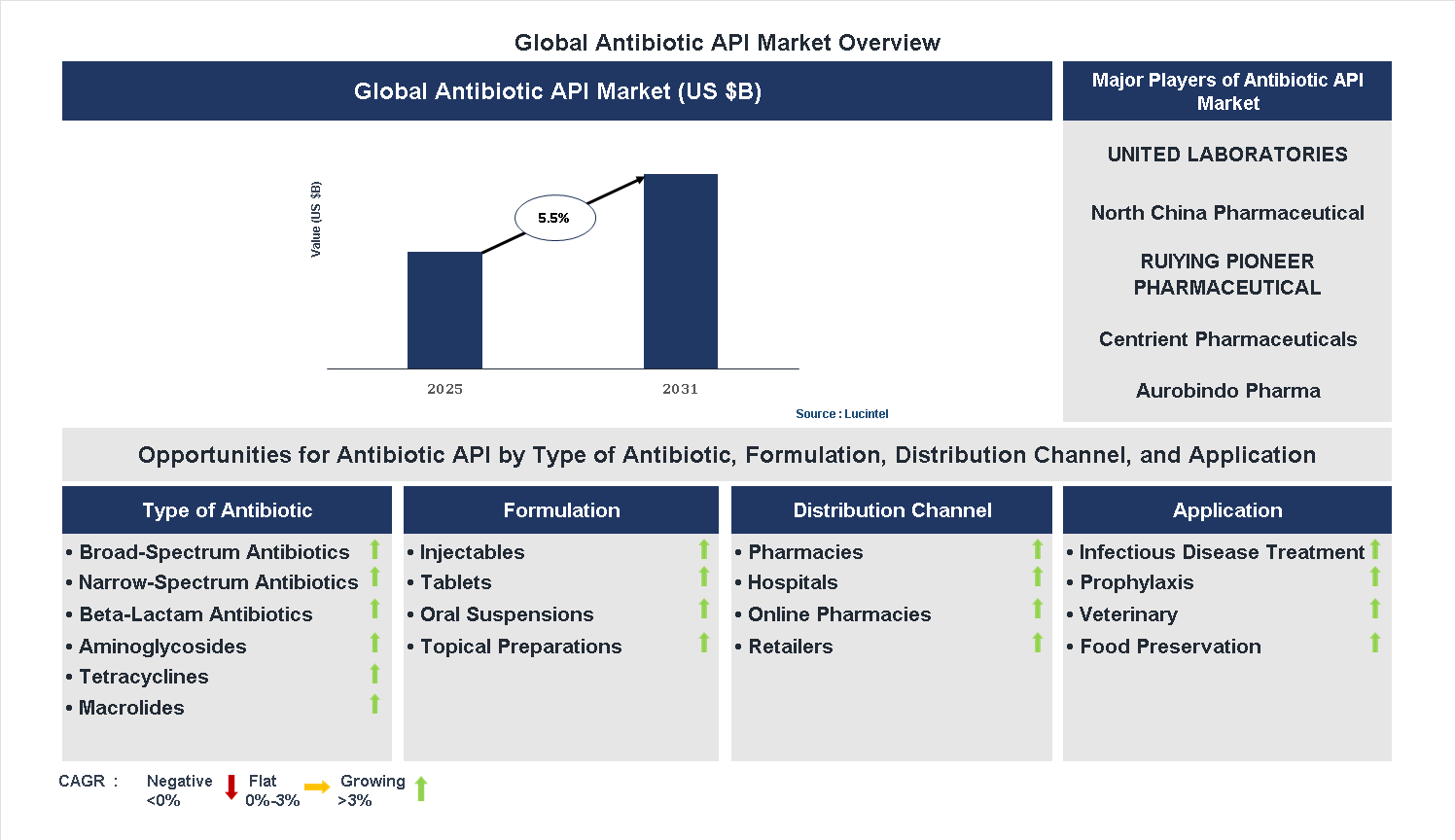
The future of the global antibiotic API market looks promising with opportunities in the infectious disease treatment, prophylaxis, veterinary, and food preservation markets. The global antibiotic API market is expected to grow with a CAGR of 5.5% from 2025 to 2031. The major drivers for this market are the increasing burden of bacterial infections, the rising consumption of generic antibiotic drugs, and the growing expansion of pharmaceutical manufacturing.• Lucintel forecasts that, within the type of antibiotic category, beta-lactam antibiotic is expected to witness the highest growth over the forecast period.
• Within the application category, infectious disease treatment is expected to witness the highest growth.
• In terms of region, APAC is expected to witness the highest growth over the forecast period. Gain valuable insights for your business decisions with our comprehensive 150+ page report. Sample figures with some insights are shown below.
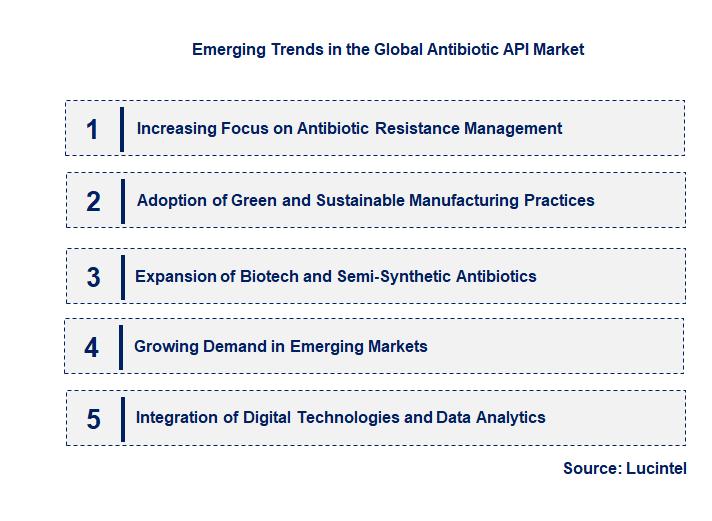
Emerging Trends in the Antibiotic API Market
The antibiotic API market is experiencing rapid evolution driven by technological advancements, regulatory changes, and shifting global health priorities. As the demand for effective antibiotics increases due to rising bacterial resistance and infectious diseases, manufacturers are innovating to meet these needs efficiently. The market is also influenced by the growing focus on sustainable practices, regulatory compliance, and the development of novel antibiotics. These developments are shaping a dynamic landscape where innovation and sustainability are key drivers. Understanding these emerging trends is essential for stakeholders aiming to capitalize on opportunities and navigate challenges in this vital sector.• Increasing Focus on Antibiotic Resistance Management: The rise of antibiotic-resistant bacteria is prompting increased investment in developing new APIs. Governments and pharmaceutical companies are prioritizing research to combat resistance, leading to a surge in innovative antibiotic production. This trend encourages the development of APIs with novel mechanisms of action, ensuring effective treatment options and reducing the threat of resistant strains. It also influences regulatory policies, pushing for stricter standards and accelerated approval processes to bring new antibiotics to market faster.
• Adoption of Green and Sustainable Manufacturing Practices: Sustainability is becoming a core aspect of API production. Manufacturers are adopting eco-friendly processes, reducing waste, and minimizing environmental impact through green chemistry techniques. This shift not only aligns with global environmental regulations but also appeals to environmentally conscious consumers and investors. Sustainable practices help companies reduce costs, improve brand reputation, and ensure long-term viability in a competitive market, ultimately transforming the supply chain and production methodologies.
• Expansion of Biotech and Semi-Synthetic Antibiotics: The market is witnessing a significant shift towards biotech and semi-synthetic antibiotics, which offer enhanced efficacy and reduced resistance development. These APIs are produced using advanced biotechnological methods, enabling more precise targeting of bacterial strains. This trend accelerates innovation, broadens the pipeline of new antibiotics, and addresses unmet medical needs. It also influences regulatory pathways, requiring new standards for biologically derived APIs, and fosters collaborations between biotech firms and traditional pharmaceutical companies.
• Growing Demand in Emerging Markets: Rapid urbanization, increasing healthcare infrastructure, and rising awareness about infectious diseases are fueling antibiotic API demand in emerging markets such as Asia-Pacific and Latin America. These regions offer significant growth opportunities due to expanding healthcare access and government initiatives to improve disease management. This trend encourages local manufacturing, technology transfer, and strategic partnerships, which help reduce costs and improve supply chain resilience. It also prompts global companies to tailor products to regional needs, fostering market diversification and competitive dynamics.
• Integration of Digital Technologies and Data Analytics: Digital transformation is revolutionizing API manufacturing and supply chain management. The use of data analytics, AI, and IoT enhances process optimization, quality control, and predictive maintenance. These technologies enable manufacturers to reduce costs, improve product consistency, and accelerate development timelines. Additionally, digital tools facilitate better regulatory compliance and traceability, ensuring transparency and safety. This trend is reshaping operational models, fostering innovation, and creating smarter, more efficient production ecosystems within the antibiotic API market. These emerging trends are fundamentally reshaping the Antibiotic API Market by fostering innovation, promoting sustainability, expanding into new regions, and leveraging digital technologies. They are driving a more resilient, efficient, and responsive industry capable of meeting global health challenges while aligning with environmental and technological advancements.
Recent Development in the Antibiotic API Market
The Antibiotic API Market is experiencing rapid growth driven by increasing global demand for effective infection treatments, advancements in pharmaceutical manufacturing, and rising investments in healthcare infrastructure. The expanding prevalence of infectious diseases and the need for innovative antibiotics are fueling market expansion. Additionally, regulatory support and strategic collaborations among key players are accelerating development and commercialization. These developments are shaping a dynamic landscape, offering significant opportunities for stakeholders to enhance production, improve drug efficacy, and meet the growing healthcare needs worldwide.• Growing Demand for Effective Antibiotics: The rising incidence of infectious diseases worldwide is boosting the need for potent antibiotics. This demand encourages pharmaceutical companies to innovate and develop new antibiotic APIs, which are crucial for combating resistant strains. The market benefits from increased R&D investments, leading to a broader pipeline of antibiotics. Enhanced focus on combating antimicrobial resistance (AMR) is also driving regulatory and industry efforts to produce more effective APIs, ultimately improving patient outcomes and expanding market opportunities.
• Advances in Manufacturing Technologies: Innovations in manufacturing processes, such as continuous synthesis and biotechnological methods, are improving API production efficiency and quality. These technological advancements reduce costs, shorten development timelines, and ensure higher purity standards. As a result, pharmaceutical companies can meet increasing demand more effectively. Improved manufacturing also facilitates compliance with stringent regulatory standards, boosting market confidence. Overall, these technological strides are enabling faster, more reliable production of antibiotic APIs, supporting market growth and global supply chain stability.
• Strategic Collaborations and Partnerships: Increasing collaborations between pharmaceutical companies, biotech firms, and research institutions are accelerating antibiotic API development. These partnerships facilitate knowledge sharing, resource pooling, and access to cutting-edge technologies. They also help in navigating regulatory pathways and expanding market reach. Such strategic alliances are crucial for addressing complex challenges like antimicrobial resistance and for bringing innovative antibiotics to market faster. This collaborative approach is fostering a more resilient and responsive market environment, encouraging innovation and investment.
• Regulatory Support and Policy Initiatives: Governments and regulatory agencies are implementing policies to promote antibiotic research and streamline approval processes. Incentives such as grants, tax benefits, and fast-track approvals are encouraging companies to invest in new API development. These supportive measures reduce time-to-market and lower costs, making antibiotic production more attractive. Enhanced regulatory frameworks also ensure safety and efficacy, boosting consumer confidence. Overall, regulatory support is creating a conducive environment for market expansion and innovation in antibiotic APIs.
• Rising Investment in R&D and Innovation: Increased funding from both public and private sectors is fueling research into novel antibiotics and APIs. This investment aims to address the growing threat of resistant bacteria and unmet medical needs. Enhanced R&D efforts lead to the discovery of new chemical entities and improved API formulations. The focus on innovation is also driving the development of targeted therapies with fewer side effects. These investments are vital for sustaining long-term growth, expanding the pipeline of antibiotic APIs, and maintaining competitive advantage in the market. These recent developments are significantly transforming the Antibiotic API Market by fostering innovation, improving manufacturing efficiency, and strengthening regulatory support. The combined effect of increased demand, technological advancements, strategic collaborations, and policy initiatives is creating a robust environment for growth. As a result, the market is poised for sustained expansion, better addressing global healthcare challenges and meeting the rising need for effective antibiotics worldwide.
Strategic Growth Opportunities in the Antibiotic API Market
The Antibiotic API Market is experiencing significant growth driven by increasing demand for effective infection treatments, rising healthcare awareness, and expanding pharmaceutical manufacturing capabilities worldwide. Innovations in synthesis processes and regulatory approvals are further fueling market expansion. As antibiotic resistance challenges persist, the development of new APIs offers substantial opportunities. Market players are focusing on strategic collaborations, technological advancements, and geographic expansion to capitalize on emerging opportunities, ensuring sustained growth and addressing global healthcare needs effectively.• Growing Demand for Effective Infection Treatments: The rising prevalence of bacterial infections and the increasing incidence of antibiotic-resistant strains are driving the need for new and more potent antibiotic APIs. Healthcare providers and governments are investing heavily in research and development to combat resistant bacteria, creating a robust demand for innovative APIs. Additionally, expanding healthcare infrastructure in emerging economies enhances access to antibiotics, further boosting market growth. This trend underscores the importance of developing APIs that meet stringent efficacy and safety standards.
• Technological Advancements in API Synthesis: Innovations in chemical synthesis and biotechnological processes are enabling more efficient, cost-effective, and environmentally friendly production of antibiotic APIs. These advancements reduce manufacturing costs, improve yield, and enable the development of complex molecules that were previously difficult to produce. Enhanced process control and automation also lead to higher quality APIs, meeting regulatory standards. Such technological progress allows pharmaceutical companies to accelerate product development and expand their portfolios, fostering market growth.
• Increasing Focus on Combating Antibiotic Resistance: The global rise in antibiotic resistance has prompted governments and industry stakeholders to prioritize the development of new APIs with novel mechanisms of action. Regulatory agencies are encouraging innovation through incentives and streamlined approval pathways. Companies are investing in research to discover new antibiotic classes and optimize existing ones. This focus on overcoming resistance challenges is expected to generate a steady pipeline of new APIs, ensuring long-term market sustainability and growth opportunities.
• Expansion into Emerging Markets: Rapid economic growth and improving healthcare infrastructure in regions like Asia-Pacific, Latin America, and Africa are creating new opportunities for antibiotic API manufacturers. These markets exhibit increasing demand for affordable and accessible antibiotics, prompting companies to establish local manufacturing facilities and distribution networks. Regulatory reforms and government initiatives aimed at improving healthcare access further support market expansion. Entering these emerging markets allows companies to diversify revenue streams and capitalize on unmet medical needs.
• Strategic Collaborations and Mergers for Market Penetration: Collaborations between pharmaceutical companies, biotech firms, and research institutions are accelerating API development and commercialization. Mergers and acquisitions enable access to advanced technologies, expand product portfolios, and enhance market reach. Strategic alliances also facilitate the sharing of expertise, reducing R&D costs and time-to-market. These partnerships are crucial for staying competitive, especially in a landscape driven by innovation and regulatory complexities, ultimately fostering sustained growth and market consolidation. In conclusion, these growth opportunities collectively shape a dynamic and expanding Antibiotic API Market. Innovations in synthesis, focus on resistance, emerging market penetration, and strategic collaborations are key drivers that will enhance market resilience and ensure the development of effective antibiotics to meet global healthcare challenges. This evolving landscape promises substantial growth prospects for industry stakeholders.
Antibiotic API Market Driver and Challenges
The antibiotic API market is influenced by a complex interplay of technological advancements, economic factors, and regulatory frameworks. Innovations in synthesis and manufacturing processes are enhancing efficiency and reducing costs, while economic growth in emerging markets increases demand for antibiotics. Regulatory policies aimed at ensuring drug safety and quality significantly impact market dynamics, often creating barriers to entry but also fostering innovation. Additionally, global health concerns, such as antimicrobial resistance, drive research and development efforts. These factors collectively shape the growth trajectory of the market, presenting both opportunities and challenges that require strategic navigation by industry stakeholders. The factors responsible for driving the antibiotic API market include:• Technological Innovation: Advances in synthesis techniques and biotechnological processes enable more efficient production of antibiotics, reducing costs and improving quality. These innovations facilitate the development of new APIs to combat resistant strains, thereby expanding market opportunities. Enhanced manufacturing methods also support scalability and compliance with regulatory standards, fostering industry growth. As R&D accelerates, the pipeline of novel antibiotics increases, meeting rising global health demands and driving market expansion.
• Rising Prevalence of Infectious Diseases: Increasing incidences of bacterial infections worldwide, driven by factors such as urbanization, poor sanitation, and aging populations, are boosting demand for antibiotics. This heightened prevalence necessitates a steady supply of high-quality APIs to meet pharmaceutical manufacturing needs. The growing burden of infectious diseases in developing regions further amplifies market demand, encouraging investments in API production capacities and innovation to address diverse bacterial strains.
• Economic Growth in Emerging Markets: Rapid economic development in countries like India, China, and Brazil enhances healthcare infrastructure and increases access to medical treatments. This economic upliftment results in higher consumption of antibiotics, thereby expanding the API market. Local manufacturing capabilities are also improving, reducing reliance on imports and fostering domestic growth. Increased healthcare spending and government initiatives to improve public health further stimulate demand for antibiotic APIs in these regions.
• Regulatory Environment and Quality Standards: Stringent regulations imposed by agencies such as the FDA, EMA, and WHO ensure the safety, efficacy, and quality of antibiotics. Compliance with these standards necessitates advanced manufacturing processes and quality control measures, which can act as barriers for new entrants but also promote innovation among established players. Regulatory harmonization across regions facilitates global trade, encouraging API manufacturers to meet international standards and expand their market reach.
• Strategic Collaborations and Mergers: Partnerships between pharmaceutical companies and API manufacturers enable technology transfer, resource sharing, and market expansion. Mergers and acquisitions consolidate market players, enhance R&D capabilities, and streamline supply chains. Such collaborations are crucial for developing new antibiotics and scaling production, ultimately driving market growth and competitiveness in a highly dynamic environment. The challenges facing this antibiotic API market include:
• Stringent Regulatory Compliance: Navigating complex regulatory landscapes poses significant hurdles for API manufacturers. Meeting diverse standards across regions requires substantial investment in quality assurance, documentation, and testing processes. Delays in approvals and compliance costs can hinder market entry and expansion, especially for smaller players. Additionally, evolving regulations demand continuous adaptation, increasing operational complexity and financial burden, which can slow innovation and market growth.
• Antimicrobial Resistance (AMR): The rise of resistant bacterial strains diminishes the effectiveness of existing antibiotics, necessitating the development of new APIs. However, R&D for novel antibiotics is costly, time-consuming, and fraught with high failure rates. The threat of AMR also leads to regulatory and clinical challenges, impacting market stability. Overcoming resistance requires significant investment and innovation, which can strain manufacturers and slow overall market progress.
• Supply Chain Disruptions: The global nature of API manufacturing exposes the market to risks such as raw material shortages, geopolitical tensions, and logistical challenges. Disruptions can lead to delays in production and supply, affecting pharmaceutical companies ability to meet demand. Additionally, reliance on specific regions for raw materials or manufacturing can create vulnerabilities, especially during crises like pandemics or trade restrictions. Strengthening supply chains and diversifying sources are essential but require substantial strategic planning and investment. In summary, the antibiotic API market is shaped by technological progress, rising disease burden, economic development, regulatory standards, and strategic collaborations. While these drivers foster growth and innovation, challenges such as regulatory hurdles, antimicrobial resistance, and supply chain vulnerabilities pose significant risks. Navigating these factors effectively will determine the markets future trajectory, requiring stakeholders to balance innovation with compliance and resilience. Overall, the markets evolution hinges on addressing these challenges while leveraging technological and economic opportunities to meet global health needs.
List of antibiotic API Companies
Companies in the market compete on the basis of product quality offered. Major players in this market focus on expanding their manufacturing facilities, R&D investments, infrastructural development, and leverage integration opportunities across the value chain. With these strategies antibiotic API companies cater increasing demand, ensure competitive effectiveness, develop innovative products & technologies, reduce production costs, and expand their customer base. Some of the antibiotic API companies profiled in this report include-• UNITED LABORATORIES
• North China Pharmaceutical
• RUIYING PIONEER PHARMACEUTICAL
• Centrient Pharmaceuticals
• Aurobindo Pharma
• Shyndec Pharmaceutical
• Nectar Lifesciences
• Harbin Pharmaceutical Group
• ACS Dobfar
• Novartis
antibiotic API Market by Segment
The study includes a forecast for the global antibiotic API market by type of antibiotic, formulation, distribution channel, application, and region.antibiotic API Market by Type of Antibiotic [Value from 2019 to 2031]:
• Broad-Spectrum Antibiotics
• Narrow-Spectrum Antibiotics
• Beta-Lactam Antibiotics
• Aminoglycosides
• Tetracyclines
• Macrolides
antibiotic API Market by Formulation [Value from 2019 to 2031]:
• Injectables
• Tablets
• Oral Suspensions
• Topical Preparations
antibiotic API Market by Distribution Channel [Value from 2019 to 2031]:
• Pharmacies
• Hospitals
• Online Pharmacies
• Retailers
antibiotic API Market by Application [Value from 2019 to 2031]:
• Infectious Disease Treatment
• Prophylaxis
• Veterinary
• Food Preservation
antibiotic API Market by Region [Value from 2019 to 2031]:
• North America
• Europe
• Asia Pacific
• The Rest of the World
Country Wise Outlook for the Antibiotic API Market
The antibiotic API market has experienced significant shifts driven by technological advancements, regulatory changes, and evolving global health needs. As antibiotic resistance becomes a growing concern, countries are investing in innovative production methods and expanding their capacities. The market dynamics are also influenced by government policies, international collaborations, and the rising demand for effective antibiotics in both developed and developing nations. These developments reflect a strategic focus on ensuring supply chain resilience, improving drug efficacy, and addressing public health challenges. Here is a country-specific overview of recent developments in this market.• United States: The US has seen increased investment in biotechnological research to develop novel antibiotics and combat resistance. Regulatory agencies like the FDA are streamlining approval processes for new APIs, encouraging innovation. Major pharmaceutical companies are expanding manufacturing capacities, and there is a growing focus on sustainable and eco-friendly production methods. The US government is also funding initiatives to support antibiotic R&D and promote responsible use.
• China: China has become a key player in the global Antibiotic API market, with substantial investments in manufacturing infrastructure and technology upgrades. The country is focusing on expanding its export capabilities and meeting international quality standards. Recent policies aim to boost domestic innovation and reduce reliance on imports. Additionally, China is increasing its R&D efforts to develop new antibiotics to address rising antimicrobial resistance.
• Germany: Germany continues to lead in high-quality API production, emphasizing stringent quality control and sustainable practices. The country is investing in advanced manufacturing technologies, including continuous flow synthesis, to improve efficiency. German companies are actively involved in research collaborations to develop next-generation antibiotics. Regulatory frameworks are supportive of innovation, and Germany remains a hub for pharmaceutical research and development.
• India: India remains a major manufacturing hub for Antibiotic APIs, driven by cost advantages and a skilled workforce. Recent developments include the adoption of advanced manufacturing techniques and compliance with international quality standards. The government is promoting API exports through favorable policies and incentives. India is also investing in R&D to develop new antibiotics and address the challenge of antimicrobial resistance domestically and globally.
• Japan: Japan is focusing on innovative and high-value APIs, with a strong emphasis on quality and safety standards. The country is investing in cutting-edge research to develop novel antibiotics and combat resistant strains. Japanese firms are collaborating with global partners to enhance API production capabilities and share technological advancements. Regulatory agencies are supporting the development of new drugs through streamlined approval processes, fostering a competitive and innovative market environment.

Features of the Global antibiotic API Market
Market Size Estimates: antibiotic API market size estimation in terms of value ($B). Trend and Forecast Analysis: Market trends (2019 to 2024) and forecast (2025 to 2031) by various segments and regions. Segmentation Analysis: antibiotic API market size by various segments, such as by type of antibiotic, formulation, distribution channel, application, and region in terms of value ($B). Regional Analysis: antibiotic API market breakdown by North America, Europe, Asia Pacific, and Rest of the World. Growth Opportunities: Analysis of growth opportunities in different types of antibiotic, formulations, distribution channels, applications, and regions for the antibiotic API market. Strategic Analysis: This includes M&A, new product development, and competitive landscape of the antibiotic API market. Analysis of competitive intensity of the industry based on Porter’s Five Forces model.
FAQ
Q1. What is the growth forecast for antibiotic API market? Answer: The global antibiotic API market is expected to grow with a CAGR of 5.5% from 2025 to 2031. Q2. What are the major drivers influencing the growth of the antibiotic API market? Answer: The major drivers for this market are the increasing burden of bacterial infections, the rising consumption of generic antibiotic drugs, and the growing expansion of pharmaceutical manufacturing. Q3. What are the major segments for antibiotic API market? Answer: The future of the antibiotic API market looks promising with opportunities in the infectious disease treatment, prophylaxis, veterinary, and food preservation markets. Q4. Who are the key antibiotic API market companies? Answer: Some of the key antibiotic API companies are as follows:• UNITED LABORATORIES
• North China Pharmaceutical
• RUIYING PIONEER PHARMACEUTICAL
• Centrient Pharmaceuticals
• Aurobindo Pharma
• Shyndec Pharmaceutical
• Nectar Lifesciences
• Harbin Pharmaceutical Group
• ACS Dobfar
• Novartis Q5. Which antibiotic API market segment will be the largest in future? Answer: Lucintel forecasts that, within the type of antibiotic category, beta-lactam antibiotic is expected to witness the highest growth over the forecast period. Q6. In antibiotic API market, which region is expected to be the largest in next 5 years? Answer: In terms of region, APAC is expected to witness the highest growth over the forecast period. Q7. Do we receive customization in this report? Answer: Yes, Lucintel provides 10% customization without any additional cost.
Table of Contents
List of Figures
List of Tables
Methodology
- In-depth interviews of the major players in this market
- Detailed secondary research from competitors’ financial statements and published data
- Extensive searches of published works, market, and database information pertaining to industry news, company press releases, and customer intentions
- A compilation of the experiences, judgments, and insights of Lucintel’s professionals, who have analyzed and tracked this market over the years.


Buy Now
Choose a license that fits your team. Instant PDF delivery.
Prices exclude taxes. Instant delivery. Custom licensing available on request.
Key Questions
- • What are some of the most promising, high-growth opportunities for the antibiotic API market by type of antibiotic (broad-spectrum antibiotics, narrow-spectrum antibiotics, beta-lactam antibiotics, aminoglycosides, tetracyclines, and macrolides), formulation (injectables, tablets, oral suspensions, and topical preparations), distribution channel (pharmacies, hospitals, online pharmacies, and retailers), application (infectious disease treatment, prophylaxis, veterinary, and food preservation), and region (North America, Europe, Asia Pacific, and the Rest of the World)?
- • Which segments will grow at a faster pace and why?
- • Which region will grow at a faster pace and why?
- • What are the key factors affecting market dynamics? What are the key challenges and business risks in this market?
- • What are the business risks and competitive threats in this market?
- • What are the emerging trends in this market and the reasons behind them?
- • What are some of the changing demands of customers in the market?
- • What are the new developments in the market? Which companies are leading these developments?
- • Who are the major players in this market? What strategic initiatives are key players pursuing for business growth?
- • What are some of the competing products in this market and how big of a threat do they pose for loss of market share by material or product substitution?
- • What M&A activity has occurred in the last 6 years and what has its impact been on the industry? For any questions related to antibiotic API Market, antibiotic API Market Size, antibiotic API Market Growth, antibiotic API Market Analysis, antibiotic API Market Report, antibiotic API Market Share, antibiotic API Market Trends, antibiotic API Market Forecast, antibiotic API Companies, write Lucintel analyst at email: helpdesk@lucintel.com. We will be glad to get back to you soon.


