
Market Report · May 18, 2026

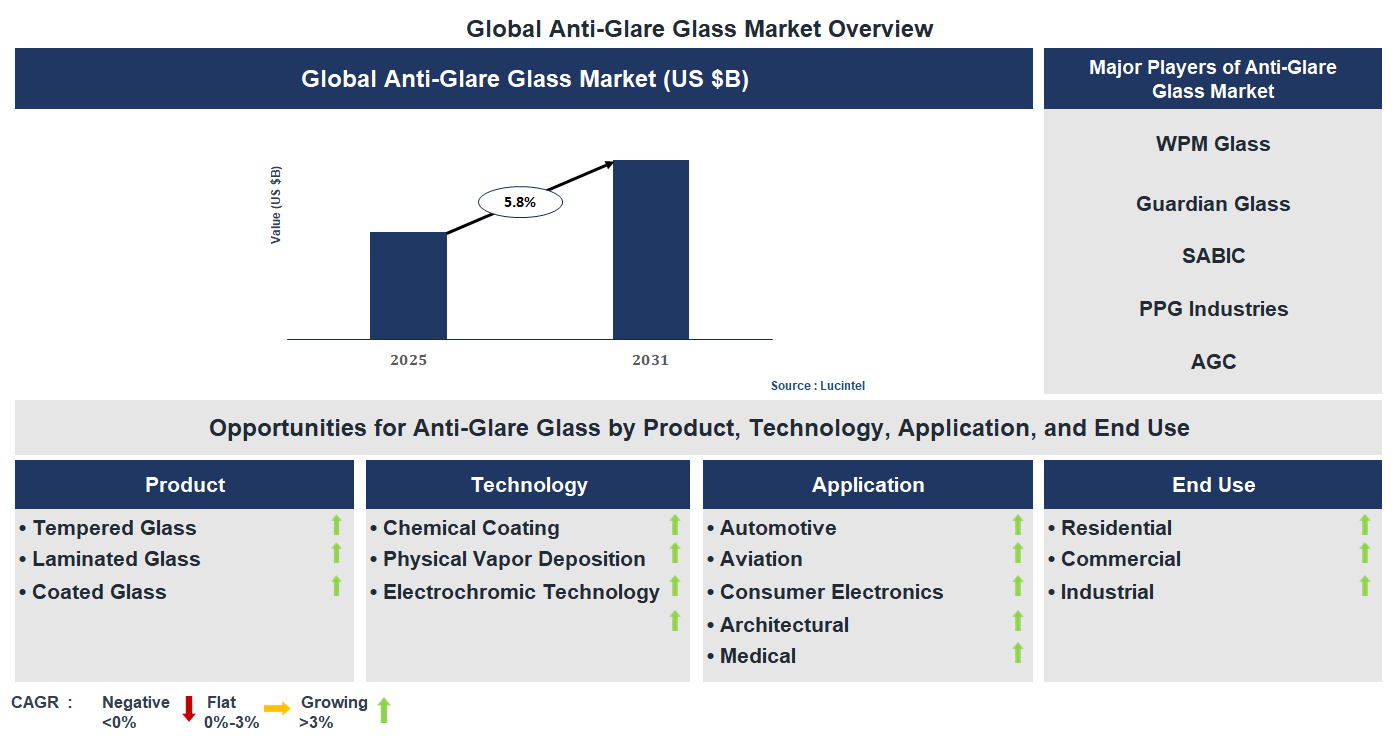
Key data points: The growth forecast = 5.8% annually for the next 7 years. Scroll below to get more insights. This market report covers trends, opportunities and forecasts in anti-glare glass market to 2031 by product type (tempered glass, laminated glass, and coated glass), technology (chemical coating, physical vapor deposition, and electrochromic technology), application (automotive, aviation, consumer electronics, architectural, and medical), end use (residential, commercial, and industrial), and region (North America, Europe, Asia Pacific, and the Rest of the World)
We'll send your sample report shortly.
• Lucintel forecasts that, within the product type category, tempered glass will remain the largest segment over the forecast period.
• Within the end use category, residential will remain the largest segment.
• In terms of region, North America will remain the largest region over the forecast period. Gain valuable insights for your business decisions with our comprehensive 150+ page report. Sample figures with some insights are shown below.
• Integration with Smart Technologies: As the demand for smart devices continues to rise, AG glass is increasingly being integrated into smart appliances and wearables. Devices like smartwatches, augmented reality (AR) headsets, and smart home gadgets are benefiting from AG glasss ability to enhance visibility and reduce glare. The trend towards smarter devices is driving the need for high-quality, functional AG glass in more diverse product categories.
• Sustainability and Eco-friendly Solutions: Sustainability has become a key concern in the AG glass market, with manufacturers focusing on eco-friendly materials and processes. Consumers are increasingly seeking products that are environmentally responsible, and AG glass is no exception. Companies are exploring ways to reduce carbon footprints during production, increase recyclability, and use renewable materials in AG glass manufacturing.
• Automotive Applications: The automotive industry is witnessing a shift towards advanced vehicle displays, infotainment systems, and driver-assistance technologies, all of which require AG glass. With the rise of electric vehicles and autonomous driving technologies, the demand for AG glass in automotive applications is growing rapidly. AG glass improves the visibility and user experience in vehicle dashboards, touch panels, and rearview mirrors.
• Increased Demand for Large Display: As consumer preferences for larger screens continue to grow, AG glass is becoming an essential component in televisions, monitors, and other large-display devices. With the rise of 4K and 8K TVs, AG glass helps reduce glare and enhances viewing quality. This trend is especially important in the consumer electronics market, where product differentiation is key to attracting consumers.
• Advanced Coating Technologies: The development of advanced coating technologies is a significant trend in the AG glass market. These coatings improve the scratch resistance, durability, and anti-reflective properties of AG glass, making it more suitable for high-usage applications such as smartphones, laptops, and automotive displays. Manufacturers are investing in innovative coatings to enhance the performance and longevity of AG glass products. These emerging trends are reshaping the AG glass market by expanding its applications, improving product performance, and encouraging innovation. As technology continues to advance, AG glass is becoming an integral component of a wide range of devices and industries. These trends highlight the growing importance of AG glass in improving user experience, sustainability, and functionality across multiple sectors.

• Growth of Automotive Applications: The automotive sector is increasingly adopting AG glass for displays, touchscreens, and rearview mirrors. With the rise of electric vehicles and autonomous driving systems, manufacturers are integrating AG glass into more vehicle applications. The demand for high-quality, glare-free displays that offer enhanced visibility and safety is driving growth in this area.
• Expansion of AG Glass in Consumer Electronics: Consumer electronics remain a major driver of AG glass demand. AG glass is commonly used in smartphones, laptops, and televisions to improve screen visibility and durability. With the growing popularity of large displays, AG glass is becoming a standard feature in many electronic devices. Manufacturers are continuously working to improve the functionality and aesthetic appeal of AG glass products.
• Advancements in Coating Technologies: The development of advanced coating technologies is improving the performance of AG glass. New coatings enhance scratch resistance, reduce glare, and improve overall durability. These innovations are critical for applications in mobile devices, automotive displays, and other high-use products. The continued advancement of these coatings is expected to further drive the adoption of AG glass across various industries.
• Sustainability and Eco-friendly Initiatives: Sustainability is increasingly becoming a focal point in the AG glass market. Manufacturers are exploring ways to make AG glass more environmentally friendly by focusing on recyclable materials, reducing energy consumption during production, and using eco-friendly coatings. As consumer awareness of environmental issues rises, companies are incorporating sustainability into their production processes to meet demand.
• Technological Innovations in Manufacturing: Advancements in manufacturing techniques, such as precision cutting and thin-film deposition, are enabling the production of higher-quality AG glass at lower costs. These technological improvements are making AG glass more accessible for various applications, including in lower-cost consumer electronics. Automation and more efficient production methods are also reducing lead times and increasing the availability of AG glass products. These recent developments are positioning the AG glass market for continued growth, with increased adoption in consumer electronics, automotive, and architectural applications. Manufacturers are focusing on improving the functionality, sustainability, and durability of AG glass, driving innovation and expanding its reach across industries.
• Consumer Electronics: The growing demand for mobile devices, laptops, and televisions presents a significant opportunity for AG glass manufacturers. As consumers increasingly prefer larger and more high-performance screens, AG glass helps reduce glare and enhances the viewing experience. Manufacturers can capitalize on this demand by developing advanced AG glass solutions that cater to the needs of modern electronics.
• Automotive Displays: The automotive sector represents a major growth opportunity for AG glass. With the rise of electric vehicles and autonomous driving technologies, the demand for advanced vehicle displays is growing rapidly. AG glass is used in touchscreens, infotainment systems, and dashboards to improve visibility and reduce glare, creating opportunities for manufacturers to supply the automotive industry with specialized AG glass solutions.
• Architectural Applications: AG glass is increasingly being used in architectural applications, including windows, skylights, and facades, to reduce glare and improve energy efficiency. As building designs become more complex and incorporate larger glass surfaces, the demand for AG glass is expected to grow. Manufacturers have an opportunity to provide solutions that enhance building aesthetics while improving energy savings and reducing heat gain.
• Wearables and Smart Devices: The rise of wearable technology and smart devices such as smartwatches and fitness trackers presents a unique growth opportunity for AG glass. These devices require small, durable, and glare-reducing displays, making AG glass an ideal solution. As the demand for wearables continues to rise, manufacturers can tap into this market by developing AG glass tailored to the needs of these compact devices.
• Medical Devices: The medical sector represents an emerging opportunity for AG glass, particularly in the development of devices such as diagnostic equipment, medical imaging screens, and surgical instruments. AG glass’s anti-glare properties can enhance visibility and reduce eye strain for healthcare professionals using these devices. As medical technology advances, AG glass can play an important role in improving the functionality and user experience of medical equipment. These strategic growth opportunities are driving the expansion of the AG glass market, as industries seek to improve user experience, enhance visibility, and incorporate sustainable solutions into their products. Manufacturers are focusing on innovation to address these growing demands, ensuring that AG glass remains a critical component in the development of new technologies across multiple sectors.
• WPM Glass
• Guardian Glass
• SABIC
• PPG Industries
• AGC
• Tru Vue
• Corning
• Oculus Glass
• Kuraray
• Saint Gobain
• Tempered Glass
• Laminated Glass
• Coated Glass
• Chemical Coating
• Physical Vapor Deposition
• Electrochromic Technology
• Automotive
• Aviation
• Consumer Electronics
• Architectural
• Medical
• Residential
• Commercial
• Industrial
• North America
• Europe
• Asia Pacific
• The Rest of the World
• United States: The United States remains a major player in the AG glass market, with a focus on innovation and product development in consumer electronics and automotive sectors. Companies are investing heavily in research and development to improve the functionality of AG glass, particularly in mobile phones, laptops, and automotive displays. The rise of electric vehicles (EVs) and advanced driver-assistance systems (ADAS) has further spurred demand for AG glass in vehicle displays and touchscreens. The growing emphasis on sustainability is also pushing manufacturers to explore eco-friendly and recyclable AG glass solutions.
• China: China is a dominant force in the global AG glass market, driven by its large-scale manufacturing capabilities and rapid adoption of advanced technologies in the automotive and electronics industries. Chinese manufacturers are increasingly integrating AG glass into smartphones, televisions, and home appliances, responding to consumer demand for enhanced screen performance and aesthetics. Additionally, the push towards electric vehicles has led to a surge in the use of AG glass in vehicle displays and infotainment systems. With a strong focus on innovation, China is expected to remain a leader in AG glass production and consumption.
• Germany: Germany is a key market for AG glass, particularly in the automotive and industrial sectors. The country’s automotive industry, known for its high-quality manufacturing standards, increasingly incorporates AG glass into vehicle displays, touchscreens, and rearview mirrors. The trend towards electric vehicles and autonomous driving is fueling demand for AG glass in these applications. Additionally, Germany’s focus on sustainability and green technologies is encouraging manufacturers to develop more environmentally friendly AG glass solutions. German companies are also at the forefront of developing advanced coating technologies that improve the durability and functionality of AG glass.
• India: India’s AG glass market is experiencing rapid growth, driven by the increasing demand for mobile phones, laptops, and automotive displays. As India becomes one of the largest smartphone markets globally, AG glass is becoming an essential component in these devices, offering better visibility and protection. The country’s automotive sector, particularly the electric vehicle market, is also contributing to the rise in AG glass demand. As the market continues to grow, Indian manufacturers are focusing on producing cost-effective and high-quality AG glass products to meet local and international demand.
• Japan: Japan has been a pioneer in the development of AG glass technology, with a strong presence in the electronics and automotive sectors. Japanese companies are leading the charge in integrating AG glass into consumer electronics, including smartphones, tablets, and television screens. The automotive sector is also witnessing an increased adoption of AG glass, especially in advanced infotainment systems and touch panels. Japan’s commitment to technological advancement and its push for sustainability are likely to further drive the AG glass market, with Japanese manufacturers focusing on high-performance, durable, and eco-friendly solutions.


• WPM Glass
• Guardian Glass
• SABIC
• PPG Industries
• AGC
• Tru Vue
• Corning
• Oculus Glass
• Kuraray
• Saint Gobain Q5. Which anti-glare glass market segment will be the largest in future? Answer: Lucintel forecasts that, within the product type category, tempered glass will remain the largest segment over the forecast period. Q6. In anti-glare glass market, which region is expected to be the largest in next 5 years? Answer: In terms of region, North America will remain the largest region over the forecast period. Q7. Do we receive customization in this report? Answer: Yes, Lucintel provides 10% customization without any additional cost.


Choose a license that fits your team. Instant PDF delivery.
Prices exclude taxes. Instant delivery. Custom licensing available on request.
Market Report · May 18, 2026
Market Report · May 16, 2026
Market Report · May 16, 2026
Trusted partner for strategic intelligence and business growth


Receive a complimentary market analysis tailored to your industry. Our analysts will identify key growth opportunities and competitive dynamics specific to your business.

Market size, growth rate, and key trend analysis for your specific sector.

Top competitor positioning and market share analysis.

Strategic recommendations backed by data-driven insights.
Get curated market intelligence and competitive moves straight to your inbox.
By subscribing, you agree to receive our monthly insights. Unsubscribe anytime.
Receive a complimentary market analysis tailored to your industry. Our analysts will identify key growth opportunities and competitive dynamics specific to your business.
Market size, growth rate, and key trend analysis for your specific sector.
Top competitor positioning and market share analysis.
Strategic recommendations backed by data-driven insights.
Get curated market intelligence, emerging trends, and competitive moves straight to your inbox each month.
By subscribing, you agree to receive our monthly insights. Unsubscribe anytime.
We'll send your sample report shortly.