
Market Report · July 24, 2026

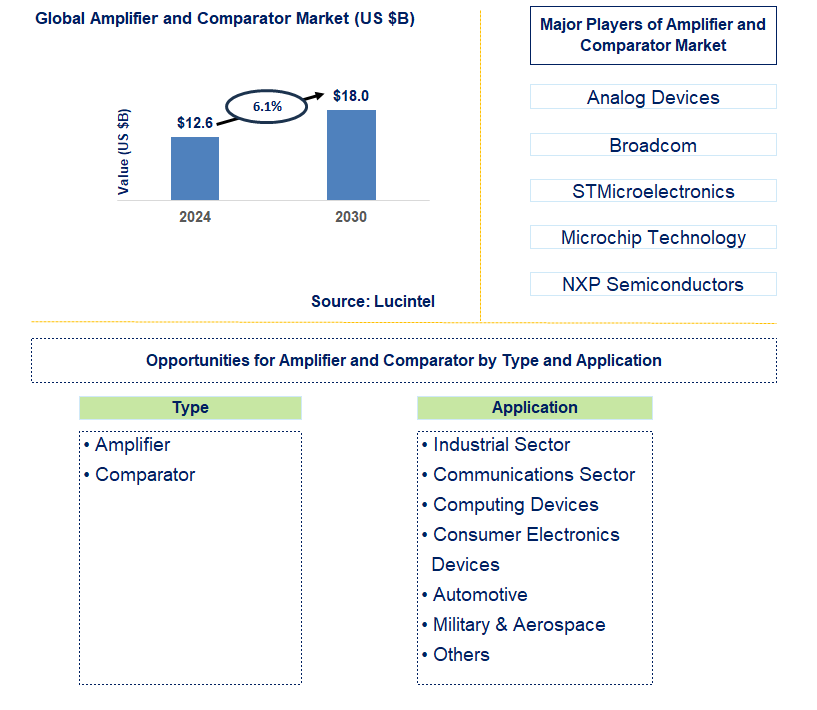
Key data points: The market size in 2030 = $18.01 billion, growth forecast = 6.1% annually next 6 years. Scroll below to get more insights. This market report covers trends, opportunities, and forecasts in the global amplifier and comparator market to 2030 by type (amplifier and comparator), application (industrial sector, communications sector, computing devices, consumer electronics devices, automotive, military & aerospace, and others), and region (North America, Europe, Asia Pacific, and the Rest of the World)
We'll send your sample report shortly.
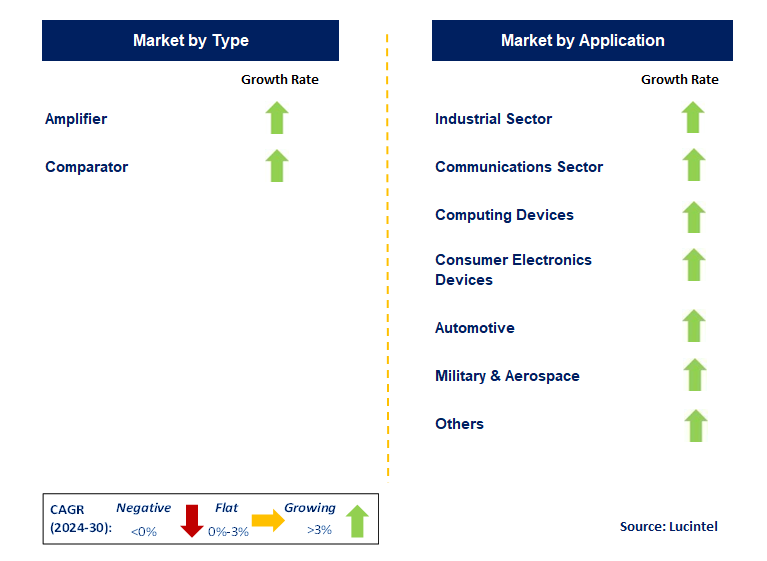
• Lucintel forecasts that, within the type category, amplifier is expected to witness highest growth over the forecast period due to constant demand for pcb-based amplifiers for several electronic products used among various industries.
• Within the application category automotive will remain the largest segment due to increasing demand for electric vehicles worldwide and to keep drivers safe, amplifiers and comparator integrated circuits are used in vehicles.
• In terms of regions, APAC is expected to witness highest growth over the forecast period due to growth of consumer electronics. Gain valuable insights for your business decisions with our comprehensive 150+ page report.
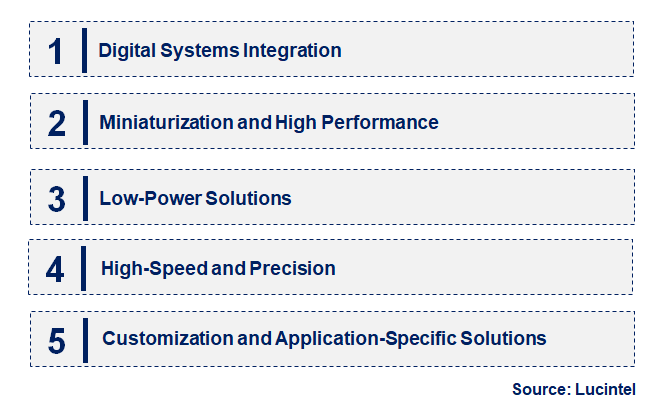
• Digital Systems Integration: The use of amplifiers and comparators in digital systems is becoming a newer approach to enhance performance. This trend involves combining analog and digital functions on a single chip design to limit the number of systems. Integration improves performance in terms of accuracy, noise, and power consumption, which are vital in high-level applications such as smart electronics and communication systems. Most electronic devices today follow this trend, demonstrating inventiveness and effectiveness.
• Miniaturization and High Performance: The quest for slimmer packages and devices continues to influence the design of amplifiers and comparators. High-performance elements are in demand for integration into compact electronic equipment, particularly as the Chinese market expands. Developments in semiconductor designs and technologies allow for the production of small-sized elements that are fast and effective. This trend enhances the future development of electronic gadgets, expected to be lightweight and slim, particularly in areas like mobile phones, wearables, and consumer electronics where space is limited.
• Low-Power Solutions: There is increasing focus on low-power amplifiers and voltage comparators due to the need for powering portable devices. Progress in low-power management designs helps manage battery consumption during performance enhancement. This is crucial for the proliferation of devices such as IoT technology, wearables, and other applications that are energy-sensitive, contributing to global energy efficiency and sustainability.
• High-Speed and Precision: The rising demand for high-speed and precision amplifiers and voltage comparators is driven by applications requiring rapid signal processing and accurate measurement. This trend is particularly relevant in telecommunications, automotive systems, and scientific instrumentation, where performance and accuracy are essential. These components improve the functionality of electronic systems and elevate the sophistication of applications across various domains.
• Customization and Application-Specific Solutions: There is a growing demand for amplifiers and comparators that specialize in various specifications. Manufacturers are responding by producing specialized voltage devices to meet the unique needs of different fields and application constraints. This approach enables optimal product performance while catering to requirements such as high bandwidth, low noise, and resilience to harsh environmental conditions. Custom solutions are improving the architecture and efficacy of components used in a wide range of applications, from industrial automation to medical systems. These trends are expected to transform the demand for amplifiers and comparators and create new avenues for technology, miniaturization, integration, and performance enhancement. The increasing emphasis on top performance and customization is a response to market dynamics across various industries and applications. These trends are likely to be critical in determining the success of the design and manufacturing of the next generation of electronic components and their areas of application.
• Advanced Semiconductor Technologies: Among the advanced semiconductor technologies, silicon-germanium (SiGe) and gallium nitride (GaN) significantly improve performance in telecommunications, automotive, and consumer electronics. These materials enhance speed, linearity, and reduce power consumption. Their application in amplifier and comparator design helps meet the increasing demands for high-performance devices.
• High-Speed Operational Amplifiers: The invention of high-speed operational amplifiers has extended the capabilities of signal processing in various applications. These amplifiers have quicker response times and operate at higher bandwidths, which are essential for applications like data converters, high-frequency signal processing, and communication. Their evolution meets the requirements of modern electronic systems needing accurate and fast signal processing for improved performance.
• Integrated Analog Front-End Solutions: The construction of compact integrated modules that combine several functions, such as an amplifier and a comparator, is becoming more popular. This design enhances system performance by combining the functions of multiple devices into a single unit, saving space and simplifying circuit design. This trend towards integration is beneficial in creating the new generation of consumer electronics, medical devices, and industrial applications, making systems more efficient and easier for designers.
• Development of Low-Power Amplifiers: The innovation of low-power amplifiers stems from the demand for portable and battery-powered devices. Developing low-power design concepts through better materials and circuitry techniques maintains device performance while lowering battery consumption. This growth pattern aligns with emerging trends in IoT, wearables, and other electronics where efficient power management is a core objective.
• Improved Precision Comparators: The market for precision comparators has evolved significantly with the development of high-performance integrated circuits. These comparators excel in high-resolution applications, such as analog-to-digital converters and precision measuring equipment. Improved precision is crucial for scientific, industrial, automotive, and other applications that rely on accurate signal processing and measurement. Recent key changes are driving transformations in the amplifier and comparator markets, particularly with advances in semiconductor technology, high-speed components, and integration. The functioning of these systems will be enhanced, and features will find applications in various fields, changing the current trends and outlook of electronic systems and components.
• Consumer Electronics: There are substantial growth opportunities for amplifiers and comparators in the consumer electronics industry. The increasing adoption of smart devices, wearables, and sophisticated audio systems is driving demand for high-performance miniaturized parts. Developments in amplifiers and comparators are leading to new advanced functionalities and better audio quality in devices, fueling market growth in this segment.
• Automotive: In the automotive domain, amplifiers and comparators are crucial in advanced driver assistance systems (ADAS) and self-driving vehicles. Opportunities for expansion include creating low-power, compact, and high-speed components for sensors, cameras, and control systems. New developments in these areas enhance vehicle safety, reliability, and efficiency, aligning with the industry's transition toward sophisticated and automated systems.
• Industrial Automation: The industrial automation segment shows strong growth prospects due to the increasing penetration of smart factories and automation technologies. Analog components enable amplifiers and comparators to integrate into control equipment, sensors, and monitoring systems. Improvements in these components enhance the accuracy, reliability, and effectiveness of industrial processes, which is a primary focus in this application.
• Telecommunications: The telecommunications industry is experiencing growth due to the ongoing rollout of 5G networks and increasing data usage. The demand for amplifiers and comparators is rising with new opportunities for signal processing, network infrastructure, and communication systems. Furthermore, advancements in high-speed and low-noise components improve the reliability and efficiency of telecommunication devices, fostering growth in this application area.
• Medical Devices: In the medical device sector, amplifiers and comparators are essential for accurate signal processing and measurement in diagnostic and monitoring equipment. Potential growth areas include precision components designed for imaging, patient monitoring, and mobile health devices. Enhancements in these components contribute to achieving necessary accuracy and functionality, supporting industry growth. Strategic growth opportunities in consumer electronics, automotive, industrial automation, telecommunications, and medical devices reflect emerging trends and technological advancements in the amplifier and comparator market. These opportunities can be harnessed for innovative development and growth, addressing the needs of different verticals and promoting overall industry expansion.
• Technological Advancements: Use of new semiconductor materials and improvement of the existing ones and manufacturing processes is driving the amplifier and comparators market. These include but are not limited to novel processes, new circuit designs, and other notable materials, all of which contribute to the construction and use of intricate small devices that consume less power and function at a higher speed. This in turn helps in securing the future growth of the market as little barriers exist on the development of better functioning systems.
• Increasing Demand for Consumer Electronics: Owing to the rise in the consumption of consumer electronics, the market for the amplifier and comparators has also been expanding more rapidly with the sales of smartphones, wearables, and smart home appliances framing the ultrawide band’s market. These technologies have high performance and miniaturized parts thereby making the need for improved comparators and amplifiers on the rise. The expansion of consumer electronics markets also drives the development of the market in components and innovations in their creation.
• Growth of IoT and Smart Technologies: An increase in the extensive use of IoT and smart technologies has increased the need for amplifiers and comparators. These components are important for several IoT applications such as smart home devices, industrial sensors, and wearables. Exciting, low power and highly efficient components are in demand to support the growth of IoT solutions which calls for growth in the market.
• Advancements in Automotive Technology: Another factor which supports the demand for amplifier and comparators, is the use of advanced driver assistance systems (ADAS) and autonomous vehicles in the automotive sector. In vehicles of today, high-speed, low-power devices are necessary for sensors, cameras, and control applications. As technological progress in automotive technology increases the incorporation of such sophisticated systems too does including the need for advanced amplifiers and comparators.
• Increasing Industrial Automation: The growth of industrial automation and smart factories is also providing an impetus for the growth of amplifiers and comparators. Such components are crucial to control systems, sensors, and monitoring devices applied in automation processes. The development of manufacturing technology especially in industrial automation helpful in market expansion as it increases the demand for robust and effective components. Challenges in the amplifier and comparator market are:
• Cost Pressures: The extent of the cost pressures presents challenges in the amplifier and comparator market. There is a need to maintain a balance of performance against the costs and the market needs for low pricing, and this can affect the profit levels and the development costs. The manufacturers are therefore under pressure to seek means of enhancing the production processes and lowering the costs, without compromising on the quality.
• Supply Chain Disruptions: Supply chain disruptions such as raw material shortages and component delivery delays pose challenges to the amplifier and comparator market. These issues might incur extra costs, result in additional market time, and make it hard to meet the requirements of the market. Thus, there is a need for companies to come up with reasonable sustenance supply chain approaches to alleviate these problems.
• Regulatory Compliance: Variance in the types of regulations that are there in the various regions poses a challenge in regard to regulatory compliance. Compliance with laws dedicated to environmental concern or relating to safety and the performance may raise the cost of development and manufacturing. Overall most countries require consideration while doing any business and this makes it difficult since it means additional regulatory compliance requirements enforcement. Technological progress, increased consumption as well as growth of the sector stand out among the drivers of the amplifier and comparator market. Cost escalation tendencies, supply chain constraints as well as compliance issues bear pressure on the extent of the development, penetrating the market, satisfying it and enhancing sales, therefore, factors resolution-engagement is quite important to the market players.
• Analog Devices
• Broadcom
• STMicroelectronics
• Microchip Technology
• NXP Semiconductors
• On Semiconductor
• Renesas Electronics
• Amplifier
• Comparator
• Industrial Sector
• Communications Sector
• Computing Devices
• Consumer Electronics Devices
• Automotive
• Military & Aerospace
• Others
• North America
• Europe
• Asia Pacific
• The Rest of the World
• United States: The amplifier and comparator market in the US is driven by technological innovations in consumer electronics and industrial automation. Recent developments include high-speed operational amplifiers and comparator components specifically designed for 5G and IoT applications. There is a growing trend toward integrating these components with digital circuits to improve effectiveness while reducing energy consumption. This trend highlights the nation's technological leadership, focusing on producing low-noise, high-accuracy components for automotive and healthcare applications.
• China: The amplifier and comparator market in China is experiencing dynamic growth due to investments in semiconductor technology and a developing local electronics market. Growth is evident in the local semiconductor industry ecosystem and the diversification of market players. Government encouragement of technological innovation has led to improvements in low-cost amplifiers and comparators targeted for the telecommunications and automotive industries. These developments align with the country's broader strategies for self-reliance in technological development and industrial upgrading.
• Germany: Quality and accuracy are paramount in Germany's amplifier and comparator market, particularly in industrial and automotive sectors. Recent innovations include fully integrated, high-speed, low-noise amplifiers and comparators designed for autonomous and industrial automation applications. Germany’s engineering focus, coupled with its strong manufacturing industry, drives these advancements. The availability of energy-efficient designs, influenced by European policy frameworks, has also positively impacted the market.
• India: India’s amplifier and comparator market is gaining momentum due to the growth of electronics manufacturing and increasing demand for digital technologies. Industry trends include advancements in indigenous semiconductor fabrication and the availability of efficient, cost-effective devices for smart appliances and renewable energy systems. Government policies promoting electronics production and a burgeoning consumer electronics market signify a shift towards more sophisticated, localized solutions.
• Japan: Japan’s amplifier and comparator market is marked by the adoption of advanced, high-tech components. Recent developments include ultra-low power, high-frequency amplifiers, driven by the nation’s ambition to lead in electronic miniaturization. Japan’s strong focus on R&D and advanced manufacturing processes enhances the performance and design of amplifier and comparator devices used in consumer electronics, robotics, and telecommunications. The trend in Japan also emphasizes the integration of these components into increasingly sophisticated electronic systems.


• Analog Devices
• Broadcom
• STMicroelectronics
• Microchip Technology
• NXP Semiconductors
• On Semiconductor
• Renesas Electronics Q6. Which amplifier and comparator market segment will be the largest in future? Answer: Lucintel forecasts that amplifier is expected to witness highest growth over the forecast period due to constant demand for pcb-based amplifiers for several electronic products used among various industries. Q7. In amplifier and comparator market, which region is expected to be the largest in next 5 years? Answer: APAC is expected to witness highest growth over the forecast period due to growth of consumer electronics. Q.8 Do we receive customization in this report? Answer: Yes, Lucintel provides 10% customization without any additional cost.


Choose a license that fits your team. Instant PDF delivery.
Prices exclude taxes. Instant delivery. Custom licensing available on request.
Market Report · July 24, 2026
Market Report · July 20, 2026
Market Report · July 20, 2026
Trusted partner for strategic intelligence and business growth


Receive a complimentary market analysis tailored to your industry. Our analysts will identify key growth opportunities and competitive dynamics specific to your business.

Market size, growth rate, and key trend analysis for your specific sector.

Top competitor positioning and market share analysis.

Strategic recommendations backed by data-driven insights.
Get curated market intelligence and competitive moves straight to your inbox.
By subscribing, you agree to receive our monthly insights. Unsubscribe anytime.
Receive a complimentary market analysis tailored to your industry. Our analysts will identify key growth opportunities and competitive dynamics specific to your business.
Market size, growth rate, and key trend analysis for your specific sector.
Top competitor positioning and market share analysis.
Strategic recommendations backed by data-driven insights.
Get curated market intelligence, emerging trends, and competitive moves straight to your inbox each month.
By subscribing, you agree to receive our monthly insights. Unsubscribe anytime.
We'll send your sample report shortly.