
Market Report · July 31, 2026

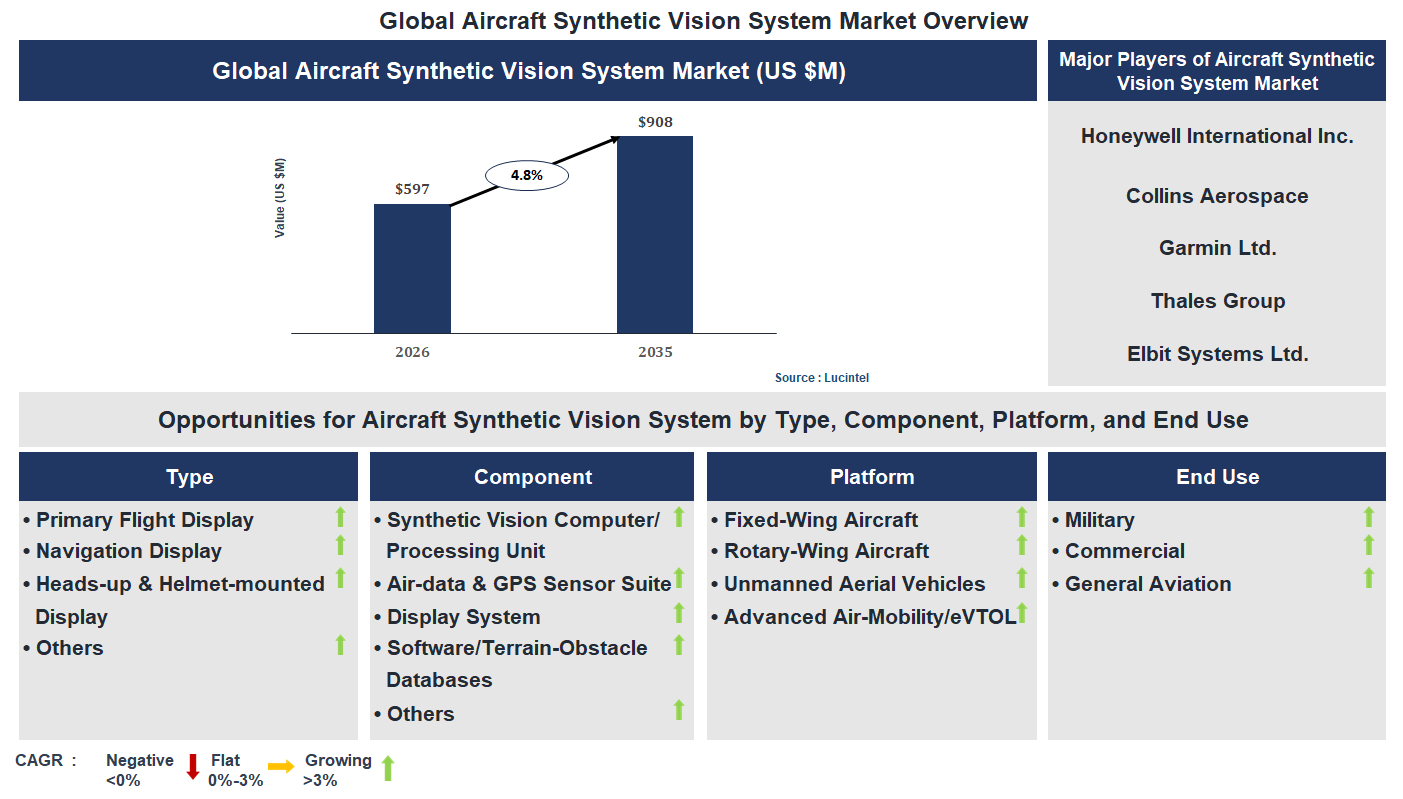
Key data points: The market size in 2035 = $908 million, growth forecast = 4.8% annually for the next 8 years. Scroll below to get more insights. This market report covers trends, opportunities and forecasts in aircraft synthetic vision system market to 2035 by type (primary flight display, navigation display, heads-up & helmet-mounted display, and others), component (synthetic vision computer/processing unit, air-data & GPS sensor suite, display system, software/terrain-obstacle databases, and others), platform (fixed-wing aircraft, rotary-wing aircraft, unmanned aerial vehicles, and advanced air-mobility/eVTOL), end use (military, commercial, and general aviation), and region (North America, Europe, Asia Pacific, and the Rest of the World)
We'll send your sample report shortly.
• Lucintel forecasts that, within the type category, primary flight display is expected to witness the highest growth over the forecast period.
• Within the end use category, military is expected to witness the highest growth.
• In terms of region, North America is expected to witness the highest growth over the forecast period. Gain valuable insights for your business decisions with our comprehensive 150+ page report. Sample figures with some insights are shown below.
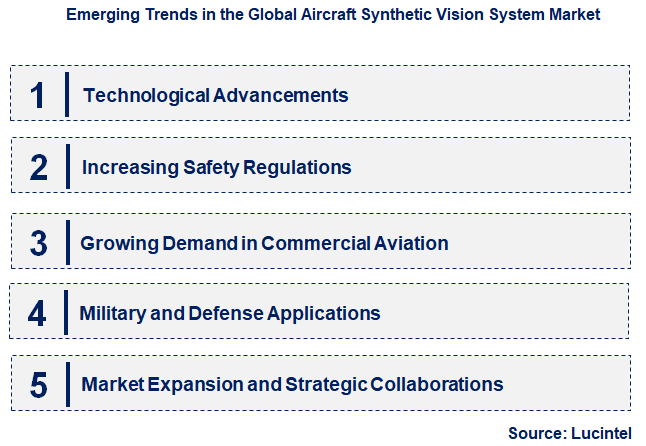
• Technological Advancements: The integration of high-resolution displays, augmented reality, and AI-driven data processing is revolutionizing SVS capabilities. These innovations enable pilots to visualize terrain, obstacles, and weather conditions more accurately, even in low visibility scenarios. The continuous improvement in sensor technology and data fusion techniques enhances the systems reliability and responsiveness. As a result, aircraft equipped with advanced SVS are better positioned to navigate complex environments, reducing the risk of accidents and improving overall safety. This trend is expected to accelerate as technology becomes more affordable and widespread.
• Increasing Safety Regulations: Regulatory bodies such as the FAA and EASA are mandating higher safety standards, encouraging the adoption of synthetic vision systems. These regulations aim to minimize human error and improve situational awareness during critical phases of flight, such as landing and takeoff. Manufacturers are responding by developing compliant systems that meet or exceed these standards, which in turn drives market growth. The push for safety compliance is also fostering innovation, leading to more integrated and comprehensive SVS solutions that can be easily certified and adopted across various aircraft types.
• Growing Demand in Commercial Aviation: Airlines are increasingly investing in SVS to enhance passenger safety and operational efficiency. Synthetic vision systems help pilots manage complex flight paths, especially in adverse weather conditions, reducing delays and cancellations. The ability to provide real-time terrain and obstacle awareness improves decision-making and situational assessment. As passenger expectations for safety and comfort rise, airlines view SVS as a strategic investment to differentiate their services. This demand is fueling market expansion, particularly in regions with challenging terrains or weather patterns, such as Asia-Pacific and North America.
• Military and Defense Applications: The defense sector is adopting SVS for enhanced mission capabilities, including navigation in hostile or GPS-degraded environments. Synthetic vision systems provide soldiers and pilots with critical situational awareness, improving safety and operational effectiveness. The integration of SVS with other military systems like targeting and reconnaissance enhances battlefield awareness. The increasing focus on modernizing defense fleets and the need for advanced training simulators are further propelling market growth. Military applications are expected to remain a significant driver, pushing technological innovations tailored for rugged, high-performance environments.
• Market Expansion and Strategic Collaborations: The market is witnessing a surge in partnerships between technology providers, aircraft manufacturers, and regulatory agencies. These collaborations aim to develop standardized, scalable SVS solutions suitable for a wide range of aircraft. Additionally, emerging markets in Asia and the Middle East are experiencing rapid adoption due to expanding aviation infrastructure and modernization efforts. Investment in research and development is fostering innovative features like augmented reality overlays and predictive analytics. This collaborative and regional expansion is broadening the market scope, making synthetic vision systems more accessible and integrated into future aircraft designs. These trends are collectively reshaping the aircraft synthetic vision system market by fostering technological innovation, enhancing safety standards, and expanding application areas. The integration of advanced digital solutions is leading to smarter, safer, and more efficient aircraft operations, ultimately transforming the future landscape of aviation safety and performance.
• Growing Adoption of Advanced Display Technologies: The integration of high-resolution, 3D displays in aircraft cockpits is revolutionizing pilot experience. These systems provide real-time, intuitive terrain and obstacle visualization, significantly reducing pilot workload and enhancing safety. The adoption is driven by regulatory mandates and airline safety initiatives, leading to increased demand for sophisticated synthetic vision solutions. This trend is expected to boost market growth, especially in commercial and military aviation sectors, by enabling safer, more efficient flight operations.
• Enhanced Sensor Integration for Improved Accuracy: Recent developments focus on integrating LiDAR, radar, and infrared sensors with synthetic vision systems. This combination improves terrain and obstacle detection accuracy, even in adverse weather conditions. Enhanced sensor fusion allows for more reliable and detailed environmental awareness, reducing the risk of accidents. These advancements are critical for operations in low visibility and challenging terrains, expanding the application scope of SVS in commercial, cargo, and military aircraft, thereby driving market expansion.
• Implementation of AI and Machine Learning Algorithms: The incorporation of AI and machine learning into SVS enhances system responsiveness and predictive capabilities. These technologies enable real-time data processing, anomaly detection, and adaptive display adjustments, providing pilots with more precise situational awareness. AI-driven systems can learn from flight data to optimize performance and safety features. This innovation is expected to significantly improve system reliability and user experience, fostering greater adoption across various aircraft types and contributing to overall market growth.
• Increasing Focus on Safety and Regulatory Compliance: Governments and aviation authorities are emphasizing safety standards that favor advanced synthetic vision systems. New regulations mandate enhanced situational awareness tools to prevent accidents, especially in poor visibility conditions. Manufacturers are aligning product development with these standards, leading to increased certification activities and market confidence. This regulatory push is accelerating SVS deployment in commercial, business, and military aircraft, ensuring safer skies and expanding market opportunities.
• Rising Demand for Cost-Effective and Lightweight Solutions: Innovations in materials and system design are producing more affordable, lightweight SVS components. These cost-effective solutions reduce aircraft weight and operational costs, making advanced vision systems accessible to a broader range of operators, including regional airlines and private aircraft. The focus on affordability and efficiency is driving widespread adoption, fostering market growth by enabling upgrades in existing fleets and supporting new aircraft designs with integrated synthetic vision capabilities. These developments are significantly transforming the aircraft synthetic vision system market by enhancing safety, operational efficiency, and system reliability. The integration of advanced display technologies, sensor fusion, AI, and regulatory support is expanding application scope across commercial, military, and private sectors. Cost-effective innovations are making these systems more accessible, fueling market growth. Overall, these advancements are positioning SVS as a critical component in modern aviation, promising safer, smarter, and more efficient flight operations worldwide.
• Enhanced Safety and Reduced Pilot Workload: The integration of synthetic vision systems significantly improves situational awareness by providing pilots with a clear, 3D view of the environment, even in low visibility conditions. This reduces the risk of accidents, enhances decision-making, and minimizes pilot workload during complex maneuvers. As safety regulations tighten, airlines and military operators are increasingly adopting SVS to meet compliance standards and ensure passenger and crew safety.
• Growing Adoption in Commercial Aviation for Navigation Efficiency: Commercial airlines are increasingly implementing SVS to optimize flight paths, reduce fuel consumption, and improve overall operational efficiency. The system’s ability to provide real-time terrain and obstacle data allows for more precise navigation, especially in challenging environments like mountainous regions or congested airspace. This trend is driven by airline focus on cost savings and environmental sustainability, creating a substantial market opportunity.
• Advancements in Sensor Technologies and Data Integration: Innovations in sensor technology, such as high-resolution terrain databases and enhanced display systems, are expanding the capabilities of SVS. Integration with other avionics systems like autopilot and weather radar further enhances aircraft performance. These technological improvements enable more accurate, reliable, and comprehensive synthetic vision solutions, encouraging manufacturers to develop next-generation systems that meet evolving safety and operational standards.
• Increasing Demand in Military and Defense Applications: Military aircraft require advanced navigation and situational awareness tools for complex missions, especially in hostile or GPS-degraded environments. SVS offers a strategic advantage by providing reliable terrain and obstacle data independent of external signals. Growing defense budgets and modernization initiatives are fueling demand for robust synthetic vision solutions, opening new avenues for market growth in military aviation sectors worldwide.
• Rising Focus on Autonomous and Unmanned Aircraft Systems: The development of autonomous and unmanned aircraft relies heavily on advanced sensing and navigation technologies like SVS. These systems enable unmanned vehicles to operate safely in diverse and challenging environments without human intervention. As the drone and autonomous aircraft markets expand, the integration of synthetic vision systems will be crucial for ensuring operational safety, precision, and regulatory compliance, presenting significant growth opportunities in this emerging sector. These growth opportunities are poised to significantly influence the aircraft synthetic vision system market by enhancing safety, operational efficiency, and technological innovation. The expanding adoption across commercial, military, and autonomous sectors underscores the system’s vital role in future aviation advancements. Strategic investments and technological developments will be key to capitalizing on these opportunities, ultimately driving market expansion and industry transformation.
• Technological Advancements: The continuous development of high-resolution displays, improved sensor technologies, and integration with other avionics systems enhance the accuracy and reliability of synthetic vision systems, making them more appealing to aircraft manufacturers and operators. These innovations lead to safer, more efficient flights and support the adoption of next-generation aircraft. As technology evolves, the market benefits from increased performance, reduced pilot workload, and better situational awareness, which are critical for commercial and military aviation sectors.
• Regulatory Support and Safety Standards: Governments and aviation authorities worldwide are emphasizing safety enhancements, leading to stricter regulations that mandate or encourage the adoption of advanced avionics like synthetic vision systems. Certification processes, such as those from FAA and EASA, are becoming more streamlined, facilitating quicker market entry. These regulatory frameworks incentivize airlines and aircraft manufacturers to incorporate synthetic vision systems to meet safety standards, thereby driving market growth and encouraging innovation within the industry.
• Growing Demand for Enhanced Pilot Situational Awareness: The increasing complexity of air traffic, coupled with the need for improved safety, has heightened the demand for synthetic vision systems that provide pilots with a clear, real-time 3D view of the environment. This technology reduces the risk of accidents during low visibility conditions and complex maneuvers. Airlines and military operators are investing in these systems to improve operational safety, efficiency, and pilot training, which significantly contributes to market expansion.
• Economic Growth and Fleet Modernization: The global economic upturn has led to increased air travel demand, prompting airlines to modernize their fleets with advanced avionics systems. Synthetic vision systems are seen as vital components of next-generation aircraft, offering competitive advantages through improved safety and operational efficiency. The rising procurement of new aircraft equipped with these systems, along with retrofitting older aircraft, fuels market growth, especially in emerging markets where fleet expansion is rapid. The challenges facing the aircraft synthetic vision system market include:-
• High Development and Implementation Costs: Developing sophisticated synthetic vision systems involves significant investment in research, advanced sensor technology, and rigorous certification processes. These costs can be prohibitive, especially for smaller manufacturers or operators, limiting widespread adoption. Additionally, retrofitting existing aircraft with new systems adds to expenses, which can slow market growth and restrict entry for some players, particularly in cost-sensitive regions.
• Regulatory and Certification Barriers: Despite regulatory support, the certification process for synthetic vision systems remains complex and time-consuming. Meeting stringent safety and performance standards requires extensive testing and validation, delaying product launches and increasing costs. Variability in regulations across different regions further complicates market entry, posing challenges for manufacturers seeking global expansion and for operators aiming to upgrade their fleets efficiently.
• Integration and Compatibility Issues: Incorporating synthetic vision systems into existing aircraft avionics architectures can be technically challenging. Compatibility issues with other onboard systems, data integration, and ensuring real-time performance require sophisticated engineering solutions. These complexities can lead to delays, increased costs, and potential safety concerns, hindering rapid deployment and widespread acceptance of the technology across diverse aircraft platforms. The aircraft synthetic vision system market is driven by technological innovations, regulatory support, safety demands, and economic growth, which collectively foster market expansion. However, high costs, regulatory hurdles, and integration challenges pose significant obstacles. The interplay of these factors will shape the market’s trajectory, requiring stakeholders to innovate and adapt strategically. Overall, the market is poised for growth, provided these challenges are effectively managed, leading to safer, more efficient aviation operations worldwide.
• Honeywell International Inc.
• Collins Aerospace
• Garmin Ltd.
• Thales Group
• Elbit Systems Ltd.
• L3Harris Technologies, Inc.
• Mercury Systems, Inc.
• Aspen Avionics, Inc.
• Avidyne Corporation
• ENSCO Inc.
• Primary Flight Display
• Navigation Display
• Heads-up & Helmet-mounted Display
• Others
• Synthetic Vision Computer/Processing Unit
• Air-data & GPS Sensor Suite
• Display System
• Software/Terrain-Obstacle Databases
• Others
• Fixed-Wing Aircraft
• Rotary-Wing Aircraft
• Unmanned Aerial Vehicles
• Advanced Air-Mobility/eVTOL
• Military
• Commercial
• General Aviation
• North America
• Europe
• Asia Pacific
• The Rest of the World
• United States: The US market has seen rapid adoption of SVS technology, driven by major aerospace companies investing in research and development. Recent advancements include integration with augmented reality displays and enhanced data processing capabilities, improving pilot situational awareness. Regulatory agencies like the FAA are supporting the deployment of SVS in commercial aircraft, encouraging industry adoption. The US also focuses on developing lightweight, energy-efficient systems to meet airline operational needs and environmental standards.
• China: China is rapidly expanding its aviation infrastructure and investing heavily in SVS technology to modernize its fleet. Recent developments include collaborations between domestic aerospace firms and international technology providers to develop indigenous SVS solutions. The Chinese government emphasizes safety and innovation, leading to increased adoption of synthetic vision systems in both commercial and military aircraft. The market is also witnessing a rise in local manufacturing and R&D activities aimed at reducing costs and increasing system reliability.
• Germany: Germanys aviation sector is characterized by a focus on high-precision, reliable SVS solutions, especially for military and business aircraft. Recent advancements include integration with advanced autopilot systems and enhanced terrain awareness features. German aerospace companies are also working on improving system robustness and certification standards to meet stringent European regulations. The emphasis on sustainable aviation has led to innovations in lightweight and energy-efficient SVS components, supporting eco-friendly flight operations.
• India: India is witnessing growing demand for SVS technology driven by expanding commercial aviation and modernization of military fleets. Recent developments include partnerships between Indian aerospace firms and global technology providers to develop cost-effective SVS solutions. The government’s focus on safety and infrastructure development has accelerated the adoption of synthetic vision systems in new aircraft. Additionally, local R&D initiatives aim to customize systems for regional operational conditions, enhancing overall flight safety and efficiency.
• Japan: Japans aviation industry is advancing SVS technology through collaborations with international aerospace companies and research institutions. Recent innovations include the integration of artificial intelligence for predictive terrain awareness and enhanced display interfaces. Japan emphasizes safety, reliability, and integration with existing cockpit systems, leading to the development of highly sophisticated SVS solutions. The market also benefits from government support for technological innovation and efforts to incorporate eco-friendly and energy-efficient components into aircraft systems.


• Honeywell International Inc.
• Collins Aerospace
• Garmin Ltd.
• Thales Group
• Elbit Systems Ltd.
• L3Harris Technologies, Inc.
• Mercury Systems, Inc.
• Aspen Avionics, Inc.
• Avidyne Corporation
• ENSCO Inc. Q6. Which aircraft synthetic vision system market segment will be the largest in future? Answer: Lucintel forecasts that, within the type category, primary flight display is expected to witness the highest growth over the forecast period. Q7. In aircraft synthetic vision system market, which region is expected to be the largest in next 8 years? Answer: In terms of region, North America is expected to witness the highest growth over the forecast period. Q8. Do we receive customization in this report? Answer: Yes, Lucintel provides 10% customization without any additional cost.


Choose a license that fits your team. Instant PDF delivery.
Prices exclude taxes. Instant delivery. Custom licensing available on request.
Market Report · July 31, 2026
Market Report · July 31, 2026
Market Report · July 22, 2026
Trusted partner for strategic intelligence and business growth


Receive a complimentary market analysis tailored to your industry. Our analysts will identify key growth opportunities and competitive dynamics specific to your business.

Market size, growth rate, and key trend analysis for your specific sector.

Top competitor positioning and market share analysis.

Strategic recommendations backed by data-driven insights.
Get curated market intelligence and competitive moves straight to your inbox.
By subscribing, you agree to receive our monthly insights. Unsubscribe anytime.
Receive a complimentary market analysis tailored to your industry. Our analysts will identify key growth opportunities and competitive dynamics specific to your business.
Market size, growth rate, and key trend analysis for your specific sector.
Top competitor positioning and market share analysis.
Strategic recommendations backed by data-driven insights.
Get curated market intelligence, emerging trends, and competitive moves straight to your inbox each month.
By subscribing, you agree to receive our monthly insights. Unsubscribe anytime.
We'll send your sample report shortly.